Dr. Soumitra Halder
Dept of Radio-diagnosis
Medical College,Kolkata
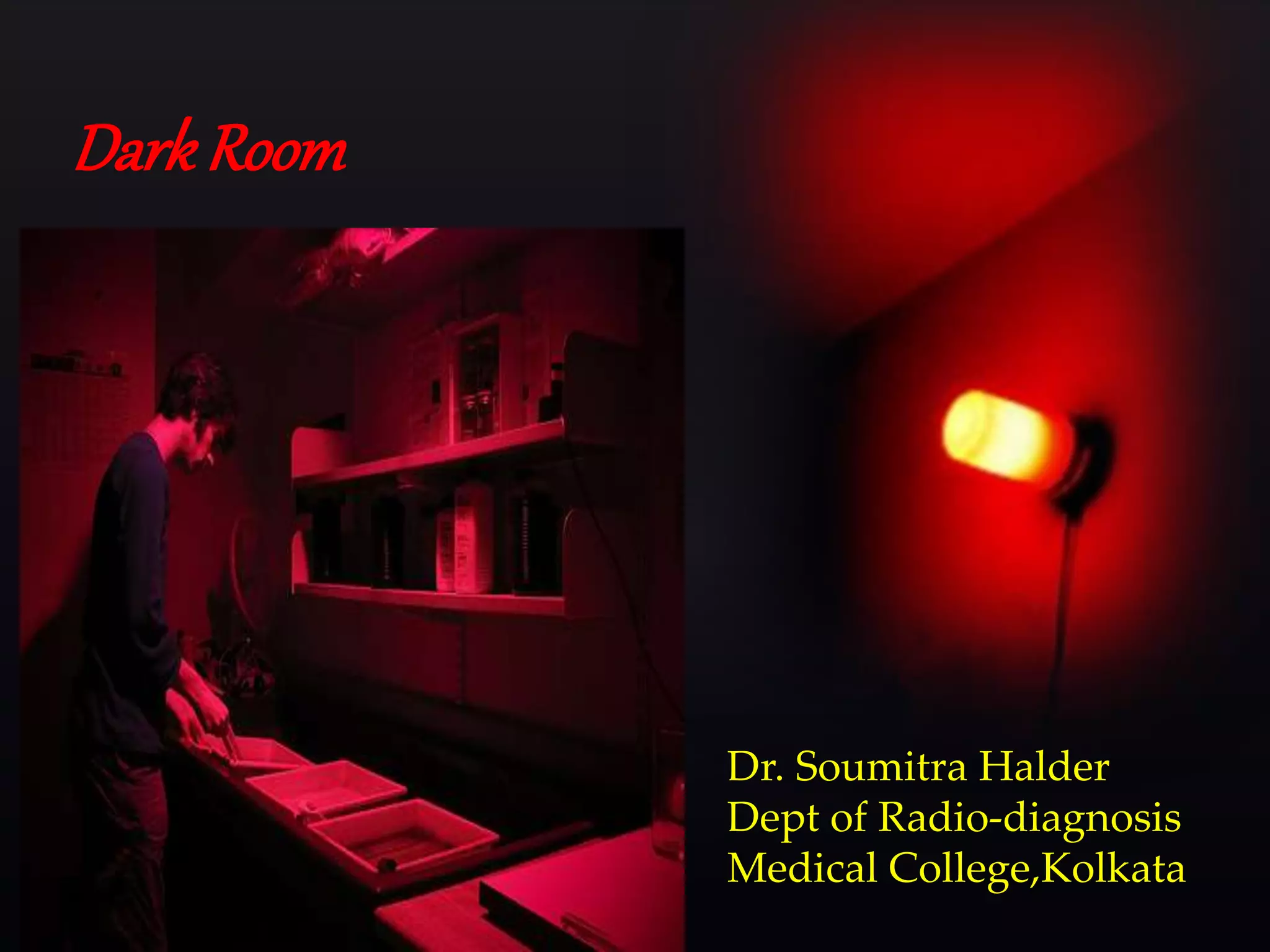
DarkRoom
 It is a place where the necessary
handling and the processing of the
film can be carried out safely and
efficiently without the hazard of
producing film fogging.
 It must exclude all outside light
and provide “SAFE” artificial
light
Dark Room
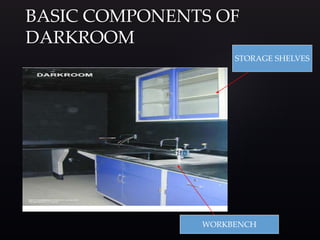
BASIC COMPONENTS OF
DARKROOM
STORAGE SHELVES
WORKBENCH
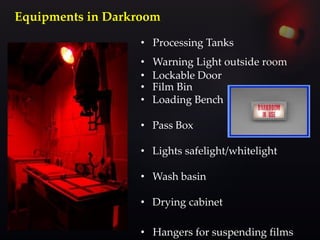
• Processing Tanks
• Warning Light outside room
• Lockable Door
• Film Bin
• Loading Bench
• Pass Box
• Lights safelight/whitelight
• Wash basin
• Drying cabinet
• Hangers for suspending films
Equipments in Darkroom
Location
 Centrally sited served with hatch's from
adjacent imaging rooms
 Away from hot or damp areas
 Power And water supply accessibility
 Near to viewing/reporting room
 Avoid windows
Dark Room
Room character
• Min 10m sq.
• Height 2.5 – 3m
Dark Room
Walls /ceiling
• Wall being Plastered/ thick wall
• Light colored to reflect the light-as to use lesser
safelight.
Floor
• Non-porous
• Non-slip
• Durable and easy maintaince
Dark Room
Ventilation And Heating
Satisfactory working conditions for staff ..
Good film handling and storage conditions..
Dark Room
Maintained by--
• Relative humidity 40-60%
• Room Temperature 18-20 °C
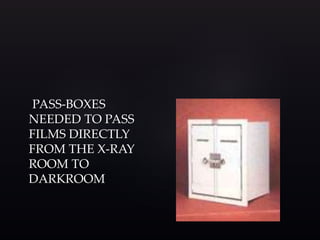
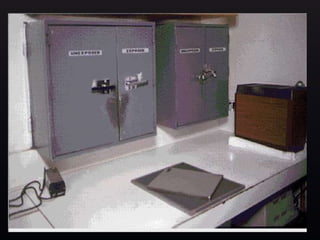
PASS-BOXES
NEEDED TO PASS
FILMS DIRECTLY
FROM THE X-RAY
ROOM TO
DARKROOM
Types of Entrance
Four designs of entrances
1. Single door system
2. Double door system
3. Labyrinth
4. Rotating door entrance
Dark Room
DARKROOM ENTRANCE:
SINGLE DOOR
Single door entrance
Access via single door only
Advantage:-
- Inexpensive.
- Less space used.
Disadvantages:-
- Not truly lightproof
- Poses safety hazard.
DARKROOM ENTRANCE:
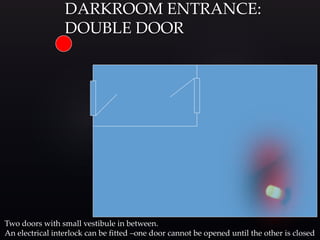
DOUBLE DOOR
Two doors with small vestibule in between.
An electrical interlock can be fitted –one door cannot be opened until the other is closed
DARKROOM ENTRANCE:
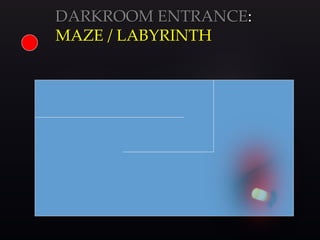
MAZE / LABYRINTH
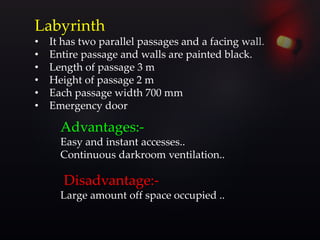
Labyrinth
• It has two parallel passages and a facing wall.
• Entire passage and walls are painted black.
• Length of passage 3 m
• Height of passage 2 m
• Each passage width 700 mm
• Emergency door
Advantages:-
Easy and instant accesses..
Continuous darkroom ventilation..
Disadvantage:-
Large amount off space occupied ..
DARKROOM ENTRANCE:
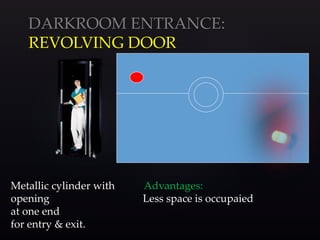
REVOLVING DOOR
Metallic cylinder with Advantages:
opening Less space is occupaied
at one end
for entry & exit.
DARKROOM LIGHT
SAFELIGHTS
WHITE LIGHTS
SafeLighting
SafeLighting
The word safe- as brief exposure will
not cause significant fogging
Functions
• Provide sufficient darkroom illumination
without any detrimental effect on the
sensitive film material.
• Helps for inspection of films during
processing.
Principle of operation
• X Ray film’s are color
sensitive- restricted to specfic
range of wavelength.
• Thus subjecting to non
sensitive wavelength and
cutting of white light.
SafeLighting
SafeLighting
Areas where safe light is required
• Film loading / unloading areas.
• Processor film feed-in points.
• Path b/w above two.
• At developer tank.
SafeLighting
Factors affecting safe lighting performance
• Safelight to film distance
• Bulb wattage
• Number and location of bulbs
• Film handling time:
Film handling time:
• the length of time the
film may be handled
in safelight condition
with out increase in
fog level.
• Its around 20 to 45sec.
SafeLighting
SafeLighting
Recommended standards
• Use only the recommended safelight filters
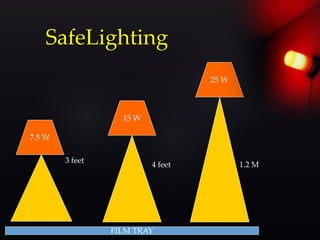
• Keep a required film light distance
• Keep minimum exposure to safelight s for
exposed as well as unexposed films
7.5 W
FILM TRAY
15 W
4 feet
3 feet
25 W
1.2 M
SafeLighting
Required for
• Inspection & maintenance off cassettes & screens
• Cleaning purpose
• Servicing off equipment's
White light should be
• Close to ceiling
• Moderate intensity (60W tungsten or 30W fluorescent)
• Centrally placed
White lighting
FILM
PROCESSING…
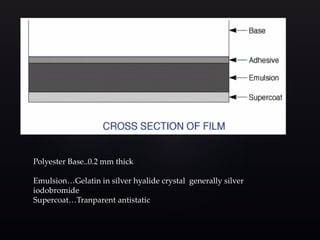
Polyester Base..0.2 mm thick
Emulsion…Gelatin in silver hyalide crystal generally silver
iodobromide
Supercoat…Tranparent antistatic
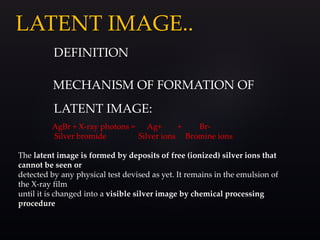
LATENT IMAGE..
DEFINITION
MECHANISM OF FORMATION OF
LATENT IMAGE:
AgBr + X-ray photons = Ag+ + Br-
Silver bromide Silver ions Bromine ions
The latent image is formed by deposits of free (ionized) silver ions that
cannot be seen or
detected by any physical test devised as yet. It remains in the emulsion of
the X-ray film
until it is changed into a visible silver image by chemical processing
procedure
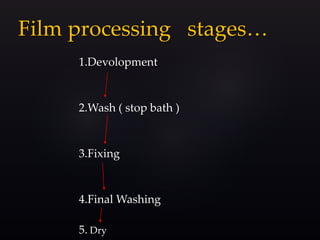
Film processing stages…
1.Devolopment
2.Wash ( stop bath )
3.Fixing
4.Final Washing
5. Dry
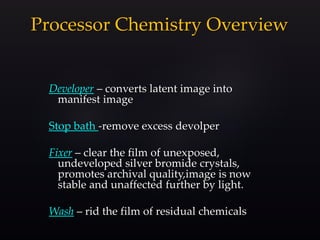
Processor Chemistry Overview
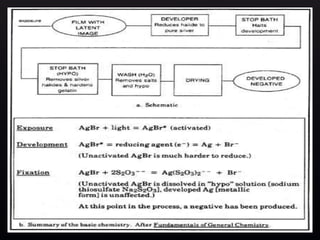
Developer – converts latent image into
manifest image
Stop bath -remove excess devolper
Fixer – clear the film of unexposed,
undeveloped silver bromide crystals,
promotes archival quality,image is now
stable and unaffected further by light.
Wash – rid the film of residual chemicals
(6 Ingredients)
1. Reducing Agent: reduce exposed silver halide to
black metallic silver
-Hydroquinone (Blacks)
-Phenidone (Grays)
2AgBr + Hydroquinone-----2Ag+quinone+2HBr
2. Activator: softens gelatin, maintains alkaline pH
(increase pH)
-Sodium Carbonate
Developer Solution
Developer Solution
3. Hardener: prevents damage to the
film from over swelling of gelatin
-Gluteraldehyde
4. Preservative: Antioxidant that
prevents oxidation of developer
-Sodium Sulfite
Developer Solution
5. Restrainer: prevents chemical fog
in new developer
-Potassium Bromide
6. Solvent: dissolves & ionizes the
developer chemicals
-Water
(5 Ingredients)
1. Clearing Agent: dissolves undeveloped
silver halide
- Thiosulfate ( HYPO )
2. Tanning Agent: shrinks, hardens,
preserves emulsion
-Aluminum Salt
Fixer Solution
Fixer Solution
3. Activator: neutralizes developer,
maintains acidic pH (decrease pH)
-Acetic Acid
4. Preservative: prevents oxidation,
prolongs solution life
-Sodium Sulfite
5. Solvent: dissolves other ingredients
-Water
Wash
 Rid the film of residual chemicals
 Residual chemicals on the film will discolor
radiograph over time.
 Cold water processors are less efficient in
removing chemicals – Warm water processors
much better.
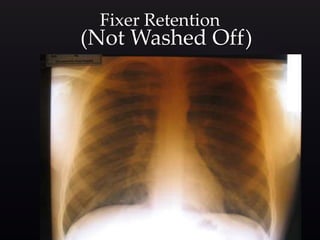
(Not Washed Off)
Fixer Retention
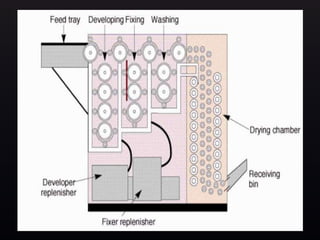
AUTOMATIC DARKROOM
PROCESSORS
Thank you…

1 Dark room by Dr Soumitra Halder

  • 1.
    Dr. Soumitra Halder Deptof Radio-diagnosis Medical College,Kolkata DarkRoom
  • 2.
     It isa place where the necessary handling and the processing of the film can be carried out safely and efficiently without the hazard of producing film fogging.  It must exclude all outside light and provide “SAFE” artificial light Dark Room
  • 3.
  • 4.
    • Processing Tanks •Warning Light outside room • Lockable Door • Film Bin • Loading Bench • Pass Box • Lights safelight/whitelight • Wash basin • Drying cabinet • Hangers for suspending films Equipments in Darkroom
  • 5.
    Location  Centrally sitedserved with hatch's from adjacent imaging rooms  Away from hot or damp areas  Power And water supply accessibility  Near to viewing/reporting room  Avoid windows Dark Room
  • 6.
    Room character • Min10m sq. • Height 2.5 – 3m Dark Room Walls /ceiling • Wall being Plastered/ thick wall • Light colored to reflect the light-as to use lesser safelight.
  • 7.
    Floor • Non-porous • Non-slip •Durable and easy maintaince Dark Room
  • 8.
    Ventilation And Heating Satisfactoryworking conditions for staff .. Good film handling and storage conditions.. Dark Room Maintained by-- • Relative humidity 40-60% • Room Temperature 18-20 °C
  • 9.
    PASS-BOXES NEEDED TO PASS FILMSDIRECTLY FROM THE X-RAY ROOM TO DARKROOM
  • 11.
    Types of Entrance Fourdesigns of entrances 1. Single door system 2. Double door system 3. Labyrinth 4. Rotating door entrance Dark Room
  • 12.
    DARKROOM ENTRANCE: SINGLE DOOR Singledoor entrance Access via single door only Advantage:- - Inexpensive. - Less space used. Disadvantages:- - Not truly lightproof - Poses safety hazard.
  • 13.
    DARKROOM ENTRANCE: DOUBLE DOOR Twodoors with small vestibule in between. An electrical interlock can be fitted –one door cannot be opened until the other is closed
  • 14.
  • 15.
    Labyrinth • It hastwo parallel passages and a facing wall. • Entire passage and walls are painted black. • Length of passage 3 m • Height of passage 2 m • Each passage width 700 mm • Emergency door Advantages:- Easy and instant accesses.. Continuous darkroom ventilation.. Disadvantage:- Large amount off space occupied ..
  • 16.
    DARKROOM ENTRANCE: REVOLVING DOOR Metalliccylinder with Advantages: opening Less space is occupaied at one end for entry & exit.
  • 17.
  • 18.
  • 19.
    SafeLighting The word safe-as brief exposure will not cause significant fogging Functions • Provide sufficient darkroom illumination without any detrimental effect on the sensitive film material. • Helps for inspection of films during processing.
  • 20.
    Principle of operation •X Ray film’s are color sensitive- restricted to specfic range of wavelength. • Thus subjecting to non sensitive wavelength and cutting of white light. SafeLighting
  • 21.
    SafeLighting Areas where safelight is required • Film loading / unloading areas. • Processor film feed-in points. • Path b/w above two. • At developer tank.
  • 22.
    SafeLighting Factors affecting safelighting performance • Safelight to film distance • Bulb wattage • Number and location of bulbs • Film handling time:
  • 23.
    Film handling time: •the length of time the film may be handled in safelight condition with out increase in fog level. • Its around 20 to 45sec. SafeLighting
  • 24.
    SafeLighting Recommended standards • Useonly the recommended safelight filters • Keep a required film light distance • Keep minimum exposure to safelight s for exposed as well as unexposed films
  • 25.
    7.5 W FILM TRAY 15W 4 feet 3 feet 25 W 1.2 M SafeLighting
  • 26.
    Required for • Inspection& maintenance off cassettes & screens • Cleaning purpose • Servicing off equipment's White light should be • Close to ceiling • Moderate intensity (60W tungsten or 30W fluorescent) • Centrally placed White lighting
  • 27.
  • 28.
    Polyester Base..0.2 mmthick Emulsion…Gelatin in silver hyalide crystal generally silver iodobromide Supercoat…Tranparent antistatic
  • 29.
    LATENT IMAGE.. DEFINITION MECHANISM OFFORMATION OF LATENT IMAGE: AgBr + X-ray photons = Ag+ + Br- Silver bromide Silver ions Bromine ions The latent image is formed by deposits of free (ionized) silver ions that cannot be seen or detected by any physical test devised as yet. It remains in the emulsion of the X-ray film until it is changed into a visible silver image by chemical processing procedure
  • 30.
    Film processing stages… 1.Devolopment 2.Wash( stop bath ) 3.Fixing 4.Final Washing 5. Dry
  • 31.
    Processor Chemistry Overview Developer– converts latent image into manifest image Stop bath -remove excess devolper Fixer – clear the film of unexposed, undeveloped silver bromide crystals, promotes archival quality,image is now stable and unaffected further by light. Wash – rid the film of residual chemicals
  • 33.
    (6 Ingredients) 1. ReducingAgent: reduce exposed silver halide to black metallic silver -Hydroquinone (Blacks) -Phenidone (Grays) 2AgBr + Hydroquinone-----2Ag+quinone+2HBr 2. Activator: softens gelatin, maintains alkaline pH (increase pH) -Sodium Carbonate Developer Solution
  • 34.
    Developer Solution 3. Hardener:prevents damage to the film from over swelling of gelatin -Gluteraldehyde 4. Preservative: Antioxidant that prevents oxidation of developer -Sodium Sulfite
  • 35.
    Developer Solution 5. Restrainer:prevents chemical fog in new developer -Potassium Bromide 6. Solvent: dissolves & ionizes the developer chemicals -Water
  • 36.
    (5 Ingredients) 1. ClearingAgent: dissolves undeveloped silver halide - Thiosulfate ( HYPO ) 2. Tanning Agent: shrinks, hardens, preserves emulsion -Aluminum Salt Fixer Solution
  • 37.
    Fixer Solution 3. Activator:neutralizes developer, maintains acidic pH (decrease pH) -Acetic Acid 4. Preservative: prevents oxidation, prolongs solution life -Sodium Sulfite 5. Solvent: dissolves other ingredients -Water
  • 38.
    Wash  Rid thefilm of residual chemicals  Residual chemicals on the film will discolor radiograph over time.  Cold water processors are less efficient in removing chemicals – Warm water processors much better.
  • 39.
  • 40.
  • 42.

Editor's Notes

  • #7 Lead thickness of the wall Pass boxes Chemical resistant materials ( special paint, varnish or ceramic tile or plastic wall) Floor-( asphalt tile or clay tile )
  • #15 Other pattern n emergency door