Processing of x-ray film
Presented by: Shila Kandel
BDS 4th year
Presented to : Dr. Deepanshu Garg
Department of Oral medicine and
Radiology
College of Medical Sciences - TH
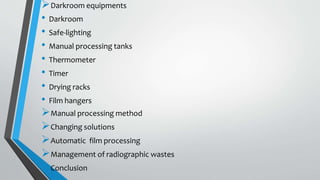
Contents
Introduction
Terminologies used in radiography
Types of image
Formation of latent image
Processing the exposed film
• Developing
• Rinsing
• Fixing
• Washing
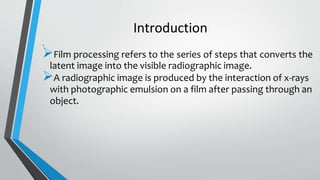
Darkroom equipments
• Darkroom
• Safe-lighting
• Manual processing tanks
• Thermometer
• Timer
• Drying racks
• Film hangers
Manual processing method
Changing solutions
Automatic film processing
Management of radiographic wastes
Conclusion
Introduction
.
Film processing refers to the series of steps that converts the
latent image into the visible radiographic image.
A radiographic image is produced by the interaction of x-rays
with photographic emulsion on a film after passing through an
object.
Terminologies used in radiography
 Radiopaque
These are the object when exposed to x-ray beam
,completely stop/absorb the x-rays and prevent them from reaching the film
,as a result silver halide crystals do not get exposed
and hence conversion into metallic silver do not occur.
The resultant image formed is radiopaque.
 Radiolucent
It represents those structures through which all the x-ray beam can pass and
can reach the film to react with the silver halide crystals converting them to
metallic silver .
The resultant image formed is radiolucent
Types of image
Latent image
Latent image is defined as an invisible image that is produced
in film emulsion by light or x-ray.
Final image
A final image or visible image can be described as a two-
dimensional picture which is made up of a variety of black ,
white , and gray superimposed shadow.
A latent image is converted into a visible record by series of
chemical reactions which is known as processing.
Processing the exposed film in developer and fixer
converts the latent image into visible radiographic image.
Processing the exposed film
•Processing
It is the term used to describe the sequence of events
required to convert the invisible latent image contained in
the sensitized film emulsion into the visible permanent
radiographic image.
• Film processing involves the following procedures :
 Immerse exposed film in developer
 Rinse developer off the film in water bath
 Immerse film in fixer
 Wash film in water bath to remove fixer
 Dry film and mount for viewing
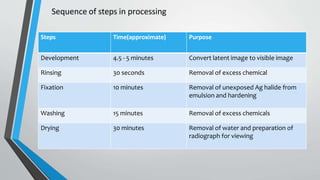
Sequence of steps in processing
Steps Time(approximate) Purpose
Development 4.5 - 5 minutes Convert latent image to visible image
Rinsing 30 seconds Removal of excess chemical
Fixation 10 minutes Removal of unexposed Ag halide from
emulsion and hardening
Washing 15 minutes Removal of excess chemicals
Drying 30 minutes Removal of water and preparation of
radiograph for viewing
Development
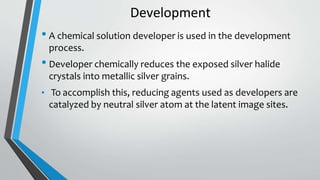
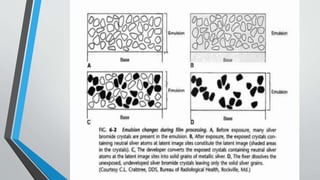
• A chemical solution developer is used in the development
process.
• Developer chemically reduces the exposed silver halide
crystals into metallic silver grains.
• To accomplish this, reducing agents used as developers are
catalyzed by neutral silver atom at the latent image sites.
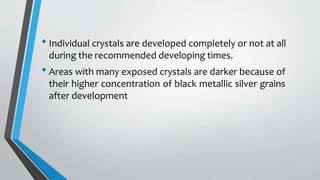
• Individual crystals are developed completely or not at all
during the recommended developing times.
• Areas with many exposed crystals are darker because of
their higher concentration of black metallic silver grains
after development
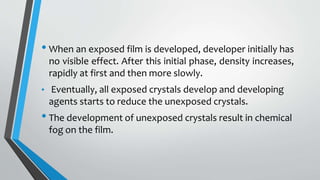
• When an exposed film is developed, developer initially has
no visible effect. After this initial phase, density increases,
rapidly at first and then more slowly.
• Eventually, all exposed crystals develop and developing
agents starts to reduce the unexposed crystals.
• The development of unexposed crystals result in chemical
fog on the film.
fig
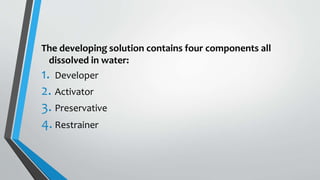
The developing solution contains four components all
dissolved in water:
1. Developer
2. Activator
3. Preservative
4. Restrainer
Rinsing
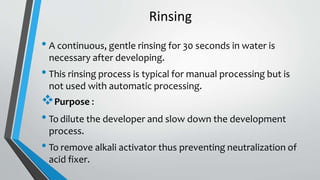
• A continuous, gentle rinsing for 30 seconds in water is
necessary after developing.
• This rinsing process is typical for manual processing but is
not used with automatic processing.
Purpose :
• To dilute the developer and slow down the development
process.
• To remove alkali activator thus preventing neutralization of
acid fixer.
Fixing
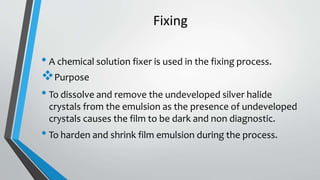
• A chemical solution fixer is used in the fixing process.
Purpose
• To dissolve and remove the undeveloped silver halide
crystals from the emulsion as the presence of undeveloped
crystals causes the film to be dark and non diagnostic.
• To harden and shrink film emulsion during the process.
Fixing solution also contains four components, all dissolved
in water.
Clearing agent
Acidifier
Preservative
Hardener
Washing
• After fixing, the processed film is washed in a sufficient
flow of water for an adequate time to ensure removal of all
thiosulfate ions and silver thiosulfate complexes.
• Washing efficiency declines rapidly when water
temperature decreases to less than 6o degree F.
• Any silver compound or thiosulfate that remains because
of improper washing discolours and causes stains, which
are most apparent in the radiopaque areas.
Drying
• Films are dried with the help of x-ray dryer in a dust free
area.
• While drying, films should not touch each other to avoid
sticking of the films.
Darkroom equipment requirements
Darkroom
Safe-lighting
Manual processing tanks
Thermometer
Timer
Drying racks
Film hangers
Darkroom
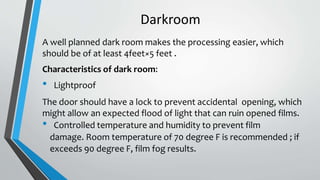
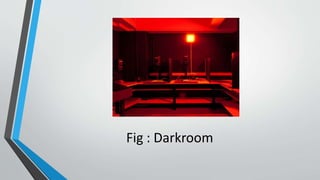
A well planned dark room makes the processing easier, which
should be of at least 4feet×5 feet .
Characteristics of dark room:
• Lightproof
The door should have a lock to prevent accidental opening, which
might allow an expected flood of light that can ruin opened films.
• Controlled temperature and humidity to prevent film
damage. Room temperature of 70 degree F is recommended ; if
exceeds 90 degree F, film fog results.
Fig : Darkroom
Safe lighting
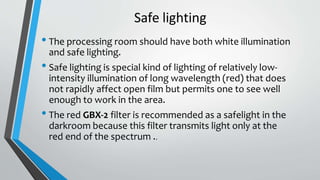
• The processing room should have both white illumination
and safe lighting.
• Safe lighting is special kind of lighting of relatively low-
intensity illumination of long wavelength (red) that does
not rapidly affect open film but permits one to see well
enough to work in the area.
• The red GBX-2 filter is recommended as a safelight in the
darkroom because this filter transmits light only at the
red end of the spectrum ..
Manual processing tanks
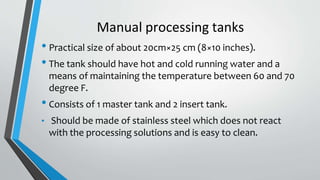
• Practical size of about 20cm×25 cm (8×10 inches).
• The tank should have hot and cold running water and a
means of maintaining the temperature between 60 and 70
degree F.
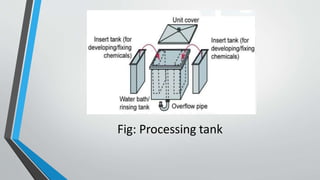
• Consists of 1 master tank and 2 insert tank.
• Should be made of stainless steel which does not react
with the processing solutions and is easy to clean.
Fig: Processing tank
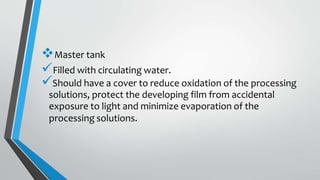
Master tank
Filled with circulating water.
Should have a cover to reduce oxidation of the processing
solutions, protect the developing film from accidental
exposure to light and minimize evaporation of the
processing solutions.
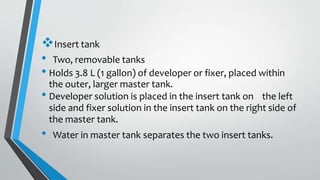
Insert tank
• Two, removable tanks
• Holds 3.8 L (1 gallon) of developer or fixer, placed within
the outer, larger master tank.
• Developer solution is placed in the insert tank on the left
side and fixer solution in the insert tank on the right side of
the master tank.
• Water in master tank separates the two insert tanks.
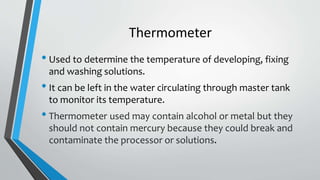
Thermometer
• Used to determine the temperature of developing, fixing
and washing solutions.
• It can be left in the water circulating through master tank
to monitor its temperature.
• Thermometer used may contain alcohol or metal but they
should not contain mercury because they could break and
contaminate the processor or solutions.
Timer
• The x-ray film must be exposed to the processing chemicals
for specific intervals.
• An interval timer is indispensable for controlling
development and fixation times.
Drying racks
• Two or three drying racks can be mounted on a convenient
wall for film hangers.
• Drip trays are placed underneath the racks to catch water
that may run off the wet films.
• An electric fan can be used to circulate the air and speed
drying the films but it should not be pointed directly at the
films.
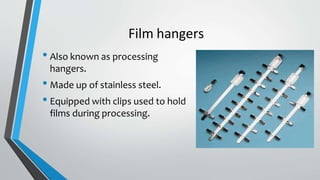
Film hangers
• Also known as processing
hangers.
• Made up of stainless steel.
• Equipped with clips used to hold
films during processing.
Processing methods
1.Manual processing method
Time-temperature method
Visual method
Rapid processing method
2. Automatic method
Monobath method
Self developing films
Automatic film processing
• Step in automatic processing are more or less same like the manual
processing with exception of rinsing , between developing and
fixing.
• This stage is omitted because excess developer is either drained
or squeezed.
• automatic processor requires only 4-6 minutes to develop, fix,
wash and dry.
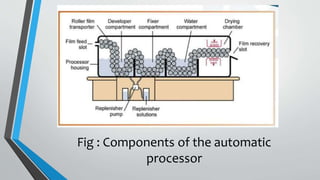
• Automatic processors have an in-line arrangement typically
consisting of a transport mechanism that picks up the
unwrapped film and passes it through the developing,
fixing, washing, and drying sections .
Fig : Components of the automatic
processor
Functions of rollers
• Moving the film through the developing solutions.
• Agitation of solution which contributes to the uniformity of
processing.
• In the developer, fixer, and water tanks the rollers press on the film
emulsion, forcing some solution out of the emulsion. The emulsions
rapidly fill again with solution, thus promoting solution exchange.
• Minimizes carryover of developer into the fixer tank.
• The solution level and temperature should be checked each morning.
• Hands should be dry while handling films.
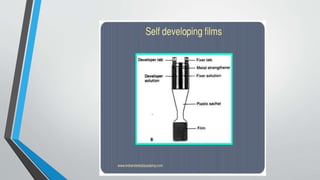
Self developing films
• Alternative to manual processing.
• The x ray film is present in sachet containing developer and
fixer .
• Following exposure the developer can be pulled, releasing
developer solution which is milked down toward the film
and flow around it.
• After 15 seconds fixer tab is pulled to release the fixer
solution which similarly baths down the film.
• After fixing the used chemicals are discarded and film is
rinsed thoroughly under running water for ten minutes.
Disadvantages
• Resultant image has poor
quality.
• Image deteriorates rapidly with
time as fixing is inadequate
• As there is no lead foil inside
film packet patient receives
more radiation dose.
• As these film packets are very
flexible and they bend easily,
these films are difficult to use
with positioning holders.
• No darkroom or processing
equipments are required.
• Final radiograph is ready in
about a minute and hence
saves time.
Advantages
Monobath method
• In this method developer and fixer are combined in one
solution .
• Fixer is alkaline and does not neutralize the developer.
• It is injected into special waterproof film packet and the
film is developed by rubbing film packet.
• There is no need of darkroom.
• It is advantageous for quick spot diagnosis and for root
canal treatment.
References
• ORAL RADIOLOGY Principles and Interpretation, Staurt C.
White , Michael J. Pharoah
• Oral and Maxillofacial Radiology: A Diagnostic Approach
David MacDonald
• Fundamentals of oral and maxillofacial radiology, Hubar,
Jack Sean
Thank you

processingofx-rayfilm-.pptx process while xray

  • 1.
    Processing of x-rayfilm Presented by: Shila Kandel BDS 4th year Presented to : Dr. Deepanshu Garg Department of Oral medicine and Radiology College of Medical Sciences - TH
  • 2.
    Contents Introduction Terminologies used inradiography Types of image Formation of latent image Processing the exposed film • Developing • Rinsing • Fixing • Washing
  • 3.
    Darkroom equipments • Darkroom •Safe-lighting • Manual processing tanks • Thermometer • Timer • Drying racks • Film hangers Manual processing method Changing solutions Automatic film processing Management of radiographic wastes Conclusion
  • 4.
    Introduction . Film processing refersto the series of steps that converts the latent image into the visible radiographic image. A radiographic image is produced by the interaction of x-rays with photographic emulsion on a film after passing through an object.
  • 5.
    Terminologies used inradiography  Radiopaque These are the object when exposed to x-ray beam ,completely stop/absorb the x-rays and prevent them from reaching the film ,as a result silver halide crystals do not get exposed and hence conversion into metallic silver do not occur. The resultant image formed is radiopaque.  Radiolucent It represents those structures through which all the x-ray beam can pass and can reach the film to react with the silver halide crystals converting them to metallic silver . The resultant image formed is radiolucent
  • 6.
    Types of image Latentimage Latent image is defined as an invisible image that is produced in film emulsion by light or x-ray. Final image A final image or visible image can be described as a two- dimensional picture which is made up of a variety of black , white , and gray superimposed shadow. A latent image is converted into a visible record by series of chemical reactions which is known as processing.
  • 7.
    Processing the exposedfilm in developer and fixer converts the latent image into visible radiographic image.
  • 8.
    Processing the exposedfilm •Processing It is the term used to describe the sequence of events required to convert the invisible latent image contained in the sensitized film emulsion into the visible permanent radiographic image.
  • 9.
    • Film processinginvolves the following procedures :  Immerse exposed film in developer  Rinse developer off the film in water bath  Immerse film in fixer  Wash film in water bath to remove fixer  Dry film and mount for viewing
  • 10.
    Sequence of stepsin processing Steps Time(approximate) Purpose Development 4.5 - 5 minutes Convert latent image to visible image Rinsing 30 seconds Removal of excess chemical Fixation 10 minutes Removal of unexposed Ag halide from emulsion and hardening Washing 15 minutes Removal of excess chemicals Drying 30 minutes Removal of water and preparation of radiograph for viewing
  • 11.
    Development • A chemicalsolution developer is used in the development process. • Developer chemically reduces the exposed silver halide crystals into metallic silver grains. • To accomplish this, reducing agents used as developers are catalyzed by neutral silver atom at the latent image sites.
  • 12.
    • Individual crystalsare developed completely or not at all during the recommended developing times. • Areas with many exposed crystals are darker because of their higher concentration of black metallic silver grains after development
  • 13.
    • When anexposed film is developed, developer initially has no visible effect. After this initial phase, density increases, rapidly at first and then more slowly. • Eventually, all exposed crystals develop and developing agents starts to reduce the unexposed crystals. • The development of unexposed crystals result in chemical fog on the film.
  • 14.
  • 15.
    The developing solutioncontains four components all dissolved in water: 1. Developer 2. Activator 3. Preservative 4. Restrainer
  • 16.
    Rinsing • A continuous,gentle rinsing for 30 seconds in water is necessary after developing. • This rinsing process is typical for manual processing but is not used with automatic processing. Purpose : • To dilute the developer and slow down the development process. • To remove alkali activator thus preventing neutralization of acid fixer.
  • 17.
    Fixing • A chemicalsolution fixer is used in the fixing process. Purpose • To dissolve and remove the undeveloped silver halide crystals from the emulsion as the presence of undeveloped crystals causes the film to be dark and non diagnostic. • To harden and shrink film emulsion during the process.
  • 18.
    Fixing solution alsocontains four components, all dissolved in water. Clearing agent Acidifier Preservative Hardener
  • 19.
    Washing • After fixing,the processed film is washed in a sufficient flow of water for an adequate time to ensure removal of all thiosulfate ions and silver thiosulfate complexes. • Washing efficiency declines rapidly when water temperature decreases to less than 6o degree F. • Any silver compound or thiosulfate that remains because of improper washing discolours and causes stains, which are most apparent in the radiopaque areas.
  • 20.
    Drying • Films aredried with the help of x-ray dryer in a dust free area. • While drying, films should not touch each other to avoid sticking of the films.
  • 21.
    Darkroom equipment requirements Darkroom Safe-lighting Manualprocessing tanks Thermometer Timer Drying racks Film hangers
  • 22.
    Darkroom A well planneddark room makes the processing easier, which should be of at least 4feet×5 feet . Characteristics of dark room: • Lightproof The door should have a lock to prevent accidental opening, which might allow an expected flood of light that can ruin opened films. • Controlled temperature and humidity to prevent film damage. Room temperature of 70 degree F is recommended ; if exceeds 90 degree F, film fog results.
  • 23.
  • 24.
    Safe lighting • Theprocessing room should have both white illumination and safe lighting. • Safe lighting is special kind of lighting of relatively low- intensity illumination of long wavelength (red) that does not rapidly affect open film but permits one to see well enough to work in the area. • The red GBX-2 filter is recommended as a safelight in the darkroom because this filter transmits light only at the red end of the spectrum ..
  • 25.
    Manual processing tanks •Practical size of about 20cm×25 cm (8×10 inches). • The tank should have hot and cold running water and a means of maintaining the temperature between 60 and 70 degree F. • Consists of 1 master tank and 2 insert tank. • Should be made of stainless steel which does not react with the processing solutions and is easy to clean.
  • 26.
  • 27.
    Master tank Filled withcirculating water. Should have a cover to reduce oxidation of the processing solutions, protect the developing film from accidental exposure to light and minimize evaporation of the processing solutions.
  • 28.
    Insert tank • Two,removable tanks • Holds 3.8 L (1 gallon) of developer or fixer, placed within the outer, larger master tank. • Developer solution is placed in the insert tank on the left side and fixer solution in the insert tank on the right side of the master tank. • Water in master tank separates the two insert tanks.
  • 29.
    Thermometer • Used todetermine the temperature of developing, fixing and washing solutions. • It can be left in the water circulating through master tank to monitor its temperature. • Thermometer used may contain alcohol or metal but they should not contain mercury because they could break and contaminate the processor or solutions.
  • 30.
    Timer • The x-rayfilm must be exposed to the processing chemicals for specific intervals. • An interval timer is indispensable for controlling development and fixation times.
  • 31.
    Drying racks • Twoor three drying racks can be mounted on a convenient wall for film hangers. • Drip trays are placed underneath the racks to catch water that may run off the wet films. • An electric fan can be used to circulate the air and speed drying the films but it should not be pointed directly at the films.
  • 32.
    Film hangers • Alsoknown as processing hangers. • Made up of stainless steel. • Equipped with clips used to hold films during processing.
  • 33.
    Processing methods 1.Manual processingmethod Time-temperature method Visual method Rapid processing method 2. Automatic method Monobath method Self developing films
  • 34.
    Automatic film processing •Step in automatic processing are more or less same like the manual processing with exception of rinsing , between developing and fixing. • This stage is omitted because excess developer is either drained or squeezed. • automatic processor requires only 4-6 minutes to develop, fix, wash and dry. • Automatic processors have an in-line arrangement typically consisting of a transport mechanism that picks up the unwrapped film and passes it through the developing, fixing, washing, and drying sections .
  • 35.
    Fig : Componentsof the automatic processor
  • 36.
    Functions of rollers •Moving the film through the developing solutions. • Agitation of solution which contributes to the uniformity of processing. • In the developer, fixer, and water tanks the rollers press on the film emulsion, forcing some solution out of the emulsion. The emulsions rapidly fill again with solution, thus promoting solution exchange. • Minimizes carryover of developer into the fixer tank. • The solution level and temperature should be checked each morning. • Hands should be dry while handling films.
  • 37.
    Self developing films •Alternative to manual processing. • The x ray film is present in sachet containing developer and fixer . • Following exposure the developer can be pulled, releasing developer solution which is milked down toward the film and flow around it. • After 15 seconds fixer tab is pulled to release the fixer solution which similarly baths down the film. • After fixing the used chemicals are discarded and film is rinsed thoroughly under running water for ten minutes.
  • 39.
    Disadvantages • Resultant imagehas poor quality. • Image deteriorates rapidly with time as fixing is inadequate • As there is no lead foil inside film packet patient receives more radiation dose. • As these film packets are very flexible and they bend easily, these films are difficult to use with positioning holders. • No darkroom or processing equipments are required. • Final radiograph is ready in about a minute and hence saves time. Advantages
  • 40.
    Monobath method • Inthis method developer and fixer are combined in one solution . • Fixer is alkaline and does not neutralize the developer. • It is injected into special waterproof film packet and the film is developed by rubbing film packet. • There is no need of darkroom. • It is advantageous for quick spot diagnosis and for root canal treatment.
  • 41.
    References • ORAL RADIOLOGYPrinciples and Interpretation, Staurt C. White , Michael J. Pharoah • Oral and Maxillofacial Radiology: A Diagnostic Approach David MacDonald • Fundamentals of oral and maxillofacial radiology, Hubar, Jack Sean
  • 42.