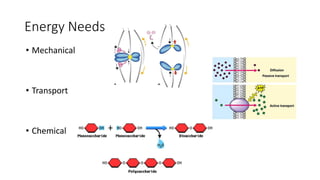
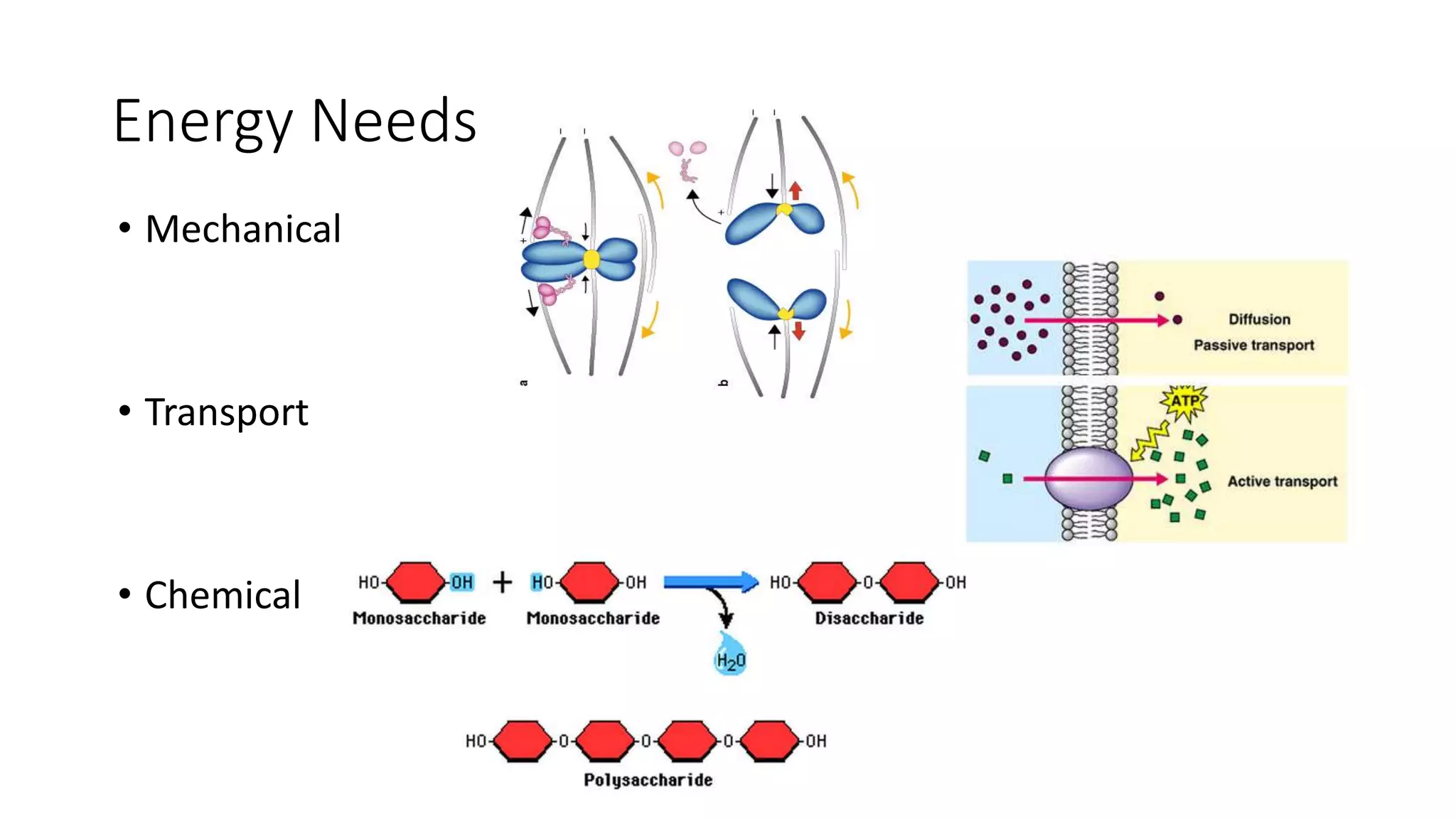
Energy Needs
• Mechanical
• Transport
• Chemical
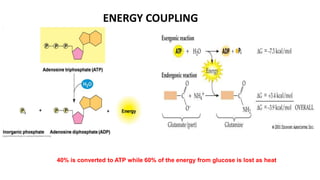
ENERGY COUPLING
40% is converted to ATP while 60% of the energy from glucose is lost as heat
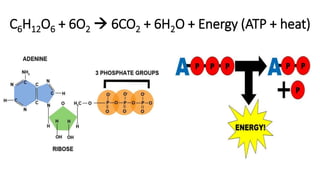
C6H12O6 + 6O2  6CO2 + 6H2O + Energy (ATP + heat)
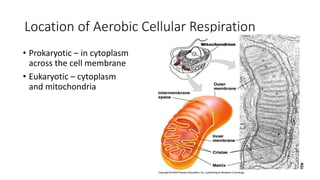
Location of Aerobic Cellular Respiration
• Prokaryotic – in cytoplasm
across the cell membrane
• Eukaryotic – cytoplasm
and mitochondria
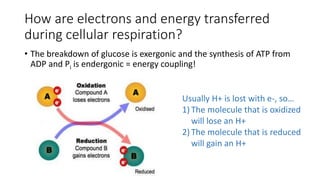
How are electrons and energy transferred
during cellular respiration?
• The breakdown of glucose is exergonic and the synthesis of ATP from
ADP and Pi is endergonic = energy coupling!
Usually H+ is lost with e-, so…
1) The molecule that is oxidized
will lose an H+
2) The molecule that is reduced
will gain an H+
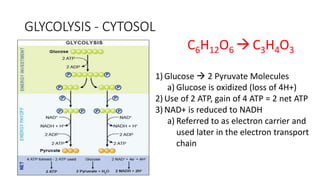
GLYCOLYSIS - CYTOSOL
1) Glucose  2 Pyruvate Molecules
a) Glucose is oxidized (loss of 4H+)
2) Use of 2 ATP, gain of 4 ATP = 2 net ATP
3) NAD+ is reduced to NADH
a) Referred to as electron carrier and
used later in the electron transport
chain
C6H12O6 C3H4O3
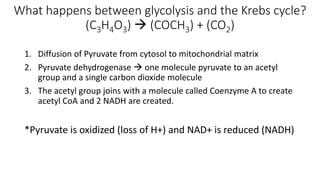
What happens between glycolysis and the Krebs cycle?
(C3H4O3)  (COCH3) + (CO2)
1. Diffusion of Pyruvate from cytosol to mitochondrial matrix
2. Pyruvate dehydrogenase  one molecule pyruvate to an acetyl
group and a single carbon dioxide molecule
3. The acetyl group joins with a molecule called Coenzyme A to create
acetyl CoA and 2 NADH are created.
*Pyruvate is oxidized (loss of H+) and NAD+ is reduced (NADH)
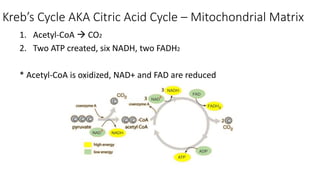
Kreb’s Cycle AKA Citric Acid Cycle – Mitochondrial Matrix
1. Acetyl-CoA  CO2
2. Two ATP created, six NADH, two FADH2
* Acetyl-CoA is oxidized, NAD+ and FAD are reduced
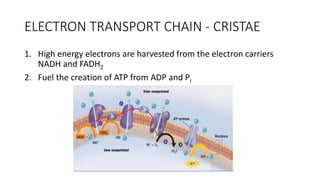
ELECTRON TRANSPORT CHAIN - CRISTAE
1. High energy electrons are harvested from the electron carriers
NADH and FADH2
2. Fuel the creation of ATP from ADP and Pi
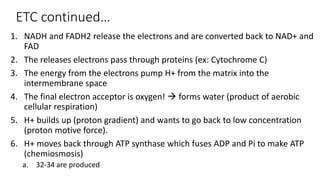
ETC continued…
1. NADH and FADH2 release the electrons and are converted back to NAD+ and
FAD
2. The releases electrons pass through proteins (ex: Cytochrome C)
3. The energy from the electrons pump H+ from the matrix into the
intermembrane space
4. The final electron acceptor is oxygen!  forms water (product of aerobic
cellular respiration)
5. H+ builds up (proton gradient) and wants to go back to low concentration
(proton motive force).
6. H+ moves back through ATP synthase which fuses ADP and Pi to make ATP
(chemiosmosis)
a. 32-34 are produced
What can be accepted as fuel for Glycolysis
• Polysaccharides can be converted into glucose monomers
• Other monosaccharides can also be modified to undergo glycolysis
• Fats and proteins can also be modified to be used
What happens when there is no oxygen to
accept the electrons at the end of the ETC?
Anaerobic Respiration
• Without oxygen to accept electrons in the electron transport chain, most
of cellular respiration stops, but fermentation provides a mechanism by
which some cells can continue to oxidize (break down) organic molecules
like glucose and generate ATP.
• Fermentation can generate ATP from glucose by substrate-level
phosphorylation during glycolysis as long as there is a supply of NAD+ to
accept electrons from glucose. If the NAD+ pool is exhausted, glycolysis
shuts down.
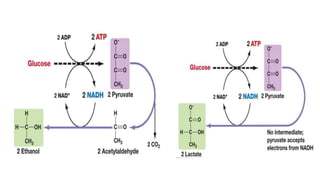
• Under anaerobic conditions (i.e. oxygen is NOT present) pyruvate then
accepts electrons from NADH, oxidizing it back to NAD+. The NAD+ is
then available to oxidize more glucose
1 cellular respiration

1 cellular respiration

  • 1.
    Energy Needs • Mechanical •Transport • Chemical
  • 2.
    ENERGY COUPLING 40% isconverted to ATP while 60% of the energy from glucose is lost as heat
  • 3.
    C6H12O6 + 6O2 6CO2 + 6H2O + Energy (ATP + heat)
  • 4.
    Location of AerobicCellular Respiration • Prokaryotic – in cytoplasm across the cell membrane • Eukaryotic – cytoplasm and mitochondria
  • 5.
    How are electronsand energy transferred during cellular respiration? • The breakdown of glucose is exergonic and the synthesis of ATP from ADP and Pi is endergonic = energy coupling! Usually H+ is lost with e-, so… 1) The molecule that is oxidized will lose an H+ 2) The molecule that is reduced will gain an H+
  • 6.
    GLYCOLYSIS - CYTOSOL 1)Glucose  2 Pyruvate Molecules a) Glucose is oxidized (loss of 4H+) 2) Use of 2 ATP, gain of 4 ATP = 2 net ATP 3) NAD+ is reduced to NADH a) Referred to as electron carrier and used later in the electron transport chain C6H12O6 C3H4O3
  • 7.
    What happens betweenglycolysis and the Krebs cycle? (C3H4O3)  (COCH3) + (CO2) 1. Diffusion of Pyruvate from cytosol to mitochondrial matrix 2. Pyruvate dehydrogenase  one molecule pyruvate to an acetyl group and a single carbon dioxide molecule 3. The acetyl group joins with a molecule called Coenzyme A to create acetyl CoA and 2 NADH are created. *Pyruvate is oxidized (loss of H+) and NAD+ is reduced (NADH)
  • 8.
    Kreb’s Cycle AKACitric Acid Cycle – Mitochondrial Matrix 1. Acetyl-CoA  CO2 2. Two ATP created, six NADH, two FADH2 * Acetyl-CoA is oxidized, NAD+ and FAD are reduced
  • 9.
    ELECTRON TRANSPORT CHAIN- CRISTAE 1. High energy electrons are harvested from the electron carriers NADH and FADH2 2. Fuel the creation of ATP from ADP and Pi
  • 10.
    ETC continued… 1. NADHand FADH2 release the electrons and are converted back to NAD+ and FAD 2. The releases electrons pass through proteins (ex: Cytochrome C) 3. The energy from the electrons pump H+ from the matrix into the intermembrane space 4. The final electron acceptor is oxygen!  forms water (product of aerobic cellular respiration) 5. H+ builds up (proton gradient) and wants to go back to low concentration (proton motive force). 6. H+ moves back through ATP synthase which fuses ADP and Pi to make ATP (chemiosmosis) a. 32-34 are produced
  • 11.
    What can beaccepted as fuel for Glycolysis • Polysaccharides can be converted into glucose monomers • Other monosaccharides can also be modified to undergo glycolysis • Fats and proteins can also be modified to be used
  • 12.
    What happens whenthere is no oxygen to accept the electrons at the end of the ETC?
  • 13.
    Anaerobic Respiration • Withoutoxygen to accept electrons in the electron transport chain, most of cellular respiration stops, but fermentation provides a mechanism by which some cells can continue to oxidize (break down) organic molecules like glucose and generate ATP. • Fermentation can generate ATP from glucose by substrate-level phosphorylation during glycolysis as long as there is a supply of NAD+ to accept electrons from glucose. If the NAD+ pool is exhausted, glycolysis shuts down. • Under anaerobic conditions (i.e. oxygen is NOT present) pyruvate then accepts electrons from NADH, oxidizing it back to NAD+. The NAD+ is then available to oxidize more glucose