Metabolism, ATP, & Energy
Big Idea #2: Energy is needed to do stuff.
Essential
Knowledge
•2A1: All living systems require
constant input of free energy.
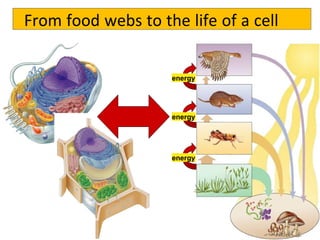
From food webs to the life of a cell
energy
energy
energy
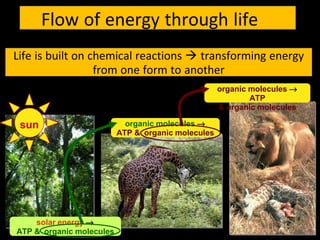
Flow of energy through life
Life is built on chemical reactions  transforming energy
from one form to another
organic molecules →
ATP & organic molecules
organic molecules →
ATP
& organic molecules
sun
solar energy →
ATP & organic molecules
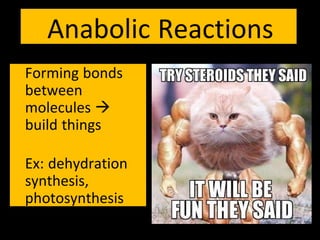
Anabolic Reactions
Forming bonds
between
molecules 
build things
Ex: dehydration
synthesis,
photosynthesis
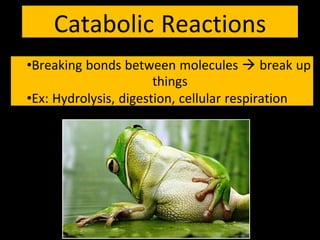
Catabolic Reactions
•Breaking bonds between molecules  break up
things
•Ex: Hydrolysis, digestion, cellular respiration
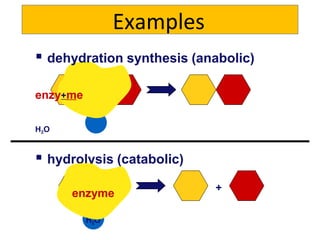
Examples
 dehydration synthesis (anabolic)
enzy+me
H2O
 hydrolysis (catabolic)
+
H2O
enzyme
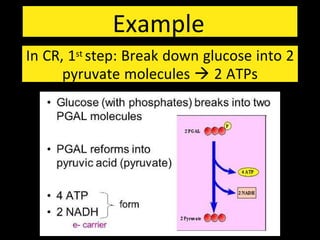
Example
In CR, 1st step: Break down glucose into 2
pyruvate molecules  2 ATPs
Question 1!
What types of reactions release energy?
Exergonic reactions!
Question 2!
What types of
reactions invest
energy?
Endergonic
reactions!
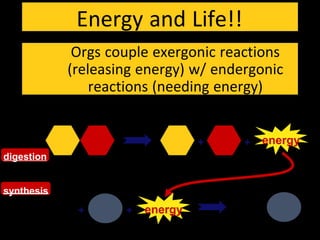
Energy and Life!!
+ + energy
+ energy+
digestion
synthesis
Orgs couple exergonic reactions
(releasing energy) w/ endergonic
reactions (needing energy)
Question 3!
What is the first rule of thermodynamics?
Energy cannot be created nor destroyed
Question 4!
What is the second rule of
thermodynamics?
No reactions is
100% efficient 
Every energy
transfer or
transformation
increases
entropy of
universe
AT
P
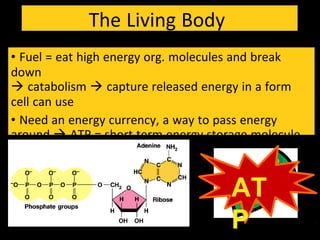
The Living Body
• Fuel = eat high energy org. molecules and break
down
 catabolism  capture released energy in a form
cell can use
• Need an energy currency, a way to pass energy
around  ATP = short term energy storage molecule
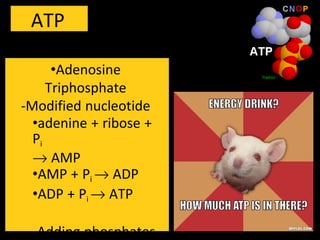
ATP
•Adenosine
Triphosphate
-Modified nucleotide
•adenine + ribose +
Pi
→ AMP
•AMP + Pi → ADP
•ADP + Pi → ATP
-Adding phosphates
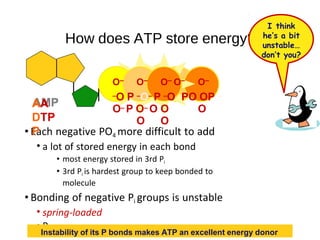
How does ATP store energy?
• Each negative PO4 more difficult to add
• a lot of stored energy in each bond
• most energy stored in 3rd Pi
• 3rd Pi is hardest group to keep bonded to
molecule
• Bonding of negative Pi groups is unstable
• spring-loaded
• Pi
O– O– O– O– O–
–O P –O– P –O –PO OP –
O– P O– O O O
O O
Instability of its P bonds makes ATP an excellent energy donor
I think
he’s a bit
unstable…
don’t you?
AA
DTP
P

2 metabolism basics.277163840

  • 1.
    Metabolism, ATP, &Energy Big Idea #2: Energy is needed to do stuff.
  • 2.
    Essential Knowledge •2A1: All livingsystems require constant input of free energy.
  • 3.
    From food websto the life of a cell energy energy energy
  • 4.
    Flow of energythrough life Life is built on chemical reactions  transforming energy from one form to another organic molecules → ATP & organic molecules organic molecules → ATP & organic molecules sun solar energy → ATP & organic molecules
  • 5.
    Anabolic Reactions Forming bonds between molecules build things Ex: dehydration synthesis, photosynthesis
  • 6.
    Catabolic Reactions •Breaking bondsbetween molecules  break up things •Ex: Hydrolysis, digestion, cellular respiration
  • 7.
    Examples  dehydration synthesis(anabolic) enzy+me H2O  hydrolysis (catabolic) + H2O enzyme
  • 8.
    Example In CR, 1ststep: Break down glucose into 2 pyruvate molecules  2 ATPs
  • 9.
    Question 1! What typesof reactions release energy? Exergonic reactions!
  • 10.
    Question 2! What typesof reactions invest energy? Endergonic reactions!
  • 11.
    Energy and Life!! ++ energy + energy+ digestion synthesis Orgs couple exergonic reactions (releasing energy) w/ endergonic reactions (needing energy)
  • 12.
    Question 3! What isthe first rule of thermodynamics? Energy cannot be created nor destroyed
  • 13.
    Question 4! What isthe second rule of thermodynamics? No reactions is 100% efficient  Every energy transfer or transformation increases entropy of universe
  • 14.
    AT P The Living Body •Fuel = eat high energy org. molecules and break down  catabolism  capture released energy in a form cell can use • Need an energy currency, a way to pass energy around  ATP = short term energy storage molecule
  • 15.
    ATP •Adenosine Triphosphate -Modified nucleotide •adenine +ribose + Pi → AMP •AMP + Pi → ADP •ADP + Pi → ATP -Adding phosphates
  • 16.
    How does ATPstore energy? • Each negative PO4 more difficult to add • a lot of stored energy in each bond • most energy stored in 3rd Pi • 3rd Pi is hardest group to keep bonded to molecule • Bonding of negative Pi groups is unstable • spring-loaded • Pi O– O– O– O– O– –O P –O– P –O –PO OP – O– P O– O O O O O Instability of its P bonds makes ATP an excellent energy donor I think he’s a bit unstable… don’t you? AA DTP P