1 
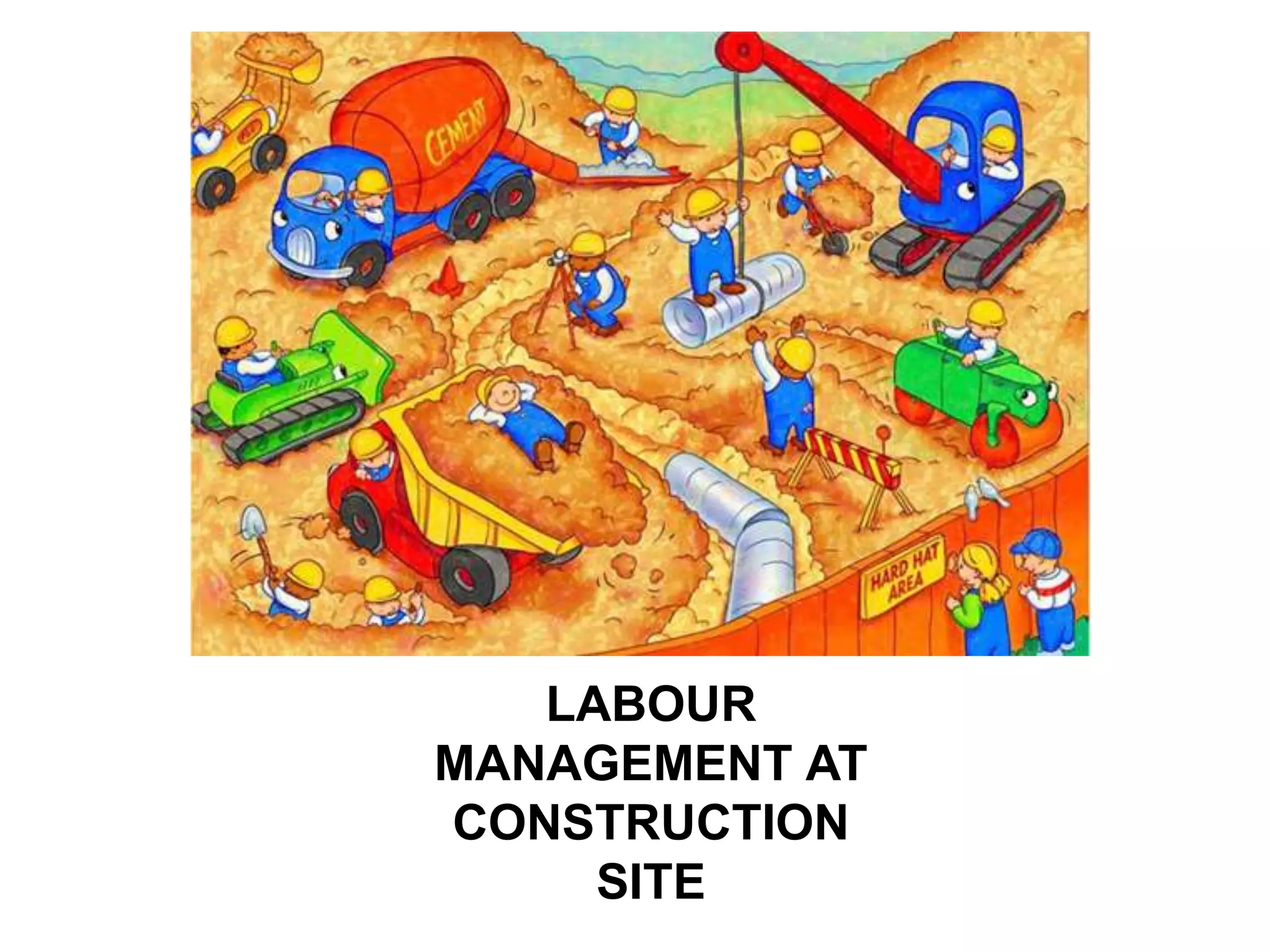
LABOR 
MANAGEMENT AT 
CONSTRUCTION 
SITE
2 
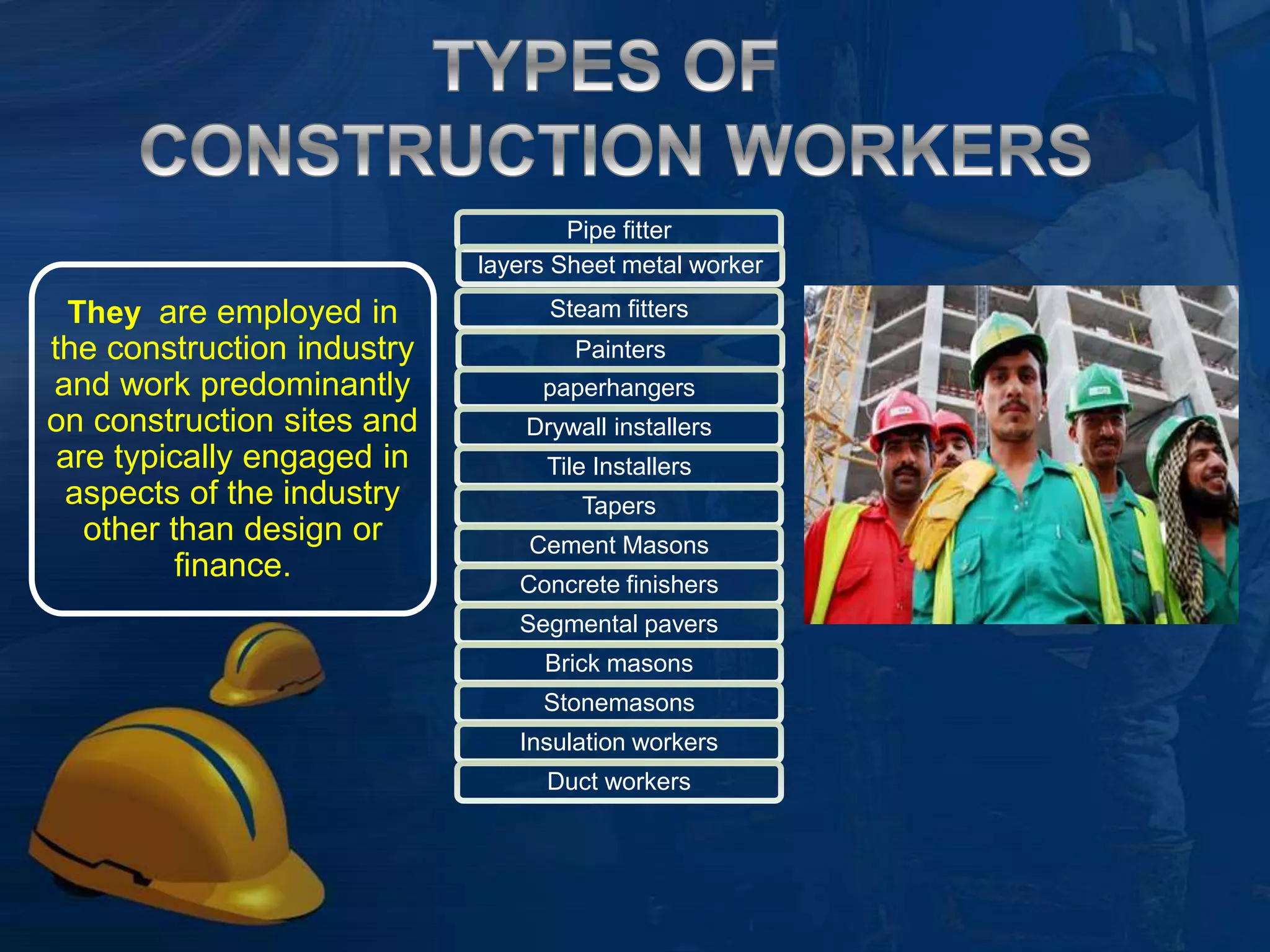
They are employed in 
the construction industry 
and work predominantly 
on construction sites and 
are typically engaged in 
aspects of the industry 
other than design or 
finance. 
Pipe fitter 
layers Sheet metal worker 
Steam fitters 
Painters 
paperhangers 
Drywall installers 
Tile Installers 
Tapers 
Cement Masons 
Concrete finishers 
Segmental pavers 
Brick masons 
Stonemasons 
Insulation workers 
Duct workers
LABOUR MANAGEMENT INVOLVES…. 
 Psychological bbaarrrriieerrss && ssoolluuttiioonnss 
PPrriimmaarryy nneeeeddss ssaattiissffaaccttiioonn 
MMaannaaggeemmeenntt ooff rruulleess aanndd ppoolliicciieess 
CCoommppeennssaattiioonn mmaannaaggeemmeenntt 
SSaaffeettyy mmaannaaggeemmeenntt 
LLaabboorr sshhoorrttaaggee mmaannaaggeemmeenntt 
3
PSYCHLOGICAL BARRIERS AND SOLUTIONS 
 Psychological barriers refers to state of 
individuals mind. 
 Psychological barriers are closely linked to 
emotional barriers like anger, fear, worry, mistrust, 
feeling of insecurity, stress, disappointment etc. 
 Psychological barriers are also linked to physical 
and mental disorders 
 Social problems like different culture, religious 
rigidity etc also affects on human psychology 
 We can solve such barriers by establishing secure 
and trustful environment, counseling and 
supervising, regular health checkups, providing 
them safety and satisfaction etc. 
4
PRIMARY NEEDS SATISFACTION 
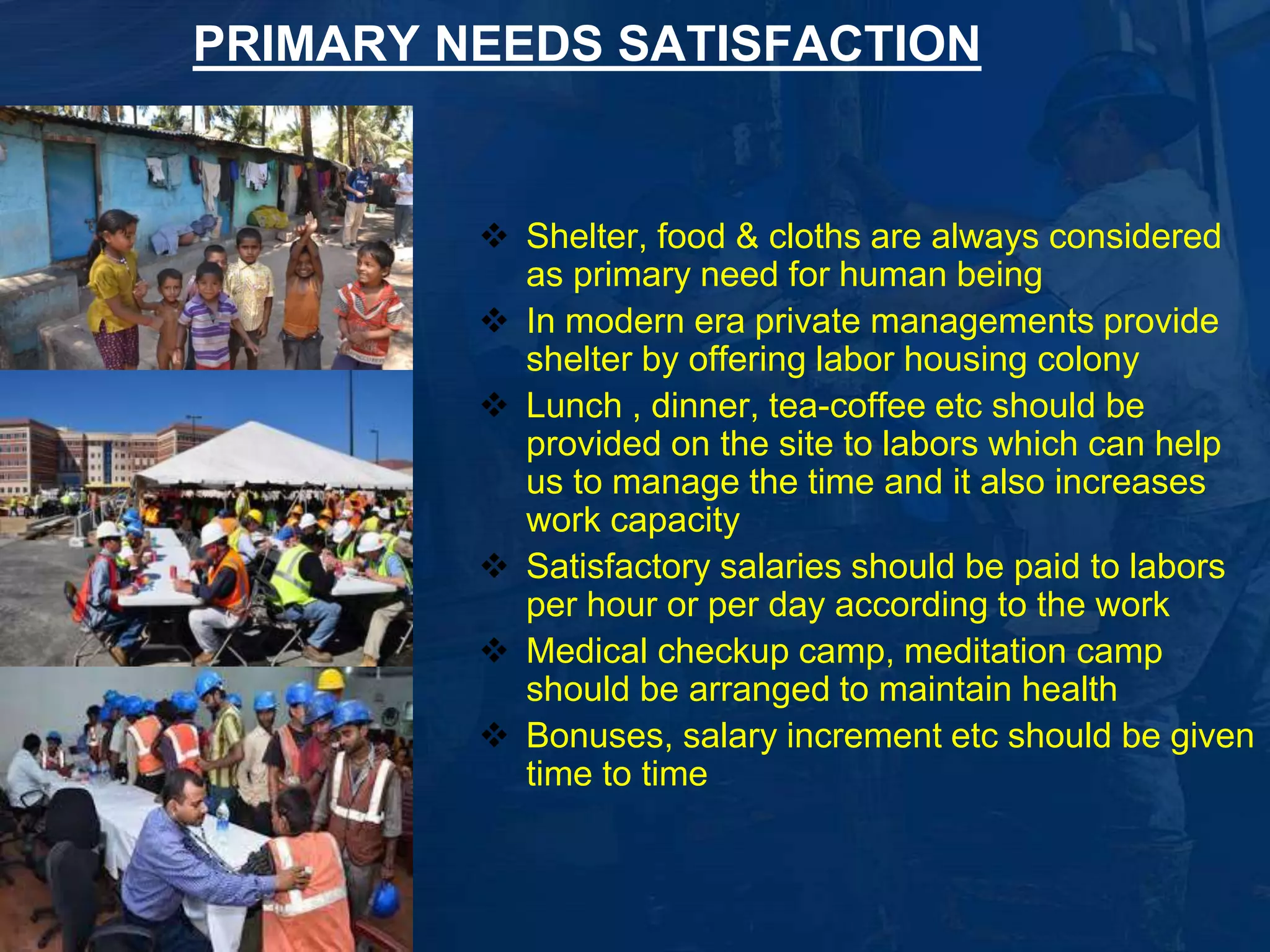
 Shelter, food & cloths are always considered 
as primary need for human being 
 In modern era private managements provide 
shelter by offering labor housing colony 
 Lunch , dinner, tea-coffee etc should be 
provided on the site to labors which can help 
us to manage the time and it also increases 
work capacity 
 Satisfactory salaries should be paid to labors 
per hour or per day according to the work 
 Medical checkup camp, meditation camp 
should be arranged to maintain health 
 Bonuses, salary increment etc should be given 
time to time 
5
MANAGEMENT OF RULES AND POLICIES 
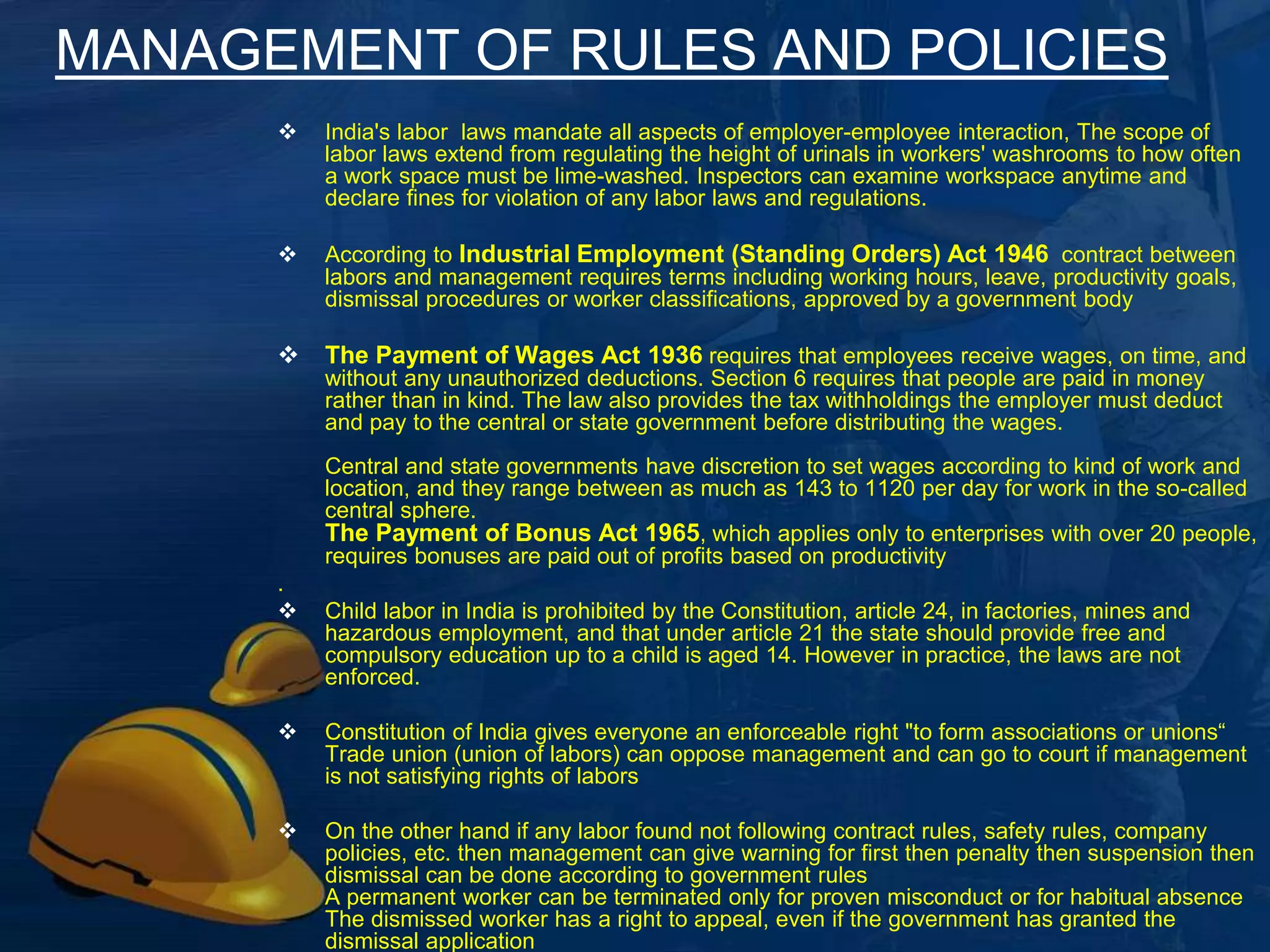
 India's labor laws mandate all aspects of employer-employee 
interaction, The scope of labor laws extend from regulating the 
height of urinals in workers' washrooms to how often a work 
space must be lime-washed. Inspectors can examine 
workspace anytime and declare fines for violation of any labor 
laws and regulations. 
 According to Industrial Employment (Standing Orders) Act 
1946 contract between labors and management requires terms 
including working hours, leave, productivity goals, dismissal 
procedures or worker classifications, approved by a government 
body 
 The Payment of Wages Act 1936 requires that employees 
receive wages, on time, and without any unauthorized 
deductions. Section 6 requires that people are paid in money 
rather than in kind. The law also provides the tax withholdings 
the employer must deduct and pay to the central or state 
government before distributing the wages. 
Central and state governments have discretion to set wages 
according to kind of work and location, and they range between 
as much as 143 to 1120 per day for work in the so-called central 
sphere. 
The Payment of Bonus Act 1965, which applies only to 
enterprises with over 20 people, requires bonuses 6 
are paid out 
of profits based on productivity
CONTINUE… 
 Child labor in India is prohibited by the Constitution, article 
24, in factories, mines and hazardous employment, and that 
under article 21 the state should provide free and 
compulsory education up to a child is aged 14. However in 
practice, the laws are not enforced. 
 Constitution of India gives everyone an enforceable right "to 
form associations or unions“ Trade union (union of labors) 
can oppose management and can go to court if 
management is not satisfying rights of labors 
 On the other hand if any labor found not following contract 
rules, safety rules, company policies, etc. then management 
can give warning for first then penalty then suspension then 
dismissal can be done according to government rules 
A permanent worker can be terminated only for proven 
misconduct or for habitual absence 
The dismissed worker has a right to appeal, even if the 
government has granted the dismissal application 
7
THE TWO ACTS WHICH FALL TO THE CATEGORY OF 
THE CONSTRUCTION WORKERS ARE AS FOLLOWS 
THE BUILDING AND OTHER 
CONSTRUCTION 
WORKERS' WELFARE 
CESS ACT, 1996 ACT NO. 
28 OF 1996 
THE BUILDINGS AND 
OTHER CONSTRUCTION 
WORKERS (REGULATION 
OF EMPLOYMENT AND 
CONDITIONS OF SERVICE) 
ACT, 1996 ACT NO. 27 OF 
1996 
8
COMPENSATION MANAGEMENT 
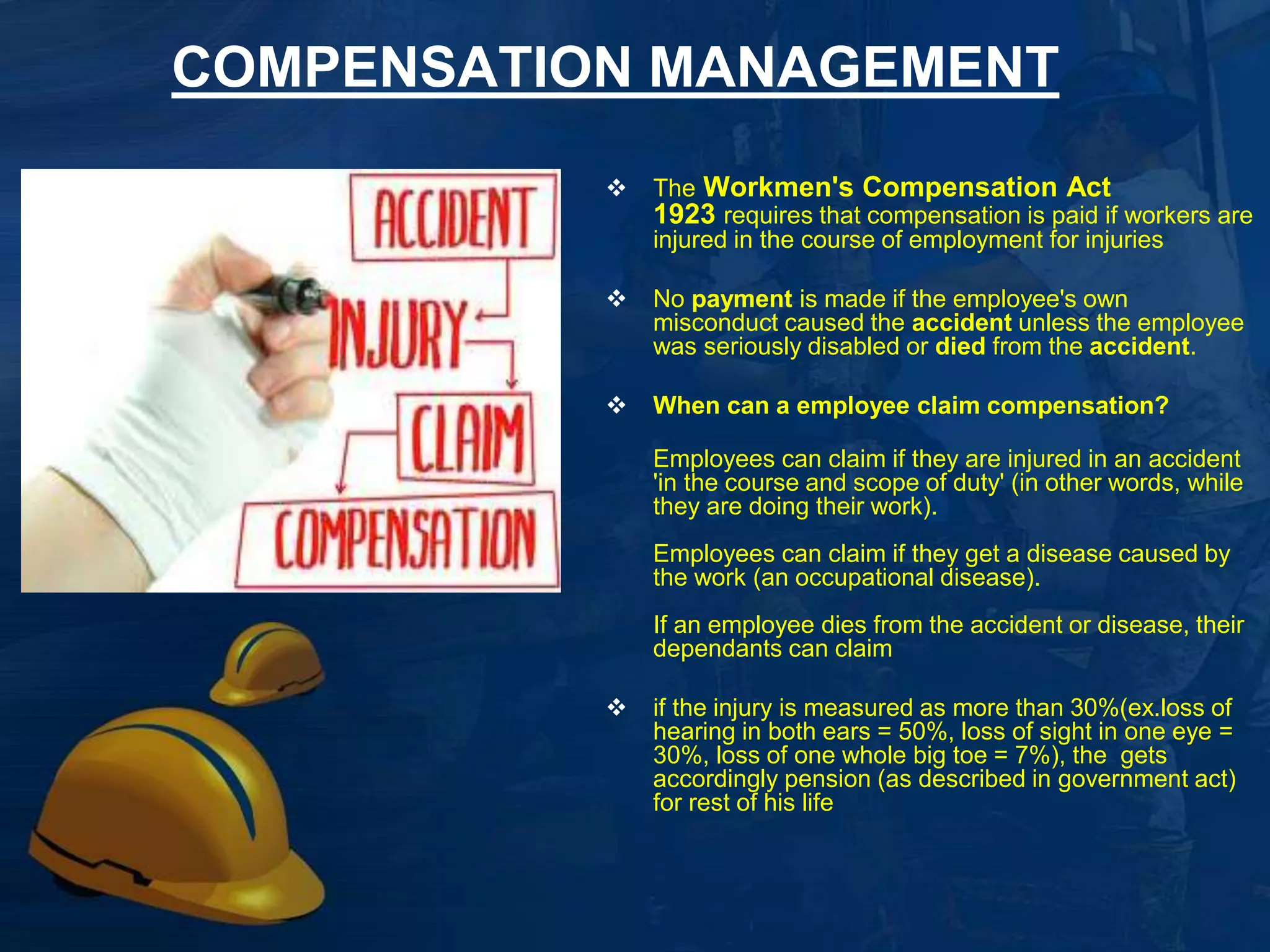
 The Workmen's Compensation Act 
1923 requires that compensation is paid if workers are 
injured in the course of employment for injuries 
 No payment is made if the employee's own 
misconduct caused the accident unless the employee 
was seriously disabled or died from the accident. 
 When can a employee claim compensation? 
Employees can claim if they are injured in an accident 
'in the course and scope of duty' (in other words, while 
they are doing their work). 
Employees can claim if they get a disease caused by 
the work (an occupational disease). 
If an employee dies from the accident or disease, their 
dependants can claim 
 if the injury is measured as more than 30%(ex.loss of 
hearing in both ears = 50%, loss of sight in one eye = 
30%, loss of one whole big toe = 7%), the gets 
accordingly pension (as described in government act) 
for rest of his life 
9
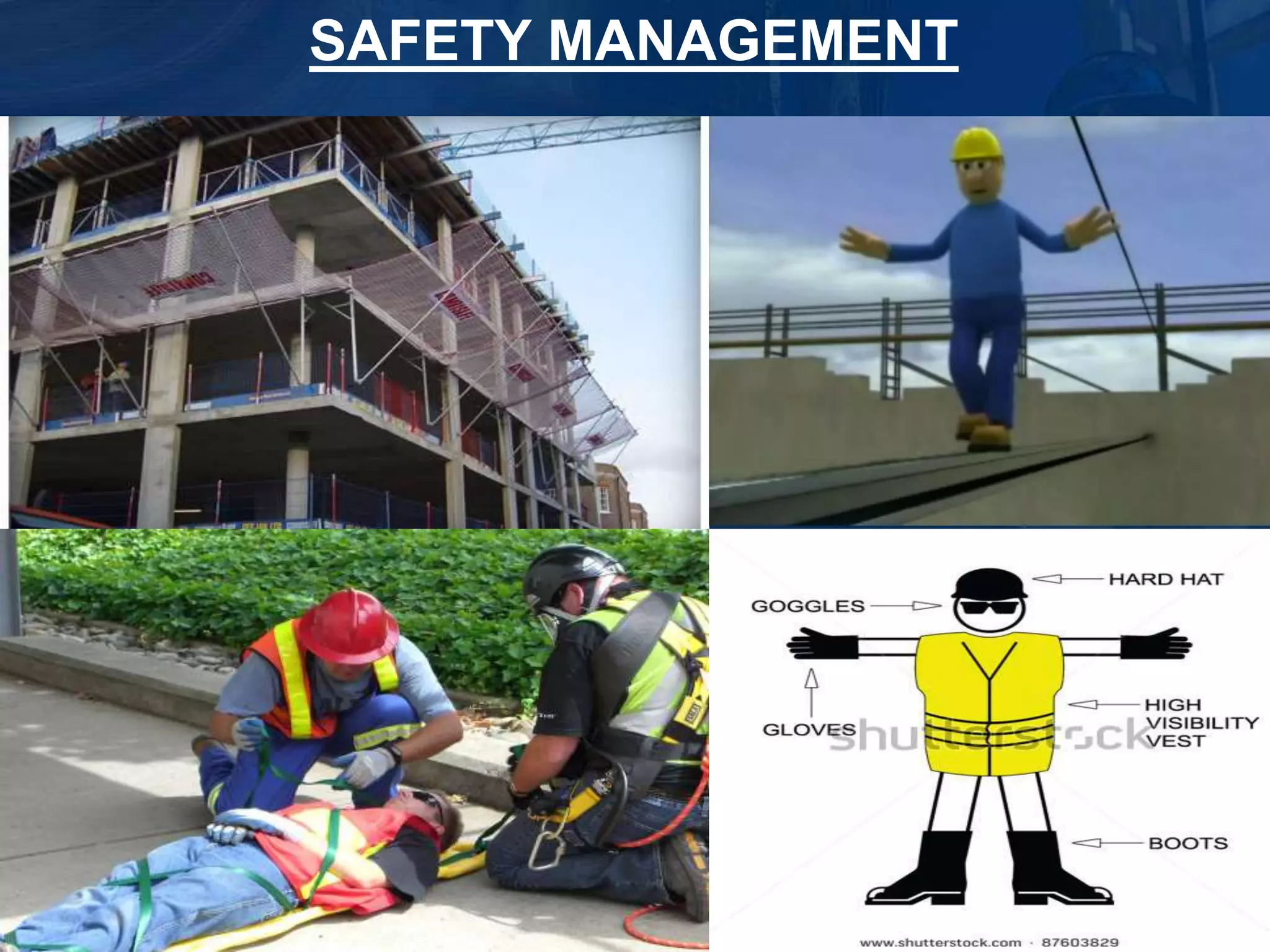
SAFETY MANAGEMENT 
10
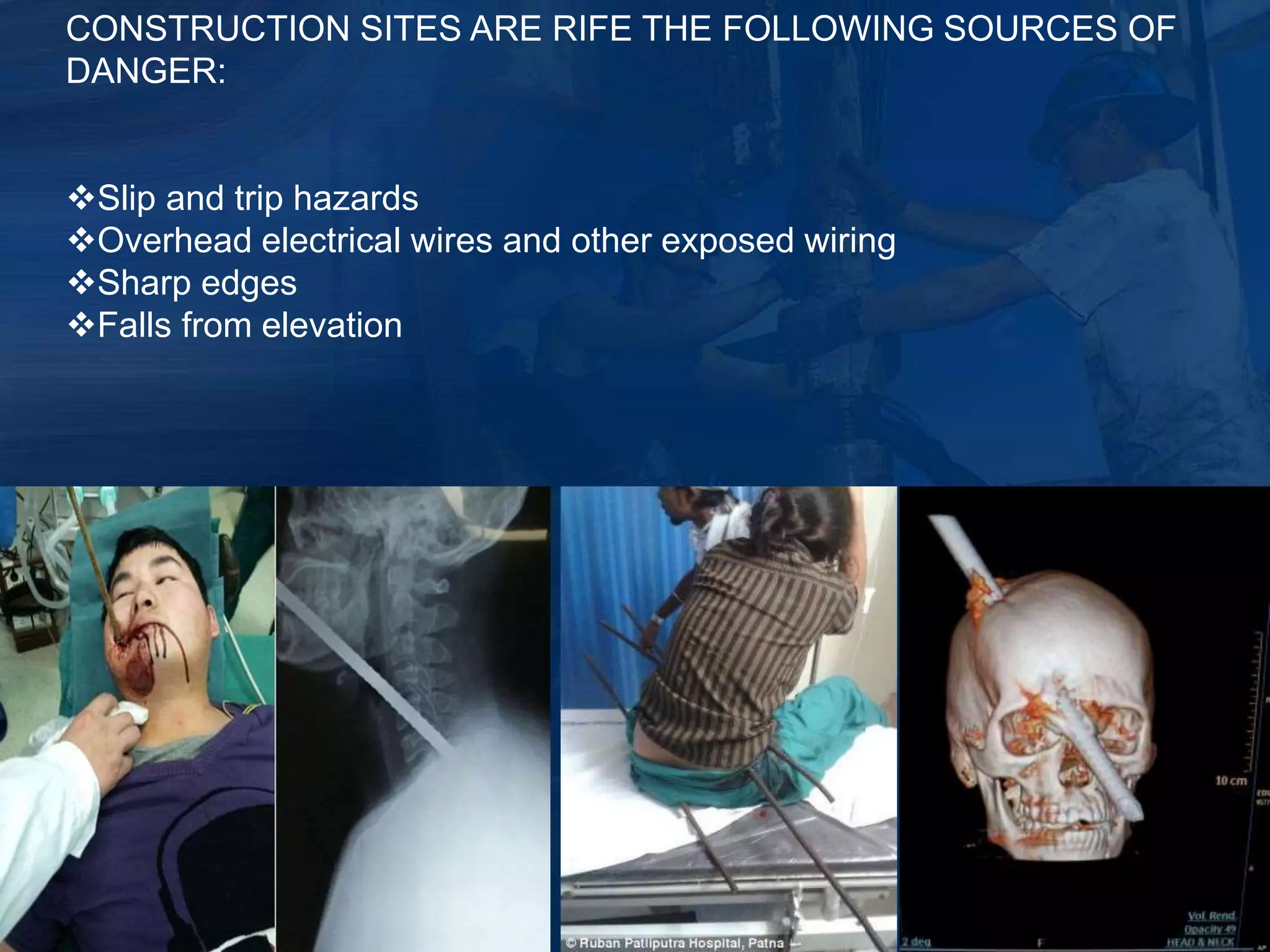
CONSTRUCTION SITES ARE RIFE THE FOLLOWING SOURCES OF 
DANGER: 
11 
Slip and trip hazards 
Overhead electrical wires and other exposed wiring 
Sharp edges 
Falls from elevation
SAFETY PARAMETERS 
Train all personnel in work-site for safety, medical 
emergency and operating procedure either on-site or at a 
training facility. 
Inspect equipment to be sure it is working properly before 
using it 
Provide personal protective equipment to all employees, 
including hard hats, safety goggles and boots, work gloves, 
ear plugs (or another form of protection) and face masks. 
Protect the public and children by barricading the 
construction site during work hours. After working hours, lock 
all points of entry. 
Follow Indian standard code for safety, and if in case of 
labor injury or death at construction site compensation 
,pension , medical help should be provided 
12
LABOR SHORTAGE MANAGEMENT 
 Shortage of skilled labors is one of the biggest 
issue in construction works 
 This shortage can be occurred due to labor union 
strikes, quarrel between two labor groups, too 
many construction site around at a time, high 
wage demand etc. 
 However management should overcome this 
issue by maintaining peaceful and trustworthy 
environment and by providing sufficient wage 
 To occupy skilled labors rather than non-skilled 
labors will save time and increase strength and 
quality of construction. 
13
PREPARED BY :- SAUMIL SHAH 
14 
9638955567

Labor management at construction site

  • 1.
    1 LABOR MANAGEMENTAT CONSTRUCTION SITE
  • 2.
    2 They areemployed in the construction industry and work predominantly on construction sites and are typically engaged in aspects of the industry other than design or finance. Pipe fitter layers Sheet metal worker Steam fitters Painters paperhangers Drywall installers Tile Installers Tapers Cement Masons Concrete finishers Segmental pavers Brick masons Stonemasons Insulation workers Duct workers
  • 3.
    LABOUR MANAGEMENT INVOLVES….  Psychological bbaarrrriieerrss && ssoolluuttiioonnss PPrriimmaarryy nneeeeddss ssaattiissffaaccttiioonn MMaannaaggeemmeenntt ooff rruulleess aanndd ppoolliicciieess CCoommppeennssaattiioonn mmaannaaggeemmeenntt SSaaffeettyy mmaannaaggeemmeenntt LLaabboorr sshhoorrttaaggee mmaannaaggeemmeenntt 3
  • 4.
    PSYCHLOGICAL BARRIERS ANDSOLUTIONS  Psychological barriers refers to state of individuals mind.  Psychological barriers are closely linked to emotional barriers like anger, fear, worry, mistrust, feeling of insecurity, stress, disappointment etc.  Psychological barriers are also linked to physical and mental disorders  Social problems like different culture, religious rigidity etc also affects on human psychology  We can solve such barriers by establishing secure and trustful environment, counseling and supervising, regular health checkups, providing them safety and satisfaction etc. 4
  • 5.
    PRIMARY NEEDS SATISFACTION  Shelter, food & cloths are always considered as primary need for human being  In modern era private managements provide shelter by offering labor housing colony  Lunch , dinner, tea-coffee etc should be provided on the site to labors which can help us to manage the time and it also increases work capacity  Satisfactory salaries should be paid to labors per hour or per day according to the work  Medical checkup camp, meditation camp should be arranged to maintain health  Bonuses, salary increment etc should be given time to time 5
  • 6.
    MANAGEMENT OF RULESAND POLICIES  India's labor laws mandate all aspects of employer-employee interaction, The scope of labor laws extend from regulating the height of urinals in workers' washrooms to how often a work space must be lime-washed. Inspectors can examine workspace anytime and declare fines for violation of any labor laws and regulations.  According to Industrial Employment (Standing Orders) Act 1946 contract between labors and management requires terms including working hours, leave, productivity goals, dismissal procedures or worker classifications, approved by a government body  The Payment of Wages Act 1936 requires that employees receive wages, on time, and without any unauthorized deductions. Section 6 requires that people are paid in money rather than in kind. The law also provides the tax withholdings the employer must deduct and pay to the central or state government before distributing the wages. Central and state governments have discretion to set wages according to kind of work and location, and they range between as much as 143 to 1120 per day for work in the so-called central sphere. The Payment of Bonus Act 1965, which applies only to enterprises with over 20 people, requires bonuses 6 are paid out of profits based on productivity
  • 7.
    CONTINUE…  Childlabor in India is prohibited by the Constitution, article 24, in factories, mines and hazardous employment, and that under article 21 the state should provide free and compulsory education up to a child is aged 14. However in practice, the laws are not enforced.  Constitution of India gives everyone an enforceable right "to form associations or unions“ Trade union (union of labors) can oppose management and can go to court if management is not satisfying rights of labors  On the other hand if any labor found not following contract rules, safety rules, company policies, etc. then management can give warning for first then penalty then suspension then dismissal can be done according to government rules A permanent worker can be terminated only for proven misconduct or for habitual absence The dismissed worker has a right to appeal, even if the government has granted the dismissal application 7
  • 8.
    THE TWO ACTSWHICH FALL TO THE CATEGORY OF THE CONSTRUCTION WORKERS ARE AS FOLLOWS THE BUILDING AND OTHER CONSTRUCTION WORKERS' WELFARE CESS ACT, 1996 ACT NO. 28 OF 1996 THE BUILDINGS AND OTHER CONSTRUCTION WORKERS (REGULATION OF EMPLOYMENT AND CONDITIONS OF SERVICE) ACT, 1996 ACT NO. 27 OF 1996 8
  • 9.
    COMPENSATION MANAGEMENT The Workmen's Compensation Act 1923 requires that compensation is paid if workers are injured in the course of employment for injuries  No payment is made if the employee's own misconduct caused the accident unless the employee was seriously disabled or died from the accident.  When can a employee claim compensation? Employees can claim if they are injured in an accident 'in the course and scope of duty' (in other words, while they are doing their work). Employees can claim if they get a disease caused by the work (an occupational disease). If an employee dies from the accident or disease, their dependants can claim  if the injury is measured as more than 30%(ex.loss of hearing in both ears = 50%, loss of sight in one eye = 30%, loss of one whole big toe = 7%), the gets accordingly pension (as described in government act) for rest of his life 9
  • 10.
  • 11.
    CONSTRUCTION SITES ARERIFE THE FOLLOWING SOURCES OF DANGER: 11 Slip and trip hazards Overhead electrical wires and other exposed wiring Sharp edges Falls from elevation
  • 12.
    SAFETY PARAMETERS Trainall personnel in work-site for safety, medical emergency and operating procedure either on-site or at a training facility. Inspect equipment to be sure it is working properly before using it Provide personal protective equipment to all employees, including hard hats, safety goggles and boots, work gloves, ear plugs (or another form of protection) and face masks. Protect the public and children by barricading the construction site during work hours. After working hours, lock all points of entry. Follow Indian standard code for safety, and if in case of labor injury or death at construction site compensation ,pension , medical help should be provided 12
  • 13.
    LABOR SHORTAGE MANAGEMENT  Shortage of skilled labors is one of the biggest issue in construction works  This shortage can be occurred due to labor union strikes, quarrel between two labor groups, too many construction site around at a time, high wage demand etc.  However management should overcome this issue by maintaining peaceful and trustworthy environment and by providing sufficient wage  To occupy skilled labors rather than non-skilled labors will save time and increase strength and quality of construction. 13
  • 14.
    PREPARED BY :-SAUMIL SHAH 14 9638955567