PRESENTED BY
AISHWARYA EKNATH
PHALKE
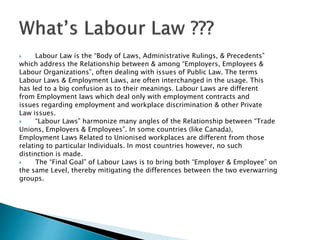
 Labour Law is the “Body of Laws, Administrative Rulings, & Precedents”
which address the Relationship between & among “Employers, Employees &
Labour Organizations”, often dealing with issues of Public Law. The terms
Labour Laws & Employment Laws, are often interchanged in the usage. This
has led to a big confusion as to their meanings. Labour Laws are different
from Employment laws which deal only with employment contracts and
issues regarding employment and workplace discrimination & other Private
Law issues.
 “Labour Laws” harmonize many angles of the Relationship between “Trade
Unions, Employers & Employees”. In some countries (like Canada),
Employment Laws Related to Unionised workplaces are different from those
relating to particular Individuals. In most countries however, no such
distinction is made.
 The “Final Goal” of Labour Laws is to bring both “Employer & Employee” on
the same Level, thereby mitigating the differences between the two everwarring
groups.
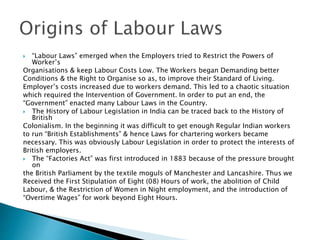
 “Labour Laws” emerged when the Employers tried to Restrict the Powers of
Worker’s
Organisations & keep Labour Costs Low. The Workers began Demanding better
Conditions & the Right to Organise so as, to improve their Standard of Living.
Employer’s costs increased due to workers demand. This led to a chaotic situation
which required the Intervention of Government. In order to put an end, the
“Government” enacted many Labour Laws in the Country.
 The History of Labour Legislation in India can be traced back to the History of
British
Colonialism. In the beginning it was difficult to get enough Regular Indian workers
to run “British Establishments” & hence Laws for chartering workers became
necessary. This was obviously Labour Legislation in order to protect the interests of
British employers.
 The “Factories Act” was first introduced in 1883 because of the pressure brought
on
the British Parliament by the textile moguls of Manchester and Lancashire. Thus we
Received the First Stipulation of Eight (08) Hours of work, the abolition of Child
Labour, & the Restriction of Women in Night employment, and the introduction of
“Overtime Wages” for work beyond Eight Hours.
 The Basic Feature of “Labour Law” in almost Every Country is that the
“Rights &
Obligations” of the “Employee & Employer” between One-another are
mediated
through the “Contract of Employment” between them. This has been the
case since the
collapse of feudalism & is the core reality of Modern Economic Relations.
Many terms
& conditions of the contract are however implied by Legislation or
Common Law, in
such a way as to restrict the freedom of people to agree to certain things
to protect
employees, and facilitate a fluid Labour Market.
 In the “United State of America” for example, Majority of State Laws allow
for
Employment to be “At Will“ meaning the Employer can Terminate an
Employee from
a Position for any Reason, so long as the Reason is not an “Illegal Reason”,
including a Termination in Violation of Public Policy.
“Labour Policy in India” has been evolving in response to specific needs of the
situation to suit requirements of planned “Economic Development & Social
Justice” has two-fold Objectives, viz., Labour Policies are devised to maintain
Economic Development, Social Justice, Industrial Harmony & Welfare of
 Labour in the countryHighlights of Labour Policy:-
 Creative Measures to attract Public & Private Investment.
 Creating New Jobs with New Social Security Schemes for workers.
 Unified and Beneficial Management of funds of Welfare Boards.
 Model Employee – Employer Relationships with Long Term Settlements.
 Vital Industries & Establishments declared as “Public Utilities”.
 Special conciliation mechanism for projects with investments of Rs. 150 cr or more.
 Industrial Relations committees in more sectors.
 Labour Law Reforms with Times. Empowered body of experts to suggest required changes.
 Statutory amendments for expediting & streamlining the mechanism of Labour Judiciary.
 Efficient functioning of Labour Department. More labour sectors under Min. Wages Act.
 Modern Medical Facilities for workers. Rehabilitation packages for displaced workers.
 Restructuring in functioning of Employment Exchanges with morden Technology.
 Revamping of Curriculum & Course content in Industrial Training.
 Joint Cell of Labour & Industries Department to study changes in Laws & Rules.
 The Apprentices Act - 1961
 The Payment of Wages Act -1936
 The Workmens’ Compensation Act -1923
 The Factories Act -1948
 The Industrial Disputes Act - 1947
 The Employees PF & MP Act - 1952
 The Employees State Insurance Act - 1948
 The Maternity Benefit Act - 1961
 The Payment of Bonus Act - 1965
 The Payment of Gratuity Act - 1972
 Object of the Act :- The Main Objectives of
Apprentices Act, 1961 is
“Promotion of New Manpower at skills”.
Improvement / Refinement of Old
Skills through Theoretical & Practical Training in
number of “Trades &
Occupation”. The Scheme is also extended to
Engineers & Diploma Holders.
 In India the “Apprentices Act” came into force in
1961 and was amended by
the Act 41 of 1986. It’s also a “Statutory
Obligation” on the part of every
Employer covered under the Act.
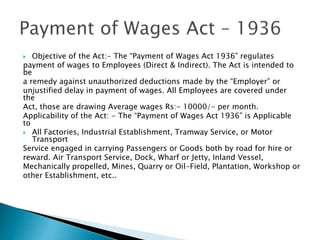
 Objective of the Act:- The “Payment of Wages Act 1936” regulates
payment of wages to Employees (Direct & Indirect). The Act is intended to
be
a remedy against unauthorized deductions made by the “Employer” or
unjustified delay in payment of wages. All Employees are covered under
the
Act, those are drawing Average wages Rs:- 10000/- per month.
Applicability of the Act: - The “Payment of Wages Act 1936” is Applicable
to
 All Factories, Industrial Establishment, Tramway Service, or Motor
Transport
Service engaged in carrying Passengers or Goods both by road for hire or
reward. Air Transport Service, Dock, Wharf or Jetty, Inland Vessel,
Mechanically propelled, Mines, Quarry or Oil-Field, Plantation, Workshop or
other Establishment, etc..
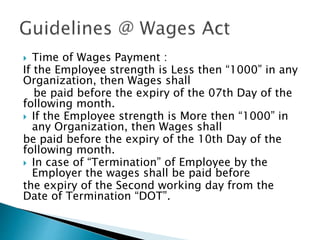
 Time of Wages Payment :
If the Employee strength is Less then “1000” in any
Organization, then Wages shall
be paid before the expiry of the 07th Day of the
following month.
 If the Employee strength is More then “1000” in
any Organization, then Wages shall
be paid before the expiry of the 10th Day of the
following month.
 In case of “Termination” of Employee by the
Employer the wages shall be paid before
the expiry of the Second working day from the
Date of Termination “DOT”.
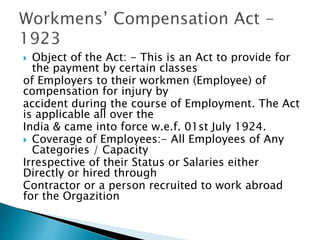
 Object of the Act: - This is an Act to provide for
the payment by certain classes
of Employers to their workmen (Employee) of
compensation for injury by
accident during the course of Employment. The Act
is applicable all over the
India & came into force w.e.f. 01st July 1924.
 Coverage of Employees:- All Employees of Any
Categories / Capacity
Irrespective of their Status or Salaries either
Directly or hired through
Contractor or a person recruited to work abroad
for the Orgazition
 Welfare of Employee:
Adequate Facilities for Washing, Sitting, Storing of cloths during
Off Working hours. [Sec - 42].
 If a worker has to work in Standing Position, Sitting Arrangement
to take Short Rests. [Sec - 44].
 Adequate First Aid Boxes shall be provided & Maintained with all
required medicines. [Sec - 45].
Facilities for Large Factories:
 Ambulance Room if 500 or More Workers are Employed in the
Factory.
 Canteen if 250 or More workers are employed. [Sec - 46].
Rest Rooms / Shelters with Drinking Water when 150 or More
workmen are Employed. [Sec - 47]
 Crèches if 30 or More Women workers are employed. [Sec - 48]
Full time “Welfare Officer” if factory Employs 500 or More workers
[Sec - 49]
 The Maximum Working hours can’t be more then 48 Hours
in a week. [Sec - 51].
 The Maximum Daily Working Hours can’t be more then 09
Hours. [Sec - 54].
 One Weekly Holiday is Compulsory which is Sunday. If
Employee works on Sunday, then he
 should Compenste with any Other day of the Week. [Sec -
52(1)].
 At least Half an hour Rest should be provided after 5 hours
of work. [Sec - 55].
 Total period of work inclusive of rest interval cannot be
more than 10.5 hours. [Sec - 56].
 A Worker should be given a Weekly Holiday. Overlapping
of Shifts is not Permitted. [Sec - 58].
 Notice of Period of Work should be displayed. [Sec - 61].
 Objective of the Act:- An act to Provide for a Scheme for the Payment of
Gratuity to
 Employees engaged in “Factories, Mines, Oilfields, Plantations, Ports,
Railway
 Companies, Shops or Other Establishments” and for matters connected
therewith or
incidental thereto, so far as it Relates to “Ports & Plantations” it does not
apply to the
State of Jammu and Kashmir. This Act Extends to the whole of India.
 Applicability of the Act:- The Act shall apply to Every “Factory, Mine,
Oilfield,
 Plantation, Port, Railway Companies, Every Shop or Establishment within
the Meaning
of any Law for the time being in force in Relation to Shops &
Establishments in a State,
in which Ten (10) or More persons are employed, or were employed, on
any day of the
preceding 01 year. The Act is applicable to “All Employees”, irrespective of
the salary.
THANK YOU

LABOUR LAWS AND FINACIAL ASPECTS

  • 1.
  • 2.
     Labour Lawis the “Body of Laws, Administrative Rulings, & Precedents” which address the Relationship between & among “Employers, Employees & Labour Organizations”, often dealing with issues of Public Law. The terms Labour Laws & Employment Laws, are often interchanged in the usage. This has led to a big confusion as to their meanings. Labour Laws are different from Employment laws which deal only with employment contracts and issues regarding employment and workplace discrimination & other Private Law issues.  “Labour Laws” harmonize many angles of the Relationship between “Trade Unions, Employers & Employees”. In some countries (like Canada), Employment Laws Related to Unionised workplaces are different from those relating to particular Individuals. In most countries however, no such distinction is made.  The “Final Goal” of Labour Laws is to bring both “Employer & Employee” on the same Level, thereby mitigating the differences between the two everwarring groups.
  • 3.
     “Labour Laws”emerged when the Employers tried to Restrict the Powers of Worker’s Organisations & keep Labour Costs Low. The Workers began Demanding better Conditions & the Right to Organise so as, to improve their Standard of Living. Employer’s costs increased due to workers demand. This led to a chaotic situation which required the Intervention of Government. In order to put an end, the “Government” enacted many Labour Laws in the Country.  The History of Labour Legislation in India can be traced back to the History of British Colonialism. In the beginning it was difficult to get enough Regular Indian workers to run “British Establishments” & hence Laws for chartering workers became necessary. This was obviously Labour Legislation in order to protect the interests of British employers.  The “Factories Act” was first introduced in 1883 because of the pressure brought on the British Parliament by the textile moguls of Manchester and Lancashire. Thus we Received the First Stipulation of Eight (08) Hours of work, the abolition of Child Labour, & the Restriction of Women in Night employment, and the introduction of “Overtime Wages” for work beyond Eight Hours.
  • 4.
     The BasicFeature of “Labour Law” in almost Every Country is that the “Rights & Obligations” of the “Employee & Employer” between One-another are mediated through the “Contract of Employment” between them. This has been the case since the collapse of feudalism & is the core reality of Modern Economic Relations. Many terms & conditions of the contract are however implied by Legislation or Common Law, in such a way as to restrict the freedom of people to agree to certain things to protect employees, and facilitate a fluid Labour Market.  In the “United State of America” for example, Majority of State Laws allow for Employment to be “At Will“ meaning the Employer can Terminate an Employee from a Position for any Reason, so long as the Reason is not an “Illegal Reason”, including a Termination in Violation of Public Policy.
  • 5.
    “Labour Policy inIndia” has been evolving in response to specific needs of the situation to suit requirements of planned “Economic Development & Social Justice” has two-fold Objectives, viz., Labour Policies are devised to maintain Economic Development, Social Justice, Industrial Harmony & Welfare of  Labour in the countryHighlights of Labour Policy:-  Creative Measures to attract Public & Private Investment.  Creating New Jobs with New Social Security Schemes for workers.  Unified and Beneficial Management of funds of Welfare Boards.  Model Employee – Employer Relationships with Long Term Settlements.  Vital Industries & Establishments declared as “Public Utilities”.  Special conciliation mechanism for projects with investments of Rs. 150 cr or more.  Industrial Relations committees in more sectors.  Labour Law Reforms with Times. Empowered body of experts to suggest required changes.  Statutory amendments for expediting & streamlining the mechanism of Labour Judiciary.  Efficient functioning of Labour Department. More labour sectors under Min. Wages Act.  Modern Medical Facilities for workers. Rehabilitation packages for displaced workers.  Restructuring in functioning of Employment Exchanges with morden Technology.  Revamping of Curriculum & Course content in Industrial Training.  Joint Cell of Labour & Industries Department to study changes in Laws & Rules.
  • 6.
     The ApprenticesAct - 1961  The Payment of Wages Act -1936  The Workmens’ Compensation Act -1923  The Factories Act -1948  The Industrial Disputes Act - 1947  The Employees PF & MP Act - 1952  The Employees State Insurance Act - 1948  The Maternity Benefit Act - 1961  The Payment of Bonus Act - 1965  The Payment of Gratuity Act - 1972
  • 7.
     Object ofthe Act :- The Main Objectives of Apprentices Act, 1961 is “Promotion of New Manpower at skills”. Improvement / Refinement of Old Skills through Theoretical & Practical Training in number of “Trades & Occupation”. The Scheme is also extended to Engineers & Diploma Holders.  In India the “Apprentices Act” came into force in 1961 and was amended by the Act 41 of 1986. It’s also a “Statutory Obligation” on the part of every Employer covered under the Act.
  • 8.
     Objective ofthe Act:- The “Payment of Wages Act 1936” regulates payment of wages to Employees (Direct & Indirect). The Act is intended to be a remedy against unauthorized deductions made by the “Employer” or unjustified delay in payment of wages. All Employees are covered under the Act, those are drawing Average wages Rs:- 10000/- per month. Applicability of the Act: - The “Payment of Wages Act 1936” is Applicable to  All Factories, Industrial Establishment, Tramway Service, or Motor Transport Service engaged in carrying Passengers or Goods both by road for hire or reward. Air Transport Service, Dock, Wharf or Jetty, Inland Vessel, Mechanically propelled, Mines, Quarry or Oil-Field, Plantation, Workshop or other Establishment, etc..
  • 9.
     Time ofWages Payment : If the Employee strength is Less then “1000” in any Organization, then Wages shall be paid before the expiry of the 07th Day of the following month.  If the Employee strength is More then “1000” in any Organization, then Wages shall be paid before the expiry of the 10th Day of the following month.  In case of “Termination” of Employee by the Employer the wages shall be paid before the expiry of the Second working day from the Date of Termination “DOT”.
  • 10.
     Object ofthe Act: - This is an Act to provide for the payment by certain classes of Employers to their workmen (Employee) of compensation for injury by accident during the course of Employment. The Act is applicable all over the India & came into force w.e.f. 01st July 1924.  Coverage of Employees:- All Employees of Any Categories / Capacity Irrespective of their Status or Salaries either Directly or hired through Contractor or a person recruited to work abroad for the Orgazition
  • 11.
     Welfare ofEmployee: Adequate Facilities for Washing, Sitting, Storing of cloths during Off Working hours. [Sec - 42].  If a worker has to work in Standing Position, Sitting Arrangement to take Short Rests. [Sec - 44].  Adequate First Aid Boxes shall be provided & Maintained with all required medicines. [Sec - 45]. Facilities for Large Factories:  Ambulance Room if 500 or More Workers are Employed in the Factory.  Canteen if 250 or More workers are employed. [Sec - 46]. Rest Rooms / Shelters with Drinking Water when 150 or More workmen are Employed. [Sec - 47]  Crèches if 30 or More Women workers are employed. [Sec - 48] Full time “Welfare Officer” if factory Employs 500 or More workers [Sec - 49]
  • 12.
     The MaximumWorking hours can’t be more then 48 Hours in a week. [Sec - 51].  The Maximum Daily Working Hours can’t be more then 09 Hours. [Sec - 54].  One Weekly Holiday is Compulsory which is Sunday. If Employee works on Sunday, then he  should Compenste with any Other day of the Week. [Sec - 52(1)].  At least Half an hour Rest should be provided after 5 hours of work. [Sec - 55].  Total period of work inclusive of rest interval cannot be more than 10.5 hours. [Sec - 56].  A Worker should be given a Weekly Holiday. Overlapping of Shifts is not Permitted. [Sec - 58].  Notice of Period of Work should be displayed. [Sec - 61].
  • 14.
     Objective ofthe Act:- An act to Provide for a Scheme for the Payment of Gratuity to  Employees engaged in “Factories, Mines, Oilfields, Plantations, Ports, Railway  Companies, Shops or Other Establishments” and for matters connected therewith or incidental thereto, so far as it Relates to “Ports & Plantations” it does not apply to the State of Jammu and Kashmir. This Act Extends to the whole of India.  Applicability of the Act:- The Act shall apply to Every “Factory, Mine, Oilfield,  Plantation, Port, Railway Companies, Every Shop or Establishment within the Meaning of any Law for the time being in force in Relation to Shops & Establishments in a State, in which Ten (10) or More persons are employed, or were employed, on any day of the preceding 01 year. The Act is applicable to “All Employees”, irrespective of the salary.
  • 15.