Labour Law II
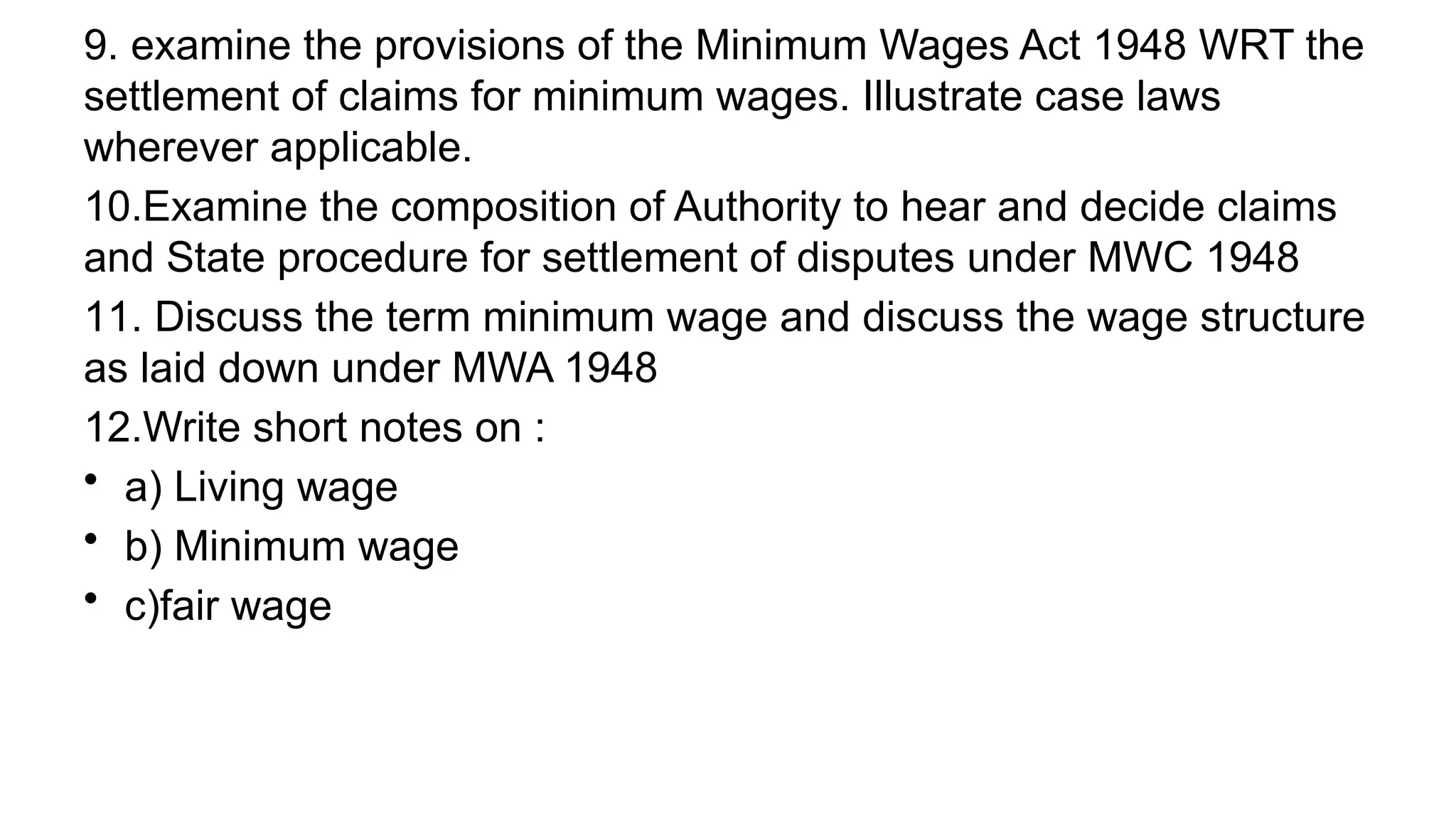
1.Minimum Wages Act 1948
a. Historical basis of Minimum wages Act
b. Definition of employer and employee
c. Definition of wages ,distinguish it with Industrial Disputes Act,
Workmen’s Compensation Act ,Payment of Wages Act.
d. Various concepts of Wages
e. Procedure for fixing and revising of minimum wages
f. The authorities appointed under the Act
g. The mode of payment of minimum rates of wages
h. Calims and procedures for presenting calims
2.
Recommended Books
• SrivastavaS.C. --- Social Security
• Mallik –Industrial Law
• Mishra S.N. ----- Labour Law
• N.D.Kapoor --- Industrial Law
• S.K.Puri—Labour and Industrial Law
• K.M .Pillai--- Labour and Industrial Law
4.
Overview of theAct
• the Act is divided into 31 sections
• it provides for fixation by the Central Government of the
minimum wages for employments detailed in the
Schedule of the Act and carried on by or under the
authority of the Central Governemnt,
• by a railway administrative or in relation to a mine, oilfield
or majorport, or any corporation established by a Central
Act
• and by the State Governemnt for other employments
covered by the Schedule of the Act.
5.
Historical basis
• Theconcept of minimum wage initially developed in terms of worker’s remuneration in
industries, where the level of wages was much lower as compared to the wages of similar
types of labour in other industries.
• Prior to the state intervention in the matter of wages, the decision related to the wages was
taken by free bargaining between workmen and employers.
• But when the enquiry held upon these matters it was revealed that there is exploitation of
women and children in small scale industries. So, to avoid these kinds of malpractices,
various legislation was introduced.
• In 1943, Standing Labour Committee and Indian Labour conference constituted a labour
inquiry committee to inquire in matters relating to working conditions and minimum wages of
workers.
• Ghosh and Nandan, the report which was Submitted by the Standing Labour Committee,
became the basis for Implementing India’s minimum wage policy.
• The Tripartite Committee on Fair Wages appointed in 1948 defined three
different types of wages: a Living wage, fair wage and minimum wage.
6.
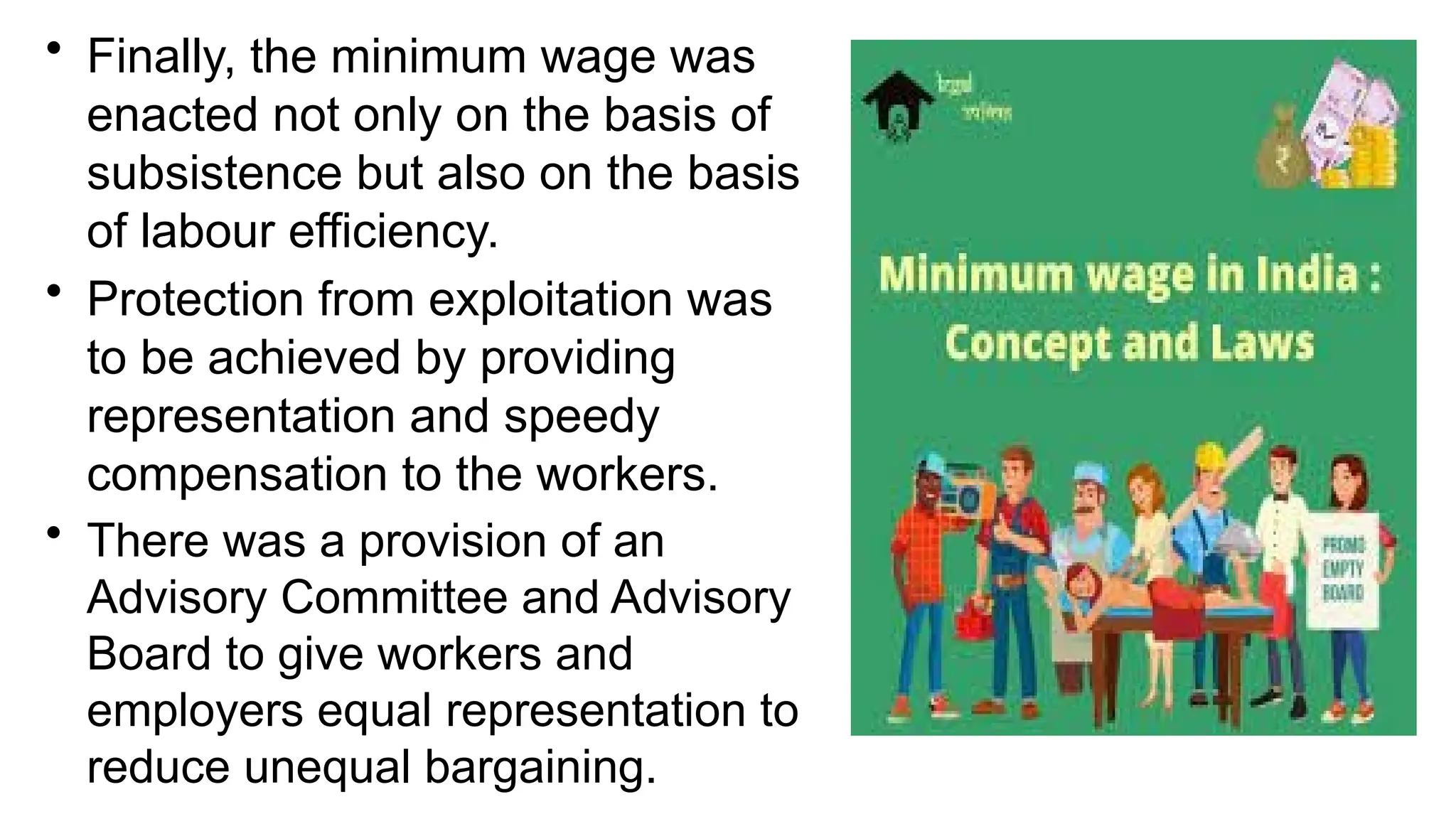
• Finally, theminimum wage was
enacted not only on the basis of
subsistence but also on the basis
of labour efficiency.
• Protection from exploitation was
to be achieved by providing
representation and speedy
compensation to the workers.
• There was a provision of an
Advisory Committee and Advisory
Board to give workers and
employers equal representation to
reduce unequal bargaining.
7.
• Thus, theAct provided early
resolution to labour
disputes through a
summary process that
would ensure penalties and
then civil prosecution of the
offending party.
• The purpose of the Act was
to protect workers from
labour exploitation which
was held in the case of
Chandra Bhavan
Boarding and Lodging
Bangalore v. State of
Mysore and another.
8.
Scope and itsapplicability
• The Act applies to the
whole of India including
Jammu and Kashmir. The
provision of the Minimum
Wages Act, 1948 are
applicable to every
employer that employs
more than 1000
employees in a state.
• The provisions of the Act
do not apply to the
employees undertaken by
the central government or
railways unless the same
has been consented by
the central government.
9.
Statement of objectof the bill points out-
• “the justification for statutory fixation of
minimum wages is obvious. Such
provisions which exist in more advance
countries are even necessary in India,
where worker’s organisations are yet
poorly developed and the worker’s
bargain power is consequently poor”
10.
Social goal:
By ensuringthat
workers have a minimal
standard of living, the
minimum wage is crucial
for ending poverty.
Economic goal: The
minimum wage should
be set at a level that
encourages employees
to give their all at work,
boosting the nation’s
economy and raising
people’s standards of
life
11.
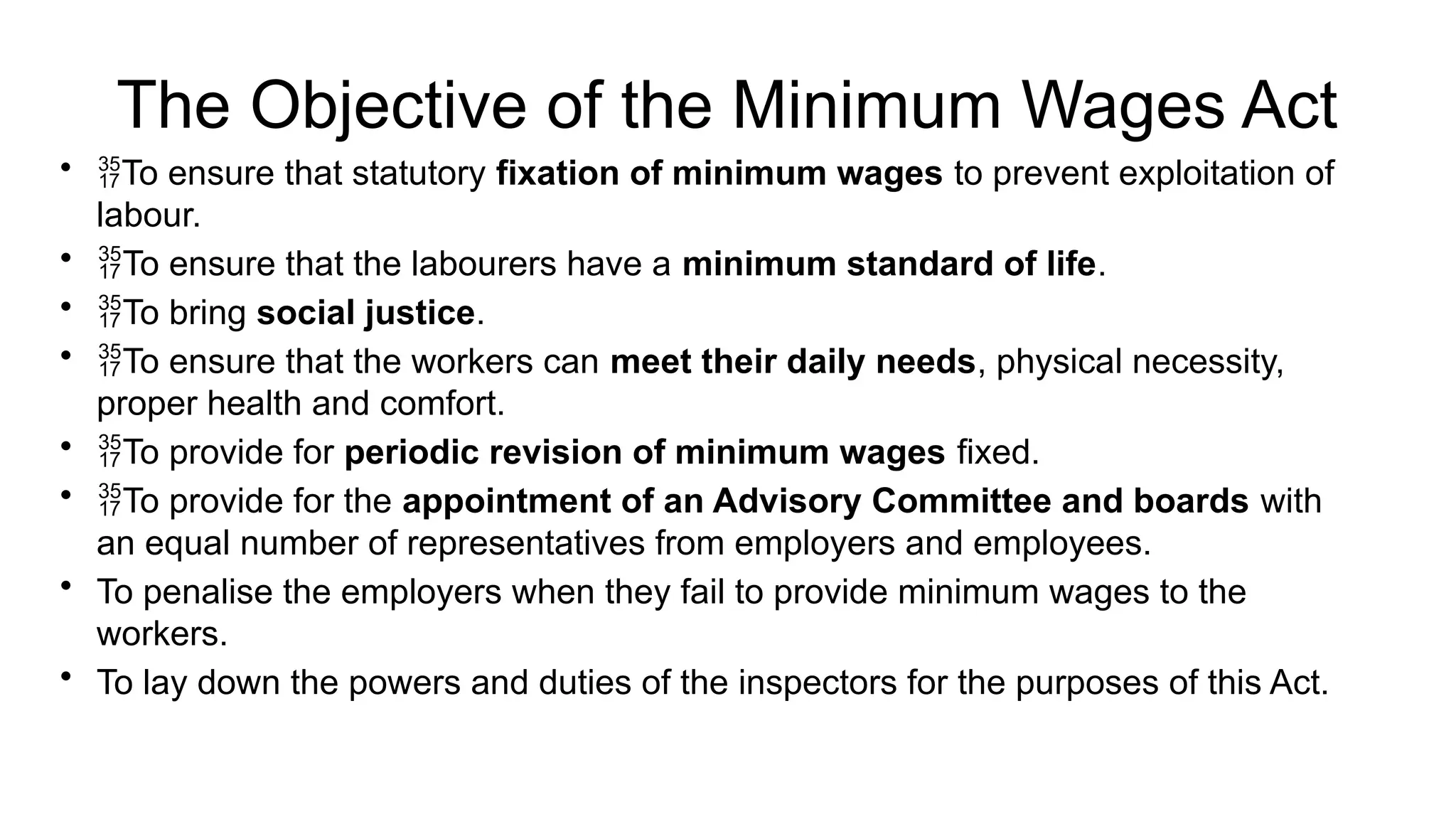
The Objective ofthe Minimum Wages Act
• To ensure that statutory fixation of minimum wages to prevent exploitation of
labour.
• To ensure that the labourers have a minimum standard of life.
• To bring social justice.
• To ensure that the workers can meet their daily needs, physical necessity,
proper health and comfort.
• To provide for periodic revision of minimum wages fixed.
• To provide for the appointment of an Advisory Committee and boards with
an equal number of representatives from employers and employees.
• To penalise the employers when they fail to provide minimum wages to the
workers.
• To lay down the powers and duties of the inspectors for the purposes of this Act.
12.
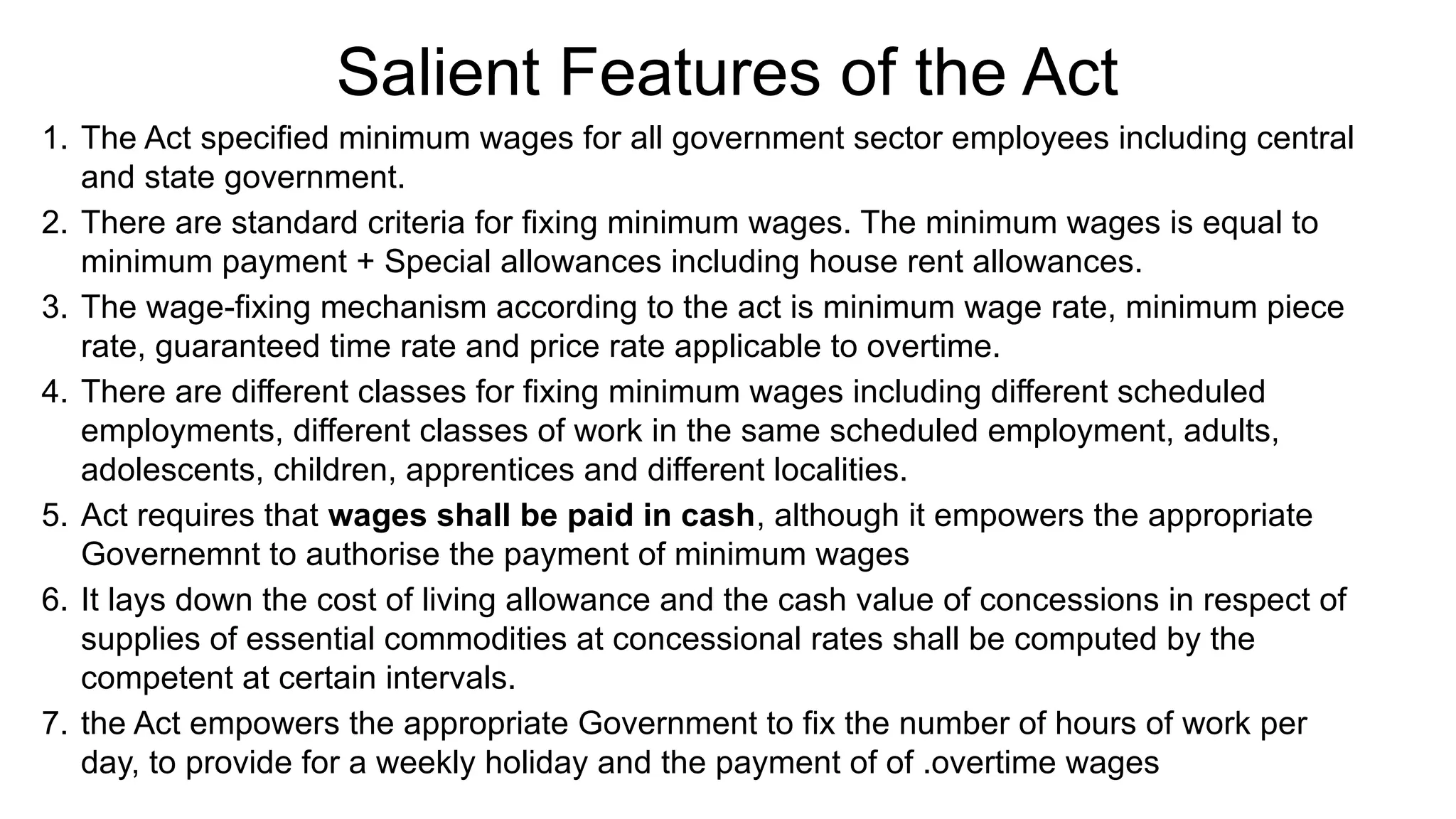
Salient Features ofthe Act
1. The Act specified minimum wages for all government sector employees including central
and state government.
2. There are standard criteria for fixing minimum wages. The minimum wages is equal to
minimum payment + Special allowances including house rent allowances.
3. The wage-fixing mechanism according to the act is minimum wage rate, minimum piece
rate, guaranteed time rate and price rate applicable to overtime.
4. There are different classes for fixing minimum wages including different scheduled
employments, different classes of work in the same scheduled employment, adults,
adolescents, children, apprentices and different localities.
5. Act requires that wages shall be paid in cash, although it empowers the appropriate
Governemnt to authorise the payment of minimum wages
6. It lays down the cost of living allowance and the cash value of concessions in respect of
supplies of essential commodities at concessional rates shall be computed by the
competent at certain intervals.
7. the Act empowers the appropriate Government to fix the number of hours of work per
day, to provide for a weekly holiday and the payment of of .overtime wages
13.
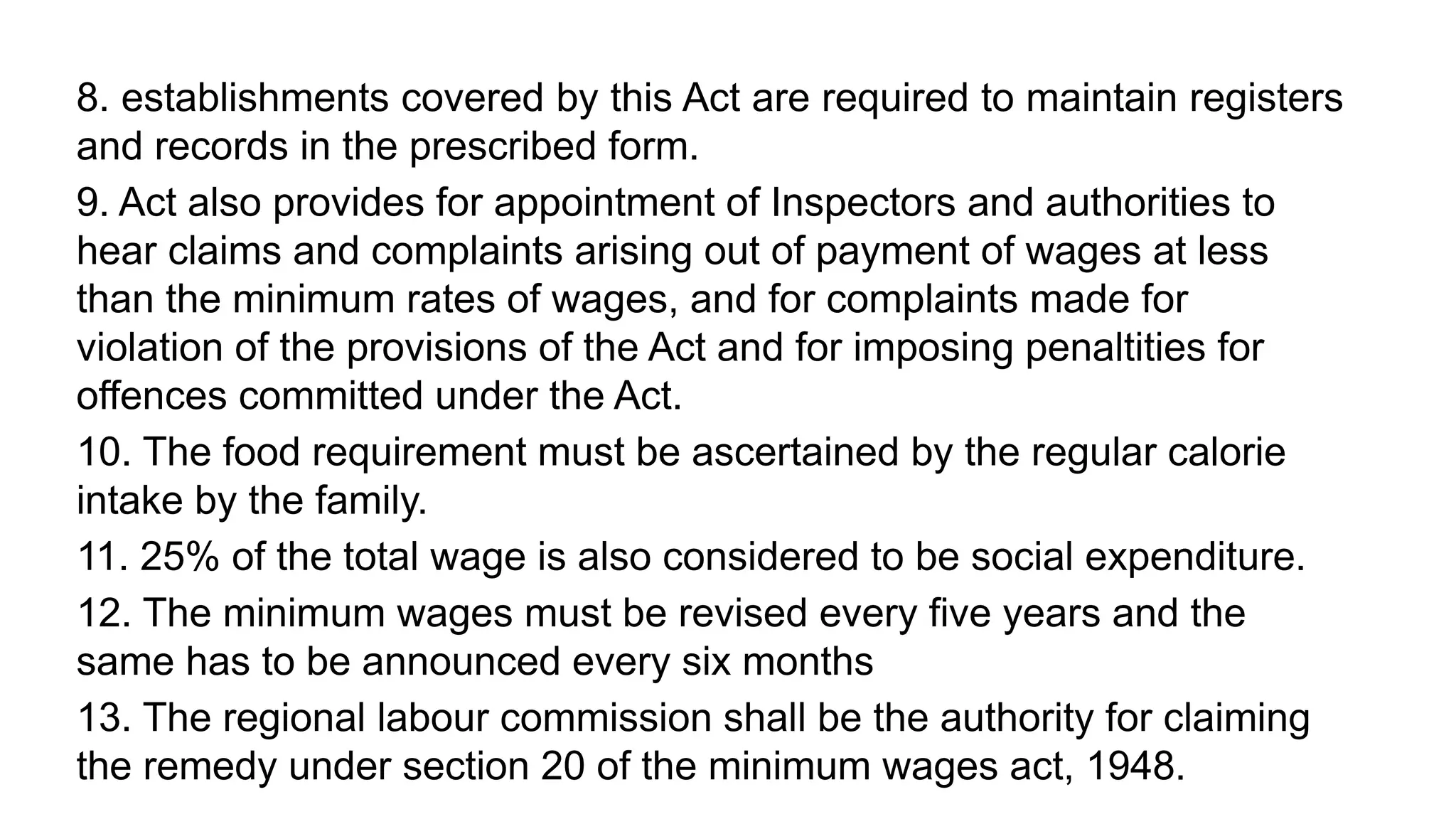
8. establishments coveredby this Act are required to maintain registers
and records in the prescribed form.
9. Act also provides for appointment of Inspectors and authorities to
hear claims and complaints arising out of payment of wages at less
than the minimum rates of wages, and for complaints made for
violation of the provisions of the Act and for imposing penaltities for
offences committed under the Act.
10. The food requirement must be ascertained by the regular calorie
intake by the family.
11. 25% of the total wage is also considered to be social expenditure.
12. The minimum wages must be revised every five years and the
same has to be announced every six months
13. The regional labour commission shall be the authority for claiming
the remedy under section 20 of the minimum wages act, 1948.
14.
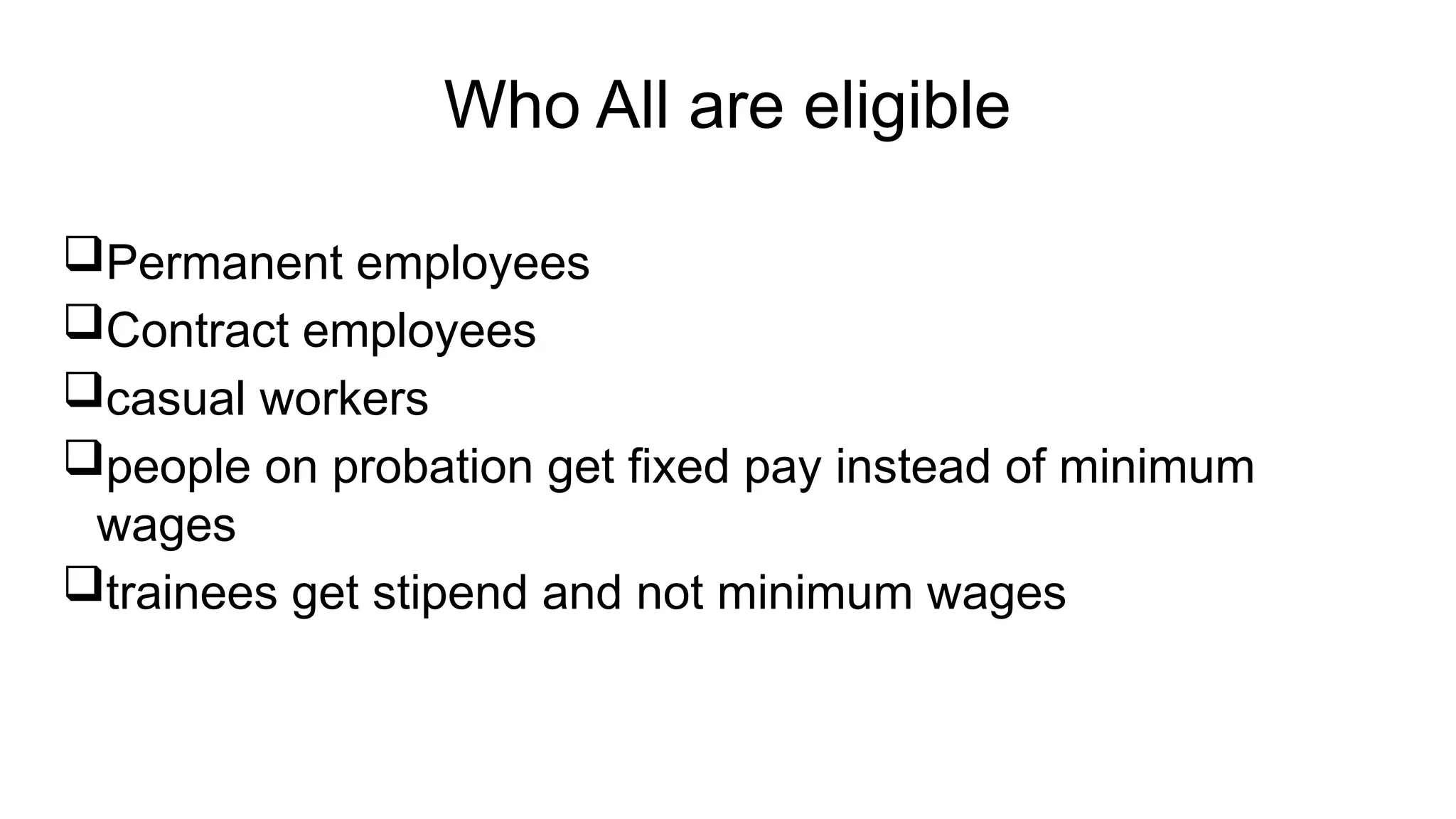
Who All areeligible
Permanent employees
Contract employees
casual workers
people on probation get fixed pay instead of minimum
wages
trainees get stipend and not minimum wages
15.
• In BijayCotton Mills Ltd v., the State of Ajmer, it was noted
that it is the responsibility of the state to ensure that all workers
receive living wages and working conditions, upholding the
constitutional legitimacy of this act.
• Section 3 gives the relevant government the authority to set
minimum wage levels. Additionally, it gives the government the
authority to examine pay no more frequently than every five
years.
• For fixing procedures, the government may appoint as many
committees or subcommittees as necessary.
• The act’s Section 12 mandates that every employee get the
minimum wage from their employer
16.
Types of wages
•Minimum wage: This is the type of wage provided for bare subsistence
so that the workers can maintain a decent standard of living such as
providing for education, medical requirements and an adequate level of
comfort. Hydro (engineer) Pvt. Ltd v. The Workmen, 199, SC
• Fair wage: Any wage paid to the employees that are more than the
minimum wage is known as a fair wage. It is the wage that seeks to
maintain a level of employment in the industry and also looks after the
industry’s capacity to pay sufficient remuneration to the
employees.S.A.F.L Works v. State Industrial Court, Nagpur, 1978, SC
• Living wage: A living wage not only meets the minimum requirement of
the employees provided by the employers but also allows individuals or
families to afford adequate shelter, food, and other necessities. It also
includes health, sanity, education, dignity, comfort, and provide for any
contingency.
17.
Minimum rates ofwages
• Under Section 3 of the Act, the minimum wages payable to the
employees are to be fixed by the appropriate government. However,
this Section also mentions that the rate of wages shall be revised
every five years. The appropriate government may fix:
• The minimum rate of wages for time work,
• the minimum rate of wage for piece work,
• a minimum rate of remuneration to apply in the case of employees
employed on piece work for the purpose of securing to such
employees a minimum rate of wages on a time work basis,
• a minimum rate of wage to substitute the for the minimum rate which
would otherwise be applicable, in respect of overtime work done by
employees
18.
In fixing orrevising minimum wages under Section 3 of
the Act
• Different minimum rates of wages may be fixed for;
different classes of work, different scheduled employment,
different localities, different age groups, etc.
• Minimum wages may be fixed by the wage period such
as; by the hour, by the day, etc.
• Sahdeo Sahu V. State of M.P it was held that Se 3(1-A)
doesnot prevent the appropriate Governemnt from fixing
the minimum rates of wages even if the number of
employees in that scheduled employment is less than one
thousand
19.
• In S.F.A.LWorks v. State Induatrial Court, Nagpur, it
was held that in fixing the minimum rate of wages, the Act
also makes a provision for special allowance to be paid
along with the basic rates of wages.
• MINIMUM WAGE WOULD NOT BE APPLICABLE
DURING THE PERIOD WHEN THE PROCEEDING S
PENDING and the award made therein is in operation or
where the notification is issued during the period of
operation of an award during that period
20.
• Section 5states that in order to fix or revise the
minimum wage of the employees the appropriate
government may establish as many committees and
subcommittees necessary to hold enquiries in matters
regarding fixing and revision of minimum wage.
• Further, the appropriate government by notification to
the Official Gazette publish its proposal for the
information of the individuals who are likely to be
affected by such information and thereby specify the
date which must not be less than two months from the
date of notification of the proposals that will be taken
into consideration.
21.
PROCEDURE FOR FIXINGAND REVISING THE MINIMUM WAGES
1. appointment of
COMMITTEES
2. NOTIFICATION in official
gazzette
3. Appointment of ADVISORY
BOARDS
4.ADVICE of the
committees& Advisory Board
5. comes into force after expiry of 3
MONTHS
22.
Central Advisory Board
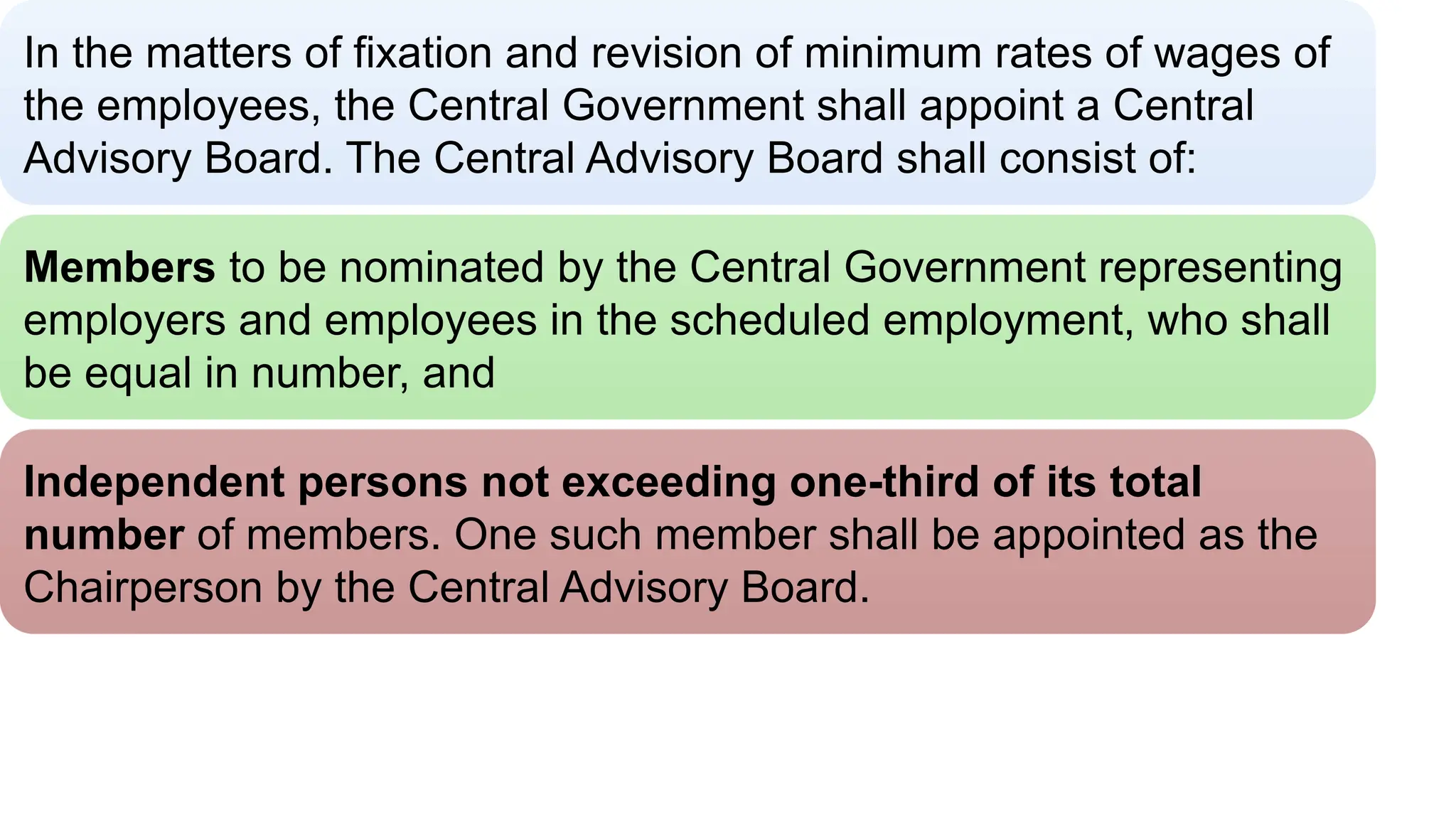
Inthe matters of fixation and revision of minimum rates of wages of
the employees, the Central Government shall appoint a Central
Advisory Board. The Central Advisory Board shall consist of:
Members to be nominated by the Central Government representing
employers and employees in the scheduled employment, who shall
be equal in number, and
Independent persons not exceeding one-third of its total
number of members. One such member shall be appointed as the
Chairperson by the Central Advisory Board.
23.
Wages in kindunder the Act
Section 11 of the Minimum wages Act, 1948 mentions how the
wages will be payable to the employees.
Minimum wages under this Act shall be paid in cash.
• The appropriate government under necessary circumstances by
notification to the Official Gazette authorise the payment of the
minimum wages either wholly or partly in kind.
• The appropriate government by notification to the Official Gazette
authorised a provision for the supply of essential commodities at
concession rates.
• The cash value of wages and the concession rates shall be
authorised in the prescribed manner stated under the Act.
24.
• Se. 10- Correction of errors- Appropriate Govt may
correct any such clerical error.
• Se. 11. Wages in kind.- (1) Minimum wages payable
under the Act shall be paid in cash.
• Se. 12. Payment of minimum rates of wages
25.
13. Fixing hoursfor a normal working day, etc.-
• 2(1) In regard to any scheduled employment minimum rates of wages in respect
of which have been fixed under this Act, the appropriate Government may-
• (a) fix the number of hours of work which shall constitute a normal working day,
inclusive of one or more specified intervals;
• (b) provide for a day of rest in every period of seven days which shall be allowed
to all employees or to any specified class of employees and for the payment of
remuneration in respect of such days of rest;
• (c) provide for payment for work on a day of rest at a rate not less than the
overtime rate
26.
(2) provisions applysubject to conditions -
• (a) employees engaged on urgent work or in any emergency which
could not have been foreseen or prevented;
• (b) employees engaged in work in the nature of preparatory or
complementary work which must necessarily be carried on outside
the limits laid down for the general working in the employment
concerned;
• (c) employees whose employment is essentially intermittent;
• (d) employees engaged in any work which for technical reasons has
to be completed before the duty is over;
• (e) employees engaged in a work which could not be carried on
except at times dependent on the irregular action of natural
forces.
27.
Se. 14. Overtime.-
•(1) Where an employee, whose minimum rates of wages is
fixed under this Act by the hour, by the day or by such a
longer wage-period as may be prescribed, works on any
day in excess of the number of hours constituting a
normal working day, the employer shall pay him for
every hour or for part of an hour so worked in excess at
the overtime rate fixed under this Act or under any law of
the appropriate Government for the time being in force
whichever is higher.
• Municipal Council, Hatta V. Bhagat Singh, it has been held that Se 14
provides for payment of overtime only to those employees who are getting
minimum rate of wages
28.
• 15. Wagesof worker who works for less than normal
working day.- entitled to receive wages in respect of
work done by him on that day as if he had worked for
a full normal working day
• EXCEPT -
• (i) in any case where his failure to work is caused by his
unwillingness to work and not by the omission of the employer to
provide him with work, and
• (ii) in such other cases and circumstances as may be prescribed.
29.
Se.16. Wages fortwo or more classes of work
Se.17. Minimum time rate wages for piece-work
Se.18. Maintenance of registers and records- and EXHIBIT it
• Se.18(3) The appropriate Government may, by rules made under this Act, provide
for the issue of wage books or wage slips to employees employed in any
scheduled employment in respect of which minimum rates of wages have been
fixed and prescribe the manner in which entries shall be made and authenticated in
such wage books or wage slips by the employer or his agent.
30.
Se. 19.AUTHORITIES UNDERTHE ACT
• Inspectors.-
• (1) The appropriate Government may, by notification in the Official
gazette, appoint such persons as it thinks fit to be Inspectors for the
purposes of this Act, and define the local limits within which they
shall exercise their functions
• (3) Every Inspector shall be deemed to be a public servant within the
meaning of the Indian Penal Code.
• 4) Any person required to produce any document or thing or to give
any information by an Inspector under sub-section (2) shall be
deemed to be legally bound to do so within the meaning of section
175 and section 176 of the Indian Penal Code
• Sarpanch grampanchayat v. Ramgiri, 1958
31.
Se. 19(2) Subjectto any rules made in this behalf, an
Inspector may, within the local limits for which he is appointed
i. enter at all reasonable hours, with such assistant to examine
any record and ask for its production
ii. examine any person who is an employee
iii. supervise the payment of wages to persons employed upon
any railway or in industrial or other establishment
iv. require by written order any person giving out-work and any
out-workers to give any information
v. seize or take copies of such register, record of wages or
notices or portions thereof as he may consider relevant, in
respect of an offence under this Act
32.
Commissioner & LabourCommissioner
U/Se. 20 for Claims
• (1) The appropriate Government may, by notification in the Official Gazette,
appoint any Commissioner for workmen's Compensation or any officer of the
Central Government exercising functions as a Labour Commissioner for any
region, or any officer of the State Government not below the rank of Labour
Commissioner or any other officer with experience as a judge of a Civil Court or as
a stipendiary Magistrate -
• to be the Authority to-
• hear and decide for any specified area all claims arising out of the payment of
less than the minimum rates of wages
• claim in respect of payment of remuneration for work done of rest
• claim of wages at the overtime rate for overtime under se. 14
33.
CLAIMS
• Claims arisingout of payment of less than the minimum
rates of wages
i. any claim in respect of payment or remuneration for days
of rest;
ii. any claim in respect of payment or remuneration for work
done on such days under clause (b) or (c) or se. 13(1)
iii. any claim of wages at the overtime rate under se.14, or
employees employed or paid n that area
34.
• Purpose ofSe. 20 is to ensure that the rates prescribed
under the Minimum wages Act are complied with by the
employer in making payments and if any attempt is to
make payments at lower rates, the workmen are given the
right to invoke aid of Authority appointed .- Town
Muncipal Council Athani v. Presiding Officer Labour
COurt, Hubli AIR 1969 SC
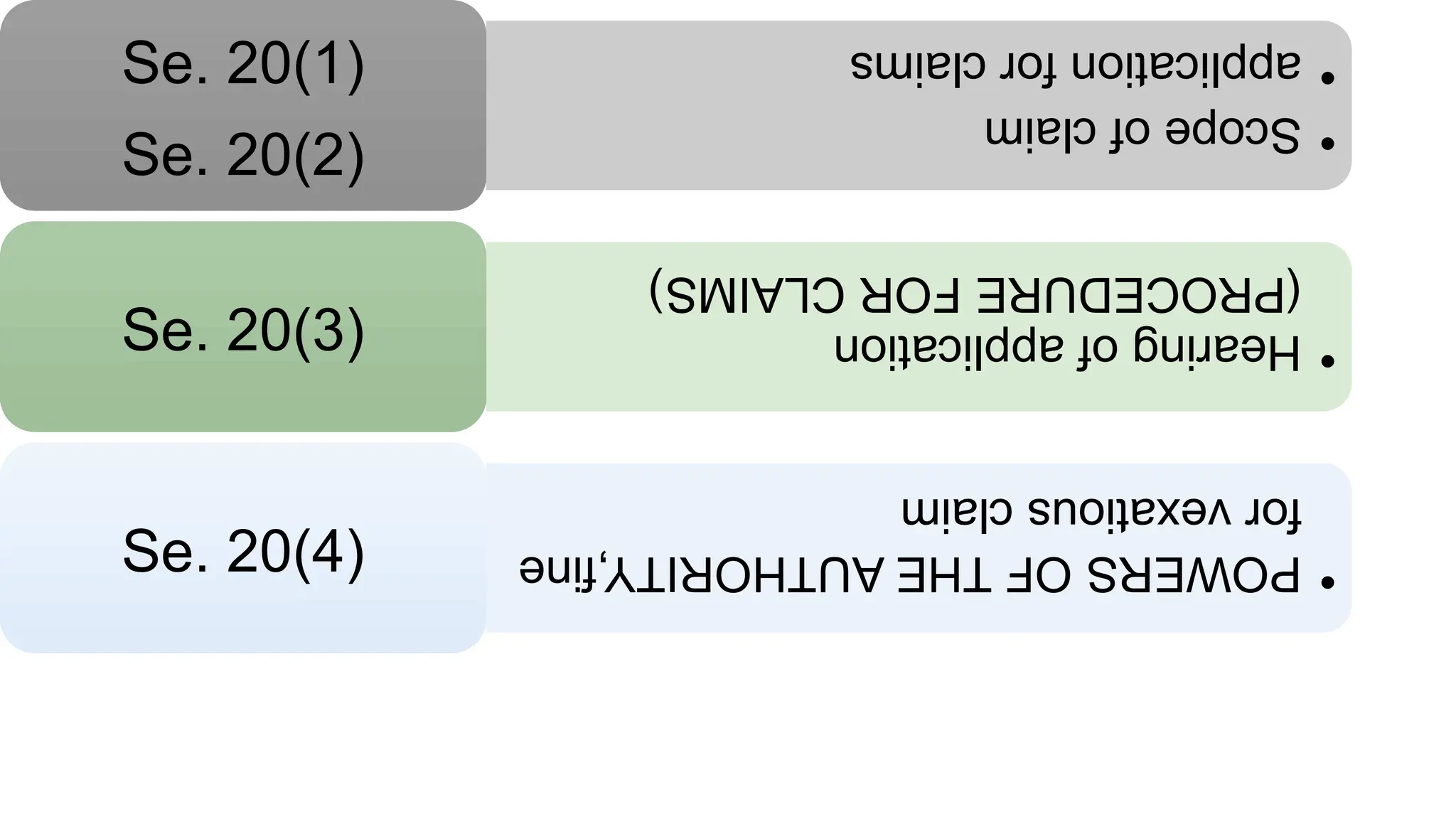
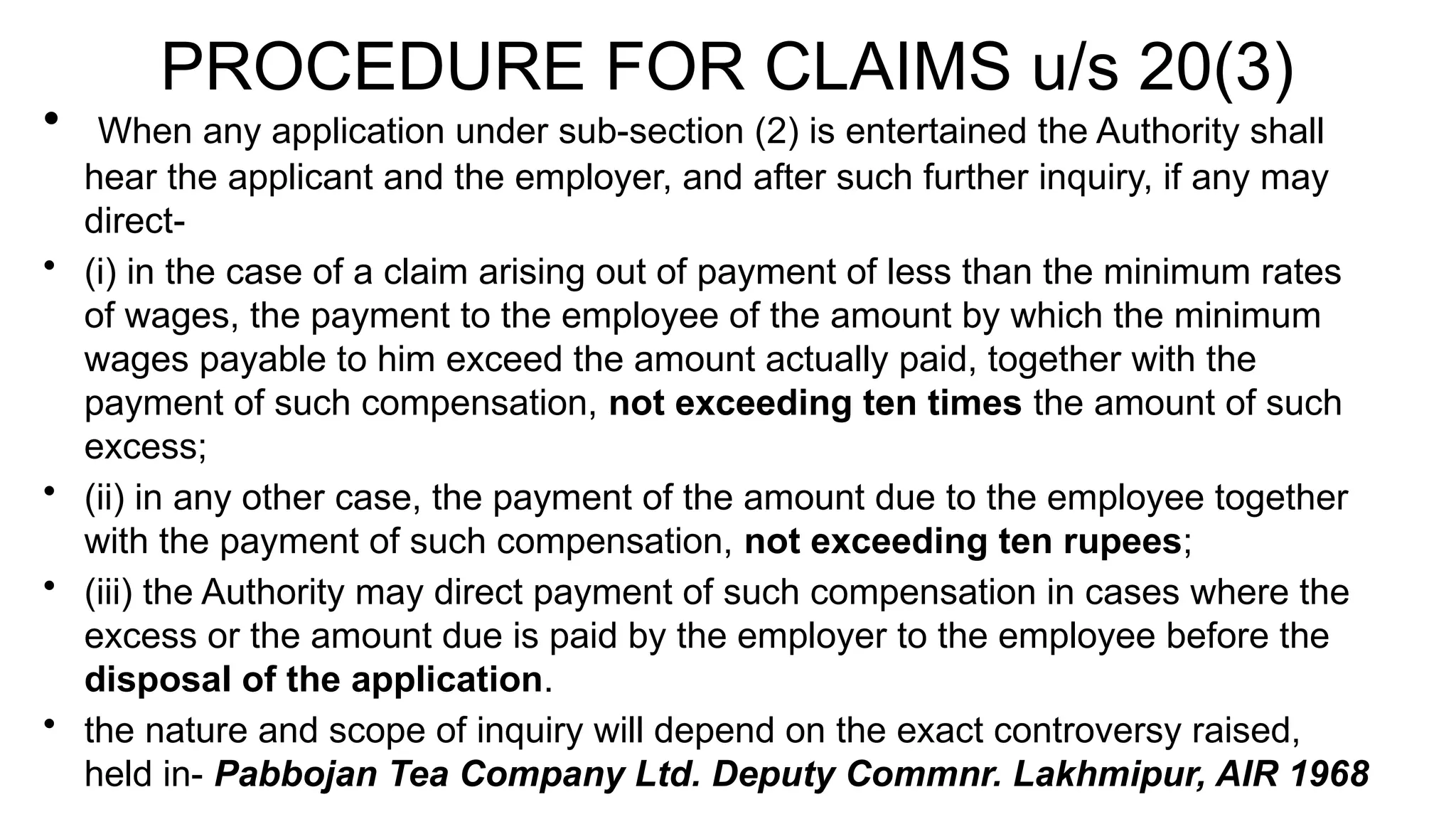
PROCEDURE FOR CLAIMSu/s 20(3)
• When any application under sub-section (2) is entertained the Authority shall
hear the applicant and the employer, and after such further inquiry, if any may
direct-
• (i) in the case of a claim arising out of payment of less than the minimum rates
of wages, the payment to the employee of the amount by which the minimum
wages payable to him exceed the amount actually paid, together with the
payment of such compensation, not exceeding ten times the amount of such
excess;
• (ii) in any other case, the payment of the amount due to the employee together
with the payment of such compensation, not exceeding ten rupees;
• (iii) the Authority may direct payment of such compensation in cases where the
excess or the amount due is paid by the employer to the employee before the
disposal of the application.
• the nature and scope of inquiry will depend on the exact controversy raised,
held in- Pabbojan Tea Company Ltd. Deputy Commnr. Lakhmipur, AIR 1968
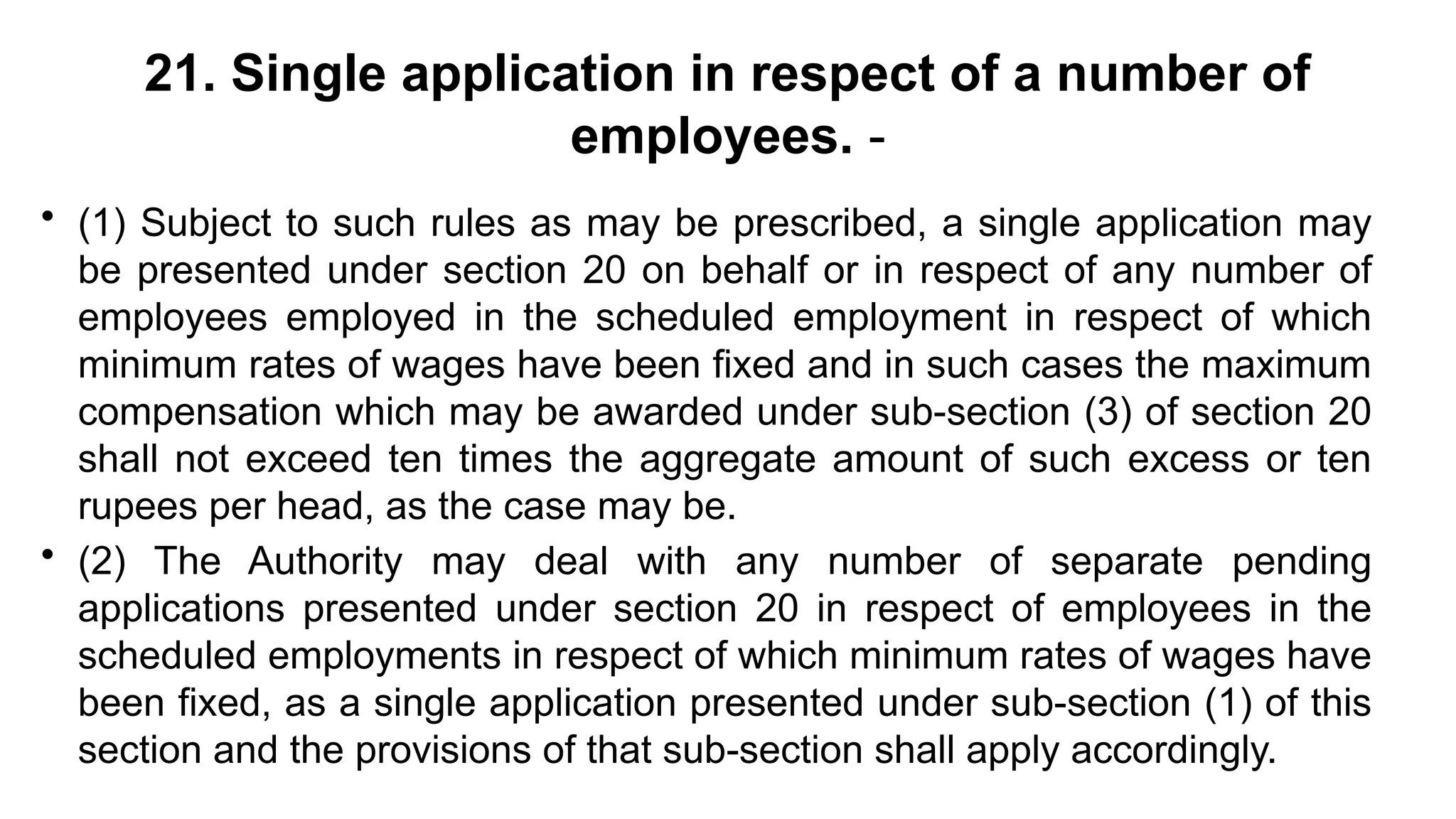
21. Single applicationin respect of a number of
employees. -
• (1) Subject to such rules as may be prescribed, a single application may
be presented under section 20 on behalf or in respect of any number of
employees employed in the scheduled employment in respect of which
minimum rates of wages have been fixed and in such cases the maximum
compensation which may be awarded under sub-section (3) of section 20
shall not exceed ten times the aggregate amount of such excess or ten
rupees per head, as the case may be.
• (2) The Authority may deal with any number of separate pending
applications presented under section 20 in respect of employees in the
scheduled employments in respect of which minimum rates of wages have
been fixed, as a single application presented under sub-section (1) of this
section and the provisions of that sub-section shall apply accordingly.
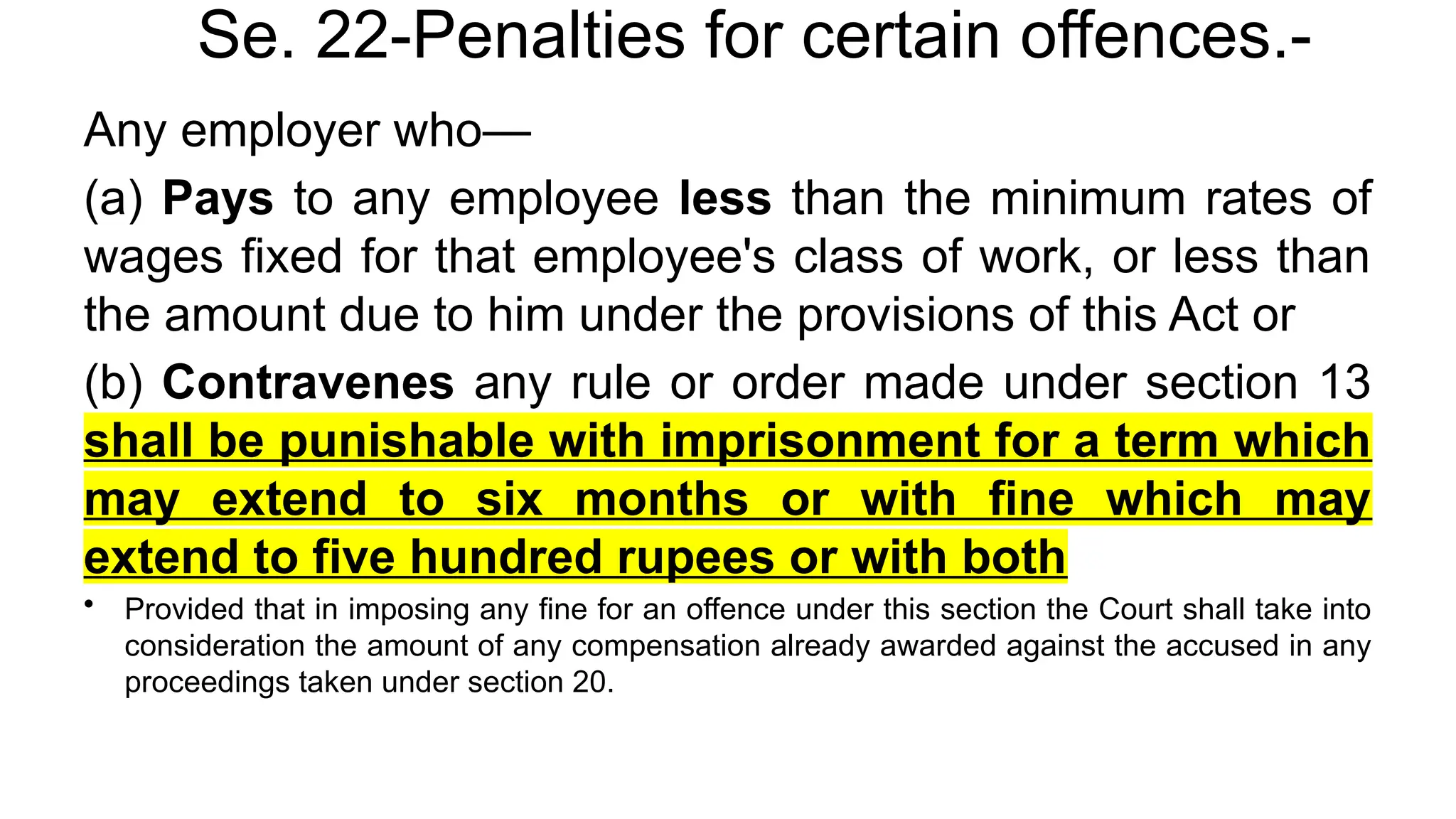
39.
Se. 22-Penalties forcertain offences.-
Any employer who—
(a) Pays to any employee less than the minimum rates of
wages fixed for that employee's class of work, or less than
the amount due to him under the provisions of this Act or
(b) Contravenes any rule or order made under section 13
shall be punishable with imprisonment for a term which
may extend to six months or with fine which may
extend to five hundred rupees or with both
• Provided that in imposing any fine for an offence under this section the Court shall take into
consideration the amount of any compensation already awarded against the accused in any
proceedings taken under section 20.
40.
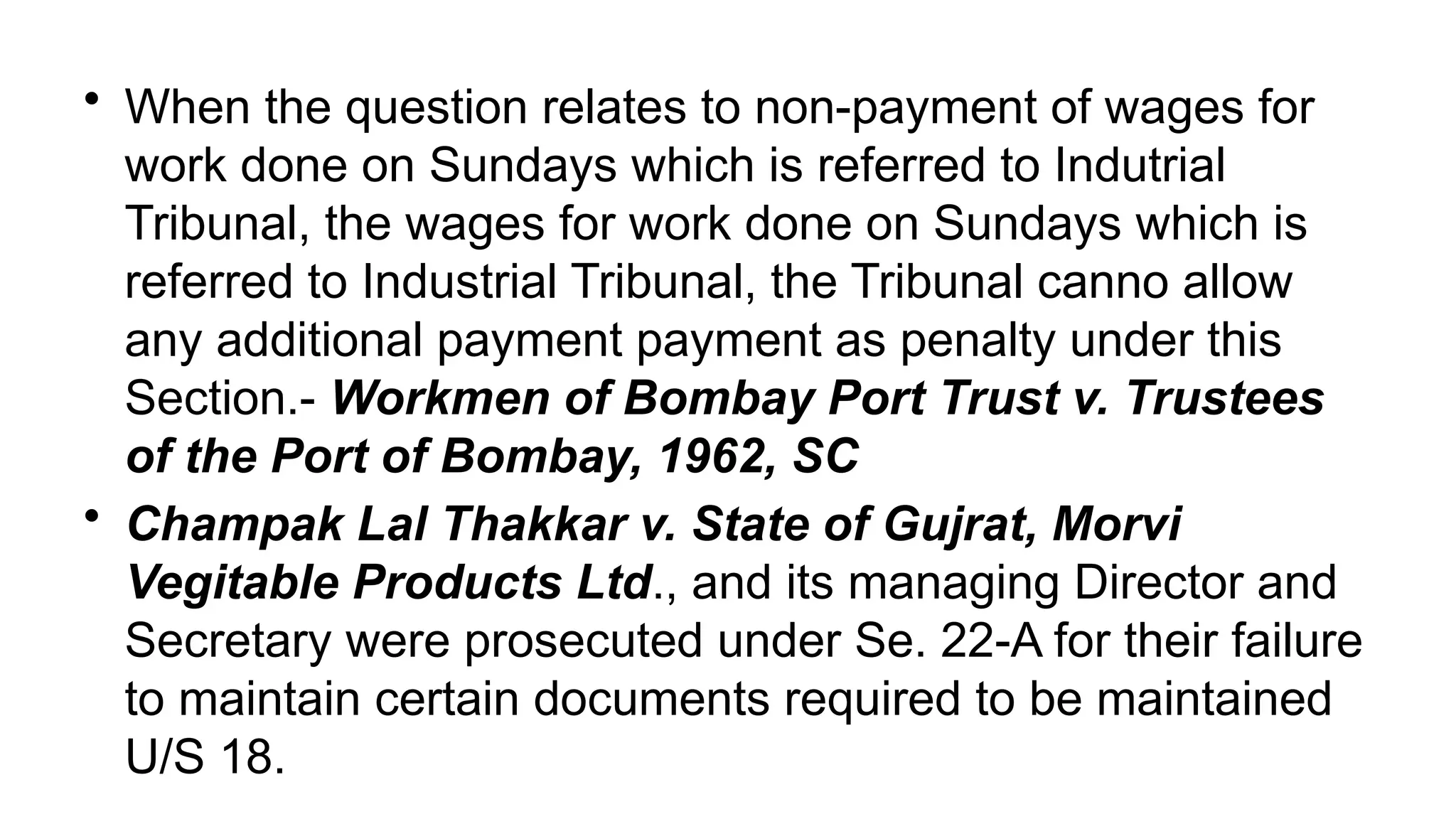
• When thequestion relates to non-payment of wages for
work done on Sundays which is referred to Indutrial
Tribunal, the wages for work done on Sundays which is
referred to Industrial Tribunal, the Tribunal canno allow
any additional payment payment as penalty under this
Section.- Workmen of Bombay Port Trust v. Trustees
of the Port of Bombay, 1962, SC
• Champak Lal Thakkar v. State of Gujrat, Morvi
Vegitable Products Ltd., and its managing Director and
Secretary were prosecuted under Se. 22-A for their failure
to maintain certain documents required to be maintained
U/S 18.
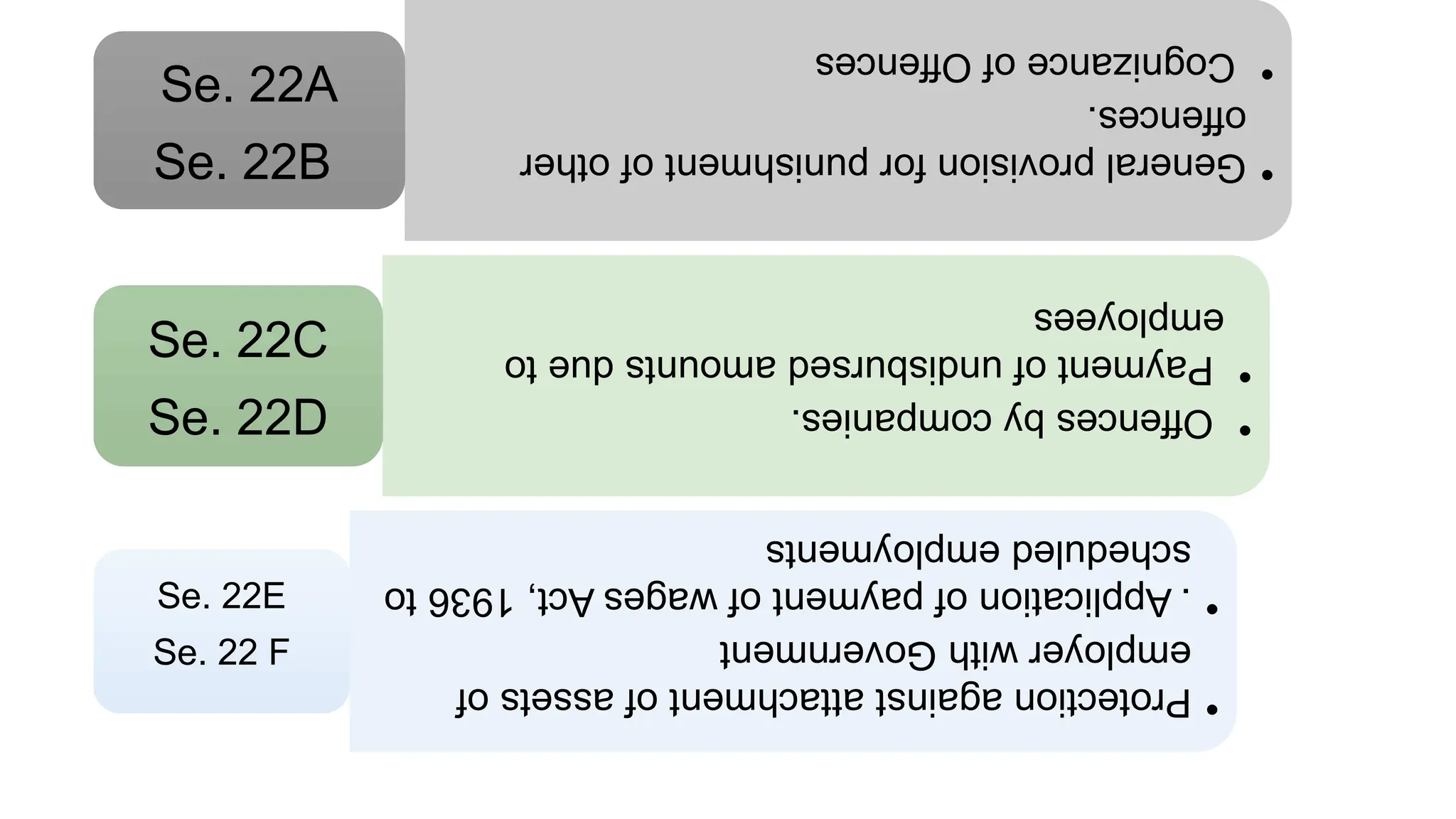
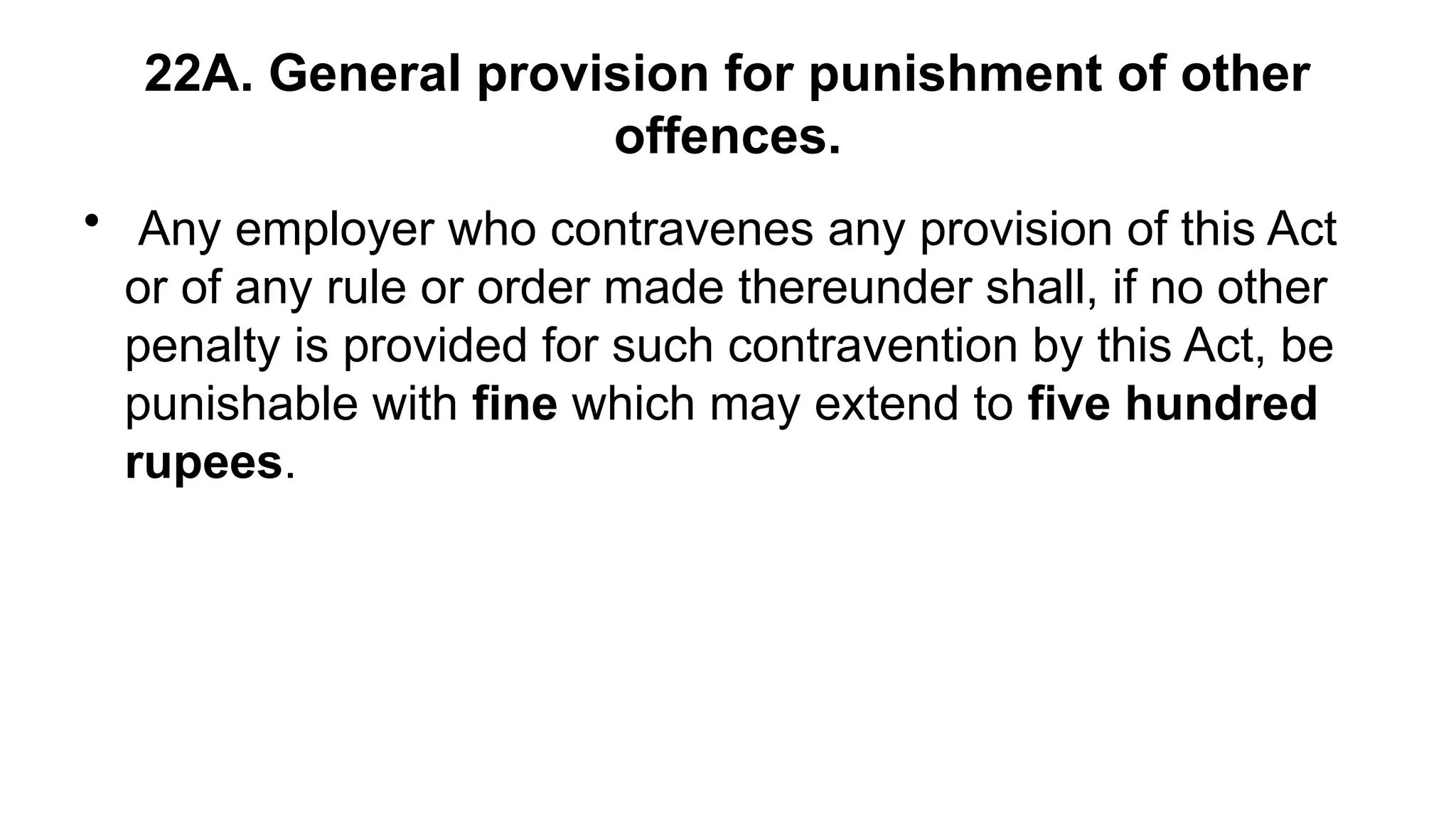
22A. General provisionfor punishment of other
offences.
• Any employer who contravenes any provision of this Act
or of any rule or order made thereunder shall, if no other
penalty is provided for such contravention by this Act, be
punishable with fine which may extend to five hundred
rupees.
43.
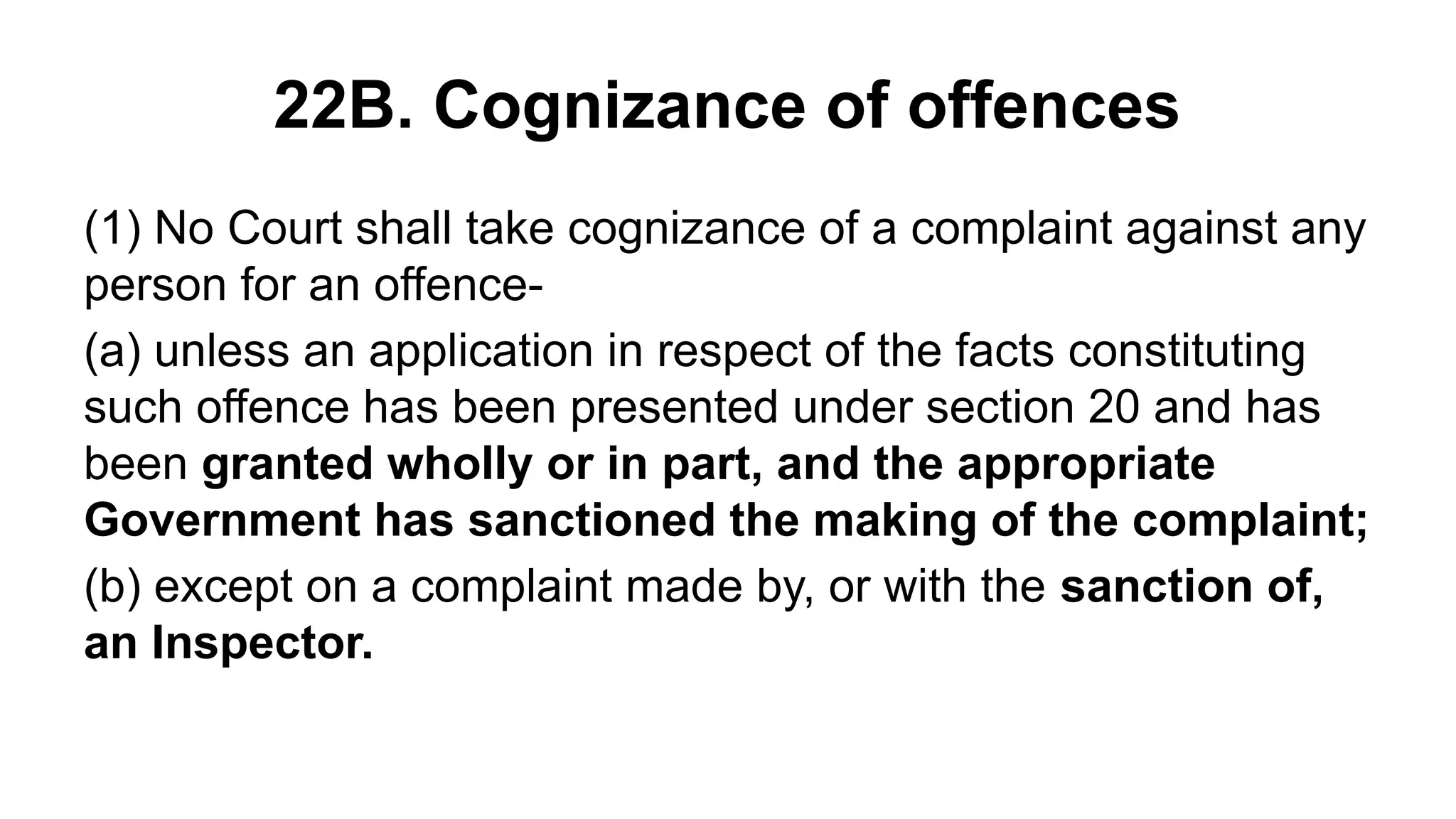
22B. Cognizance ofoffences
(1) No Court shall take cognizance of a complaint against any
person for an offence-
(a) unless an application in respect of the facts constituting
such offence has been presented under section 20 and has
been granted wholly or in part, and the appropriate
Government has sanctioned the making of the complaint;
(b) except on a complaint made by, or with the sanction of,
an Inspector.
44.
(2) No Courtshall take cognizance of an offence-
(a) unless complaint thereof is made within one month of
the grant of sanction under this section;
(b) unless complaint thereof is made within six months of
the date on which the offence is alleged to have been
committed
45.
22C. Offences bycompanies. -
• (1) If the person committing any offence under this Act is a
company, every person who at the time the offence was
committed, was in charge of, and was responsible to, the
company for the conduct of the business of the company
as well as the company shall be deemed to be guilty of the
offence and shall be liable to be proceeded against and
punished accordingly; unless proves:
• 1.offence was committed without his knowledge
• 2. he exercised all due diligence to prevent the commission of such offence
• “company” means any body corporate and includes a firm or other association of individuals
46.
• 22D. Paymentof undisbursed amounts due to
employees.
• 22E. Protection against attachment of assets of
employer with Government.
• 22F. Application of Payment of Wages Act, 1936, to
scheduled employments
• 23. Exemption of employer from liability in certain cases
• 24. Bar of suits
47.
23. Exemption ofemployer from liability in
certain cases.-
• Where an employer is charged with an offence against this Act, he shall be
entitled, upon complaint duly made by him, to have any other person whom he
charges as the actual offender, brought before the Court at the time appointed
for hearing the charge; and if, after the commission of the offence has been
proved, the employer proves to the satisfaction of the Court-
(a) that he has used due diligence to enforce the execution of this act, and
(b) that the said other person committed the offence in question without his
knowledge, consent or connivance,
• that other person shall be convicted of the offence and shall be liable to the like
• punishment as if he were the employer and the employer shall be discharged:
• Provided that in seeking to prove, as aforesaid, the employer may be examined on oath, and
the evidence of the employer or his witness, if any, shall be subject to cross examination by or
on behalf of the person whom the employer charges as the actual offender and by the
prosecution.
48.
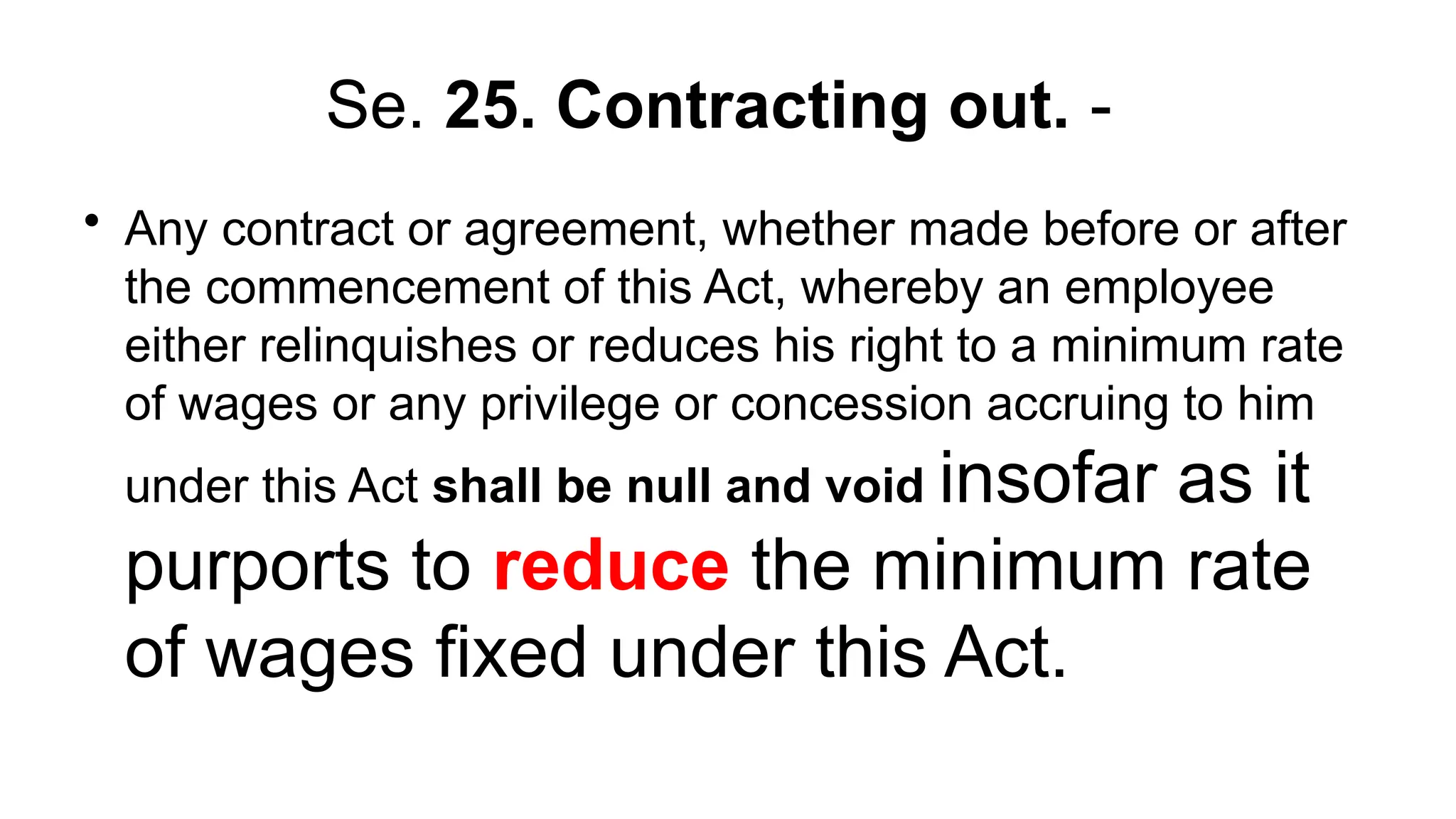
Se. 25. Contractingout. -
• Any contract or agreement, whether made before or after
the commencement of this Act, whereby an employee
either relinquishes or reduces his right to a minimum rate
of wages or any privilege or concession accruing to him
under this Act shall be null and void insofar as it
purports to reduce the minimum rate
of wages fixed under this Act.
49.
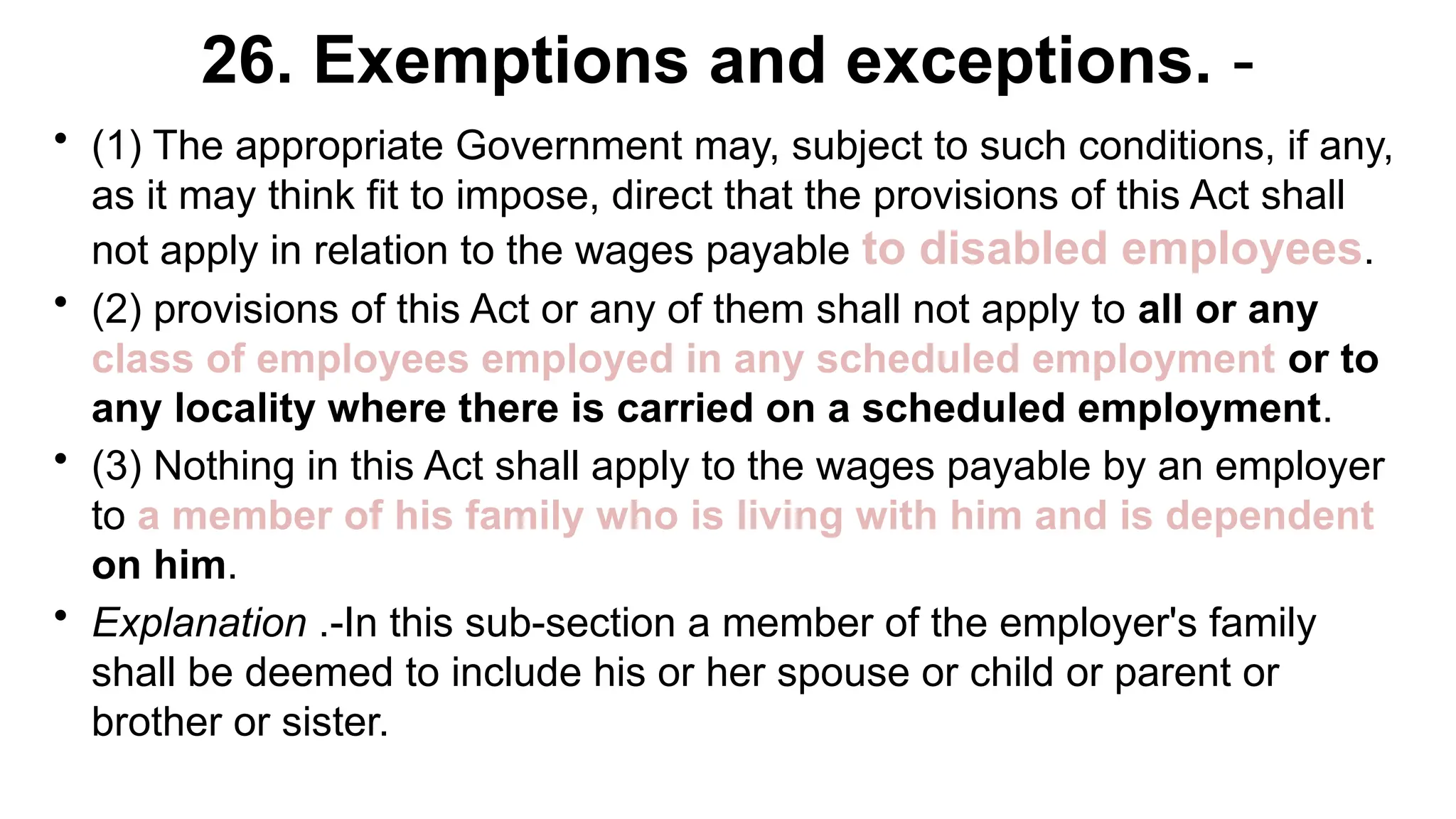
26. Exemptions andexceptions. -
• (1) The appropriate Government may, subject to such conditions, if any,
as it may think fit to impose, direct that the provisions of this Act shall
not apply in relation to the wages payable to disabled employees.
• (2) provisions of this Act or any of them shall not apply to all or any
class of employees employed in any scheduled employment or to
any locality where there is carried on a scheduled employment.
• (3) Nothing in this Act shall apply to the wages payable by an employer
to a member of his family who is living with him and is dependent
on him.
• Explanation .-In this sub-section a member of the employer's family
shall be deemed to include his or her spouse or child or parent or
brother or sister.
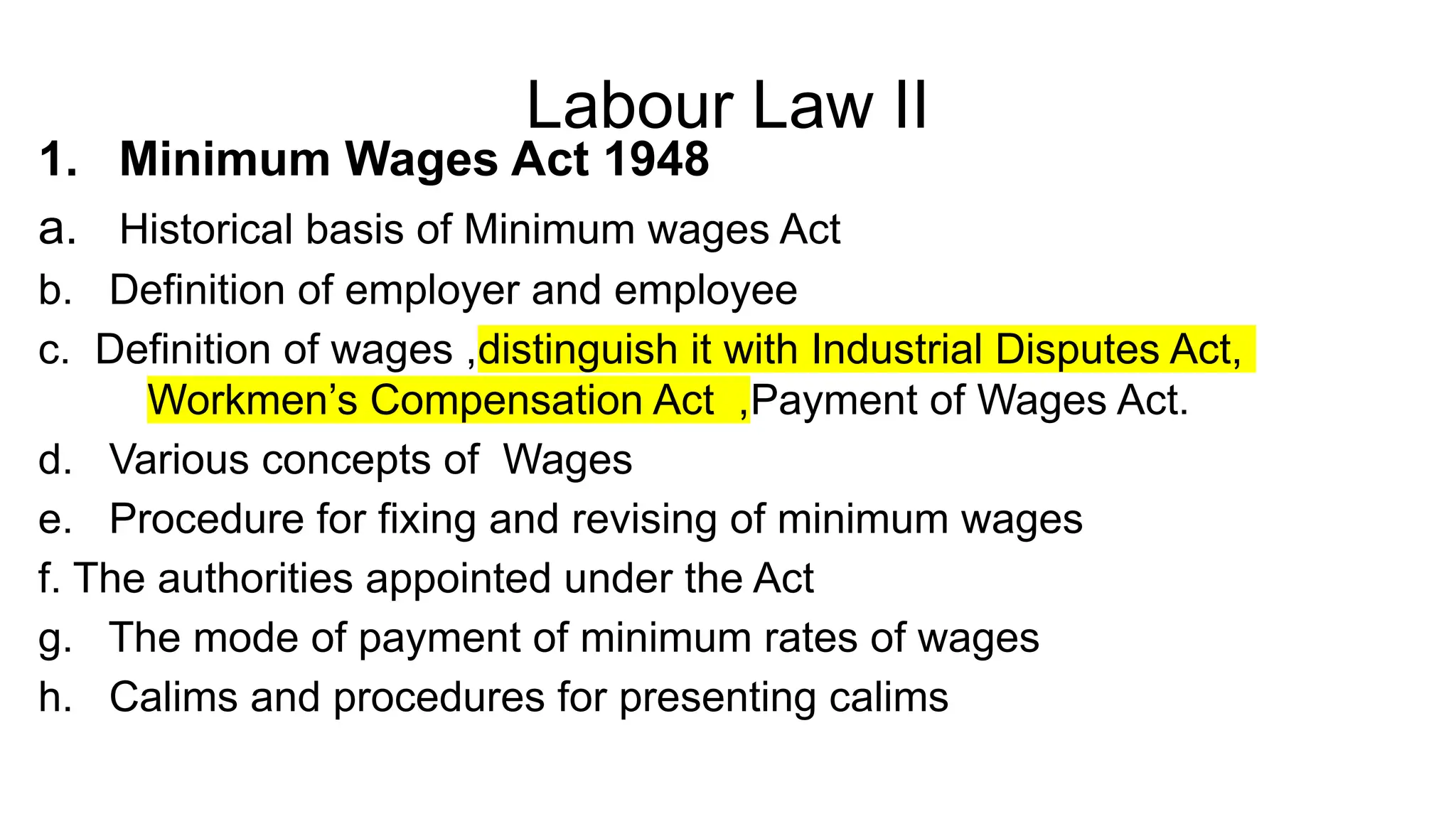
Judicial Views:
• The rates to be fixed need not be uniform. Different rates can be fixed for
different zones or localities. [Basti Ram v. State of AP AIR 1969 A.P. 227]
• The constitutional validity of Section 3 was challenged in Bijoy Cotton Mills
vs. State of Ajmer 1955 S.C. 3
• . The Supreme Court held that the restrictions imposed upon the freedom of
contract by the fixation of minimum rate of wages, though they interfere to
some extent with freedom of trade or business guarantee under Article
19(1)(g) of the Constitution, are not unreasonable and being imposed and in
the interest of general public and with a view to carrying out one of the
Directive Principles of the State Policy as embodied in Article 43 of the
Constitution, are protected by the terms of Clause (6) of Article 9.
52.
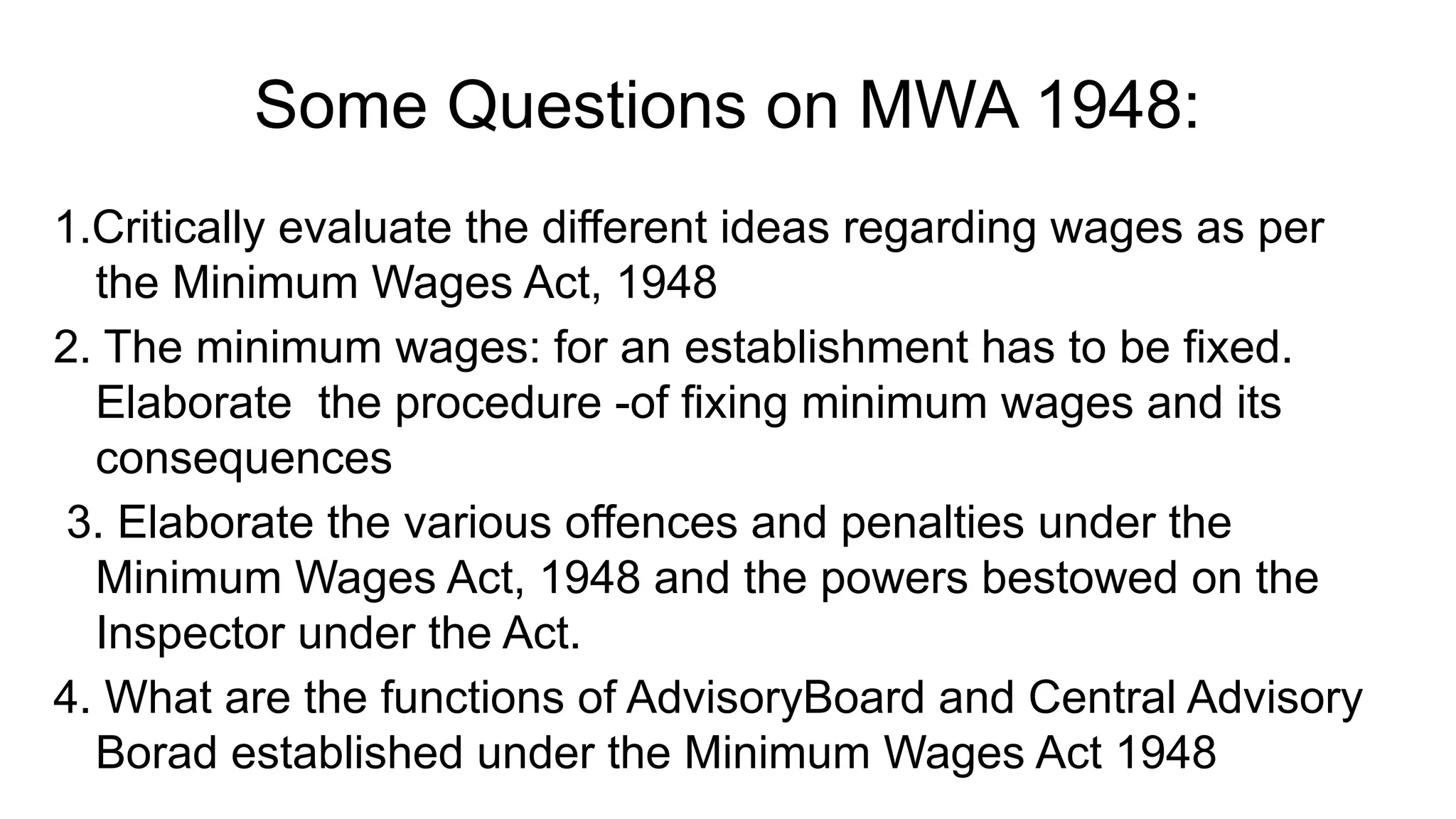
Some Questions onMWA 1948:
1.Critically evaluate the different ideas regarding wages as per
the Minimum Wages Act, 1948
2. The minimum wages: for an establishment has to be fixed.
Elaborate the procedure -of fixing minimum wages and its
consequences
3. Elaborate the various offences and penalties under the
Minimum Wages Act, 1948 and the powers bestowed on the
Inspector under the Act.
4. What are the functions of AdvisoryBoard and Central Advisory
Borad established under the Minimum Wages Act 1948
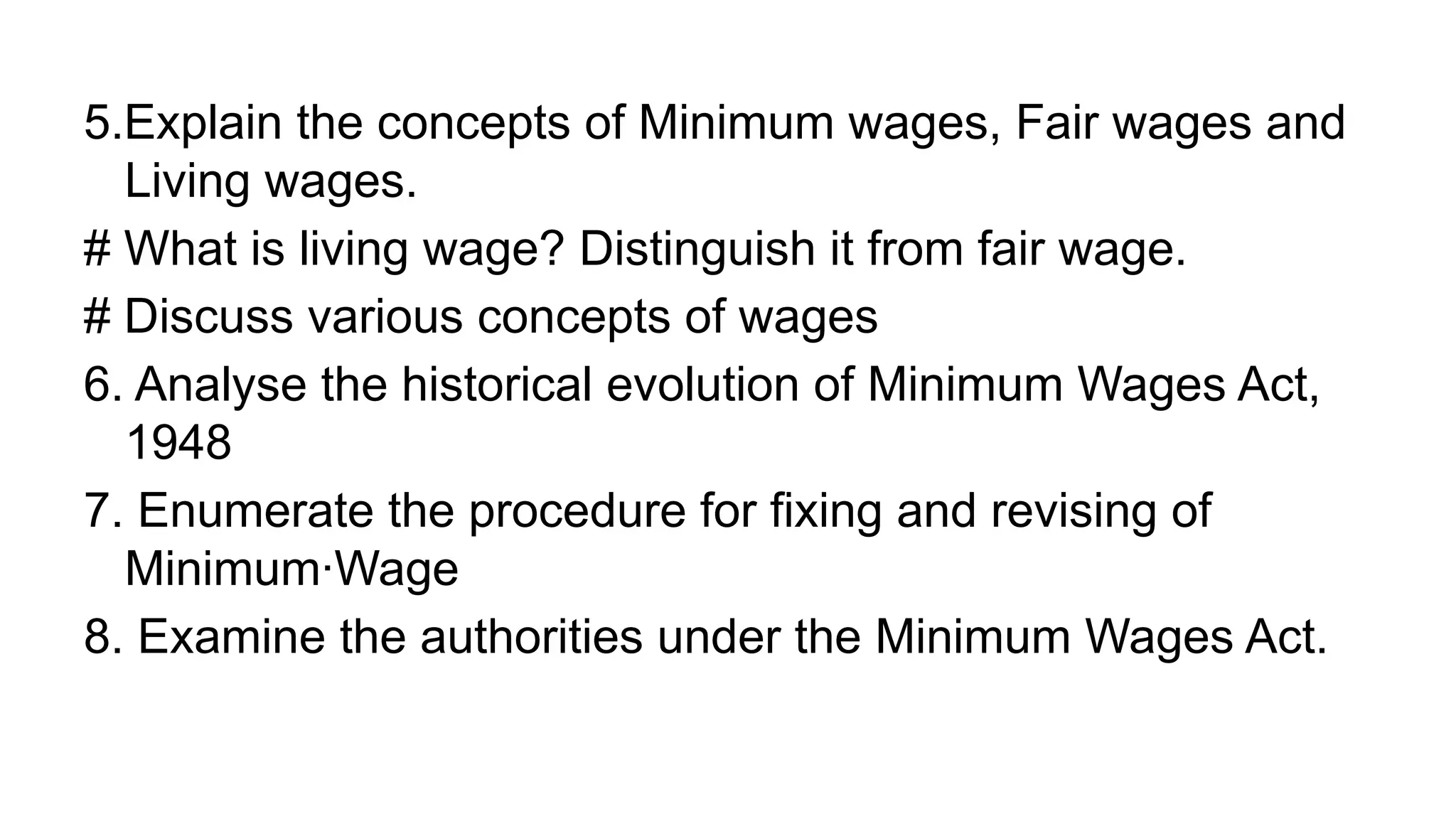
53.
5.Explain the conceptsof Minimum wages, Fair wages and
Living wages.
# What is living wage? Distinguish it from fair wage.
# Discuss various concepts of wages
6. Analyse the historical evolution of Minimum Wages Act,
1948
7. Enumerate the procedure for fixing and revising of
Minimum·Wage
8. Examine the authorities under the Minimum Wages Act.
54.
9. examine theprovisions of the Minimum Wages Act 1948 WRT the
settlement of claims for minimum wages. Illustrate case laws
wherever applicable.
10.Examine the composition of Authority to hear and decide claims
and State procedure for settlement of disputes under MWC 1948
11. Discuss the term minimum wage and discuss the wage structure
as laid down under MWA 1948
12.Write short notes on :
• a) Living wage
• b) Minimum wage
• c)fair wage



![Judicial Views:
• The rates to be fixed need not be uniform. Different rates can be fixed for
different zones or localities. [Basti Ram v. State of AP AIR 1969 A.P. 227]
• The constitutional validity of Section 3 was challenged in Bijoy Cotton Mills
vs. State of Ajmer 1955 S.C. 3
• . The Supreme Court held that the restrictions imposed upon the freedom of
contract by the fixation of minimum rate of wages, though they interfere to
some extent with freedom of trade or business guarantee under Article
19(1)(g) of the Constitution, are not unreasonable and being imposed and in
the interest of general public and with a view to carrying out one of the
Directive Principles of the State Policy as embodied in Article 43 of the
Constitution, are protected by the terms of Clause (6) of Article 9.](https://image.slidesharecdn.com/minimumwagesact1948-1-250508092948-445b4eea/75/MINIMUM-WAGES-ACT-1948-1-pptx-Labour-Law-51-2048.jpg)