The benefits of e-commerce
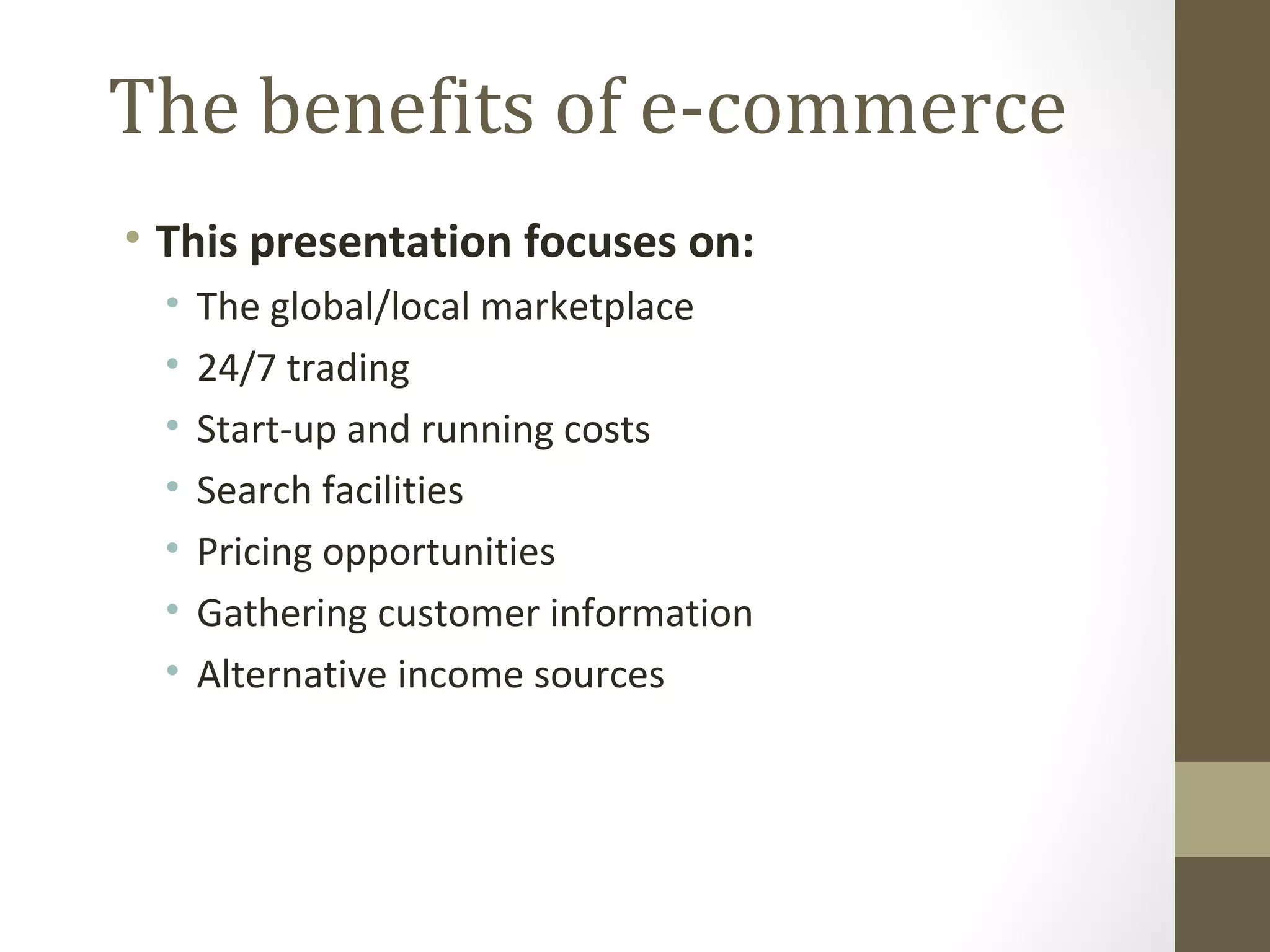
• This presentation focuses on:
  •   The global/local marketplace
  •   24/7 trading
  •   Start-up and running costs
  •   Search facilities
  •   Pricing opportunities
  •   Gathering customer information
  •   Alternative income sources
The global marketplace

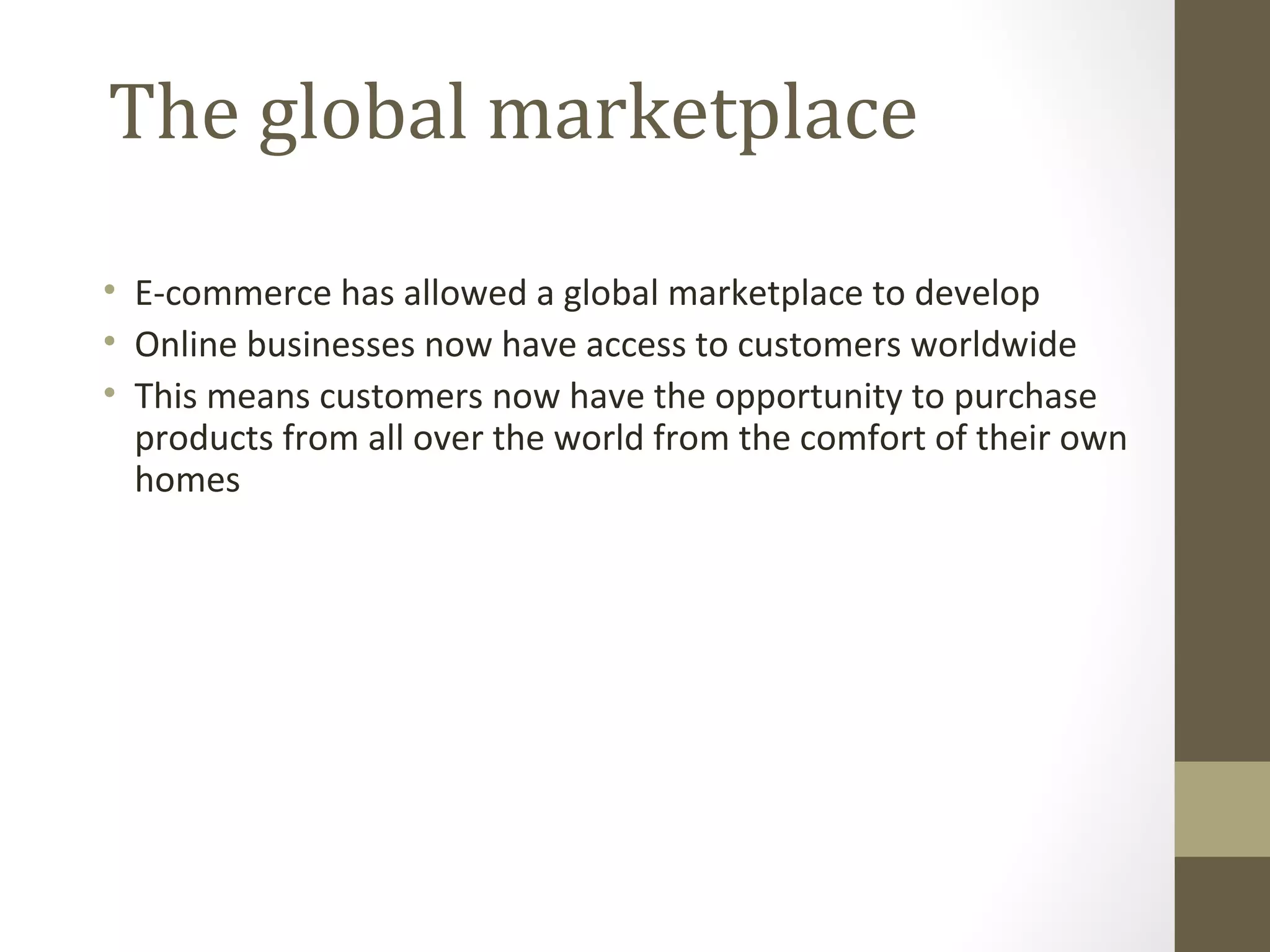
• E-commerce has allowed a global marketplace to develop
• Online businesses now have access to customers worldwide
• This means customers now have the opportunity to purchase
  products from all over the world from the comfort of their own
  homes
The local marketplace

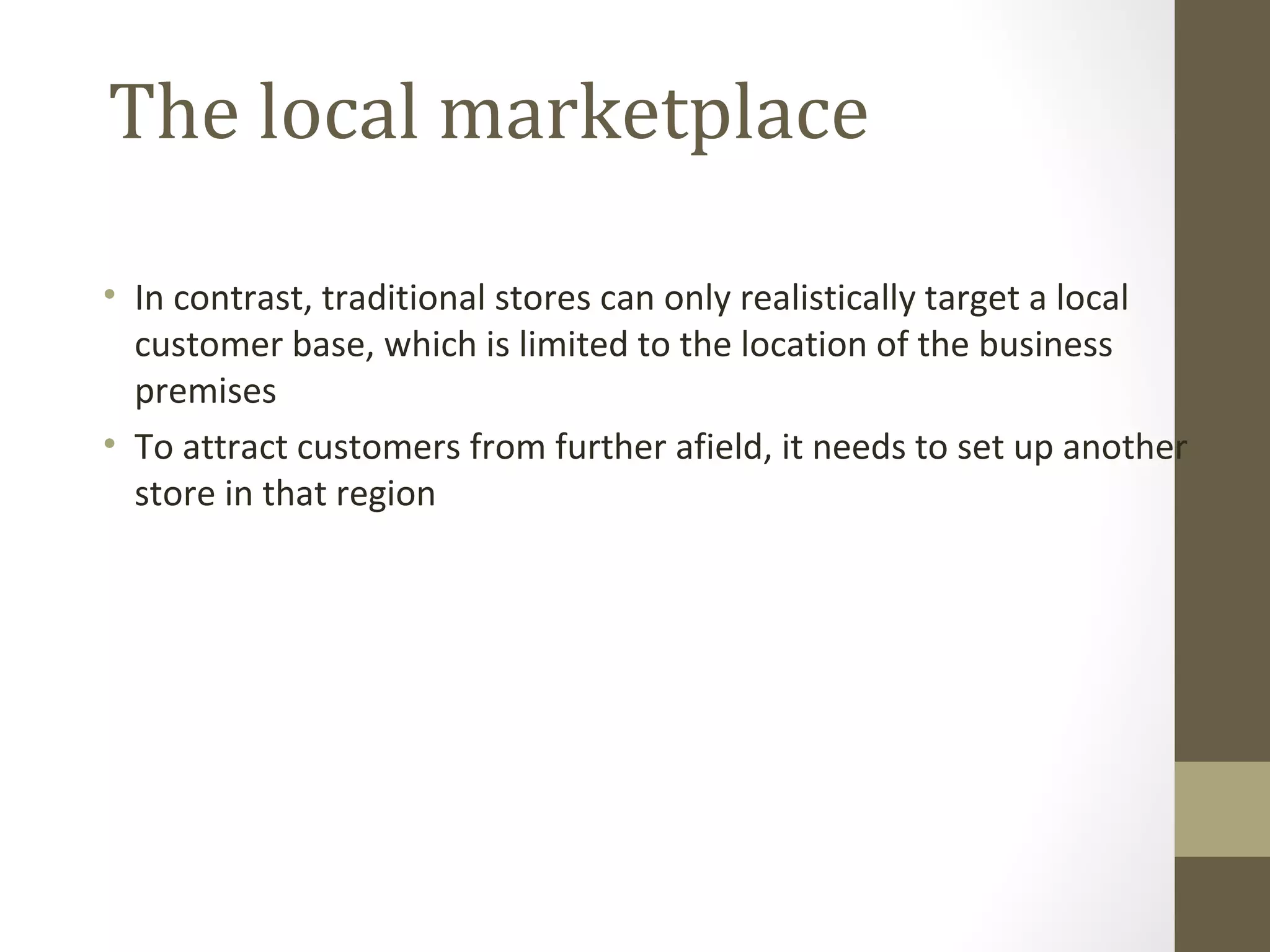
• In contrast, traditional stores can only realistically target a local
  customer base, which is limited to the location of the business
  premises
• To attract customers from further afield, it needs to set up another
  store in that region
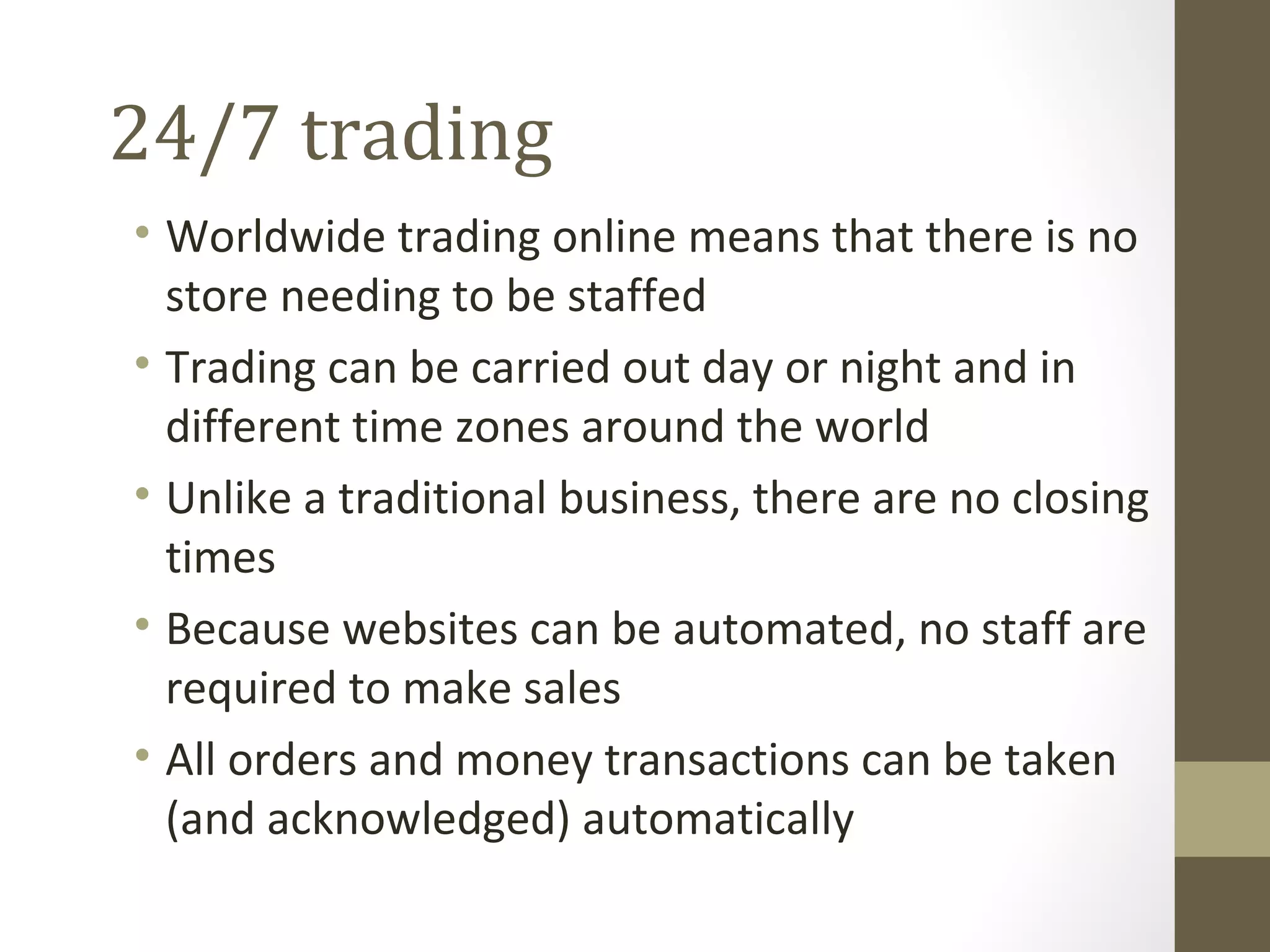
24/7 trading
• Worldwide trading online means that there is no
  store needing to be staffed
• Trading can be carried out day or night and in
  different time zones around the world
• Unlike a traditional business, there are no closing
  times
• Because websites can be automated, no staff are
  required to make sales
• All orders and money transactions can be taken
  (and acknowledged) automatically
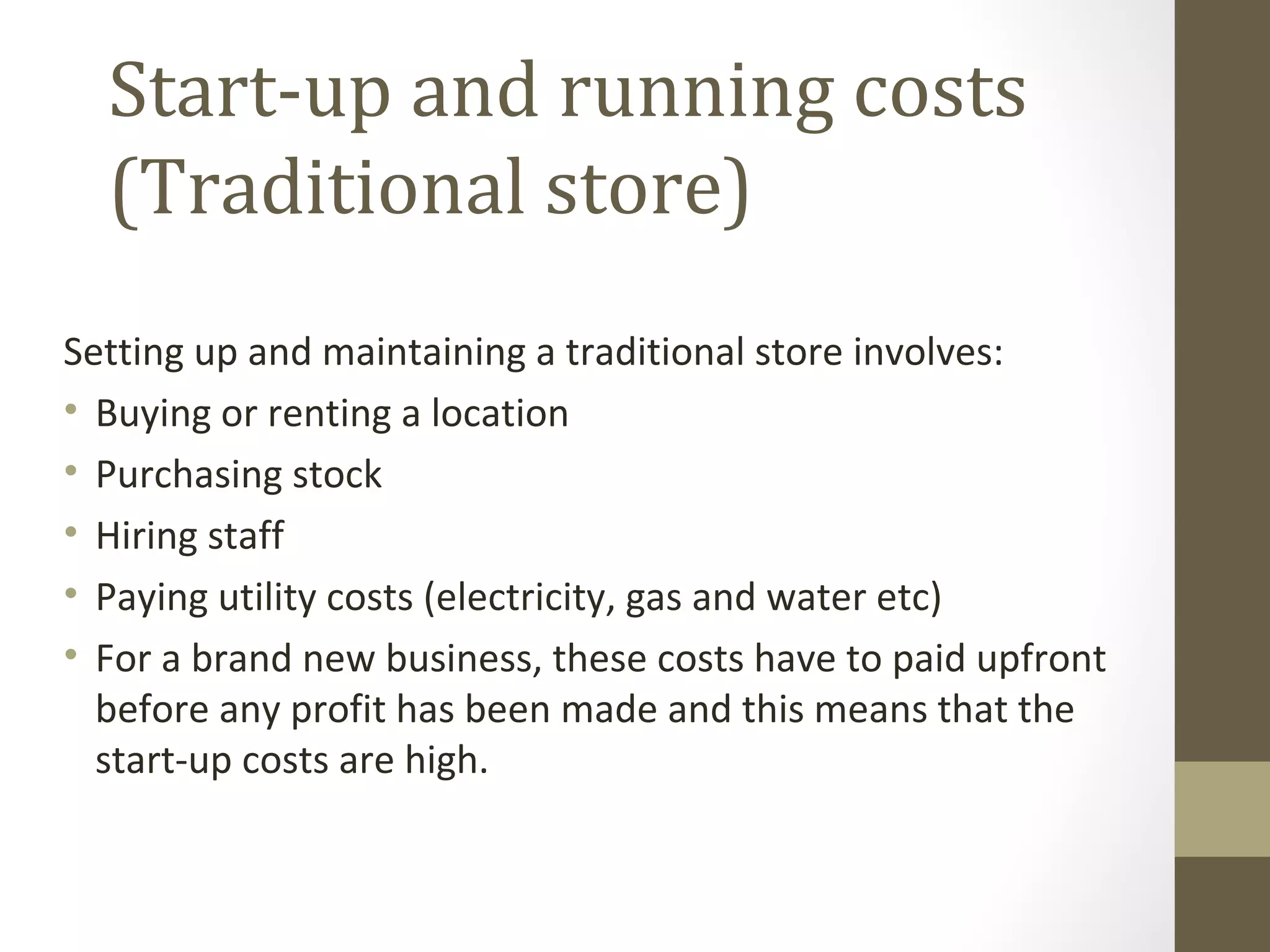
Start-up and running costs
  (Traditional store)
Setting up and maintaining a traditional store involves:
• Buying or renting a location
• Purchasing stock
• Hiring staff
• Paying utility costs (electricity, gas and water etc)
• For a brand new business, these costs have to paid upfront
  before any profit has been made and this means that the
  start-up costs are high.
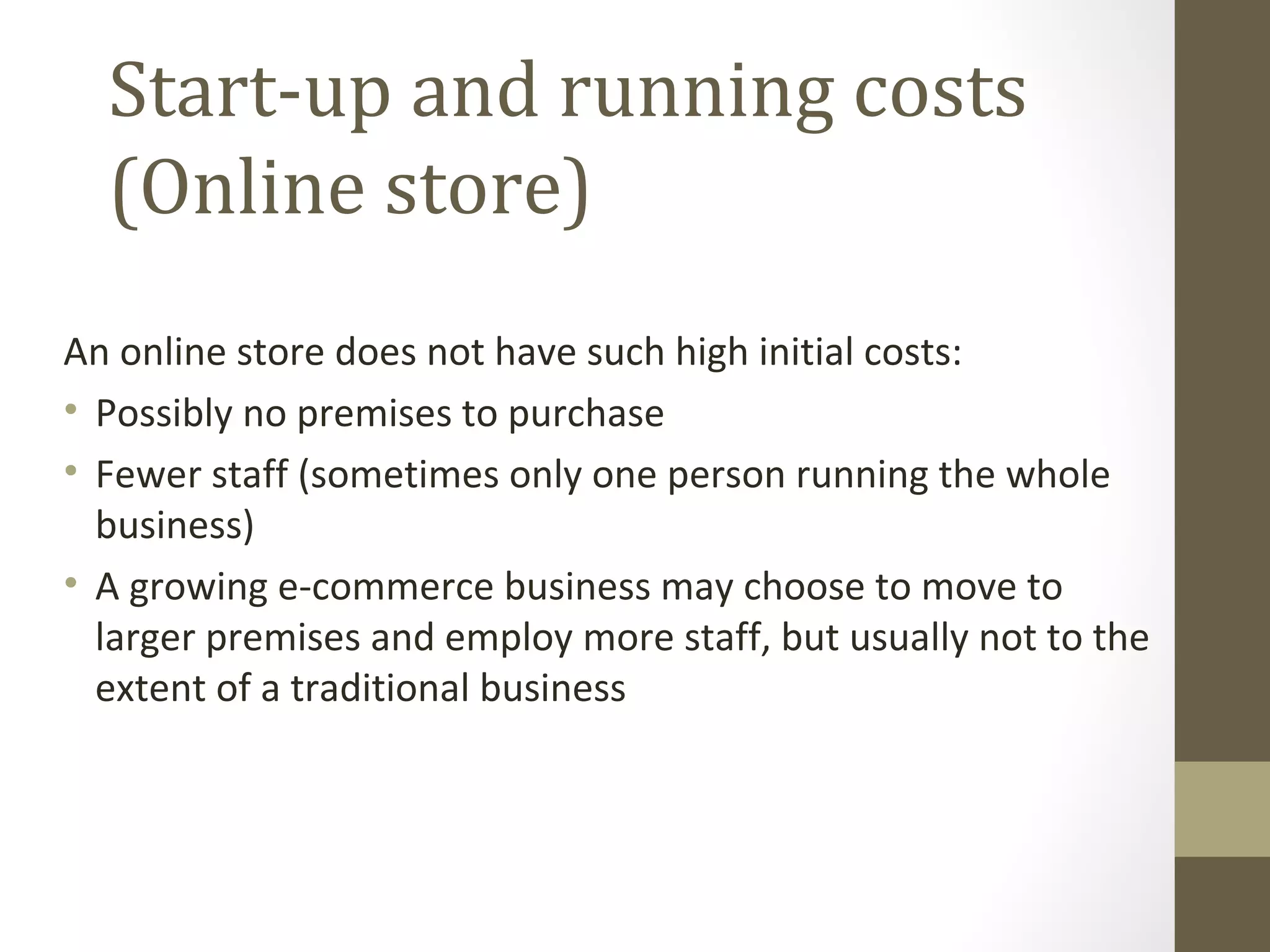
Start-up and running costs
  (Online store)
An online store does not have such high initial costs:
• Possibly no premises to purchase
• Fewer staff (sometimes only one person running the whole
  business)
• A growing e-commerce business may choose to move to
  larger premises and employ more staff, but usually not to the
  extent of a traditional business
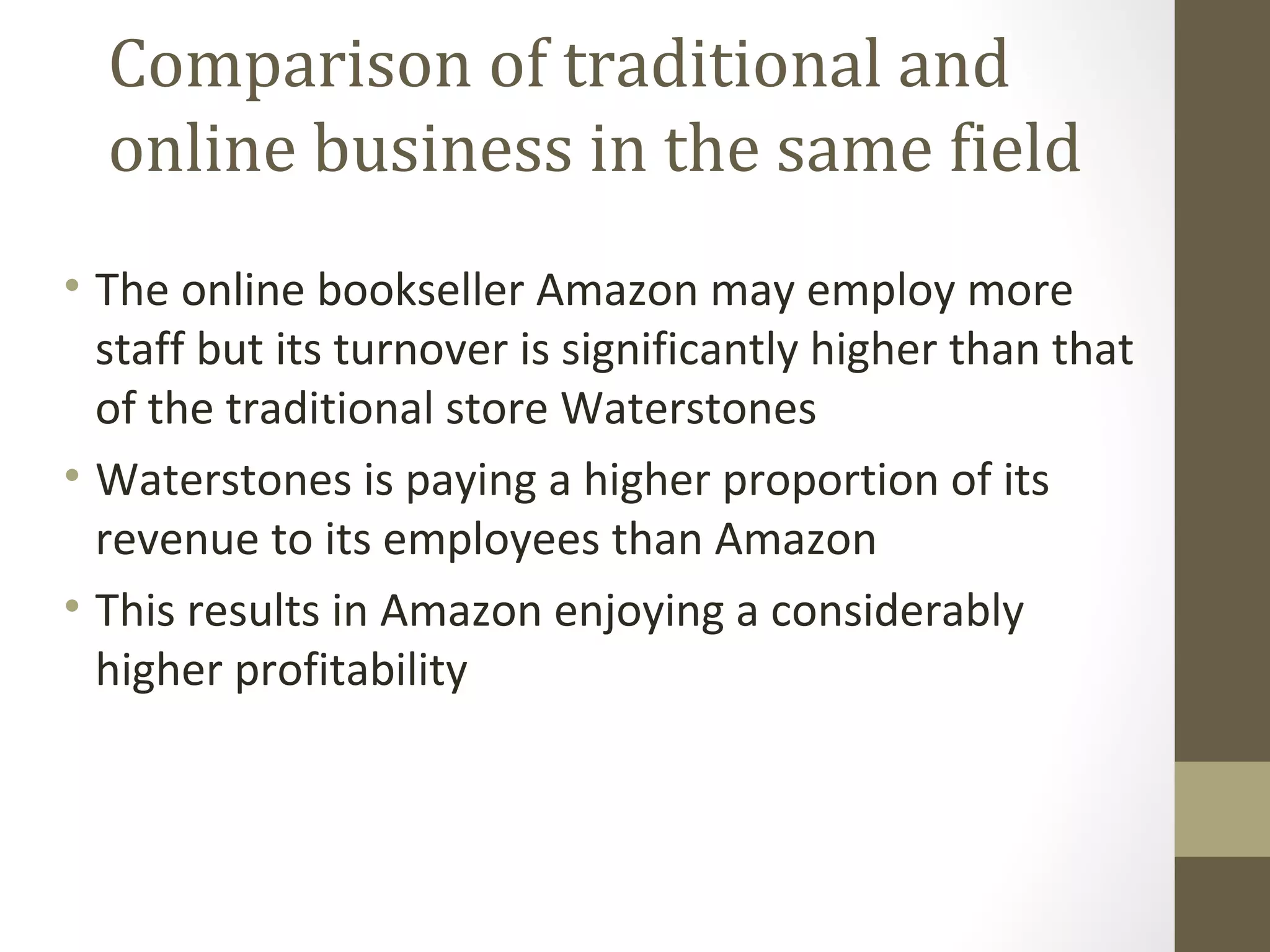
Comparison of traditional and
  online business in the same field
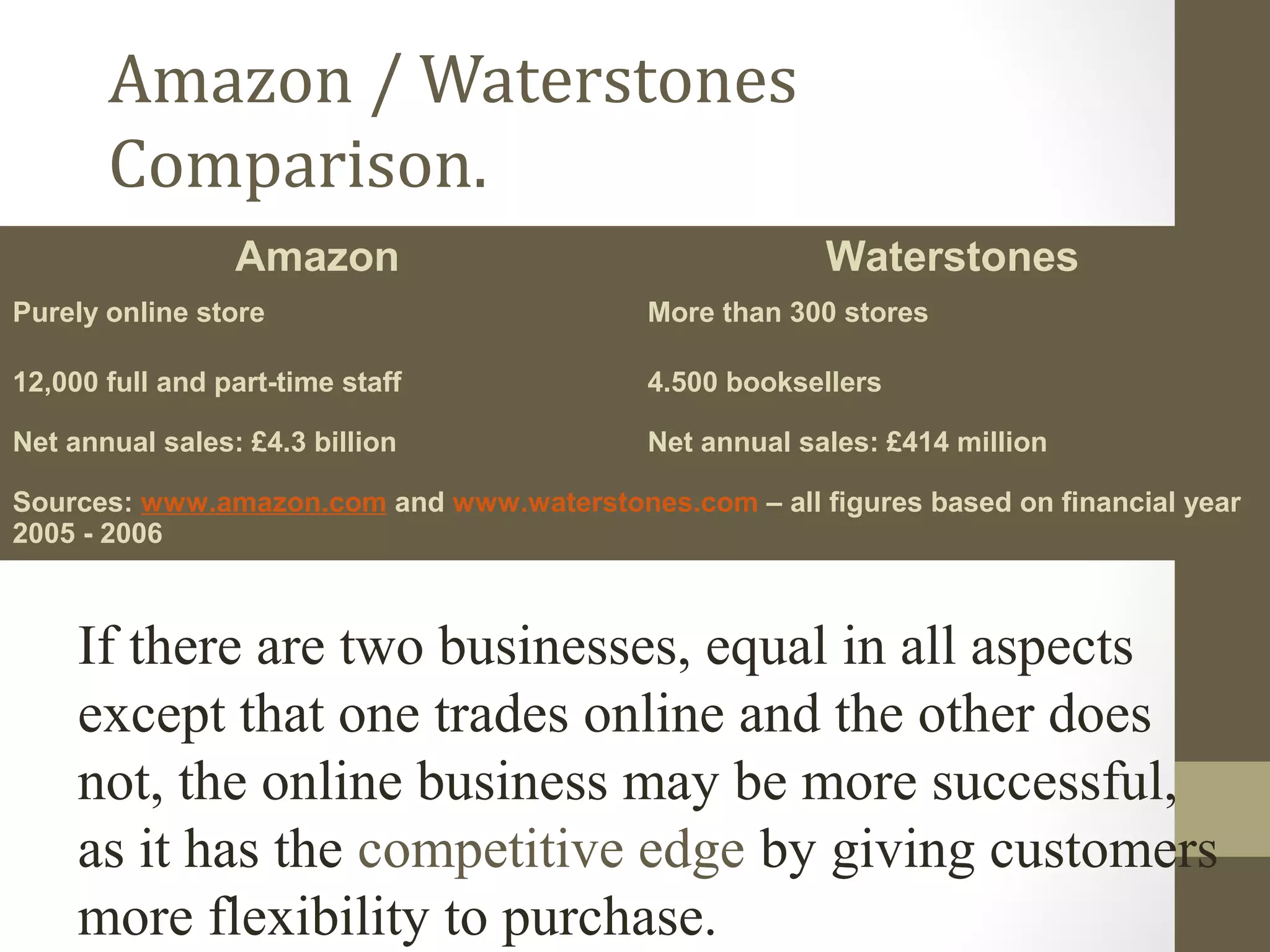
• The online bookseller Amazon may employ more
  staff but its turnover is significantly higher than that
  of the traditional store Waterstones
• Waterstones is paying a higher proportion of its
  revenue to its employees than Amazon
• This results in Amazon enjoying a considerably
  higher profitability
Amazon / Waterstones
       Comparison.
                 Amazon                                 Waterstones
Purely online store                        More than 300 stores

12,000 full and part-time staff            4.500 booksellers

Net annual sales: £4.3 billion             Net annual sales: £414 million

Sources: www.amazon.com and www.waterstones.com – all figures based on financial year
2005 - 2006


     If there are two businesses, equal in all aspects
     except that one trades online and the other does
     not, the online business may be more successful,
     as it has the competitive edge by giving customers
     more flexibility to purchase.
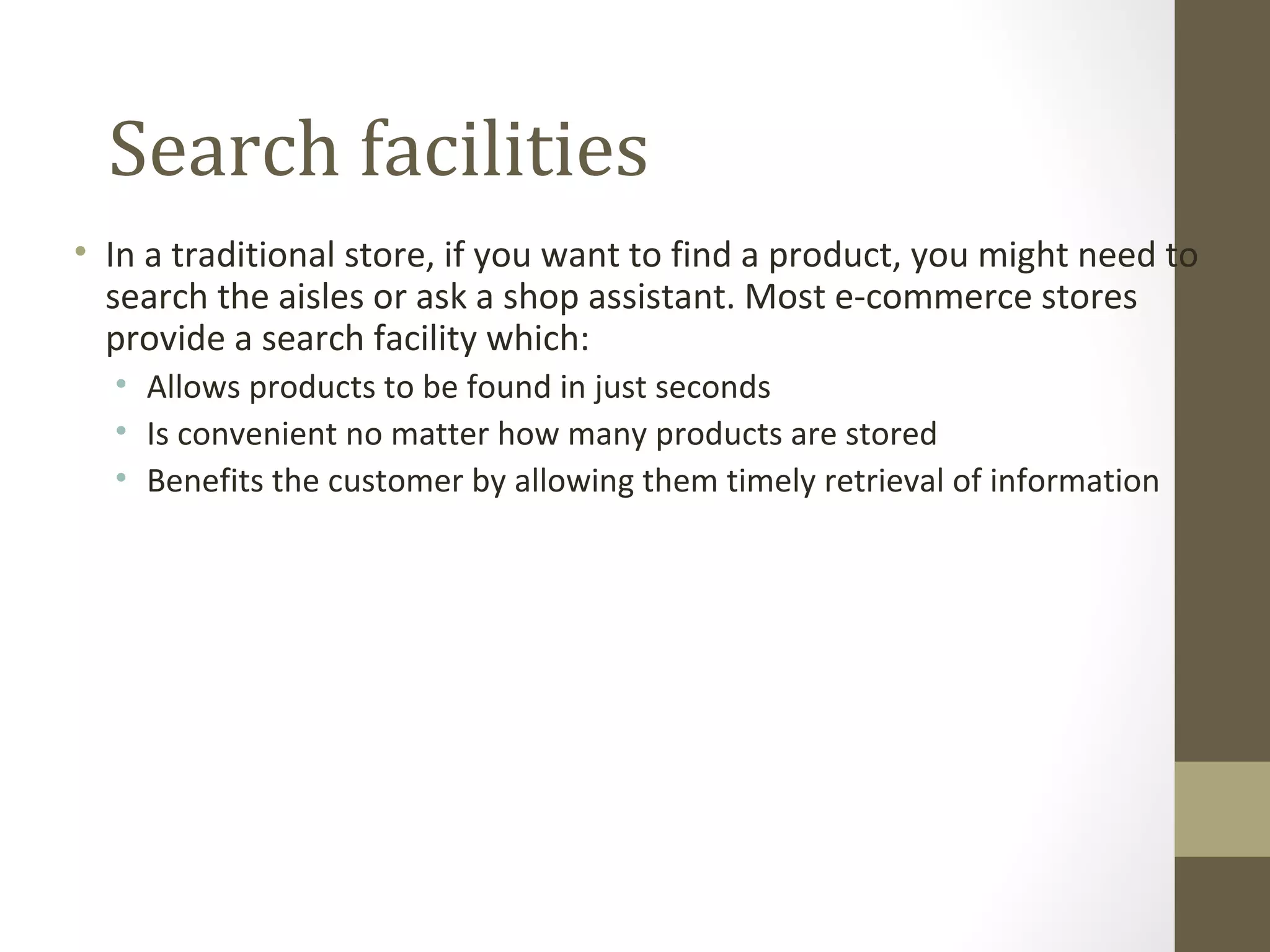
Search facilities
• In a traditional store, if you want to find a product, you might need to
  search the aisles or ask a shop assistant. Most e-commerce stores
  provide a search facility which:
  • Allows products to be found in just seconds
  • Is convenient no matter how many products are stored
  • Benefits the customer by allowing them timely retrieval of information
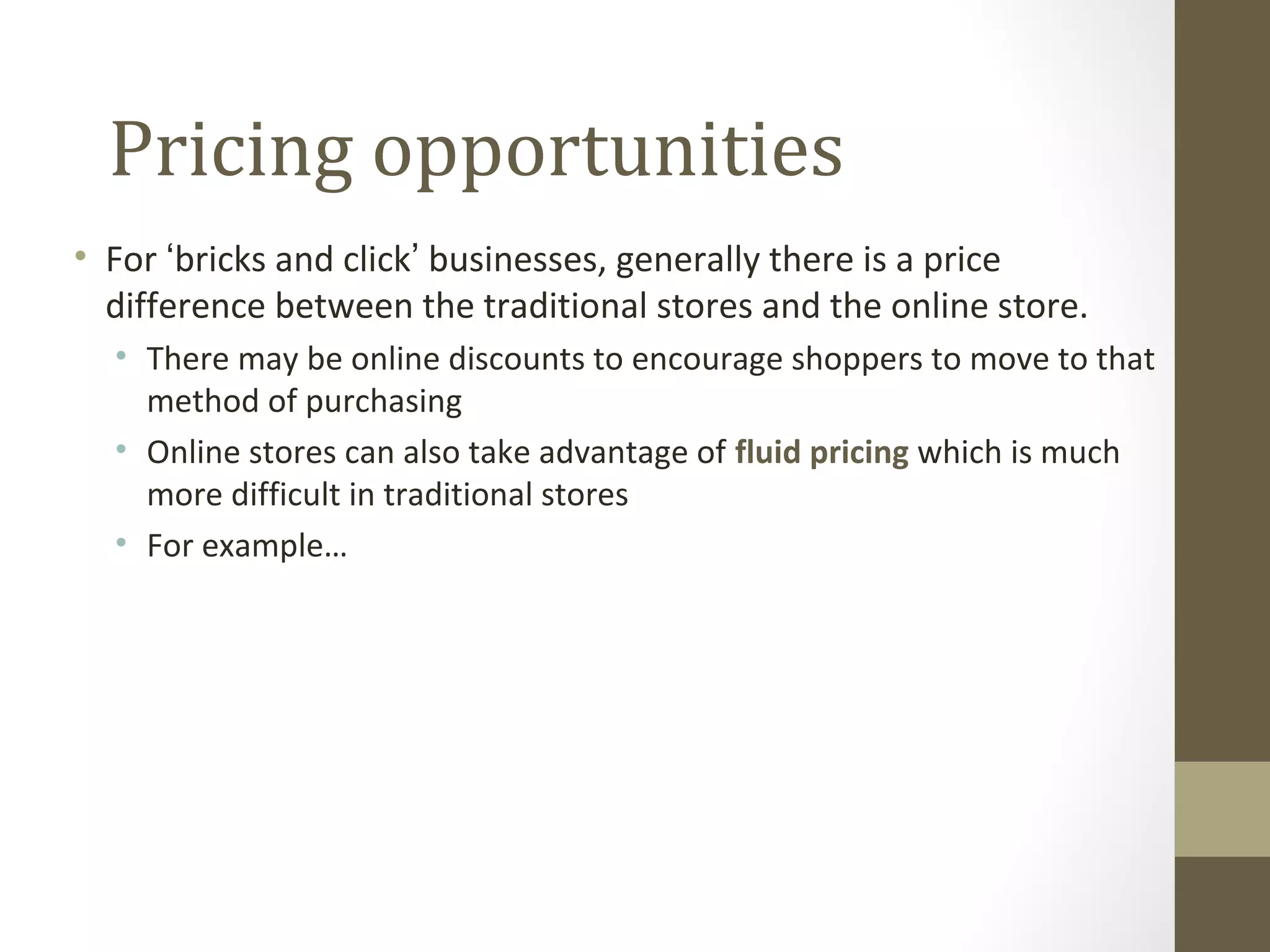
Pricing opportunities
• For ‘bricks and click’ businesses, generally there is a price
  difference between the traditional stores and the online store.
  • There may be online discounts to encourage shoppers to move to that
    method of purchasing
  • Online stores can also take advantage of fluid pricing which is much
    more difficult in traditional stores
  • For example…
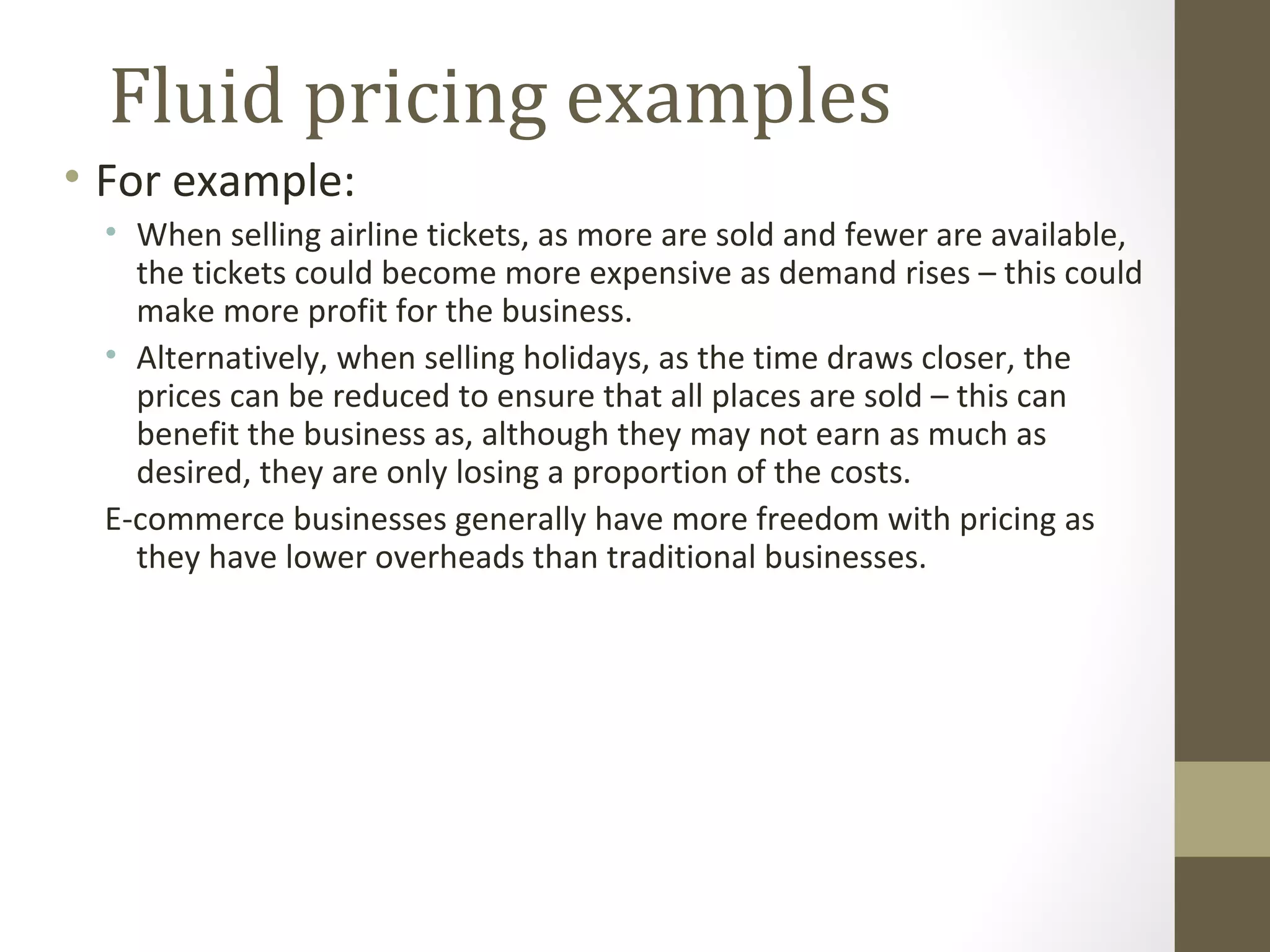
Fluid pricing examples
• For example:
 • When selling airline tickets, as more are sold and fewer are available,
   the tickets could become more expensive as demand rises – this could
   make more profit for the business.
 • Alternatively, when selling holidays, as the time draws closer, the
   prices can be reduced to ensure that all places are sold – this can
   benefit the business as, although they may not earn as much as
   desired, they are only losing a proportion of the costs.
 E-commerce businesses generally have more freedom with pricing as
   they have lower overheads than traditional businesses.
Gathering customer
  information
• Information is the cornerstone of all businesses and learning
  about the customers can be key to increasing profit.
   • It is difficult to gather information about customers
     shopping in a traditional stores – one method is to use
     loyalty cards that allow the business to track purchases
   • Online customers need to register as members to purchase
     products or services,
   • This allows the business to find out a lot about their
     customers and tailor their services to suit
   • As an example, when someone wants to purchase from
     Amazon, as soon as he/she logs in, he/she is greeted with a
     personalised message and a list of products he/she might
     like to buy based on previous purchases
Alternative income sources
• Once a business has an e-commerce facility, additional sources
  of income become available to it. For example:
  • Pay-per-click advertising – this may navigate the customer
     away from the site but each click on the advert would still
     gain money for the business
  • Can you think of any other ways that an e-commerce facility
     could generate income?
Further reading

• Textbooks:
  • Chaffey D – E-business and E-Commerce management, Second
    Edition (FT Prentice Hall, 2003) ISBN 0273683780
  • Lawson J – Information Technology Practitioners (Book1), Second
    Edition. (Heinemann, 2007) ISBN 9780435465490
  • Malmsten E, Leander K, Portanger E and Drazin C – Boo Hoo: A
    Dot.com Story from Concept to Catastrophe (Arrow Books Ltd,
    2002) ISBN 0099418371
  • Vise D – The Google Story (Macmillan, 2005) ISBN 1405053712

  • Websites
     • www.ico.gov.uk International Commissioners Office
     • www.w3.org World Wide Web Consortium

08 benefits of e-commerce

  • 1.
    The benefits ofe-commerce
  • 2.
    The benefits ofe-commerce • This presentation focuses on: • The global/local marketplace • 24/7 trading • Start-up and running costs • Search facilities • Pricing opportunities • Gathering customer information • Alternative income sources
  • 3.
    The global marketplace •E-commerce has allowed a global marketplace to develop • Online businesses now have access to customers worldwide • This means customers now have the opportunity to purchase products from all over the world from the comfort of their own homes
  • 4.
    The local marketplace •In contrast, traditional stores can only realistically target a local customer base, which is limited to the location of the business premises • To attract customers from further afield, it needs to set up another store in that region
  • 5.
    24/7 trading • Worldwidetrading online means that there is no store needing to be staffed • Trading can be carried out day or night and in different time zones around the world • Unlike a traditional business, there are no closing times • Because websites can be automated, no staff are required to make sales • All orders and money transactions can be taken (and acknowledged) automatically
  • 6.
    Start-up and runningcosts (Traditional store) Setting up and maintaining a traditional store involves: • Buying or renting a location • Purchasing stock • Hiring staff • Paying utility costs (electricity, gas and water etc) • For a brand new business, these costs have to paid upfront before any profit has been made and this means that the start-up costs are high.
  • 7.
    Start-up and runningcosts (Online store) An online store does not have such high initial costs: • Possibly no premises to purchase • Fewer staff (sometimes only one person running the whole business) • A growing e-commerce business may choose to move to larger premises and employ more staff, but usually not to the extent of a traditional business
  • 8.
    Comparison of traditionaland online business in the same field • The online bookseller Amazon may employ more staff but its turnover is significantly higher than that of the traditional store Waterstones • Waterstones is paying a higher proportion of its revenue to its employees than Amazon • This results in Amazon enjoying a considerably higher profitability
  • 9.
    Amazon / Waterstones Comparison. Amazon Waterstones Purely online store More than 300 stores 12,000 full and part-time staff 4.500 booksellers Net annual sales: £4.3 billion Net annual sales: £414 million Sources: www.amazon.com and www.waterstones.com – all figures based on financial year 2005 - 2006 If there are two businesses, equal in all aspects except that one trades online and the other does not, the online business may be more successful, as it has the competitive edge by giving customers more flexibility to purchase.
  • 10.
    Search facilities • Ina traditional store, if you want to find a product, you might need to search the aisles or ask a shop assistant. Most e-commerce stores provide a search facility which: • Allows products to be found in just seconds • Is convenient no matter how many products are stored • Benefits the customer by allowing them timely retrieval of information
  • 11.
    Pricing opportunities • For‘bricks and click’ businesses, generally there is a price difference between the traditional stores and the online store. • There may be online discounts to encourage shoppers to move to that method of purchasing • Online stores can also take advantage of fluid pricing which is much more difficult in traditional stores • For example…
  • 12.
    Fluid pricing examples •For example: • When selling airline tickets, as more are sold and fewer are available, the tickets could become more expensive as demand rises – this could make more profit for the business. • Alternatively, when selling holidays, as the time draws closer, the prices can be reduced to ensure that all places are sold – this can benefit the business as, although they may not earn as much as desired, they are only losing a proportion of the costs. E-commerce businesses generally have more freedom with pricing as they have lower overheads than traditional businesses.
  • 13.
    Gathering customer information • Information is the cornerstone of all businesses and learning about the customers can be key to increasing profit. • It is difficult to gather information about customers shopping in a traditional stores – one method is to use loyalty cards that allow the business to track purchases • Online customers need to register as members to purchase products or services, • This allows the business to find out a lot about their customers and tailor their services to suit • As an example, when someone wants to purchase from Amazon, as soon as he/she logs in, he/she is greeted with a personalised message and a list of products he/she might like to buy based on previous purchases
  • 14.
    Alternative income sources •Once a business has an e-commerce facility, additional sources of income become available to it. For example: • Pay-per-click advertising – this may navigate the customer away from the site but each click on the advert would still gain money for the business • Can you think of any other ways that an e-commerce facility could generate income?
  • 15.
    Further reading • Textbooks: • Chaffey D – E-business and E-Commerce management, Second Edition (FT Prentice Hall, 2003) ISBN 0273683780 • Lawson J – Information Technology Practitioners (Book1), Second Edition. (Heinemann, 2007) ISBN 9780435465490 • Malmsten E, Leander K, Portanger E and Drazin C – Boo Hoo: A Dot.com Story from Concept to Catastrophe (Arrow Books Ltd, 2002) ISBN 0099418371 • Vise D – The Google Story (Macmillan, 2005) ISBN 1405053712 • Websites • www.ico.gov.uk International Commissioners Office • www.w3.org World Wide Web Consortium