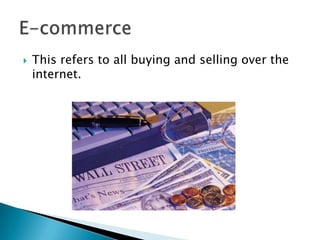
   This refers to all buying and selling over the
    internet.
   Advantages
    ◦   Services available 24 / 7
    ◦   Large stock range
    ◦   Detailed product information
    ◦   Ability to compare prices
    ◦   Equal delivery to town and country

   Disadvantages
    ◦ Possible credit card fraud
    ◦ What about returning faulty goods?
    ◦ How are you covered when you purchase goods from
      another country?
   This allows you to manage your money on-
    line.
   Advantages
    ◦   Service available 24/7
    ◦   Secure
    ◦   From comfort of home
    ◦   Can make various payments/transfers
    ◦   View transactions
   Disadvantages
    ◦ No face to face communication
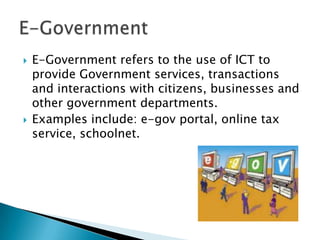
   E-Government refers to the use of ICT to
    provide Government services, transactions
    and interactions with citizens, businesses and
    other government departments.
   Examples include: e-gov portal, online tax
    service, schoolnet.
   Advantages
    ◦ No need to queue
    ◦ Can view all services
        available from home
    ◦ Quick communication

   Disadvantages
    ◦ No face to face communication therefore cannot get
      suggestions of alternative actions
   E-learning refers to learning via the internet
    or working through a disc based tutorial
   One trainer can train many people at different
    locations
   Students can work at their own pace
   Teaching can be 24/7
   E-learning solutions are cheaper than
    traditional teaching methods
   No opportunity to ask question and receive
    answer there and then
   Internet connection may fail
   Download speed may be slow
   Materials may be limited
   Refers to people working at home connected
    to the rest of the organisation via network, e-
    mail or telephone
   Reduced or Zero commuting
    ◦ No travelling
    ◦ Less stress due to traffic
   Greater ability to focus on one task
   Flexible schedule
   Reduced office space/desk requirements
   Lack of human contact
   Negative impact on team work
   Self-discipline (might be difficult to focus)

E-Services

  • 2.
    This refers to all buying and selling over the internet.
  • 3.
    Advantages ◦ Services available 24 / 7 ◦ Large stock range ◦ Detailed product information ◦ Ability to compare prices ◦ Equal delivery to town and country  Disadvantages ◦ Possible credit card fraud ◦ What about returning faulty goods? ◦ How are you covered when you purchase goods from another country?
  • 4.
    This allows you to manage your money on- line.
  • 5.
    Advantages ◦ Service available 24/7 ◦ Secure ◦ From comfort of home ◦ Can make various payments/transfers ◦ View transactions  Disadvantages ◦ No face to face communication
  • 6.
    E-Government refers to the use of ICT to provide Government services, transactions and interactions with citizens, businesses and other government departments.  Examples include: e-gov portal, online tax service, schoolnet.
  • 7.
    Advantages ◦ No need to queue ◦ Can view all services available from home ◦ Quick communication  Disadvantages ◦ No face to face communication therefore cannot get suggestions of alternative actions
  • 8.
    E-learning refers to learning via the internet or working through a disc based tutorial
  • 9.
    One trainer can train many people at different locations  Students can work at their own pace  Teaching can be 24/7  E-learning solutions are cheaper than traditional teaching methods
  • 10.
    No opportunity to ask question and receive answer there and then  Internet connection may fail  Download speed may be slow  Materials may be limited
  • 11.
    Refers to people working at home connected to the rest of the organisation via network, e- mail or telephone
  • 12.
    Reduced or Zero commuting ◦ No travelling ◦ Less stress due to traffic  Greater ability to focus on one task  Flexible schedule  Reduced office space/desk requirements
  • 13.
    Lack of human contact  Negative impact on team work  Self-discipline (might be difficult to focus)