

(Perspective, Rules, Scope, Goals and Significance)
What is HRM?
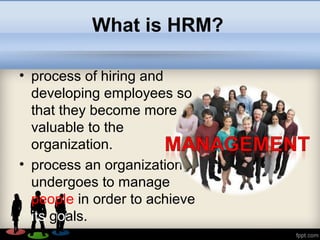
• process of hiring and
developing employees so
that they become more
valuable to the
organization.
• process an organization
undergoes to manage
people in order to achieve
its goals.
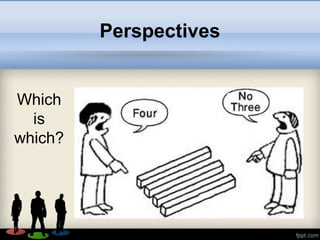
Perspectives
Which
is
which?
1. Normative Perspectve
• Hard HRM
-traditional approach
-stresses the linkage of functional areas to
corporate strategy
-views workforce as passive resources of the org.
and can be dispose at will
• Soft HRM
-modern approach
-considers human capital as “asset” rather than
“resources”
2. Critical Perspective
•Reaction against the normative perception
•Claim to follow soft HRM policies when they
actually enforces hard HRM
•Interest of the organization always take priority
over the individual employee.
3. Behavioral Perspective
• Considers employees behavior as the
mediator between strategy and organizational
performance.
• Control employees attitudes and behaviors to
suit the various strategies adopted to attain
the desired performance.
• Bases itself on the role behavior of
employees instead of their skills, knowledge,
and abilities.
4. Systems Perspective
• Describes an organization in terms of input,
throughput, and output
INPUT – organized activities of
employees
THROUGHPUT – transformation of
energies within the system
OUTPUT – resulting product or service
5. Agency or Transaction Cost Perspective
• Holds the view that the strong natural
inclination of people working in groups is to
reduce their performance and rely on the
efforts of others in the group.
• 2 Major Approaches to reduce conflicts
1.) Monitor employee behavior, establish
effective control system, and improve
productivity
2.) Provide employees with incentives
SCOPE
1. HRM in Personnel Management
• includes human resources planning, training and
development, induction and orientation, transfer,
promotion, compensation, layoff and
retrenchment, employee productivity
• Objective is to ascertain individual growth,
development and effectiveness
• Also includes performance appraisal, developing
new skills, disbursement of wages, incentives,
allowances, travelling policies and procedures
etc.
2. HRM in Employee Welfare
• Deals with working conditions and amenities at
workplace
• Includes array of responsibilities and services
(safety services, health services, welfare funds,
social security and medical services)
• Also relates to supervision, employee
counseling, establishing harmonious
relationships, education and training
3. HRM in Industrial Relations
• Careful interactions with labor or employee
unions, addressing their grievances and settling
the disputes effectively in order to maintain
peace and harmony in the organization
• Art and science of understanding employment
relations, joint consultation, disciplinary
procedures, solving problems with mutual
efforts, understanding human behavior and
maintaining work relations, collective bargaining
and settlement of disputes
GOALS
• Fundamental goals involve placing
appropriate employees in open positions,
promoting impartial and legal treatment of
all workers and ensuing the company
complies with applicable labor laws.
Objectives
1. Recruiting and Hiring – develop company’s
brand and attract quality employees
2. Employee Benefits – Insurance and retirement
plan to retain and attract quality employees
3. Recognition and Reward- Recognition and
reward programs to retain high performers and
to motivate employees
4. Training and Development – Employees who
need more knowledge or skills to capably
perform their duties or grow with the
company can benefit from professional
development.
Objectives
5. Legal Compliance – Interpreting federal, state
and local employment laws and ensuring the
company adhere them
6. Goal Setting Standards – Establishing goal
setting standards allows HR to monitor whether
employees are meeting company standards
7. Metrics and Reports – Uses HR metrics and
reports to measure the effectiveness of the
department
SIGNIFICANCE
• Objective – helps a company to achieve its
objective from time to time by creating a positive
attitude among workers.
• Facilitates professional growth– Due to
proper HR policies employees are trained well and this
makes them ready for future promotions
• Better relations between union and
management– Healthy HRM practices can help
the organization to maintain co-ordinal relationships
with the unions.
• .
SIGNIFICANCE
• Helps and individual to work in a
team/group– Effective HR practices teach
individuals team work and adjustment.
• Identifies person for the future– Since
employees are constantly trained, they are ready to
meet the job requirements.
• Allocating the jobs to the right person– If
proper recruitment and selection methods are
followed, the company will be able to select the right
people for the right job.
RULES
• Title VII of the Civil Rights Act of 1964 and Civil
Rights Act of 1991
– Made illegal the discrimination against employees or potential
recruits for reasons of race, color, religion, sex, and national
origin
– Forces employees to follow-and often-document-fairness
practices related to hiring, training, pay, benefits, and virtually
all other activities and responsibilities of HRM.
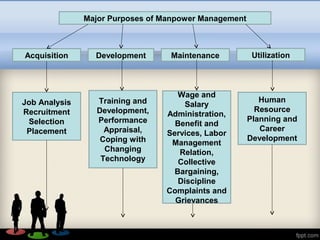
Major Purposes of Manpower Management
Acquisition Development Maintenance Utilization
Job Analysis
Recruitment
Selection
Placement
Training and
Development,
Performance
Appraisal,
Coping with
Changing
Technology
Wage and
Salary
Administration,
Benefit and
Services, Labor
Management
Relation,
Collective
Bargaining,
Discipline
Complaints and
Grievances
Human
Resource
Planning and
Career
Development
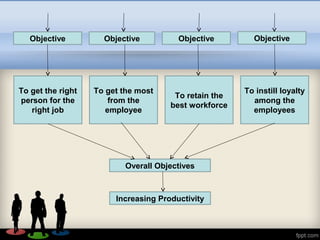
To get the right
person for the
right job
To get the most
from the
employee
To retain the
best workforce
To instill loyalty
among the
employees
Overall Objectives
Increasing Productivity
Objective Objective Objective Objective
Human Resource Management-Introduction

Human Resource Management-Introduction

  • 1.
    (Perspective, Rules, Scope,Goals and Significance)
  • 2.
    What is HRM? •process of hiring and developing employees so that they become more valuable to the organization. • process an organization undergoes to manage people in order to achieve its goals.
  • 3.
  • 4.
    1. Normative Perspectve •Hard HRM -traditional approach -stresses the linkage of functional areas to corporate strategy -views workforce as passive resources of the org. and can be dispose at will • Soft HRM -modern approach -considers human capital as “asset” rather than “resources”
  • 5.
    2. Critical Perspective •Reactionagainst the normative perception •Claim to follow soft HRM policies when they actually enforces hard HRM •Interest of the organization always take priority over the individual employee.
  • 6.
    3. Behavioral Perspective •Considers employees behavior as the mediator between strategy and organizational performance. • Control employees attitudes and behaviors to suit the various strategies adopted to attain the desired performance. • Bases itself on the role behavior of employees instead of their skills, knowledge, and abilities.
  • 7.
    4. Systems Perspective •Describes an organization in terms of input, throughput, and output INPUT – organized activities of employees THROUGHPUT – transformation of energies within the system OUTPUT – resulting product or service
  • 8.
    5. Agency orTransaction Cost Perspective • Holds the view that the strong natural inclination of people working in groups is to reduce their performance and rely on the efforts of others in the group. • 2 Major Approaches to reduce conflicts 1.) Monitor employee behavior, establish effective control system, and improve productivity 2.) Provide employees with incentives
  • 9.
  • 10.
    1. HRM inPersonnel Management • includes human resources planning, training and development, induction and orientation, transfer, promotion, compensation, layoff and retrenchment, employee productivity • Objective is to ascertain individual growth, development and effectiveness • Also includes performance appraisal, developing new skills, disbursement of wages, incentives, allowances, travelling policies and procedures etc.
  • 11.
    2. HRM inEmployee Welfare • Deals with working conditions and amenities at workplace • Includes array of responsibilities and services (safety services, health services, welfare funds, social security and medical services) • Also relates to supervision, employee counseling, establishing harmonious relationships, education and training
  • 12.
    3. HRM inIndustrial Relations • Careful interactions with labor or employee unions, addressing their grievances and settling the disputes effectively in order to maintain peace and harmony in the organization • Art and science of understanding employment relations, joint consultation, disciplinary procedures, solving problems with mutual efforts, understanding human behavior and maintaining work relations, collective bargaining and settlement of disputes
  • 13.
    GOALS • Fundamental goalsinvolve placing appropriate employees in open positions, promoting impartial and legal treatment of all workers and ensuing the company complies with applicable labor laws.
  • 14.
    Objectives 1. Recruiting andHiring – develop company’s brand and attract quality employees 2. Employee Benefits – Insurance and retirement plan to retain and attract quality employees 3. Recognition and Reward- Recognition and reward programs to retain high performers and to motivate employees 4. Training and Development – Employees who need more knowledge or skills to capably perform their duties or grow with the company can benefit from professional development.
  • 15.
    Objectives 5. Legal Compliance– Interpreting federal, state and local employment laws and ensuring the company adhere them 6. Goal Setting Standards – Establishing goal setting standards allows HR to monitor whether employees are meeting company standards 7. Metrics and Reports – Uses HR metrics and reports to measure the effectiveness of the department
  • 16.
    SIGNIFICANCE • Objective –helps a company to achieve its objective from time to time by creating a positive attitude among workers. • Facilitates professional growth– Due to proper HR policies employees are trained well and this makes them ready for future promotions • Better relations between union and management– Healthy HRM practices can help the organization to maintain co-ordinal relationships with the unions. • .
  • 17.
    SIGNIFICANCE • Helps andindividual to work in a team/group– Effective HR practices teach individuals team work and adjustment. • Identifies person for the future– Since employees are constantly trained, they are ready to meet the job requirements. • Allocating the jobs to the right person– If proper recruitment and selection methods are followed, the company will be able to select the right people for the right job.
  • 18.
    RULES • Title VIIof the Civil Rights Act of 1964 and Civil Rights Act of 1991 – Made illegal the discrimination against employees or potential recruits for reasons of race, color, religion, sex, and national origin – Forces employees to follow-and often-document-fairness practices related to hiring, training, pay, benefits, and virtually all other activities and responsibilities of HRM.
  • 20.
    Major Purposes ofManpower Management Acquisition Development Maintenance Utilization Job Analysis Recruitment Selection Placement Training and Development, Performance Appraisal, Coping with Changing Technology Wage and Salary Administration, Benefit and Services, Labor Management Relation, Collective Bargaining, Discipline Complaints and Grievances Human Resource Planning and Career Development
  • 21.
    To get theright person for the right job To get the most from the employee To retain the best workforce To instill loyalty among the employees Overall Objectives Increasing Productivity Objective Objective Objective Objective