WORKING CAPITAL
    MANAGEMENT


By: Noor ul hadi Lecturer GCMS Peshawar
Working Capital Management
• Working Capital Management is another
  important area of financial management.
• – Working Capital Management is
  component of financial management that
  focuses on Current Assets & Liabilities of
  Balance Sheet in day-to-day operation.
Working Capital Terminology:
• Working capital is also called gross working capital,
  simply refers to current assets used in operations.
• Working Capital (Gross) = Current Assets
• – Current Assets = Inventory + Accounts Receivables +
  Cash + Marketable Securities +
• …(The mentioned items are four major items)
• – Working Capital is different from “Capital” (as used
  in Capital Budgeting) which refers
• to Capital Expenditure in Fixed Assets
• – Also it is different from “Capital” (as used in Capital
  Structure) which refers to
• Financing in the form of Debt or Equity (Loans or share
  capital)
Working Capital Terminology:
•  Net Working Capital = Current Assets – Current Liabilities
• Net working capital is slightly different from gross working capital.
• – working capital is different from Net Worth
• = Assets – Liabilities = Equity
• = Stock + Retained Earnings
• – Current Liabilities
• = Accounts Payables + Accruals + Short Term Loans + (as well as
  other minor items)
• • Important Measure of the Short-term Liquidity of a Firm
• – Working capital is a measure of how easy it is for a firm to
  convert short-term assets
• into “Liquid” Cash in order to meet the Current Obligations by selling
  assets
Terminology
• – Some ratios to measure liquidity of firm are:
• Current Ratio = Current Assets / Current Liabilities
• Acid Test or Quick Ratio = Quick Assets / Current
  Liabilities
• • Quick Assets = Current Assets – Inventory
• • Fundamental Tradeoff in Working Capital (or Current
  Assets)
• Decision in working capital management is how much
  working capital should be maintained by a firm. It
  requires how much money needs to be invested in
  Inventory, Accounts Receivables, Marketable Securities
  and how much cash should be maintained.
Current Assets
•   Advantages of Large Current Assets:
•    less risk of shortages & interruptions and less loss
•   of sales due to availability of funds for lo an payments and purchases and
    inventory.
•   High Liquidity so better CREDIT Rating.
•   Advantages of Small Current Assets:
•   Less investment in current assets means less amount of money tied to the
    assets which are generating no return. So lower Opportunity Cost of Capital.
•   – Find the Optimum Current Assets (working capital) At Any Given Time
    and for a
•   Given Level of Sales & Growth:
•   • For this Alternative Investment Policies have been proposed and a good
•   business judgment is required
Working Capital Policies:

• • What is the Optimum Working Capital
  (or Current Assets) for a Firm at any given
  time given in level of Sales and Growth
  Strategy? This requirement fluctuates with
  time depending on sales and seasons.
Type of policy in Working Capital
Practically the following policies are used by
   the mangers to decide what is the best
   amount of current assets or mix of
   assets to be kept for the firm:
1. Relaxed Policy
2. Moderate Policy
3. Restricted Policy
1. “Fat Cat” or Relaxed Policy

– It requires Large Amount of Current Assets not
  to loose any sales i. e. when a customer
• places order for a large amount, there is no
  shortage of inventory
– Occurs when High sales driven by lot of credit
  facility to buyers
– Good Credit Rating because High Liquidity and
  good Current Ratio
– Case: Wall Mart retail chain during New Year
  and Christmas
2.“Lean & Mean” or Restricted Policy

–   Small Amount of Current Assets
–   It increases turnover and therefore Profits
•  Current Asset Turnover = Sales / Current Assets. Higher than 20.
•  Lowers Carrying Costs of Inventory
–   Frees up cash and speeds up production (operational efficiency)
–   Small Current Assets means Lower Opportunity Cost of Capital. Firms have
    raised
Capital from Investors (Debt Holders and Shareholders) which comes at a Cost
    (the WACC includes Interest paid to Debt Holders and Dividends paid to
    Shareholders).
Firms must mobilize the capital in high-return investments in order to repay
    their investors.
– “Zero Working Capital Policy” (Extreme form of Lean & Mean Policy)
It can not be 0 in reality but its objective is to minimize.
• Japanese Just in Time (JIT) i.e. Toyota Motor Co. It means the spare parts
    reach
just a few hours ago from the assembly time.
3.Moderate Policy

– In between the Fat Cat and Lean & Mean
  Policies
Impact of working capital on Firm Value:
There is a link between working capital
  policy and our basic objective of financial
  management of maximizing shareholder’s
  wealth.
MANAGING THE COMPONENT
   OF WORKING CAPITAL
• WORKING CAPITAL CONSIST FOUR MAIN
  COMPONENT
  –   CASH
  –   MARKETABLE
  –   INVENTORIES
  –   ACCOUNT RECIEVABLE
  For each type of assets, fundamental trade off: that current assets
    are necessary to conduct business, and the greater the holding
    of current assets, the smaller the danger of running business,
    holding current asset is costly if inventories are too large, then
    the firm will have asset with zero or negative return.
Cash Management
• The cash conversion cycle:
Conversion cycle include purchase of inventory, sell goods
  on credit, and the collect account receivable. The cycle is
  referred to as the cash conversion cycle, sound working
  capital is designed to minimizes the time between cash
  expenditures on material and the collection of cash on
  sale.
The cash conversion cylce model focused on the length of
  time between when the company makes payment and
  when it receives cash inflow, the following term are used
  in the model.
1. Inventory conversion period.

It is the average time required to convert material
    into finashied goods and thet o sell those good.
    It is calculated as follow:
Inventory conversion period=
  inventory /sale per day
For example average inventory is 2,000,000 and
    sale are 10000000 then conversion period
=2000000/(10000000)360 =72 days
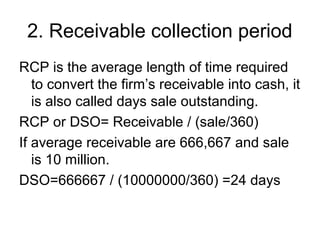
2. Receivable collection period
RCP is the average length of time required
   to convert the firm’s receivable into cash, it
   is also called days sale outstanding.
RCP or DSO= Receivable / (sale/360)
If average receivable are 666,667 and sale
   is 10 million.
DSO=666667 / (10000000/360) =24 days
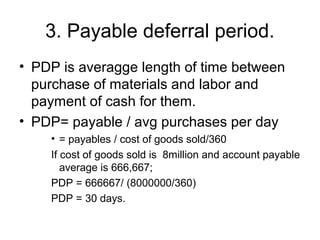
3. Payable deferral period.
• PDP is averagge length of time between
  purchase of materials and labor and
  payment of cash for them.
• PDP= payable / avg purchases per day
    • = payables / cost of goods sold/360
    If cost of goods sold is 8million and account payable
       average is 666,667;
    PDP = 666667/ (8000000/360)
    PDP = 30 days.
Cash conversion Cycle
It is nets out the three periods
   (ICP,RCP,PDP)

L09 working capital management

  • 1.
    WORKING CAPITAL MANAGEMENT By: Noor ul hadi Lecturer GCMS Peshawar
  • 2.
    Working Capital Management •Working Capital Management is another important area of financial management. • – Working Capital Management is component of financial management that focuses on Current Assets & Liabilities of Balance Sheet in day-to-day operation.
  • 3.
    Working Capital Terminology: •Working capital is also called gross working capital, simply refers to current assets used in operations. • Working Capital (Gross) = Current Assets • – Current Assets = Inventory + Accounts Receivables + Cash + Marketable Securities + • …(The mentioned items are four major items) • – Working Capital is different from “Capital” (as used in Capital Budgeting) which refers • to Capital Expenditure in Fixed Assets • – Also it is different from “Capital” (as used in Capital Structure) which refers to • Financing in the form of Debt or Equity (Loans or share capital)
  • 4.
    Working Capital Terminology: • Net Working Capital = Current Assets – Current Liabilities • Net working capital is slightly different from gross working capital. • – working capital is different from Net Worth • = Assets – Liabilities = Equity • = Stock + Retained Earnings • – Current Liabilities • = Accounts Payables + Accruals + Short Term Loans + (as well as other minor items) • • Important Measure of the Short-term Liquidity of a Firm • – Working capital is a measure of how easy it is for a firm to convert short-term assets • into “Liquid” Cash in order to meet the Current Obligations by selling assets
  • 5.
    Terminology • – Someratios to measure liquidity of firm are: • Current Ratio = Current Assets / Current Liabilities • Acid Test or Quick Ratio = Quick Assets / Current Liabilities • • Quick Assets = Current Assets – Inventory • • Fundamental Tradeoff in Working Capital (or Current Assets) • Decision in working capital management is how much working capital should be maintained by a firm. It requires how much money needs to be invested in Inventory, Accounts Receivables, Marketable Securities and how much cash should be maintained.
  • 6.
    Current Assets • Advantages of Large Current Assets: • less risk of shortages & interruptions and less loss • of sales due to availability of funds for lo an payments and purchases and inventory. • High Liquidity so better CREDIT Rating. • Advantages of Small Current Assets: • Less investment in current assets means less amount of money tied to the assets which are generating no return. So lower Opportunity Cost of Capital. • – Find the Optimum Current Assets (working capital) At Any Given Time and for a • Given Level of Sales & Growth: • • For this Alternative Investment Policies have been proposed and a good • business judgment is required
  • 7.
    Working Capital Policies: •• What is the Optimum Working Capital (or Current Assets) for a Firm at any given time given in level of Sales and Growth Strategy? This requirement fluctuates with time depending on sales and seasons.
  • 8.
    Type of policyin Working Capital Practically the following policies are used by the mangers to decide what is the best amount of current assets or mix of assets to be kept for the firm: 1. Relaxed Policy 2. Moderate Policy 3. Restricted Policy
  • 9.
    1. “Fat Cat”or Relaxed Policy – It requires Large Amount of Current Assets not to loose any sales i. e. when a customer • places order for a large amount, there is no shortage of inventory – Occurs when High sales driven by lot of credit facility to buyers – Good Credit Rating because High Liquidity and good Current Ratio – Case: Wall Mart retail chain during New Year and Christmas
  • 10.
    2.“Lean & Mean”or Restricted Policy – Small Amount of Current Assets – It increases turnover and therefore Profits • Current Asset Turnover = Sales / Current Assets. Higher than 20. • Lowers Carrying Costs of Inventory – Frees up cash and speeds up production (operational efficiency) – Small Current Assets means Lower Opportunity Cost of Capital. Firms have raised Capital from Investors (Debt Holders and Shareholders) which comes at a Cost (the WACC includes Interest paid to Debt Holders and Dividends paid to Shareholders). Firms must mobilize the capital in high-return investments in order to repay their investors. – “Zero Working Capital Policy” (Extreme form of Lean & Mean Policy) It can not be 0 in reality but its objective is to minimize. • Japanese Just in Time (JIT) i.e. Toyota Motor Co. It means the spare parts reach just a few hours ago from the assembly time.
  • 11.
    3.Moderate Policy – Inbetween the Fat Cat and Lean & Mean Policies Impact of working capital on Firm Value: There is a link between working capital policy and our basic objective of financial management of maximizing shareholder’s wealth.
  • 12.
    MANAGING THE COMPONENT OF WORKING CAPITAL • WORKING CAPITAL CONSIST FOUR MAIN COMPONENT – CASH – MARKETABLE – INVENTORIES – ACCOUNT RECIEVABLE For each type of assets, fundamental trade off: that current assets are necessary to conduct business, and the greater the holding of current assets, the smaller the danger of running business, holding current asset is costly if inventories are too large, then the firm will have asset with zero or negative return.
  • 13.
    Cash Management • Thecash conversion cycle: Conversion cycle include purchase of inventory, sell goods on credit, and the collect account receivable. The cycle is referred to as the cash conversion cycle, sound working capital is designed to minimizes the time between cash expenditures on material and the collection of cash on sale. The cash conversion cylce model focused on the length of time between when the company makes payment and when it receives cash inflow, the following term are used in the model.
  • 14.
    1. Inventory conversionperiod. It is the average time required to convert material into finashied goods and thet o sell those good. It is calculated as follow: Inventory conversion period= inventory /sale per day For example average inventory is 2,000,000 and sale are 10000000 then conversion period =2000000/(10000000)360 =72 days
  • 15.
    2. Receivable collectionperiod RCP is the average length of time required to convert the firm’s receivable into cash, it is also called days sale outstanding. RCP or DSO= Receivable / (sale/360) If average receivable are 666,667 and sale is 10 million. DSO=666667 / (10000000/360) =24 days
  • 16.
    3. Payable deferralperiod. • PDP is averagge length of time between purchase of materials and labor and payment of cash for them. • PDP= payable / avg purchases per day • = payables / cost of goods sold/360 If cost of goods sold is 8million and account payable average is 666,667; PDP = 666667/ (8000000/360) PDP = 30 days.
  • 17.
    Cash conversion Cycle Itis nets out the three periods (ICP,RCP,PDP)