Financial Management
    Lecture No. 4
Modifying Accounting Data for
    Managerial Decision
Modifying Accounting Data for
       Managerial Decision
Financial Statements are presented in
  Annual Report, Share holders and
  managers use these statements, some
  others stakeholders are also interest in
  these statement. Stakeholders need some
  modified information for corporate
  decision. Financial analyst combine stock
  prices and accounting data to make the
  statement more useful.
1st step in modifying Account is
         categories of Assets
Two Categories of Assets:
1. Operating Assets:
  •   Assets necessary to operate Business. Operating
      Assets are further divided in two categories
  1. Operating Current Assets 2. Long term operating
      Assets.
2. Non Operating Assets
  1. Non Operating assets refers to assets above the
     level of operating requirement, such short term
     investment, land held by company, and cash above
     the level of requirement.
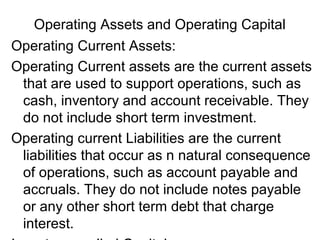
Operating Assets and Operating Capital
Operating Current Assets:
Operating Current assets are the current assets
 that are used to support operations, such as
 cash, inventory and account receivable. They
 do not include short term investment.
Operating current Liabilities are the current
 liabilities that occur as n natural consequence
 of operations, such as account payable and
 accruals. They do not include notes payable
 or any other short term debt that charge
 interest.
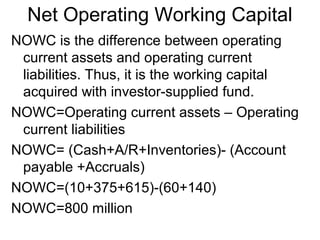
Net Operating Working Capital
NOWC is the difference between operating
 current assets and operating current
 liabilities. Thus, it is the working capital
 acquired with investor-supplied fund.
NOWC=Operating current assets – Operating
 current liabilities
NOWC= (Cash+A/R+Inventories)- (Account
 payable +Accruals)
NOWC=(10+375+615)-(60+140)
NOWC=800 million
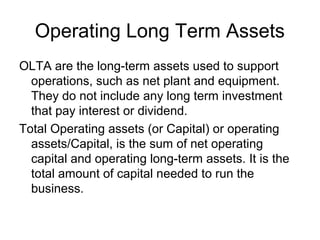
Operating Long Term Assets
OLTA are the long-term assets used to support
  operations, such as net plant and equipment.
  They do not include any long term investment
  that pay interest or dividend.
Total Operating assets (or Capital) or operating
  assets/Capital, is the sum of net operating
  capital and operating long-term assets. It is the
  total amount of capital needed to run the
  business.
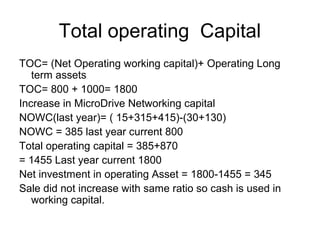
Total operating Capital
TOC= (Net Operating working capital)+ Operating Long
   term assets
TOC= 800 + 1000= 1800
Increase in MicroDrive Networking capital
NOWC(last year)= ( 15+315+415)-(30+130)
NOWC = 385 last year current 800
Total operating capital = 385+870
= 1455 Last year current 1800
Net investment in operating Asset = 1800-1455 = 345
Sale did not increase with same ratio so cash is used in
   working capital.
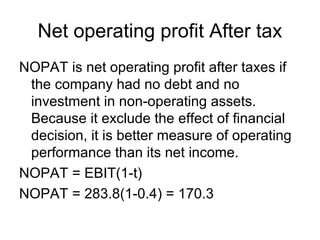
Net operating profit After tax
NOPAT is net operating profit after taxes if
 the company had no debt and no
 investment in non-operating assets.
 Because it exclude the effect of financial
 decision, it is better measure of operating
 performance than its net income.
NOPAT = EBIT(1-t)
NOPAT = 283.8(1-0.4) = 170.3
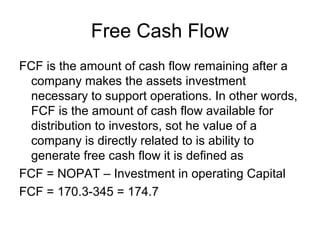
Free Cash Flow
FCF is the amount of cash flow remaining after a
 company makes the assets investment
 necessary to support operations. In other words,
 FCF is the amount of cash flow available for
 distribution to investors, sot he value of a
 company is directly related to is ability to
 generate free cash flow it is defined as
FCF = NOPAT – Investment in operating Capital
FCF = 170.3-345 = 174.7
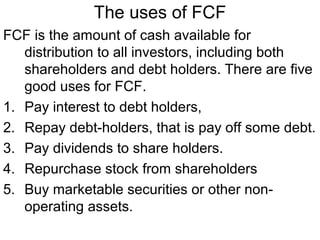
The uses of FCF
FCF is the amount of cash available for
   distribution to all investors, including both
   shareholders and debt holders. There are five
   good uses for FCF.
1. Pay interest to debt holders,
2. Repay debt-holders, that is pay off some debt.
3. Pay dividends to share holders.
4. Repurchase stock from shareholders
5. Buy marketable securities or other non-
   operating assets.
FCF and corporate value
FCF is the cash available for distribution to
 investors. Therefore, the value of a firm is
 primarily dependent on its expected future
 Free cash flow.
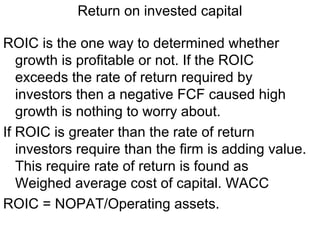
Return on invested capital

ROIC is the one way to determined whether
   growth is profitable or not. If the ROIC
   exceeds the rate of return required by
   investors then a negative FCF caused high
   growth is nothing to worry about.
If ROIC is greater than the rate of return
   investors require than the firm is adding value.
   This require rate of return is found as
   Weighed average cost of capital. WACC
ROIC = NOPAT/Operating assets.
MVA and EVA
These are two more tools other than traditional
 and modifying accounting data. Financial
 analyst develop these two methods to
 examine the maximization of the firms. These
 are MVA and EVA.
Market value added
MVA represents the difference between the
 total market value of a firm and the total
 amount of investors-supplied capital. If the
 market values of debt and preferred stock
 equal their values as reported on the
 financial statements, then MVA is the
 difference between the market value of a
 firm’s stock and the amount of equity its
 shareholders have supplies.
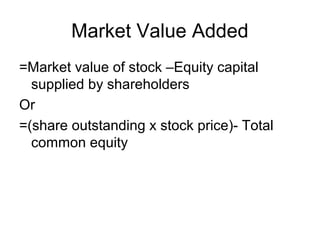
Market Value Added
=Market value of stock –Equity capital
  supplied by shareholders
Or
=(share outstanding x stock price)- Total
  common equity
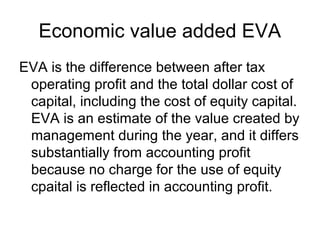
Economic value added EVA
EVA is the difference between after tax
 operating profit and the total dollar cost of
 capital, including the cost of equity capital.
 EVA is an estimate of the value created by
 management during the year, and it differs
 substantially from accounting profit
 because no charge for the use of equity
 cpaital is reflected in accounting profit.
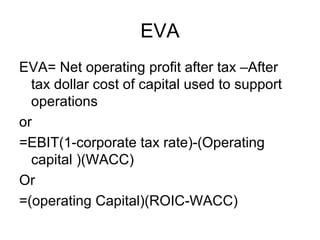
EVA
EVA= Net operating profit after tax –After
  tax dollar cost of capital used to support
  operations
or
=EBIT(1-corporate tax rate)-(Operating
  capital )(WACC)
Or
=(operating Capital)(ROIC-WACC)
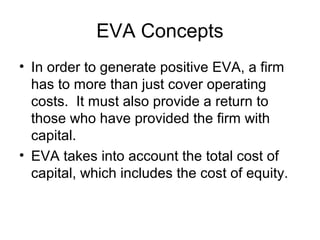
EVA Concepts
• In order to generate positive EVA, a firm
  has to more than just cover operating
  costs. It must also provide a return to
  those who have provided the firm with
  capital.
• EVA takes into account the total cost of
  capital, which includes the cost of equity.
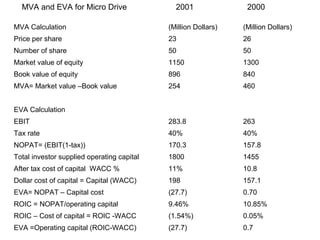
MVA and EVA for Micro Drive                 2001               2000

MVA Calculation                             (Million Dollars)   (Million Dollars)
Price per share                             23                  26
Number of share                             50                  50
Market value of equity                      1150                1300
Book value of equity                        896                 840
MVA= Market value –Book value               254                 460


EVA Calculation
EBIT                                        283.8               263
Tax rate                                    40%                 40%
NOPAT= (EBIT(1-tax))                        170.3               157.8
Total investor supplied operating capital   1800                1455
After tax cost of capital WACC %            11%                 10.8
Dollar cost of capital = Capital (WACC)     198                 157.1
EVA= NOPAT – Capital cost                   (27.7)              0.70
ROIC = NOPAT/operating capital              9.46%               10.85%
ROIC – Cost of capital = ROIC -WACC         (1.54%)             0.05%
EVA =Operating capital (ROIC-WACC)          (27.7)              0.7
Depreciation
Depreciation is important tools to reduce
 income tax. The larger the depreciation,
 the lower the taxable income and thus the
 lower the tax bill, hence the higher the
 cash flow from the operation.

L04 modifying accounting data for managerial decision

  • 1.
    Financial Management Lecture No. 4 Modifying Accounting Data for Managerial Decision
  • 2.
    Modifying Accounting Datafor Managerial Decision Financial Statements are presented in Annual Report, Share holders and managers use these statements, some others stakeholders are also interest in these statement. Stakeholders need some modified information for corporate decision. Financial analyst combine stock prices and accounting data to make the statement more useful.
  • 3.
    1st step inmodifying Account is categories of Assets Two Categories of Assets: 1. Operating Assets: • Assets necessary to operate Business. Operating Assets are further divided in two categories 1. Operating Current Assets 2. Long term operating Assets. 2. Non Operating Assets 1. Non Operating assets refers to assets above the level of operating requirement, such short term investment, land held by company, and cash above the level of requirement.
  • 4.
    Operating Assets andOperating Capital Operating Current Assets: Operating Current assets are the current assets that are used to support operations, such as cash, inventory and account receivable. They do not include short term investment. Operating current Liabilities are the current liabilities that occur as n natural consequence of operations, such as account payable and accruals. They do not include notes payable or any other short term debt that charge interest.
  • 5.
    Net Operating WorkingCapital NOWC is the difference between operating current assets and operating current liabilities. Thus, it is the working capital acquired with investor-supplied fund. NOWC=Operating current assets – Operating current liabilities NOWC= (Cash+A/R+Inventories)- (Account payable +Accruals) NOWC=(10+375+615)-(60+140) NOWC=800 million
  • 6.
    Operating Long TermAssets OLTA are the long-term assets used to support operations, such as net plant and equipment. They do not include any long term investment that pay interest or dividend. Total Operating assets (or Capital) or operating assets/Capital, is the sum of net operating capital and operating long-term assets. It is the total amount of capital needed to run the business.
  • 7.
    Total operating Capital TOC=(Net Operating working capital)+ Operating Long term assets TOC= 800 + 1000= 1800 Increase in MicroDrive Networking capital NOWC(last year)= ( 15+315+415)-(30+130) NOWC = 385 last year current 800 Total operating capital = 385+870 = 1455 Last year current 1800 Net investment in operating Asset = 1800-1455 = 345 Sale did not increase with same ratio so cash is used in working capital.
  • 8.
    Net operating profitAfter tax NOPAT is net operating profit after taxes if the company had no debt and no investment in non-operating assets. Because it exclude the effect of financial decision, it is better measure of operating performance than its net income. NOPAT = EBIT(1-t) NOPAT = 283.8(1-0.4) = 170.3
  • 9.
    Free Cash Flow FCFis the amount of cash flow remaining after a company makes the assets investment necessary to support operations. In other words, FCF is the amount of cash flow available for distribution to investors, sot he value of a company is directly related to is ability to generate free cash flow it is defined as FCF = NOPAT – Investment in operating Capital FCF = 170.3-345 = 174.7
  • 10.
    The uses ofFCF FCF is the amount of cash available for distribution to all investors, including both shareholders and debt holders. There are five good uses for FCF. 1. Pay interest to debt holders, 2. Repay debt-holders, that is pay off some debt. 3. Pay dividends to share holders. 4. Repurchase stock from shareholders 5. Buy marketable securities or other non- operating assets.
  • 11.
    FCF and corporatevalue FCF is the cash available for distribution to investors. Therefore, the value of a firm is primarily dependent on its expected future Free cash flow.
  • 12.
    Return on investedcapital ROIC is the one way to determined whether growth is profitable or not. If the ROIC exceeds the rate of return required by investors then a negative FCF caused high growth is nothing to worry about. If ROIC is greater than the rate of return investors require than the firm is adding value. This require rate of return is found as Weighed average cost of capital. WACC ROIC = NOPAT/Operating assets.
  • 13.
    MVA and EVA Theseare two more tools other than traditional and modifying accounting data. Financial analyst develop these two methods to examine the maximization of the firms. These are MVA and EVA.
  • 14.
    Market value added MVArepresents the difference between the total market value of a firm and the total amount of investors-supplied capital. If the market values of debt and preferred stock equal their values as reported on the financial statements, then MVA is the difference between the market value of a firm’s stock and the amount of equity its shareholders have supplies.
  • 15.
    Market Value Added =Marketvalue of stock –Equity capital supplied by shareholders Or =(share outstanding x stock price)- Total common equity
  • 16.
    Economic value addedEVA EVA is the difference between after tax operating profit and the total dollar cost of capital, including the cost of equity capital. EVA is an estimate of the value created by management during the year, and it differs substantially from accounting profit because no charge for the use of equity cpaital is reflected in accounting profit.
  • 17.
    EVA EVA= Net operatingprofit after tax –After tax dollar cost of capital used to support operations or =EBIT(1-corporate tax rate)-(Operating capital )(WACC) Or =(operating Capital)(ROIC-WACC)
  • 18.
    EVA Concepts • Inorder to generate positive EVA, a firm has to more than just cover operating costs. It must also provide a return to those who have provided the firm with capital. • EVA takes into account the total cost of capital, which includes the cost of equity.
  • 19.
    MVA and EVAfor Micro Drive 2001 2000 MVA Calculation (Million Dollars) (Million Dollars) Price per share 23 26 Number of share 50 50 Market value of equity 1150 1300 Book value of equity 896 840 MVA= Market value –Book value 254 460 EVA Calculation EBIT 283.8 263 Tax rate 40% 40% NOPAT= (EBIT(1-tax)) 170.3 157.8 Total investor supplied operating capital 1800 1455 After tax cost of capital WACC % 11% 10.8 Dollar cost of capital = Capital (WACC) 198 157.1 EVA= NOPAT – Capital cost (27.7) 0.70 ROIC = NOPAT/operating capital 9.46% 10.85% ROIC – Cost of capital = ROIC -WACC (1.54%) 0.05% EVA =Operating capital (ROIC-WACC) (27.7) 0.7
  • 20.
    Depreciation Depreciation is importanttools to reduce income tax. The larger the depreciation, the lower the taxable income and thus the lower the tax bill, hence the higher the cash flow from the operation.