Система распределенного,
 масштабируемого и высоконадежного
 хранения данных для виртуальных
 машин (и не только)
                            HighLoad++, 22-23 октября 2012


Kirill Korotaev
VP of Advanced Research, Parallels
Prehistory
Virtualization & needs


          1. VM migration   2. HA on failures


                            3
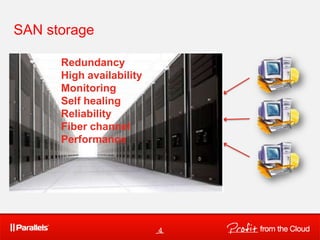
SAN storage

      Redundancy
      High availability
      Monitoring
      Self healing
      Reliability
      Fiber channel
      Performance


                          4
SAN

local


        How to get best of 2
             worlds?


100$                           100,000$


                   5
Idea of maximum simplification
Focus on needed capabilities is a key to success
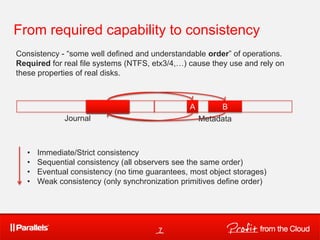
From required capability to consistency
Consistency - “some well defined and understandable order” of operations.
Required for real file systems (NTFS, etx3/4,…) cause they use and rely on
these properties of real disks.


                         A
                         B                      A        B
              Journal                               Metadata


   •   Immediate/Strict consistency
   •   Sequential consistency (all observers see the same order)
   •   Eventual consistency (no time guarantees, most object storages)
   •   Weak consistency (only synchronization primitives define order)


                                        7
We want grow on demand also…
• Grow on demand means ability to allocate more then locally
  available (>HDD or no free space)
• Requires split of data into pieces
• Probability(any of N computer failure) is increasing with N 
• So redundancy/replication and auto recovery is a MUST
• But recovery can be done in parallel (~1TB in 10mins)
• Good news is that MTTF ~1/T2, where T is recovery time.
• So let’s split all objects to chunks (64Mb)
• Replicate chunks, not objects
• Spread chunks over the cluster to reduce recovery T
• Need to take into account topology of cluster 

                               8
More ideas
Simplifications:
• No need for POSIX FS
• Optimize for big objects only
• Can assume infrequent/slow metadata updates

Major assumption:
• Shit happens: servers die, even DC can crash


                            9
Why consistency is not easy? Replication…

Simplest case: object is fully stored on a single node                   Object

Next step: object is replicated, i.e. multiple instances present
                                                                     t
 Server1         v1       v2


 Server2         v1       v2     DC crash

 Server3         v1                         v1           Stale data can be read!


                                            10
Why consistency is not easy? Data striping…

Splitting data into chunks leads to similar issues as replication:
    File     =    c1v1         c2v1

                                                                               t
                                      write   write

Server1           c1v1
Server2          c1v1                 c1v2


                                                      DC crash
Server3           c1v1                c1v2
                                                                    actual state is
Server4             c2v1                                               c1v2+c2v2,
Server5                 c2v1                   c2v2              but all combinations
Server6             c2v1                       c2v2               civj can be found


Note: c1v1 or/and c2v1 should never be read!


                                                11
So why consistency is not easy?
Data versioning is crucial and should be attributed
to data, plus heavily checked on operations!
Problems with versions:
1. Tracking versions requires transactions support and sync operations.
   SLOW! 
2. Can’t store versions near data only! Node can not decide alone whether
   it’s uptodate or not.

Solution:
1. Let’s update version only when some server can’t complete write! And
   leave it constant on successful data modifications.
2. To solve #2 let’s store versions on metadata servers (MDS) – authority
   which tracks full cluster state. It should be reliable and HA.


                                      12
Design
Overall design
                                       Meta Data Server (MDS)
                                         • Metadata database
                                         • Chunks and versions tracker
                                         • HA
             …

         Clients
                                                         MDS
      Chunk Server (CS)         Ethernet
      • Stores data (chunks)
      • Chunk management
      • READ/WRITE


 CS     CS         CS      CS       CS                   CS
                                                …                 CS


                                  14
Magic (MetaData) Server HA

• Single point of failure => need HA…
• Ouch, but we don’t want replicated DB, MySQL or Oracle…
  It’s a nightmare to manage. Not scalable.
• Database adds noticeable latency per chunk access


    We have to create our own replicated DB for MDS


                            15
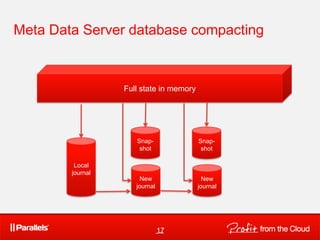
Meta Data Server database
 Ideas from GoogleFS:

                               • ~128 byte per chunk
                               • 64Mb RAM describe ~32 Terabytes
      Full state in memory       chunks


        Commit deltas
                             • Journal stores modification records
                             • It’s growing, so need compacting
             Local             method
             Local
            journal          • To compact in background, need
            journal            memory snapshotting
                             • Journal and state can be synced to
                               outdated nodes


                              16
Meta Data Server database compacting


                  Full state in memory


                     Snap-               Snap-
                      shot                shot

         Local
        journal
                       New                 New
                     journal             journal


                               17
PAXOS algorithm
The Part-Time Parliament, Leslie Lamport:
• The Island of Paxos, parliament government
• Legislators are traders, travel a lot and often not present in
  chamber
• They used non-reliable messengers for notifications and
  communication
• Decree is adopted using ballots, need majority of votes
• Legislators are each having it’s own journal of records
• Consistency of decrees is required
• Add/removal of legislators is needed
• Progress is needed

                                18
Performance
Chunk server performance tricks
 Write requests are split (64k) and chained:
                  Chained write


                                  CS              CS                CS


Write 256Kb req                   Completion                             t

      64k

                                        1 server, 256K write
                                        3 servers, 256K split/chained write
                                                                    3 servers, dumb

                                          20
SSD caching on clients
    • SSD bursts performance > 10x times
    • Caching on 2nd read access only to avoid excessive caching
    • Detect sequential access and avoid caching
                                         {fileID, offset}
       8-way hash                        generation
       and LRU                           blockid
                            …
                                         accesstime
• 3 parts: filter (RAM), cache, boot cache (1/8, 100MB / 2min)
• Sequential access detection relies on access time
• Write simply invalidates cached blocks
• Avoid interlaced reads: remote block, cached, remote,
  cached
• Writes (caching) affect reads performance (user I/O)

                                 21
SSD journaling at CS

• Bursts write performance, async commit to rotational drives
• Allows to implement data check summing and scrubbing
• Reason: major difference from object storages –
  performance and latency are very noticeable and important.
  Latency is not hidden by WAN.


                              22
Summary
Final result

Storage system:
• With file system interface, scalable to Petabytes
• Suitable for running VMs and Containers, Object Storage,
  shared hosting and other needs
• SAN like performance over ethernet networks:
  •   13K IOPS on 14 machines cluster (4 SATA HDD each)
  •   600K IOPS with SSD caching
  •   1TB drive recovery takes 10 minutes!


                                  24
Some experience to share

• Asynchronous non-blocking design
• QA: unit tests and stress testing are the must
• QA: how to emulate power off? SIGSTOP+SIGCONT/KILL.
   • It hangs connections and avoids RESETs as if host
     disappeared
• Drives/RAIDs/SSDs lie about FLUSHes.
• SSD write performance depends on data. Beware compression
  inside.
• Checksum everything (4GB/sec) and validate HW memtest86


                              25
Some experience to share

• All queues should be limited and controlled, like in TCP
  congestion control is required (both for memory limit and latency
  control, i.e. IO queue length)
  •   One client can fire Nx4K random requests and effectively it’s equivalent to
      1MB requests. Congestion should be calculated correctly (taking into
      accoung quality of queue).
• In addition to queues limit FDs/connections etc.
• Linux sync() / syncfs() is not usable
• Linux fdatasync() is 3.5-4x faster then fsync(), but should not be
  used when file size changed.
• Replication should be done by pairs


                                         26
Some experience to share

• Cluster identity: unique ID and name
• Cluster resolving: DNS, manual and zeroconf

• Interesting OSDI’12 Microsoft Research storage: uniform network
  topology, 2GB/sec per client, sorting world record 1.4TB in
  ~60sec.


                                27
Object storage

                 Image: ext4 filesystem

      Object                 Object       Object


                           28
Object storage

                 Image: ext4 filesystem

      Object                 Object       Object


                           29
Object storage


                                                     Image: ext4 filesystem
                                                Object            O           O


                                                                      Image: ext4 filesystem
      Image: ext4 filesystem
                                                                Object             O            O
  Object           O           O


                                                                                                    Image: ext4 filesystem
                                                                                               Object            O           O
                                   Image: ext4 filesystem
                               Object           O           O


                                                                                       Image: ext4 filesystem
                                                                                  Object                O        O


                                                                30
Thank You

Kirill Korotaev dev@parallels.com

Try Parallels Cloud Server 6.0 beta2 at
http://www.parallels.com/product/pcs


                                    31
Parallels - лидер на международном рынке в своих сегментах

• Автоматизация оказания              • Виртуализация ПК и Mac
  облачных сервисов                   • 3 млн. ПК во всем мире
• 10 млн. СМБ в 125 странах           • 81% рынка в розничных сетях США


Работа в Parallels - от программирования в ядрах ОС до
создания web интерфейсов и мобильных приложений


• Интересные проекты                    • Процесс разработки
                                          мирового класса
• Работа бок о бок с
  легендами ИТ-                         • Карьера, опционы
  индустрии
              Присоединяйся к лучшим! Job@parallels.com


                               • 32

Cистема распределенного, масштабируемого и высоконадежного хранения данных для виртуальных машин (Кирилл Коротаев)

  • 1.
    Система распределенного, масштабируемогои высоконадежного хранения данных для виртуальных машин (и не только) HighLoad++, 22-23 октября 2012 Kirill Korotaev VP of Advanced Research, Parallels
  • 2.
  • 3.
    Virtualization & needs 1. VM migration 2. HA on failures 3
  • 4.
    SAN storage Redundancy High availability Monitoring Self healing Reliability Fiber channel Performance 4
  • 5.
    SAN local How to get best of 2 worlds? 100$ 100,000$ 5
  • 6.
    Idea of maximumsimplification Focus on needed capabilities is a key to success
  • 7.
    From required capabilityto consistency Consistency - “some well defined and understandable order” of operations. Required for real file systems (NTFS, etx3/4,…) cause they use and rely on these properties of real disks. A B A B Journal Metadata • Immediate/Strict consistency • Sequential consistency (all observers see the same order) • Eventual consistency (no time guarantees, most object storages) • Weak consistency (only synchronization primitives define order) 7
  • 8.
    We want growon demand also… • Grow on demand means ability to allocate more then locally available (>HDD or no free space) • Requires split of data into pieces • Probability(any of N computer failure) is increasing with N  • So redundancy/replication and auto recovery is a MUST • But recovery can be done in parallel (~1TB in 10mins) • Good news is that MTTF ~1/T2, where T is recovery time. • So let’s split all objects to chunks (64Mb) • Replicate chunks, not objects • Spread chunks over the cluster to reduce recovery T • Need to take into account topology of cluster  8
  • 9.
    More ideas Simplifications: • Noneed for POSIX FS • Optimize for big objects only • Can assume infrequent/slow metadata updates Major assumption: • Shit happens: servers die, even DC can crash 9
  • 10.
    Why consistency isnot easy? Replication… Simplest case: object is fully stored on a single node Object Next step: object is replicated, i.e. multiple instances present t Server1 v1 v2 Server2 v1 v2 DC crash Server3 v1 v1 Stale data can be read! 10
  • 11.
    Why consistency isnot easy? Data striping… Splitting data into chunks leads to similar issues as replication: File = c1v1 c2v1 t write write Server1 c1v1 Server2 c1v1 c1v2 DC crash Server3 c1v1 c1v2 actual state is Server4 c2v1 c1v2+c2v2, Server5 c2v1 c2v2 but all combinations Server6 c2v1 c2v2 civj can be found Note: c1v1 or/and c2v1 should never be read! 11
  • 12.
    So why consistencyis not easy? Data versioning is crucial and should be attributed to data, plus heavily checked on operations! Problems with versions: 1. Tracking versions requires transactions support and sync operations. SLOW!  2. Can’t store versions near data only! Node can not decide alone whether it’s uptodate or not. Solution: 1. Let’s update version only when some server can’t complete write! And leave it constant on successful data modifications. 2. To solve #2 let’s store versions on metadata servers (MDS) – authority which tracks full cluster state. It should be reliable and HA. 12
  • 13.
  • 14.
    Overall design Meta Data Server (MDS) • Metadata database • Chunks and versions tracker • HA … Clients MDS Chunk Server (CS) Ethernet • Stores data (chunks) • Chunk management • READ/WRITE CS CS CS CS CS CS … CS 14
  • 15.
    Magic (MetaData) ServerHA • Single point of failure => need HA… • Ouch, but we don’t want replicated DB, MySQL or Oracle… It’s a nightmare to manage. Not scalable. • Database adds noticeable latency per chunk access We have to create our own replicated DB for MDS 15
  • 16.
    Meta Data Serverdatabase Ideas from GoogleFS: • ~128 byte per chunk • 64Mb RAM describe ~32 Terabytes Full state in memory chunks Commit deltas • Journal stores modification records • It’s growing, so need compacting Local method Local journal • To compact in background, need journal memory snapshotting • Journal and state can be synced to outdated nodes 16
  • 17.
    Meta Data Serverdatabase compacting Full state in memory Snap- Snap- shot shot Local journal New New journal journal 17
  • 18.
    PAXOS algorithm The Part-TimeParliament, Leslie Lamport: • The Island of Paxos, parliament government • Legislators are traders, travel a lot and often not present in chamber • They used non-reliable messengers for notifications and communication • Decree is adopted using ballots, need majority of votes • Legislators are each having it’s own journal of records • Consistency of decrees is required • Add/removal of legislators is needed • Progress is needed 18
  • 19.
  • 20.
    Chunk server performancetricks Write requests are split (64k) and chained: Chained write CS CS CS Write 256Kb req Completion t 64k 1 server, 256K write 3 servers, 256K split/chained write 3 servers, dumb 20
  • 21.
    SSD caching onclients • SSD bursts performance > 10x times • Caching on 2nd read access only to avoid excessive caching • Detect sequential access and avoid caching {fileID, offset} 8-way hash generation and LRU blockid … accesstime • 3 parts: filter (RAM), cache, boot cache (1/8, 100MB / 2min) • Sequential access detection relies on access time • Write simply invalidates cached blocks • Avoid interlaced reads: remote block, cached, remote, cached • Writes (caching) affect reads performance (user I/O) 21
  • 22.
    SSD journaling atCS • Bursts write performance, async commit to rotational drives • Allows to implement data check summing and scrubbing • Reason: major difference from object storages – performance and latency are very noticeable and important. Latency is not hidden by WAN. 22
  • 23.
  • 24.
    Final result Storage system: •With file system interface, scalable to Petabytes • Suitable for running VMs and Containers, Object Storage, shared hosting and other needs • SAN like performance over ethernet networks: • 13K IOPS on 14 machines cluster (4 SATA HDD each) • 600K IOPS with SSD caching • 1TB drive recovery takes 10 minutes! 24
  • 25.
    Some experience toshare • Asynchronous non-blocking design • QA: unit tests and stress testing are the must • QA: how to emulate power off? SIGSTOP+SIGCONT/KILL. • It hangs connections and avoids RESETs as if host disappeared • Drives/RAIDs/SSDs lie about FLUSHes. • SSD write performance depends on data. Beware compression inside. • Checksum everything (4GB/sec) and validate HW memtest86 25
  • 26.
    Some experience toshare • All queues should be limited and controlled, like in TCP congestion control is required (both for memory limit and latency control, i.e. IO queue length) • One client can fire Nx4K random requests and effectively it’s equivalent to 1MB requests. Congestion should be calculated correctly (taking into accoung quality of queue). • In addition to queues limit FDs/connections etc. • Linux sync() / syncfs() is not usable • Linux fdatasync() is 3.5-4x faster then fsync(), but should not be used when file size changed. • Replication should be done by pairs 26
  • 27.
    Some experience toshare • Cluster identity: unique ID and name • Cluster resolving: DNS, manual and zeroconf • Interesting OSDI’12 Microsoft Research storage: uniform network topology, 2GB/sec per client, sorting world record 1.4TB in ~60sec. 27
  • 28.
    Object storage Image: ext4 filesystem Object Object Object 28
  • 29.
    Object storage Image: ext4 filesystem Object Object Object 29
  • 30.
    Object storage Image: ext4 filesystem Object O O Image: ext4 filesystem Image: ext4 filesystem Object O O Object O O Image: ext4 filesystem Object O O Image: ext4 filesystem Object O O Image: ext4 filesystem Object O O 30
  • 31.
    Thank You Kirill Korotaevdev@parallels.com Try Parallels Cloud Server 6.0 beta2 at http://www.parallels.com/product/pcs 31
  • 32.
    Parallels - лидерна международном рынке в своих сегментах • Автоматизация оказания • Виртуализация ПК и Mac облачных сервисов • 3 млн. ПК во всем мире • 10 млн. СМБ в 125 странах • 81% рынка в розничных сетях США Работа в Parallels - от программирования в ядрах ОС до создания web интерфейсов и мобильных приложений • Интересные проекты • Процесс разработки мирового класса • Работа бок о бок с легендами ИТ- • Карьера, опционы индустрии Присоединяйся к лучшим! Job@parallels.com • 32

Editor's Notes

  • #3 Let’s start from prehistory about how our logic and vision evolved and why idea was developed this way historically…
  • #4 Slide beginning: it was about single computer and single disk. The whole story below is about disks and storage.What local storage means?Can’t grow on demand (more then locally available)Can’t quickly migrate dataCan’t access data from different nodesSingle point of failureManual HW support
  • #5 This approach changes a lot! Automation, scalability
  • #6 Cheap/slow vs. manageability/fast/reliable/scalable
  • #8 Mention object storages…Tell about FLUSH/BARRIER, it’s not present on this pic
  • #13 - S3 and scality have only put/get operations since they write version with data and do fsync. After that new object version is discoverable/accessible and old one can be removed.GoogleFS does similar version increment on close. i.e. on crash inconsistent state may be detected.NOTE: in reality version must be updated when client issues SYNC only (not after every write). But it is still slow to do it this way.
  • #16 Sounds like авантюра векаBut think about requirements: low read latency, full state replication