System Design Handbook
System Design Basics ①
1)
Try to break the problem into simpler
modules ( Top down approach)
2) T
alk about the trade -
offs
( No solution is perfect)
calculate the impact on system based on
all the constraints and the end test cases .
←
Focus on interviewer 's
heproblem
] intentions .
T
Ask
Abstract
]
questions
( constraints &
Functionality
finding
Requirements) bottlenecks
idudas
System Design Basics ccontd ) ②
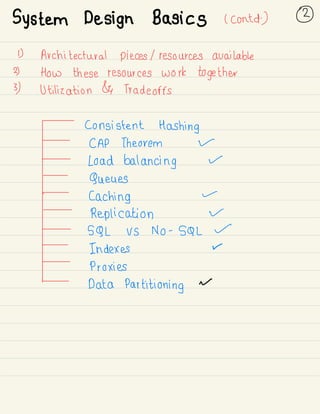
D Architectural pieces / resources available
2) How these resources work together
3) Utilization & Tradeoffs
-
consistent Hashing
-
CAP Theorem ✓
-
Load balancing ✓
-
queues
f- caching -
-
Replication
-
59L vs No -
SQL
I
-
Indexes ✓
-
Proxies
1 -
Data Partitioning
✓
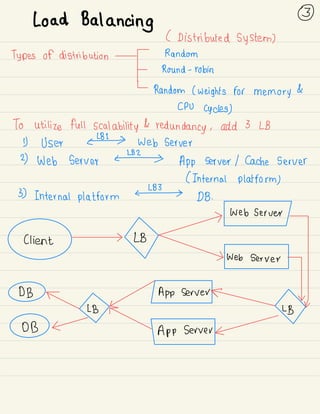
Load Balancing
③
( Distributed system)
Types of distribution -
f
Random
Round -
robin
<
Random ( weights for memory
&
CPU
cycles)
To utilize full scalability &
redundancy ,
add 3 LB
D User ¥ web server
2) Web server ¥
App server 1 Cache Server
( Internal platform)
3) Internal platform DB .
#W
Client LB
er
DB
T ,, LB
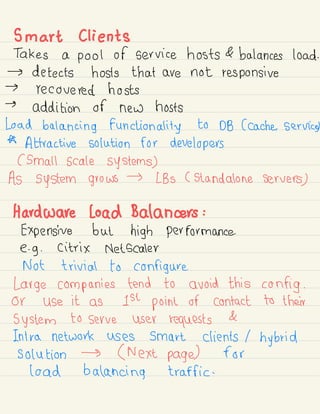
Smart clients
Takes a pool of service hosts & balances load.
→ detects hosts that are not responsive
→
recovered hosts
→
addition of new hosts
Load balancing functionality to DB (cache. Service
*
Attractive solution for developers
( small scale systems)
As system grows
→ LBS ( standalone servers
)
Hardware load Balancers :
Expensive but high performance.
e.
g . Citrix Netscaler
Not trivial to configure.
Large companies tend to avoid this config .
or use it as 1st point or contact to their
system to serve user requests
&
Intra network uses smart clients / hybrid
solution → ( Next page) for
load balancing traffic .
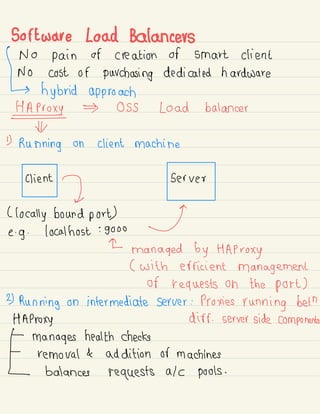
Software Load Balancers
'
No pain of creation of smart client
No cost of purchasing dedicated hardware
[ hybrid approach
HA Proxy OSS Load balancer
-4
1)
Running on client machine
'
2
( locally bound port)
e -
g
.
local host : 9000
I
F-
managed by HA Proxy
( with efficient management
of requests on the port )
2) Running on intermediate server : Proxies
running beth
HA Proxy
[
Manages health checks
dirt server side components
removal & addition of machines
balances requests alc pools .
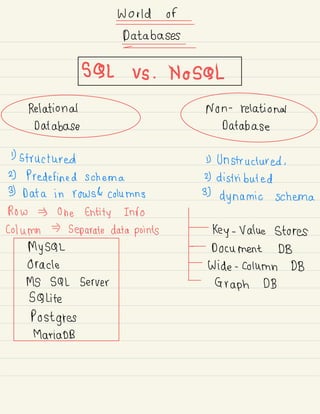
Wortdof
Databases
=
S9Lvs.NoS÷
iaa
1) structured D Unstructured .
2) Predefined schema 2) distributed
3) Data in rows & columns 3)
dynamic schema
Row One Entity Into
column Separate data points
mysar
¥'s::L:L: stores
Oracle
9sa¥fl wait:p:
'
:3;
DB
Postgres
MariaDB
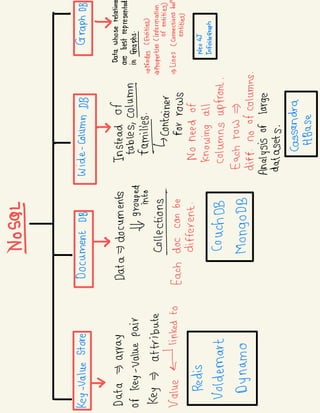
an E o
e
r
÷÷÷÷÷÷÷÷÷÷÷÷÷÷÷÷÷÷÷÷÷÷÷÷÷
O
e
ai
s I E
E cs O
S O
th s I 3 is
J
Os
e
to 6
of = G
IT u
E
s
O
U
'
E s O S
-
I
g O
f÷÷÷¥÷÷÷÷÷÷÷÷÷.
Et-
s o
U
te
O
G O
e e O
:
tr
- I
'
J S T
O
g
e
I E
E O or I
is
E E
ET
o o
① ± . ÷EE
or or o J
-
E e E E
s
is 3 Er er .
.
I 8 Ess E -3 o
o -
G o
OS u
c S s
d d
- E
E
OE s
w t
o E o o J E
=
O E E
G -
r d Id O is 8 e
E
t
E
°
i n u EE s E -
E -
E O
E s -
d s
gu -
so
§
n
E
d s
f O s . - c O G
e
u f O
d O O - 88
U
I 0
or 6 by us is •
u
w S S s s
o
- W s e
j d u
E
U
o
g
O s a ou ou N & si u
O
or 883
A
88 it's too >
u
s
I E
ch t g - o o
O
s 't ⑤
I
it
Cs cs T g J as a
Notre u
E
O o
-
v
. I d g.
E n
S
E KE u e I
o
O
→
of E s
o s 8 s I I 8 of to
E Z t
-
-
n y
U ou u @ at so .
-
In
O Es O s
6
w o @ Ed O t T
i N
T S e e E O
ng O w . - u
& .
o -
E U -
o E on s a •
R g
S w O -
z
-
O or O
U
N
b d
s D
J O s cry
to Nos y
U G - u
-
-
t O
u z > so I
'
E O
og
u
O si
w Dw or • ← we
t w
O
F
acs
n
-
o
o 8 3 u
f o
S
- T I Z o
's
- E u 06 I d.E es
°
6
§ 03
O
T
w
E s
if÷÷÷÷f÷÷÷i÷÷÷:ff÷÷:÷f÷÷i÷÷÷
G O z
S T
s 89 f-
od '
I O
U
G o T
u Es E o 8- or
#
O E D
s @ u w
u o
J as
6
'
I t
O L
O t u
'
Es
D O 6
g
y
U
d 62
g-
U
w u o
g
N s or
y es or
u
O >
u
d
U s
-
- d E nd
o b Eire E # E E
=
T I n
- ooo EEE -
o
'
E
O o
-
I •
as u
a
1- o
's x G
, +
as
I o
'
88 go.IT IT IT IT
-
w
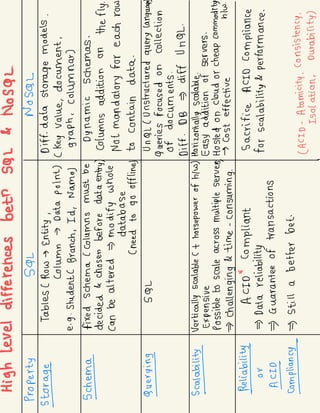
s
q El if ¥4
. - e d
J o
I 0 8 u
s u g
Ev or
on us
or
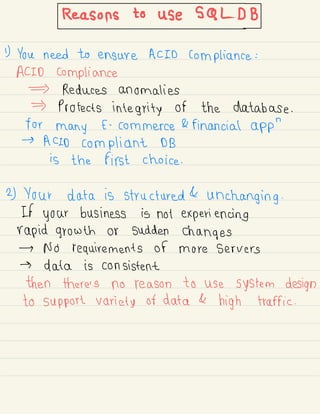
Reasonstouses.cl#BJ
1) You need to ensure ACID compliance :
ACID compliance
Reduces anomalies
Protects integrity of the database .
for
many E -
commerce & financial app
"
→
ACID compliant DB
is the first choice .
2) Your data is structured &
unchanging .
If your business is not experiencing
rapid growth or sudden changes
→ No requirements of more servers
→ data is consistent
then there's no reason to use system design
to support variety of data &
high traffic .
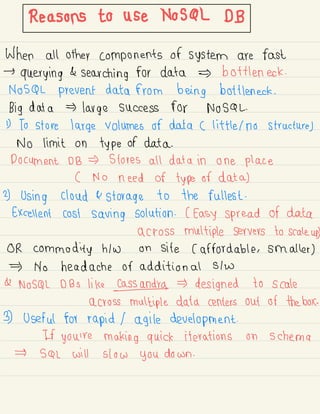
Reasonstouse.NO#IB
When all other components of system are fast
→
querying &
searching for data bottleneck .
NoSQL prevent data from being bottleneck .
Big data large success for NoSQL.
1) To store large volumes of data C little Ino structure)
No limit on type of data.
Document DB Stores all data in one place
( No need of type of data)
2) Using cloud & storage to the fullest .
Excellent cost saving solution .
( Easy spread of data
across multiple servers to scale up
)
OR commodity hlw on site ( affordable , smaller )
No headache or additional Stw
& NoSQL DBS like Cassander designed to scale
across multiple data centers out of the box.
3) Useful for rapid 1 agile development.
If you're making quick iterations on schema
SQL will slow you down .
Achieved by
CAP-heore€
tenyC All nodes see same data
updating several nodes .
at same time)
before allowing
g)
reads
E
"
"
"
"
e.
%%%,
Not
g
pareieiontdera£
Availability
[cassandra . Couch DB]
Hr Hr
Every request gets System continues to work
response ( success ( failure) despite message loss ( partial
Achieved by replicating Failure .
data across different servers ( can sustain any amount
of network failure without
- resulting in failure of entire
Data is sufficiently replicated network )
across combination of nodes /
networks to keep the system up .
.in:6#eo:::i:::::ia::i:n:::ans'
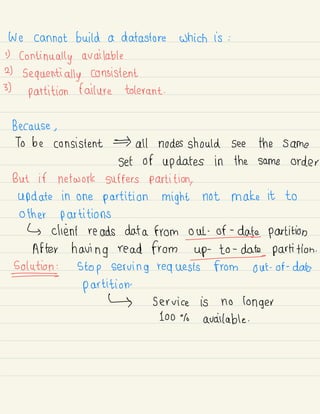
We cannot build a datastore which is :
D
continually available
2)
sequentially consistent
3)
partition failure tolerant .
Because ,
To be consistent all nodes should see the same
set of updates in the same order
But if network suffers partition,
update in one partition might not make it to
other partitions
↳ client reads data from out-of-date partition
After having read from up-to-date partition .
Solutions stop serving requests from out -
of -
date
partition.
↳ service is no longer
100% available .
Redundancy&ReplicationJ
Duplication of critical data & services
↳
increasing reliability of system .
For critical services & data ensure that multiple
copies 1 versions are running simultaneously on different
servers 1 databases .
Secure against single node failures .
Provides backups if needed in crisis .
Deter Dow
Primary server secondary server
& Data
2
- - a
Ig Replication 2
Active data Mirrored data
# Service
Redundancy : shared -
nothing architecture.
Every node independent. No central service managing state .
]
More resilient ← New servers
←
Helps in
[ to failures addition without scalability
Nosing special conditions
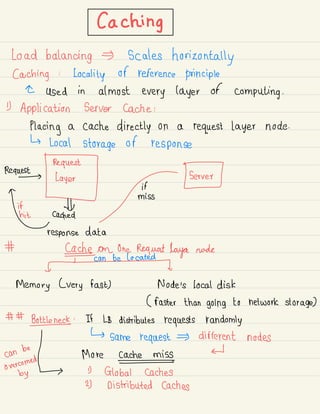
Caching
Load balancing Scales horizontally
caching :
Locality of reference principle
I Used in almost every layer of
computing .
I Application Server cache :
Placing a cache directly on a
request layer node.
↳ Local storage of response
Requests
in€.÷.
miss
response data
# Caches on one Request layer made
T
catedy
✓
Memory (very fast) Node 's local disk
( faster than going to network storage)
# #
Bottleneck :
If LB distributes requests randomly
↳ same request different nodes
our:c!m£ More
d
by
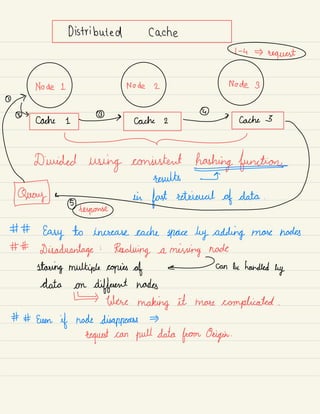
D Global caches
2) Distributed caches
Distributed
Gimme
-
Divided
using consistent
hashing function
③ ⑤gµeautts.-€#
# #
Easy to increase cache space by adding more hordes
##
Disadvantage :
Resolving a missing node
staring multiple copies of I can be handled
by
data on
different hordes
likes making it more complicated .
# # Even
if node disappears
request can pull data from Origin.
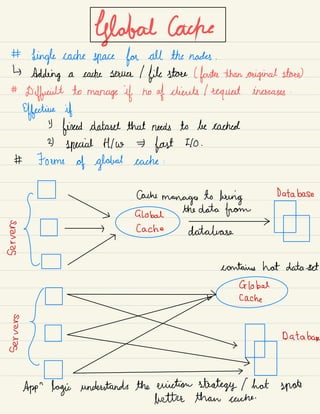
flabellate
#
Single cache space for all the hacks .
↳
Adding a cache source I file store ( faster than original store
)
#
Difficult to manage if no
af clients I request increases -
effective if
Y
fixed dataset that needs to be cached
2)
special Hlw fast Ho .
# Forms of global cache :
GEE { %fbtae.mn?hdEtahhYm
Database
database
contains hot data at
Global
cache
%gz { Database
App
"
logic understands the eviction strategy that spoils
better than cache .
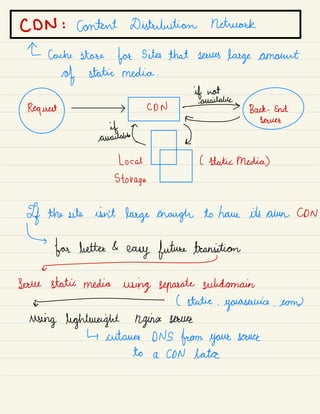
CDN : content Distribution network
4- Cache store for sites that saves
large amount
of static media .
if not
available
Request CDN -
Baek- End
if a
- server
available( L
local ( static Media)
storage
Lf the site isn't large enough to have its own CDN
4µA
transition
Some static media using separate subdomain
- ( static .
yaursuuice.com
using lightweight Nginse serves
↳ entrance DNS from your sauce
to a CDN later
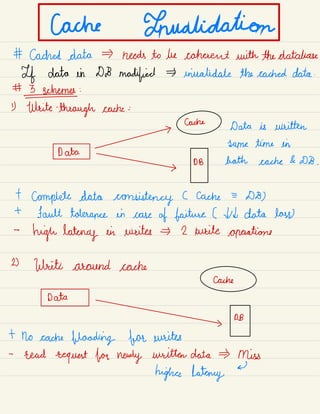
Cache Invalidation
# Cached data needs to be coherent with the database
Lf data in DB modified invalidate the cached data .
# 3 schemes :
=
I Write -
through cache :
cache
Data is written
same time in
Data
DB hath cache & DB .
+
Complete data consistency C cache = DB)
+
Fault tolerance in case of failure Club data loss
)
-
high latency in writes 2 write operations
2)
Write around cache
Cache
Data
DB
+ No cache flooding foe writes
-
read request for newly written data miss
higher latency
d
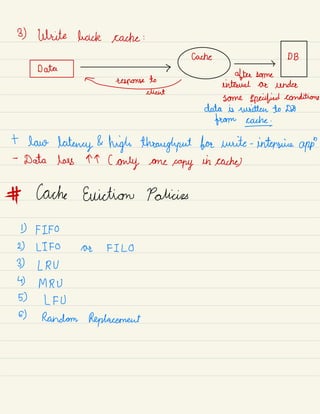
B) Write back cache :
cache DB
Data
after some
£ interval as under
client
some sepciifird conditions
data is written to DB
from cache
+ law latency &
high throughput bae write -
intensive app
"
-
Data loss TT ( only one
copy
in caches
# Cache Eviction Policies
D FIFO
2) LIFO Ae FILO
3) LRV
4) MRU
5) LF U
Random Replacement
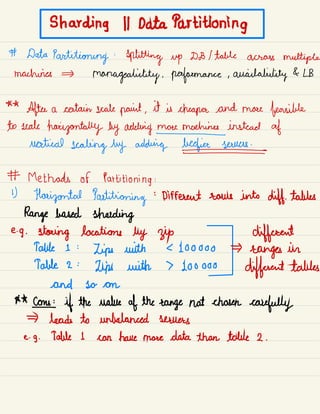
S harding 11 Data Partitioning
# Data
Partitioning :
splitting up DD I table across multiple
machines
manageability .
performance , availability & LB
**
After a certain scale paint ,
it is cheaper and more feasible
to scale
horizontally by adding money instead of
vertical
scaling by adding beefiness
# Methods of Partitioning :
1)
Horizontal Partitioning
:
Different rows into diff.
tables
Range based shading
e.
g .
staring locations by zip different
Table 1 :
Lips with L 100000
ranges in
Table 2 :
Lips with 7 Loo ooo
different tables
and so on
**
come if the value of the range not chosen
carefully
leads to unbalanced servers
e. g . Table I can have more data than table 2 .
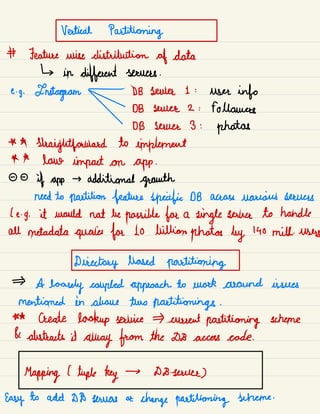
Vertical Partitioning
# Feature wise distribution of data
↳ in
different servers .
e.
g.
Instagram - DB sauce 1 :
user info
DB sauce 2 : followers
DB server 3 :
photos
* A
straightforward to implement
* A
lane impact on app .
- -
if app
→ additional growth
need to partition feature specific DB across various sources
( e -
g. it would not be possible for a
single sewer to handle
all metadata queries for Lo billion photos by 140 mill.
users
Directory based partitioning
A
loosely coupled approach to work around issues
mentioned in above two partitioning .
** Create lookup service current partitioning scheme
& abstracts it
away from the DB access code.
Mapping l tuple key → D8 sauce)
Easy to add DD towers or
change partitioning scheme .
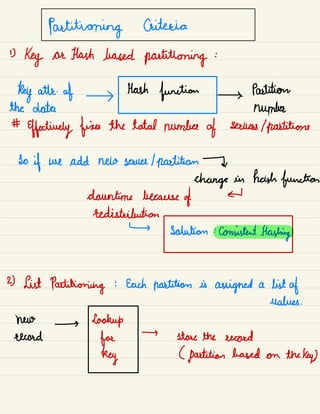
Partitioning Criteria
D
key or Hash based partitioning :
Kay atte-
af Hash
function →
Partition
the data number
#
Effectively fines the total number
of sauces 1partitions
So
if we add new source I partition T
o
change in hash function
downtime because
of
d
redistribution
↳
Solution :
consistent Hashing
2) List Partitioning : Each partition is
assigned a list of
values .
Nuo → hookup
record for
→
stare the record
key ( partition based on the key)
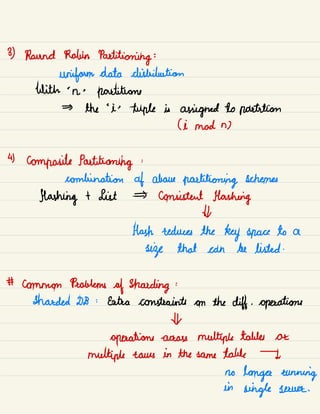
3) Round Robin
Partitioning :
uniform data distribution
with '
n .
partitions
the
'
is tuple is assigned to partition
(i mad n)
4
Composite Partitioning :
combination af above
partitioning schemes
flashing t List consistent Hashing
Hr
Hash reduces the
key space to a
size that can be listed .
# Common Problems
of Shouting :
Iharded DB :
Entree constraints on the diff .
operations
Hr
operations -
across multiple tables or
multiple rains in the same table 7
no
longer running
in
single severe.
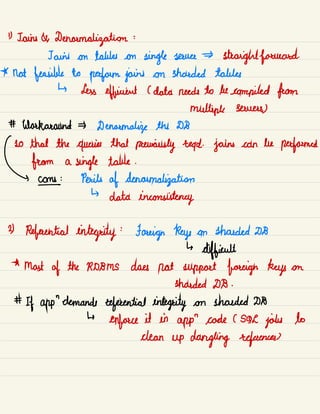
" Jains A Denoumalizatiom :
Jains on tables on
single sauce straightforward.
* not feasible to
perform joins on shrouded tables
↳ Less efficient C data needs to be compiled from
multiple servers)
# Workaround Denarmalip the DB
so that the queries that
previously read.
jains can be
performed
from a
single table .
( coins Perils of denavmalizatiom
↳
data inconsistency
2)
Referential integrity
:
Foreign keys om shrouded D8
↳
difficult
*
Mast of the RDBMS does not support foreign keys on
stranded DB .
#
If app
"
-
demands referential integrity om shrouded DB
↳
enforce it in app
"
code C SOL
jobs to
clean up dangling references)
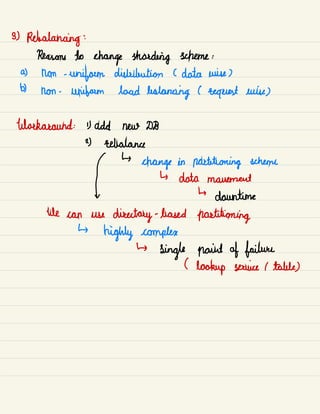
3)
Rebalancing :
Reasons to change sharking scheme :
a) horn -
uniform distribution C data wise )
b) non -
uniform laced balancing C request wise)
Workaround: Y add new DB
2) rebalance
↳
change in partitioning scheme
↳ data monument
{ ↳
downtime
We can use
directory -
based
partitioning
↳
highly complex
↳
single paint of failure
(
lookup service 1 table)
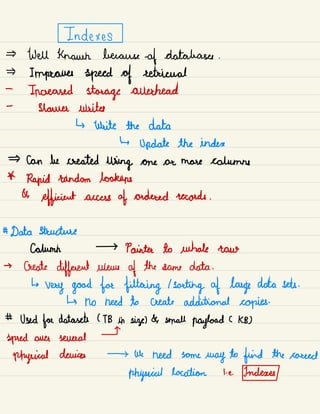
Indexes
Well known because -
of databases .
Improves speed of retrieval
-
Increased storage auerhead
-
Shauna writes
↳ write the data
↳
Update the index
Can be created
using one or more columns
*
Rapid random lookups
&
efficient access of ordered records .
# Data structure
column → Painter to whale raw
→ Create
different views of the -
same data .
↳
very good for filtering /
sorting of large data sets .
↳ no need to create additional copies.
# Used foe datasets ( TB in size) & small
payload ( KB)
I
spied over several
physical devices → We need some
way to find the correct
physical location i. e. Indexes
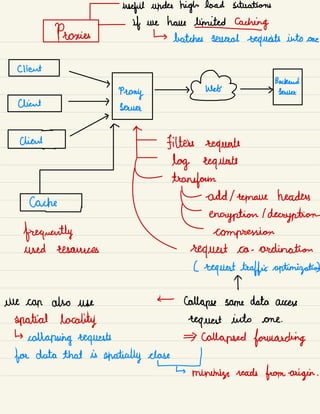
useful under high load situations
Peonies
-
if we have limitcdcaehing
↳ batches several requests into one
client
Backend
>
>
MY > sauce
>
Peony
client
>
Source
^
a
filters requests
-
log requests
transform
-
add / remain headers
encryption / decryption
frequently compression
used resources request co -
ordination
( request traffic optimization
T
we can also use
←
Collapse same data access
spatial locality request into one.
↳
collapsing requests collapsed forwarding
for data that is
spatially
Ipsf
minimize reads from -
origin .
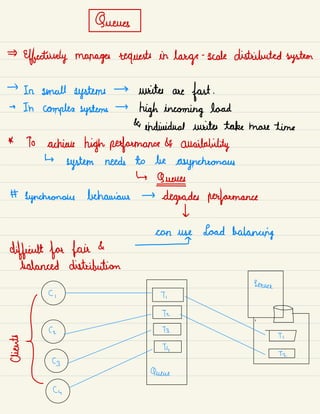
Queues
Effectively manages requests in
large
-
scale distributed system
→
In small systems
→ writes are
fast .
→
In complex systems
→
high incoming load
4- individual writes take more time
*
To achieve high performance & availability
↳
system needs to be
asynchronous
↳
Queue
#
Synchronous behaviour →
degrades performance
d
ye
Load balancing
difficult for fair &
balanced distribution
server
C
, T,
-
T2
r
C,
-13
T ,
gag { ,
T2
↳
Queue
Cu
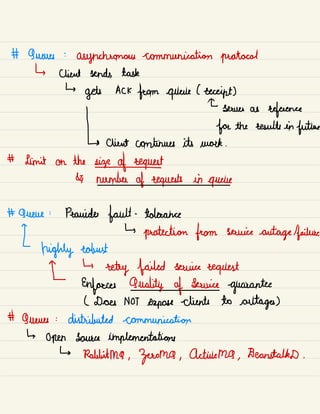
# Queues :
asynchronous communication protocol
↳ client sends task
↳
gets ACK
from queue lecccipt)
I
serves as
reference
for the results in
future
[ client continues its work .
# Limit on the
sispafeeguest
& number of requests in
queue
# Queue :
Provides fault -
tolerance
[
↳
protection from service
outage /
failure
highly robust
[
↳
retry failed service request
Enforces Quality of Service
guarantee
L Does NOT expose clients to outages)
# Queues :
distributed communication
↳
Open source implementations
↳ Rabbitma ,
Zoeoma ,
Active MQ ,
BeanstalkD .
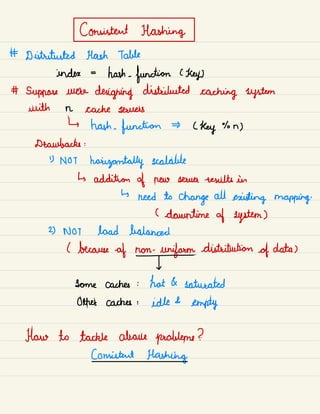
Consistent Hashing
# Distributed Hash Table
index =
hash -
function C
key)
# Suppose we're
designing distributed
caching system
with n cache servers
↳ hash .
function (
key % n )
Drawbacks :
1) NOT
horizontally scalable
↳ addition of new server results in
↳
need to
change all
existing mapping.
( downtime of system)
2) NOT load balanced
l because -
af non -
uniform distribution of data )
1-
Some caches : hat & saturated
Other caches :
idk &
empty
How to tackle about problems ?
Consistent flashing
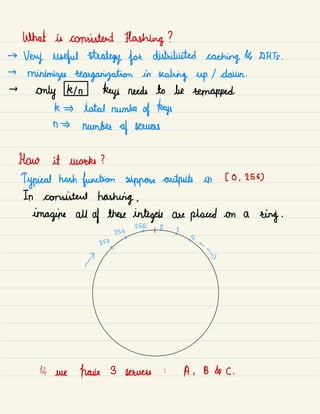
What is consistent Hashing ?
→
Very useful strategy for distributed caching & outs .
→
minimizes reorganization in
scaling up / dawn.
→
only kin keys needs to be remapped.
k total number of keys
n number of servers
How it works ?
Typical hash function suppose outputs in [ 0 .
2567
In consistent hashing ,
imagine all
of these integers are placed on a
ring .
255 0
254
,
• •
of
253
,
•
2
±
"
& we have 3 servers : A ,
B & C .
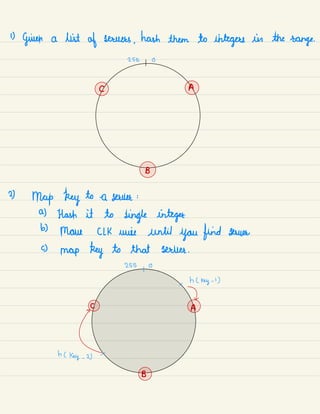
1)
Given a list
of servers ,
hash them to integers in the
range.
255 0
C A
B
2)
Map key to a serum :
a) Hash it to
single integer
b) Mane CLK wise until
you find Laura
c)
map key to that server .
255 0
hL key -
1)
of A
"
h (
key - 2)
'
B
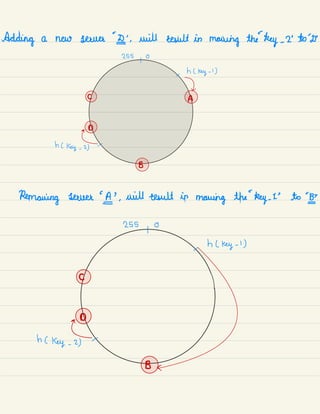
Adding a new server
'
.
will result in
morning the
-
key -2
'
to 'D
255 0
hL key -
1)
C A
"
a
D
h (
key - 2)
'
B
Removing server IA
'
,
will result in
morning the
-
key-1
'
to II
255 O
h ( key -
1)
①
a
D
h (
key - 2)
'
B •
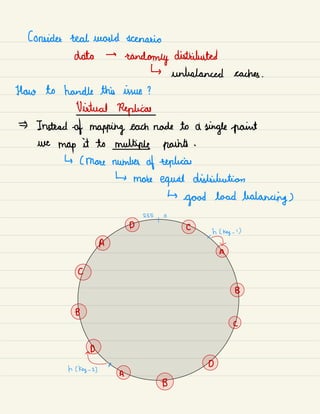
Consider real world scenario
data →
randomly distributed
↳ unbalanced cactus .
How to handle this issue ?
Virtual Replicas
Instead -
of mapping each node to a
single paint
we
map it to multiply paints .
↳ ( more number of replicas
↳ more
equal distribution
↳
good load
balancing)
255 0
D C
•
h ( key -
1)
A
a-
C
B
B
C
AD
D
h [ Key -
2)
^
A
B
Long -
Palling vs tikbsoekrts us Serves -
Sent Events
'
↳
Client -
Senior Communication Protocols
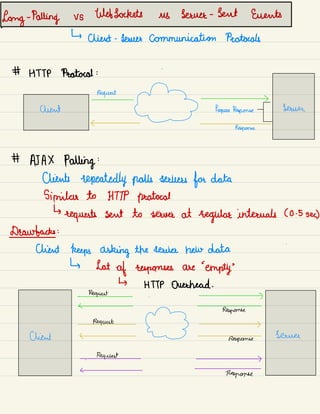
# HTTP Protocol :
request
NJ prepare Remorse
client
>
Serum
<
.
Response
# AJAX Patting :
Clients repeatedly palls servers for data
similar to HTTP protocol
↳
requests sent to screen at regular intervals (0.5sec
)
Drawbacks :

Client keeps asking the source now data
↳ Lot
of
uspomsgy.au
'
empty
'
↳ HTTP Overhead.
.
Request .
)
4
Response
Request.
>
Client a
response
sooner

.
Request >
<
Response
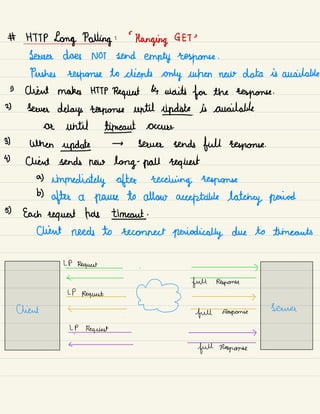
# HTTP Long Patting :
•
Hanging GET '
Sauce does NOT send empty response .
Pushes response to clients only when new data is available
☐
Client makes HTTP
Request 4- waits for the response .
2) Server delays response until update is available
or until time-out occurs.
3) When update → server sends full response.
4) Client sends now
long-
poll request
a)
immediately after receiving response
d)
after a pause to allow acceptable latency period
5) Each request has timeout.
Client needs to reconnect periodically due to timeouts
LP Request .
7
<
My
full Response
LP
Request.
>
Client <
.
full Response
Showa
LP Request >
a
full Response
Wet Sockets
→
duplex communication channel over
single TCP connection .
→ Provides
'
persistent communication
'
( client a serum can send data at anytime]
→
bidirectional communication in always open channel .
pep
socket
Handshake
Request
Handshake Success
Response
<
-
:
is i.
Client <
'
.
Source
.
Communication
}
channel
→ Lower overheads
→
Real time data transfer
Server -
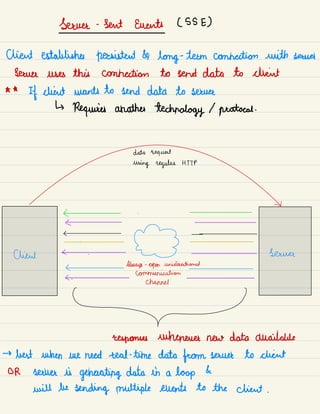
sent Events ( SSE)
client establishes persistent & long-
term connection with sauna
server uses this connection to send data to client
* *
If client wants to send data to server
↳
Requires another technology / protocol .
data request
using regular HTTP
v
'
ing
=
i.
Client < .
Source
•
Always -
open unidirectional
<
communication
< .
channel
-
responses whenever now data available
→
best when we need real -
time data from soever to client
OR server is
generating data in a loop &
will be sending multiple events to the client .

System Design.pdf

  • 1.
  • 2.
    System Design Basics① 1) Try to break the problem into simpler modules ( Top down approach) 2) T alk about the trade - offs ( No solution is perfect) calculate the impact on system based on all the constraints and the end test cases . ← Focus on interviewer 's heproblem ] intentions . T Ask Abstract ] questions ( constraints & Functionality finding Requirements) bottlenecks idudas
  • 3.
    System Design Basicsccontd ) ② D Architectural pieces / resources available 2) How these resources work together 3) Utilization & Tradeoffs - consistent Hashing - CAP Theorem ✓ - Load balancing ✓ - queues f- caching - - Replication - 59L vs No - SQL I - Indexes ✓ - Proxies 1 - Data Partitioning ✓
  • 4.
    Load Balancing ③ ( Distributedsystem) Types of distribution - f Random Round - robin < Random ( weights for memory & CPU cycles) To utilize full scalability & redundancy , add 3 LB D User ¥ web server 2) Web server ¥ App server 1 Cache Server ( Internal platform) 3) Internal platform DB . #W Client LB er DB T ,, LB
  • 5.
    Smart clients Takes apool of service hosts & balances load. → detects hosts that are not responsive → recovered hosts → addition of new hosts Load balancing functionality to DB (cache. Service * Attractive solution for developers ( small scale systems) As system grows → LBS ( standalone servers ) Hardware load Balancers : Expensive but high performance. e. g . Citrix Netscaler Not trivial to configure. Large companies tend to avoid this config . or use it as 1st point or contact to their system to serve user requests & Intra network uses smart clients / hybrid solution → ( Next page) for load balancing traffic .
  • 6.
    Software Load Balancers ' Nopain of creation of smart client No cost of purchasing dedicated hardware [ hybrid approach HA Proxy OSS Load balancer -4 1) Running on client machine ' 2 ( locally bound port) e - g . local host : 9000 I F- managed by HA Proxy ( with efficient management of requests on the port ) 2) Running on intermediate server : Proxies running beth HA Proxy [ Manages health checks dirt server side components removal & addition of machines balances requests alc pools .
  • 7.
    Wortdof Databases = S9Lvs.NoS÷ iaa 1) structured DUnstructured . 2) Predefined schema 2) distributed 3) Data in rows & columns 3) dynamic schema Row One Entity Into column Separate data points mysar ¥'s::L:L: stores Oracle 9sa¥fl wait:p: ' :3; DB Postgres MariaDB
  • 8.
    an E o e r ÷÷÷÷÷÷÷÷÷÷÷÷÷÷÷÷÷÷÷÷÷÷÷÷÷ O e ai sI E E cs O S O th s I 3 is J Os e to 6 of = G IT u E s O U ' E s O S - I g O f÷÷÷¥÷÷÷÷÷÷÷÷÷. Et- s o U te O G O e e O : tr - I ' J S T O g e I E E O or I is E E ET o o ① ± . ÷EE or or o J - E e E E s
  • 9.
    is 3 Erer . . I 8 Ess E -3 o o - G o OS u c S s d d - E E OE s w t o E o o J E = O E E G - r d Id O is 8 e E t E ° i n u EE s E - E - E O E s - d s gu - so § n E d s f O s . - c O G e u f O d O O - 88 U I 0 or 6 by us is • u w S S s s o - W s e j d u E U o g O s a ou ou N & si u O or 883 A 88 it's too > u s I E ch t g - o o O s 't ⑤ I it Cs cs T g J as a Notre u E O o - v . I d g. E n S E KE u e I o O → of E s o s 8 s I I 8 of to E Z t - - n y U ou u @ at so . - In O Es O s 6 w o @ Ed O t T i N T S e e E O ng O w . - u & . o - E U - o E on s a • R g S w O - z - O or O U N b d s D J O s cry to Nos y U G - u - - t O u z > so I ' E O og u O si w Dw or • ← we t w O F acs n - o o 8 3 u f o S - T I Z o 's - E u 06 I d.E es ° 6 § 03 O T w E s if÷÷÷÷f÷÷÷i÷÷÷:ff÷÷:÷f÷÷i÷÷÷ G O z S T s 89 f- od ' I O U G o T u Es E o 8- or # O E D s @ u w u o J as 6 ' I t O L O t u ' Es D O 6 g y U d 62 g- U w u o g N s or y es or u O > u d U s - - d E nd o b Eire E # E E = T I n - ooo EEE - o ' E O o - I • as u a 1- o 's x G , + as I o ' 88 go.IT IT IT IT - w s q El if ¥4 . - e d J o I 0 8 u s u g Ev or on us or
  • 10.
    Reasonstouses.cl#BJ 1) You needto ensure ACID compliance : ACID compliance Reduces anomalies Protects integrity of the database . for many E - commerce & financial app " → ACID compliant DB is the first choice . 2) Your data is structured & unchanging . If your business is not experiencing rapid growth or sudden changes → No requirements of more servers → data is consistent then there's no reason to use system design to support variety of data & high traffic .
  • 11.
    Reasonstouse.NO#IB When all othercomponents of system are fast → querying & searching for data bottleneck . NoSQL prevent data from being bottleneck . Big data large success for NoSQL. 1) To store large volumes of data C little Ino structure) No limit on type of data. Document DB Stores all data in one place ( No need of type of data) 2) Using cloud & storage to the fullest . Excellent cost saving solution . ( Easy spread of data across multiple servers to scale up ) OR commodity hlw on site ( affordable , smaller ) No headache or additional Stw & NoSQL DBS like Cassander designed to scale across multiple data centers out of the box. 3) Useful for rapid 1 agile development. If you're making quick iterations on schema SQL will slow you down .
  • 12.
    Achieved by CAP-heore€ tenyC Allnodes see same data updating several nodes . at same time) before allowing g) reads E " " " " e. %%%, Not g pareieiontdera£ Availability [cassandra . Couch DB] Hr Hr Every request gets System continues to work response ( success ( failure) despite message loss ( partial Achieved by replicating Failure . data across different servers ( can sustain any amount of network failure without - resulting in failure of entire Data is sufficiently replicated network ) across combination of nodes / networks to keep the system up . .in:6#eo:::i:::::ia::i:n:::ans'
  • 13.
    We cannot builda datastore which is : D continually available 2) sequentially consistent 3) partition failure tolerant . Because , To be consistent all nodes should see the same set of updates in the same order But if network suffers partition, update in one partition might not make it to other partitions ↳ client reads data from out-of-date partition After having read from up-to-date partition . Solutions stop serving requests from out - of - date partition. ↳ service is no longer 100% available .
  • 14.
    Redundancy&ReplicationJ Duplication of criticaldata & services ↳ increasing reliability of system . For critical services & data ensure that multiple copies 1 versions are running simultaneously on different servers 1 databases . Secure against single node failures . Provides backups if needed in crisis . Deter Dow Primary server secondary server & Data 2 - - a Ig Replication 2 Active data Mirrored data # Service Redundancy : shared - nothing architecture. Every node independent. No central service managing state . ] More resilient ← New servers ← Helps in [ to failures addition without scalability Nosing special conditions
  • 15.
    Caching Load balancing Scaleshorizontally caching : Locality of reference principle I Used in almost every layer of computing . I Application Server cache : Placing a cache directly on a request layer node. ↳ Local storage of response Requests in€.÷. miss response data # Caches on one Request layer made T catedy ✓ Memory (very fast) Node 's local disk ( faster than going to network storage) # # Bottleneck : If LB distributes requests randomly ↳ same request different nodes our:c!m£ More d by D Global caches 2) Distributed caches
  • 16.
    Distributed Gimme - Divided using consistent hashing function ③⑤gµeautts.-€# # # Easy to increase cache space by adding more hordes ## Disadvantage : Resolving a missing node staring multiple copies of I can be handled by data on different hordes likes making it more complicated . # # Even if node disappears request can pull data from Origin.
  • 17.
    flabellate # Single cache spacefor all the hacks . ↳ Adding a cache source I file store ( faster than original store ) # Difficult to manage if no af clients I request increases - effective if Y fixed dataset that needs to be cached 2) special Hlw fast Ho . # Forms of global cache : GEE { %fbtae.mn?hdEtahhYm Database database contains hot data at Global cache %gz { Database App " logic understands the eviction strategy that spoils better than cache .
  • 18.
    CDN : contentDistribution network 4- Cache store for sites that saves large amount of static media . if not available Request CDN - Baek- End if a - server available( L local ( static Media) storage Lf the site isn't large enough to have its own CDN 4µA transition Some static media using separate subdomain - ( static . yaursuuice.com using lightweight Nginse serves ↳ entrance DNS from your sauce to a CDN later
  • 19.
    Cache Invalidation # Cacheddata needs to be coherent with the database Lf data in DB modified invalidate the cached data . # 3 schemes : = I Write - through cache : cache Data is written same time in Data DB hath cache & DB . + Complete data consistency C cache = DB) + Fault tolerance in case of failure Club data loss ) - high latency in writes 2 write operations 2) Write around cache Cache Data DB + No cache flooding foe writes - read request for newly written data miss higher latency d
  • 20.
    B) Write backcache : cache DB Data after some £ interval as under client some sepciifird conditions data is written to DB from cache + law latency & high throughput bae write - intensive app " - Data loss TT ( only one copy in caches # Cache Eviction Policies D FIFO 2) LIFO Ae FILO 3) LRV 4) MRU 5) LF U Random Replacement
  • 21.
    S harding 11Data Partitioning # Data Partitioning : splitting up DD I table across multiple machines manageability . performance , availability & LB ** After a certain scale paint , it is cheaper and more feasible to scale horizontally by adding money instead of vertical scaling by adding beefiness # Methods of Partitioning : 1) Horizontal Partitioning : Different rows into diff. tables Range based shading e. g . staring locations by zip different Table 1 : Lips with L 100000 ranges in Table 2 : Lips with 7 Loo ooo different tables and so on ** come if the value of the range not chosen carefully leads to unbalanced servers e. g . Table I can have more data than table 2 .
  • 22.
    Vertical Partitioning # Featurewise distribution of data ↳ in different servers . e. g. Instagram - DB sauce 1 : user info DB sauce 2 : followers DB server 3 : photos * A straightforward to implement * A lane impact on app . - - if app → additional growth need to partition feature specific DB across various sources ( e - g. it would not be possible for a single sewer to handle all metadata queries for Lo billion photos by 140 mill. users Directory based partitioning A loosely coupled approach to work around issues mentioned in above two partitioning . ** Create lookup service current partitioning scheme & abstracts it away from the DB access code. Mapping l tuple key → D8 sauce) Easy to add DD towers or change partitioning scheme .
  • 23.
    Partitioning Criteria D key orHash based partitioning : Kay atte- af Hash function → Partition the data number # Effectively fines the total number of sauces 1partitions So if we add new source I partition T o change in hash function downtime because of d redistribution ↳ Solution : consistent Hashing 2) List Partitioning : Each partition is assigned a list of values . Nuo → hookup record for → stare the record key ( partition based on the key)
  • 24.
    3) Round Robin Partitioning: uniform data distribution with ' n . partitions the ' is tuple is assigned to partition (i mad n) 4 Composite Partitioning : combination af above partitioning schemes flashing t List consistent Hashing Hr Hash reduces the key space to a size that can be listed . # Common Problems of Shouting : Iharded DB : Entree constraints on the diff . operations Hr operations - across multiple tables or multiple rains in the same table 7 no longer running in single severe.
  • 25.
    " Jains ADenoumalizatiom : Jains on tables on single sauce straightforward. * not feasible to perform joins on shrouded tables ↳ Less efficient C data needs to be compiled from multiple servers) # Workaround Denarmalip the DB so that the queries that previously read. jains can be performed from a single table . ( coins Perils of denavmalizatiom ↳ data inconsistency 2) Referential integrity : Foreign keys om shrouded D8 ↳ difficult * Mast of the RDBMS does not support foreign keys on stranded DB . # If app " - demands referential integrity om shrouded DB ↳ enforce it in app " code C SOL jobs to clean up dangling references)
  • 26.
    3) Rebalancing : Reasons tochange sharking scheme : a) horn - uniform distribution C data wise ) b) non - uniform laced balancing C request wise) Workaround: Y add new DB 2) rebalance ↳ change in partitioning scheme ↳ data monument { ↳ downtime We can use directory - based partitioning ↳ highly complex ↳ single paint of failure ( lookup service 1 table)
  • 27.
    Indexes Well known because- of databases . Improves speed of retrieval - Increased storage auerhead - Shauna writes ↳ write the data ↳ Update the index Can be created using one or more columns * Rapid random lookups & efficient access of ordered records . # Data structure column → Painter to whale raw → Create different views of the - same data . ↳ very good for filtering / sorting of large data sets . ↳ no need to create additional copies. # Used foe datasets ( TB in size) & small payload ( KB) I spied over several physical devices → We need some way to find the correct physical location i. e. Indexes
  • 28.
    useful under highload situations Peonies - if we have limitcdcaehing ↳ batches several requests into one client Backend > > MY > sauce > Peony client > Source ^ a filters requests - log requests transform - add / remain headers encryption / decryption frequently compression used resources request co - ordination ( request traffic optimization T we can also use ← Collapse same data access spatial locality request into one. ↳ collapsing requests collapsed forwarding for data that is spatially Ipsf minimize reads from - origin .
  • 29.
    Queues Effectively manages requestsin large - scale distributed system → In small systems → writes are fast . → In complex systems → high incoming load 4- individual writes take more time * To achieve high performance & availability ↳ system needs to be asynchronous ↳ Queue # Synchronous behaviour → degrades performance d ye Load balancing difficult for fair & balanced distribution server C , T, - T2 r C, -13 T , gag { , T2 ↳ Queue Cu
  • 30.
    # Queues : asynchronouscommunication protocol ↳ client sends task ↳ gets ACK from queue lecccipt) I serves as reference for the results in future [ client continues its work . # Limit on the sispafeeguest & number of requests in queue # Queue : Provides fault - tolerance [ ↳ protection from service outage / failure highly robust [ ↳ retry failed service request Enforces Quality of Service guarantee L Does NOT expose clients to outages) # Queues : distributed communication ↳ Open source implementations ↳ Rabbitma , Zoeoma , Active MQ , BeanstalkD .
  • 31.
    Consistent Hashing # DistributedHash Table index = hash - function C key) # Suppose we're designing distributed caching system with n cache servers ↳ hash . function ( key % n ) Drawbacks : 1) NOT horizontally scalable ↳ addition of new server results in ↳ need to change all existing mapping. ( downtime of system) 2) NOT load balanced l because - af non - uniform distribution of data ) 1- Some caches : hat & saturated Other caches : idk & empty How to tackle about problems ? Consistent flashing
  • 32.
    What is consistentHashing ? → Very useful strategy for distributed caching & outs . → minimizes reorganization in scaling up / dawn. → only kin keys needs to be remapped. k total number of keys n number of servers How it works ? Typical hash function suppose outputs in [ 0 . 2567 In consistent hashing , imagine all of these integers are placed on a ring . 255 0 254 , • • of 253 , • 2 ± " & we have 3 servers : A , B & C .
  • 33.
    1) Given a list ofservers , hash them to integers in the range. 255 0 C A B 2) Map key to a serum : a) Hash it to single integer b) Mane CLK wise until you find Laura c) map key to that server . 255 0 hL key - 1) of A " h ( key - 2) ' B
  • 34.
    Adding a newserver ' . will result in morning the - key -2 ' to 'D 255 0 hL key - 1) C A " a D h ( key - 2) ' B Removing server IA ' , will result in morning the - key-1 ' to II 255 O h ( key - 1) ① a D h ( key - 2) ' B •
  • 35.
    Consider real worldscenario data → randomly distributed ↳ unbalanced cactus . How to handle this issue ? Virtual Replicas Instead - of mapping each node to a single paint we map it to multiply paints . ↳ ( more number of replicas ↳ more equal distribution ↳ good load balancing) 255 0 D C • h ( key - 1) A a- C B B C AD D h [ Key - 2) ^ A B
  • 36.
    Long - Palling vstikbsoekrts us Serves - Sent Events ' ↳ Client - Senior Communication Protocols # HTTP Protocol : request NJ prepare Remorse client > Serum < . Response # AJAX Patting : Clients repeatedly palls servers for data similar to HTTP protocol ↳ requests sent to screen at regular intervals (0.5sec ) Drawbacks : Client keeps asking the source now data ↳ Lot of uspomsgy.au ' empty ' ↳ HTTP Overhead. . Request . ) 4 Response Request. > Client a response sooner . Request > < Response
  • 37.
    # HTTP LongPatting : • Hanging GET ' Sauce does NOT send empty response . Pushes response to clients only when new data is available ☐ Client makes HTTP Request 4- waits for the response . 2) Server delays response until update is available or until time-out occurs. 3) When update → server sends full response. 4) Client sends now long- poll request a) immediately after receiving response d) after a pause to allow acceptable latency period 5) Each request has timeout. Client needs to reconnect periodically due to timeouts LP Request . 7 < My full Response LP Request. > Client < . full Response Showa LP Request > a full Response
  • 38.
    Wet Sockets → duplex communicationchannel over single TCP connection . → Provides ' persistent communication ' ( client a serum can send data at anytime] → bidirectional communication in always open channel . pep socket Handshake Request Handshake Success Response < - : is i. Client < ' . Source . Communication } channel → Lower overheads → Real time data transfer
  • 39.
    Server - sent Events( SSE) client establishes persistent & long- term connection with sauna server uses this connection to send data to client * * If client wants to send data to server ↳ Requires another technology / protocol . data request using regular HTTP v ' ing = i. Client < . Source • Always - open unidirectional < communication < . channel - responses whenever now data available → best when we need real - time data from soever to client OR server is generating data in a loop & will be sending multiple events to the client .