Animal Tissue
By:
DORA INDRIANA,S.Pd.M.Pd
SMA NEGERI 1 JEMBER.
ds/biologi/smasa 2013
Development Stages of
Animal’s Embryo
- Cleavage (Division/segmentation)
- Morphogenesis
- Differentiation (embryonic tissue)

ds/biologi/smasa 2013
Embryonic Tissues
Ectoderm, mesoderm, and endoderm are
embryonic tissues that give rise to all of
the tissues, organs, and organ systems in
the body.

ds/biologi/smasa 2013
Ectoderm forms the outer layer of skin and nervous

system.
Mesoderm forms the muscles, connective tissues,
skeleton, kidneys, and circulatory and reproductive
organs.
Endoderm forms the lining of the gut, respiratory

tract, and urinary bladder.
It also forms the glands associated with the gut and
respiratory tract.
ds/biologi/smasa 2013
Animal Tissue

Epithelium

ds/biologi/smasa 2013

Connective

Muscle

Nervous
ds/biologi/smasa 2013
1. Epithelial Tissue
Epithelial tissue lies on a basement membrane
Cells within this tissue readily divide to make more
cells (recover)
Does not have any vasculature
The cells within this tissue are firmly attached to
each other
Protection
Secretion
Absorption
Excretion
ds/biologi/smasa 2013
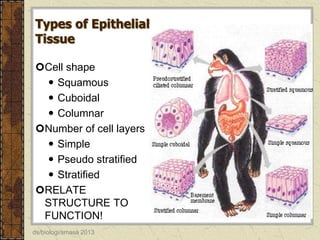
Types of Epithelial
Tissue
Cell shape
 Squamous
 Cuboidal
 Columnar
Number of cell layers
 Simple
 Pseudo stratified
 Stratified
RELATE
STRUCTURE TO
FUNCTION!
ds/biologi/smasa 2013
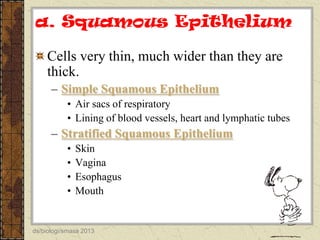
a. Squamous Epithelium
Cells very thin, much wider than they are
thick.
– Simple Squamous Epithelium
• Air sacs of respiratory
• Lining of blood vessels, heart and lymphatic tubes

– Stratified Squamous Epithelium
•
•
•
•

Skin
Vagina
Esophagus
Mouth

ds/biologi/smasa 2013
Stratified Squamous Epithelium

the human skin shown below contains stratified
epithelium

ds/biologi/smasa 2013
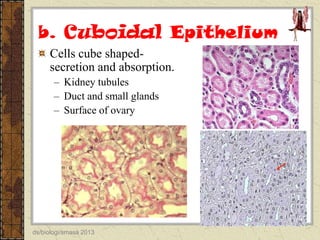
b. Cuboidal Epithelium
Cells cube shapedsecretion and absorption.
– Kidney tubules
– Duct and small glands
– Surface of ovary

ds/biologi/smasa 2013
c. Columnar Epithelium
Elongated cells, much longer than they are wide.
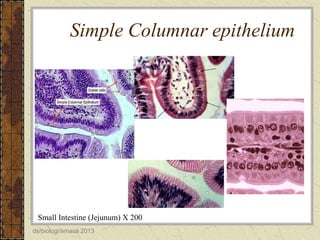
– Simple Columnar Epithelium
• A single layer of cells that line the digestive tract, gallbladder and
excretory ducts of some glands. Has microvilli at surface for
absorption.
– Stratified Columnar
Has secretion and movement funtion. In nose, the surface of larynx,
urethra
– Pseudostratified ciliated columnar epithelium
• Lines the bronchi, trachea, uterine tubes and some of the uterus.
Propels mucus or reproductive cells by ciliary action.

ds/biologi/smasa 2013
Simple Columnar epithelium

Small Intestine (Jejunum) X 200
ds/biologi/smasa 2013
Stratified Columnar

In trachea

ds/biologi/smasa 2013
d. Pseudostratified Ciliated
Columnar Epithelium

ds/biologi/smasa 2013
2. Connective tissue
(Framework)
Main function:
binding and
support other
tissues
Large amount of
extra-cellular
matrix with fewer
cells
Connective tissue
cells secrete the
extra-cellular
matrix
Extracellular
matrix consists of
network of fibers
in liquid, jelly-like
or solid matrix
ds/biologi/smasa 2013
Connective Tissue
Characterized by the cells widely separated from
each other in a matrix that is produced by the cells.
Tissue protects and supports.
Cell Matrix composed of two regions
– Ground
• Liquid (sol), Gel, Gum or solid

– Fibers
• Non-elastic (= white or Collagen)
• Elastic (= yellow fibers)

ds/biologi/smasa 2013
Types of Connective Tissue
Loose (Areolar) Connective Tissue
Dense Connective Tissue
Adipose
Cartilage
Bone
Blood

ds/biologi/smasa 2013
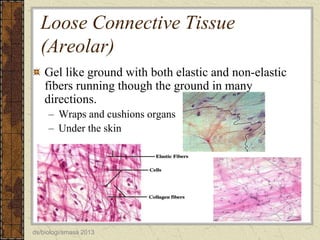
Loose Connective Tissue
(Areolar)
Gel like ground with both elastic and non-elastic
fibers running though the ground in many
directions.
– Wraps and cushions organs
– Under the skin

ds/biologi/smasa 2013
Dense (fiber)Regular Connective
Tissue
Nuclei and fibers arranged in parallel rows.
– Tendons and ligaments
– Fibers mostly non-elastic

ds/biologi/smasa 2013
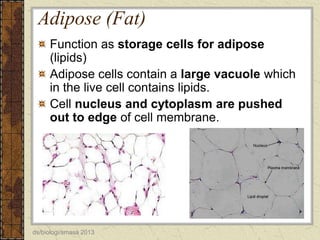
Adipose (Fat)
Function as storage cells for adipose
(lipids)
Adipose cells contain a large vacuole which
in the live cell contains lipids.
Cell nucleus and cytoplasm are pushed
out to edge of cell membrane.

ds/biologi/smasa 2013
Cartilage
Ground of matrix is gum like.
Cells are found in Lacunae within the matrix.
Fibers may be elastic or non-elastic, or a form of nonelastic called reticular(where the non-elastic fibers of very
thin)
– Hyaline Cartilage-example on the ends of bones
– Elastic Cartilage- example ear cartilage
– Non-elastic Cartilage- example nose cartilage.

ds/biologi/smasa 2013
Hyaline cartilage

ds/biologi/smasa 2013
Elastic Cartilage

ds/biologi/smasa 2013
Bone
– Ground of matrix is Solid (Calcium carbonate).
– Has blood supply and nerves running through
the Haversian canal systems.

Bone, dry ground human c.s. X 100
ds/biologi/smasa
2013
Vascular Tissue (Blood)
Liquid matrix = plasma
– 90% water
– 10%Plasma proteins, electrolytes, hormones, oxygen,
glucose etc.

Formed elements
– Erythrocytes -48billion(female) to 54 billion (male) cell
/ ml of blood in humans. Mammals are enucleated
while rest of the vertebrates they have nuclei
– Leukocytes -about 7.5 million / ml of blood
– Platelets -blood clotting

ds/biologi/smasa
2013
Blood

ds/biologi/smasa 2013
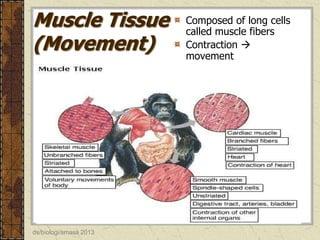
Muscle Tissue
(Movement)

ds/biologi/smasa 2013

Composed of long cells
called muscle fibers
Contraction 
movement
Muscle Tissue
Tissue with cells having fibers specialized for contraction.
– Skeletal Muscle (Striated, voluntary)
• Parallel elongated cells (fibers)
• multinucleated and each cell is the length of the muscle.
• Light meat, Dark meat—Slow twitch, fast twitch muscle
– Smooth Muscle (Visceral, involuntary)
• Cells are long and tapered.
• Organized into sheets of muscle.
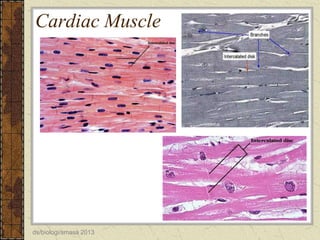
– Cardiac Muscle
• Intercalated disc
• Myogenic
• branched

ds/biologi/smasa 2013
Skeletal Muscle

ds/biologi/smasa 2013
Smooth Muscle

ds/biologi/smasa 2013
Cardiac Muscle

ds/biologi/smasa 2013
• Senses stimuli
and transmits
signals called
nerve
impulses from
one part of an
animal to
another
• Consists of a
cell body and
long
extensions
called
dendrites
(towards cell
body) and
axons
(towards
another cell or
an effectors)
ds/biologi/smasa 2013

Axon

Dendrite

Cell body
Nervous Tissue
Cells specialized to polarize and
depolarize.
Cell is a neuron
Motor Neuron X 200

ds/biologi/smasa 2013
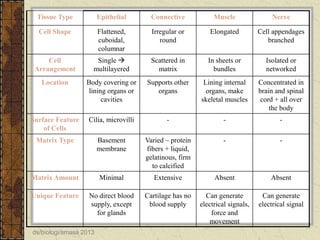
Tissue Type

Epithelial

Connective

Muscle

Nerve

Cell Shape

Flattened,
cuboidal,
columnar

Irregular or
round

Elongated

Cell appendages
branched

Cell
Arrangement

Single 
multilayered

Scattered in
matrix

In sheets or
bundles

Isolated or
networked

Location

Body covering or
lining organs or
cavities

Supports other
organs

Lining internal
organs, make
skeletal muscles

Concentrated in
brain and spinal
cord + all over
the body

Surface Feature
of Cells

Cilia, microvilli

-

-

-

Matrix Type

Basement
membrane

Varied – protein
fibers + liquid,
gelatinous, firm
to calcified

-

-

Matrix Amount

Minimal

Extensive

Absent

Absent

Unique Feature

No direct blood
supply, except
for glands

Cartilage has no
blood supply

Can generate
electrical signals,
force and
movement

Can generate
electrical signal

ds/biologi/smasa 2013
Mention the kinds of

animal tissues

The Function of Animal
Tissues

Differences of Animal Tissues

ds/biologi/smasa 2013
Our Next Meeting: About Cancer

Don’t Forget to Study!

ds/biologi/smasa 2013

Animal structure

  • 1.
    Animal Tissue By: DORA INDRIANA,S.Pd.M.Pd SMANEGERI 1 JEMBER. ds/biologi/smasa 2013
  • 2.
    Development Stages of Animal’sEmbryo - Cleavage (Division/segmentation) - Morphogenesis - Differentiation (embryonic tissue) ds/biologi/smasa 2013
  • 3.
    Embryonic Tissues Ectoderm, mesoderm,and endoderm are embryonic tissues that give rise to all of the tissues, organs, and organ systems in the body. ds/biologi/smasa 2013
  • 4.
    Ectoderm forms theouter layer of skin and nervous system. Mesoderm forms the muscles, connective tissues, skeleton, kidneys, and circulatory and reproductive organs. Endoderm forms the lining of the gut, respiratory tract, and urinary bladder. It also forms the glands associated with the gut and respiratory tract. ds/biologi/smasa 2013
  • 5.
  • 6.
  • 7.
    1. Epithelial Tissue Epithelialtissue lies on a basement membrane Cells within this tissue readily divide to make more cells (recover) Does not have any vasculature The cells within this tissue are firmly attached to each other Protection Secretion Absorption Excretion ds/biologi/smasa 2013
  • 8.
  • 9.
    Types of Epithelial Tissue Cellshape  Squamous  Cuboidal  Columnar Number of cell layers  Simple  Pseudo stratified  Stratified RELATE STRUCTURE TO FUNCTION! ds/biologi/smasa 2013
  • 10.
    a. Squamous Epithelium Cellsvery thin, much wider than they are thick. – Simple Squamous Epithelium • Air sacs of respiratory • Lining of blood vessels, heart and lymphatic tubes – Stratified Squamous Epithelium • • • • Skin Vagina Esophagus Mouth ds/biologi/smasa 2013
  • 11.
    Stratified Squamous Epithelium thehuman skin shown below contains stratified epithelium ds/biologi/smasa 2013
  • 12.
    b. Cuboidal Epithelium Cellscube shapedsecretion and absorption. – Kidney tubules – Duct and small glands – Surface of ovary ds/biologi/smasa 2013
  • 13.
    c. Columnar Epithelium Elongatedcells, much longer than they are wide. – Simple Columnar Epithelium • A single layer of cells that line the digestive tract, gallbladder and excretory ducts of some glands. Has microvilli at surface for absorption. – Stratified Columnar Has secretion and movement funtion. In nose, the surface of larynx, urethra – Pseudostratified ciliated columnar epithelium • Lines the bronchi, trachea, uterine tubes and some of the uterus. Propels mucus or reproductive cells by ciliary action. ds/biologi/smasa 2013
  • 14.
    Simple Columnar epithelium SmallIntestine (Jejunum) X 200 ds/biologi/smasa 2013
  • 15.
  • 16.
    d. Pseudostratified Ciliated ColumnarEpithelium ds/biologi/smasa 2013
  • 17.
    2. Connective tissue (Framework) Mainfunction: binding and support other tissues Large amount of extra-cellular matrix with fewer cells Connective tissue cells secrete the extra-cellular matrix Extracellular matrix consists of network of fibers in liquid, jelly-like or solid matrix ds/biologi/smasa 2013
  • 18.
  • 19.
    Connective Tissue Characterized bythe cells widely separated from each other in a matrix that is produced by the cells. Tissue protects and supports. Cell Matrix composed of two regions – Ground • Liquid (sol), Gel, Gum or solid – Fibers • Non-elastic (= white or Collagen) • Elastic (= yellow fibers) ds/biologi/smasa 2013
  • 20.
    Types of ConnectiveTissue Loose (Areolar) Connective Tissue Dense Connective Tissue Adipose Cartilage Bone Blood ds/biologi/smasa 2013
  • 21.
    Loose Connective Tissue (Areolar) Gellike ground with both elastic and non-elastic fibers running though the ground in many directions. – Wraps and cushions organs – Under the skin ds/biologi/smasa 2013
  • 22.
    Dense (fiber)Regular Connective Tissue Nucleiand fibers arranged in parallel rows. – Tendons and ligaments – Fibers mostly non-elastic ds/biologi/smasa 2013
  • 23.
    Adipose (Fat) Function asstorage cells for adipose (lipids) Adipose cells contain a large vacuole which in the live cell contains lipids. Cell nucleus and cytoplasm are pushed out to edge of cell membrane. ds/biologi/smasa 2013
  • 24.
    Cartilage Ground of matrixis gum like. Cells are found in Lacunae within the matrix. Fibers may be elastic or non-elastic, or a form of nonelastic called reticular(where the non-elastic fibers of very thin) – Hyaline Cartilage-example on the ends of bones – Elastic Cartilage- example ear cartilage – Non-elastic Cartilage- example nose cartilage. ds/biologi/smasa 2013
  • 25.
  • 26.
  • 27.
    Bone – Ground ofmatrix is Solid (Calcium carbonate). – Has blood supply and nerves running through the Haversian canal systems. Bone, dry ground human c.s. X 100 ds/biologi/smasa 2013
  • 28.
    Vascular Tissue (Blood) Liquidmatrix = plasma – 90% water – 10%Plasma proteins, electrolytes, hormones, oxygen, glucose etc. Formed elements – Erythrocytes -48billion(female) to 54 billion (male) cell / ml of blood in humans. Mammals are enucleated while rest of the vertebrates they have nuclei – Leukocytes -about 7.5 million / ml of blood – Platelets -blood clotting ds/biologi/smasa 2013
  • 29.
  • 30.
    Muscle Tissue (Movement) ds/biologi/smasa 2013 Composedof long cells called muscle fibers Contraction  movement
  • 31.
    Muscle Tissue Tissue withcells having fibers specialized for contraction. – Skeletal Muscle (Striated, voluntary) • Parallel elongated cells (fibers) • multinucleated and each cell is the length of the muscle. • Light meat, Dark meat—Slow twitch, fast twitch muscle – Smooth Muscle (Visceral, involuntary) • Cells are long and tapered. • Organized into sheets of muscle. – Cardiac Muscle • Intercalated disc • Myogenic • branched ds/biologi/smasa 2013
  • 32.
  • 33.
  • 34.
  • 35.
    • Senses stimuli andtransmits signals called nerve impulses from one part of an animal to another • Consists of a cell body and long extensions called dendrites (towards cell body) and axons (towards another cell or an effectors) ds/biologi/smasa 2013 Axon Dendrite Cell body
  • 36.
    Nervous Tissue Cells specializedto polarize and depolarize. Cell is a neuron Motor Neuron X 200 ds/biologi/smasa 2013
  • 37.
    Tissue Type Epithelial Connective Muscle Nerve Cell Shape Flattened, cuboidal, columnar Irregularor round Elongated Cell appendages branched Cell Arrangement Single  multilayered Scattered in matrix In sheets or bundles Isolated or networked Location Body covering or lining organs or cavities Supports other organs Lining internal organs, make skeletal muscles Concentrated in brain and spinal cord + all over the body Surface Feature of Cells Cilia, microvilli - - - Matrix Type Basement membrane Varied – protein fibers + liquid, gelatinous, firm to calcified - - Matrix Amount Minimal Extensive Absent Absent Unique Feature No direct blood supply, except for glands Cartilage has no blood supply Can generate electrical signals, force and movement Can generate electrical signal ds/biologi/smasa 2013
  • 38.
    Mention the kindsof animal tissues The Function of Animal Tissues Differences of Animal Tissues ds/biologi/smasa 2013
  • 39.
    Our Next Meeting:About Cancer Don’t Forget to Study! ds/biologi/smasa 2013