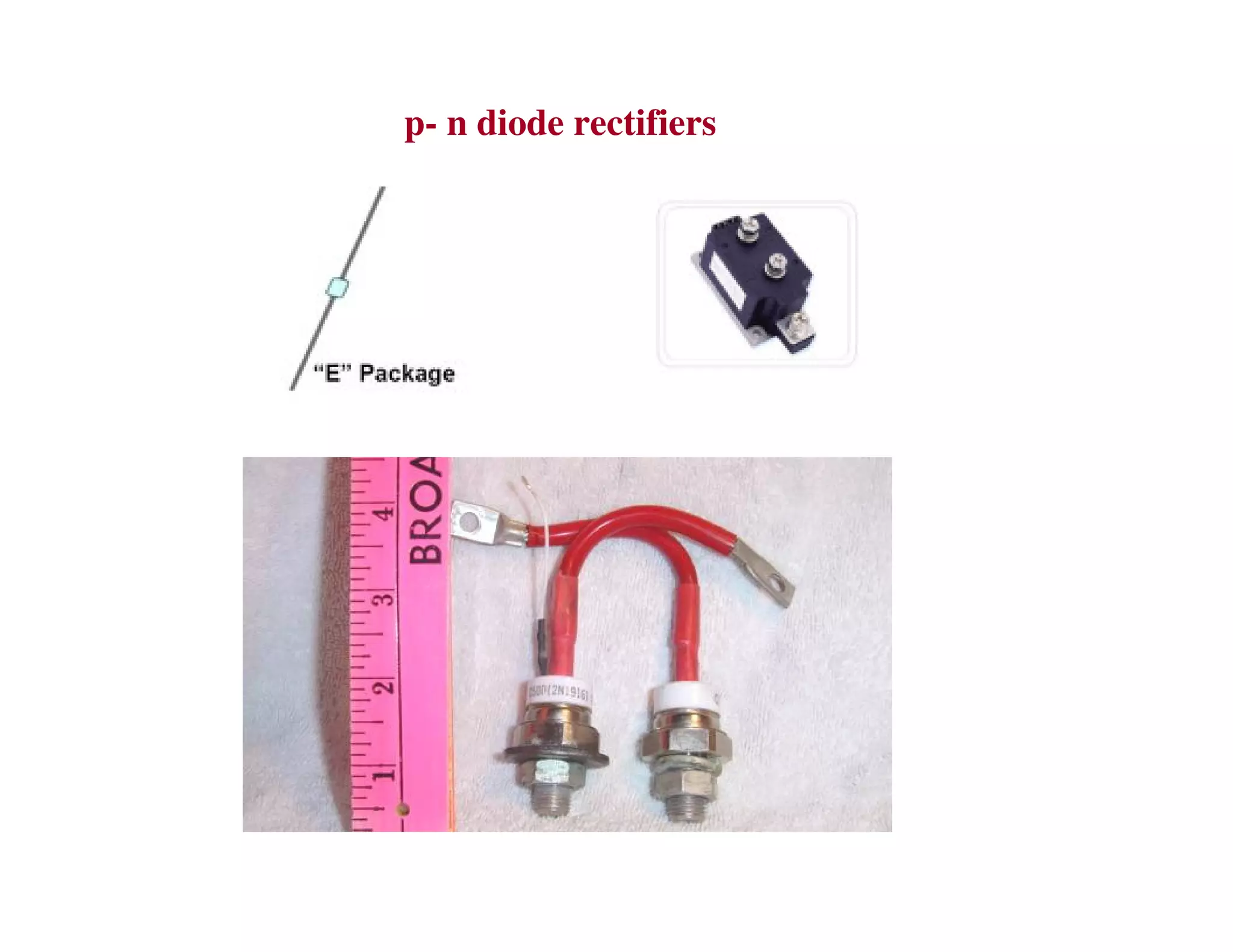
p- n diode rectifiers






−1exp
kT
qV
IS






−1exp
kT
qV
IS
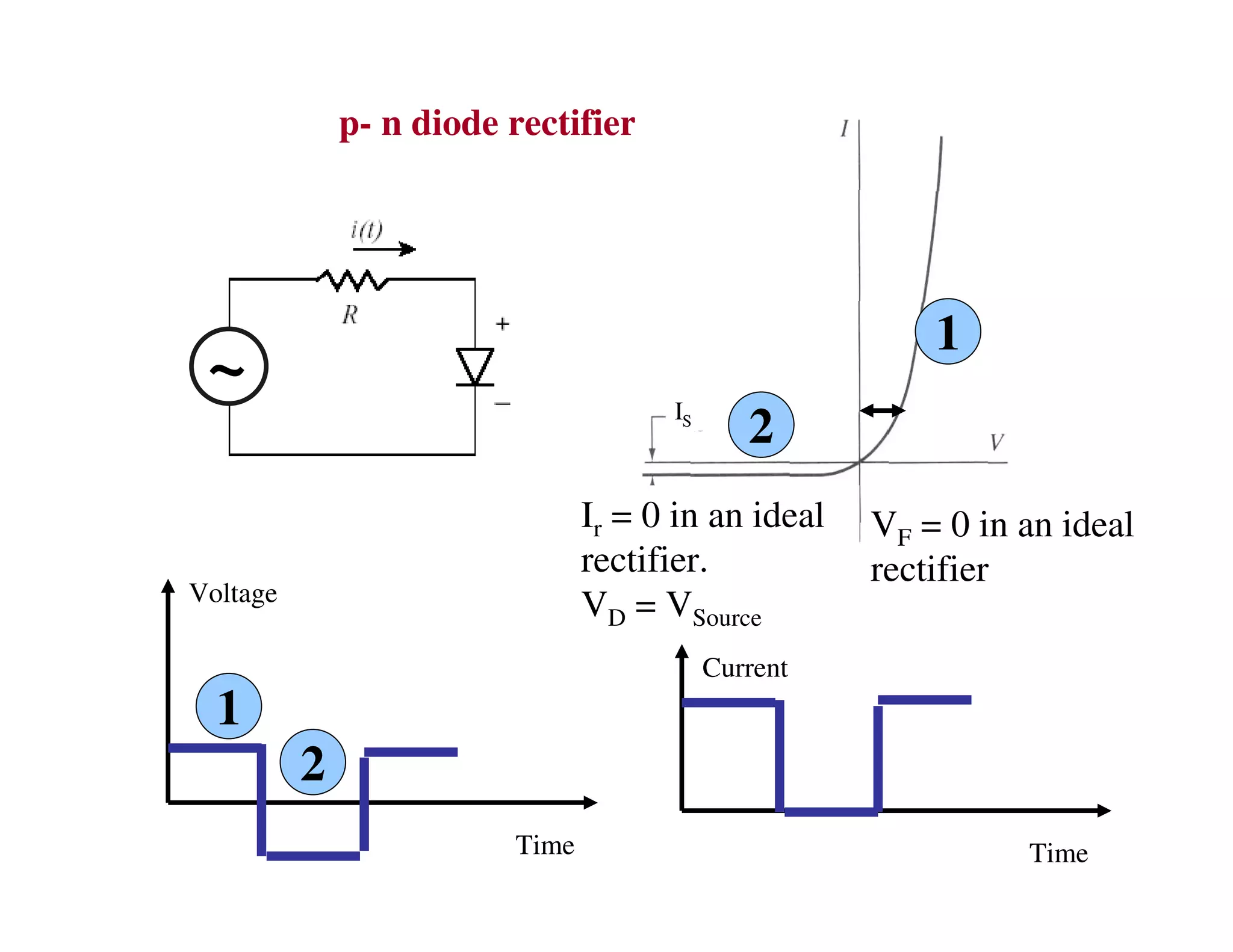
~
Time
Current
1
VF = 0 in an ideal
rectifier
Time
Voltage
1
2
2
Ir = 0 in an ideal
rectifier.
VD = VSource
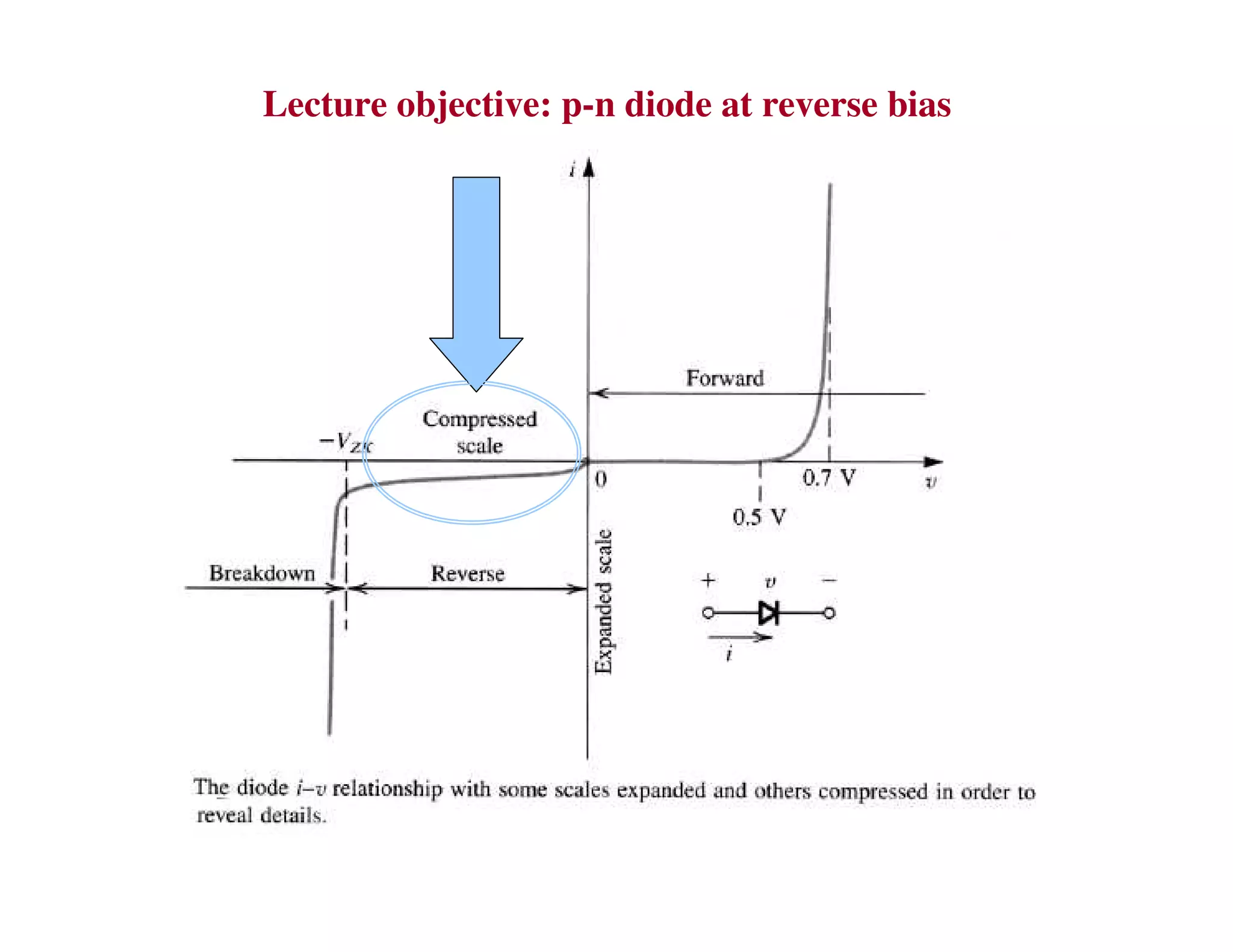
Lecture objective: p-n diode at reverse bias
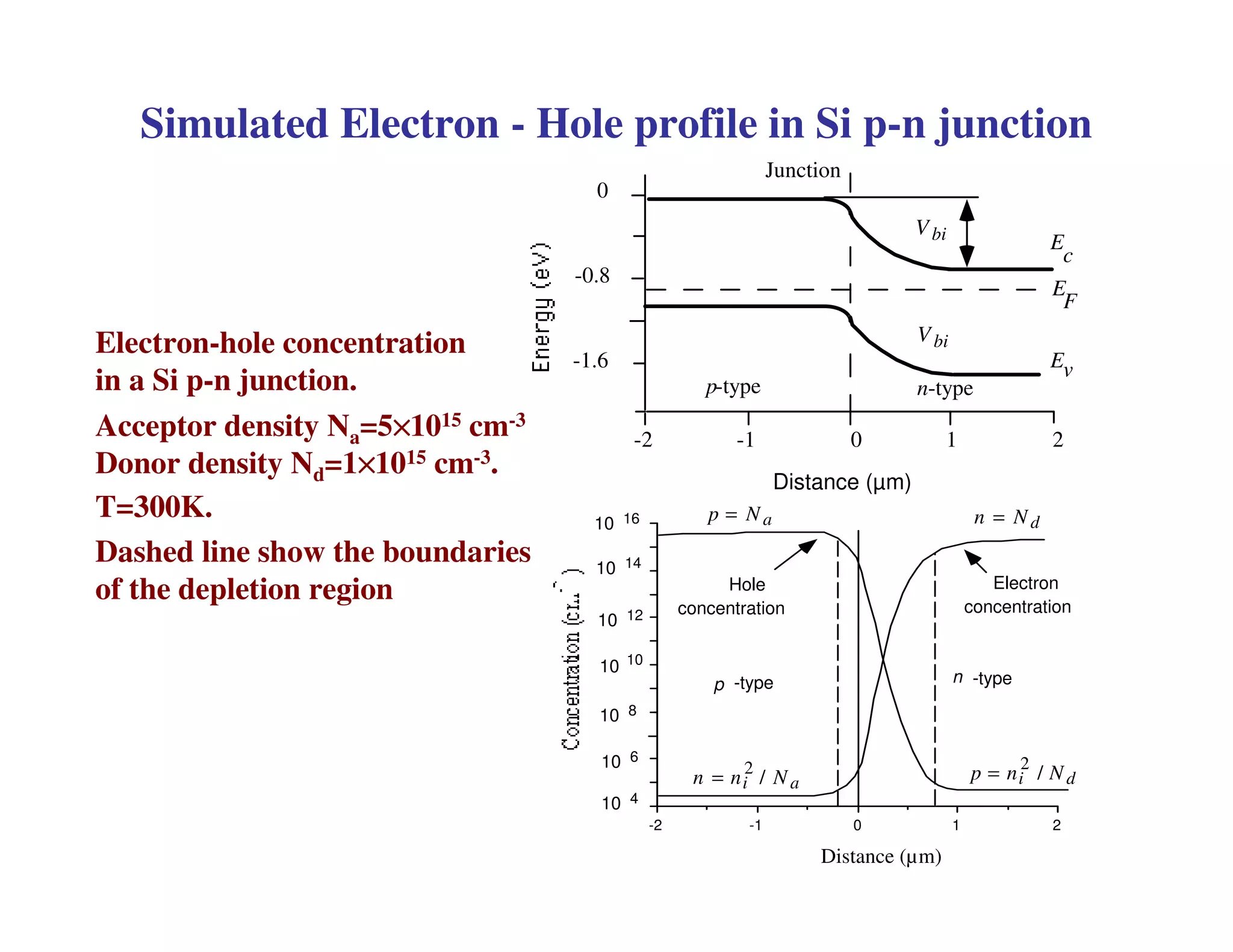
Simulated Electron - Hole profile in Si p-n junction
Electron-hole concentration
in a Si p-n junction.
Acceptor density Na=5××××1015 cm-3
Donor density Nd=1××××1015 cm-3.
T=300K.
Dashed line show the boundaries
of the depletion region
Vbi
Junction
-2 -1 0 1 2
Distance (µm)
0
-0.8
-1.6
E
F
E
c
Ev
p-type n-type
Vbi
210-1-2
10 16
10 14
10 12
10 10
10 8
10 6
10 4
Distance (µm)
p -type n -type
Electron
concentration
Hole
concentration
p = Na n = Nd
n = ni
2
/ Na
p = ni
2
/ Nd
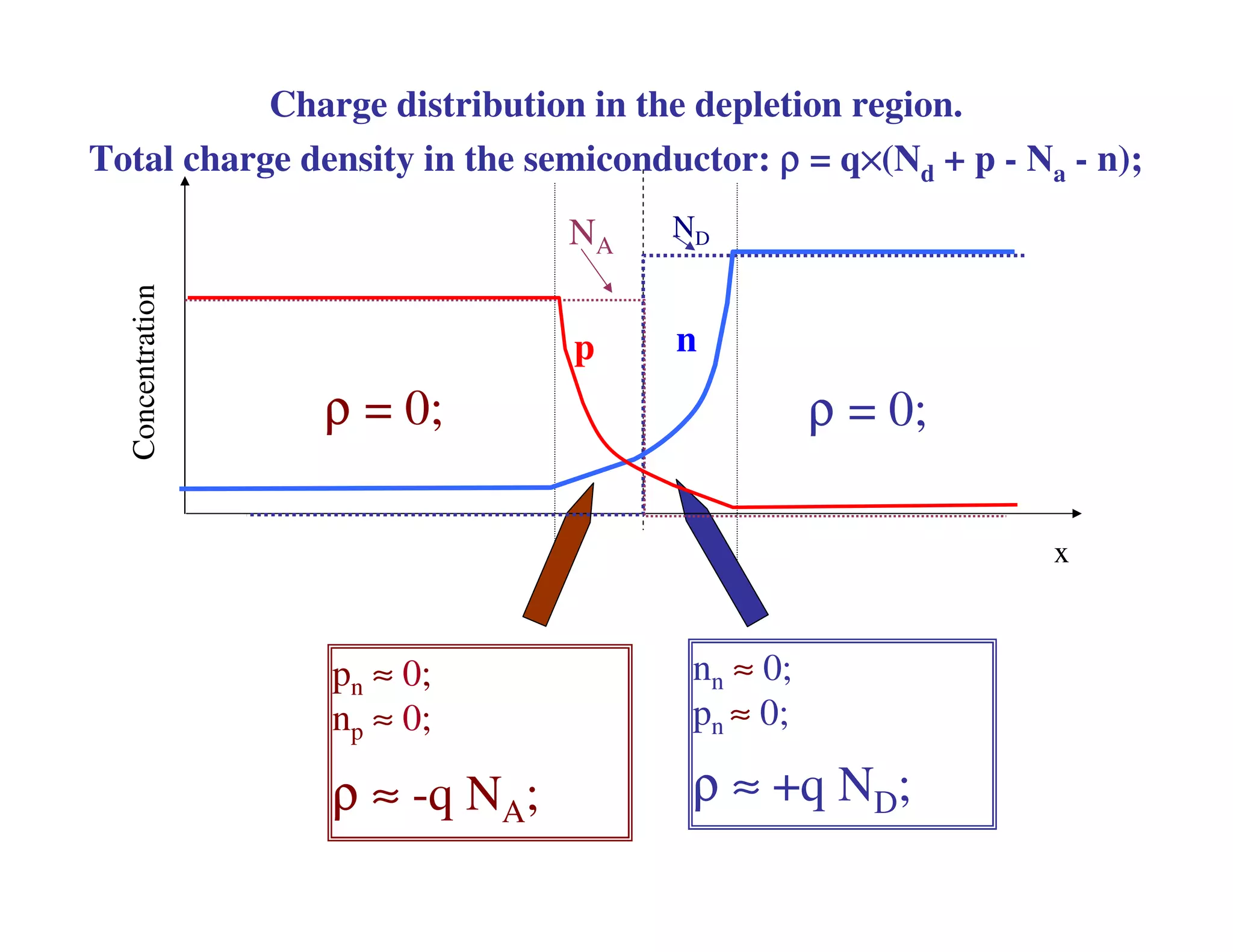
pn ≈ 0;
np ≈ 0;
ρ ≈ -q NA;
nn ≈ 0;
pn ≈ 0;
ρ ≈ +q ND;
Concentration
x
ND
np
NA
ρ = 0; ρ = 0;
Charge distribution in the depletion region.
Total charge density in the semiconductor: ρρρρ = q××××(Nd + p - Na - n);
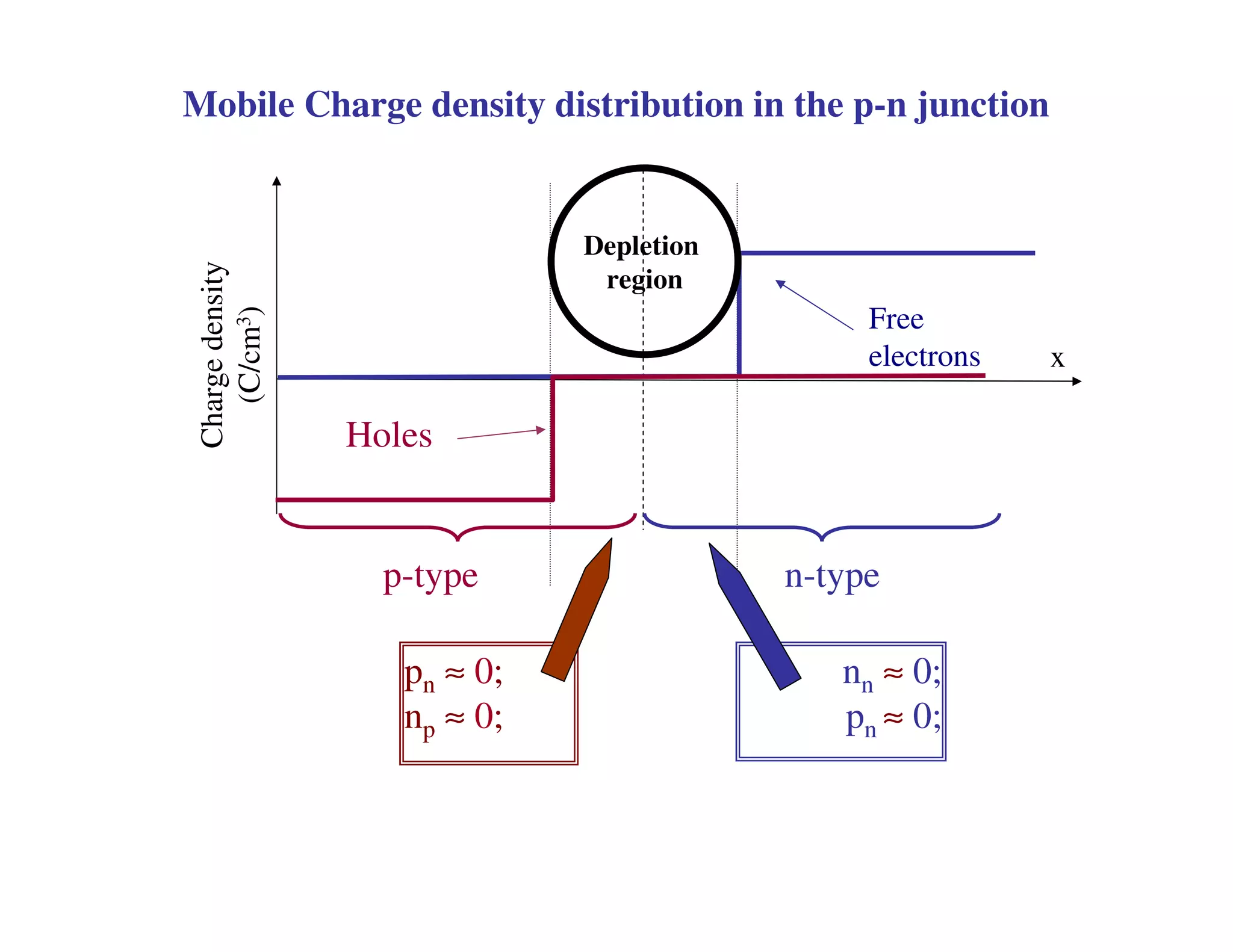
pn ≈ 0;
np ≈ 0;
nn ≈ 0;
pn ≈ 0;
Chargedensity
(C/cm3)
x
Free
electrons
Holes
Mobile Charge density distribution in the p-n junction
Depletion
region
p-type n-type
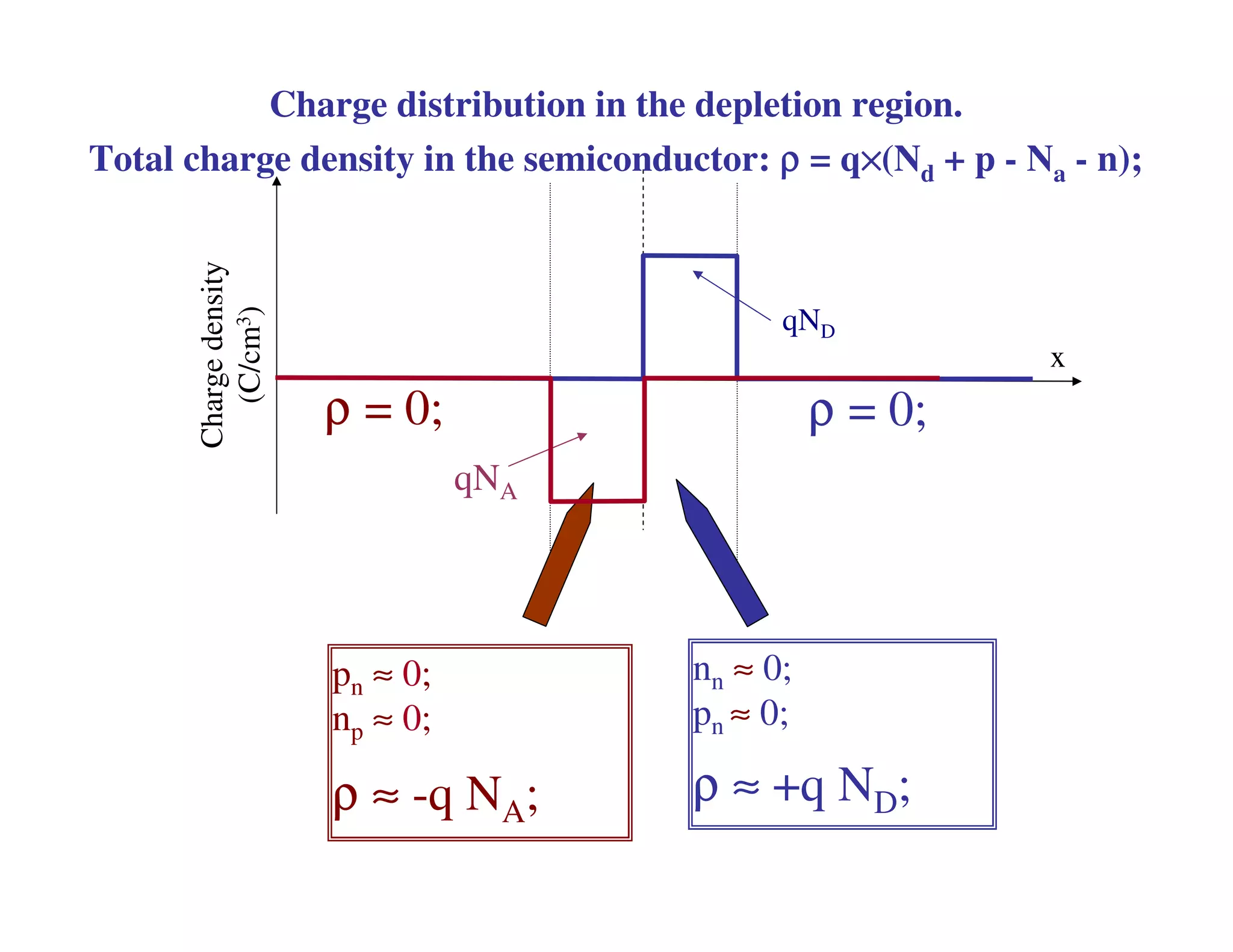
pn ≈ 0;
np ≈ 0;
ρ ≈ -q NA;
nn ≈ 0;
pn ≈ 0;
ρ ≈ +q ND;
Chargedensity
(C/cm3)
x
qND
qNA
ρ = 0; ρ = 0;
Charge distribution in the depletion region.
Total charge density in the semiconductor: ρρρρ = q××××(Nd + p - Na - n);
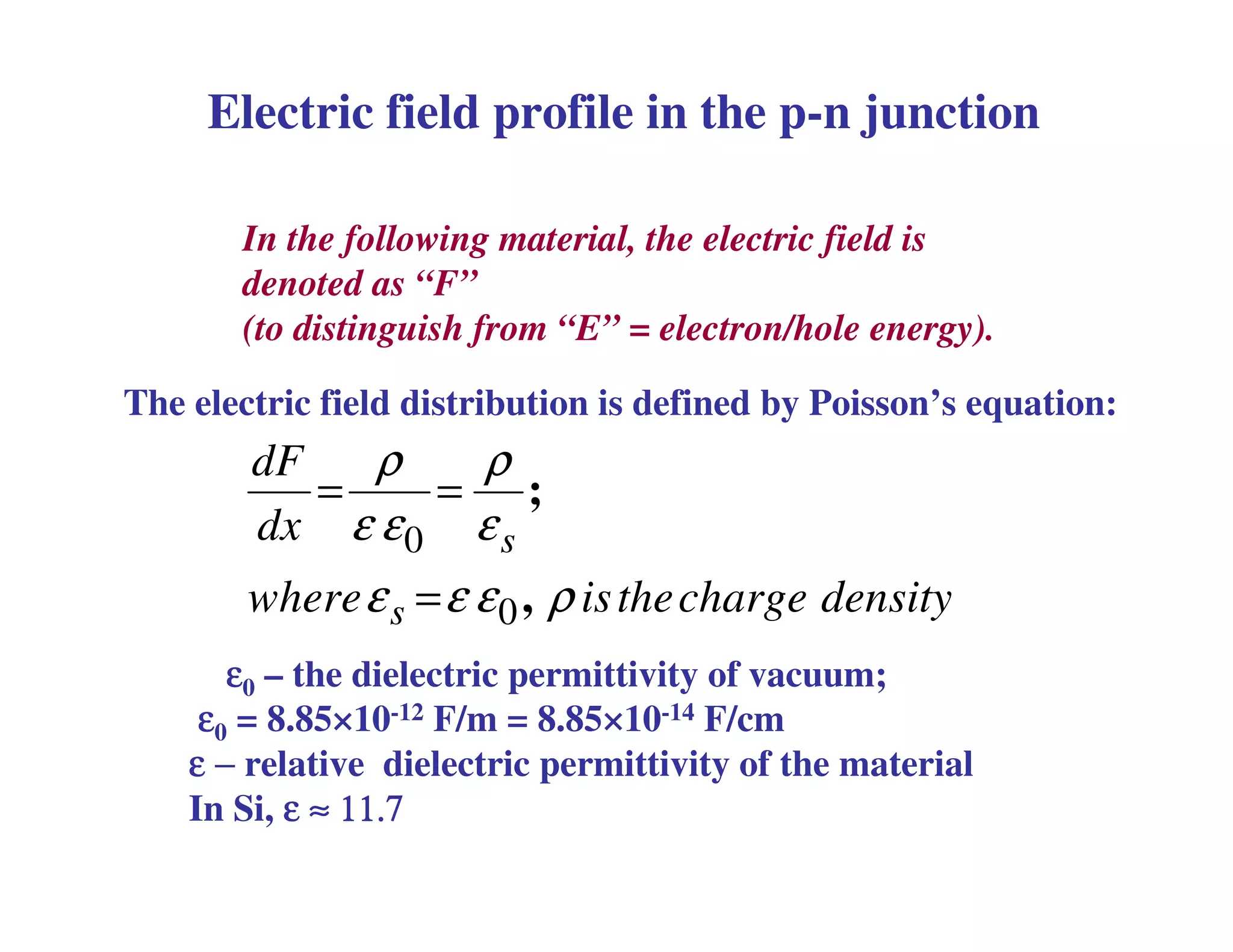
In the following material, the electric field is
denoted as “F”
(to distinguish from “E” = electron/hole energy).
0
0
s
s
dF
dx
where isthecharge density
ρ ρ
ε ε ε
ε ε ε ρ
= =
=
;
,
The electric field distribution is defined by Poisson’s equation:
Electric field profile in the p-n junction
εεεε0 – the dielectric permittivity of vacuum;
εεεε0 = 8.85×10⁻¹² F/m = 8.85×10⁻¹⁴ F/cm
εεεε −−−− relative dielectric permittivity of the material
In Si, εεεε ≈≈≈≈ 11.711.711.711.7
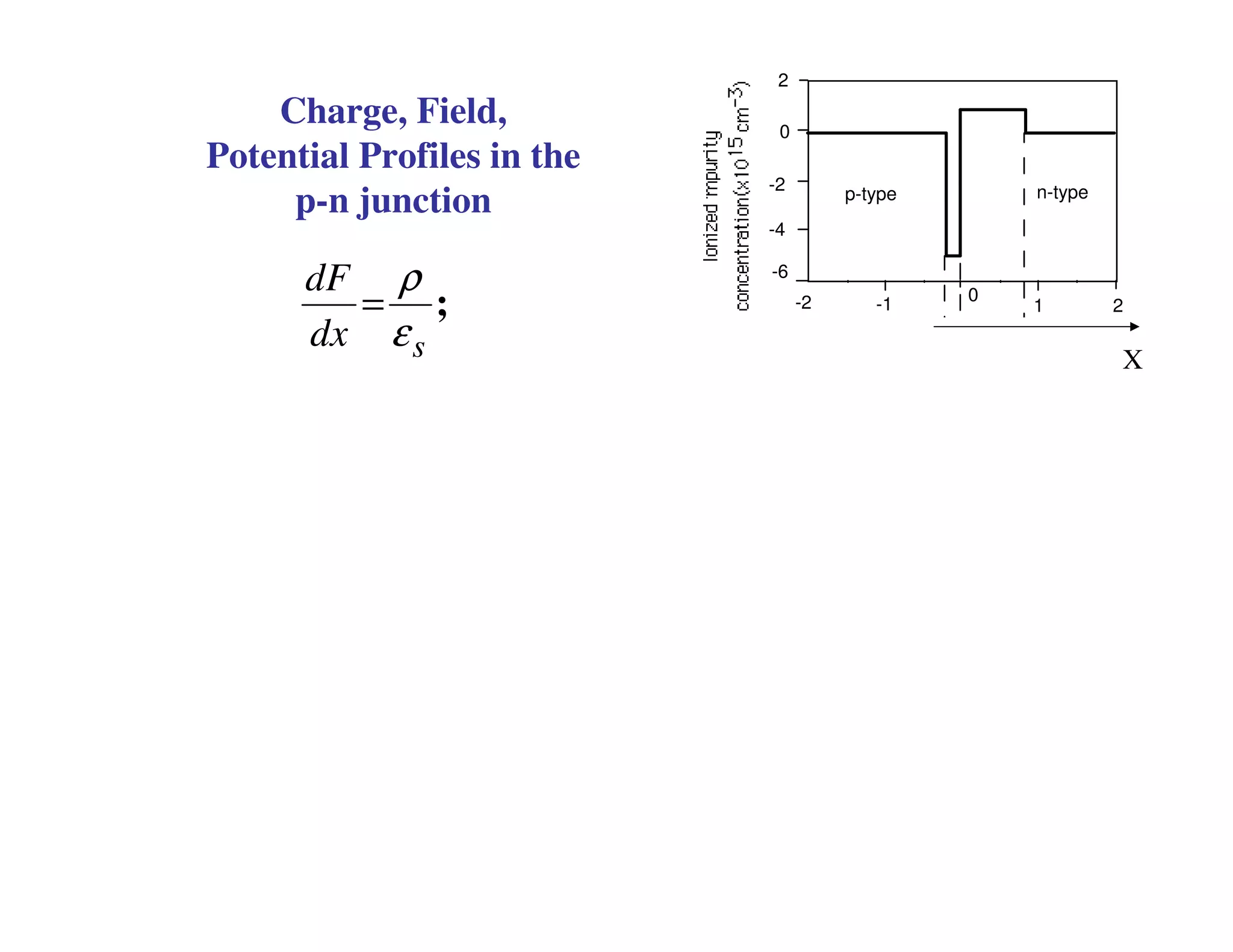
Charge, Field,
Potential Profiles in the
p-n junction
s
dF
dx
ρ
ε
= ; -2 -1
0
1 2
2
0
-2
-4
-6
p-type n-type
X
Charge, Field,
Potential Profiles in the
p-n junction
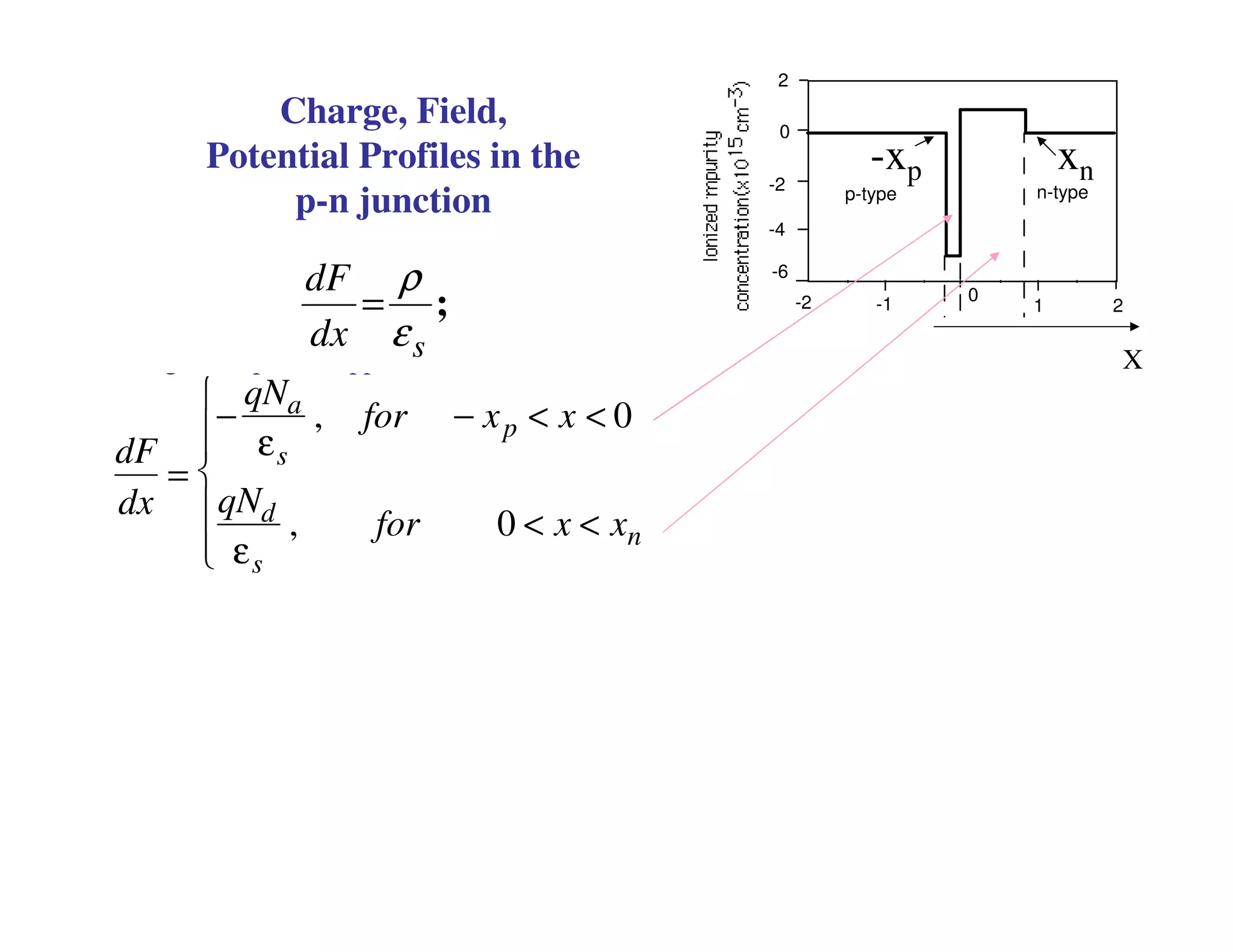
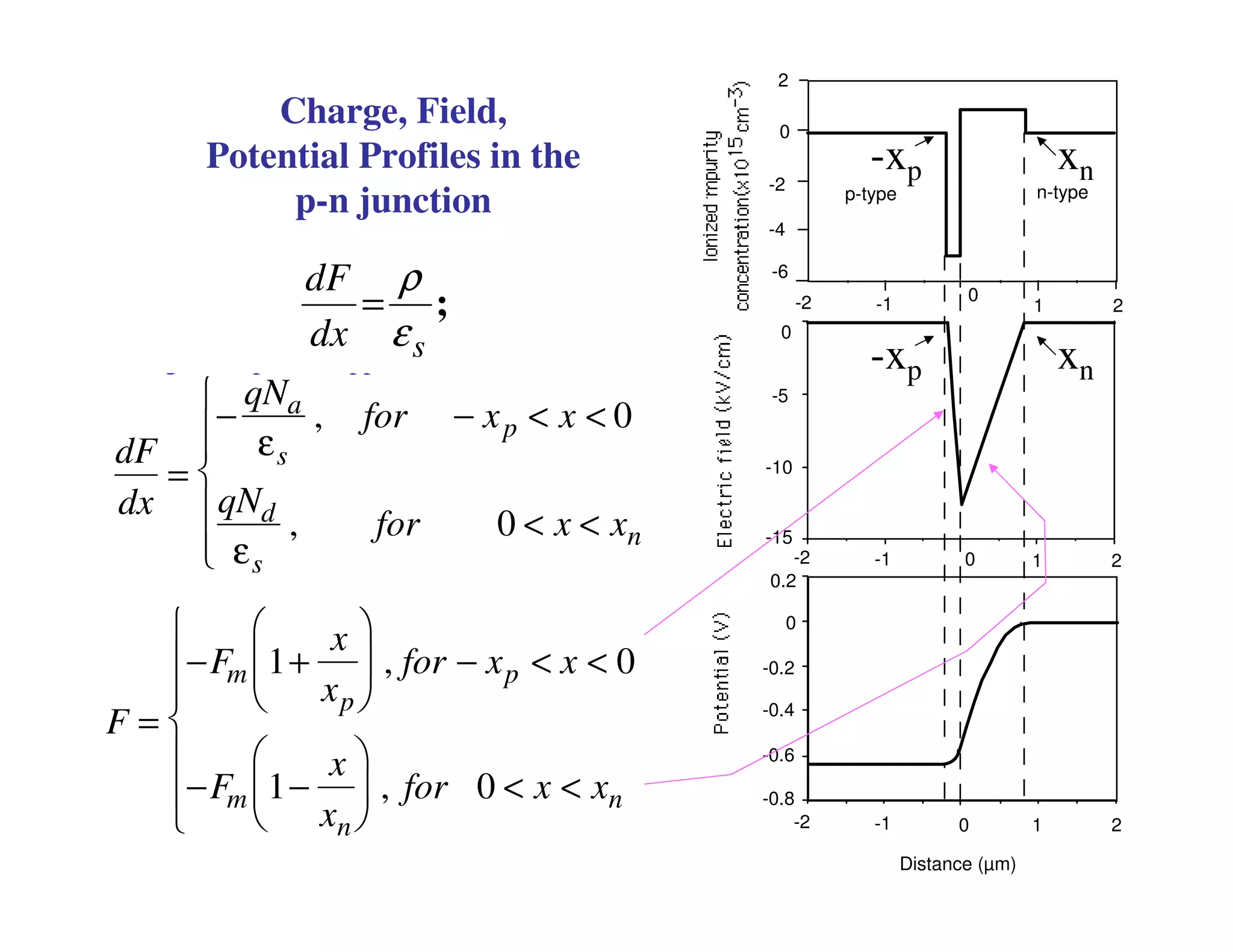
Using the depletion approximation, we obtain
dF
dx
=
−
qNa
εs
, for − xp < x < 0
qNd
εs
, for 0 < x < xn






s
dF
dx
ρ
ε
= ; -2 -1
0
1 2
2
0
-2
-4
-6
p-type n-type
-xp xn
X
Charge, Field,
Potential Profiles in the
p-n junction
Using the depletion approximation, we obtain
dF
dx
=
−
qNa
εs
, for − xp < x < 0
qNd
εs
, for 0 < x < xn






F =
−Fm 1+
x
xp





 , for − xp < x < 0
−Fm 1−
x
xn





 , for 0 < x < xn







-2 -1
0
1 2
2
0
-2
-4
-6
p-type n-type
-2 -1 0 1 2
0
-5
-10
-15
-2 -1 0 1 2
Distance (µm)
0.2
0
-0.2
-0.4
-0.6
-0.8
s
dF
dx
ρ
ε
= ;
-xp xn
-xp xn
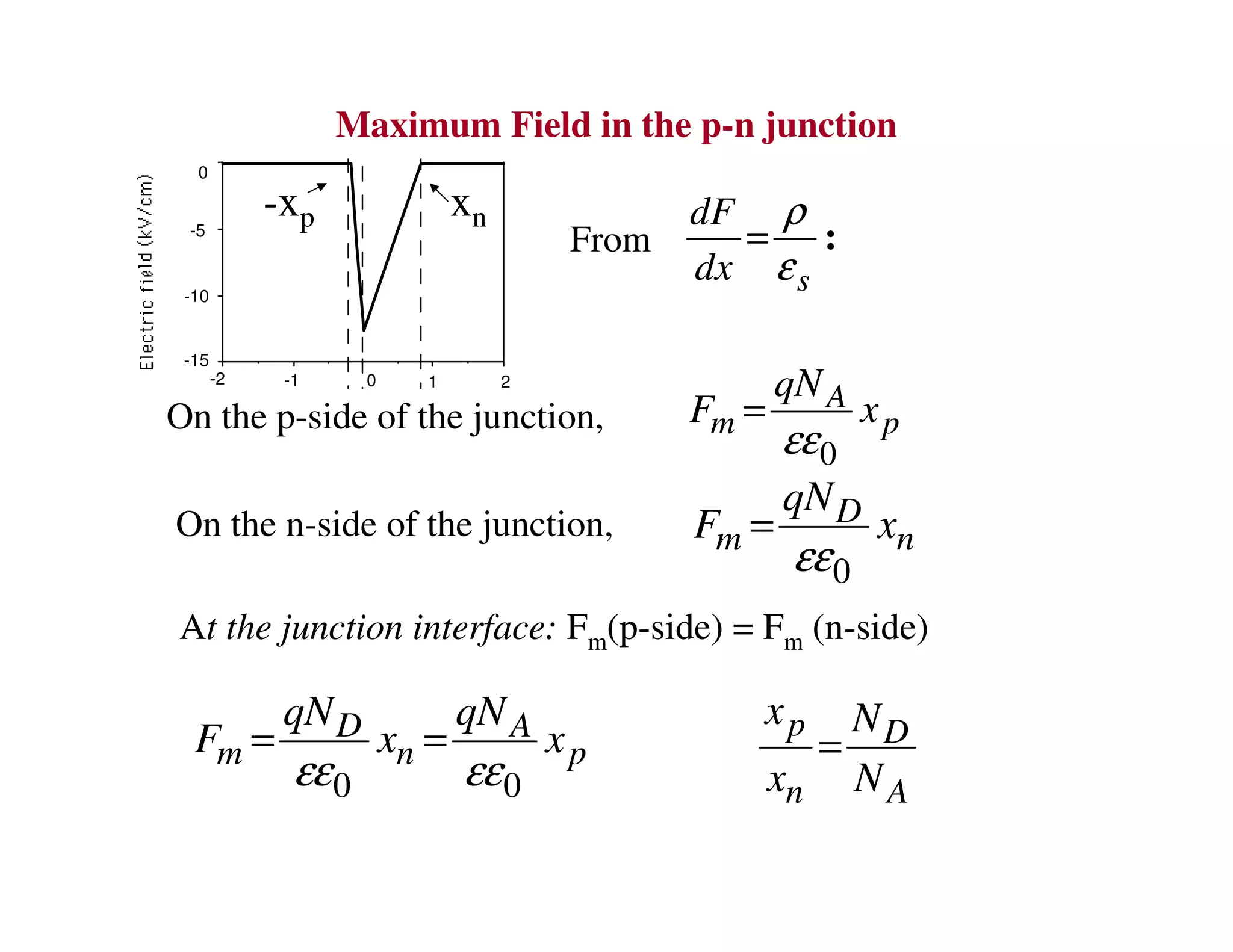
On the p-side of the junction,
0
A
m p
qN
F x
εε
=
On the n-side of the junction,
0
D
m n
qN
F x
εε
=
At the junction interface: Fm(p-side) = Fm (n-side)
0 0
D A
m n p
qN qN
F x x
εε εε
= =
Maximum Field in the p-n junction
From
-2 -1 0 1 2
0
-5
-10
-15
-xp xn
s
dF
dx
ρ
ε
= :
p D
n A
x N
x N
=
0 0
D A
m n p
qN qN
F x x
εε εε
= =
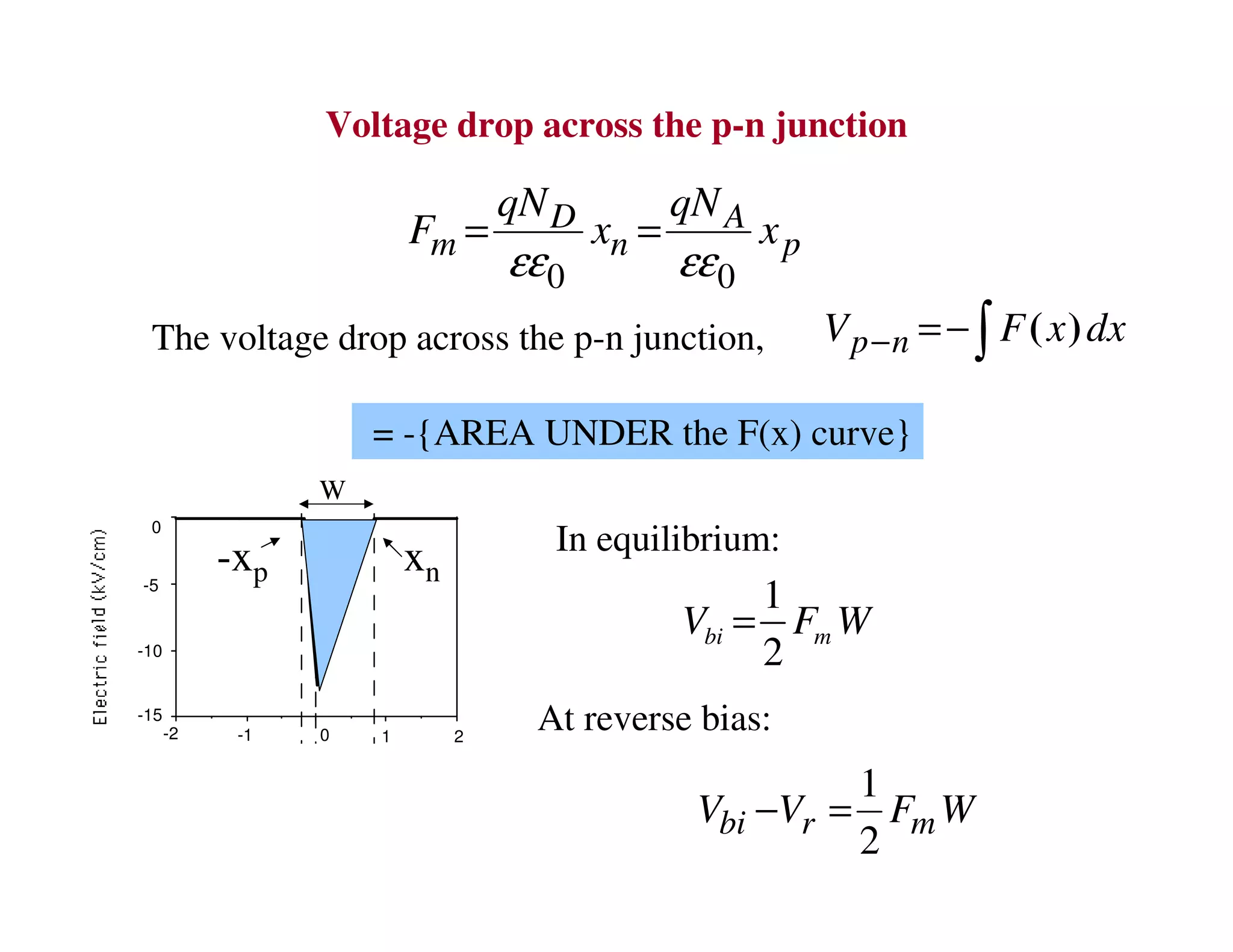
The voltage drop across the p-n junction, p nV F x dx− =−∫ ( )
= -{AREA UNDER the F(x) curve}
1
2
bi mV F W=
Voltage drop across the p-n junction
In equilibrium:
At reverse bias:
1
2bi r mV V F W− =
-2 -1 0 1 2
0
-5
-10
-15
-xp xn
W
2 2
0 0 0
1
/ 2
2 1 / 2
D D D A
bi r n
D A A D
qN qN q N N
V V x W W W
N N N Nεε εε εε
 
− = = = 
+ + 
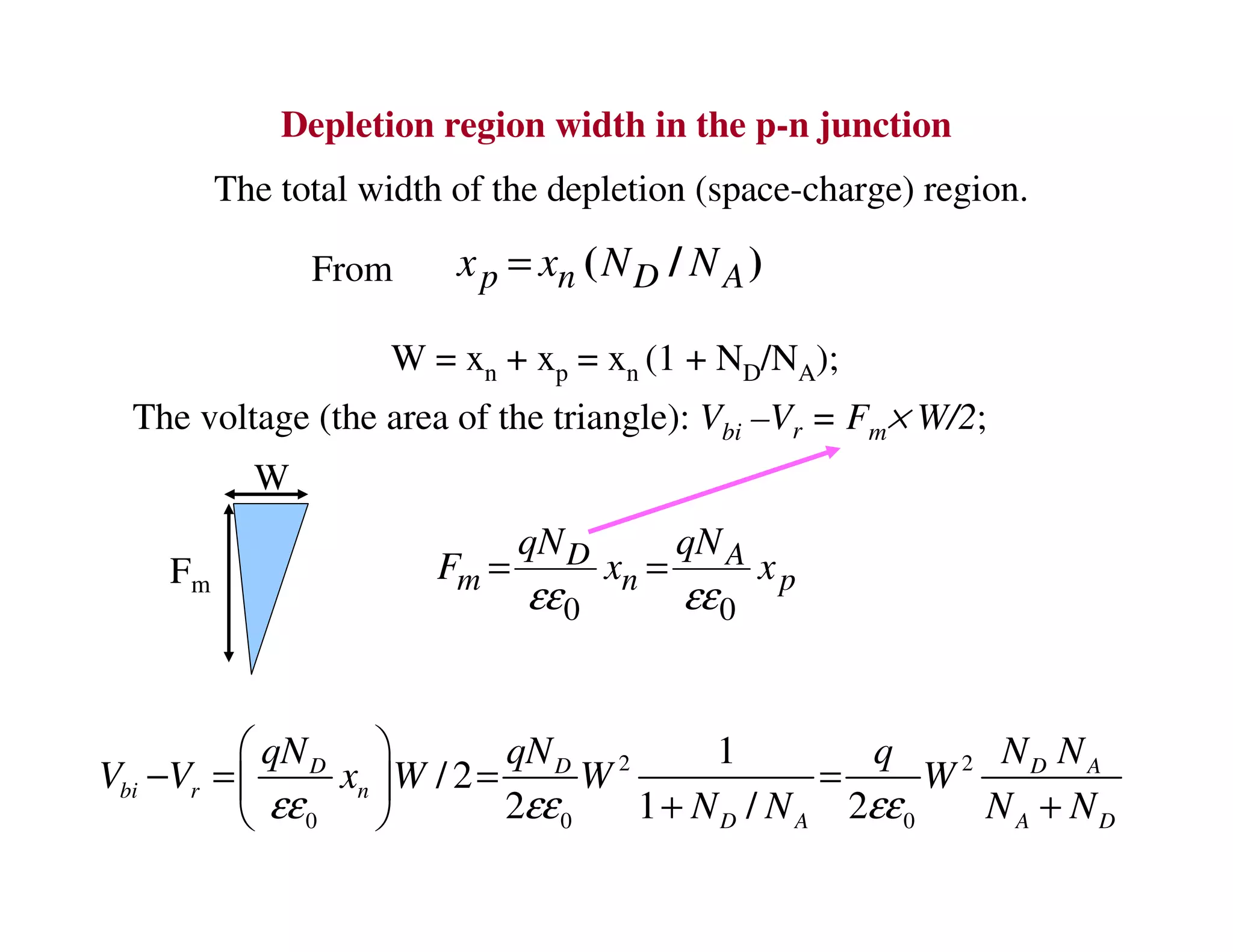
The total width of the depletion (space-charge) region.
W = xn + xp = xn (1 + ND/NA);
The voltage (the area of the triangle): Vbi –Vr = Fm× W/2;
Depletion region width in the p-n junction
p n D Ax x N N= ( / )From
W
Fm
0 0
D A
m n p
qN qN
F x x
εε εε
= =
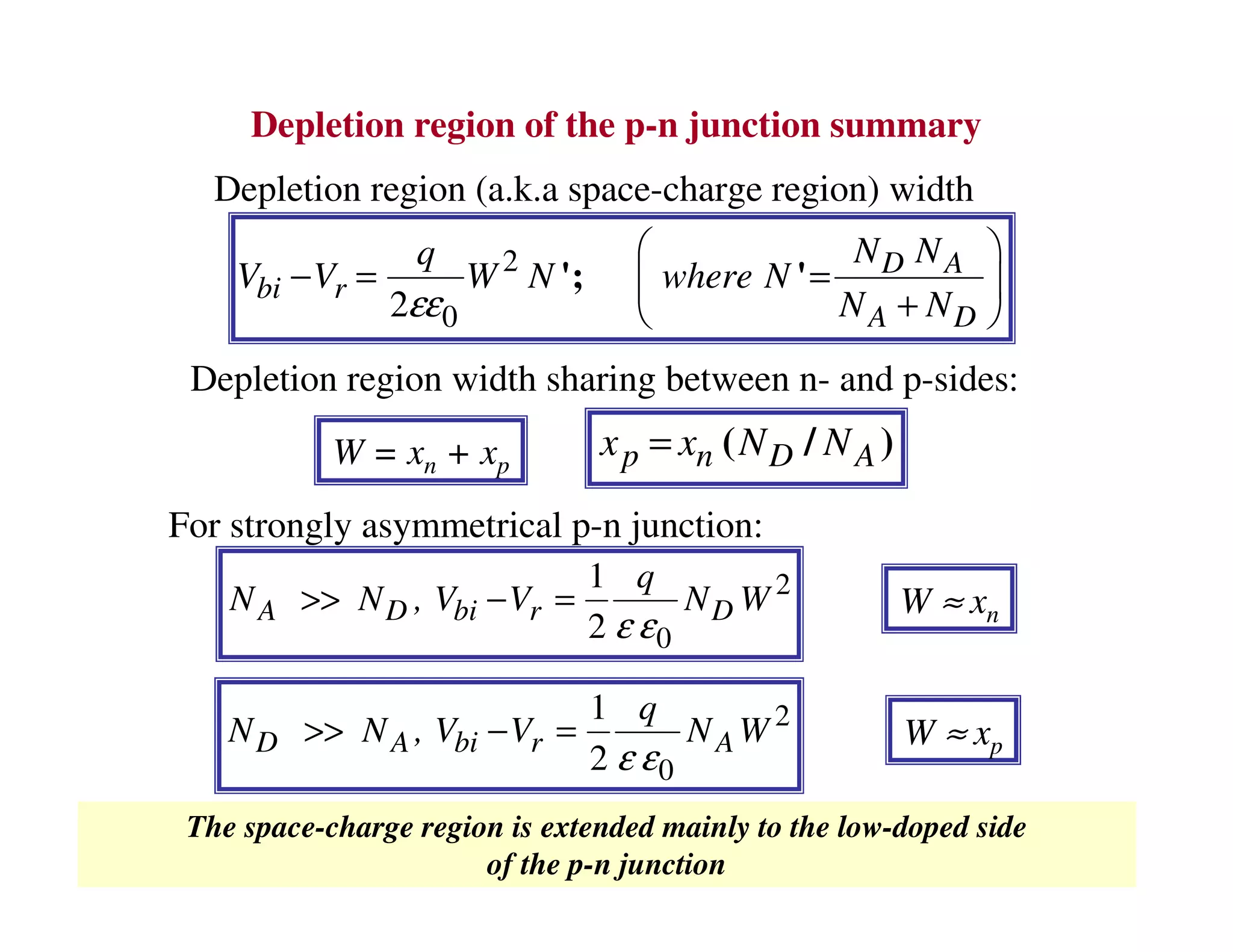
Depletion region (a.k.a space-charge region) width
Depletion region of the p-n junction summary
2
02
D A
bi r
A D
N Nq
V V W N where N
N N
'; '
εε
 
− = = 
+ 
2
0
1
2A D bi r D
q
N N , V V N W
ε ε
>> − =
For strongly asymmetrical p-n junction:
2
0
1
2D A bi r A
q
N N , V V N W
ε ε
>> − =
The space-charge region is extended mainly to the low-doped side
of the p-n junction
Depletion region width sharing between n- and p-sides:
p n D Ax x N N( / )=W = xn + xp
W ≈ xn
W ≈ xp
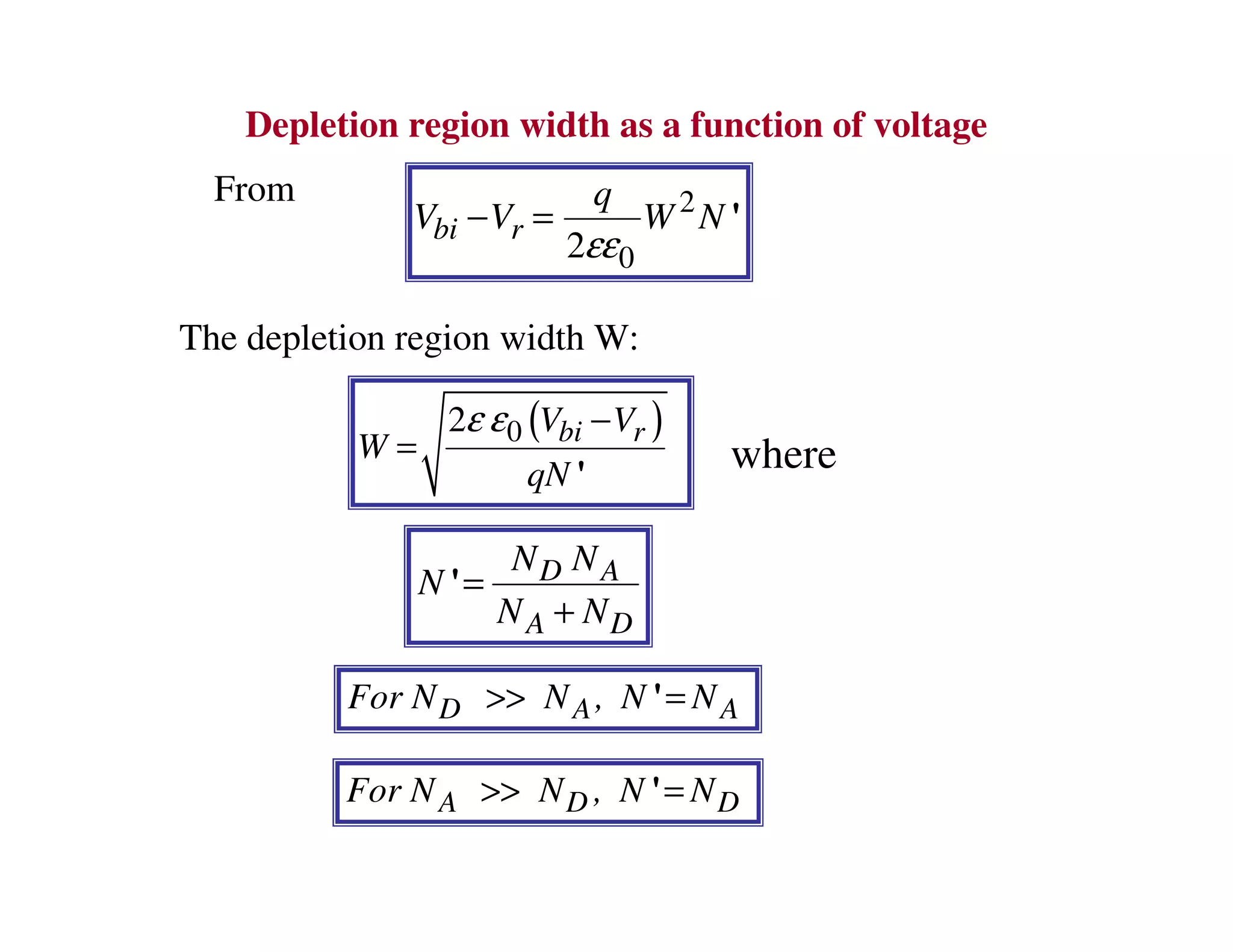
From
Depletion region width as a function of voltage
2
02
bi r
q
V V W N '
εε
− =
( )02 bi rV V
W
qN
ε ε −
=
'
D A AFor N N , N N>> ='
The depletion region width W:
where
D A
A D
N N
N
N N
=
+
'
A D DFor N N , N N>> ='
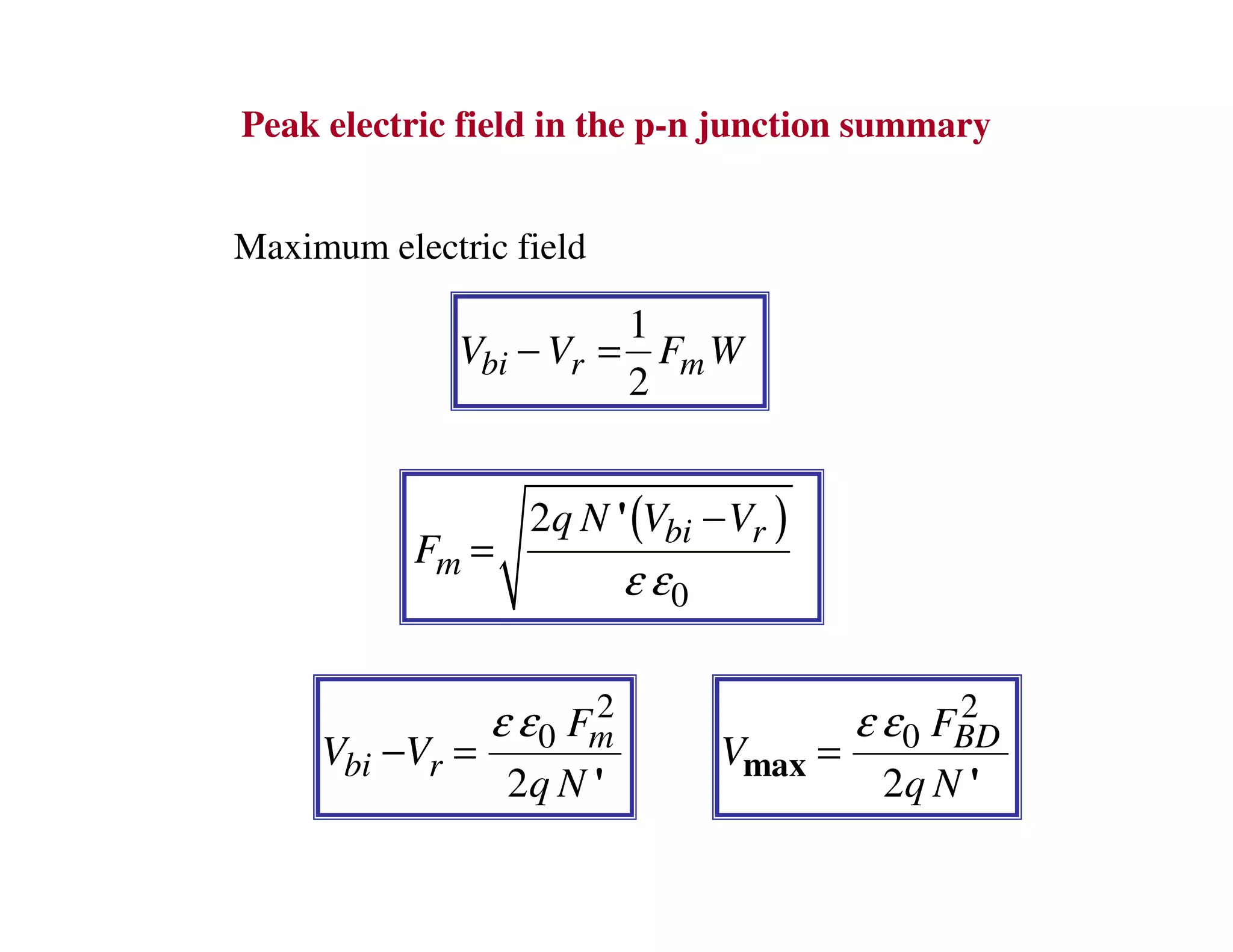
Peak electric field in the p-n junction summary
Maximum electric field
1
2bi r mV V F W− =
( )
0
2 bi r
m
q N V V
F
'
ε ε
−
=
2
0
2
m
bi r
F
V V
q N '
ε ε
− =
2
0
2
BDF
V
q Nmax
'
ε ε
=
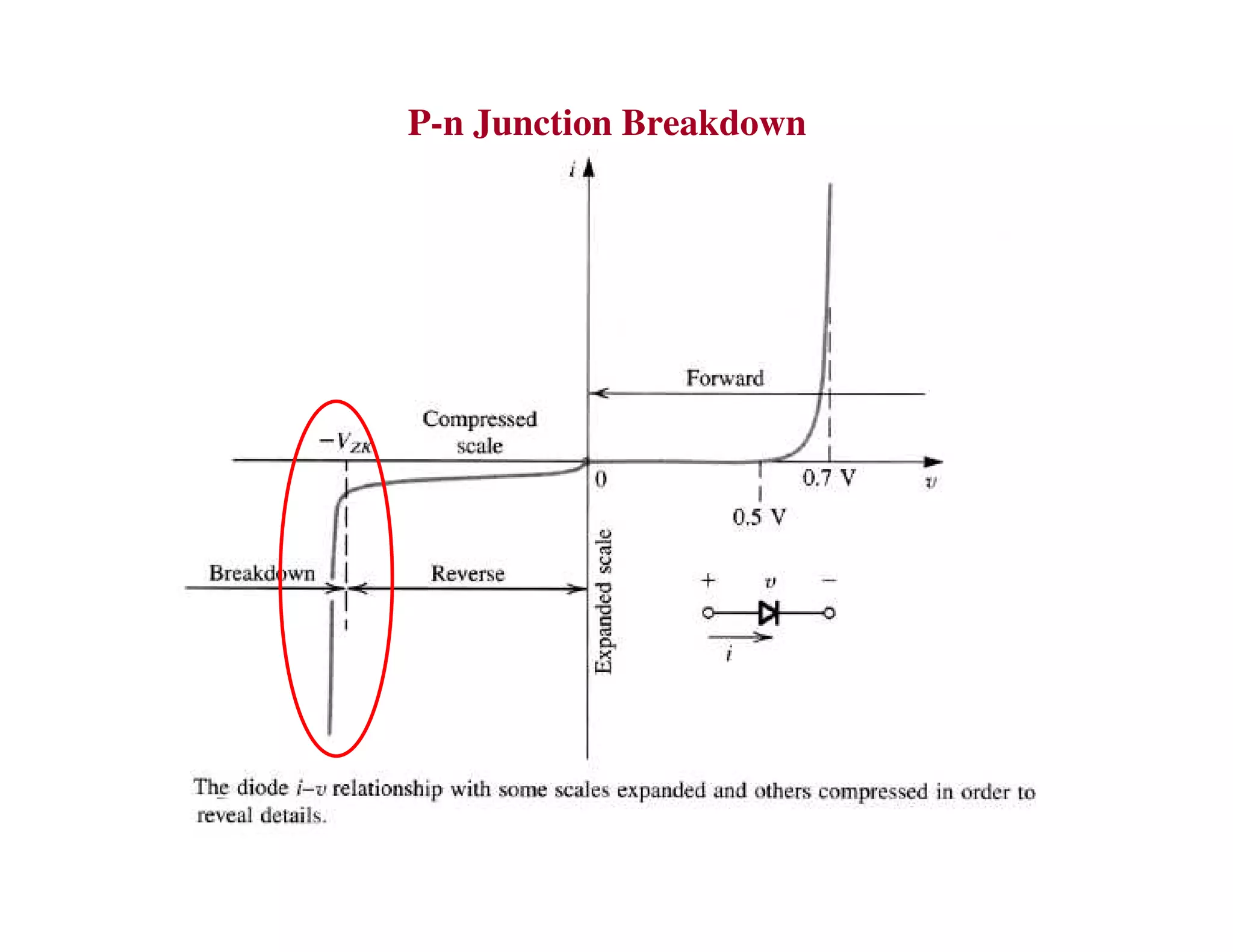
P-n Junction Breakdown
Avalanche Breakdown mechanism
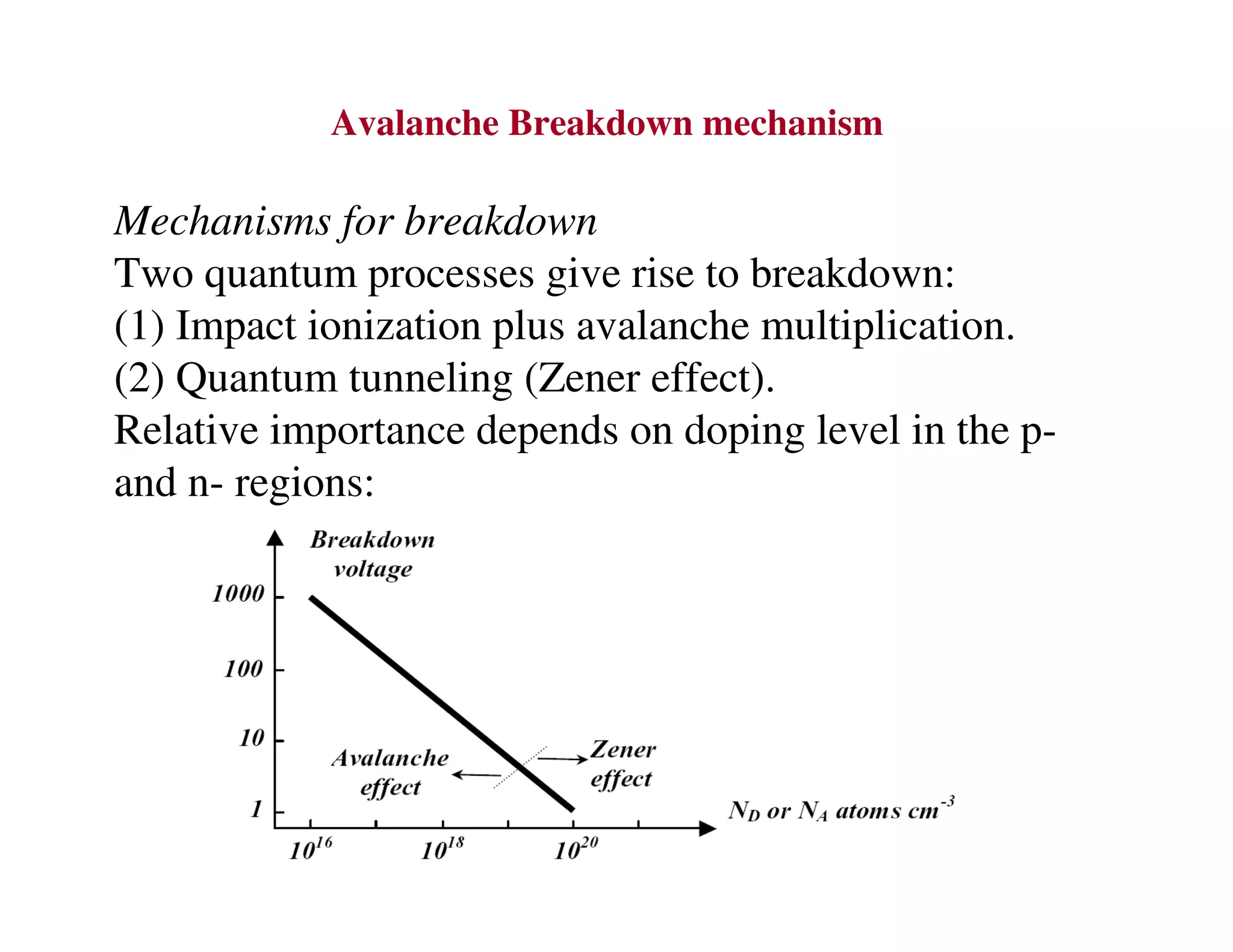
Mechanisms for breakdown
Two quantum processes give rise to breakdown:
(1) Impact ionization plus avalanche multiplication.
(2) Quantum tunneling (Zener effect).
Relative importance depends on doping level in the p-
and n- regions:
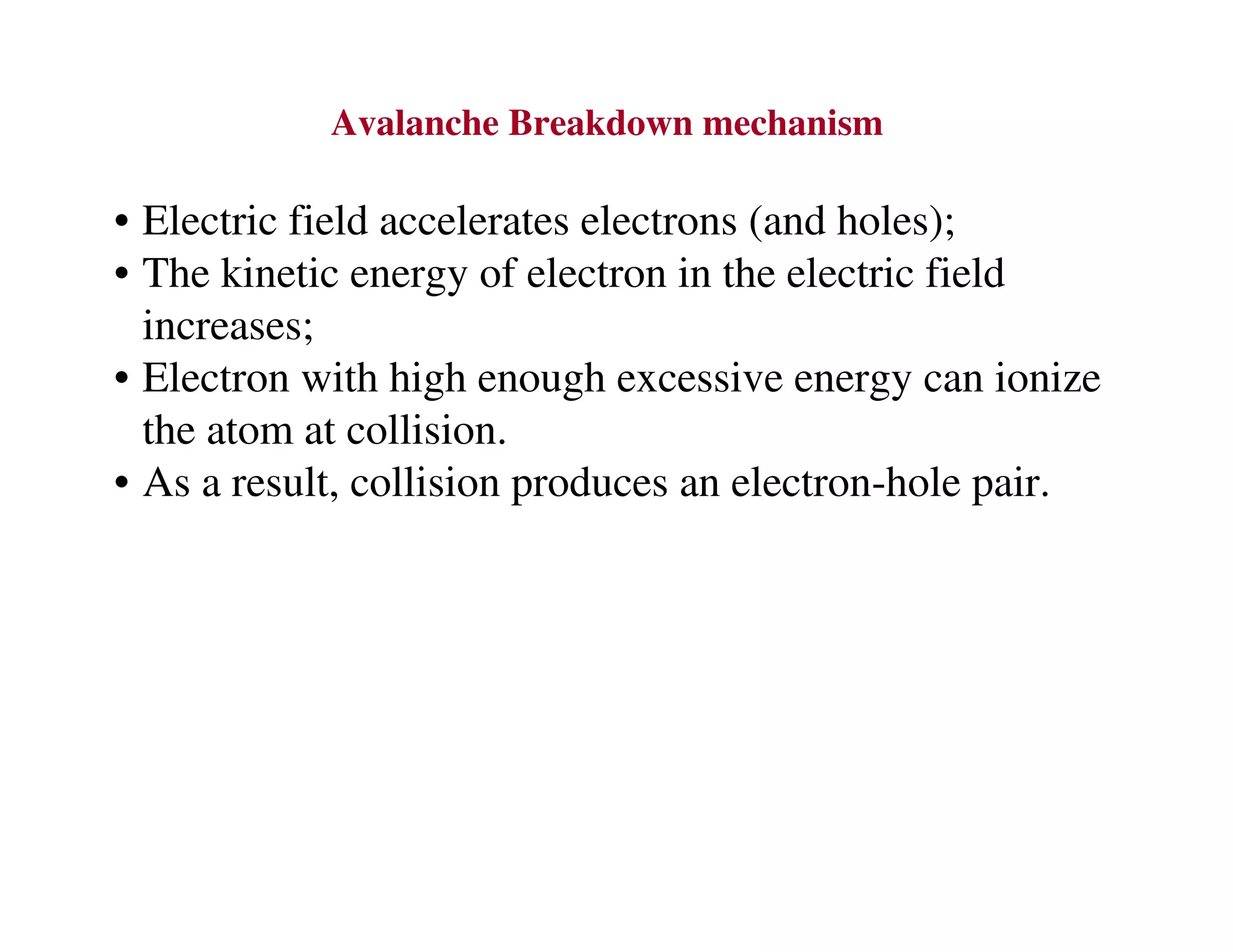
Avalanche Breakdown mechanism
• Electric field accelerates electrons (and holes);
• The kinetic energy of electron in the electric field
increases;
• Electron with high enough excessive energy can ionize
the atom at collision.
• As a result, collision produces an electron-hole pair.
Avalanche Breakdown mechanism
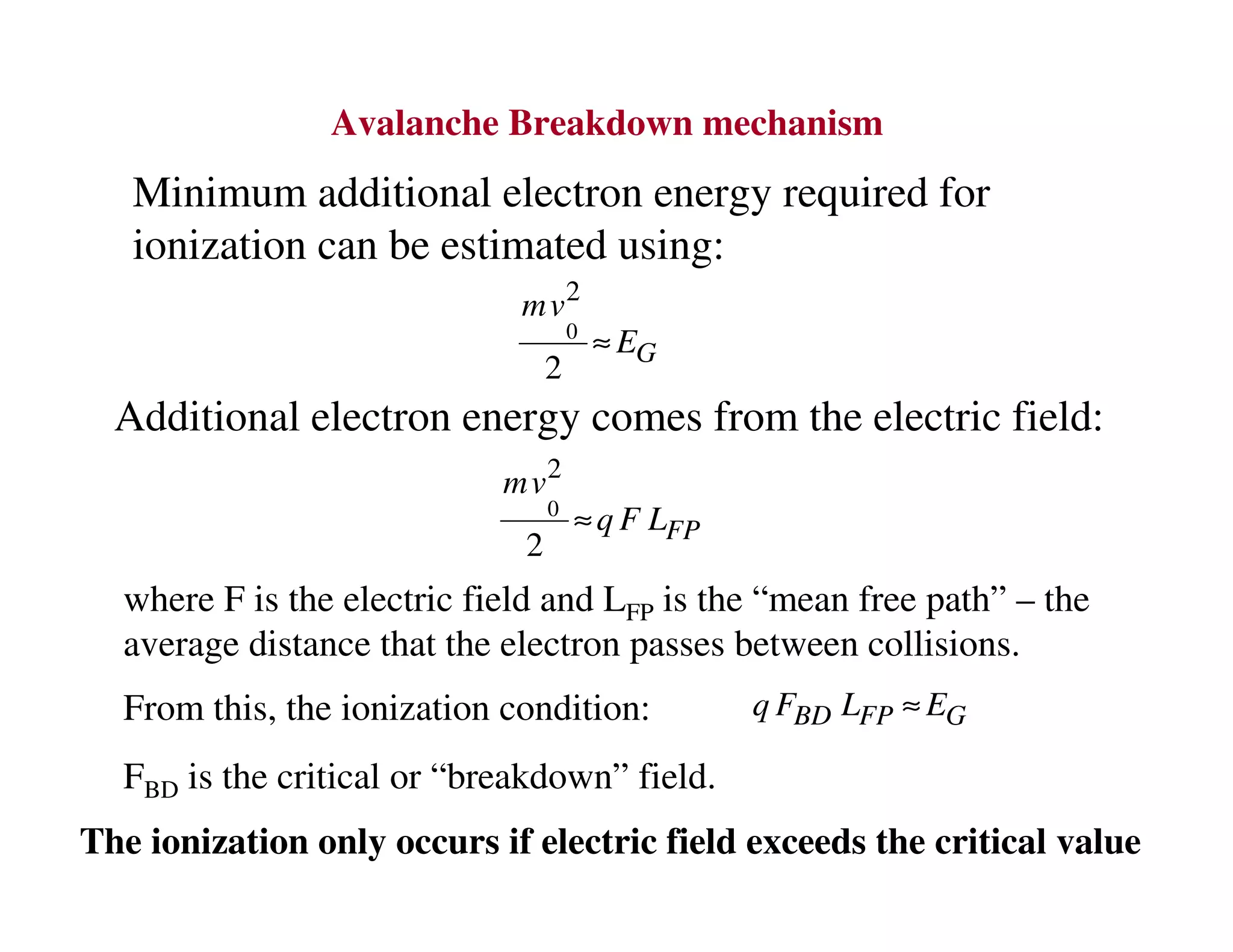
Minimum additional electron energy required for
ionization can be estimated using:
0
2
2 G
mv
E≈
Additional electron energy comes from the electric field:
0
2
2 FP
mv
q F L≈
where F is the electric field and LFP is the “mean free path” – the
average distance that the electron passes between collisions.
From this, the ionization condition: BD FP Gq F L E≈
FBD is the critical or “breakdown” field.
The ionization only occurs if electric field exceeds the critical value
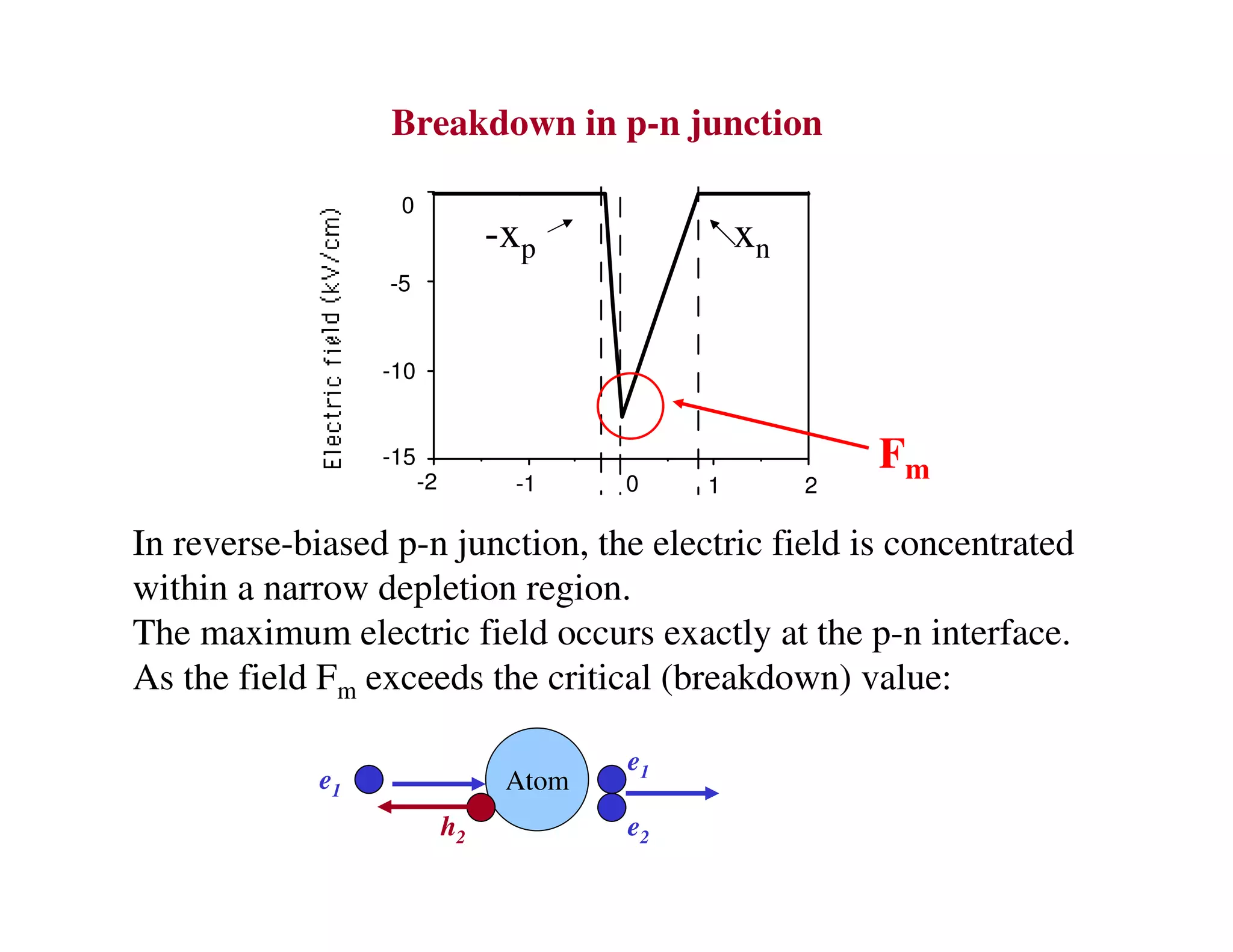
Breakdown in p-n junction
-2 -1 0 1 2
0
-5
-10
-15
-xp xn
In reverse-biased p-n junction, the electric field is concentrated
within a narrow depletion region.
The maximum electric field occurs exactly at the p-n interface.
As the field Fm exceeds the critical (breakdown) value:
Fm
Atome1
e1
e2h2
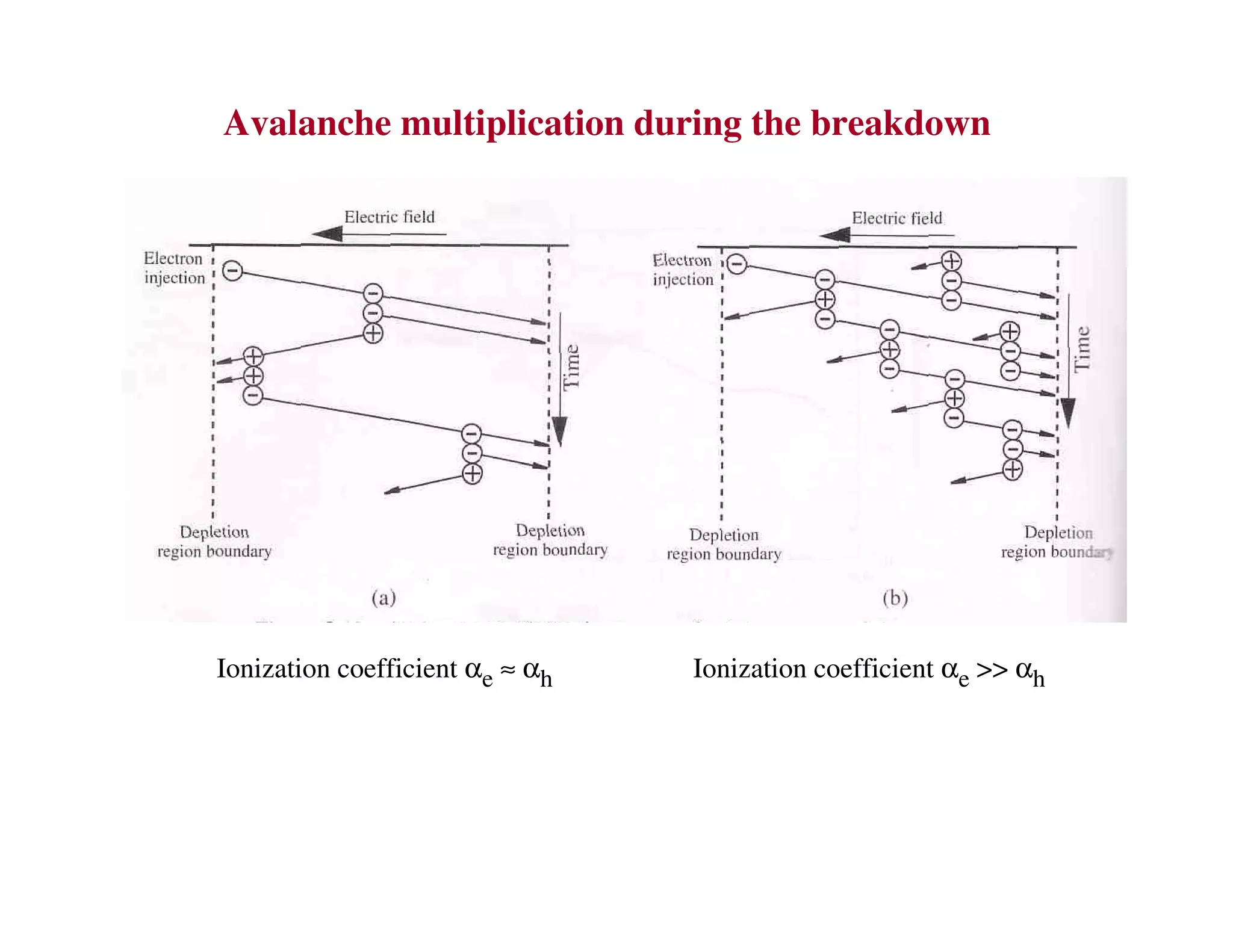
Avalanche multiplication during the breakdown
Ionization coefficient αe ≈ αh Ionization coefficient αe >> αh
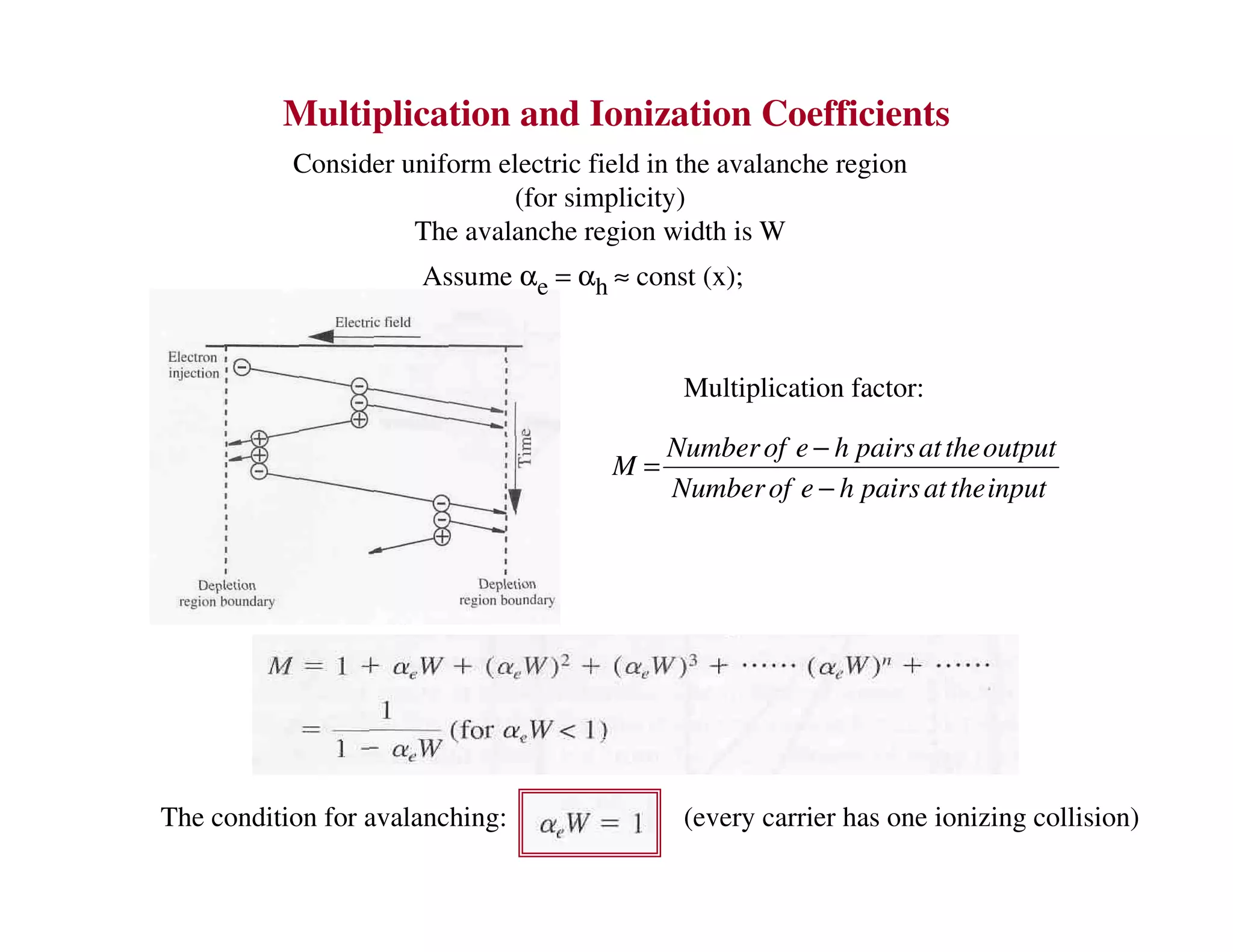
Multiplication and Ionization Coefficients
Consider uniform electric field in the avalanche region
(for simplicity)
The avalanche region width is W
The condition for avalanching: (every carrier has one ionizing collision)
Assume αe = αh ≈ const (x);
Multiplication factor:
Numberof e h pairsattheoutput
M
Numberof e h pairsattheinput
−
=
−
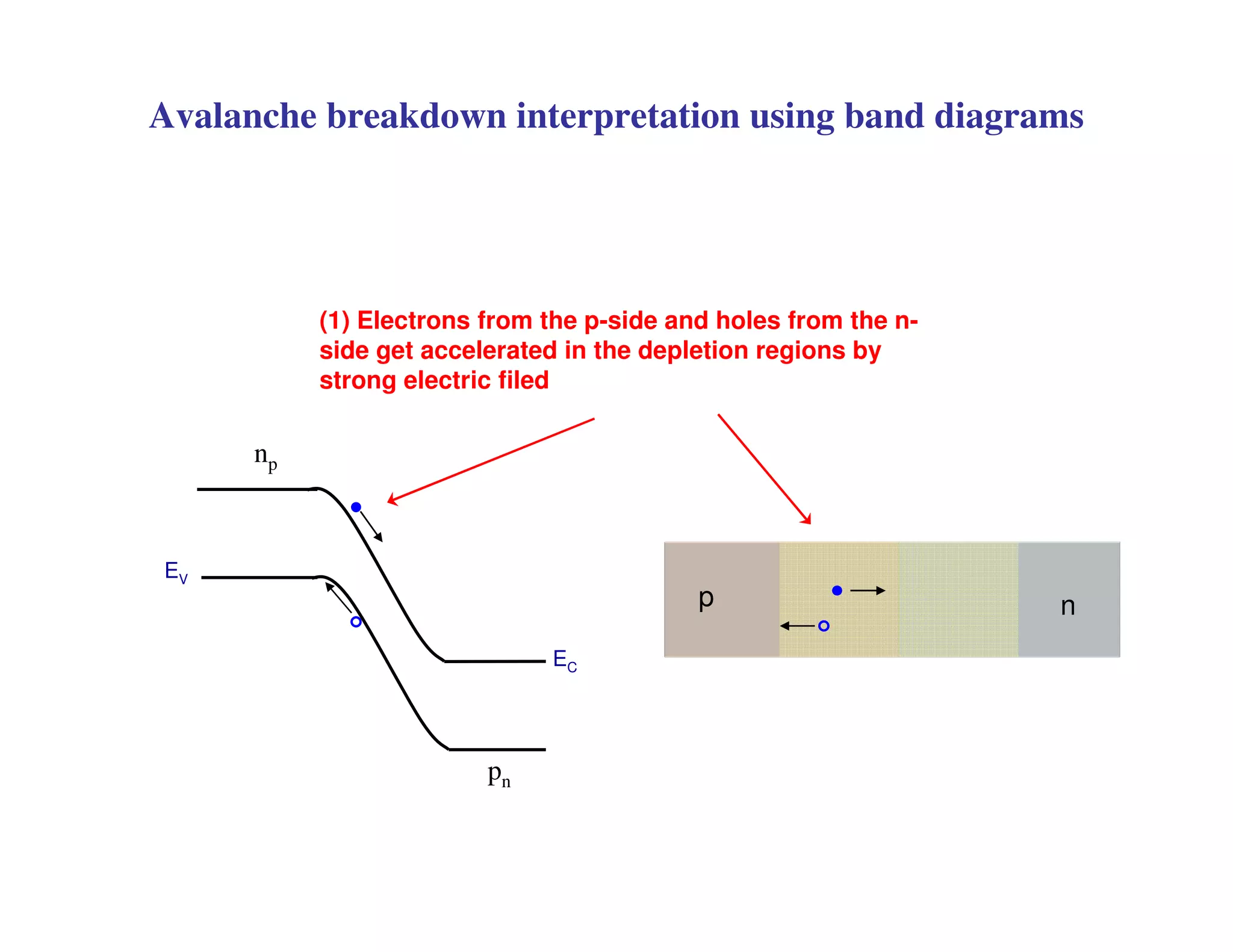
Avalanche breakdown interpretation using band diagrams
EV
EC
p n
(1) Electrons from the p-side and holes from the n-
side get accelerated in the depletion regions by
strong electric filed
np
pn
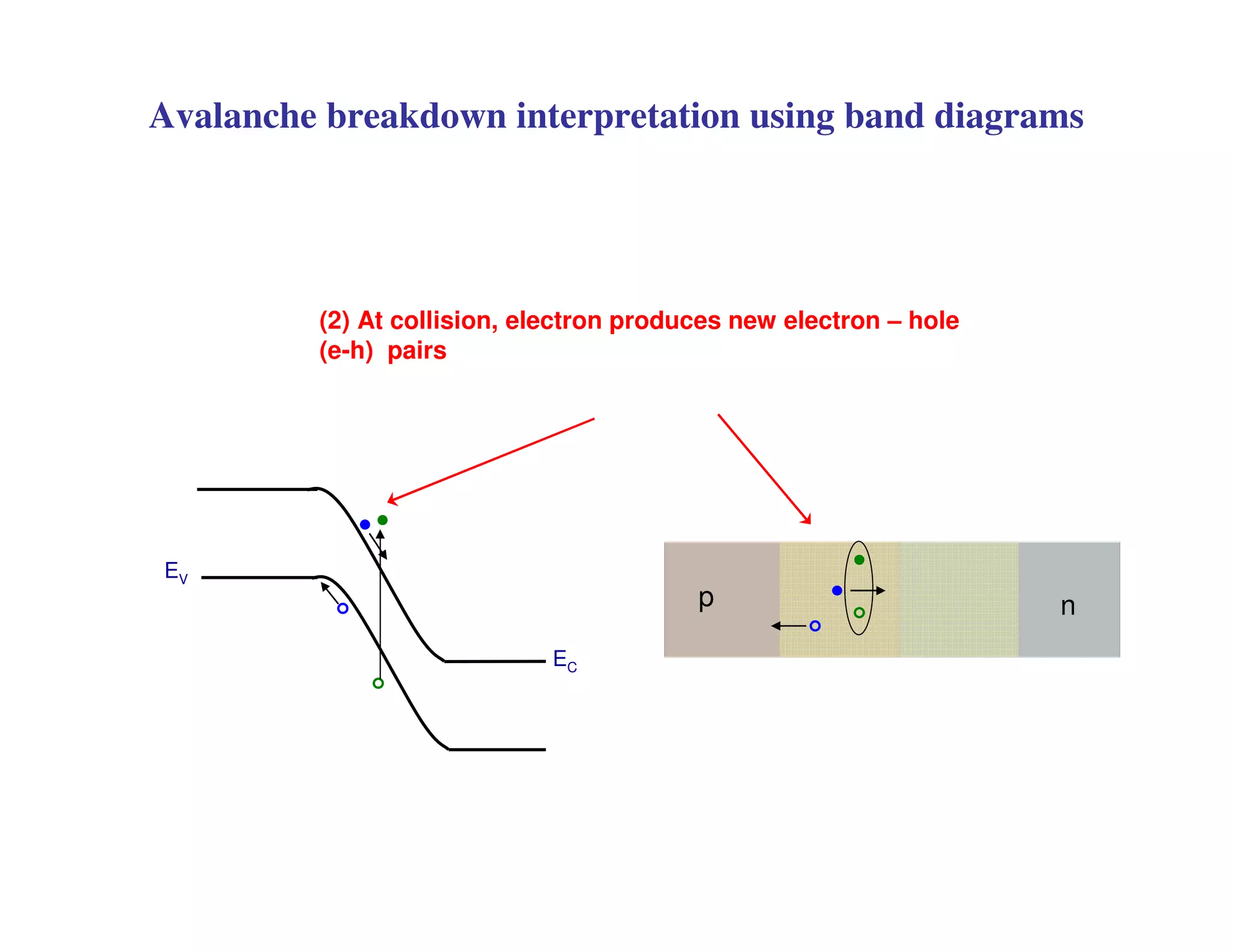
EV
EC
p n
(2) At collision, electron produces new electron – hole
(e-h) pairs
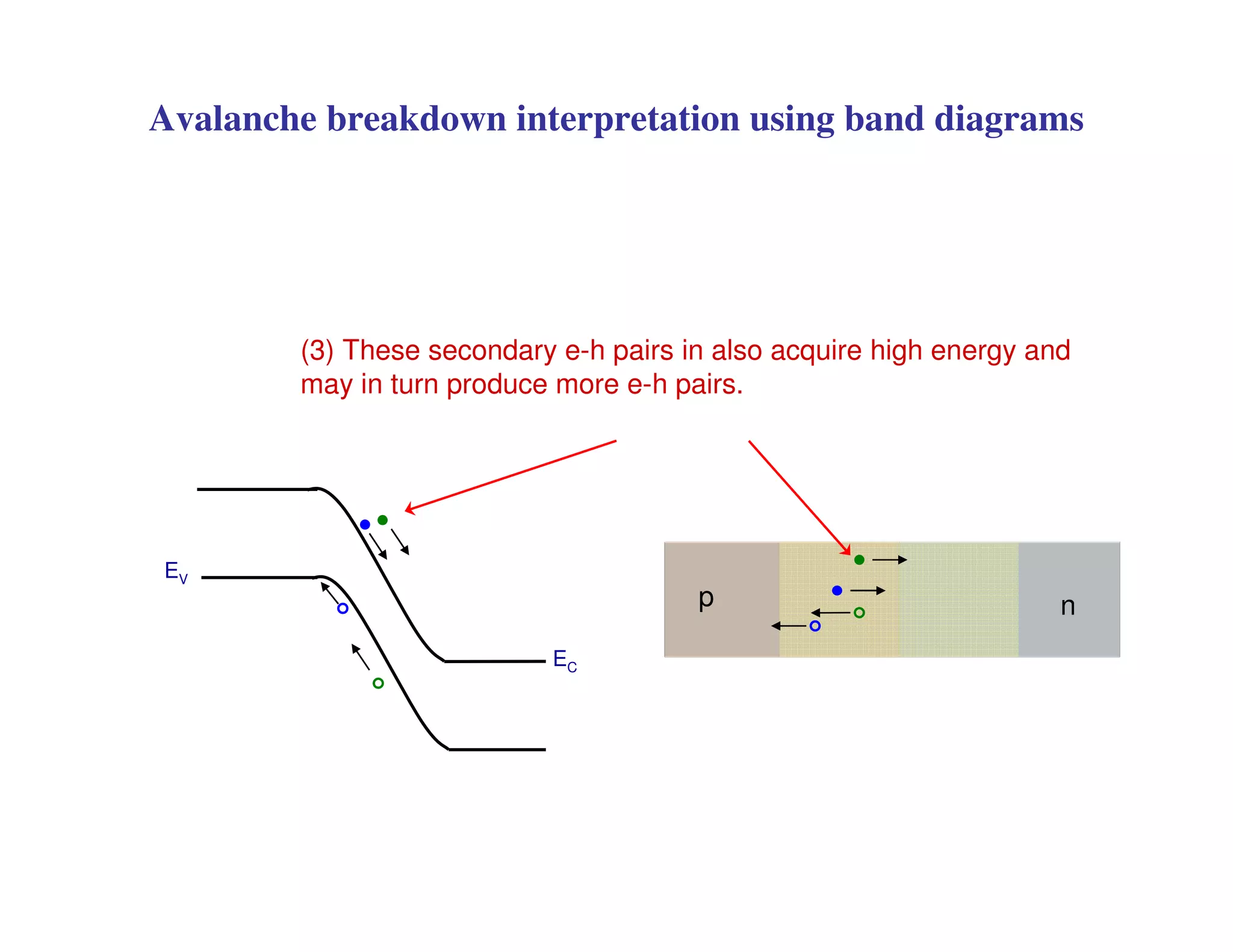
Avalanche breakdown interpretation using band diagrams
EV
EC
p n
(3) These secondary e-h pairs in also acquire high energy and
may in turn produce more e-h pairs.
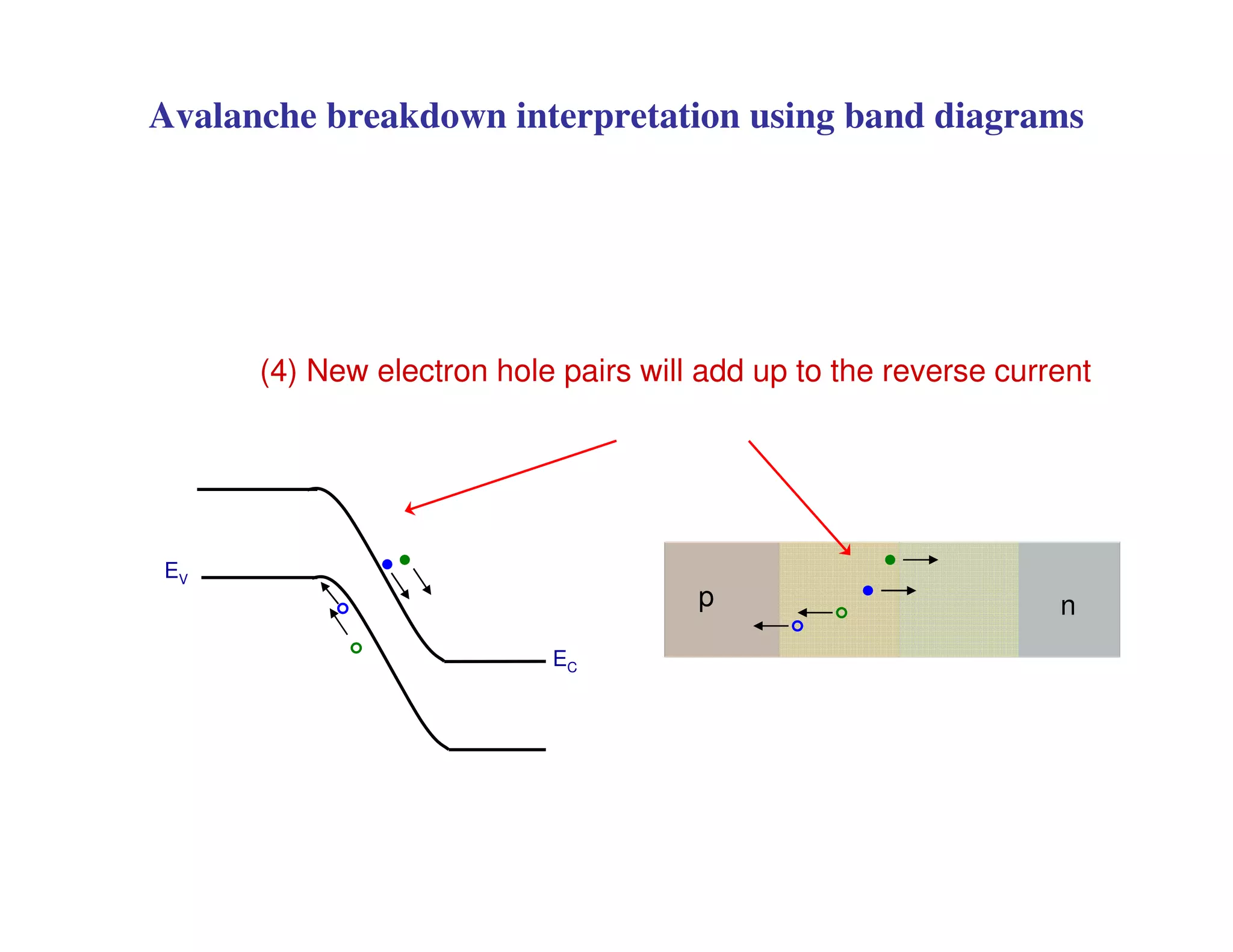
Avalanche breakdown interpretation using band diagrams
EV
EC
p n
(4) New electron hole pairs will add up to the reverse current
Avalanche breakdown interpretation using band diagrams
EV
EC
p n
(5) New electron-hole pairs will also create more electron
hole pairs (avalanche multiplication)
Avalanche breakdown interpretation using band diagrams
2
2
s bd
abd
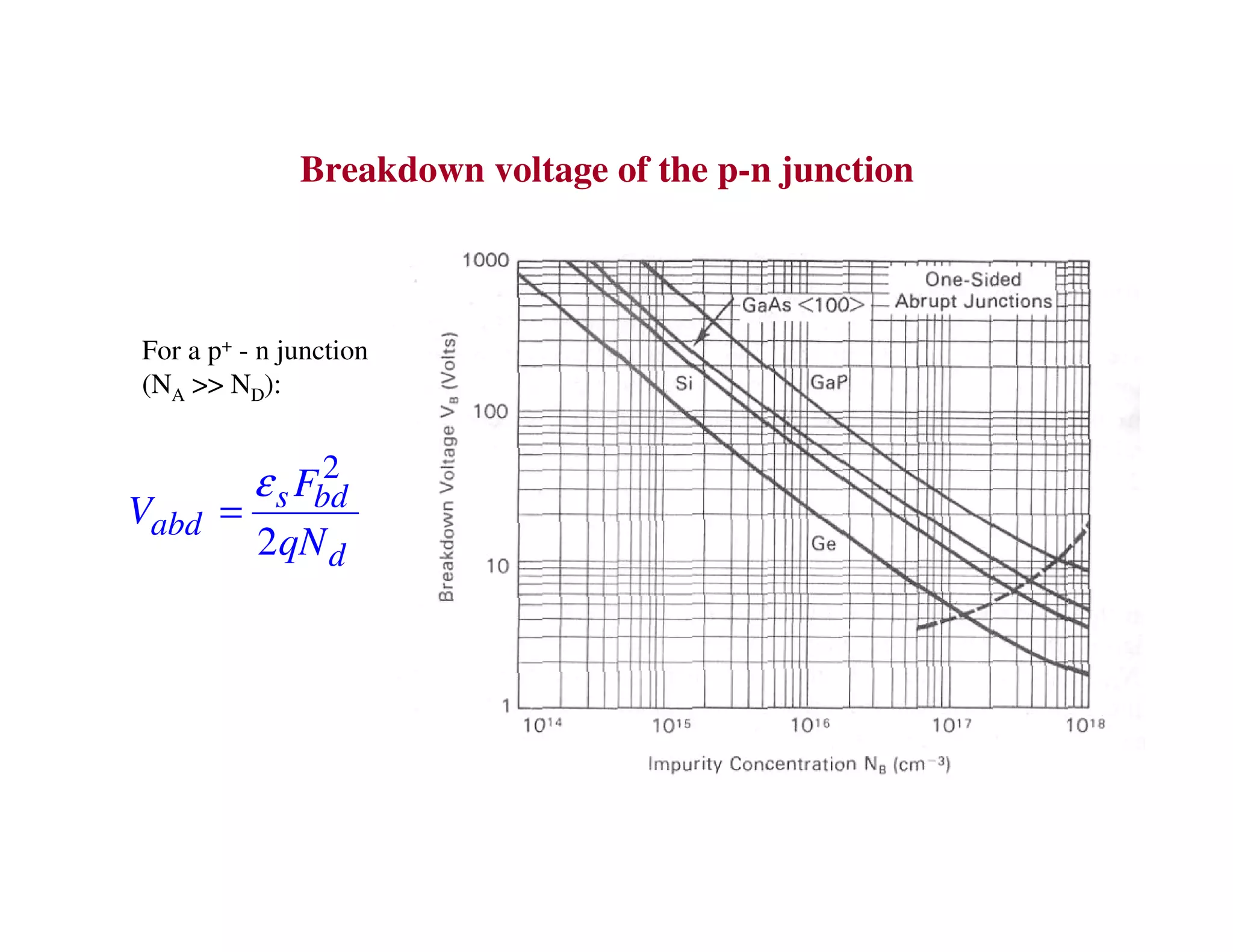
d
F
V
qN
ε
=
Breakdown voltage of the p-n junction
For a p+ - n junction
(NA >> ND):
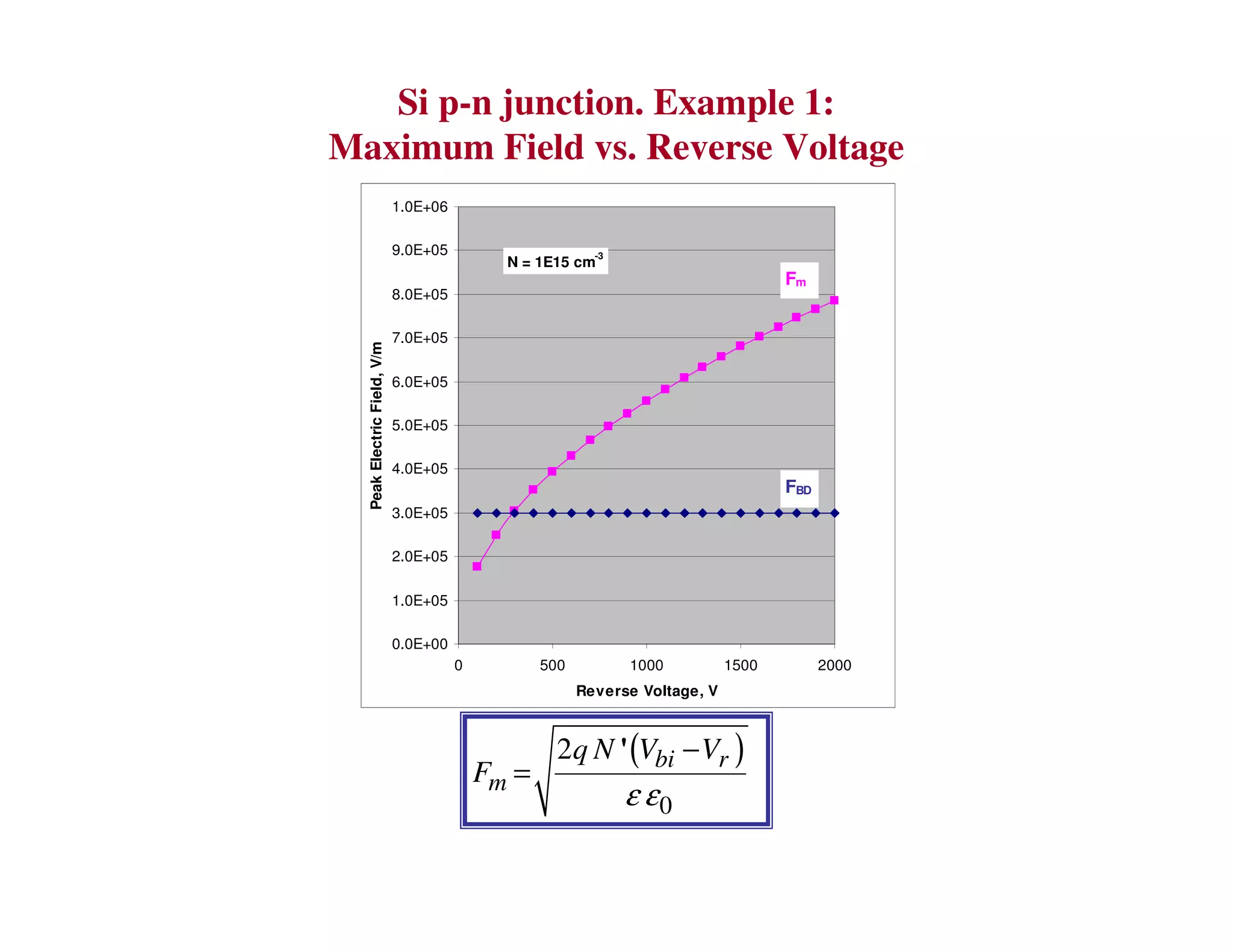
Si p-n junction. Example 1:
Maximum Field vs. Reverse Voltage
0.0E+00
1.0E+05
2.0E+05
3.0E+05
4.0E+05
5.0E+05
6.0E+05
7.0E+05
8.0E+05
9.0E+05
1.0E+06
0 500 1000 1500 2000
Reverse Voltage, V
PeakElectricField,V/m
Fm
N = 1E15 cm
-3
FBD
( )
0
2 bi r
m
q N V V
F
'
ε ε
−
=
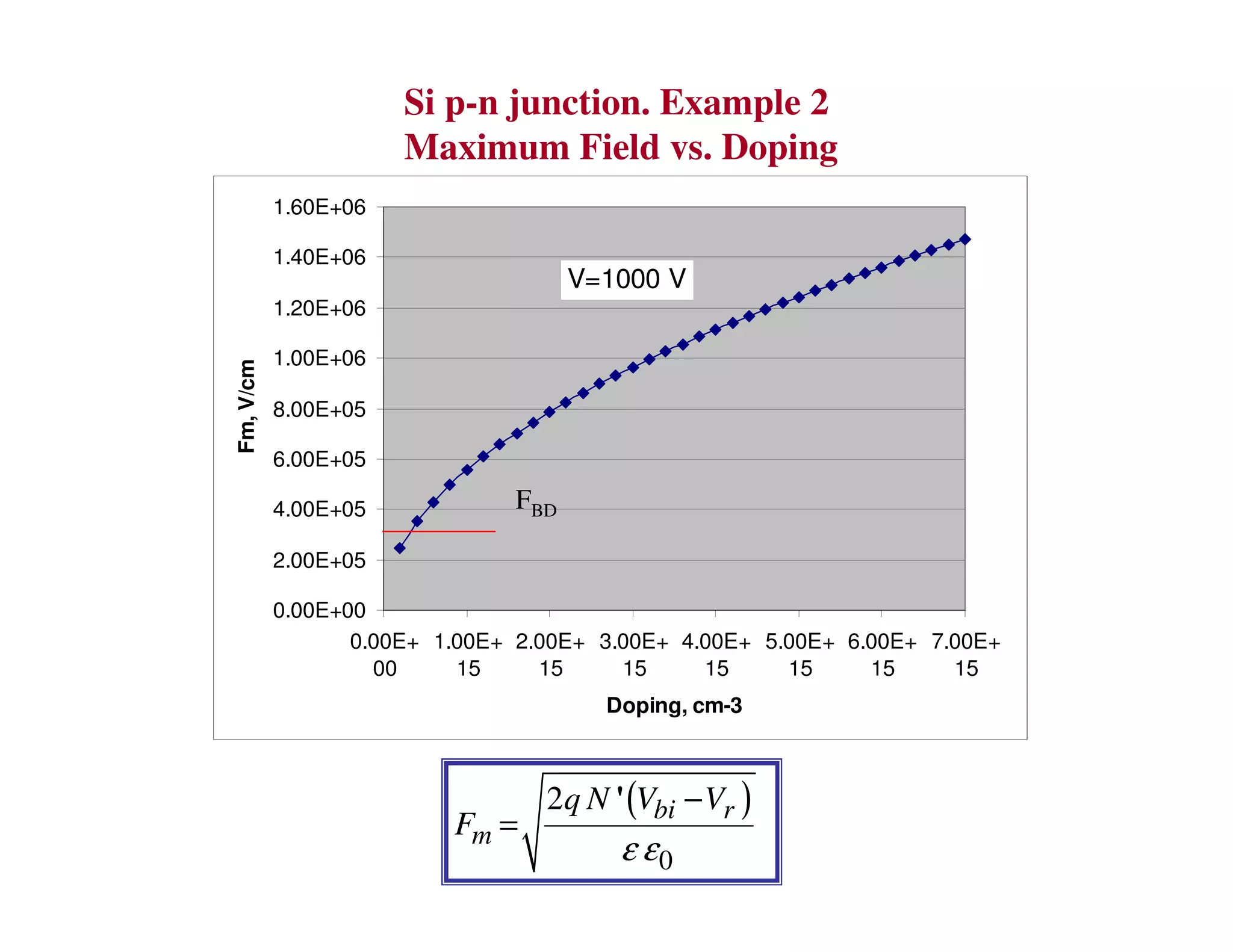
Si p-n junction. Example 2
Maximum Field vs. Doping
0.00E+00
2.00E+05
4.00E+05
6.00E+05
8.00E+05
1.00E+06
1.20E+06
1.40E+06
1.60E+06
0.00E+
00
1.00E+
15
2.00E+
15
3.00E+
15
4.00E+
15
5.00E+
15
6.00E+
15
7.00E+
15
Doping, cm-3
Fm,V/cm
V=1000 V
( )
0
2 bi r
m
q N V V
F
'
ε ε
−
=
FBD
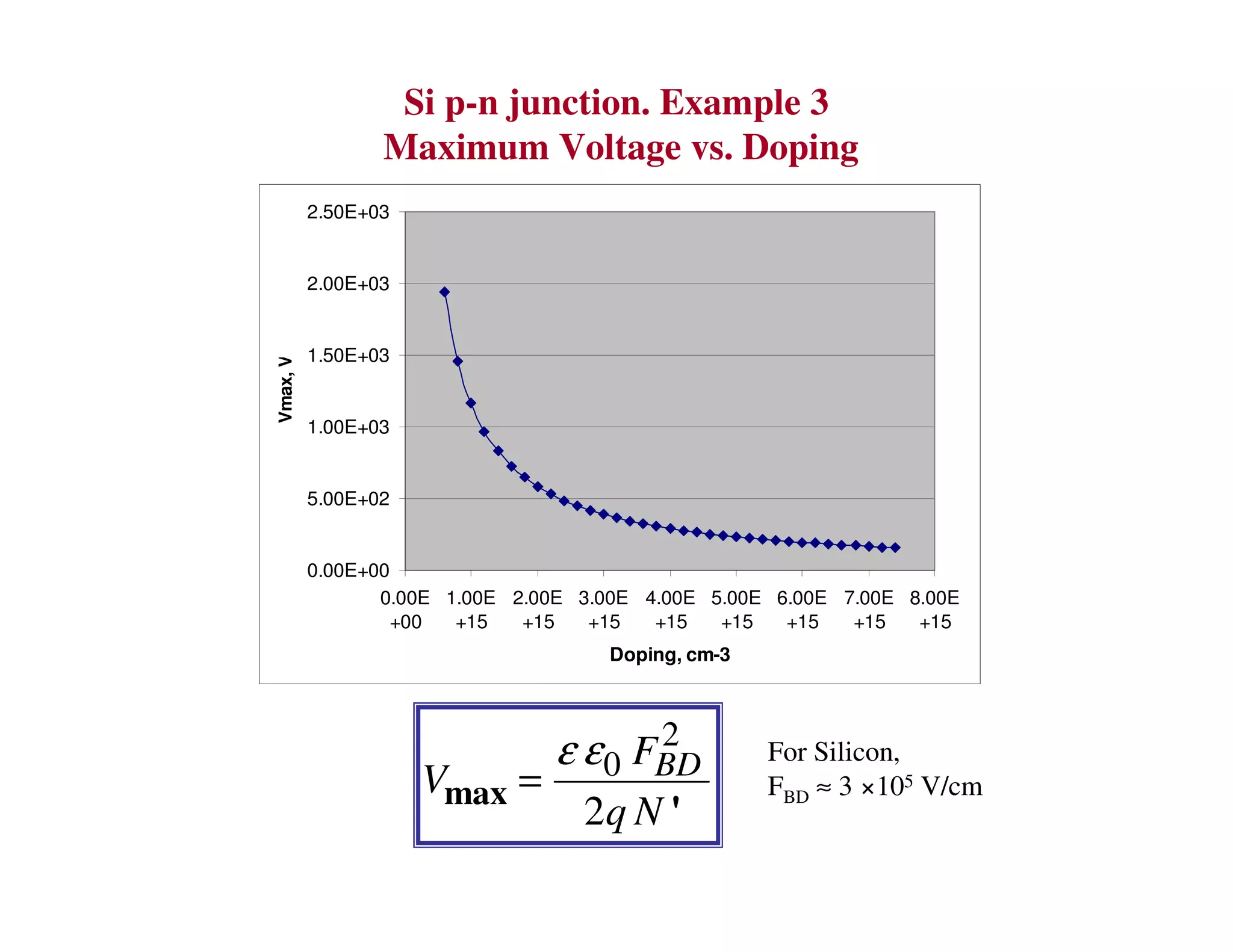
Si p-n junction. Example 3
Maximum Voltage vs. Doping
0.00E+00
5.00E+02
1.00E+03
1.50E+03
2.00E+03
2.50E+03
0.00E
+00
1.00E
+15
2.00E
+15
3.00E
+15
4.00E
+15
5.00E
+15
6.00E
+15
7.00E
+15
8.00E
+15
Doping, cm-3
Vmax,V
2
0
2
BDF
V
q Nmax
'
ε ε
=
For Silicon,
FBD ≈ 3 ×10⁵ V/cm
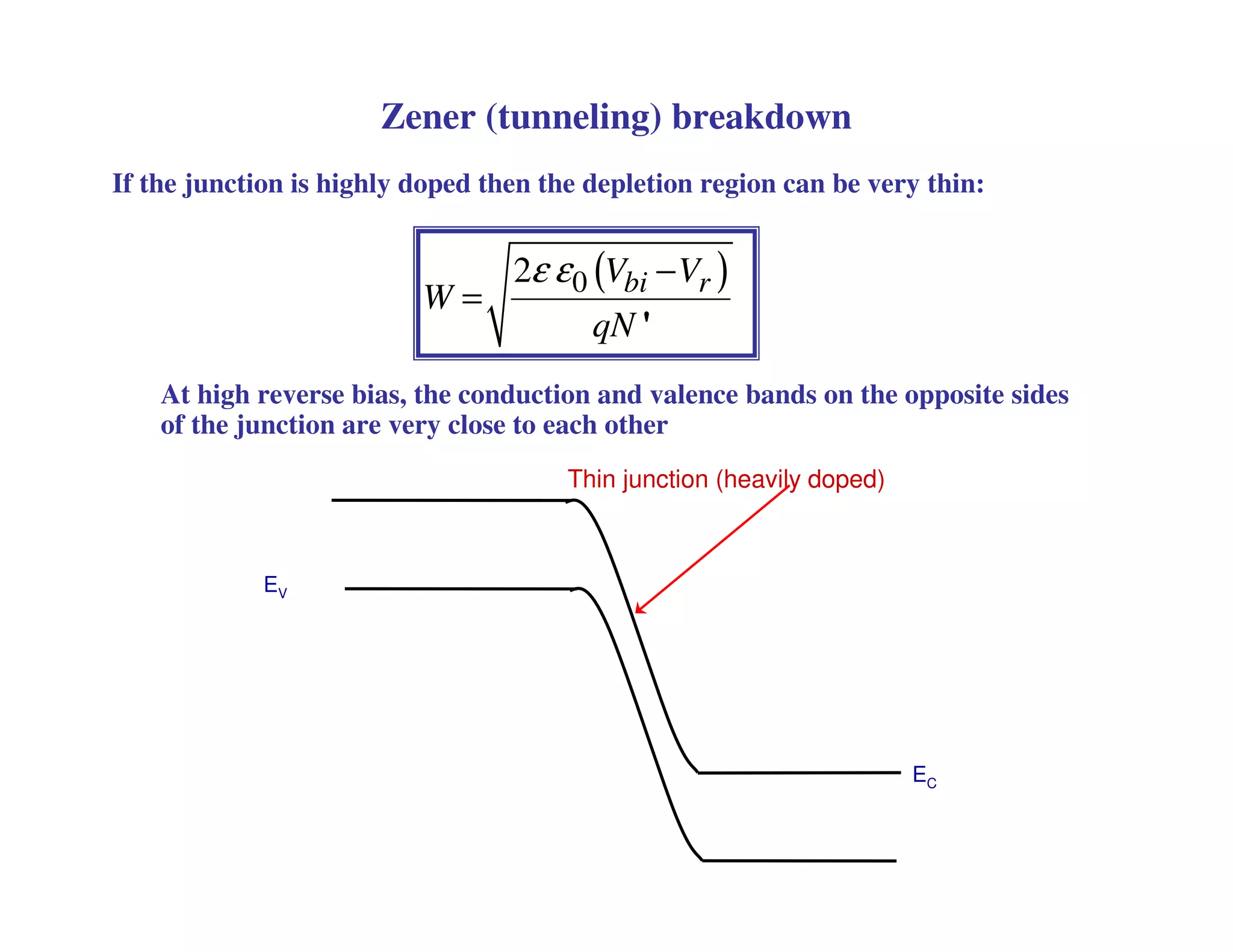
Zener (tunneling) breakdown
If the junction is highly doped then the depletion region can be very thin:
EV
EC
Thin junction (heavily doped)
( )02 bi rV V
W
qN
ε ε −
=
'
At high reverse bias, the conduction and valence bands on the opposite sides
of the junction are very close to each other
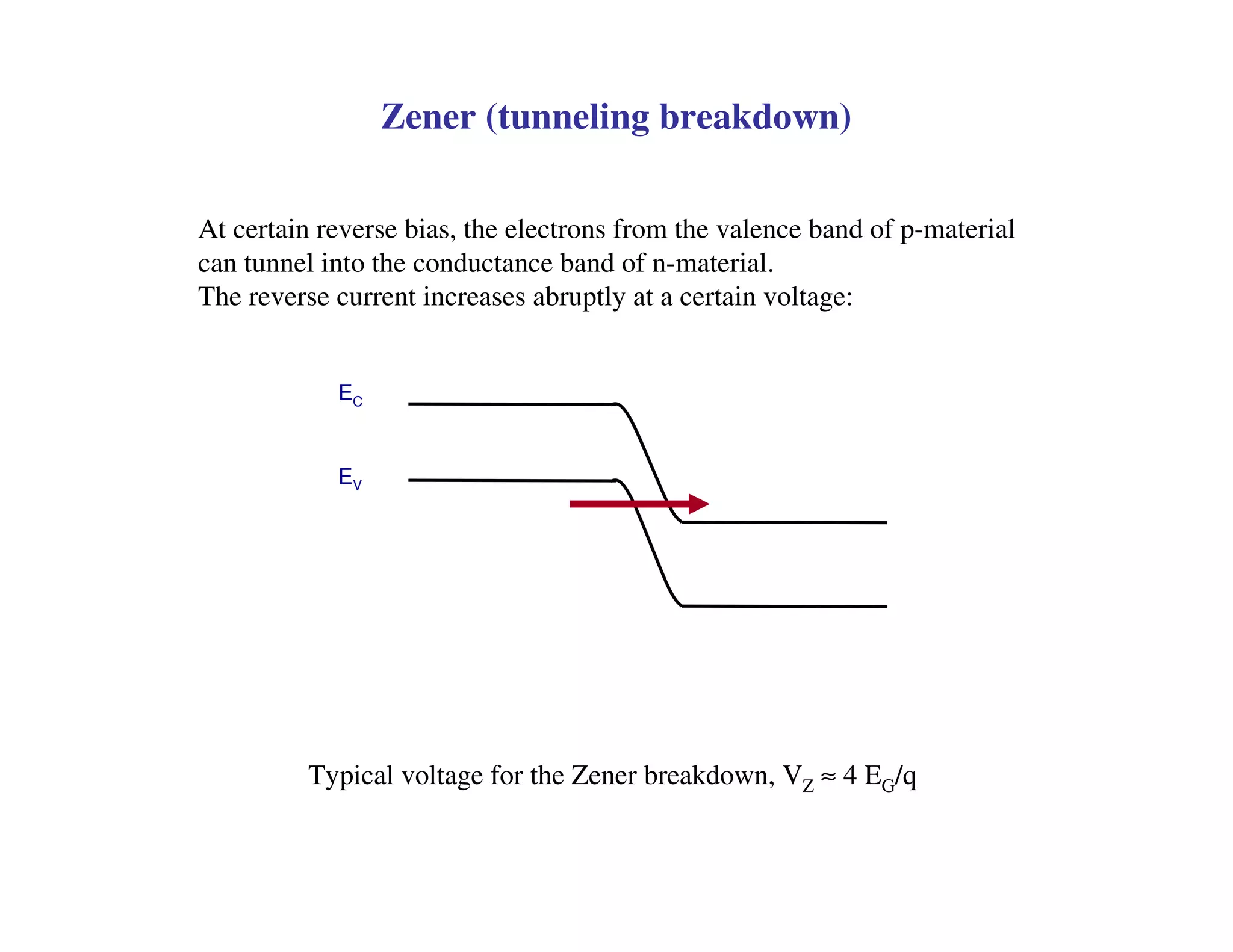
Zener (tunneling breakdown)
EV
EC
At certain reverse bias, the electrons from the valence band of p-material
can tunnel into the conductance band of n-material.
The reverse current increases abruptly at a certain voltage:
Typical voltage for the Zener breakdown, VZ ≈ 4 EG/q
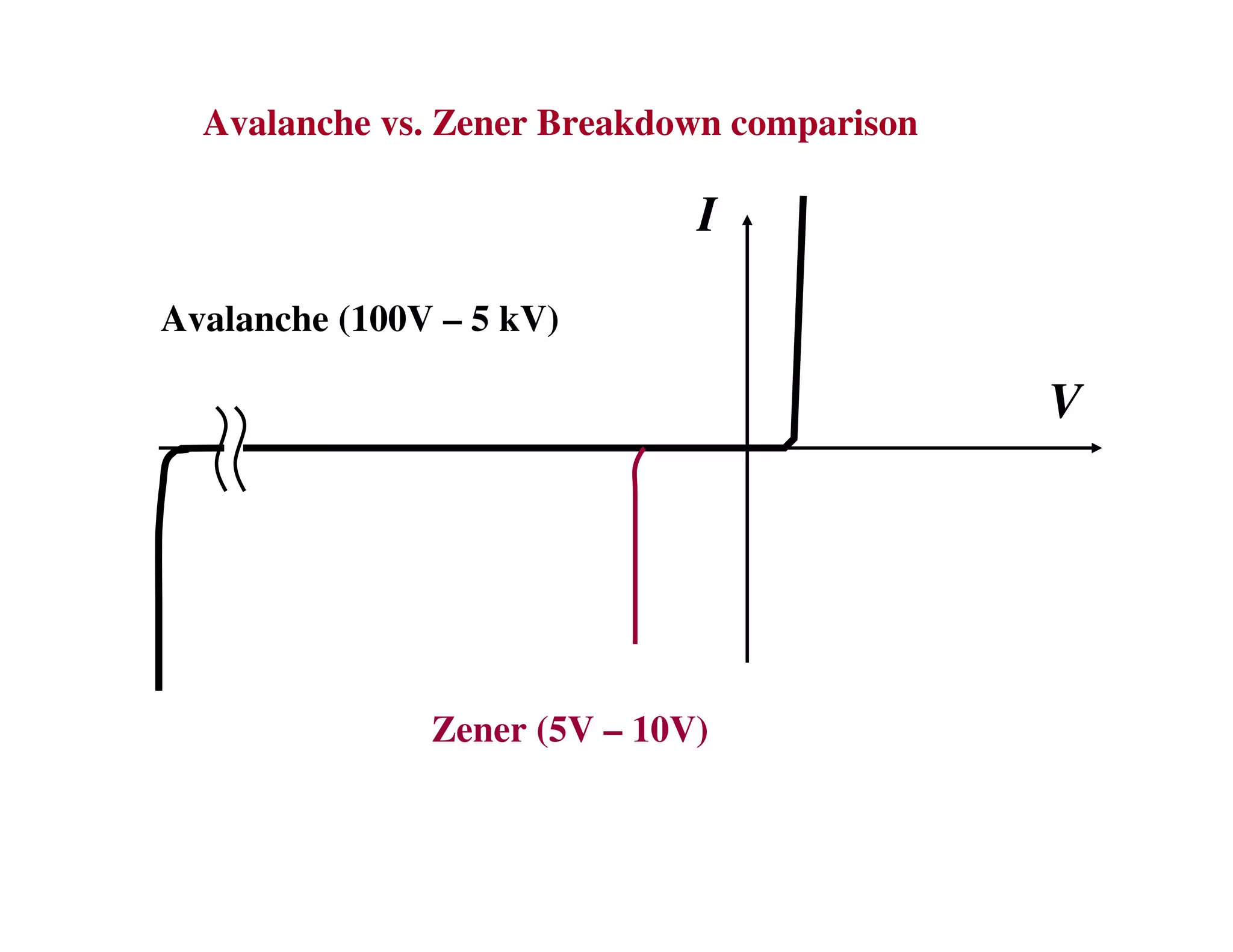
Avalanche vs. Zener Breakdown comparison
Avalanche (100V – 5 kV)
Zener (5V – 10V)
I
V

05 reverse biased junction &amp; breakdown

  • 1.
    p- n dioderectifiers
  • 2.
    p- n dioderectifiers       −1exp kT qV IS       −1exp kT qV IS ~ Time Current 1 VF = 0 in an ideal rectifier Time Voltage 1 2 2 Ir = 0 in an ideal rectifier. VD = VSource
  • 3.
    Lecture objective: p-ndiode at reverse bias
  • 4.
    Simulated Electron -Hole profile in Si p-n junction Electron-hole concentration in a Si p-n junction. Acceptor density Na=5××××1015 cm-3 Donor density Nd=1××××1015 cm-3. T=300K. Dashed line show the boundaries of the depletion region Vbi Junction -2 -1 0 1 2 Distance (µm) 0 -0.8 -1.6 E F E c Ev p-type n-type Vbi 210-1-2 10 16 10 14 10 12 10 10 10 8 10 6 10 4 Distance (µm) p -type n -type Electron concentration Hole concentration p = Na n = Nd n = ni 2 / Na p = ni 2 / Nd
  • 5.
    pn ≈ 0; np≈ 0; ρ ≈ -q NA; nn ≈ 0; pn ≈ 0; ρ ≈ +q ND; Concentration x ND np NA ρ = 0; ρ = 0; Charge distribution in the depletion region. Total charge density in the semiconductor: ρρρρ = q××××(Nd + p - Na - n);
  • 6.
    pn ≈ 0; np≈ 0; nn ≈ 0; pn ≈ 0; Chargedensity (C/cm3) x Free electrons Holes Mobile Charge density distribution in the p-n junction Depletion region p-type n-type
  • 7.
    pn ≈ 0; np≈ 0; ρ ≈ -q NA; nn ≈ 0; pn ≈ 0; ρ ≈ +q ND; Chargedensity (C/cm3) x qND qNA ρ = 0; ρ = 0; Charge distribution in the depletion region. Total charge density in the semiconductor: ρρρρ = q××××(Nd + p - Na - n);
  • 8.
    In the followingmaterial, the electric field is denoted as “F” (to distinguish from “E” = electron/hole energy). 0 0 s s dF dx where isthecharge density ρ ρ ε ε ε ε ε ε ρ = = = ; , The electric field distribution is defined by Poisson’s equation: Electric field profile in the p-n junction εεεε0 – the dielectric permittivity of vacuum; εεεε0 = 8.85×10⁻¹² F/m = 8.85×10⁻¹⁴ F/cm εεεε −−−− relative dielectric permittivity of the material In Si, εεεε ≈≈≈≈ 11.711.711.711.7
  • 9.
    Charge, Field, Potential Profilesin the p-n junction s dF dx ρ ε = ; -2 -1 0 1 2 2 0 -2 -4 -6 p-type n-type X
  • 10.
    Charge, Field, Potential Profilesin the p-n junction Using the depletion approximation, we obtain dF dx = − qNa εs , for − xp < x < 0 qNd εs , for 0 < x < xn       s dF dx ρ ε = ; -2 -1 0 1 2 2 0 -2 -4 -6 p-type n-type -xp xn X
  • 11.
    Charge, Field, Potential Profilesin the p-n junction Using the depletion approximation, we obtain dF dx = − qNa εs , for − xp < x < 0 qNd εs , for 0 < x < xn       F = −Fm 1+ x xp       , for − xp < x < 0 −Fm 1− x xn       , for 0 < x < xn        -2 -1 0 1 2 2 0 -2 -4 -6 p-type n-type -2 -1 0 1 2 0 -5 -10 -15 -2 -1 0 1 2 Distance (µm) 0.2 0 -0.2 -0.4 -0.6 -0.8 s dF dx ρ ε = ; -xp xn -xp xn
  • 12.
    On the p-sideof the junction, 0 A m p qN F x εε = On the n-side of the junction, 0 D m n qN F x εε = At the junction interface: Fm(p-side) = Fm (n-side) 0 0 D A m n p qN qN F x x εε εε = = Maximum Field in the p-n junction From -2 -1 0 1 2 0 -5 -10 -15 -xp xn s dF dx ρ ε = : p D n A x N x N =
  • 13.
    0 0 D A mn p qN qN F x x εε εε = = The voltage drop across the p-n junction, p nV F x dx− =−∫ ( ) = -{AREA UNDER the F(x) curve} 1 2 bi mV F W= Voltage drop across the p-n junction In equilibrium: At reverse bias: 1 2bi r mV V F W− = -2 -1 0 1 2 0 -5 -10 -15 -xp xn W
  • 14.
    2 2 0 00 1 / 2 2 1 / 2 D D D A bi r n D A A D qN qN q N N V V x W W W N N N Nεε εε εε   − = = =  + +  The total width of the depletion (space-charge) region. W = xn + xp = xn (1 + ND/NA); The voltage (the area of the triangle): Vbi –Vr = Fm× W/2; Depletion region width in the p-n junction p n D Ax x N N= ( / )From W Fm 0 0 D A m n p qN qN F x x εε εε = =
  • 15.
    Depletion region (a.k.aspace-charge region) width Depletion region of the p-n junction summary 2 02 D A bi r A D N Nq V V W N where N N N '; ' εε   − = =  +  2 0 1 2A D bi r D q N N , V V N W ε ε >> − = For strongly asymmetrical p-n junction: 2 0 1 2D A bi r A q N N , V V N W ε ε >> − = The space-charge region is extended mainly to the low-doped side of the p-n junction Depletion region width sharing between n- and p-sides: p n D Ax x N N( / )=W = xn + xp W ≈ xn W ≈ xp
  • 16.
    From Depletion region widthas a function of voltage 2 02 bi r q V V W N ' εε − = ( )02 bi rV V W qN ε ε − = ' D A AFor N N , N N>> =' The depletion region width W: where D A A D N N N N N = + ' A D DFor N N , N N>> ='
  • 17.
    Peak electric fieldin the p-n junction summary Maximum electric field 1 2bi r mV V F W− = ( ) 0 2 bi r m q N V V F ' ε ε − = 2 0 2 m bi r F V V q N ' ε ε − = 2 0 2 BDF V q Nmax ' ε ε =
  • 18.
  • 19.
    Avalanche Breakdown mechanism Mechanismsfor breakdown Two quantum processes give rise to breakdown: (1) Impact ionization plus avalanche multiplication. (2) Quantum tunneling (Zener effect). Relative importance depends on doping level in the p- and n- regions:
  • 20.
    Avalanche Breakdown mechanism •Electric field accelerates electrons (and holes); • The kinetic energy of electron in the electric field increases; • Electron with high enough excessive energy can ionize the atom at collision. • As a result, collision produces an electron-hole pair.
  • 21.
    Avalanche Breakdown mechanism Minimumadditional electron energy required for ionization can be estimated using: 0 2 2 G mv E≈ Additional electron energy comes from the electric field: 0 2 2 FP mv q F L≈ where F is the electric field and LFP is the “mean free path” – the average distance that the electron passes between collisions. From this, the ionization condition: BD FP Gq F L E≈ FBD is the critical or “breakdown” field. The ionization only occurs if electric field exceeds the critical value
  • 22.
    Breakdown in p-njunction -2 -1 0 1 2 0 -5 -10 -15 -xp xn In reverse-biased p-n junction, the electric field is concentrated within a narrow depletion region. The maximum electric field occurs exactly at the p-n interface. As the field Fm exceeds the critical (breakdown) value: Fm Atome1 e1 e2h2
  • 23.
    Avalanche multiplication duringthe breakdown Ionization coefficient αe ≈ αh Ionization coefficient αe >> αh
  • 24.
    Multiplication and IonizationCoefficients Consider uniform electric field in the avalanche region (for simplicity) The avalanche region width is W The condition for avalanching: (every carrier has one ionizing collision) Assume αe = αh ≈ const (x); Multiplication factor: Numberof e h pairsattheoutput M Numberof e h pairsattheinput − = −
  • 25.
    Avalanche breakdown interpretationusing band diagrams EV EC p n (1) Electrons from the p-side and holes from the n- side get accelerated in the depletion regions by strong electric filed np pn
  • 26.
    EV EC p n (2) Atcollision, electron produces new electron – hole (e-h) pairs Avalanche breakdown interpretation using band diagrams
  • 27.
    EV EC p n (3) Thesesecondary e-h pairs in also acquire high energy and may in turn produce more e-h pairs. Avalanche breakdown interpretation using band diagrams
  • 28.
    EV EC p n (4) Newelectron hole pairs will add up to the reverse current Avalanche breakdown interpretation using band diagrams
  • 29.
    EV EC p n (5) Newelectron-hole pairs will also create more electron hole pairs (avalanche multiplication) Avalanche breakdown interpretation using band diagrams
  • 30.
    2 2 s bd abd d F V qN ε = Breakdown voltageof the p-n junction For a p+ - n junction (NA >> ND):
  • 31.
    Si p-n junction.Example 1: Maximum Field vs. Reverse Voltage 0.0E+00 1.0E+05 2.0E+05 3.0E+05 4.0E+05 5.0E+05 6.0E+05 7.0E+05 8.0E+05 9.0E+05 1.0E+06 0 500 1000 1500 2000 Reverse Voltage, V PeakElectricField,V/m Fm N = 1E15 cm -3 FBD ( ) 0 2 bi r m q N V V F ' ε ε − =
  • 32.
    Si p-n junction.Example 2 Maximum Field vs. Doping 0.00E+00 2.00E+05 4.00E+05 6.00E+05 8.00E+05 1.00E+06 1.20E+06 1.40E+06 1.60E+06 0.00E+ 00 1.00E+ 15 2.00E+ 15 3.00E+ 15 4.00E+ 15 5.00E+ 15 6.00E+ 15 7.00E+ 15 Doping, cm-3 Fm,V/cm V=1000 V ( ) 0 2 bi r m q N V V F ' ε ε − = FBD
  • 33.
    Si p-n junction.Example 3 Maximum Voltage vs. Doping 0.00E+00 5.00E+02 1.00E+03 1.50E+03 2.00E+03 2.50E+03 0.00E +00 1.00E +15 2.00E +15 3.00E +15 4.00E +15 5.00E +15 6.00E +15 7.00E +15 8.00E +15 Doping, cm-3 Vmax,V 2 0 2 BDF V q Nmax ' ε ε = For Silicon, FBD ≈ 3 ×10⁵ V/cm
  • 34.
    Zener (tunneling) breakdown Ifthe junction is highly doped then the depletion region can be very thin: EV EC Thin junction (heavily doped) ( )02 bi rV V W qN ε ε − = ' At high reverse bias, the conduction and valence bands on the opposite sides of the junction are very close to each other
  • 35.
    Zener (tunneling breakdown) EV EC Atcertain reverse bias, the electrons from the valence band of p-material can tunnel into the conductance band of n-material. The reverse current increases abruptly at a certain voltage: Typical voltage for the Zener breakdown, VZ ≈ 4 EG/q
  • 36.
    Avalanche vs. ZenerBreakdown comparison Avalanche (100V – 5 kV) Zener (5V – 10V) I V