Electronics I - PN Junction
talarico@gonzaga.edu 1
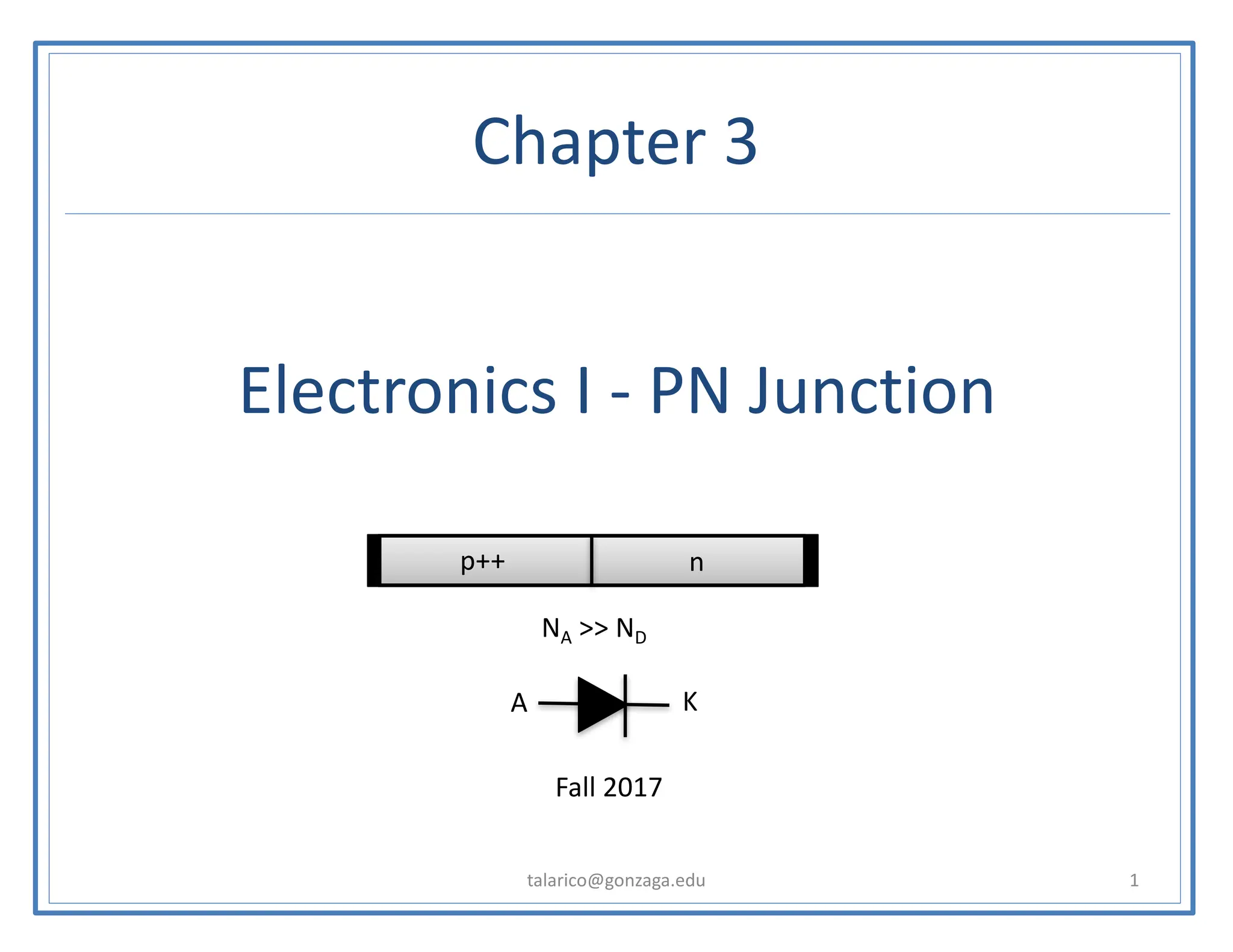
p++ n
NA >> ND
A K
Chapter 3
Fall 2017
PN Junction (Diode)
talarico@gonzaga.edu 2
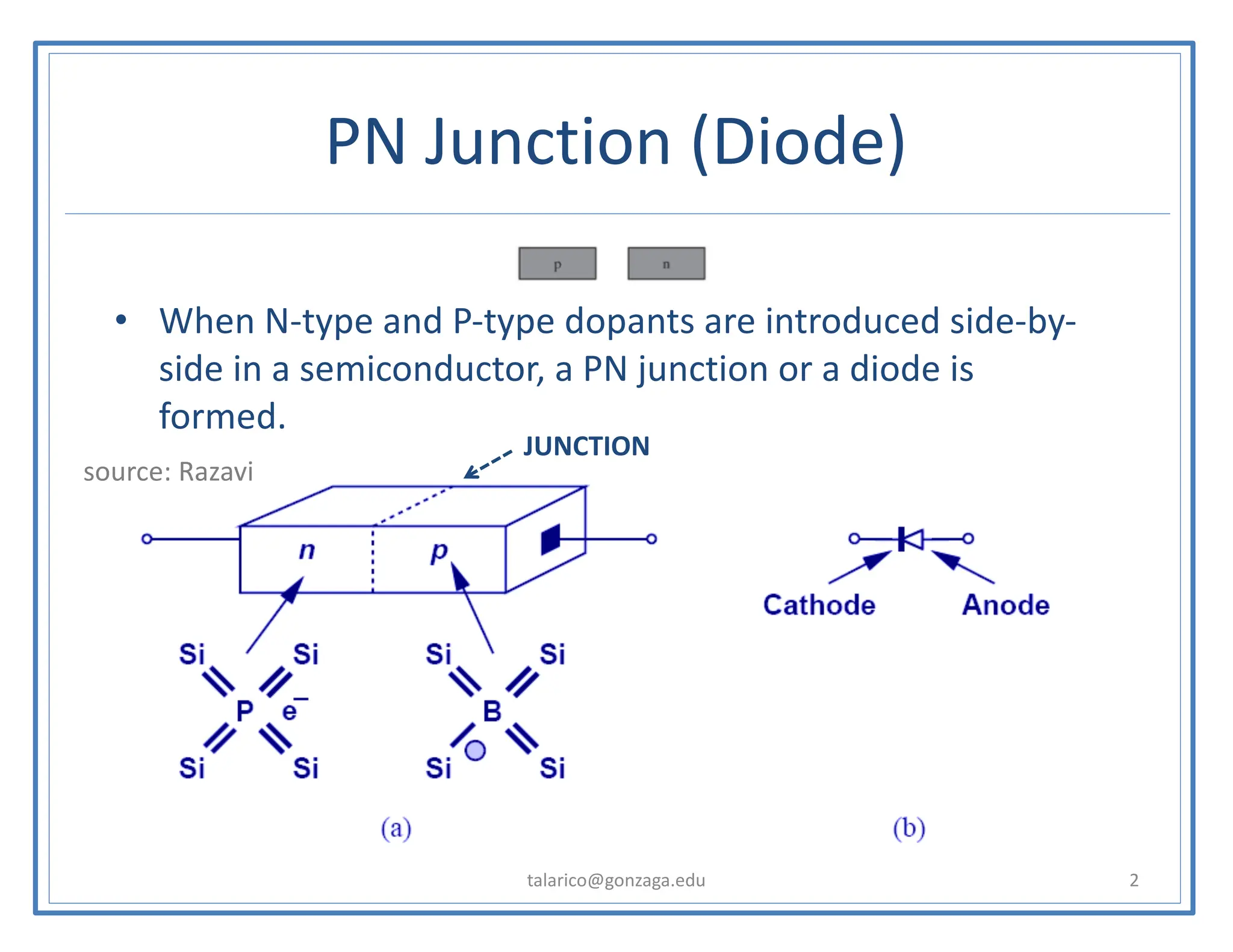
• When N-type and P-type dopants are introduced side-by-
side in a semiconductor, a PN junction or a diode is
formed.
source: Razavi
JUNCTION
Diode I/V characteristics
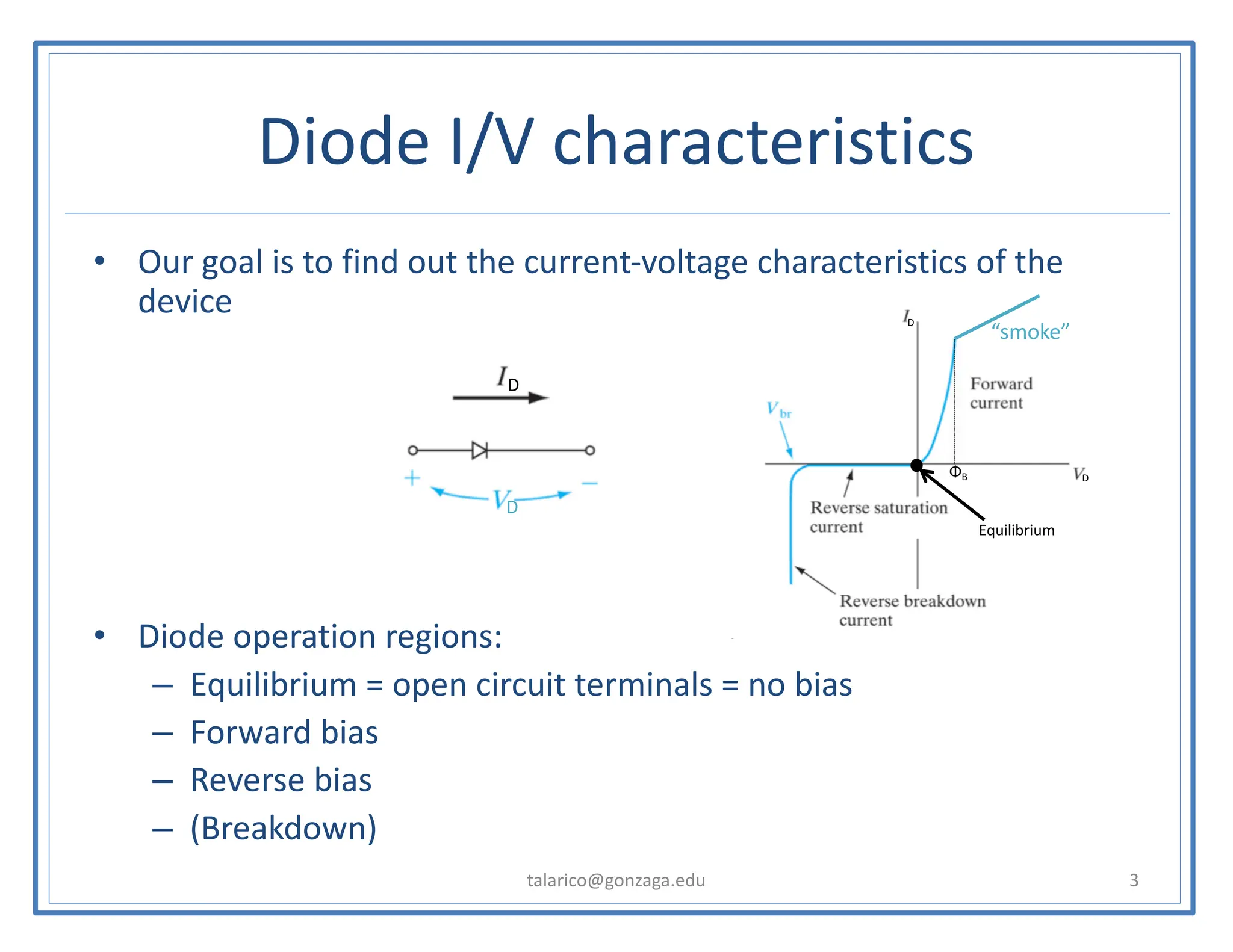
• Our goal is to find out the current-voltage characteristics of the
device
• Diode operation regions:
– Equilibrium = open circuit terminals = no bias
– Forward bias
– Reverse bias
– (Breakdown)
talarico@gonzaga.edu 3
D
D
Equilibrium
D
D
“smoke”
ΦB
PN Junction in Equilibrium (no Bias applied)
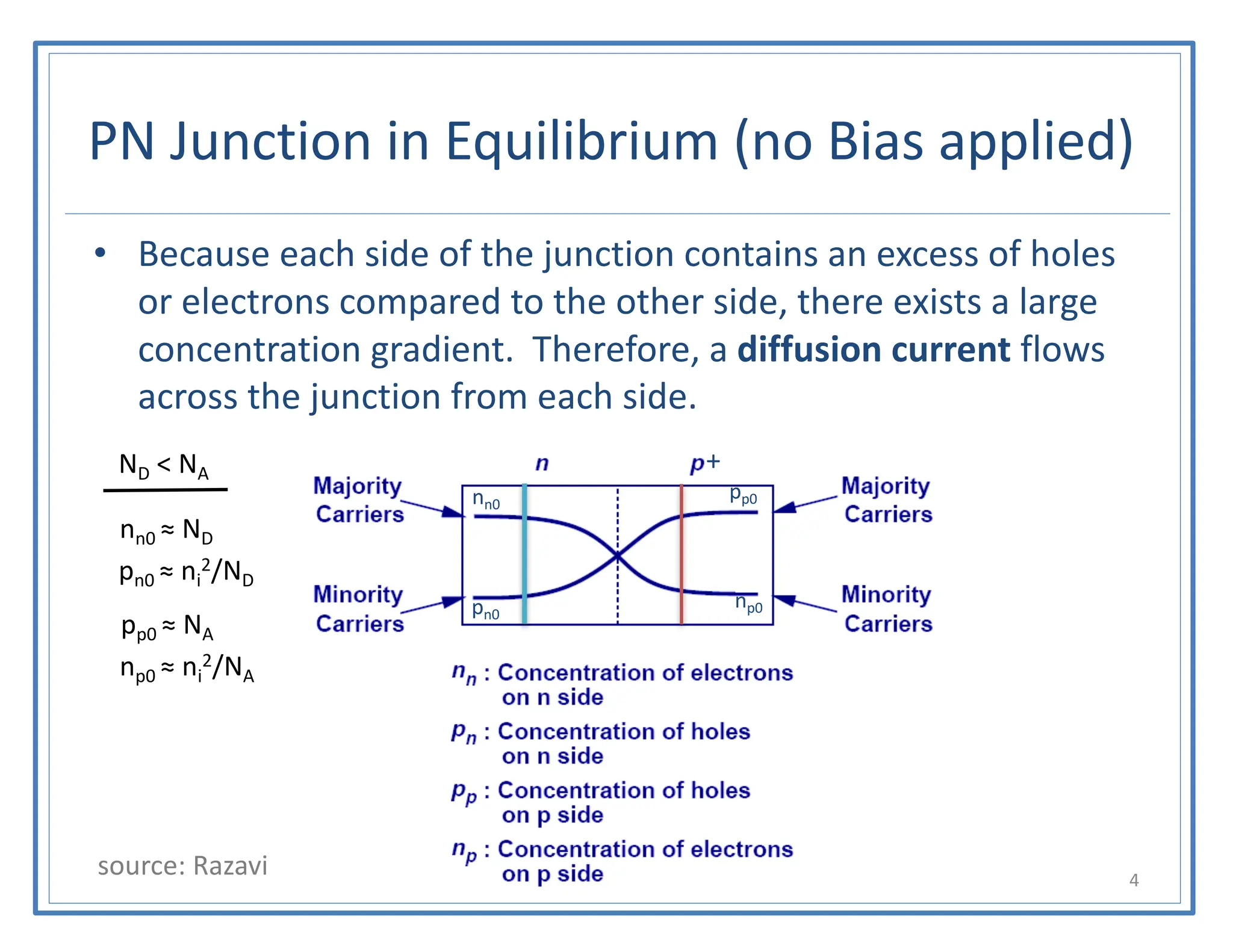
• Because each side of the junction contains an excess of holes
or electrons compared to the other side, there exists a large
concentration gradient. Therefore, a diffusion current flows
across the junction from each side.
talarico@gonzaga.edu 4
source: Razavi
nn0
pn0
np0
pp0
+
ND < NA
nn0 ≈ ND
pn0 ≈ ni
2/ND
pp0 ≈ NA
np0 ≈ ni
2/NA
PN junction in Equilibrium (no bias applied)
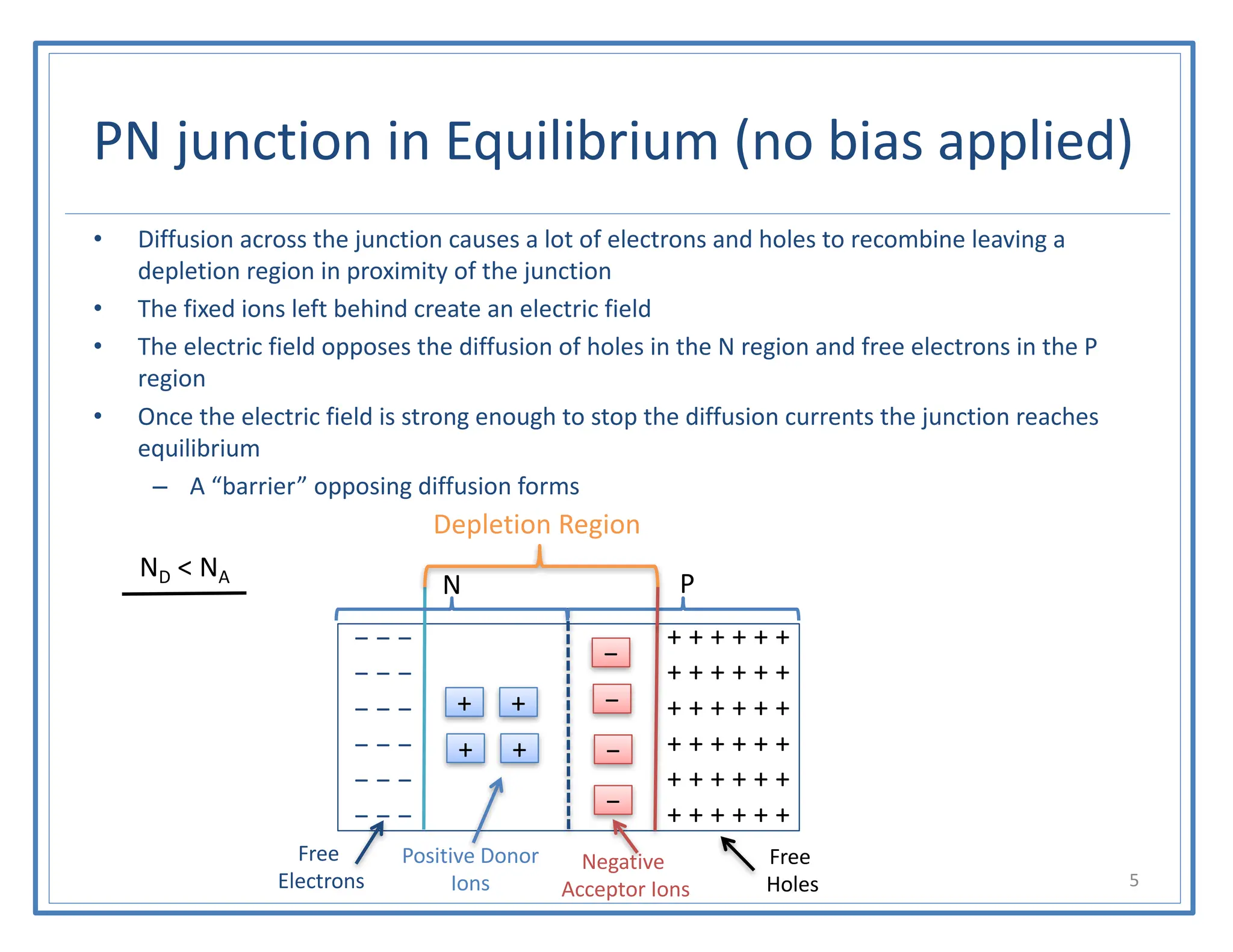
• Diffusion across the junction causes a lot of electrons and holes to recombine leaving a
depletion region in proximity of the junction
• The fixed ions left behind create an electric field
• The electric field opposes the diffusion of holes in the N region and free electrons in the P
region
• Once the electric field is strong enough to stop the diffusion currents the junction reaches
equilibrium
– A “barrier” opposing diffusion forms
5
− − −
− − −
− − −
− − −
− − −
− − −
+ + + + + +
+ + + + + +
+ + + + + +
+ + + + + +
+ + + + + +
+ + + + + +
−
−
−
−
+
+
+
+
Free
Electrons
Positive Donor
Ions
Negative
Acceptor Ions
Free
Holes
Depletion Region
P
N
ND < NA
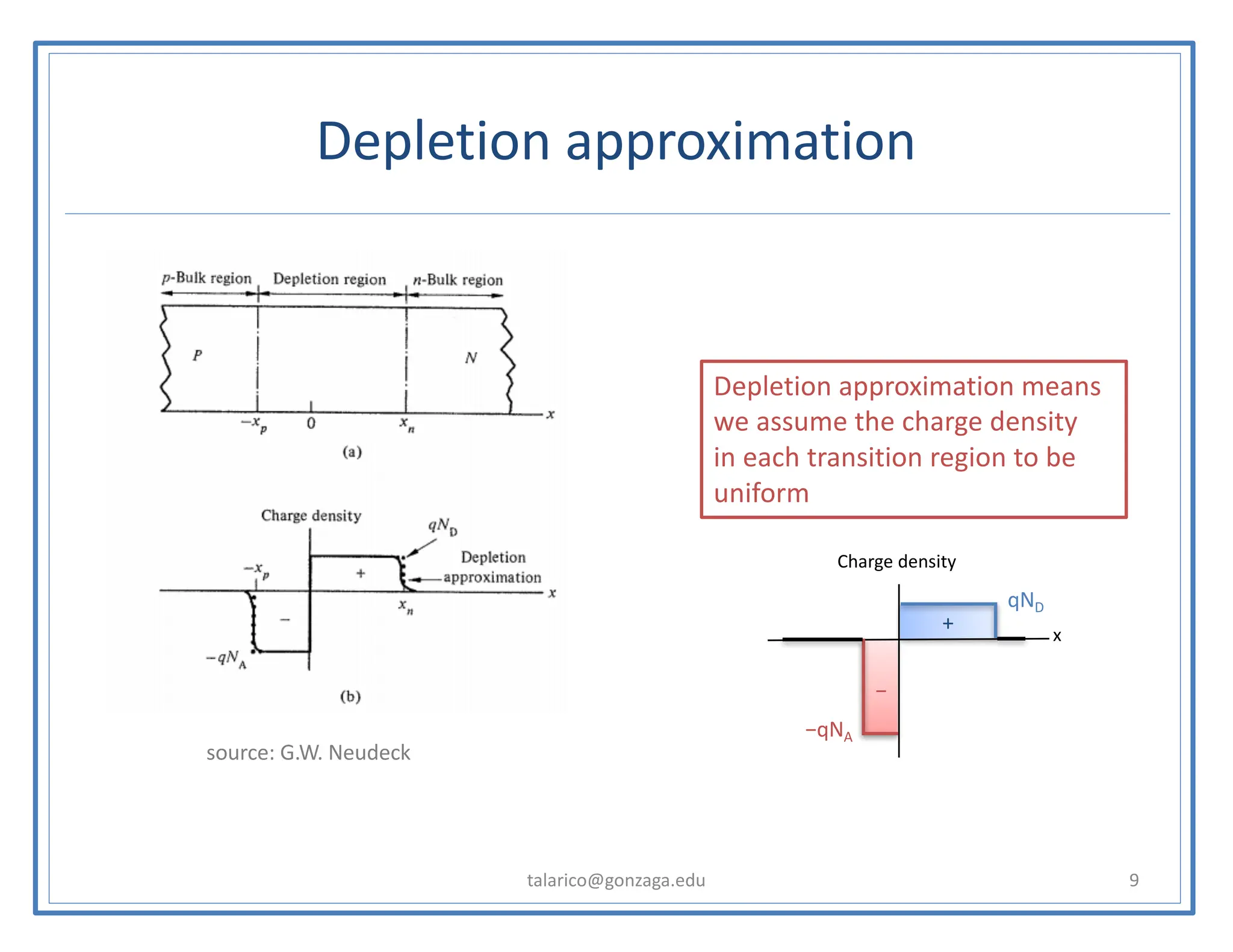
Depletion approximation
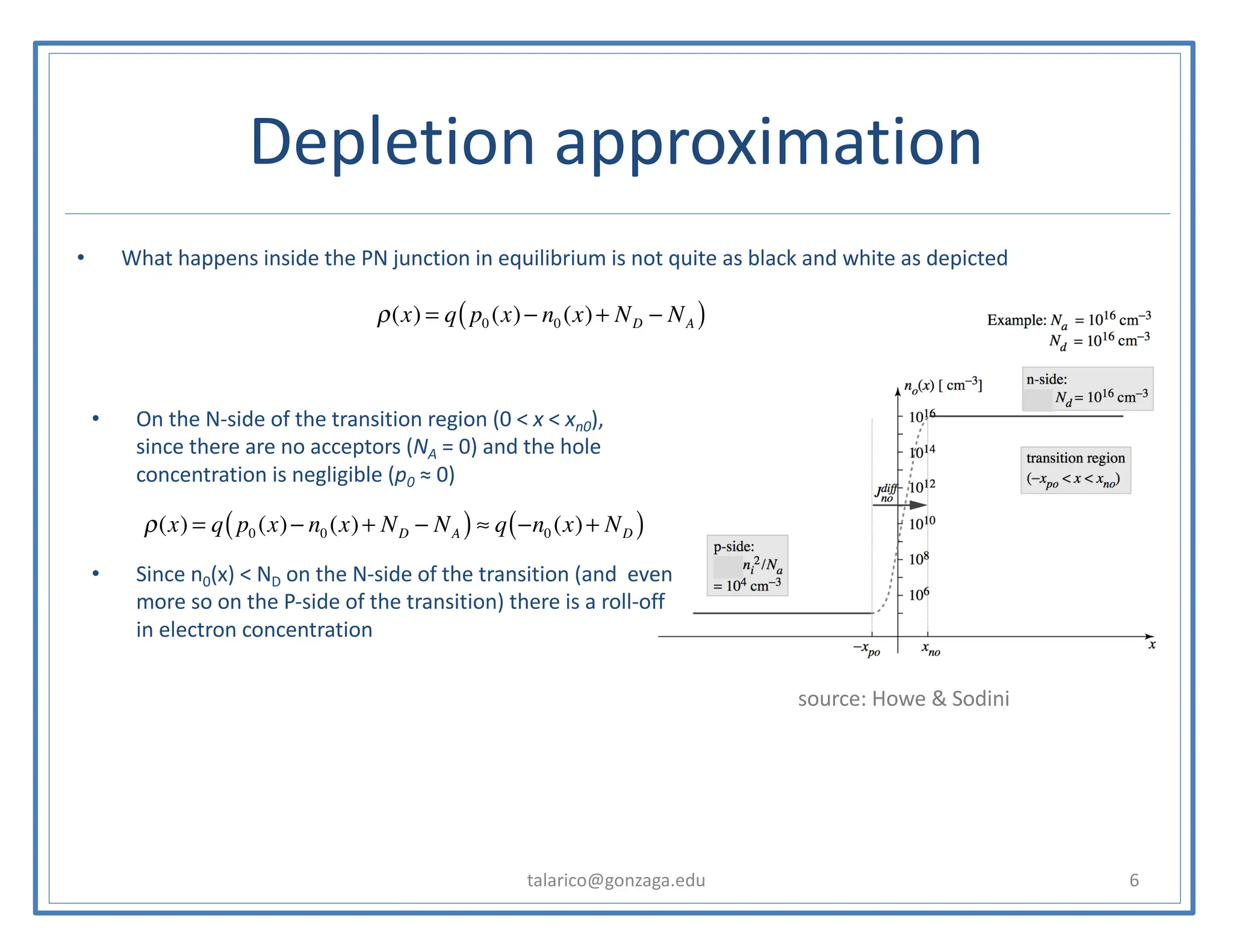
• What happens inside the PN junction in equilibrium is not quite as black and white as depicted
talarico@gonzaga.edu 6
ρ(x) = q p0 (x)− n0 (x)+ ND − NA
( )
• On the N-side of the transition region (0 < x < xn0),
since there are no acceptors (NA = 0) and the hole
concentration is negligible (p0 ≈ 0)
• Since n0(x) < ND on the N-side of the transition (and even
more so on the P-side of the transition) there is a roll-off
in electron concentration
ρ(x) = q p0 (x)− n0 (x)+ ND − NA
( )≈ q −n0 (x)+ ND
( )
source: Howe & Sodini
Depletion approximation
talarico@gonzaga.edu 7
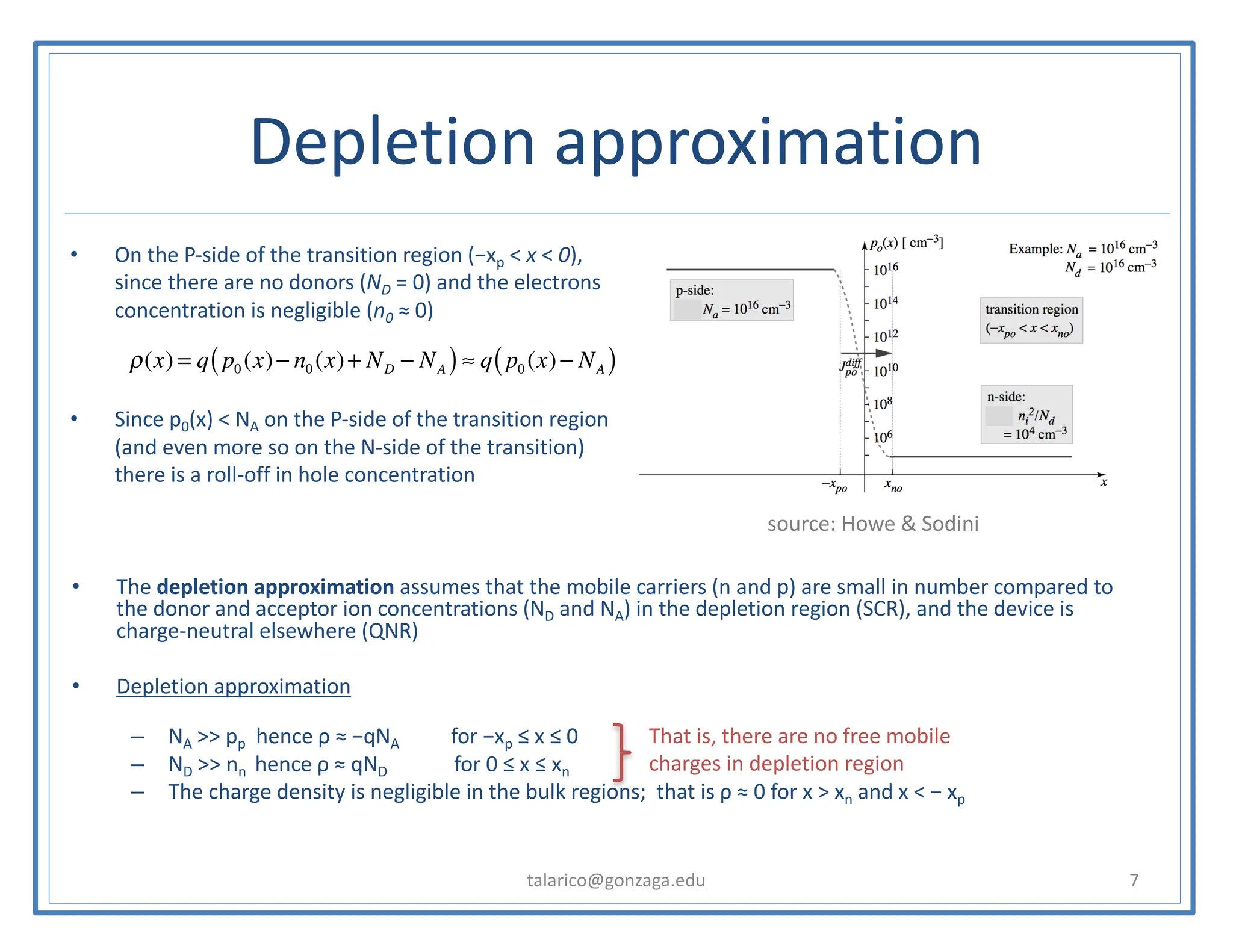
• The depletion approximation assumes that the mobile carriers (n and p) are small in number compared to
the donor and acceptor ion concentrations (ND and NA) in the depletion region (SCR), and the device is
charge-neutral elsewhere (QNR)
• Depletion approximation
– NA >> pp hence ρ ≈ −qNA for −xp ≤ x ≤ 0
– ND >> nn hence ρ ≈ qND for 0 ≤ x ≤ xn
– The charge density is negligible in the bulk regions; that is ρ ≈ 0 for x > xn and x < − xp
• On the P-side of the transition region (−xp < x < 0),
since there are no donors (ND = 0) and the electrons
concentration is negligible (n0 ≈ 0)
• Since p0(x) < NA on the P-side of the transition region
(and even more so on the N-side of the transition)
there is a roll-off in hole concentration
ρ(x) = q p0 (x)− n0 (x)+ ND − NA
( )≈ q p0 (x)− NA
( )
source: Howe & Sodini
That is, there are no free mobile
charges in depletion region
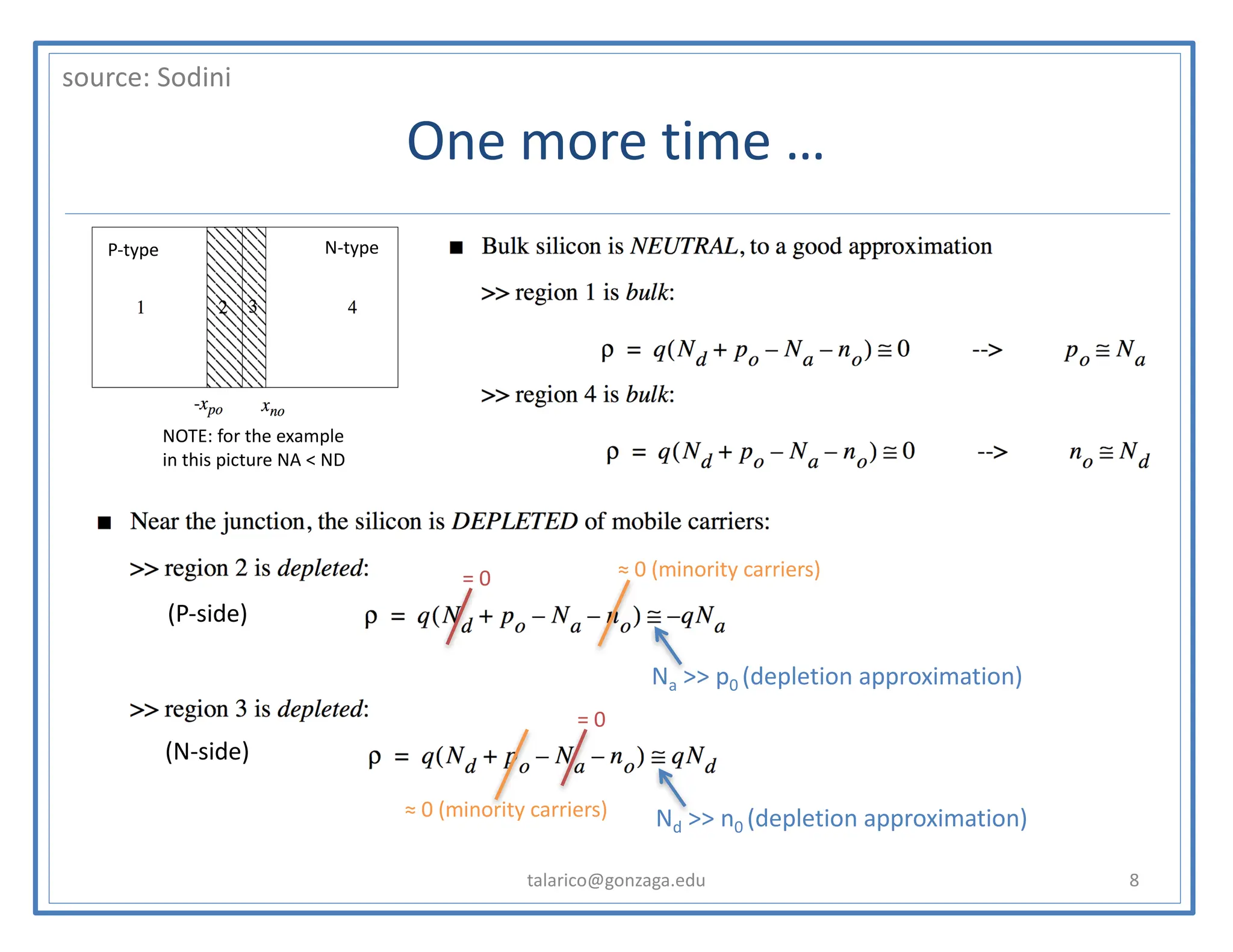
One more time …
• aa
talarico@gonzaga.edu 8
source: Sodini
(P-side)
(N-side)
= 0
= 0 ≈ 0 (minority carriers)
≈ 0 (minority carriers)
Na >> p0 (depletion approximation)
Nd >> n0 (depletion approximation)
P-type N-type
NOTE: for the example
in this picture NA < ND
Depletion approximation
talarico@gonzaga.edu 9
Depletion approximation means
we assume the charge density
in each transition region to be
uniform
Charge density
x
qND
−qNA
−
+
source: G.W. Neudeck
PN junction in Equilibrium (no bias applied)
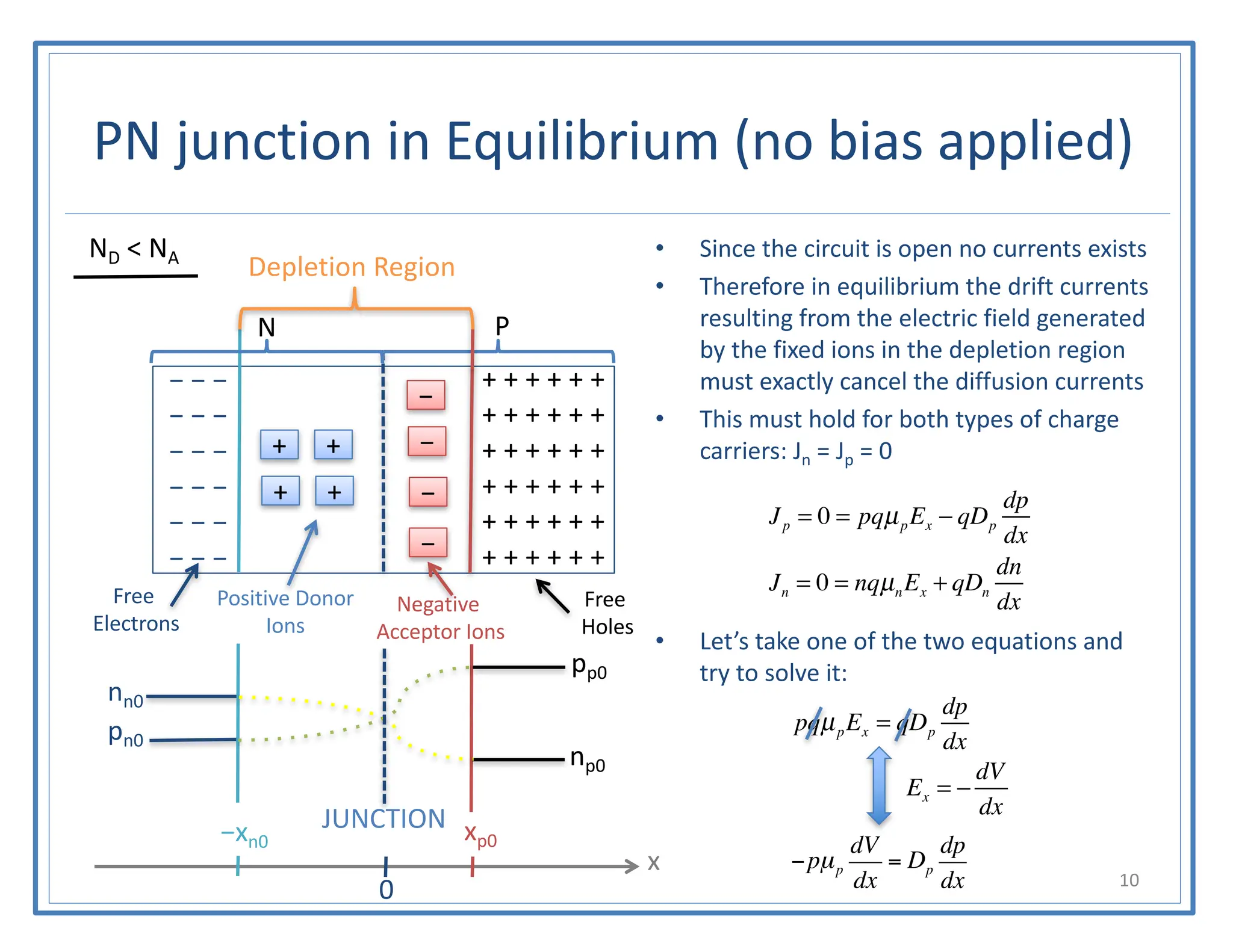
• Since the circuit is open no currents exists
• Therefore in equilibrium the drift currents
resulting from the electric field generated
by the fixed ions in the depletion region
must exactly cancel the diffusion currents
• This must hold for both types of charge
carriers: Jn = Jp = 0
• Let’s take one of the two equations and
try to solve it:
10
− − −
− − −
− − −
− − −
− − −
− − −
+ + + + + +
+ + + + + +
+ + + + + +
+ + + + + +
+ + + + + +
+ + + + + +
−
−
−
−
+
+
+
+
Free
Electrons
Positive Donor
Ions
Negative
Acceptor Ions
Free
Holes
Depletion Region
P
N
ND < NA
Jp = 0 = pqµpEx − qDp
dp
dx
Jn = 0 = nqµnEx + qDn
dn
dx
0
nn0
pn0
pp0
np0
JUNCTION
x
xp0
−xn0
−pµp
dV
dx
= Dp
dp
dx
pqµpEx = qDp
dp
dx
Ex = −
dV
dx
Built-in voltage (equilibrium)
talarico@gonzaga.edu 11
−pµp
dV
dx
= Dp
dp
dx
− dV
V (−xn0)
V (xp0)
∫ =
Dp
µp
dp
p
p(−xn0)
p(xp0)
∫
V(−xn0 )−V(xp0 ) =VT ln
pp0
pn0
ΦB =VT ln
NA
ni
2
/ ND
!
ΦB =VT ln
NA ND
ni
2
nn0
pn0
pp0
np0
x
xp0
−xn0
P
N
+
+
−
−
Ex
0
ΦB
+ −
+
+ −
−
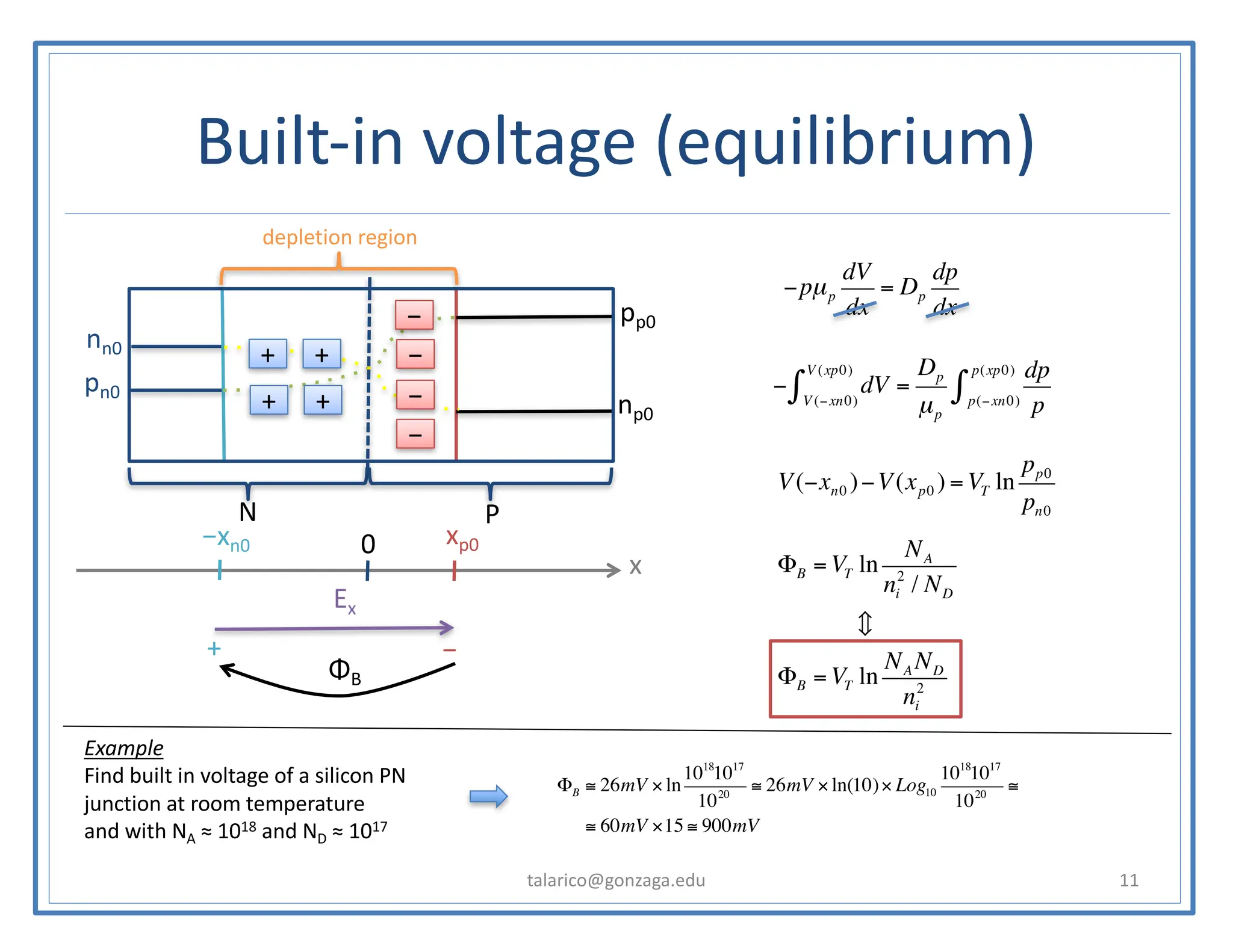
Example
Find built in voltage of a silicon PN
junction at room temperature
and with NA ≈ 1018 and ND ≈ 1017
ΦB ≅ 26mV × ln
1018
1017
1020
≅ 26mV × ln(10)× Log10
1018
1017
1020
≅
≅ 60mV ×15 ≅ 900mV
depletion region
PN Junction in equilibrium (no bias applied)
talarico@gonzaga.edu 12
− − −
− − −
− − −
− − −
− − −
− − −
+ + + + + +
+ + + + + +
+ + + + + +
+ + + + + +
+ + + + + +
+ + + + + +
−
−
−
−
+
+
+
+
Depletion Region
P
N
+
−
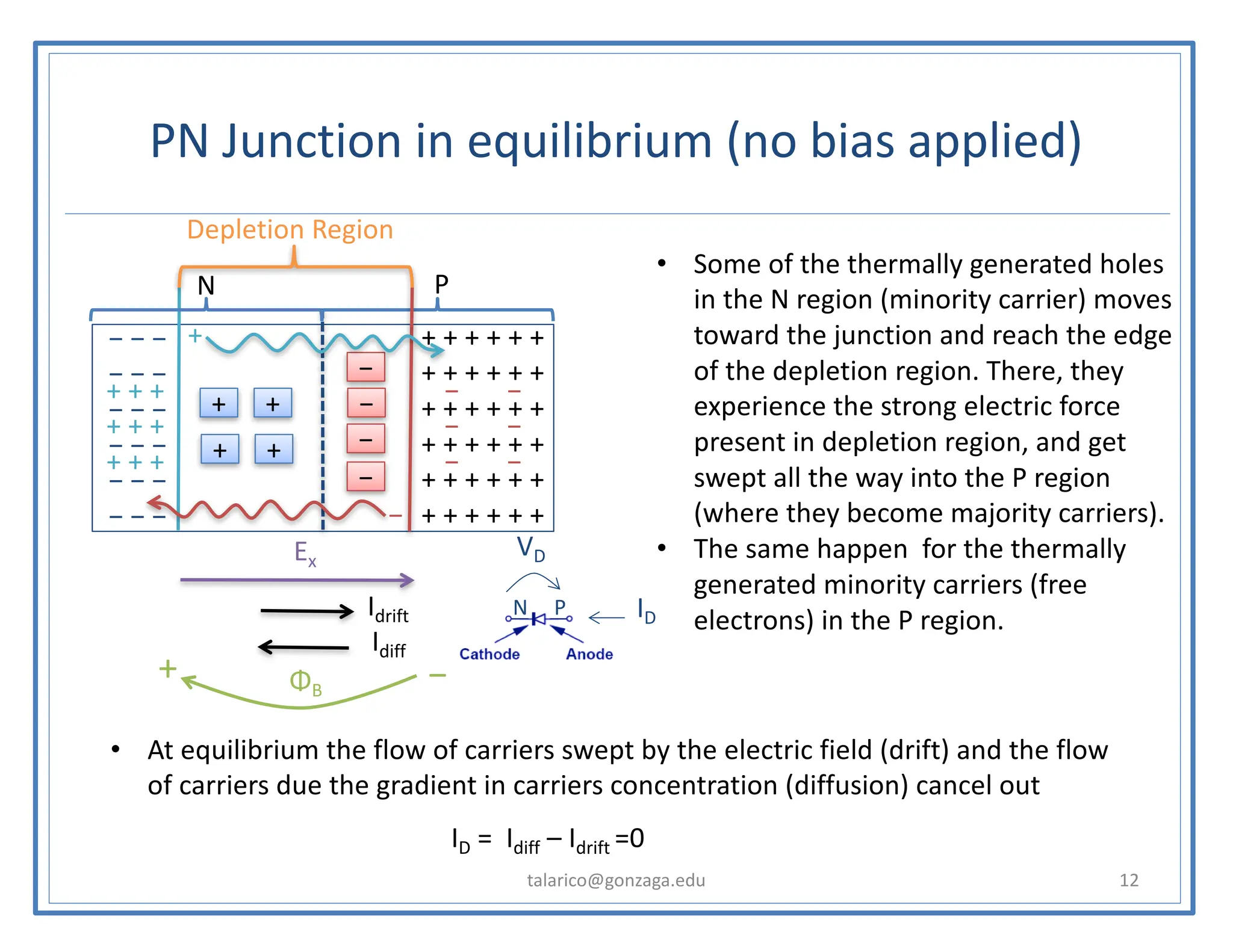
• Some of the thermally generated holes
in the N region (minority carrier) moves
toward the junction and reach the edge
of the depletion region. There, they
experience the strong electric force
present in depletion region, and get
swept all the way into the P region
(where they become majority carriers).
• The same happen for the thermally
generated minority carriers (free
electrons) in the P region.
• At equilibrium the flow of carriers swept by the electric field (drift) and the flow
of carriers due the gradient in carriers concentration (diffusion) cancel out
ID = Idiff – Idrift =0
Ex
Idrift
Idiff
+ −
ΦB
P
N ID
− −
− −
− −
+ + +
+ + +
+ + +
VD
Width of the Depletion region in equilibrium
13
− − −
− − −
− − −
− − −
+ + + + + +
+ + + + + +
+ + + + + +
+ + + + + +
−
−
−
−
+
+
+
+
P
N
−xn0 +xp0
0
E
metal contact
A
K
metal contact
−xn0 +xp0
x
concentration [cm−3]
pp0=NA
np0≈ni
2/NA
nn0=ND
pn0≈ni
2/ND
W=Xd0
Idrift
Idiff
−xn0
x
+xp0
ρ = charge density [Cb/cm−3]
−qNA
+qND
|Q −|= qNAAxp0
|Q +|= qNDAxn0
Width of the Depletion region in equilibrium
talarico@gonzaga.edu 14
−xn0
x
+xp0
ρ = charge density [Cb/cm−3]
−qNA
+qND
|Q −|= qNAAxp0
|Q +|= qNDAxn0
Charge conservation:
|Q+ |=|Q− | ! QJ 0
"
AqND xn0 = AqNAxp0
"
ND xn0 = NAxp0
E(x)
x
−xn0 +xp0
E(0) =
−qNAxp0
εsi
=
−qND xn0
εsi
! Emax
PoissonEquation:
dE
dx
=
ρ
εsi
!
dE =
ρ
εsi
dx
As long as we know how to compute
the area of a rectangle we are fine
with the math !!!
Permittivity of crystalline silicon:
εsi ≈ 11.7×8.85×10−12 F/m
εr ε0
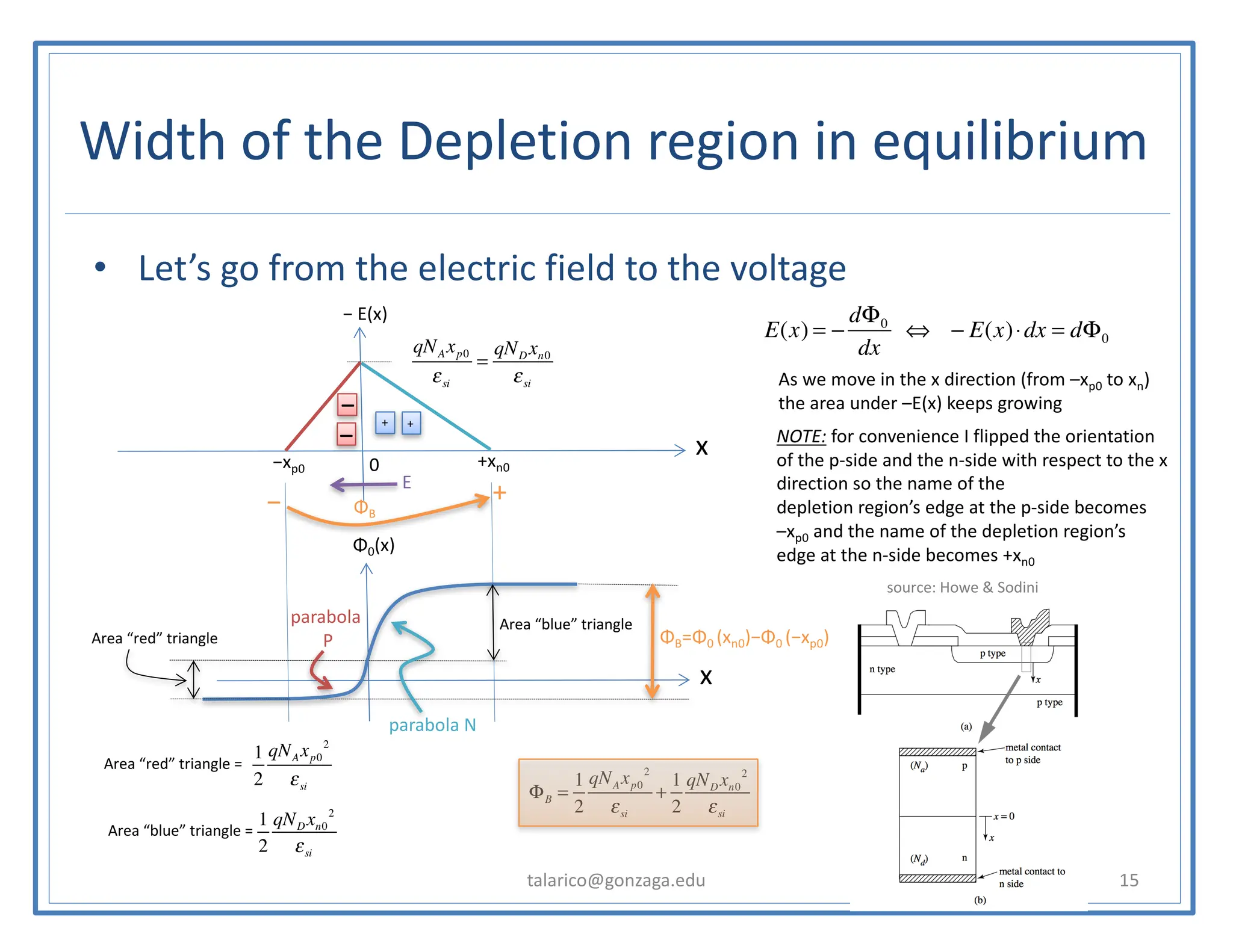
• Let’s go from the electric field to the voltage
talarico@gonzaga.edu 15
Width of the Depletion region in equilibrium
− E(x)
x
−xp0 +xn0
qNAxp0
εsi
=
qND xn0
εsi
E(x) = −
dΦ0
dx
⇔ − E(x)⋅dx = dΦ0
Φ0(x)
x
Area “red” triangle
1
2
qND xn0
2
εsi
Area “blue” triangle =
Area “blue” triangle
1
2
qNAxp0
2
εsi
Area “red” triangle =
0
As we move in the x direction (from –xp0 to xn)
the area under –E(x) keeps growing
NOTE: for convenience I flipped the orientation
of the p-side and the n-side with respect to the x
direction so the name of the
depletion region’s edge at the p-side becomes
–xp0 and the name of the depletion region’s
edge at the n-side becomes +xn0
ΦB=Φ0 (xn0)−Φ0 (−xp0)
ΦB =
1
2
qNAxp0
2
εsi
+
1
2
qND xn0
2
εsi
ΦB
+
−
E
−
+
+
parabola N
parabola
P
source: Howe & Sodini
−
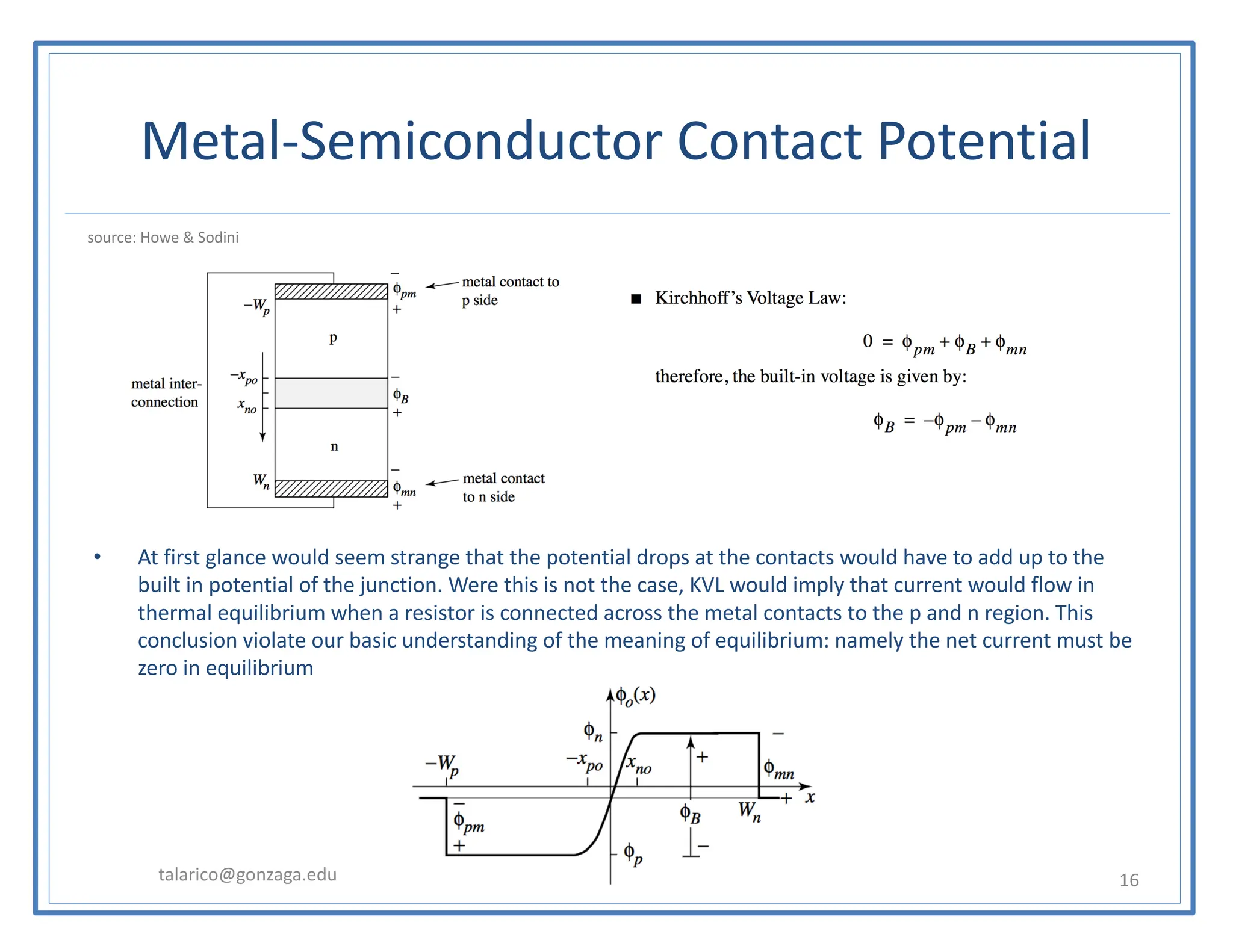
Metal-Semiconductor Contact Potential
• At first glance would seem strange that the potential drops at the contacts would have to add up to the
built in potential of the junction. Were this is not the case, KVL would imply that current would flow in
thermal equilibrium when a resistor is connected across the metal contacts to the p and n region. This
conclusion violate our basic understanding of the meaning of equilibrium: namely the net current must be
zero in equilibrium
talarico@gonzaga.edu 16
source: Howe & Sodini
talarico@gonzaga.edu 17
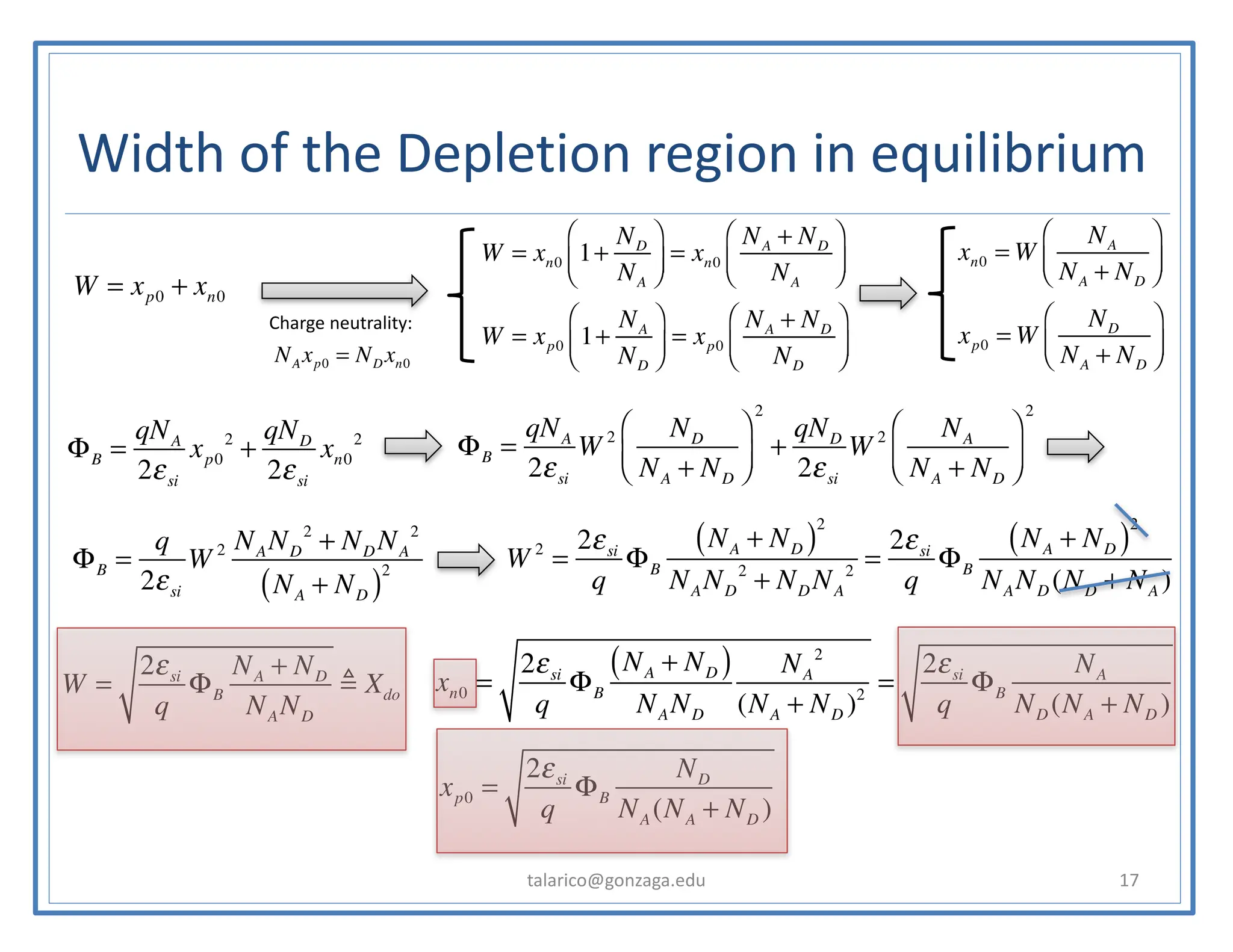
Width of the Depletion region in equilibrium
W = xp0 + xn0
W = xn0 1+
ND
NA
⎛
⎝
⎜
⎞
⎠
⎟ = xn0
NA + ND
NA
⎛
⎝
⎜
⎞
⎠
⎟
W = xp0 1+
NA
ND
⎛
⎝
⎜
⎞
⎠
⎟ = xp0
NA + ND
ND
⎛
⎝
⎜
⎞
⎠
⎟
NAxp0 = ND xn0
Charge neutrality:
xn0 = W
NA
NA + ND
⎛
⎝
⎜
⎞
⎠
⎟
xp0 = W
ND
NA + ND
⎛
⎝
⎜
⎞
⎠
⎟
ΦB =
qNA
2εsi
xp0
2
+
qND
2εsi
xn0
2
ΦB =
qNA
2εsi
W 2 ND
NA + ND
⎛
⎝
⎜
⎞
⎠
⎟
2
+
qND
2εsi
W 2 NA
NA + ND
⎛
⎝
⎜
⎞
⎠
⎟
2
ΦB =
q
2εsi
W 2 NAND
2
+ ND NA
2
NA + ND
( )2 W 2
=
2εsi
q
ΦB
NA + ND
( )2
NAND
2
+ ND NA
2
=
2εsi
q
ΦB
NA + ND
( )2
NAND (ND + NA )
W =
2εsi
q
ΦB
NA + ND
NAND
! Xdo
xn0 =
2εsi
q
ΦB
NA + ND
( )
NAND
NA
2
(NA + ND )2
=
2εsi
q
ΦB
NA
ND (NA + ND )
xp0 =
2εsi
q
ΦB
ND
NA (NA + ND )
Charge on either side of the depletion region
(in equilibrium)
talarico@gonzaga.edu 18
QJ 0 !|Q+ |=|Q− |= AqND xn0
xn0
x
−xp0
ρ = charge density [Cb/cm−3]
−qNA
+qND
|Q −|= qNAAxp0
|Q +|= qNDAxn0
QJ 0 = AqNDW
NA
NA + ND
= Aq
NAND
NA + ND
W
QJ 0 = Aq
NAND
NA + ND
2εsi
q
ΦB
NA + ND
NAND
= A 2εsiq
NAND
NA + ND
ΦB
Junction Charge
xn0 = W
NA
NA + ND
⎛
⎝
⎜
⎞
⎠
⎟
xp0 = W
ND
NA + ND
⎛
⎝
⎜
⎞
⎠
⎟
= xn0
= W=Xd0
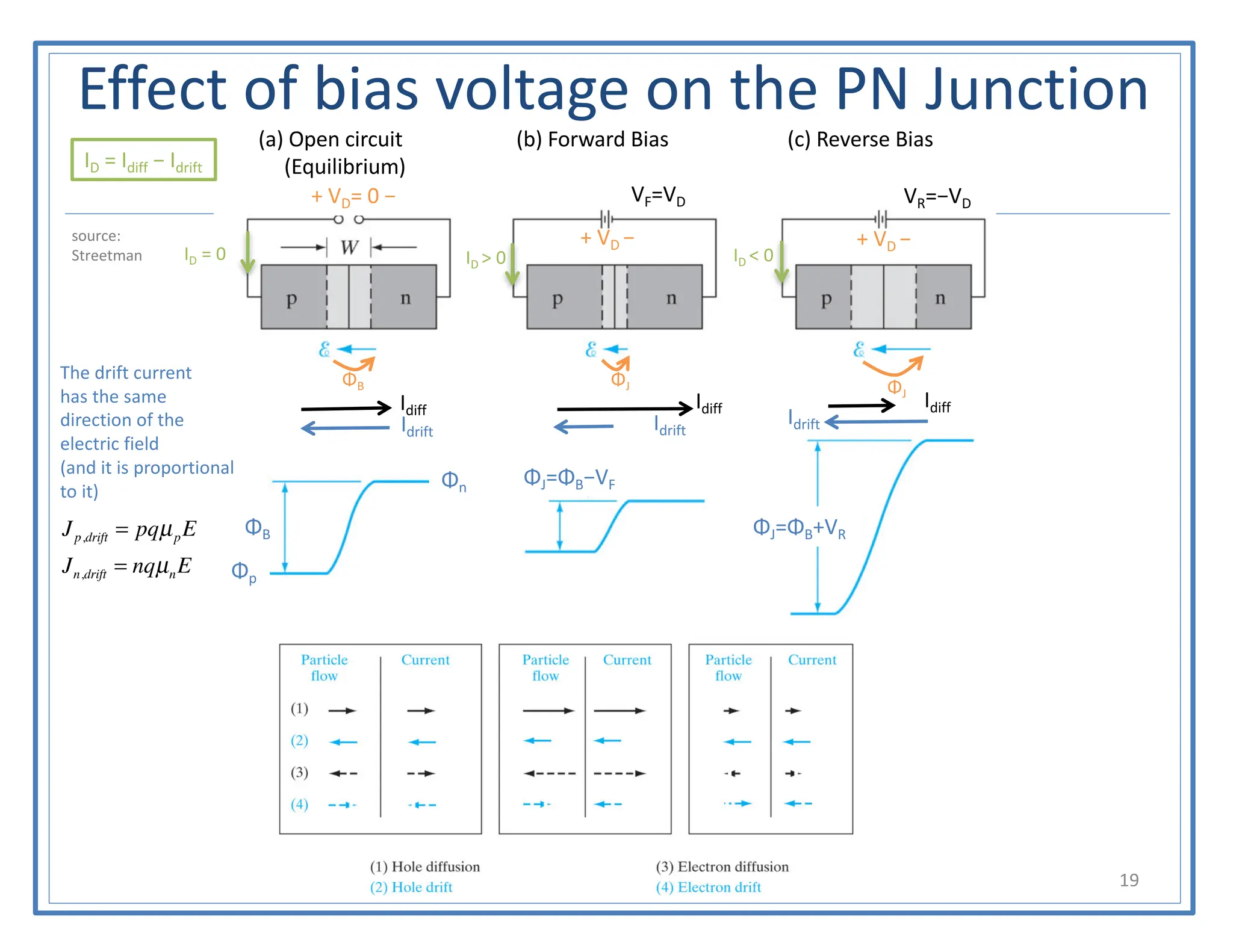
Effect of bias voltage on the PN Junction
talarico@gonzaga.edu 19
source:
Streetman
ΦB
Φp
Φn
ΦJ=ΦB−VF
ΦJ=ΦB+VR
VF=VD VR=−VD
+ VD − + VD −
+ VD= 0 −
Idiff
Idrift
Idiff
Idrift
Idrift
Idiff
ID = 0 ID > 0 ID < 0
ID = Idiff − Idrift
The drift current
has the same
direction of the
electric field
(and it is proportional
to it)
(a) Open circuit (b) Forward Bias (c) Reverse Bias
(Equilibrium)
Jp,drift = pqµpE
Jn,drift = nqµnE
ΦB ΦJ ΦJ
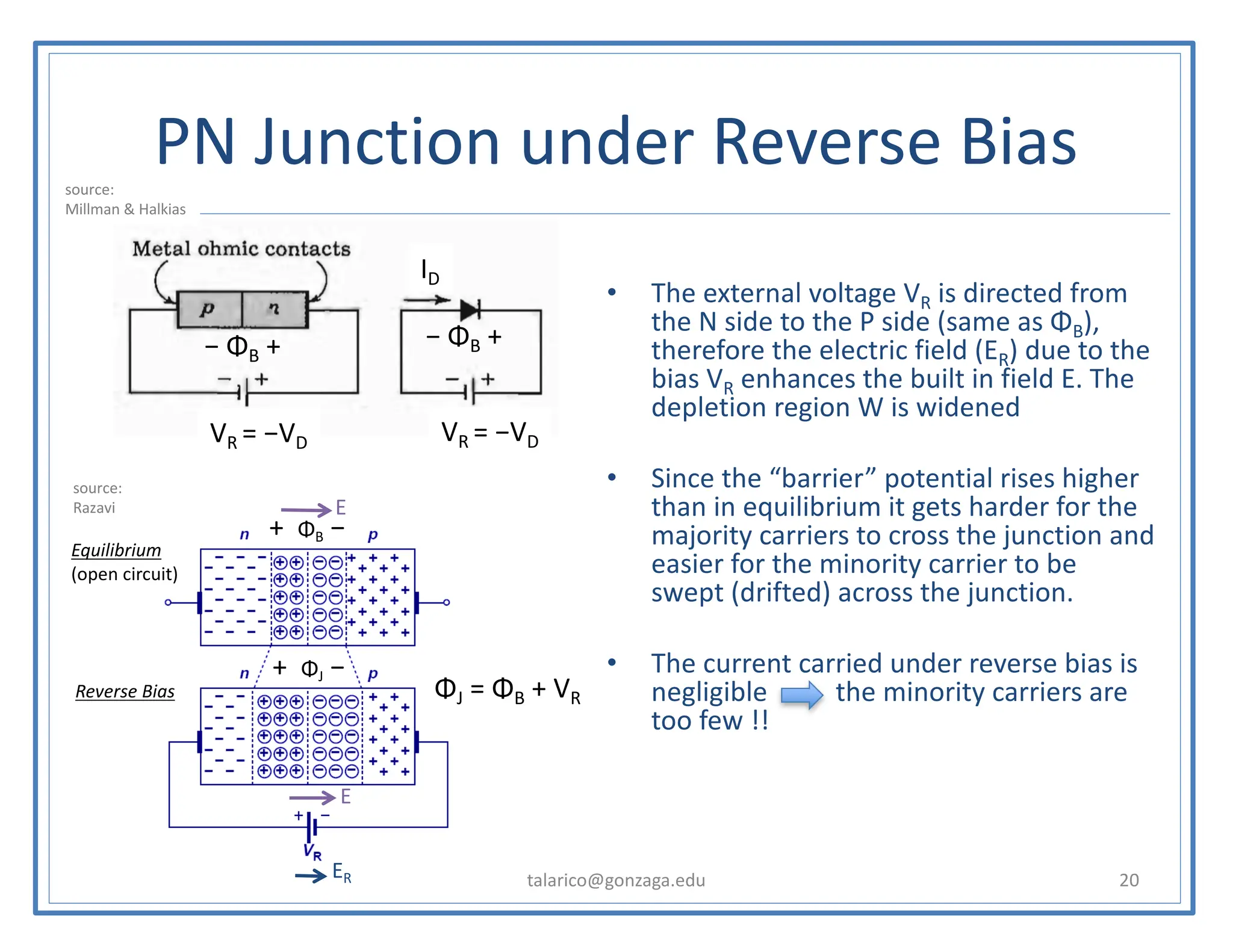
PN Junction under Reverse Bias
• The external voltage VR is directed from
the N side to the P side (same as ΦB),
therefore the electric field (ER) due to the
bias VR enhances the built in field E. The
depletion region W is widened
• Since the “barrier” potential rises higher
than in equilibrium it gets harder for the
majority carriers to cross the junction and
easier for the minority carrier to be
swept (drifted) across the junction.
• The current carried under reverse bias is
negligible the minority carriers are
too few !!
talarico@gonzaga.edu 20
VR = −VD VR = −VD
ID
− ΦB + − ΦB +
source:
Millman & Halkias
source:
Razavi
Equilibrium
(open circuit)
Reverse Bias
+ ΦB −
E
E
ER
+ ΦJ −
ΦJ = ΦB + VR
PN junction under reverse bias
talarico@gonzaga.edu 21
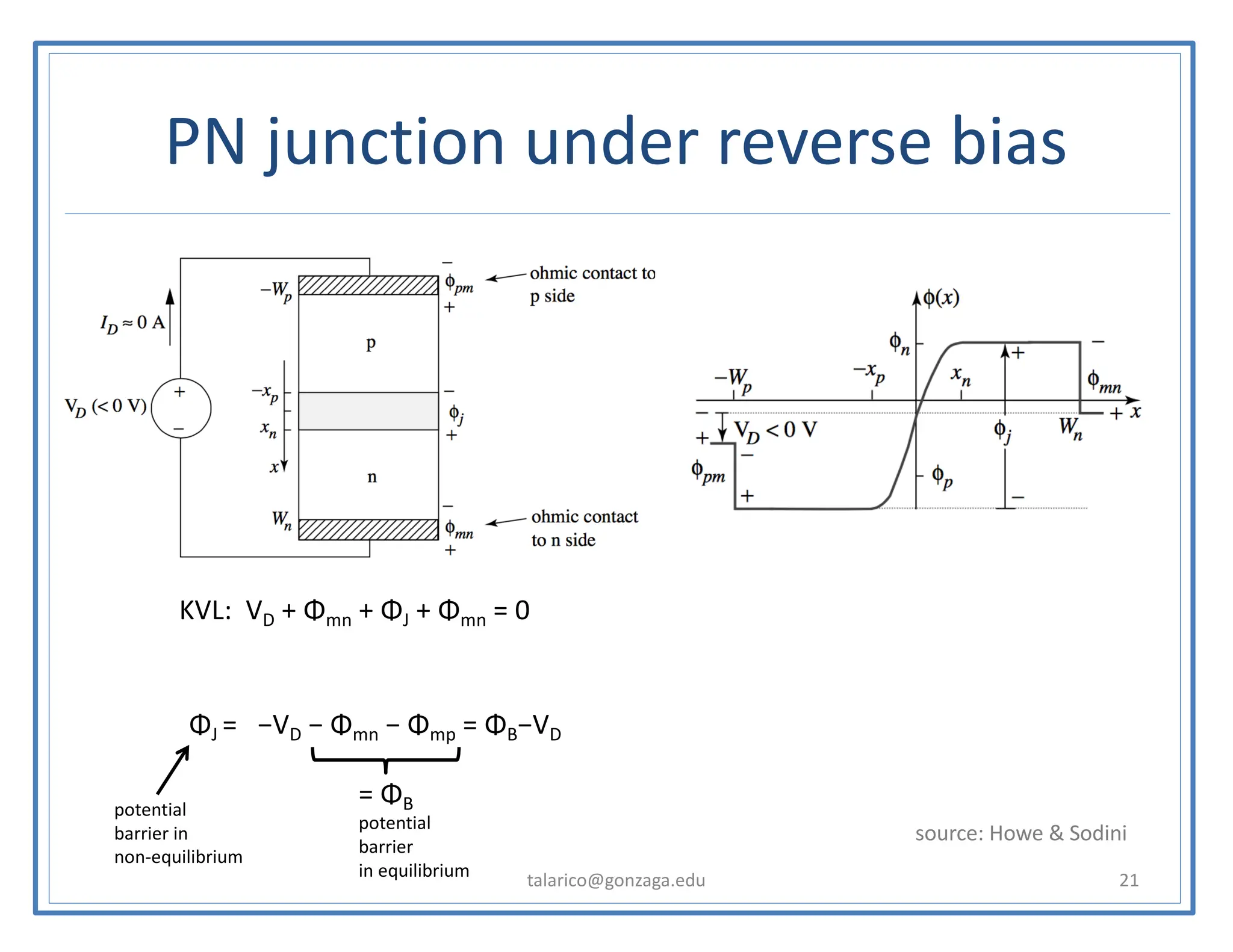
KVL: VD + Φmn + ΦJ + Φmn = 0
ΦJ = −VD − Φmn − Φmp = ΦB−VD
= ΦB
potential
barrier
in equilibrium
potential
barrier in
non-equilibrium
source: Howe & Sodini
PN junction under reverse bias
22
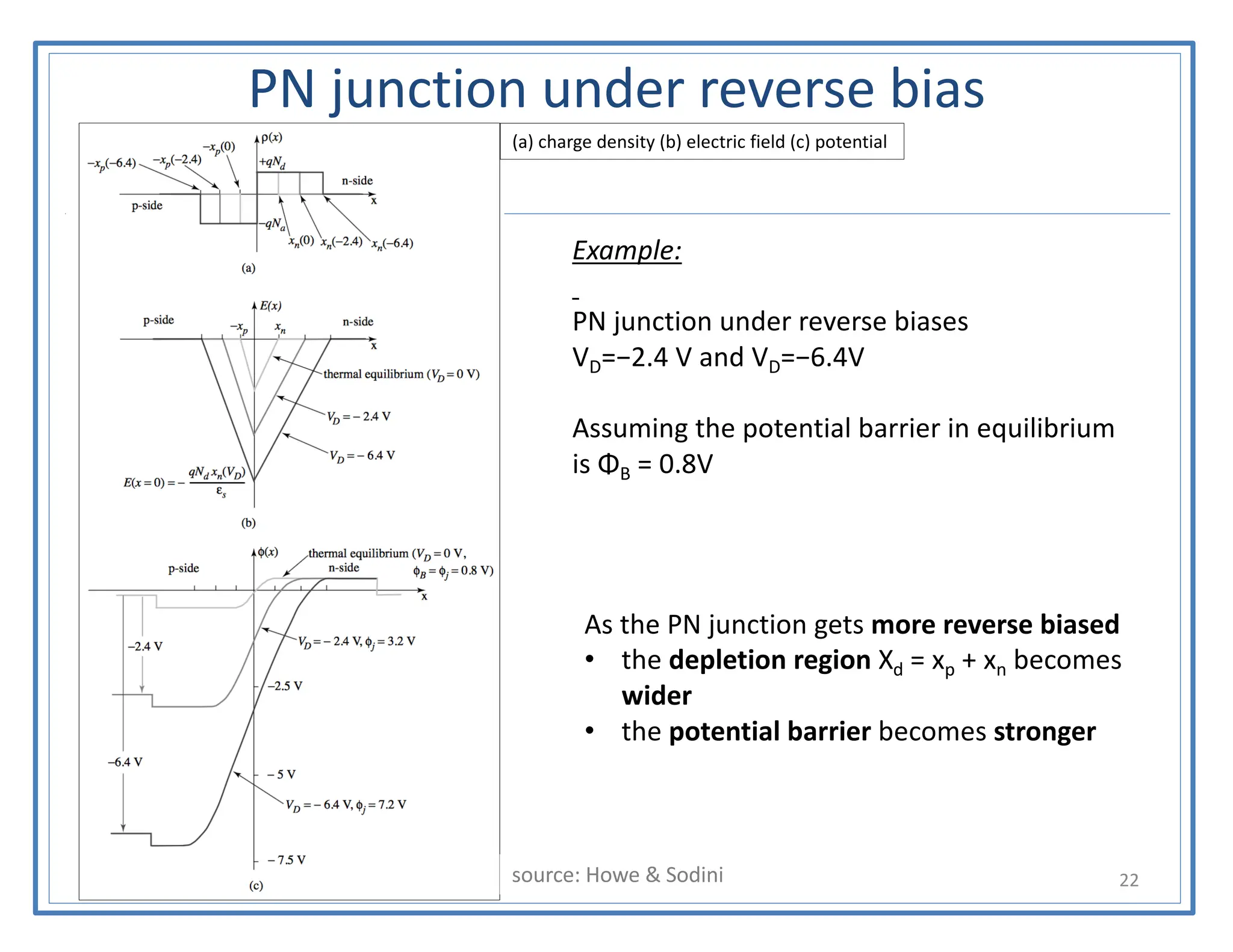
Example:
PN junction under reverse biases
VD=−2.4 V and VD=−6.4V
Assuming the potential barrier in equilibrium
is ΦB = 0.8V
As the PN junction gets more reverse biased
• the depletion region Xd = xp + xn becomes
wider
• the potential barrier becomes stronger
(a) charge density (b) electric field (c) potential
source: Howe & Sodini
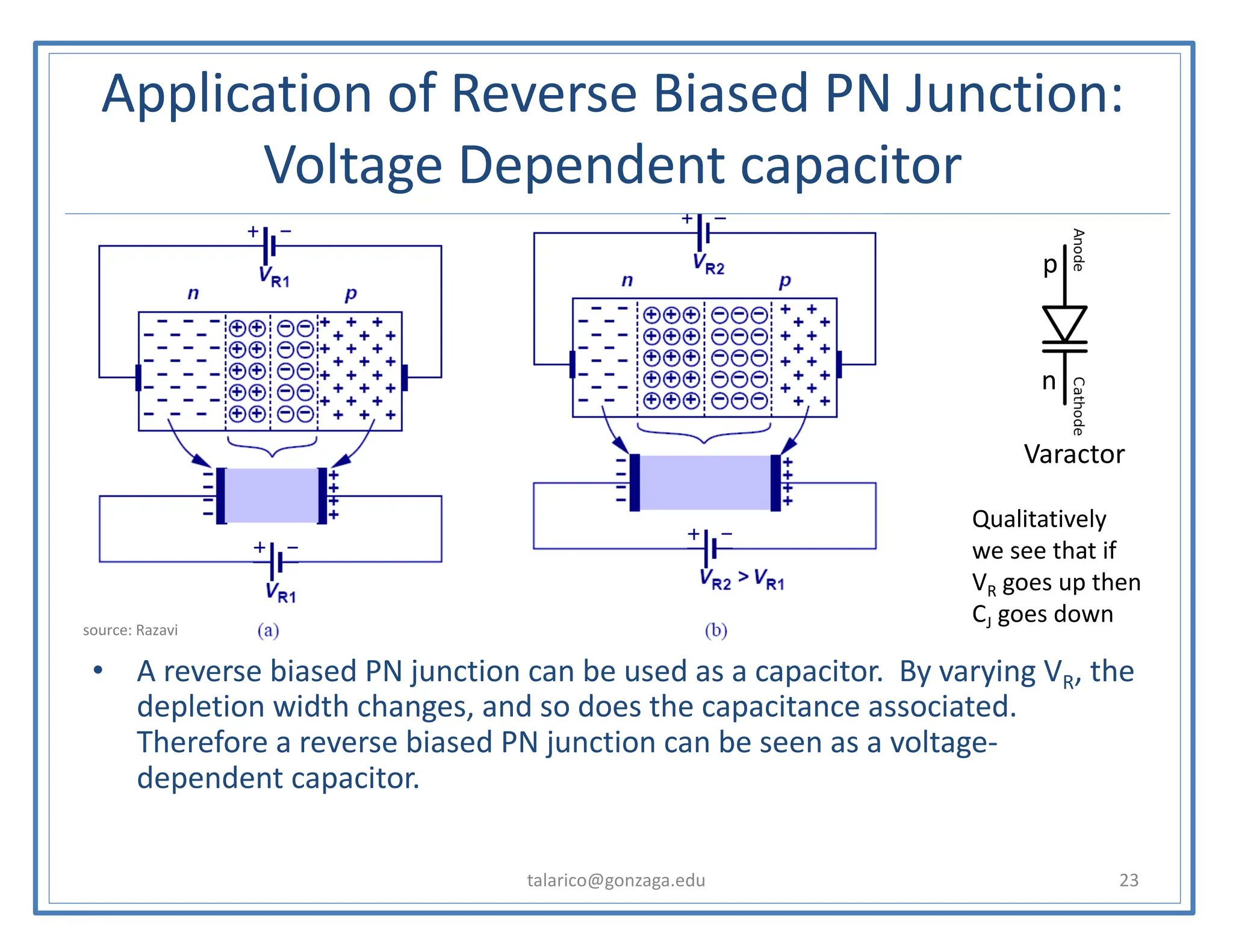
Application of Reverse Biased PN Junction:
Voltage Dependent capacitor
• A reverse biased PN junction can be used as a capacitor. By varying VR, the
depletion width changes, and so does the capacitance associated.
Therefore a reverse biased PN junction can be seen as a voltage-
dependent capacitor.
talarico@gonzaga.edu 23
Varactor
p
n
Qualitatively
we see that if
VR goes up then
CJ goes down
source: Razavi
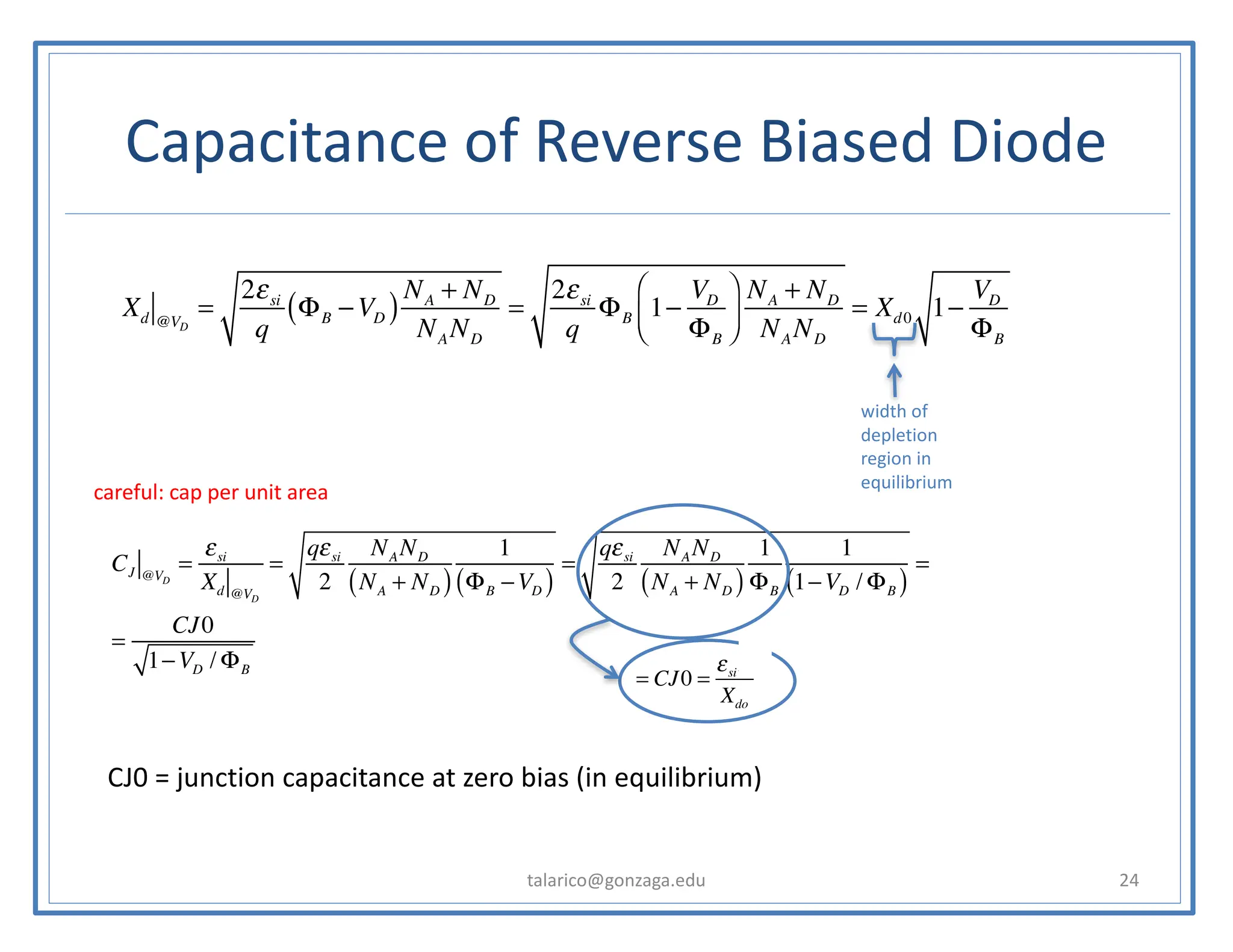
Capacitance of Reverse Biased Diode
talarico@gonzaga.edu 24
Xd @VD
=
2εsi
q
ΦB −VD
( )
NA + ND
NAND
=
2εsi
q
ΦB 1−
VD
ΦB
⎛
⎝
⎜
⎞
⎠
⎟
NA + ND
NAND
= Xd0 1−
VD
ΦB
CJ @VD
=
εsi ⋅ A
Xd @VD
=
qεsi
2
NAND
NA + ND
( )
1
ΦB −VD
( )
=
qεsi
2
NAND
NA + ND
( )
1
ΦB
1
1−VD / ΦB
( )
=
=
CJ0
1−VD / ΦB
width of
depletion
region in
equilibrium
CJ0 = junction capacitance at zero bias (in equilibrium)
= CJ0 =
εsi A
Xdo
careful: cap per unit area
Junction capacitance of reverse biased diode
talarico@gonzaga.edu 25
CJ0
VR=−VD
VD= VF
Reverse Voltage Forward Voltage
CJ
source: Streetman
CJ (VD ) =
CJ0
1−
VD
ΦB
⎛
⎝
⎜
⎞
⎠
⎟
M =
CJ0
1+
VR
ΦB
⎛
⎝
⎜
⎞
⎠
⎟
M
• M=0.5 for the abrupt PN junction we
modeled
• Typical values for M range from 0.3 to
0.5
• SPICE uses VJ (or PB) to denote the
built in voltage in equilibrium (ΦB)
The junction
capacitance
is non linear
talarico@gonzaga.edu 26
QJ @VD
= A 2εsiq
NAND
NA + ND
ΦB −VD
( ) = A 2εsiq
NAND
NA + ND
ΦB 1−
VD
ΦB
⎛
⎝
⎜
⎞
⎠
⎟ = QJ 0 1−
VD
ΦB
=
= QJ 0 1+
VR
ΦB
charge stored in
either side of the
depletion region
in equilibrium
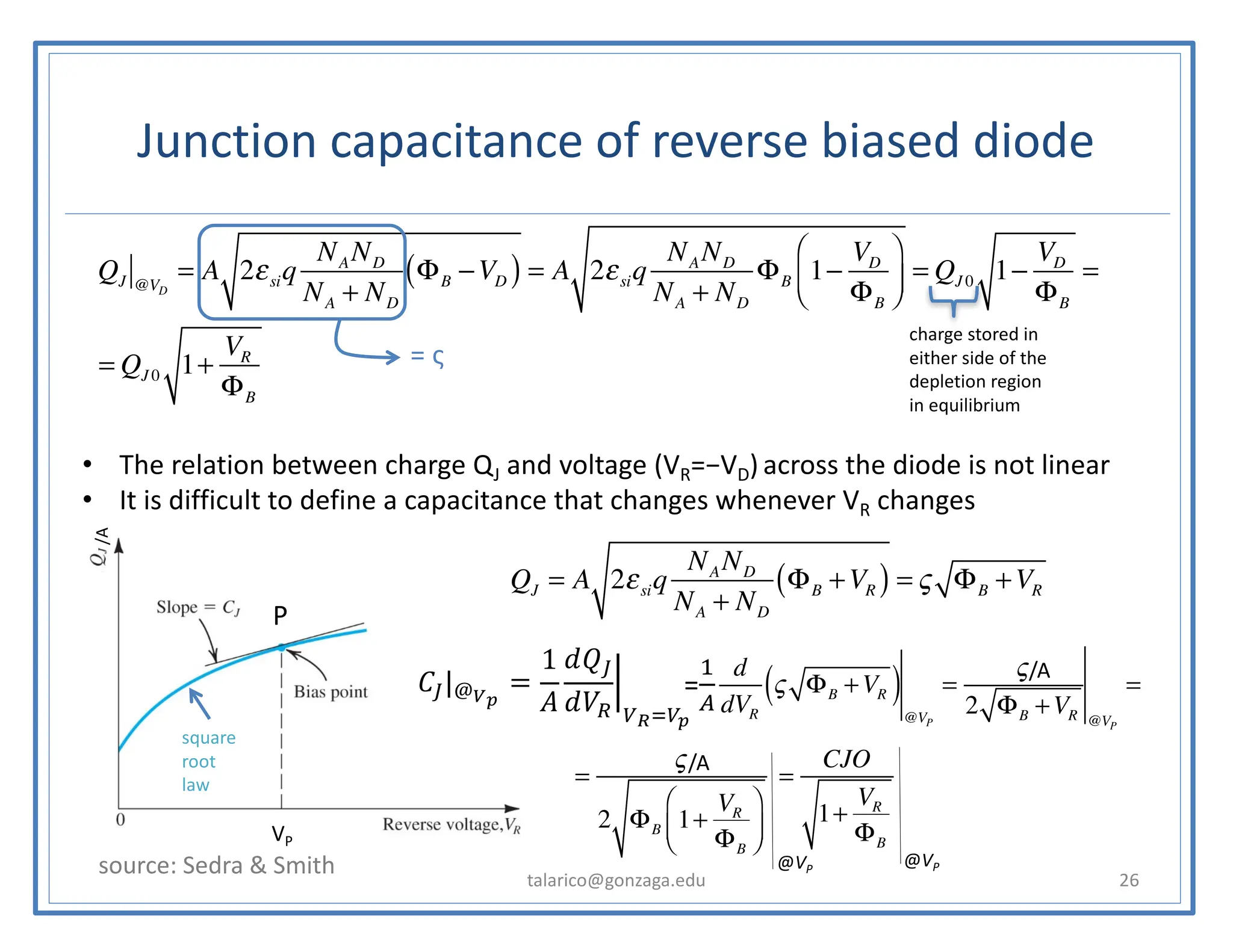
Junction capacitance of reverse biased diode
• The relation between charge QJ and voltage (VR=−VD) across the diode is not linear
• It is difficult to define a capacitance that changes whenever VR changes
source: Sedra & Smith
P
VP
QJ = A 2εsiq
NAND
NA + ND
ΦB +VR
( ) = ς ΦB +VR
=
ς
2 ΦB 1+
VR
ΦB
⎛
⎝
⎜
⎞
⎠
⎟
=
CJO
1+
VR
ΦB
CJ @VP
=
dQJ
dVR VR =VP
=
d
dVR
ς ΦB +VR
( )
@VP
=
ς
2 ΦB +VR @VP
=
= ς
@VP
@VP
square
root
law
𝐶"|@%&
=
1
𝐴
𝑑𝑄"
𝑑𝑉-
.
/01/&
/A
=
2
3
/A
/A
talarico@gonzaga.edu 27
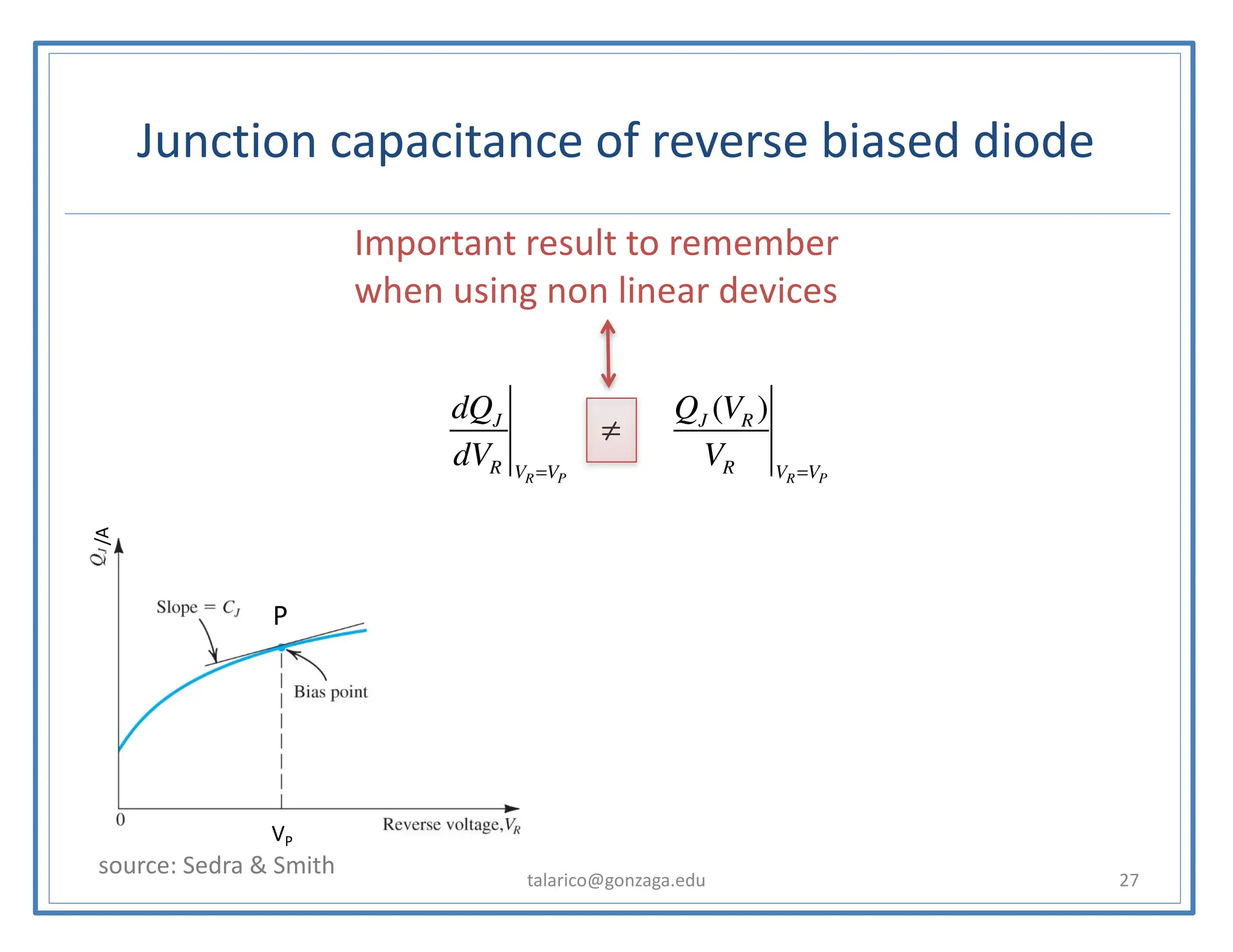
Junction capacitance of reverse biased diode
source: Sedra & Smith
P
VP
CJ @VP
=
dQJ
dVR VR =VP
≠
QJ (VR )
VR VR =VP
Important result to remember
when using non linear devices
/A
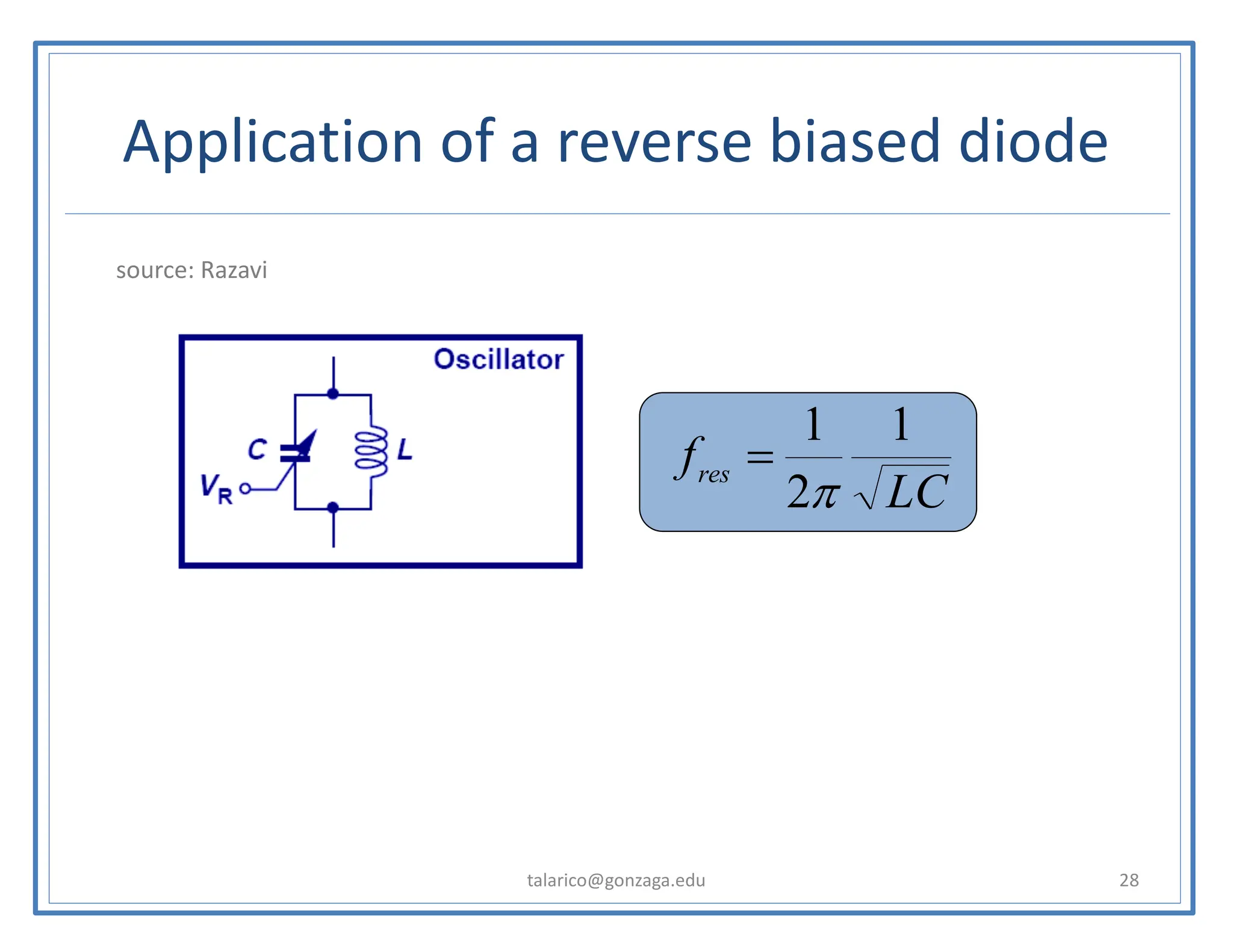
Application of a reverse biased diode
talarico@gonzaga.edu 28
LC
fres
1
2
1
p
=
source: Razavi
PN Junction in Forward Bias
talarico@gonzaga.edu 29
ID
VD=VF VD=VF
− ΦB + − ΦB +
source:
Millman & Halkias
• The electric field (EF) due to the
bias (VF) is opposite to the built
in field E. The depletion region
W is shortened
• Since the “barrier” potential
becomes lower than in
equilibrium it gets easier for
the majority carriers to diffuse
through the junction and
harder for the minority carrier
to be swept (drifted) across the
junction.
• The majority carriers are a lot,
so we expect a considerable
current flow:
ID = Idiff − Idrift
Equilibrium
(open circuit)
+ ΦB −
+ ΦJ −
Forward Bias
EF
E
ΦJ = ΦB − VF
source:
Razavi
p-n
ID
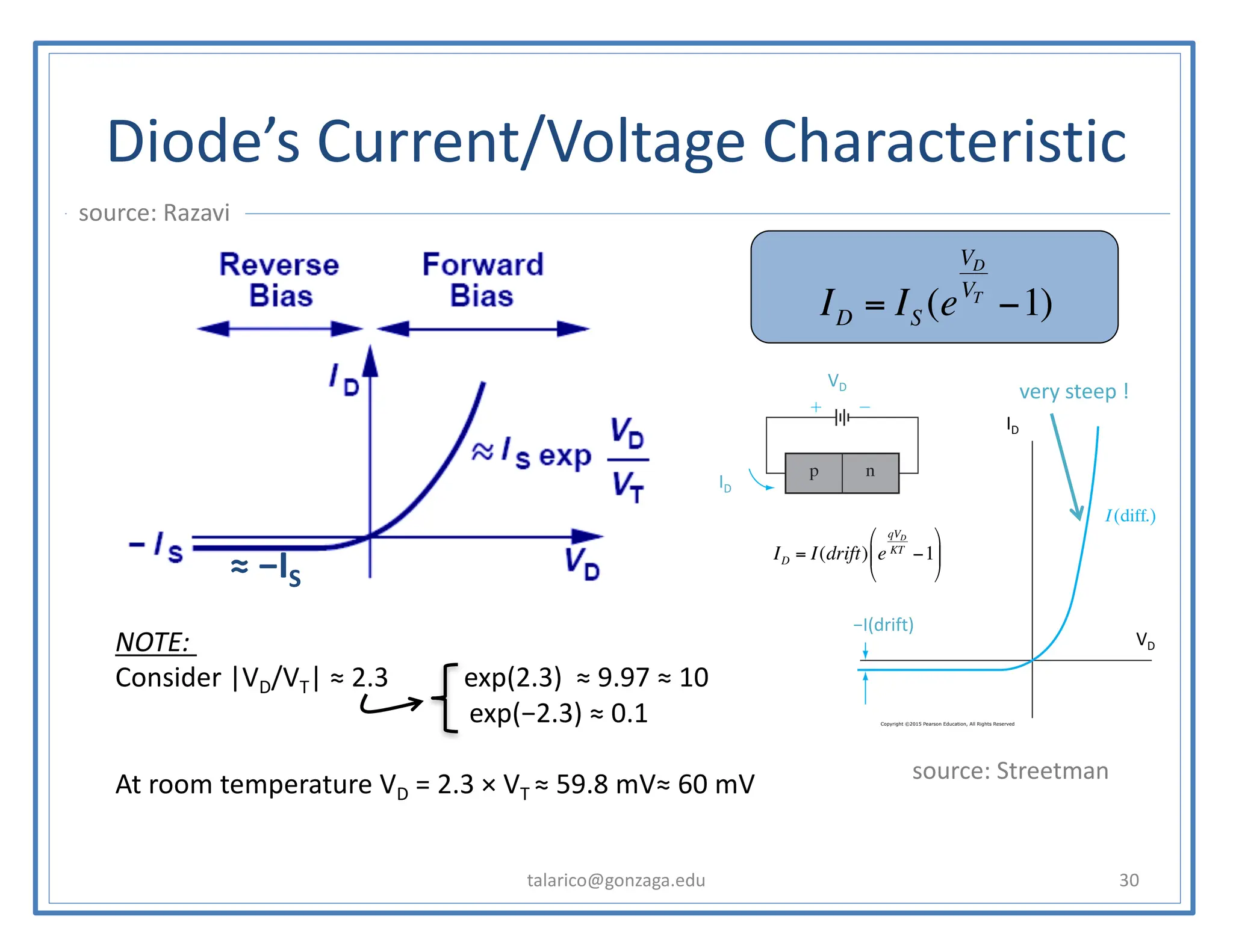
Diode’s Current/Voltage Characteristic
talarico@gonzaga.edu 30
ID = IS (e
VD
VT
−1)
≈ −IS
NOTE:
Consider |VD/VT| ≈ 2.3 exp(2.3) ≈ 9.97 ≈ 10
exp(−2.3) ≈ 0.1
At room temperature VD = 2.3 × VT ≈ 59.8 mV≈ 60 mV
source: Razavi
source: Streetman
−I(drift)
ID
VD
VD
ID
ID = I(drift) e
qVD
KT
−1
⎛
⎝
⎜
⎞
⎠
⎟
very steep !
Diode’s Current/Voltage Characteristic
31
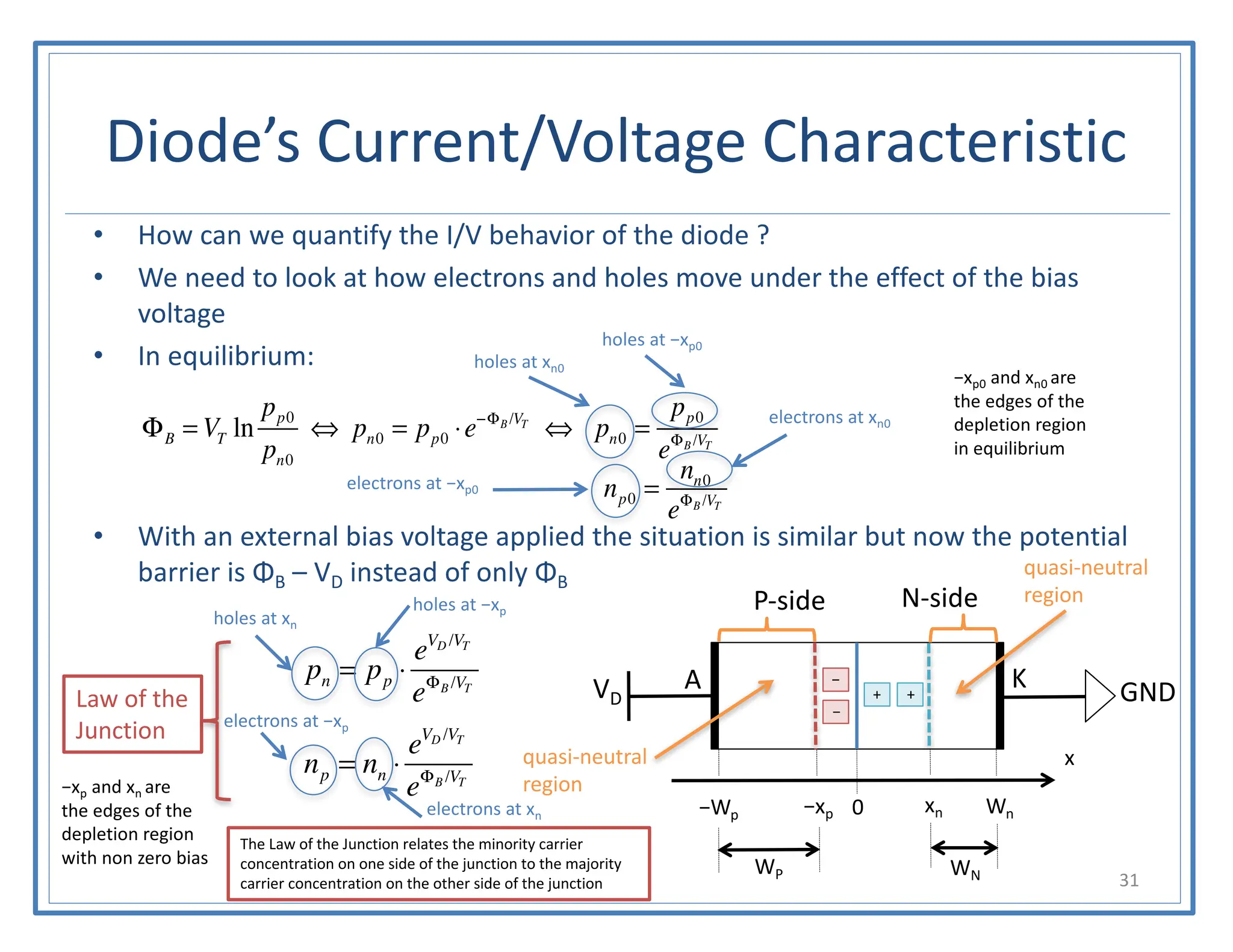
• How can we quantify the I/V behavior of the diode ?
• We need to look at how electrons and holes move under the effect of the bias
voltage
• In equilibrium:
• With an external bias voltage applied the situation is similar but now the potential
barrier is ΦB – VD instead of only ΦB
ΦB = VT ln
pp0
pn0
⇔ pn0 = pp0 ⋅e−ΦB /VT
⇔ pn0 =
pp0
eΦB /VT
holes at xn0
holes at −xp0
−xp0 and xn0 are
the edges of the
depletion region
in equilibrium
pn = pp ⋅
eVD /VT
eΦB /VT
holes at xn
holes at −xp
−xp and xn are
the edges of the
depletion region
with non zero bias
x
−Wp −xp 0 xn Wn
WP WN
P-side N-side
+ +
−
−
VD GND
A K
quasi-neutral
region
quasi-neutral
region
Law of the
Junction
np = nn ⋅
eVD /VT
eΦB /VT
electrons at −xp
electrons at xn
The Law of the Junction relates the minority carrier
concentration on one side of the junction to the majority
carrier concentration on the other side of the junction
np0 =
nn0
eΦB /VT
electrons at −xp0
electrons at xn0
Diode’s Current/Voltage Characteristic
talarico@gonzaga.edu 32
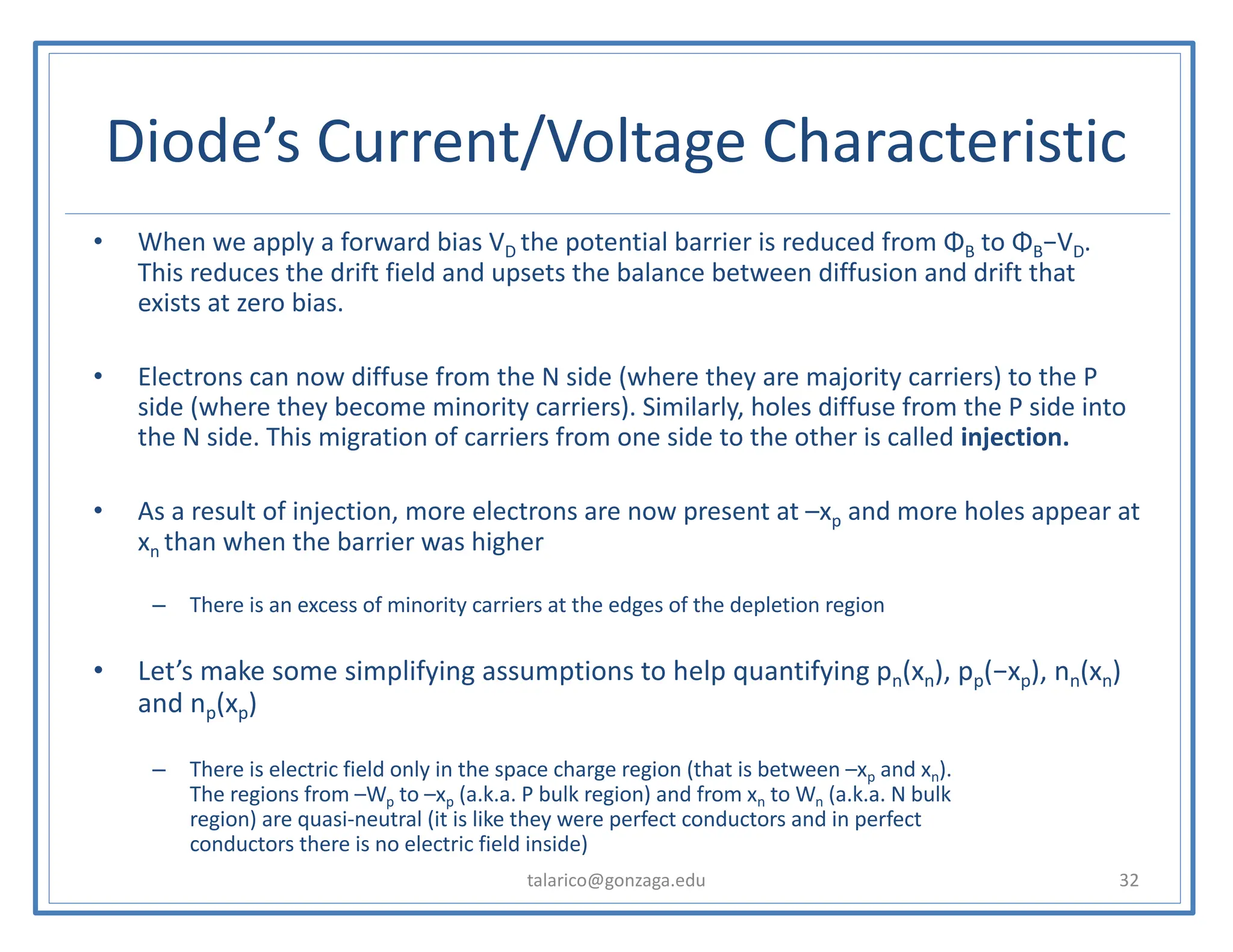
• When we apply a forward bias VD the potential barrier is reduced from ΦB to ΦB−VD.
This reduces the drift field and upsets the balance between diffusion and drift that
exists at zero bias.
• Electrons can now diffuse from the N side (where they are majority carriers) to the P
side (where they become minority carriers). Similarly, holes diffuse from the P side into
the N side. This migration of carriers from one side to the other is called injection.
• As a result of injection, more electrons are now present at –xp and more holes appear at
xn than when the barrier was higher
– There is an excess of minority carriers at the edges of the depletion region
• Let’s make some simplifying assumptions to help quantifying pn(xn), pp(−xp), nn(xn)
and np(xp)
– There is electric field only in the space charge region (that is between –xp and xn).
The regions from –Wp to –xp (a.k.a. P bulk region) and from xn to Wn (a.k.a. N bulk
region) are quasi-neutral (it is like they were perfect conductors and in perfect
conductors there is no electric field inside)
Diode’s Current/Voltage Characteristic
talarico@gonzaga.edu 33
• The requirement that the bulk regions on either side remain charge-neutral
even under applied bias (remember: E(x) = ρ(x)/ε, so no field means no charge
density) implies that any increases in the minority carriers due to injection
must be counter balanced by in an increase of majority carriers
– On the P side ρ(x=−xp) = 0 implies that:
– On the N side ρ(x=xn) = 0 implies that:
• Assuming the level of injection is low we can neglect the slight increase in
majority carrier concentration due to carrier injection and write:
pp (−xp ) = NA + np (−xp ) ≈ pp0 + np (−xp )
nn (xn ) = ND + pn (xn ) ≈ nn0 + pn (xn )
pp (−xp ) ≈ pp0 ≈ NA nn (xn ) ≈ nn0 ≈ ND
np (−xp ) << pp0 pn (xn ) << nn0
Minority and Majority carriers concentrations in a
forward biased diode
• Concentrations Howe & Sodini
talarico@gonzaga.edu 34
x
pn0
np0
Quasi-neutrality demands that at every
point in the quasi-neutral regions:
excess minority carrier concentration =
excess majority carriers concentration
source:
Howe
&
Sodini
talarico@gonzaga.edu 35
Minority and Majority carriers concentrations in
a forward biased diode
Quasi-neutrality demands that at every point in the quasi-neutral regions:
excess minority carrier concentration = excess majority carriers concentration
NOTE:
at this point we did
not put much thinking
in the profile of the
minority carriers
diffusing in the QNRs,
however if we
assume the diffusion
occurs over a short
distance we can
approximate the
curves with straight
lines !
0
−xp
−Wp
p(−xp)
p
p-QNR
Na
qPp
qNp
n(−xp)
ni
2
Na
x
source: Sodini
n
• Under the low injection condition we can approximate the Law of the
Junction as follows:
talarico@gonzaga.edu 36
pn (xn ) =
pp (−xp )
eΦB /VT
⋅eVD /VT
≈
pp0
eΦB /VT
⋅eVD /VT
= pn0 ⋅eVD /VT
np (−xp ) =
nn (xn )
eΦB /VT
⋅eVD /VT
≈
nn0
eΦB /VT
⋅eVD /VT
= np0 ⋅eVD /VT
pn (xn ) ≈ pn0 ⋅eVD /VT
≈
ni
2
ND
⋅eVD /VT
np (−xp ) ≈ np0 ⋅eVD /VT
≈
ni
2
NA
⋅eVD /VT
The concentration of minority carriers
at the edges of the space charge region
are an exponential function of the
applied bias
Diode’s Current/Voltage Characteristic
source: G.W. Neudeck
Minority carriers in a forward biased PN junction
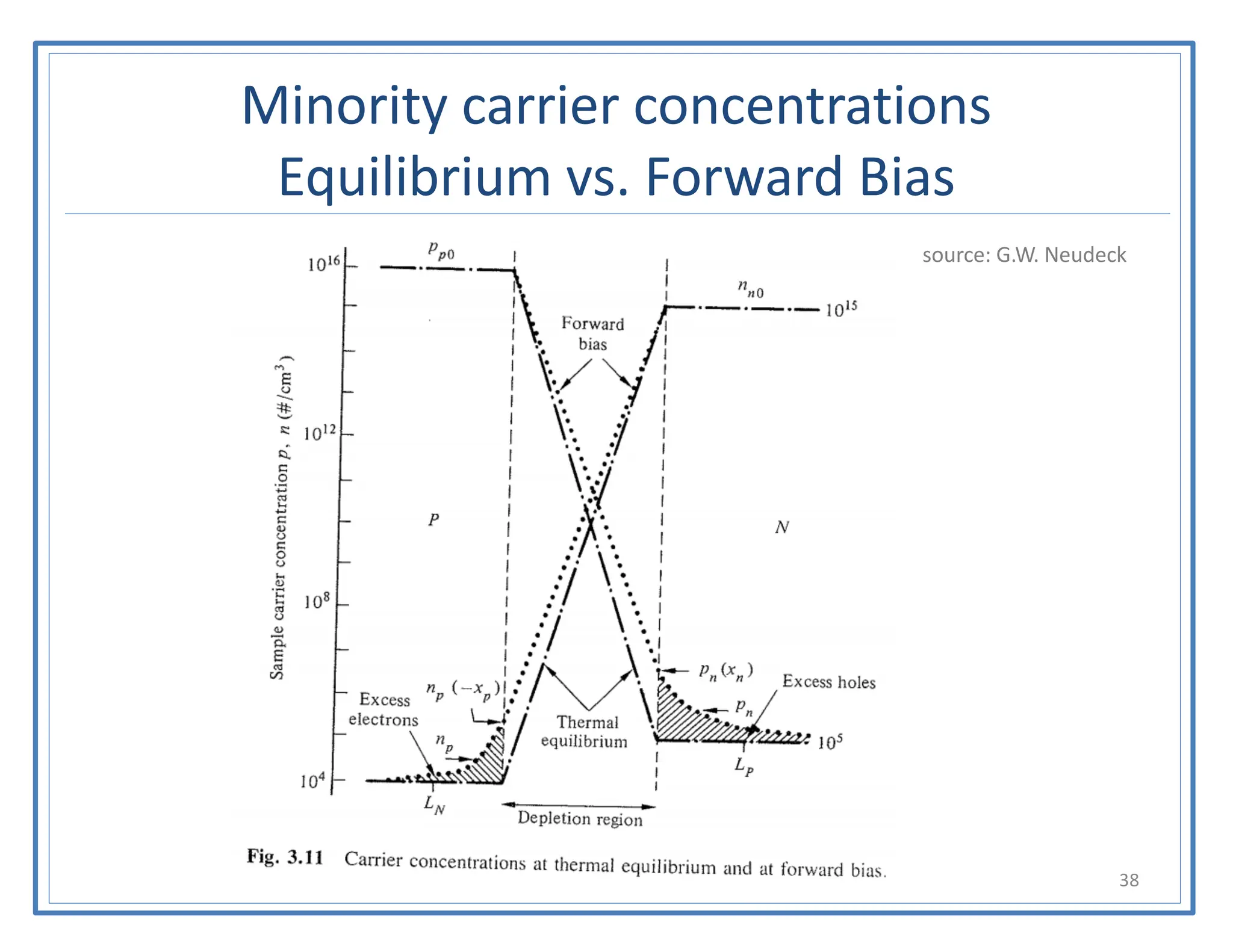
• The excess concentration of minority carriers at the edges is:
• As the injected carriers diffuse through the quasi-neutral regions they recombine with the
majority carriers and eventually disappear. The excess minority carriers decay exponentially
with distance, and the decay constant is called diffusion length L.
talarico@gonzaga.edu 37
Δnp ! np0 ⋅eVD /VT
− np0 = np0 1− eVD /VT
( ) Δpn ! pn0 ⋅eVD /VT
− pn0 = pn0 1− eVD /VT
( )
np (x) = Δnpe
(x+xp )
Ln
pn (x) = Δpne
−(x−xn )
Lp
source:
Sedra & Smith p+ n
It can be shown through the
current continuity equation
that under the low injection
condition the concentration’s
profile of the minority
carriers diffusing in the quasi
neutral regions is exponential
Minority carrier concentrations
Equilibrium vs. Forward Bias
talarico@gonzaga.edu 38
source: G.W. Neudeck
Aside (a simple trick to simplify the math)
talarico@gonzaga.edu 39
• Change the axis selection for the bulk regions as follows:
• This way we can write the minority carriers concentrations as follows:
np (x'') = Δnpe
−
x''
Ln
pn (x') = Δpne
−
x'
Lp
x'' ! 0'' ≡ −xp
x' ! 0' ≡ xn
Ln = Dnτn
Lp = Dpτ p
source: G.W. Neudeck
Ln = Diffusion length for electrons [m]
Lp = Diffusion length for holes [m]
Dn = Diffusion coefficient for electron [m2/s]
Dp = Diffusion coefficient for holes [m2/s]
τn = mean lifetime for electrons [s]
τp = mean lifetime for holes [s]
VA = voltage applied ≡ VD
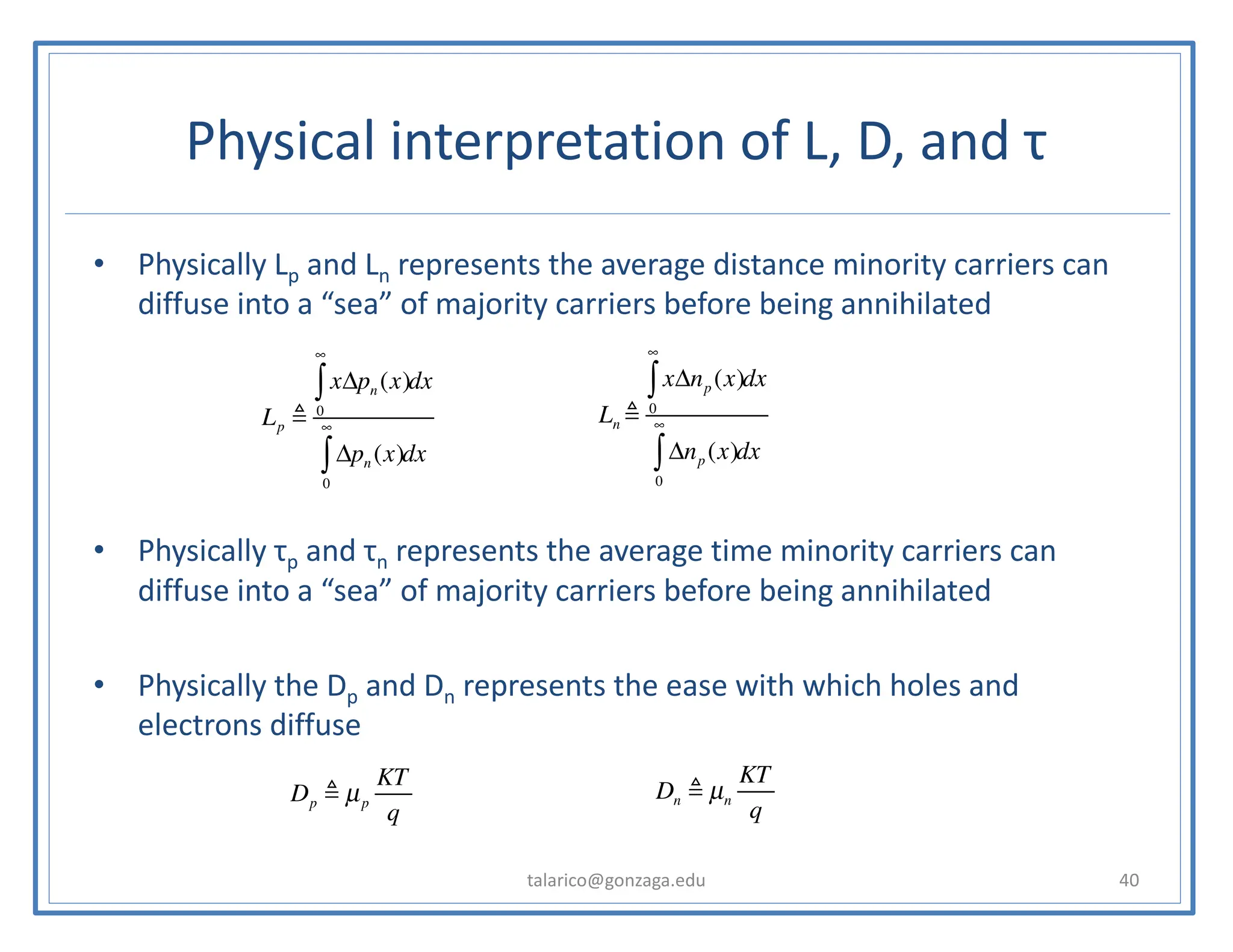
Physical interpretation of L, D, and τ
• Physically Lp and Ln represents the average distance minority carriers can
diffuse into a “sea” of majority carriers before being annihilated
• Physically τp and τn represents the average time minority carriers can
diffuse into a “sea” of majority carriers before being annihilated
• Physically the Dp and Dn represents the ease with which holes and
electrons diffuse
talarico@gonzaga.edu 40
Lp !
xΔpn (x)
0
∞
∫ dx
Δpn (x)
0
∞
∫ dx
Ln !
xΔnp (x)
0
∞
∫ dx
Δnp (x)
0
∞
∫ dx
Dp ! µp
KT
q
Dn ! µn
KT
q
PN Junction current
• The current that flows through any “transverse” section x must be the
same and is formed by both holes and electrons
• If we look at the current through a section x in the quasi-neutral regions,
since in the quasi-neutral regions there is no electric field there will be no
drift
talarico@gonzaga.edu 41
J(x) = Jn (x)+ Jp (x)
Jn (x) = Jn,drift (x)+ Jn,diff (x)
Jp (x) = Jp,drift (x)+ Jp,diff (x)
Jn (x) = Jn,diff (x) = qDn
dnp (x)
dx
= q
Dn
Ln
np0 eVD /VT
−1
( )e
(x+xp )/Lp
for −Wp ≤ x ≤ −xp
Jp (x) = Jp,diff (x) = −qDp
dpn (x)
dx
= q
Dp
Lp
pn0 eVD /VT
−1
( )e
−(x−xn )/Lp
for xn ≤ x ≤ Wn
injected electrons diffusing on P-side (minority carriers)
injected holes diffusing on N-side (minority carriers)
+(x+xp)/Ln
PN Junction currents
• The easier sections for evaluating the diffusion currents are the edges of the space
charge region (x=−xp and x=xn)
• The total current through a section of the diode can be found as follows:
• If we make the simplifying assumption that there is no recombination-generation
in the space-charge region, this means that the electrons/holes current at
x=−xp and at x=xn do not change in the space-charge region and therefore we can
write:
talarico@gonzaga.edu 42
Jn (−xp ) = Jn,diff (−xp ) = q
Dn
Ln
np0 eVD /VT
−1
( )
Jp (xn ) = Jp,diff (xn ) = q
Dp
Lp
pn0 eVD /VT
−1
( )
J = Jn (−xp )+ Jp (−xp ) = Jn (xn )+ Jp (xn )
Jn (−xp ) = Jn (xn )
Jp (xn ) = Jp (−xp )
We do not know have this value (yet) !
PN Junction current
• Therefore we can add together the diffusion currents at x=−xp and x=xn
43
J = Jn (−xp )+ Jp (xn ) = q
Dn
Ln
np0 eVD /VT
−1
( )+ q
Dp
Lp
pn0 eVD /VT
−1
( )
J = q
Dn
Ln
np0 + q
Dp
Lp
pn0
⎛
⎝
⎜
⎞
⎠
⎟ eVD /VT
−1
( )
ID = J × A = In,diff + Ip,diff = Aq
Dn
Ln
np0 + Aq
Dp
Lp
pn0
⎛
⎝
⎜
⎞
⎠
⎟ eVD /VT
−1
( )
ID = Aq
Dn
Ln
ni
2
NA
+
Dp
Lp
ni
2
ND
⎛
⎝
⎜
⎞
⎠
⎟ eVD /VT
−1
( )= IS eVD /VT
−1
( )
scale current (a.k.a. saturation current)
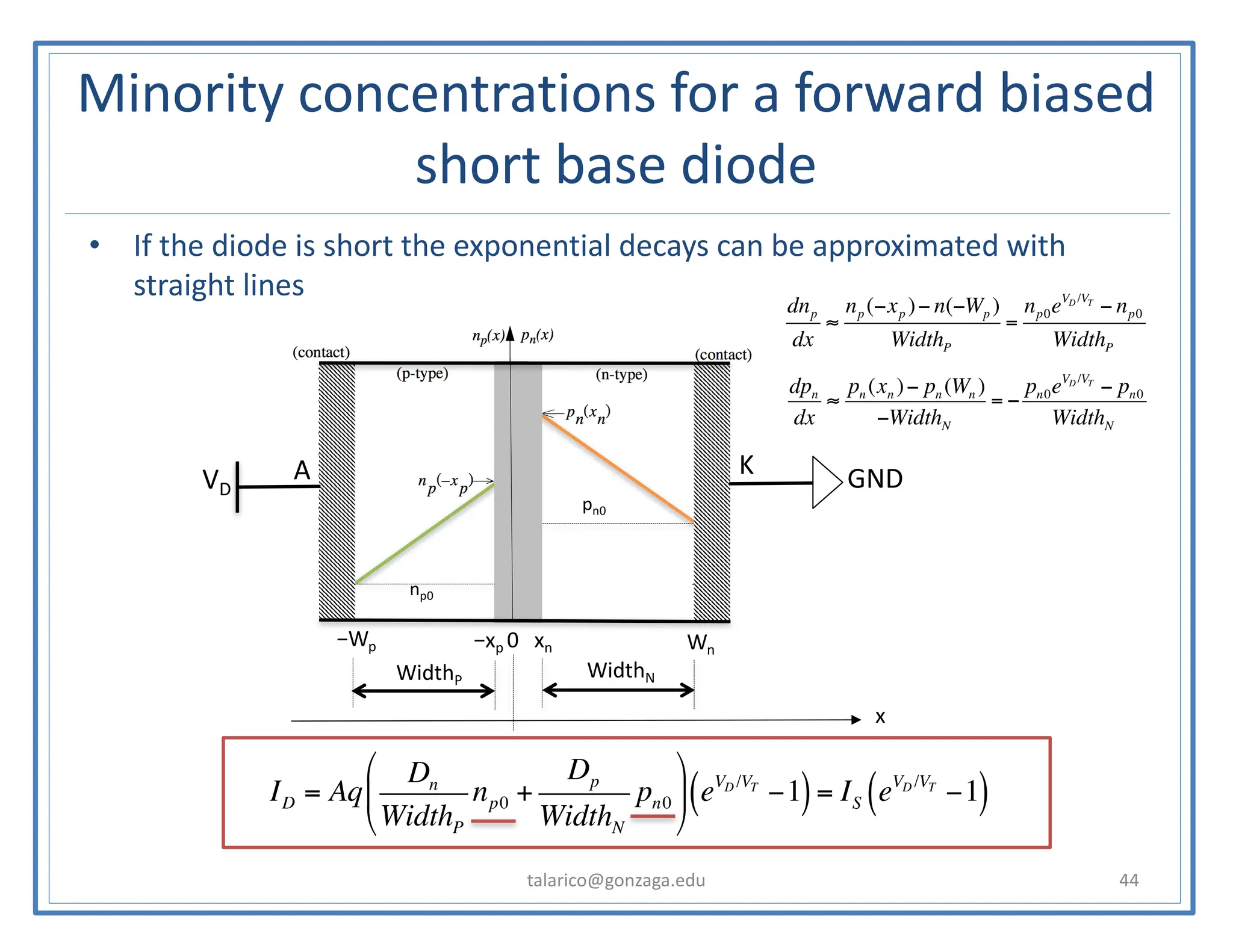
Minority concentrations for a forward biased
short base diode
• If the diode is short the exponential decays can be approximated with
straight lines
talarico@gonzaga.edu 44
−xp 0 xn
np0
pn0
−Wp Wn
VD
A GND
K
WidthN
WidthP
x
ID = Aq
Dn
WidthP
np0 +
Dp
WidthN
pn0
⎛
⎝
⎜
⎞
⎠
⎟ eVD /VT
−1
( )= IS eVD /VT
−1
( )
dnp
dx
≈
np (−xp )− n(−Wp )
WidthP
=
np0eVD /VT
− np0
WidthP
dpn
dx
≈
pn (xn )− pn (Wn )
−WidthN
= −
pn0eVD /VT
− pn0
WidthN
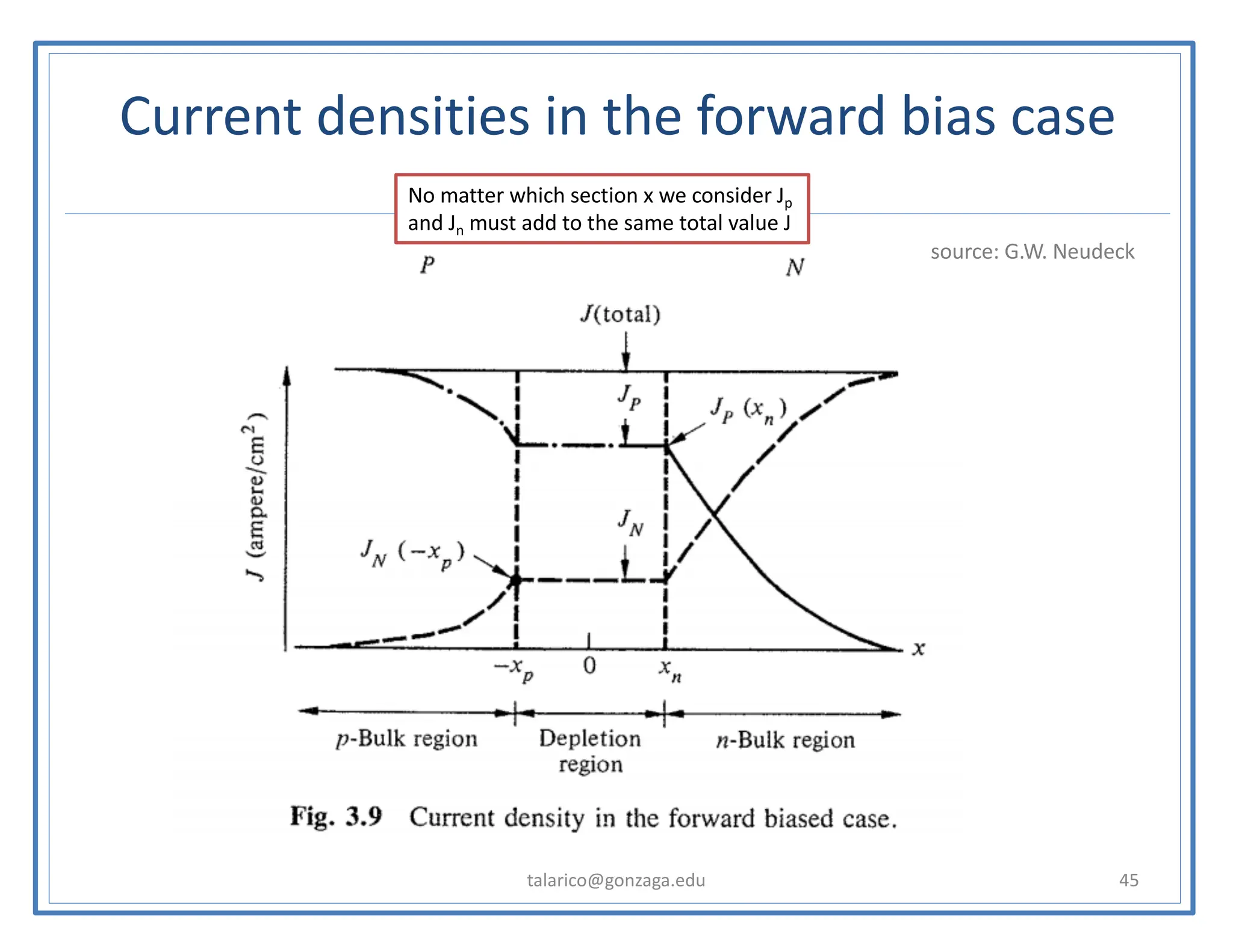
Current densities in the forward bias case
talarico@gonzaga.edu 45
source: G.W. Neudeck
No matter which section x we consider Jp
and Jn must add to the same total value J
Assumptions used to derive the
Ideal diode equation
• Depletion approximation (in depletion region: NA >> pp0(x), ND >> nn0(x))
• Negligible fields in the quasi neutral regions (QNR). This means that the
applied voltage VD is dropped entirely across the space charge region
(SCR)
• Quasi-neutral regions that are so long that the injected carriers all
recombine before reaching the end contacts
• Low levels of injection
• No recombination-generation in the space-charge region. This means
that the electron current and the hole current are constant in the space-
charge region ( that is Jn(−xp)=Jn(xn) and Jp(xn)=Jp(−xp) )
• Real diodes may deviate considerably from the ideal equation.
46
ID = I*
S (e
VD
nVT
−1)
n = emission coefficient (a.k.a. ideality factor)
Typically the ideality factor n varies from 1 to 2
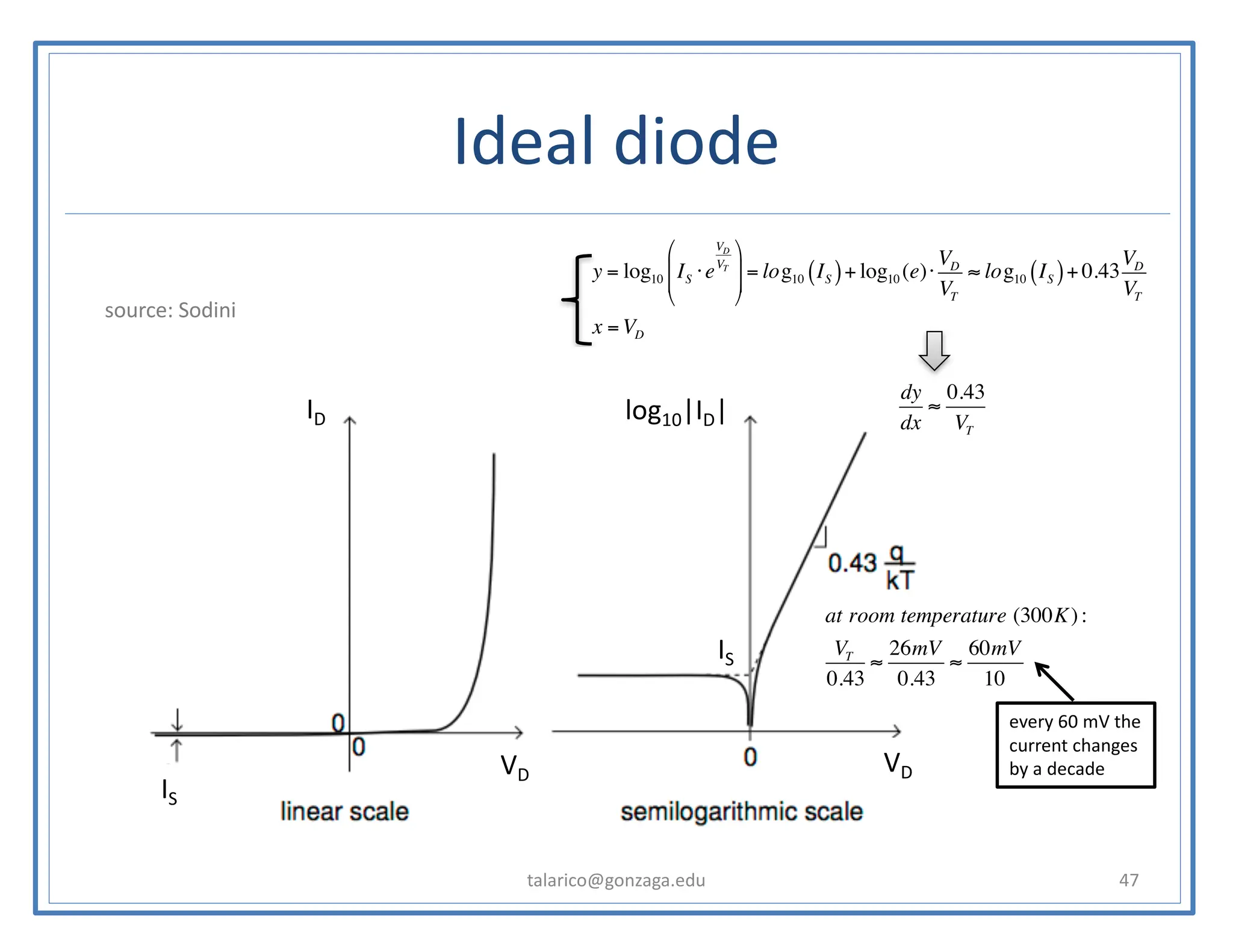
Ideal diode
talarico@gonzaga.edu 47
ID
IS
VD VD
log10|ID|
IS
y = log10 IS ⋅e
VD
VT
⎛
⎝
⎜
⎜
⎞
⎠
⎟
⎟ = log10 IS
( )+ log10 (e)⋅
VD
VT
≈ log10 IS
( )+ 0.43
VD
VT
x =VD
dy
dx
≈
0.43
VT
at room temperature (300K):
VT
0.43
≈
26mV
0.43
≈
60mV
10
source: Sodini
every 60 mV the
current changes
by a decade
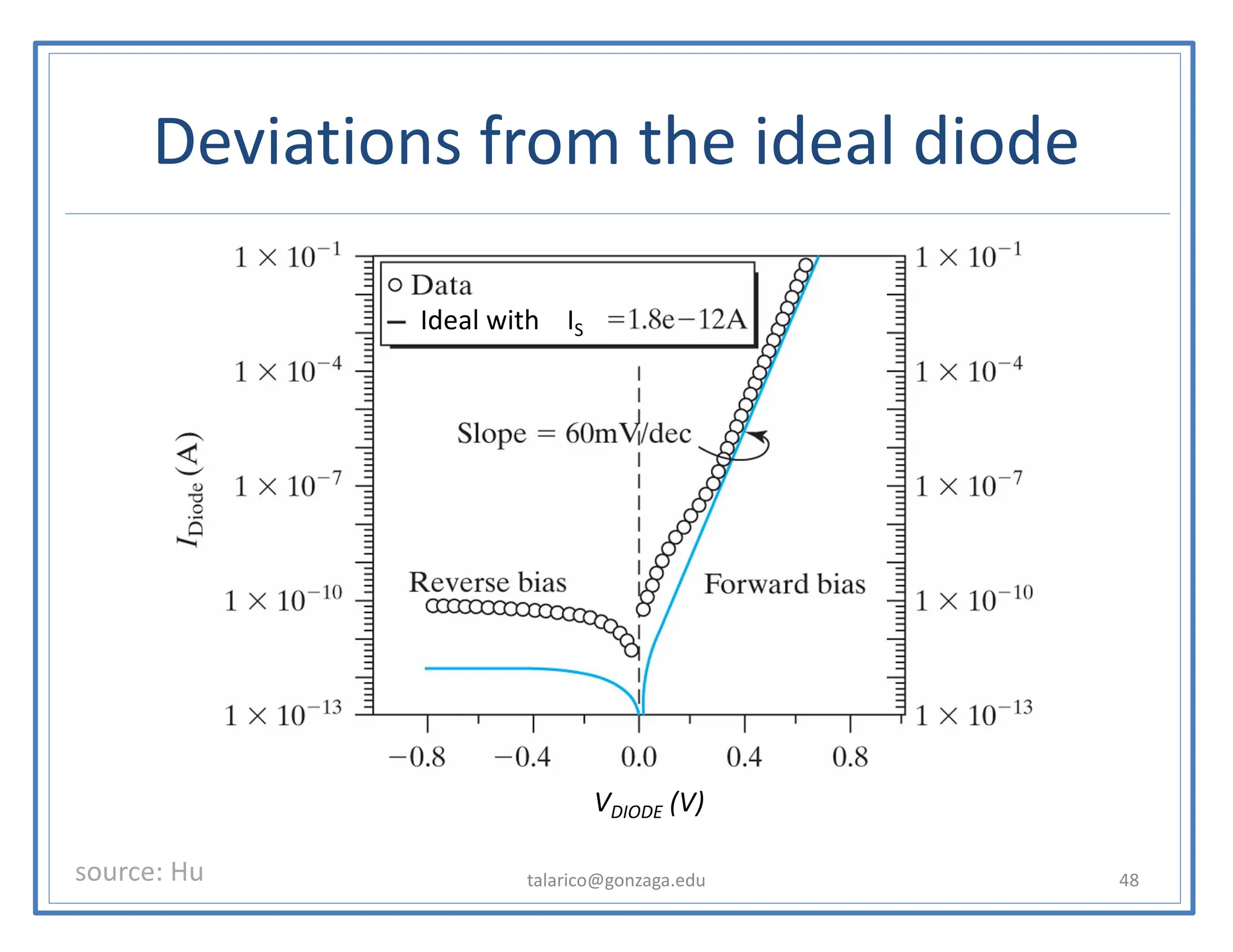
Deviations from the ideal diode
talarico@gonzaga.edu 48
source: Hu
Ideal with IS
VDIODE (V)
Ideal diode equation
• Although we derived the ideal diode equation by subjecting the diode to a
forward bias, the steps followed can also be applied for the case of reverse
bias (the only difference is that now VD < 0).
• The equation works for both forward and reverse region.
talarico@gonzaga.edu 49
ID
VD
ID = IS eVD /VT
−1
( )
source: Streetman ≈ ISeVD /VT
≈ −IS
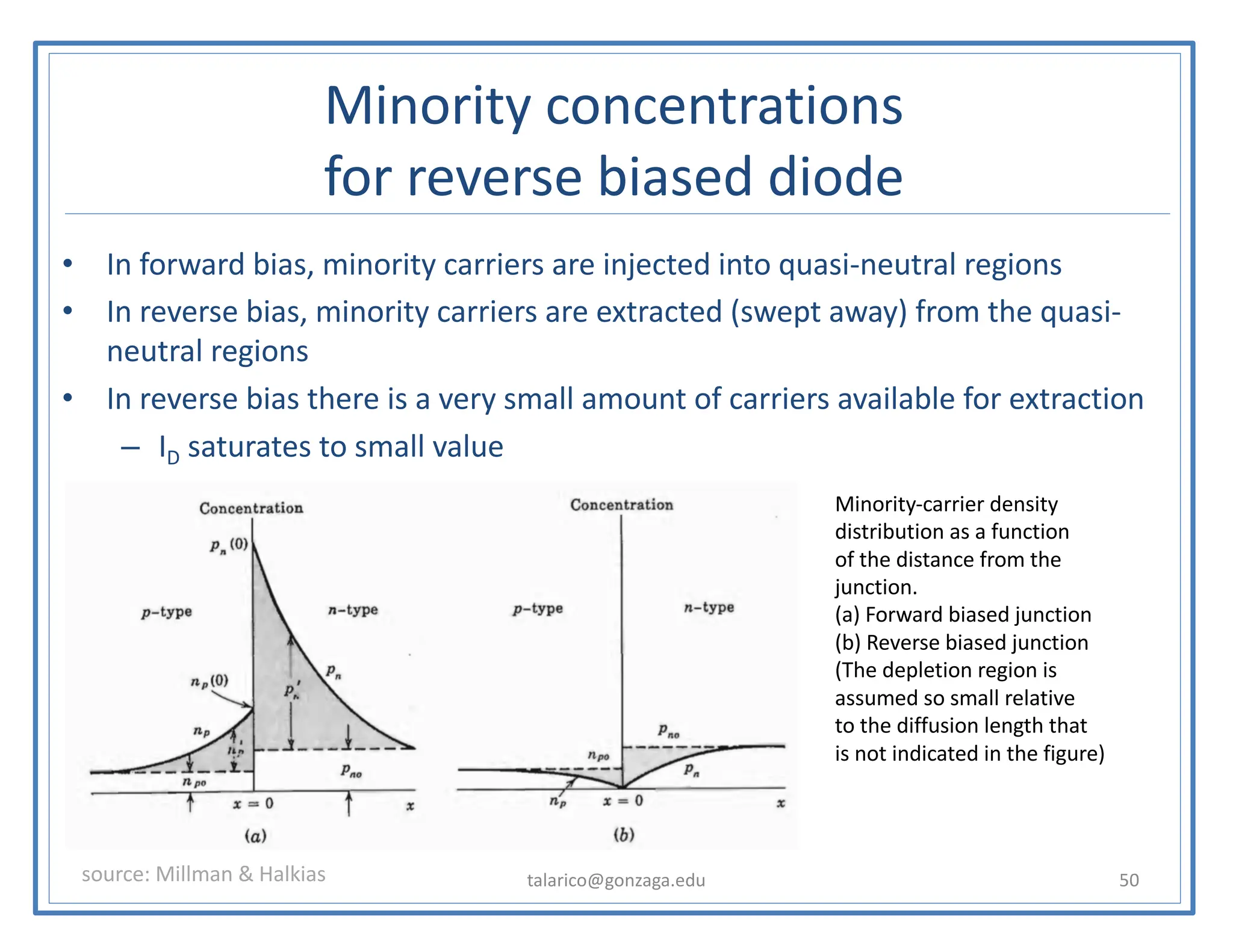
Minority concentrations
for reverse biased diode
• In forward bias, minority carriers are injected into quasi-neutral regions
• In reverse bias, minority carriers are extracted (swept away) from the quasi-
neutral regions
• In reverse bias there is a very small amount of carriers available for extraction
– ID saturates to small value
talarico@gonzaga.edu 50
Minority-carrier density
distribution as a function
of the distance from the
junction.
(a) Forward biased junction
(b) Reverse biased junction
(The depletion region is
assumed so small relative
to the diffusion length that
is not indicated in the figure)
source: Millman & Halkias
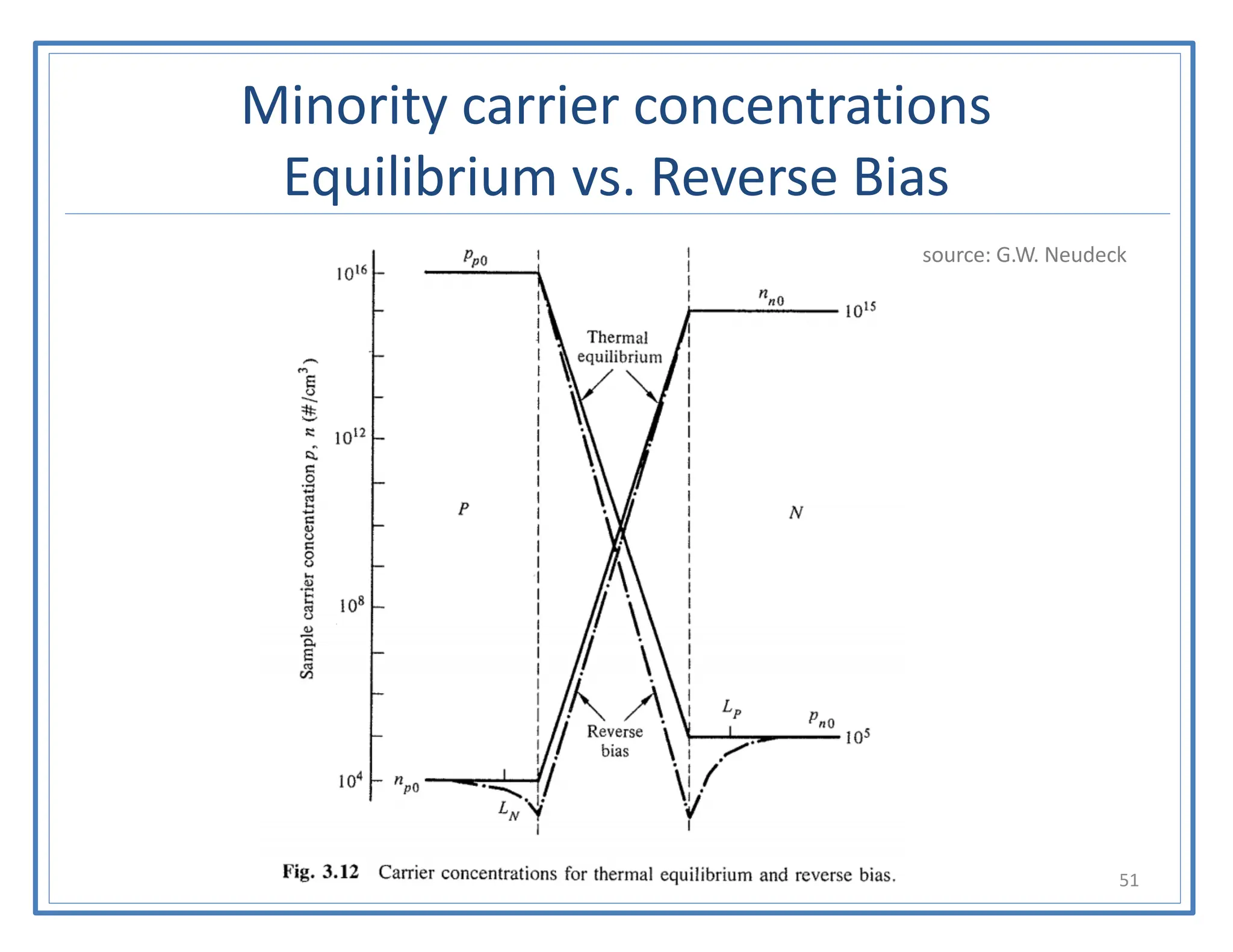
Minority carrier concentrations
Equilibrium vs. Reverse Bias
talarico@gonzaga.edu 51
source: G.W. Neudeck
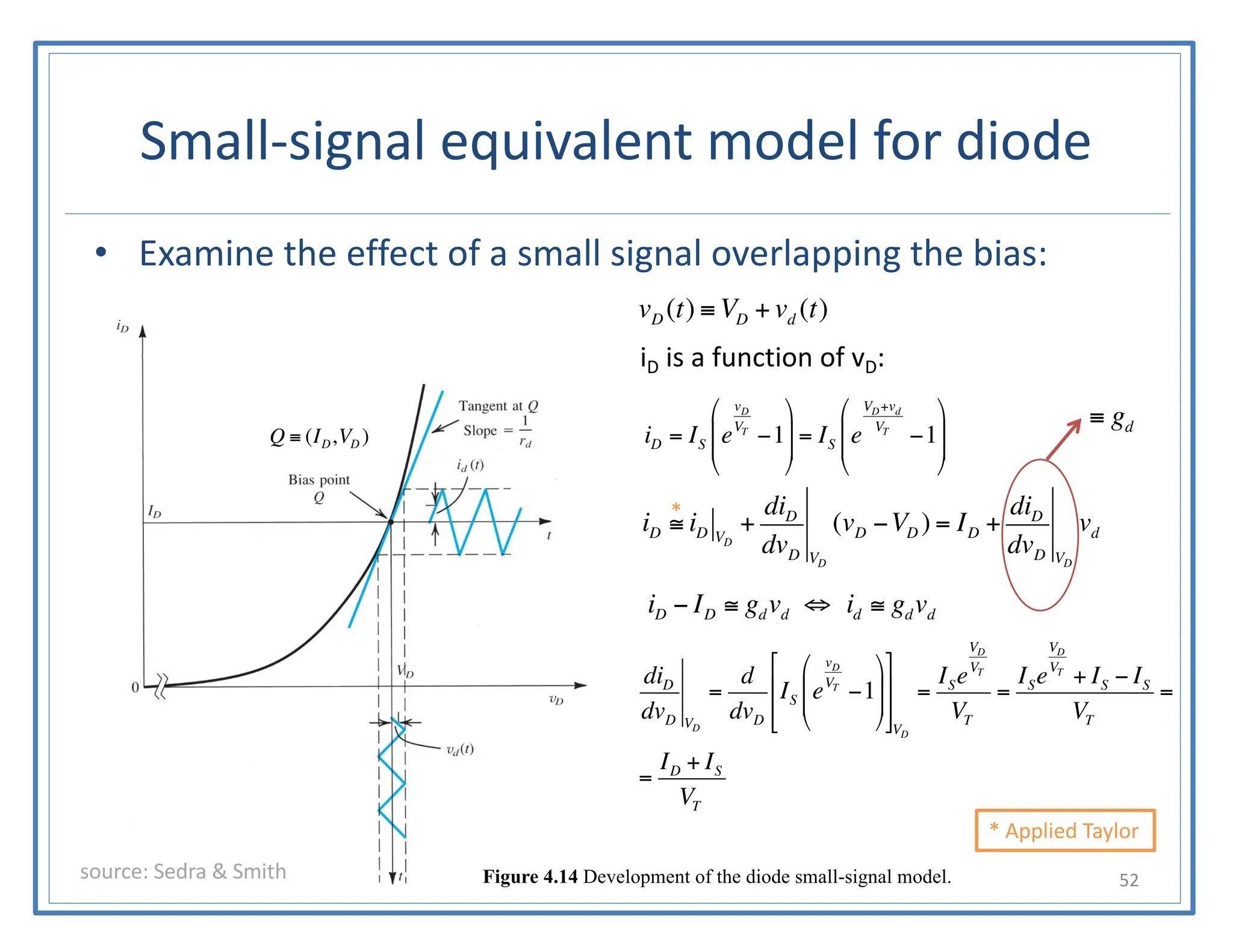
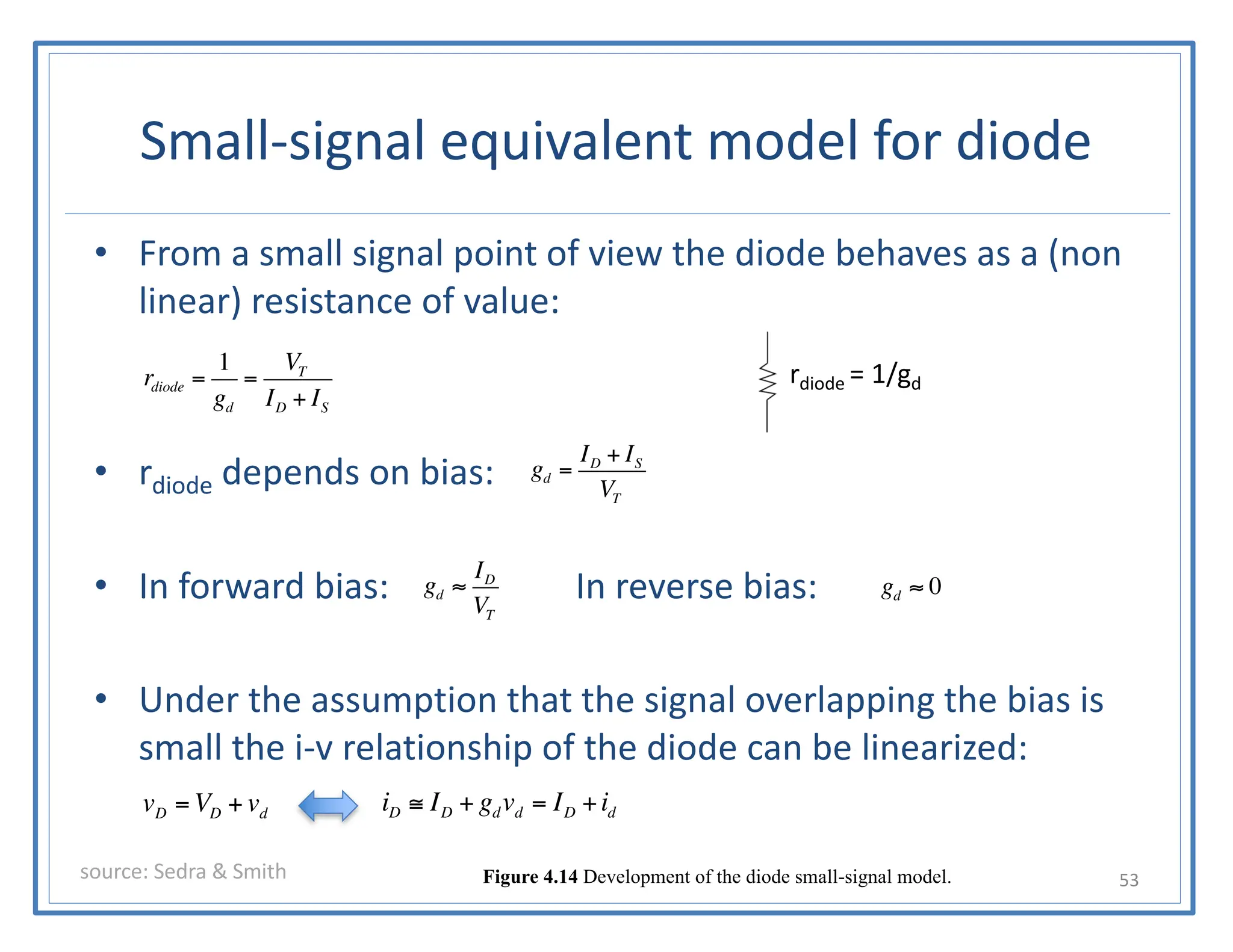
Small-signal equivalent model for diode
• Examine the effect of a small signal overlapping the bias:
talarico@gonzaga.edu 52
Figure 4.14 Development of the diode small-signal model.
source: Sedra & Smith
vD (t) ≡VD + vd (t)
iD = IS e
vD
VT
−1
⎛
⎝
⎜
⎜
⎞
⎠
⎟
⎟ = IS e
VD+vd
VT
−1
⎛
⎝
⎜
⎜
⎞
⎠
⎟
⎟
iD ≅ iD VD
+
diD
dvD VD
(vD −VD ) = ID +
diD
dvD VD
vd
iD is a function of vD:
Q ≡ (ID,VD )
diD
dvD VD
=
d
dvD
IS e
vD
VT
−1
⎛
⎝
⎜
⎜
⎞
⎠
⎟
⎟
⎡
⎣
⎢
⎢
⎤
⎦
⎥
⎥
VD
=
ISe
VD
VT
VT
=
ISe
VD
VT
+ IS − IS
VT
=
=
ID + IS
VT
iD − ID ≅ gdvd ⇔ id ≅ gdvd
≡ gd
* Applied Taylor
*
Small-signal equivalent model for diode
• From a small signal point of view the diode behaves as a (non
linear) resistance of value:
• rdiode depends on bias:
• In forward bias: In reverse bias:
• Under the assumption that the signal overlapping the bias is
small the i-v relationship of the diode can be linearized:
talarico@gonzaga.edu 53
Figure 4.14 Development of the diode small-signal model.
source: Sedra & Smith
rdiode =
1
gd
=
VT
ID + IS
iD ≅ ID + gdvd = ID +id
vD =VD + vd
gd =
ID + IS
VT
gd ≈
ID
VT
gd ≈ 0
rdiode = 1/gd
Small-signal equivalent model for diode
• Besides having current flowing through it (resistive behavior) the diode
also exhibit charge displacement mechanisms that can be modeled as a
capacitive behavior
• The charge response to the voltage applied across the diode is non-linear
• As long as the voltage signal superimposed to the bias voltage is small, the
relationship between charge and voltage can be linearized.
• Complete small signal model for diode
talarico@gonzaga.edu 54
vD =VD + vd
≡ Cdiode
qD ≈ QD VD
+
dqD
dvD VD
(vD −VD ) = QD VD
+Cdiode ⋅vd
rdiode Cdiode
talarico@gonzaga.edu 55
Capacitive effects in the PN junction
• Diodes have two capacitive effects
• But … please careful:
there are way too many letters “D”:
– depletion capacitance = junction capacitance = CJ
– diffusion capacitance = storage capacitance = CS
– Cdiode = CJ + CS
• We already know quite a bit about the junction cap. that develops when
the diode is in reverse bias (… but what about forward bias?)
• So far we did not even think about the existence of storage (diffusion)
capacitance
• We need to dig more into the capacitive effects …
Cdiode
A
K
CJ
A
K
CS
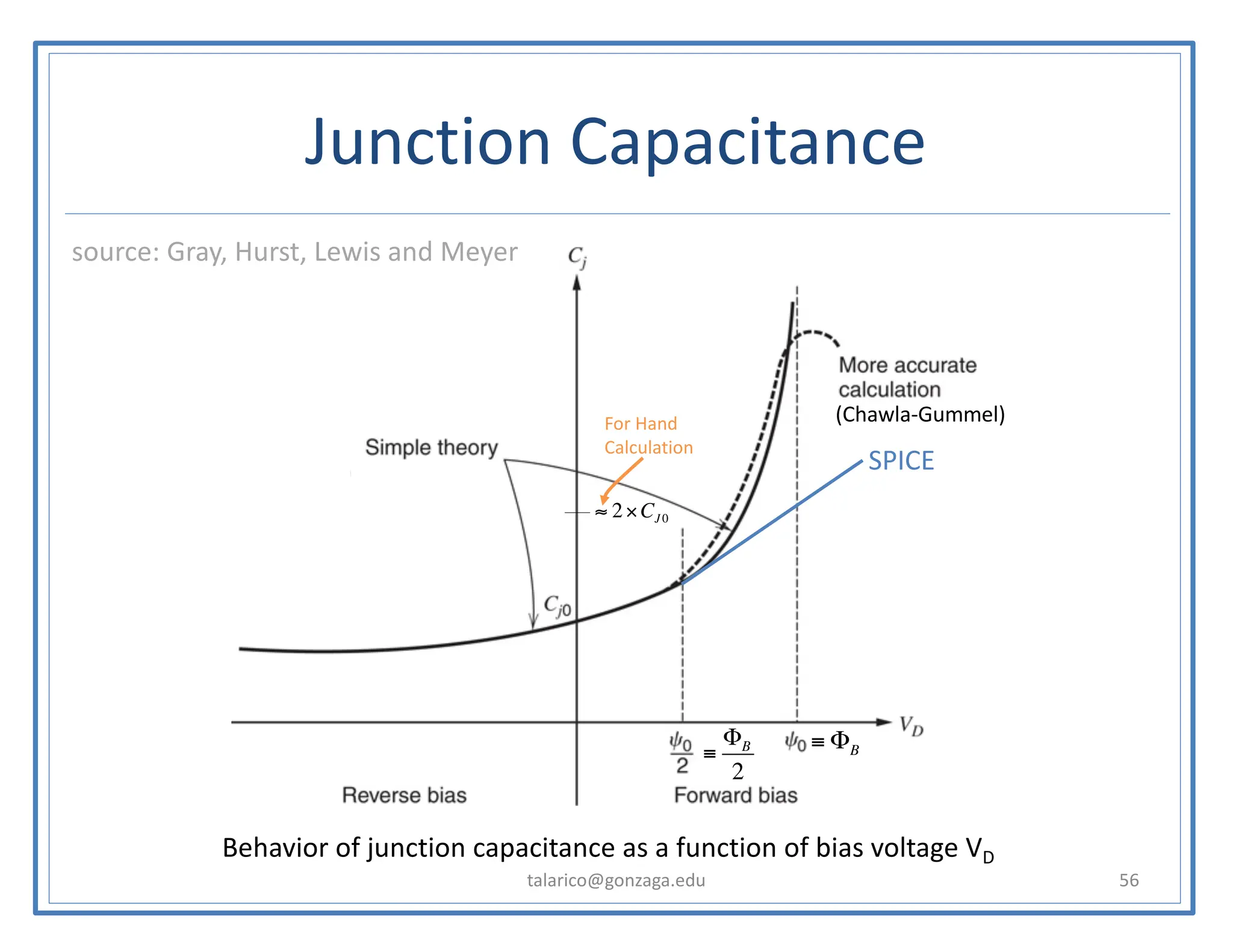
Junction Capacitance
talarico@gonzaga.edu 56
Behavior of junction capacitance as a function of bias voltage VD
(Chawla-Gummel)
≡ ΦB
≡
ΦB
2
SPICE
≈ 2×CJ 0
For Hand
Calculation
source: Gray, Hurst, Lewis and Meyer
Junction Capacitance
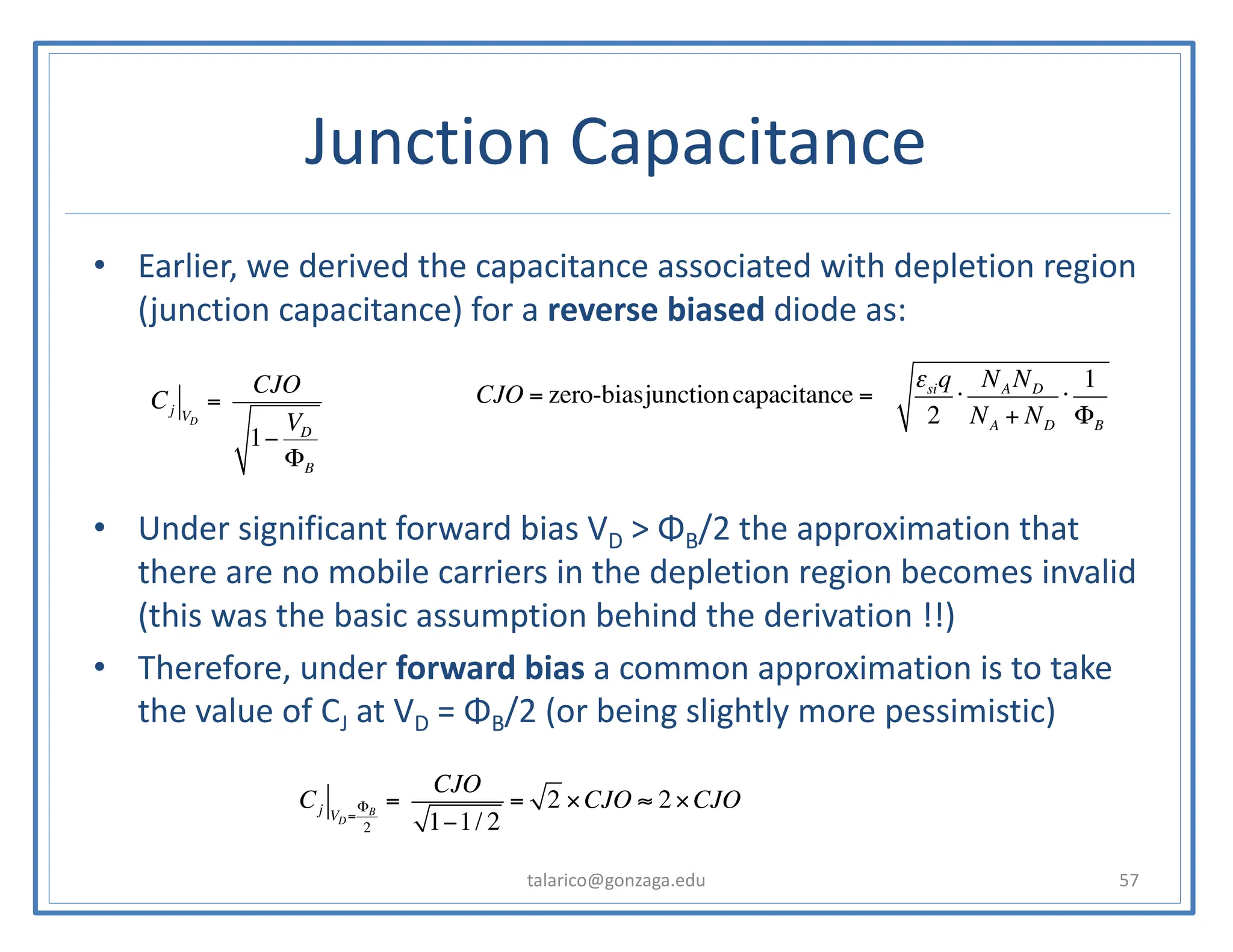
• Earlier, we derived the capacitance associated with depletion region
(junction capacitance) for a reverse biased diode as:
• Under significant forward bias VD > ΦB/2 the approximation that
there are no mobile carriers in the depletion region becomes invalid
(this was the basic assumption behind the derivation !!)
• Therefore, under forward bias a common approximation is to take
the value of CJ at VD = ΦB/2 (or being slightly more pessimistic)
talarico@gonzaga.edu 57
Cj VD
=
CJO
1−
VD
ΦB
CJO = zero-biasjunctioncapacitance = A
εsiq
2
⋅
NA ND
NA + ND
⋅
1
ΦB
Cj VD=
ΦB
2
=
CJO
1−1/ 2
= 2 ×CJO ≈ 2×CJO
Diffusion capacitance
• The diffusion capacitance is due to charge carrier storage
occurring in QNRs (to maintain quasi-neutrality)
talarico@gonzaga.edu 58
0
−xp
−Wp
p(−xp)
p
p-QNR
Na
qPp
qNp
n(−xp)
ni
2
Na
x
Majority (+)
Minority (−)
Majority (−)
Minority (+)
qPn =
qA
2
Wn − xn
( )
ni
2
Nd
e
VD
VT
−
ni
2
Nd
⎛
⎝
⎜
⎜
⎞
⎠
⎟
⎟ = −qNn
n(−xp ) =
ni
2
Na
e
VD
VT
What happen to the majority
carriers in the QNRs ?
minority carriers charge in QNRs?
p(xn ) =
ni
2
Nd
e
VD
VT
Let’s compute charge in minority
carriers “triangles”:
qNp = −
qA
2
Wp
− xp
( )
ni
2
Na
e
VD
VT
−
ni
2
Na
⎛
⎝
⎜
⎜
⎞
⎠
⎟
⎟ = −qPp
Quasi-neutrality demands that at every point in the quasi-neutral regions:
excess minority carrier concentration = excess majority carriers concentration
n
Diffusion capacitance
• Let’s examine what happen when we apply a small increase in
voltage (vD=VD+vd=VD+ΔvD)
talarico@gonzaga.edu 59
Small increase in VD
Small increase in qPn
Small increase in qNn
Behaves as a capacitor of capacitance:
n(xn) [for VD+vd]
n(xn) [for VD]
n
p
p(xn) [for VD+vd]
p(xn) [for VD]
Cdn =
dqPn
dvD vD=VD
=
qA
2
Wn − xn
( )
ni
2
Nd
1
VT
e
VD
VT
• If we recall the equation of the short-base diode:
• using some math manipulation we can rewrite the diffusion capacitance of
the n-QSR region as a function of the portion of diode current due to the
holes in n-QNR (ID,p) :
• We define transit time of the holes through the n-QNR the average time
for a hole to diffuse through N-QNR:
talarico@gonzaga.edu 60
Cdn =
qA
2
Wn − xn
( )
ni
2
Nd
1
VT
e
VD
VT
Wn − xn
( )
Wn − xn
( )
Dp
Dp
=
1
VT
Wn − xn
( )
2
2Dp
qA
Wn − xn
( )
Dp
ni
2
Nd
e
VD
VT
≅
1
VT
Wn − xn
( )
2
2Dp
ID,p
ID = Aq
Dn
WP − xp
ni
2
Na
+
Dp
WN − xn
ni
2
Nd
⎛
⎝
⎜
⎜
⎞
⎠
⎟
⎟ eVD /VT
−1
( )= ID,n (−xp )+ ID,p (xn )
Diffusion capacitance
τTp ≡
Wn − xn
( )
2
2Dp
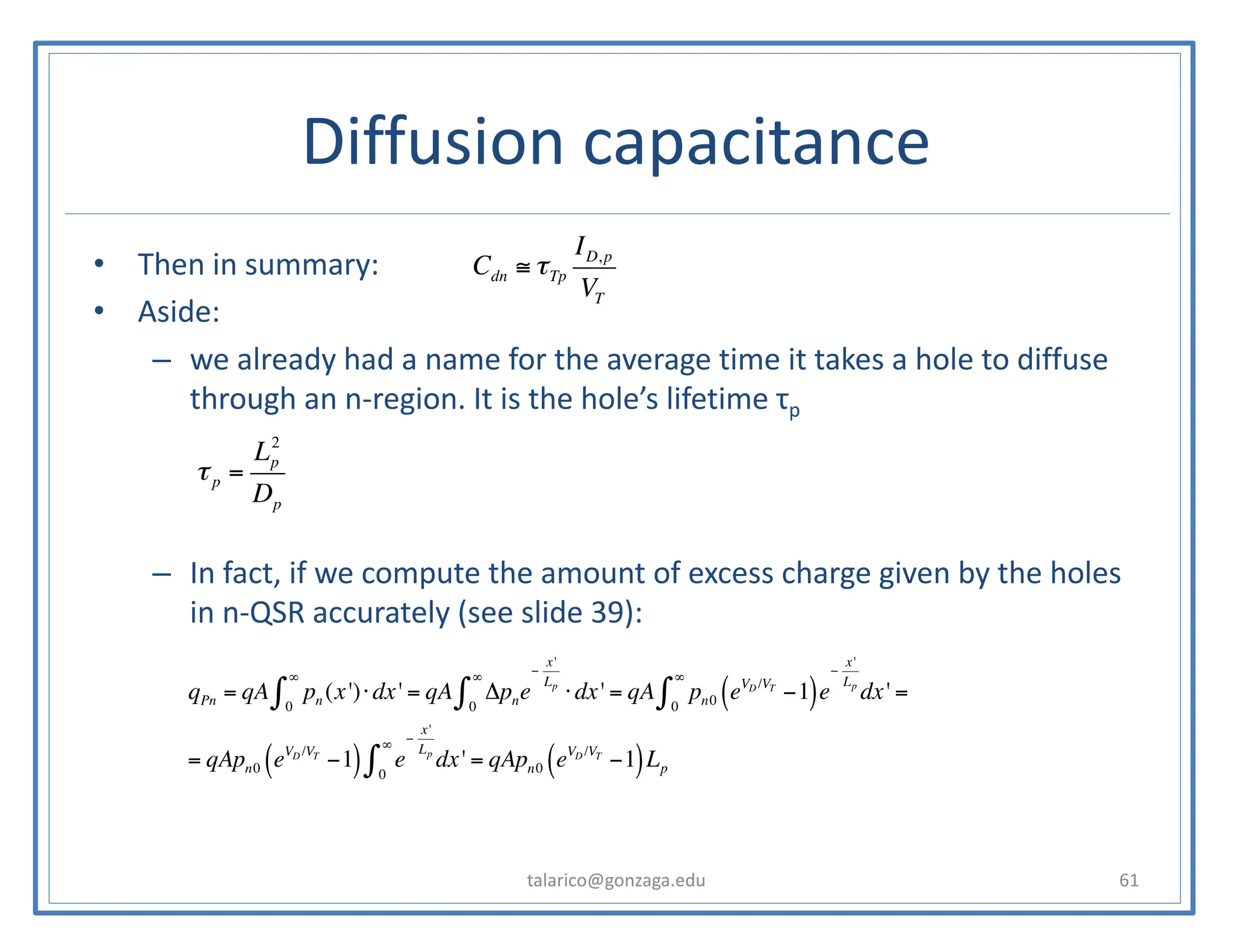
• Then in summary:
• Aside:
– we already had a name for the average time it takes a hole to diffuse
through an n-region. It is the hole’s lifetime τp
– In fact, if we compute the amount of excess charge given by the holes
in n-QSR accurately (see slide 39):
talarico@gonzaga.edu 61
Diffusion capacitance
τp =
Lp
2
Dp
Cdn ≅ τTp
ID,p
VT
qPn = qA pn (x')
0
∞
∫ ⋅dx' = qA Δpne
−
x'
Lp
0
∞
∫ ⋅dx' = qA pn0 eVD /VT
−1
( )e
−
x'
Lp
0
∞
∫ dx' =
= qApn0 eVD /VT
−1
( ) e
−
x'
Lp
0
∞
∫ dx' = qApn0 eVD /VT
−1
( )Lp
– Therefore:
– Similarly for the excess charge and capacitance in the p-QNR
– The total excess charge stored and the associated total capacitance is:
talarico@gonzaga.edu 62
Diffusion capacitance τp ≡
Lp
2
Dp
Cdn =
dqPn
dvD vD=VD
= qA
ni
2
Nd
Lp
VT
eVD /VT
=
Lp
2
Dp
1
VT
qA
ni
2
Nd
Dp
Lp
eVD /VT
≈ τp
ID,p
VT
qNp = −qA np (x'')
0
∞
∫ ⋅dx'' = −qA Δnpe
−
x''
Ln
0
∞
∫ ⋅dx'' = −qAnp0 eVD /VT
−1
( )Ln
Cdp =
−dqNp
dvD vD=VD
=
dqNp
dvD
vD=VD
=
Ln
2
Dn
1
VT
qA
ni
2
Na
Dn
Ln
eVD /VT
≈ τn
ID,n
VT
qS
= qPn + qNp = τpID,p +τnID,n
Note: The increment in stored
electron charge is negative,
but results from electrons that
are injected from the cathode
(N-side) to the anode (P-SIDE)
CS =
dqS
dvD vD=VD
= Cdn +Cdp ≈ τn
ID.n
VT
+τp
ID. p
VT
Note: The increment in the
stored hole charge comes
from injected holes from the
P-SIDE (anode) to the N-side
(cathode)
Diffusion capacitance
talarico@gonzaga.edu 63
0
−xp
−Wp
p(−xp) for VD
p
p-QNR
Na
−dqNp
n(−xp) for VD
ni
2
Na
x
n
p(−xp) for VD+vd
+dqPp
n(−xp) for VD+vd
n(xn) [for VD+vd]
n(xn) [for VD]
n
p
p(xn) [for VD+vd]
p(xn) [for VD]
−dqNn
+dqPn
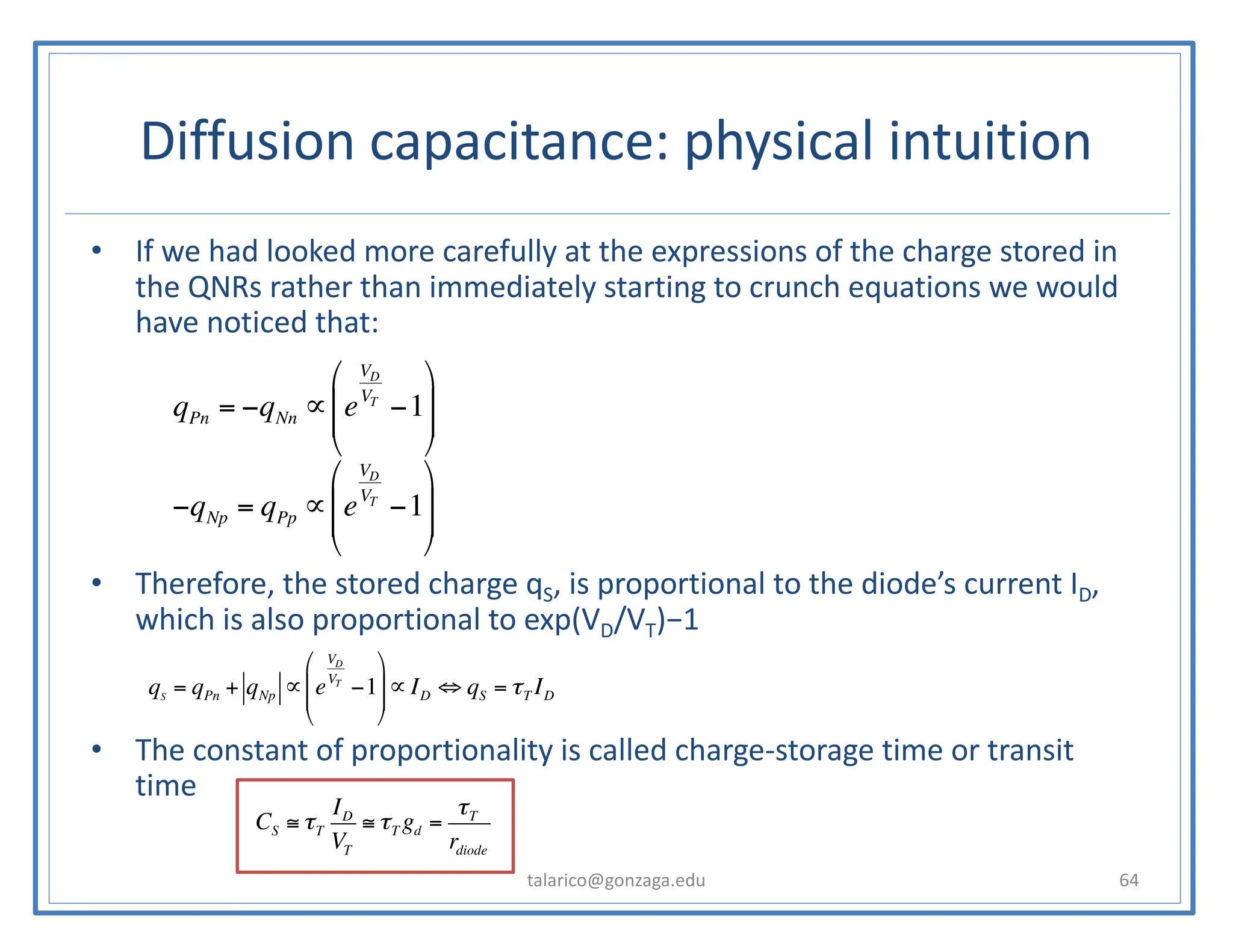
Diffusion capacitance: physical intuition
• If we had looked more carefully at the expressions of the charge stored in
the QNRs rather than immediately starting to crunch equations we would
have noticed that:
• Therefore, the stored charge qS, is proportional to the diode’s current ID,
which is also proportional to exp(VD/VT)−1
• The constant of proportionality is called charge-storage time or transit
time
talarico@gonzaga.edu 64
−qNp = qPp ∝ e
VD
VT
−1
⎛
⎝
⎜
⎜
⎞
⎠
⎟
⎟
qPn = −qNn ∝ e
VD
VT
−1
⎛
⎝
⎜
⎜
⎞
⎠
⎟
⎟
qS
= qPn + qNp ∝ e
VD
VT
−1
⎛
⎝
⎜
⎜
⎞
⎠
⎟
⎟∝ ID ⇔ qS = τT ID
CS ≅ τT
ID
VT
≅ τT gd =
τT
rdiode
• There is a very simple explanation to this proportionality, ID is the rate of
minority charge injection into the diode.
• In steady state. This rate must be equal to the rate of charge recombination,
which is qS/τT
• In a one-sided junction the transit time τT is the recombination lifetime on the
lighter-doping side, where most of the charge injection and recombination
take place
• In general, τT is an average of the recombination lifetimes on the N-side and P-
side
• In any event, ID and qS are simply linked through a charge storage time τT
(a.k.a. τS)
talarico@gonzaga.edu 65
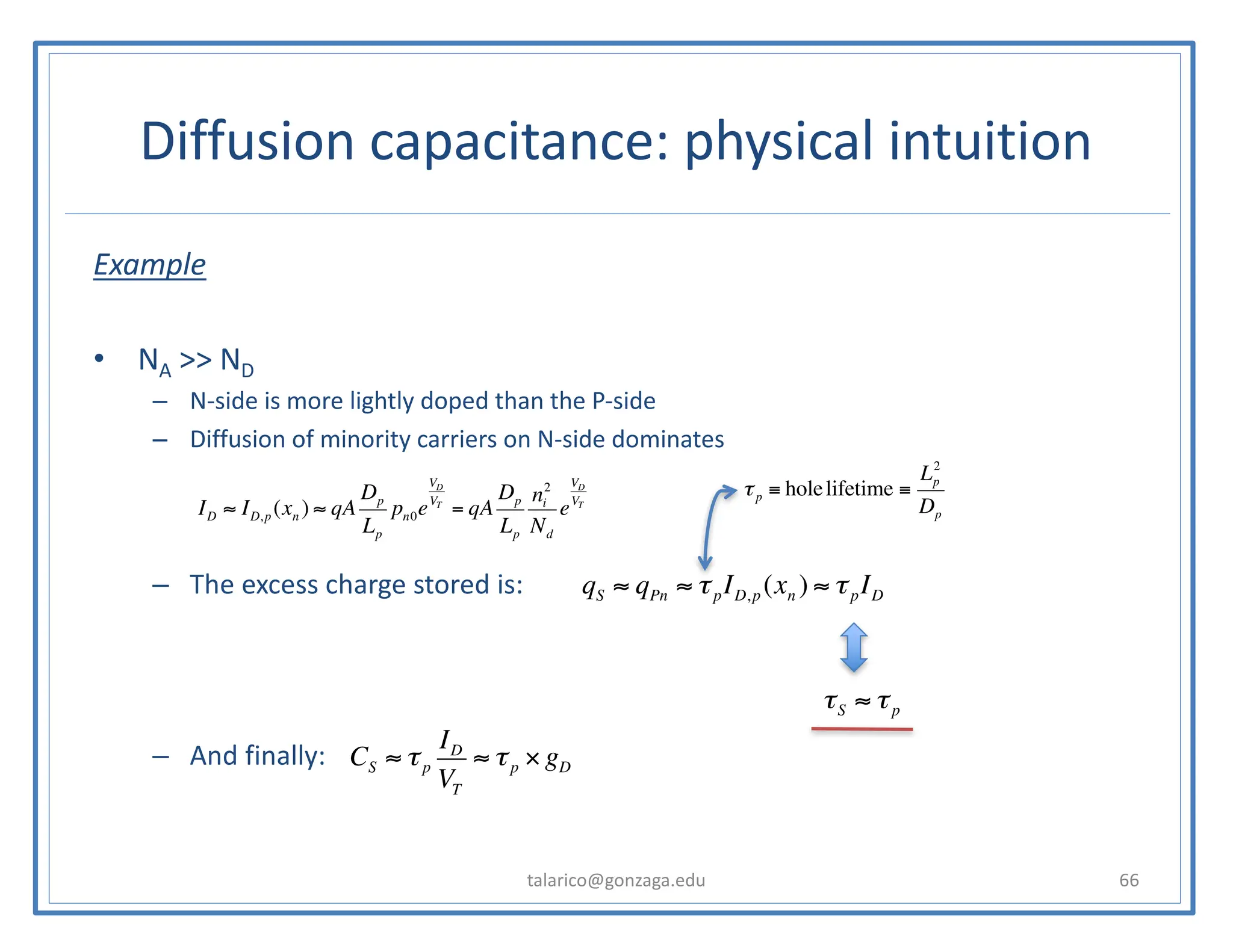
Diffusion capacitance: physical intuition
Example
• NA >> ND
– N-side is more lightly doped than the P-side
– Diffusion of minority carriers on N-side dominates
– The excess charge stored is:
– And finally:
talarico@gonzaga.edu 66
Diffusion capacitance: physical intuition
ID ≈ ID,p (xn ) ≈ qA
Dp
Lp
pn0e
VD
VT
= qA
Dp
Lp
ni
2
Nd
e
VD
VT
τp ≡ holelifetime ≡
Lp
2
Dp
τS ≈ τp
CS ≈ τp
ID
VT
≈ τp × gD
qS ≈ qPn ≈ τpID,p (xn ) ≈ τpID
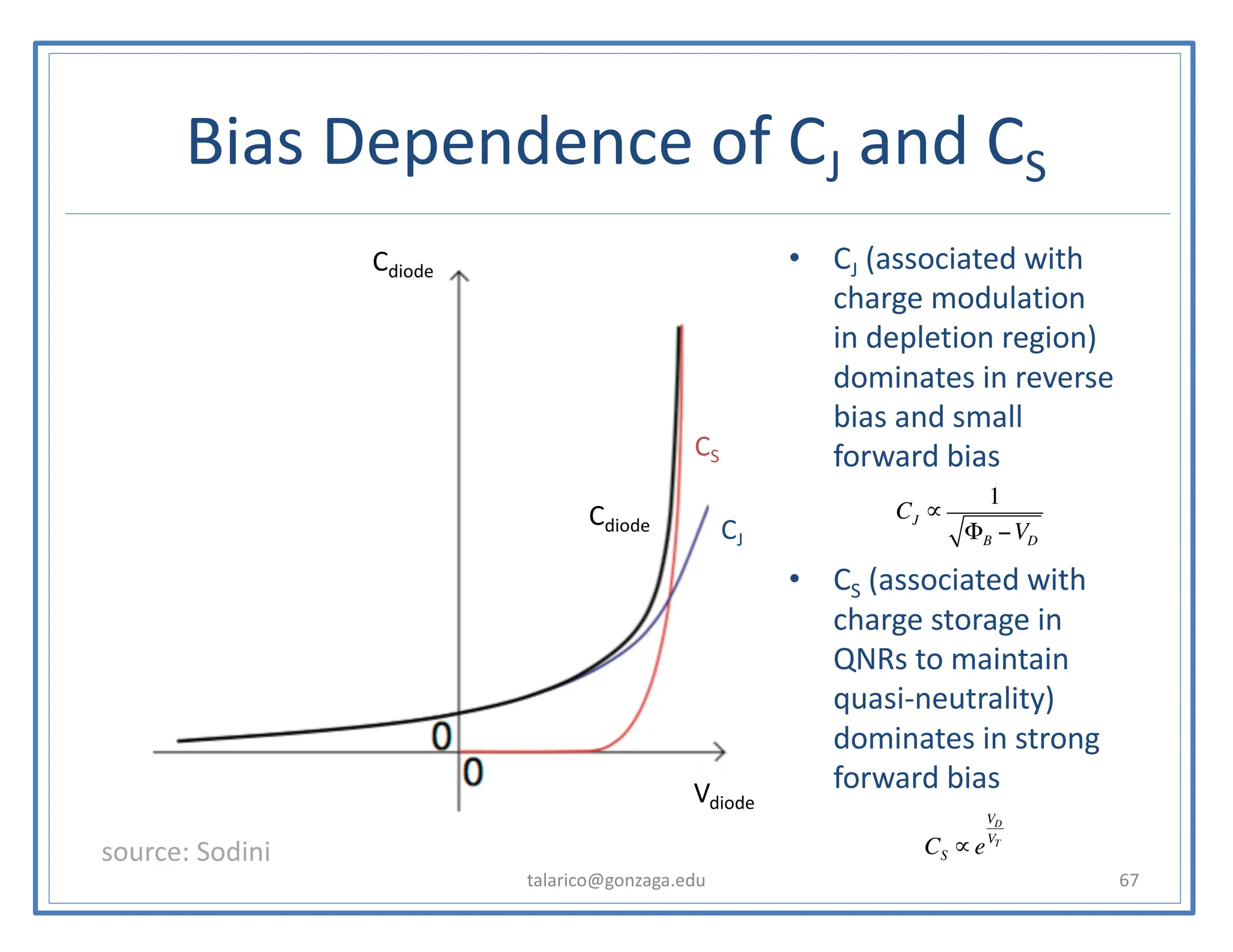
Bias Dependence of CJ and CS
• CJ (associated with
charge modulation
in depletion region)
dominates in reverse
bias and small
forward bias
• CS (associated with
charge storage in
QNRs to maintain
quasi-neutrality)
dominates in strong
forward bias
talarico@gonzaga.edu 67
source: Sodini
Cdiode
Cdiode
CS
CJ
Vdiode
CS ∝e
VD
VT
CJ ∝
1
ΦB −VD
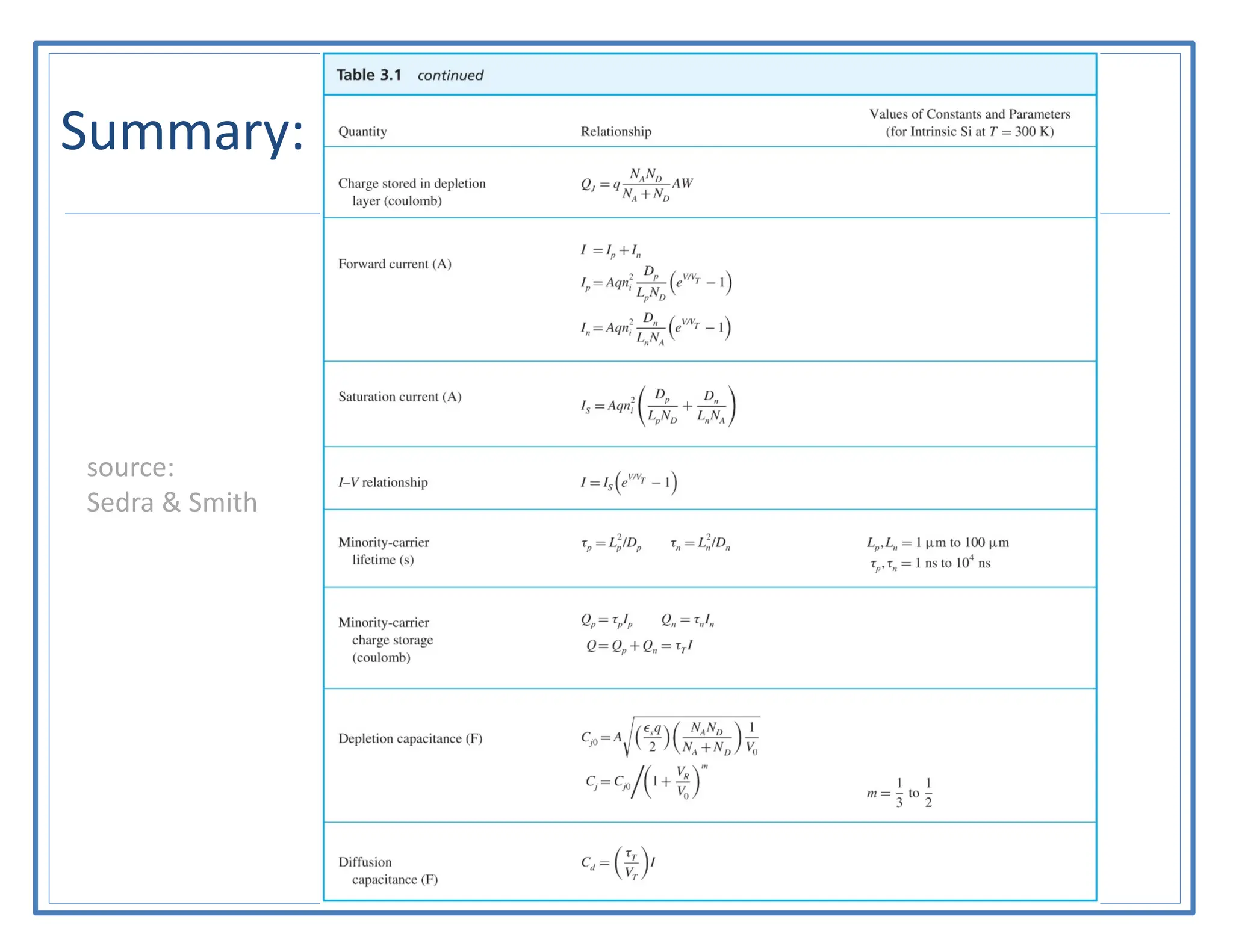
source:
Sedra & Smith
Summary: B = 5×1015 cm−3K−3/2
ni = 1×1010 cm−3
Eg = 1.12 eV
Summary:
source:
Sedra & Smith
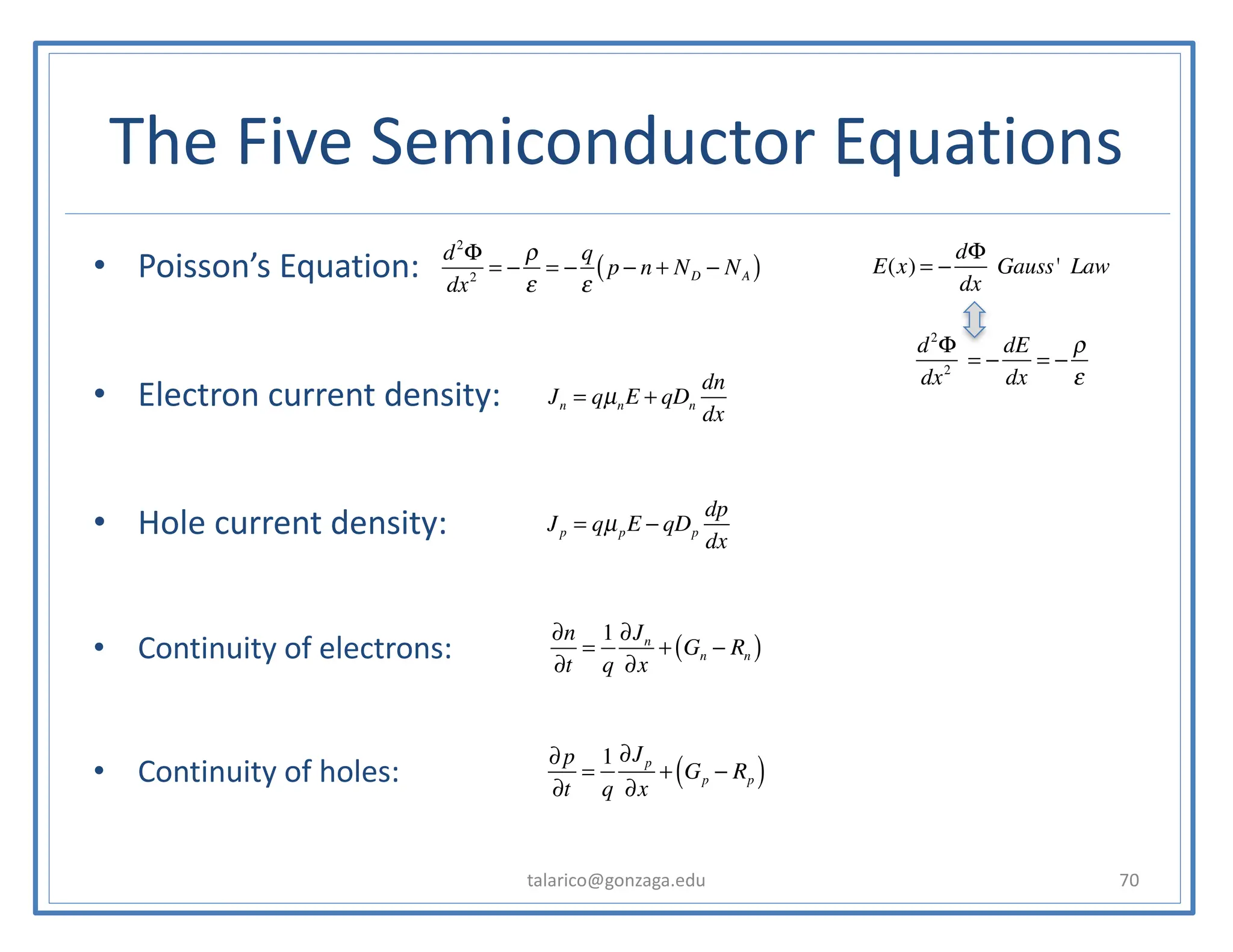
The Five Semiconductor Equations
• Poisson’s Equation:
• Electron current density:
• Hole current density:
• Continuity of electrons:
• Continuity of holes:
talarico@gonzaga.edu 70
d2
Φ
dx2
= −
ρ
ε
= −
q
ε
p − n + ND − NA
( ) E(x) = −
dΦ
dx
Gauss' Law
Jn = qµnE + qDn
dn
dx
Jp = qµpE − qDp
dp
dx
∂n
∂t
=
1
q
∂Jn
∂x
+ Gn − Rn
( )
∂p
∂t
=
1
q
∂Jp
∂x
+ Gp − Rp
( )
d2
Φ
dx2
= −
dE
dx
= −
ρ
ε
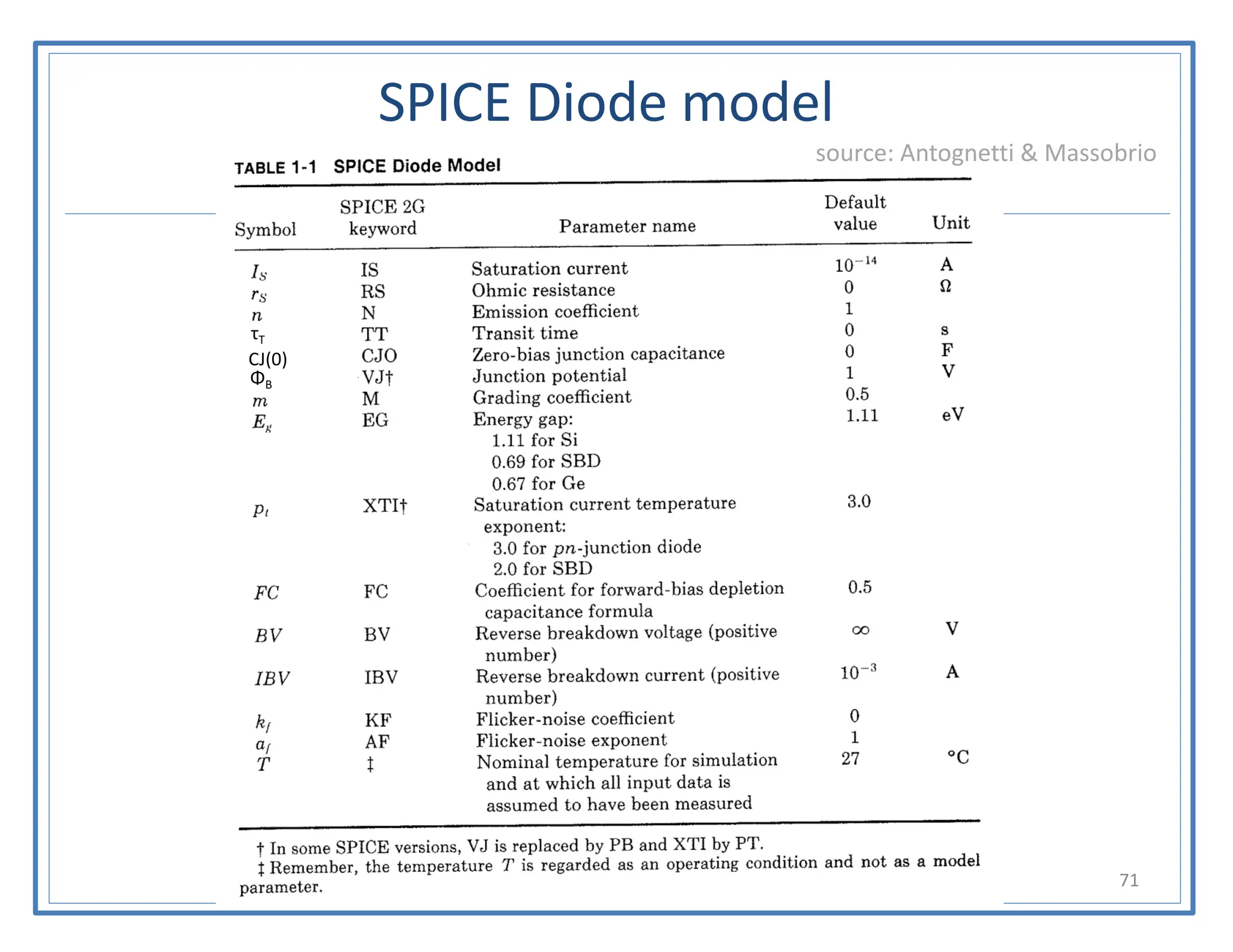
SPICE Diode model
talarico@gonzaga.edu 71
source: Antognetti & Massobrio
CJ(0)
τT
ΦB
SPICE characteristic of diode
talarico@gonzaga.edu 72
SPICE
source: Antognetti & Massobrio
Example:
D1 1 2 diode_1N4004
.model diode_1N4004 D (IS=18.8n RS=0 BV=400
+ IBV=5.00u CJO=30 M=0.333 N=2)
D2 3 4 idealmod_d
.model idealmod_d D
+ IS=10f
+ n = 0.01
+ IBV=0.1n
* By default BV = inf
General Sxntax:
D[name] <anode_node> <cathode_node> <modelname>
.model <modelname> D (<paramX>=<valueX> <paramY>=<valueY> ...)

ch3_pnjunction.pptx.pdf

  • 1.
    Electronics I -PN Junction talarico@gonzaga.edu 1 p++ n NA >> ND A K Chapter 3 Fall 2017
  • 2.
    PN Junction (Diode) talarico@gonzaga.edu2 • When N-type and P-type dopants are introduced side-by- side in a semiconductor, a PN junction or a diode is formed. source: Razavi JUNCTION
  • 3.
    Diode I/V characteristics •Our goal is to find out the current-voltage characteristics of the device • Diode operation regions: – Equilibrium = open circuit terminals = no bias – Forward bias – Reverse bias – (Breakdown) talarico@gonzaga.edu 3 D D Equilibrium D D “smoke” ΦB
  • 4.
    PN Junction inEquilibrium (no Bias applied) • Because each side of the junction contains an excess of holes or electrons compared to the other side, there exists a large concentration gradient. Therefore, a diffusion current flows across the junction from each side. talarico@gonzaga.edu 4 source: Razavi nn0 pn0 np0 pp0 + ND < NA nn0 ≈ ND pn0 ≈ ni 2/ND pp0 ≈ NA np0 ≈ ni 2/NA
  • 5.
    PN junction inEquilibrium (no bias applied) • Diffusion across the junction causes a lot of electrons and holes to recombine leaving a depletion region in proximity of the junction • The fixed ions left behind create an electric field • The electric field opposes the diffusion of holes in the N region and free electrons in the P region • Once the electric field is strong enough to stop the diffusion currents the junction reaches equilibrium – A “barrier” opposing diffusion forms 5 − − − − − − − − − − − − − − − − − − + + + + + + + + + + + + + + + + + + + + + + + + + + + + + + + + + + + + − − − − + + + + Free Electrons Positive Donor Ions Negative Acceptor Ions Free Holes Depletion Region P N ND < NA
  • 6.
    Depletion approximation • Whathappens inside the PN junction in equilibrium is not quite as black and white as depicted talarico@gonzaga.edu 6 ρ(x) = q p0 (x)− n0 (x)+ ND − NA ( ) • On the N-side of the transition region (0 < x < xn0), since there are no acceptors (NA = 0) and the hole concentration is negligible (p0 ≈ 0) • Since n0(x) < ND on the N-side of the transition (and even more so on the P-side of the transition) there is a roll-off in electron concentration ρ(x) = q p0 (x)− n0 (x)+ ND − NA ( )≈ q −n0 (x)+ ND ( ) source: Howe & Sodini
  • 7.
    Depletion approximation talarico@gonzaga.edu 7 •The depletion approximation assumes that the mobile carriers (n and p) are small in number compared to the donor and acceptor ion concentrations (ND and NA) in the depletion region (SCR), and the device is charge-neutral elsewhere (QNR) • Depletion approximation – NA >> pp hence ρ ≈ −qNA for −xp ≤ x ≤ 0 – ND >> nn hence ρ ≈ qND for 0 ≤ x ≤ xn – The charge density is negligible in the bulk regions; that is ρ ≈ 0 for x > xn and x < − xp • On the P-side of the transition region (−xp < x < 0), since there are no donors (ND = 0) and the electrons concentration is negligible (n0 ≈ 0) • Since p0(x) < NA on the P-side of the transition region (and even more so on the N-side of the transition) there is a roll-off in hole concentration ρ(x) = q p0 (x)− n0 (x)+ ND − NA ( )≈ q p0 (x)− NA ( ) source: Howe & Sodini That is, there are no free mobile charges in depletion region
  • 8.
    One more time… • aa talarico@gonzaga.edu 8 source: Sodini (P-side) (N-side) = 0 = 0 ≈ 0 (minority carriers) ≈ 0 (minority carriers) Na >> p0 (depletion approximation) Nd >> n0 (depletion approximation) P-type N-type NOTE: for the example in this picture NA < ND
  • 9.
    Depletion approximation talarico@gonzaga.edu 9 Depletionapproximation means we assume the charge density in each transition region to be uniform Charge density x qND −qNA − + source: G.W. Neudeck
  • 10.
    PN junction inEquilibrium (no bias applied) • Since the circuit is open no currents exists • Therefore in equilibrium the drift currents resulting from the electric field generated by the fixed ions in the depletion region must exactly cancel the diffusion currents • This must hold for both types of charge carriers: Jn = Jp = 0 • Let’s take one of the two equations and try to solve it: 10 − − − − − − − − − − − − − − − − − − + + + + + + + + + + + + + + + + + + + + + + + + + + + + + + + + + + + + − − − − + + + + Free Electrons Positive Donor Ions Negative Acceptor Ions Free Holes Depletion Region P N ND < NA Jp = 0 = pqµpEx − qDp dp dx Jn = 0 = nqµnEx + qDn dn dx 0 nn0 pn0 pp0 np0 JUNCTION x xp0 −xn0 −pµp dV dx = Dp dp dx pqµpEx = qDp dp dx Ex = − dV dx
  • 11.
    Built-in voltage (equilibrium) talarico@gonzaga.edu11 −pµp dV dx = Dp dp dx − dV V (−xn0) V (xp0) ∫ = Dp µp dp p p(−xn0) p(xp0) ∫ V(−xn0 )−V(xp0 ) =VT ln pp0 pn0 ΦB =VT ln NA ni 2 / ND ! ΦB =VT ln NA ND ni 2 nn0 pn0 pp0 np0 x xp0 −xn0 P N + + − − Ex 0 ΦB + − + + − − Example Find built in voltage of a silicon PN junction at room temperature and with NA ≈ 1018 and ND ≈ 1017 ΦB ≅ 26mV × ln 1018 1017 1020 ≅ 26mV × ln(10)× Log10 1018 1017 1020 ≅ ≅ 60mV ×15 ≅ 900mV depletion region
  • 12.
    PN Junction inequilibrium (no bias applied) talarico@gonzaga.edu 12 − − − − − − − − − − − − − − − − − − + + + + + + + + + + + + + + + + + + + + + + + + + + + + + + + + + + + + − − − − + + + + Depletion Region P N + − • Some of the thermally generated holes in the N region (minority carrier) moves toward the junction and reach the edge of the depletion region. There, they experience the strong electric force present in depletion region, and get swept all the way into the P region (where they become majority carriers). • The same happen for the thermally generated minority carriers (free electrons) in the P region. • At equilibrium the flow of carriers swept by the electric field (drift) and the flow of carriers due the gradient in carriers concentration (diffusion) cancel out ID = Idiff – Idrift =0 Ex Idrift Idiff + − ΦB P N ID − − − − − − + + + + + + + + + VD
  • 13.
    Width of theDepletion region in equilibrium 13 − − − − − − − − − − − − + + + + + + + + + + + + + + + + + + + + + + + + − − − − + + + + P N −xn0 +xp0 0 E metal contact A K metal contact −xn0 +xp0 x concentration [cm−3] pp0=NA np0≈ni 2/NA nn0=ND pn0≈ni 2/ND W=Xd0 Idrift Idiff −xn0 x +xp0 ρ = charge density [Cb/cm−3] −qNA +qND |Q −|= qNAAxp0 |Q +|= qNDAxn0
  • 14.
    Width of theDepletion region in equilibrium talarico@gonzaga.edu 14 −xn0 x +xp0 ρ = charge density [Cb/cm−3] −qNA +qND |Q −|= qNAAxp0 |Q +|= qNDAxn0 Charge conservation: |Q+ |=|Q− | ! QJ 0 " AqND xn0 = AqNAxp0 " ND xn0 = NAxp0 E(x) x −xn0 +xp0 E(0) = −qNAxp0 εsi = −qND xn0 εsi ! Emax PoissonEquation: dE dx = ρ εsi ! dE = ρ εsi dx As long as we know how to compute the area of a rectangle we are fine with the math !!! Permittivity of crystalline silicon: εsi ≈ 11.7×8.85×10−12 F/m εr ε0
  • 15.
    • Let’s gofrom the electric field to the voltage talarico@gonzaga.edu 15 Width of the Depletion region in equilibrium − E(x) x −xp0 +xn0 qNAxp0 εsi = qND xn0 εsi E(x) = − dΦ0 dx ⇔ − E(x)⋅dx = dΦ0 Φ0(x) x Area “red” triangle 1 2 qND xn0 2 εsi Area “blue” triangle = Area “blue” triangle 1 2 qNAxp0 2 εsi Area “red” triangle = 0 As we move in the x direction (from –xp0 to xn) the area under –E(x) keeps growing NOTE: for convenience I flipped the orientation of the p-side and the n-side with respect to the x direction so the name of the depletion region’s edge at the p-side becomes –xp0 and the name of the depletion region’s edge at the n-side becomes +xn0 ΦB=Φ0 (xn0)−Φ0 (−xp0) ΦB = 1 2 qNAxp0 2 εsi + 1 2 qND xn0 2 εsi ΦB + − E − + + parabola N parabola P source: Howe & Sodini −
  • 16.
    Metal-Semiconductor Contact Potential •At first glance would seem strange that the potential drops at the contacts would have to add up to the built in potential of the junction. Were this is not the case, KVL would imply that current would flow in thermal equilibrium when a resistor is connected across the metal contacts to the p and n region. This conclusion violate our basic understanding of the meaning of equilibrium: namely the net current must be zero in equilibrium talarico@gonzaga.edu 16 source: Howe & Sodini
  • 17.
    talarico@gonzaga.edu 17 Width ofthe Depletion region in equilibrium W = xp0 + xn0 W = xn0 1+ ND NA ⎛ ⎝ ⎜ ⎞ ⎠ ⎟ = xn0 NA + ND NA ⎛ ⎝ ⎜ ⎞ ⎠ ⎟ W = xp0 1+ NA ND ⎛ ⎝ ⎜ ⎞ ⎠ ⎟ = xp0 NA + ND ND ⎛ ⎝ ⎜ ⎞ ⎠ ⎟ NAxp0 = ND xn0 Charge neutrality: xn0 = W NA NA + ND ⎛ ⎝ ⎜ ⎞ ⎠ ⎟ xp0 = W ND NA + ND ⎛ ⎝ ⎜ ⎞ ⎠ ⎟ ΦB = qNA 2εsi xp0 2 + qND 2εsi xn0 2 ΦB = qNA 2εsi W 2 ND NA + ND ⎛ ⎝ ⎜ ⎞ ⎠ ⎟ 2 + qND 2εsi W 2 NA NA + ND ⎛ ⎝ ⎜ ⎞ ⎠ ⎟ 2 ΦB = q 2εsi W 2 NAND 2 + ND NA 2 NA + ND ( )2 W 2 = 2εsi q ΦB NA + ND ( )2 NAND 2 + ND NA 2 = 2εsi q ΦB NA + ND ( )2 NAND (ND + NA ) W = 2εsi q ΦB NA + ND NAND ! Xdo xn0 = 2εsi q ΦB NA + ND ( ) NAND NA 2 (NA + ND )2 = 2εsi q ΦB NA ND (NA + ND ) xp0 = 2εsi q ΦB ND NA (NA + ND )
  • 18.
    Charge on eitherside of the depletion region (in equilibrium) talarico@gonzaga.edu 18 QJ 0 !|Q+ |=|Q− |= AqND xn0 xn0 x −xp0 ρ = charge density [Cb/cm−3] −qNA +qND |Q −|= qNAAxp0 |Q +|= qNDAxn0 QJ 0 = AqNDW NA NA + ND = Aq NAND NA + ND W QJ 0 = Aq NAND NA + ND 2εsi q ΦB NA + ND NAND = A 2εsiq NAND NA + ND ΦB Junction Charge xn0 = W NA NA + ND ⎛ ⎝ ⎜ ⎞ ⎠ ⎟ xp0 = W ND NA + ND ⎛ ⎝ ⎜ ⎞ ⎠ ⎟ = xn0 = W=Xd0
  • 19.
    Effect of biasvoltage on the PN Junction talarico@gonzaga.edu 19 source: Streetman ΦB Φp Φn ΦJ=ΦB−VF ΦJ=ΦB+VR VF=VD VR=−VD + VD − + VD − + VD= 0 − Idiff Idrift Idiff Idrift Idrift Idiff ID = 0 ID > 0 ID < 0 ID = Idiff − Idrift The drift current has the same direction of the electric field (and it is proportional to it) (a) Open circuit (b) Forward Bias (c) Reverse Bias (Equilibrium) Jp,drift = pqµpE Jn,drift = nqµnE ΦB ΦJ ΦJ
  • 20.
    PN Junction underReverse Bias • The external voltage VR is directed from the N side to the P side (same as ΦB), therefore the electric field (ER) due to the bias VR enhances the built in field E. The depletion region W is widened • Since the “barrier” potential rises higher than in equilibrium it gets harder for the majority carriers to cross the junction and easier for the minority carrier to be swept (drifted) across the junction. • The current carried under reverse bias is negligible the minority carriers are too few !! talarico@gonzaga.edu 20 VR = −VD VR = −VD ID − ΦB + − ΦB + source: Millman & Halkias source: Razavi Equilibrium (open circuit) Reverse Bias + ΦB − E E ER + ΦJ − ΦJ = ΦB + VR
  • 21.
    PN junction underreverse bias talarico@gonzaga.edu 21 KVL: VD + Φmn + ΦJ + Φmn = 0 ΦJ = −VD − Φmn − Φmp = ΦB−VD = ΦB potential barrier in equilibrium potential barrier in non-equilibrium source: Howe & Sodini
  • 22.
    PN junction underreverse bias 22 Example: PN junction under reverse biases VD=−2.4 V and VD=−6.4V Assuming the potential barrier in equilibrium is ΦB = 0.8V As the PN junction gets more reverse biased • the depletion region Xd = xp + xn becomes wider • the potential barrier becomes stronger (a) charge density (b) electric field (c) potential source: Howe & Sodini
  • 23.
    Application of ReverseBiased PN Junction: Voltage Dependent capacitor • A reverse biased PN junction can be used as a capacitor. By varying VR, the depletion width changes, and so does the capacitance associated. Therefore a reverse biased PN junction can be seen as a voltage- dependent capacitor. talarico@gonzaga.edu 23 Varactor p n Qualitatively we see that if VR goes up then CJ goes down source: Razavi
  • 24.
    Capacitance of ReverseBiased Diode talarico@gonzaga.edu 24 Xd @VD = 2εsi q ΦB −VD ( ) NA + ND NAND = 2εsi q ΦB 1− VD ΦB ⎛ ⎝ ⎜ ⎞ ⎠ ⎟ NA + ND NAND = Xd0 1− VD ΦB CJ @VD = εsi ⋅ A Xd @VD = qεsi 2 NAND NA + ND ( ) 1 ΦB −VD ( ) = qεsi 2 NAND NA + ND ( ) 1 ΦB 1 1−VD / ΦB ( ) = = CJ0 1−VD / ΦB width of depletion region in equilibrium CJ0 = junction capacitance at zero bias (in equilibrium) = CJ0 = εsi A Xdo careful: cap per unit area
  • 25.
    Junction capacitance ofreverse biased diode talarico@gonzaga.edu 25 CJ0 VR=−VD VD= VF Reverse Voltage Forward Voltage CJ source: Streetman CJ (VD ) = CJ0 1− VD ΦB ⎛ ⎝ ⎜ ⎞ ⎠ ⎟ M = CJ0 1+ VR ΦB ⎛ ⎝ ⎜ ⎞ ⎠ ⎟ M • M=0.5 for the abrupt PN junction we modeled • Typical values for M range from 0.3 to 0.5 • SPICE uses VJ (or PB) to denote the built in voltage in equilibrium (ΦB) The junction capacitance is non linear
  • 26.
    talarico@gonzaga.edu 26 QJ @VD =A 2εsiq NAND NA + ND ΦB −VD ( ) = A 2εsiq NAND NA + ND ΦB 1− VD ΦB ⎛ ⎝ ⎜ ⎞ ⎠ ⎟ = QJ 0 1− VD ΦB = = QJ 0 1+ VR ΦB charge stored in either side of the depletion region in equilibrium Junction capacitance of reverse biased diode • The relation between charge QJ and voltage (VR=−VD) across the diode is not linear • It is difficult to define a capacitance that changes whenever VR changes source: Sedra & Smith P VP QJ = A 2εsiq NAND NA + ND ΦB +VR ( ) = ς ΦB +VR = ς 2 ΦB 1+ VR ΦB ⎛ ⎝ ⎜ ⎞ ⎠ ⎟ = CJO 1+ VR ΦB CJ @VP = dQJ dVR VR =VP = d dVR ς ΦB +VR ( ) @VP = ς 2 ΦB +VR @VP = = ς @VP @VP square root law 𝐶"|@%& = 1 𝐴 𝑑𝑄" 𝑑𝑉- . /01/& /A = 2 3 /A /A
  • 27.
    talarico@gonzaga.edu 27 Junction capacitanceof reverse biased diode source: Sedra & Smith P VP CJ @VP = dQJ dVR VR =VP ≠ QJ (VR ) VR VR =VP Important result to remember when using non linear devices /A
  • 28.
    Application of areverse biased diode talarico@gonzaga.edu 28 LC fres 1 2 1 p = source: Razavi
  • 29.
    PN Junction inForward Bias talarico@gonzaga.edu 29 ID VD=VF VD=VF − ΦB + − ΦB + source: Millman & Halkias • The electric field (EF) due to the bias (VF) is opposite to the built in field E. The depletion region W is shortened • Since the “barrier” potential becomes lower than in equilibrium it gets easier for the majority carriers to diffuse through the junction and harder for the minority carrier to be swept (drifted) across the junction. • The majority carriers are a lot, so we expect a considerable current flow: ID = Idiff − Idrift Equilibrium (open circuit) + ΦB − + ΦJ − Forward Bias EF E ΦJ = ΦB − VF source: Razavi p-n ID
  • 30.
    Diode’s Current/Voltage Characteristic talarico@gonzaga.edu30 ID = IS (e VD VT −1) ≈ −IS NOTE: Consider |VD/VT| ≈ 2.3 exp(2.3) ≈ 9.97 ≈ 10 exp(−2.3) ≈ 0.1 At room temperature VD = 2.3 × VT ≈ 59.8 mV≈ 60 mV source: Razavi source: Streetman −I(drift) ID VD VD ID ID = I(drift) e qVD KT −1 ⎛ ⎝ ⎜ ⎞ ⎠ ⎟ very steep !
  • 31.
    Diode’s Current/Voltage Characteristic 31 •How can we quantify the I/V behavior of the diode ? • We need to look at how electrons and holes move under the effect of the bias voltage • In equilibrium: • With an external bias voltage applied the situation is similar but now the potential barrier is ΦB – VD instead of only ΦB ΦB = VT ln pp0 pn0 ⇔ pn0 = pp0 ⋅e−ΦB /VT ⇔ pn0 = pp0 eΦB /VT holes at xn0 holes at −xp0 −xp0 and xn0 are the edges of the depletion region in equilibrium pn = pp ⋅ eVD /VT eΦB /VT holes at xn holes at −xp −xp and xn are the edges of the depletion region with non zero bias x −Wp −xp 0 xn Wn WP WN P-side N-side + + − − VD GND A K quasi-neutral region quasi-neutral region Law of the Junction np = nn ⋅ eVD /VT eΦB /VT electrons at −xp electrons at xn The Law of the Junction relates the minority carrier concentration on one side of the junction to the majority carrier concentration on the other side of the junction np0 = nn0 eΦB /VT electrons at −xp0 electrons at xn0
  • 32.
    Diode’s Current/Voltage Characteristic talarico@gonzaga.edu32 • When we apply a forward bias VD the potential barrier is reduced from ΦB to ΦB−VD. This reduces the drift field and upsets the balance between diffusion and drift that exists at zero bias. • Electrons can now diffuse from the N side (where they are majority carriers) to the P side (where they become minority carriers). Similarly, holes diffuse from the P side into the N side. This migration of carriers from one side to the other is called injection. • As a result of injection, more electrons are now present at –xp and more holes appear at xn than when the barrier was higher – There is an excess of minority carriers at the edges of the depletion region • Let’s make some simplifying assumptions to help quantifying pn(xn), pp(−xp), nn(xn) and np(xp) – There is electric field only in the space charge region (that is between –xp and xn). The regions from –Wp to –xp (a.k.a. P bulk region) and from xn to Wn (a.k.a. N bulk region) are quasi-neutral (it is like they were perfect conductors and in perfect conductors there is no electric field inside)
  • 33.
    Diode’s Current/Voltage Characteristic talarico@gonzaga.edu33 • The requirement that the bulk regions on either side remain charge-neutral even under applied bias (remember: E(x) = ρ(x)/ε, so no field means no charge density) implies that any increases in the minority carriers due to injection must be counter balanced by in an increase of majority carriers – On the P side ρ(x=−xp) = 0 implies that: – On the N side ρ(x=xn) = 0 implies that: • Assuming the level of injection is low we can neglect the slight increase in majority carrier concentration due to carrier injection and write: pp (−xp ) = NA + np (−xp ) ≈ pp0 + np (−xp ) nn (xn ) = ND + pn (xn ) ≈ nn0 + pn (xn ) pp (−xp ) ≈ pp0 ≈ NA nn (xn ) ≈ nn0 ≈ ND np (−xp ) << pp0 pn (xn ) << nn0
  • 34.
    Minority and Majoritycarriers concentrations in a forward biased diode • Concentrations Howe & Sodini talarico@gonzaga.edu 34 x pn0 np0 Quasi-neutrality demands that at every point in the quasi-neutral regions: excess minority carrier concentration = excess majority carriers concentration source: Howe & Sodini
  • 35.
    talarico@gonzaga.edu 35 Minority andMajority carriers concentrations in a forward biased diode Quasi-neutrality demands that at every point in the quasi-neutral regions: excess minority carrier concentration = excess majority carriers concentration NOTE: at this point we did not put much thinking in the profile of the minority carriers diffusing in the QNRs, however if we assume the diffusion occurs over a short distance we can approximate the curves with straight lines ! 0 −xp −Wp p(−xp) p p-QNR Na qPp qNp n(−xp) ni 2 Na x source: Sodini n
  • 36.
    • Under thelow injection condition we can approximate the Law of the Junction as follows: talarico@gonzaga.edu 36 pn (xn ) = pp (−xp ) eΦB /VT ⋅eVD /VT ≈ pp0 eΦB /VT ⋅eVD /VT = pn0 ⋅eVD /VT np (−xp ) = nn (xn ) eΦB /VT ⋅eVD /VT ≈ nn0 eΦB /VT ⋅eVD /VT = np0 ⋅eVD /VT pn (xn ) ≈ pn0 ⋅eVD /VT ≈ ni 2 ND ⋅eVD /VT np (−xp ) ≈ np0 ⋅eVD /VT ≈ ni 2 NA ⋅eVD /VT The concentration of minority carriers at the edges of the space charge region are an exponential function of the applied bias Diode’s Current/Voltage Characteristic source: G.W. Neudeck
  • 37.
    Minority carriers ina forward biased PN junction • The excess concentration of minority carriers at the edges is: • As the injected carriers diffuse through the quasi-neutral regions they recombine with the majority carriers and eventually disappear. The excess minority carriers decay exponentially with distance, and the decay constant is called diffusion length L. talarico@gonzaga.edu 37 Δnp ! np0 ⋅eVD /VT − np0 = np0 1− eVD /VT ( ) Δpn ! pn0 ⋅eVD /VT − pn0 = pn0 1− eVD /VT ( ) np (x) = Δnpe (x+xp ) Ln pn (x) = Δpne −(x−xn ) Lp source: Sedra & Smith p+ n It can be shown through the current continuity equation that under the low injection condition the concentration’s profile of the minority carriers diffusing in the quasi neutral regions is exponential
  • 38.
    Minority carrier concentrations Equilibriumvs. Forward Bias talarico@gonzaga.edu 38 source: G.W. Neudeck
  • 39.
    Aside (a simpletrick to simplify the math) talarico@gonzaga.edu 39 • Change the axis selection for the bulk regions as follows: • This way we can write the minority carriers concentrations as follows: np (x'') = Δnpe − x'' Ln pn (x') = Δpne − x' Lp x'' ! 0'' ≡ −xp x' ! 0' ≡ xn Ln = Dnτn Lp = Dpτ p source: G.W. Neudeck source: G.W. Neudeck Ln = Diffusion length for electrons [m] Lp = Diffusion length for holes [m] Dn = Diffusion coefficient for electron [m2/s] Dp = Diffusion coefficient for holes [m2/s] τn = mean lifetime for electrons [s] τp = mean lifetime for holes [s] VA = voltage applied ≡ VD
  • 40.
    Physical interpretation ofL, D, and τ • Physically Lp and Ln represents the average distance minority carriers can diffuse into a “sea” of majority carriers before being annihilated • Physically τp and τn represents the average time minority carriers can diffuse into a “sea” of majority carriers before being annihilated • Physically the Dp and Dn represents the ease with which holes and electrons diffuse talarico@gonzaga.edu 40 Lp ! xΔpn (x) 0 ∞ ∫ dx Δpn (x) 0 ∞ ∫ dx Ln ! xΔnp (x) 0 ∞ ∫ dx Δnp (x) 0 ∞ ∫ dx Dp ! µp KT q Dn ! µn KT q
  • 41.
    PN Junction current •The current that flows through any “transverse” section x must be the same and is formed by both holes and electrons • If we look at the current through a section x in the quasi-neutral regions, since in the quasi-neutral regions there is no electric field there will be no drift talarico@gonzaga.edu 41 J(x) = Jn (x)+ Jp (x) Jn (x) = Jn,drift (x)+ Jn,diff (x) Jp (x) = Jp,drift (x)+ Jp,diff (x) Jn (x) = Jn,diff (x) = qDn dnp (x) dx = q Dn Ln np0 eVD /VT −1 ( )e (x+xp )/Lp for −Wp ≤ x ≤ −xp Jp (x) = Jp,diff (x) = −qDp dpn (x) dx = q Dp Lp pn0 eVD /VT −1 ( )e −(x−xn )/Lp for xn ≤ x ≤ Wn injected electrons diffusing on P-side (minority carriers) injected holes diffusing on N-side (minority carriers) +(x+xp)/Ln
  • 42.
    PN Junction currents •The easier sections for evaluating the diffusion currents are the edges of the space charge region (x=−xp and x=xn) • The total current through a section of the diode can be found as follows: • If we make the simplifying assumption that there is no recombination-generation in the space-charge region, this means that the electrons/holes current at x=−xp and at x=xn do not change in the space-charge region and therefore we can write: talarico@gonzaga.edu 42 Jn (−xp ) = Jn,diff (−xp ) = q Dn Ln np0 eVD /VT −1 ( ) Jp (xn ) = Jp,diff (xn ) = q Dp Lp pn0 eVD /VT −1 ( ) J = Jn (−xp )+ Jp (−xp ) = Jn (xn )+ Jp (xn ) Jn (−xp ) = Jn (xn ) Jp (xn ) = Jp (−xp ) We do not know have this value (yet) ! We do not know have this value (yet) !
  • 43.
    PN Junction current •Therefore we can add together the diffusion currents at x=−xp and x=xn 43 J = Jn (−xp )+ Jp (xn ) = q Dn Ln np0 eVD /VT −1 ( )+ q Dp Lp pn0 eVD /VT −1 ( ) J = q Dn Ln np0 + q Dp Lp pn0 ⎛ ⎝ ⎜ ⎞ ⎠ ⎟ eVD /VT −1 ( ) ID = J × A = In,diff + Ip,diff = Aq Dn Ln np0 + Aq Dp Lp pn0 ⎛ ⎝ ⎜ ⎞ ⎠ ⎟ eVD /VT −1 ( ) ID = Aq Dn Ln ni 2 NA + Dp Lp ni 2 ND ⎛ ⎝ ⎜ ⎞ ⎠ ⎟ eVD /VT −1 ( )= IS eVD /VT −1 ( ) scale current (a.k.a. saturation current)
  • 44.
    Minority concentrations fora forward biased short base diode • If the diode is short the exponential decays can be approximated with straight lines talarico@gonzaga.edu 44 −xp 0 xn np0 pn0 −Wp Wn VD A GND K WidthN WidthP x ID = Aq Dn WidthP np0 + Dp WidthN pn0 ⎛ ⎝ ⎜ ⎞ ⎠ ⎟ eVD /VT −1 ( )= IS eVD /VT −1 ( ) dnp dx ≈ np (−xp )− n(−Wp ) WidthP = np0eVD /VT − np0 WidthP dpn dx ≈ pn (xn )− pn (Wn ) −WidthN = − pn0eVD /VT − pn0 WidthN
  • 45.
    Current densities inthe forward bias case talarico@gonzaga.edu 45 source: G.W. Neudeck No matter which section x we consider Jp and Jn must add to the same total value J
  • 46.
    Assumptions used toderive the Ideal diode equation • Depletion approximation (in depletion region: NA >> pp0(x), ND >> nn0(x)) • Negligible fields in the quasi neutral regions (QNR). This means that the applied voltage VD is dropped entirely across the space charge region (SCR) • Quasi-neutral regions that are so long that the injected carriers all recombine before reaching the end contacts • Low levels of injection • No recombination-generation in the space-charge region. This means that the electron current and the hole current are constant in the space- charge region ( that is Jn(−xp)=Jn(xn) and Jp(xn)=Jp(−xp) ) • Real diodes may deviate considerably from the ideal equation. 46 ID = I* S (e VD nVT −1) n = emission coefficient (a.k.a. ideality factor) Typically the ideality factor n varies from 1 to 2
  • 47.
    Ideal diode talarico@gonzaga.edu 47 ID IS VDVD log10|ID| IS y = log10 IS ⋅e VD VT ⎛ ⎝ ⎜ ⎜ ⎞ ⎠ ⎟ ⎟ = log10 IS ( )+ log10 (e)⋅ VD VT ≈ log10 IS ( )+ 0.43 VD VT x =VD dy dx ≈ 0.43 VT at room temperature (300K): VT 0.43 ≈ 26mV 0.43 ≈ 60mV 10 source: Sodini every 60 mV the current changes by a decade
  • 48.
    Deviations from theideal diode talarico@gonzaga.edu 48 source: Hu Ideal with IS VDIODE (V)
  • 49.
    Ideal diode equation •Although we derived the ideal diode equation by subjecting the diode to a forward bias, the steps followed can also be applied for the case of reverse bias (the only difference is that now VD < 0). • The equation works for both forward and reverse region. talarico@gonzaga.edu 49 ID VD ID = IS eVD /VT −1 ( ) source: Streetman ≈ ISeVD /VT ≈ −IS
  • 50.
    Minority concentrations for reversebiased diode • In forward bias, minority carriers are injected into quasi-neutral regions • In reverse bias, minority carriers are extracted (swept away) from the quasi- neutral regions • In reverse bias there is a very small amount of carriers available for extraction – ID saturates to small value talarico@gonzaga.edu 50 Minority-carrier density distribution as a function of the distance from the junction. (a) Forward biased junction (b) Reverse biased junction (The depletion region is assumed so small relative to the diffusion length that is not indicated in the figure) source: Millman & Halkias
  • 51.
    Minority carrier concentrations Equilibriumvs. Reverse Bias talarico@gonzaga.edu 51 source: G.W. Neudeck
  • 52.
    Small-signal equivalent modelfor diode • Examine the effect of a small signal overlapping the bias: talarico@gonzaga.edu 52 Figure 4.14 Development of the diode small-signal model. source: Sedra & Smith vD (t) ≡VD + vd (t) iD = IS e vD VT −1 ⎛ ⎝ ⎜ ⎜ ⎞ ⎠ ⎟ ⎟ = IS e VD+vd VT −1 ⎛ ⎝ ⎜ ⎜ ⎞ ⎠ ⎟ ⎟ iD ≅ iD VD + diD dvD VD (vD −VD ) = ID + diD dvD VD vd iD is a function of vD: Q ≡ (ID,VD ) diD dvD VD = d dvD IS e vD VT −1 ⎛ ⎝ ⎜ ⎜ ⎞ ⎠ ⎟ ⎟ ⎡ ⎣ ⎢ ⎢ ⎤ ⎦ ⎥ ⎥ VD = ISe VD VT VT = ISe VD VT + IS − IS VT = = ID + IS VT iD − ID ≅ gdvd ⇔ id ≅ gdvd ≡ gd * Applied Taylor *
  • 53.
    Small-signal equivalent modelfor diode • From a small signal point of view the diode behaves as a (non linear) resistance of value: • rdiode depends on bias: • In forward bias: In reverse bias: • Under the assumption that the signal overlapping the bias is small the i-v relationship of the diode can be linearized: talarico@gonzaga.edu 53 Figure 4.14 Development of the diode small-signal model. source: Sedra & Smith rdiode = 1 gd = VT ID + IS iD ≅ ID + gdvd = ID +id vD =VD + vd gd = ID + IS VT gd ≈ ID VT gd ≈ 0 rdiode = 1/gd
  • 54.
    Small-signal equivalent modelfor diode • Besides having current flowing through it (resistive behavior) the diode also exhibit charge displacement mechanisms that can be modeled as a capacitive behavior • The charge response to the voltage applied across the diode is non-linear • As long as the voltage signal superimposed to the bias voltage is small, the relationship between charge and voltage can be linearized. • Complete small signal model for diode talarico@gonzaga.edu 54 vD =VD + vd ≡ Cdiode qD ≈ QD VD + dqD dvD VD (vD −VD ) = QD VD +Cdiode ⋅vd rdiode Cdiode
  • 55.
    talarico@gonzaga.edu 55 Capacitive effectsin the PN junction • Diodes have two capacitive effects • But … please careful: there are way too many letters “D”: – depletion capacitance = junction capacitance = CJ – diffusion capacitance = storage capacitance = CS – Cdiode = CJ + CS • We already know quite a bit about the junction cap. that develops when the diode is in reverse bias (… but what about forward bias?) • So far we did not even think about the existence of storage (diffusion) capacitance • We need to dig more into the capacitive effects … Cdiode A K CJ A K CS
  • 56.
    Junction Capacitance talarico@gonzaga.edu 56 Behaviorof junction capacitance as a function of bias voltage VD (Chawla-Gummel) ≡ ΦB ≡ ΦB 2 SPICE ≈ 2×CJ 0 For Hand Calculation source: Gray, Hurst, Lewis and Meyer
  • 57.
    Junction Capacitance • Earlier,we derived the capacitance associated with depletion region (junction capacitance) for a reverse biased diode as: • Under significant forward bias VD > ΦB/2 the approximation that there are no mobile carriers in the depletion region becomes invalid (this was the basic assumption behind the derivation !!) • Therefore, under forward bias a common approximation is to take the value of CJ at VD = ΦB/2 (or being slightly more pessimistic) talarico@gonzaga.edu 57 Cj VD = CJO 1− VD ΦB CJO = zero-biasjunctioncapacitance = A εsiq 2 ⋅ NA ND NA + ND ⋅ 1 ΦB Cj VD= ΦB 2 = CJO 1−1/ 2 = 2 ×CJO ≈ 2×CJO
  • 58.
    Diffusion capacitance • Thediffusion capacitance is due to charge carrier storage occurring in QNRs (to maintain quasi-neutrality) talarico@gonzaga.edu 58 0 −xp −Wp p(−xp) p p-QNR Na qPp qNp n(−xp) ni 2 Na x Majority (+) Minority (−) Majority (−) Minority (+) qPn = qA 2 Wn − xn ( ) ni 2 Nd e VD VT − ni 2 Nd ⎛ ⎝ ⎜ ⎜ ⎞ ⎠ ⎟ ⎟ = −qNn n(−xp ) = ni 2 Na e VD VT What happen to the majority carriers in the QNRs ? minority carriers charge in QNRs? p(xn ) = ni 2 Nd e VD VT Let’s compute charge in minority carriers “triangles”: qNp = − qA 2 Wp − xp ( ) ni 2 Na e VD VT − ni 2 Na ⎛ ⎝ ⎜ ⎜ ⎞ ⎠ ⎟ ⎟ = −qPp Quasi-neutrality demands that at every point in the quasi-neutral regions: excess minority carrier concentration = excess majority carriers concentration n
  • 59.
    Diffusion capacitance • Let’sexamine what happen when we apply a small increase in voltage (vD=VD+vd=VD+ΔvD) talarico@gonzaga.edu 59 Small increase in VD Small increase in qPn Small increase in qNn Behaves as a capacitor of capacitance: n(xn) [for VD+vd] n(xn) [for VD] n p p(xn) [for VD+vd] p(xn) [for VD] Cdn = dqPn dvD vD=VD = qA 2 Wn − xn ( ) ni 2 Nd 1 VT e VD VT
  • 60.
    • If werecall the equation of the short-base diode: • using some math manipulation we can rewrite the diffusion capacitance of the n-QSR region as a function of the portion of diode current due to the holes in n-QNR (ID,p) : • We define transit time of the holes through the n-QNR the average time for a hole to diffuse through N-QNR: talarico@gonzaga.edu 60 Cdn = qA 2 Wn − xn ( ) ni 2 Nd 1 VT e VD VT Wn − xn ( ) Wn − xn ( ) Dp Dp = 1 VT Wn − xn ( ) 2 2Dp qA Wn − xn ( ) Dp ni 2 Nd e VD VT ≅ 1 VT Wn − xn ( ) 2 2Dp ID,p ID = Aq Dn WP − xp ni 2 Na + Dp WN − xn ni 2 Nd ⎛ ⎝ ⎜ ⎜ ⎞ ⎠ ⎟ ⎟ eVD /VT −1 ( )= ID,n (−xp )+ ID,p (xn ) Diffusion capacitance τTp ≡ Wn − xn ( ) 2 2Dp
  • 61.
    • Then insummary: • Aside: – we already had a name for the average time it takes a hole to diffuse through an n-region. It is the hole’s lifetime τp – In fact, if we compute the amount of excess charge given by the holes in n-QSR accurately (see slide 39): talarico@gonzaga.edu 61 Diffusion capacitance τp = Lp 2 Dp Cdn ≅ τTp ID,p VT qPn = qA pn (x') 0 ∞ ∫ ⋅dx' = qA Δpne − x' Lp 0 ∞ ∫ ⋅dx' = qA pn0 eVD /VT −1 ( )e − x' Lp 0 ∞ ∫ dx' = = qApn0 eVD /VT −1 ( ) e − x' Lp 0 ∞ ∫ dx' = qApn0 eVD /VT −1 ( )Lp
  • 62.
    – Therefore: – Similarlyfor the excess charge and capacitance in the p-QNR – The total excess charge stored and the associated total capacitance is: talarico@gonzaga.edu 62 Diffusion capacitance τp ≡ Lp 2 Dp Cdn = dqPn dvD vD=VD = qA ni 2 Nd Lp VT eVD /VT = Lp 2 Dp 1 VT qA ni 2 Nd Dp Lp eVD /VT ≈ τp ID,p VT qNp = −qA np (x'') 0 ∞ ∫ ⋅dx'' = −qA Δnpe − x'' Ln 0 ∞ ∫ ⋅dx'' = −qAnp0 eVD /VT −1 ( )Ln Cdp = −dqNp dvD vD=VD = dqNp dvD vD=VD = Ln 2 Dn 1 VT qA ni 2 Na Dn Ln eVD /VT ≈ τn ID,n VT qS = qPn + qNp = τpID,p +τnID,n Note: The increment in stored electron charge is negative, but results from electrons that are injected from the cathode (N-side) to the anode (P-SIDE) CS = dqS dvD vD=VD = Cdn +Cdp ≈ τn ID.n VT +τp ID. p VT Note: The increment in the stored hole charge comes from injected holes from the P-SIDE (anode) to the N-side (cathode)
  • 63.
    Diffusion capacitance talarico@gonzaga.edu 63 0 −xp −Wp p(−xp)for VD p p-QNR Na −dqNp n(−xp) for VD ni 2 Na x n p(−xp) for VD+vd +dqPp n(−xp) for VD+vd n(xn) [for VD+vd] n(xn) [for VD] n p p(xn) [for VD+vd] p(xn) [for VD] −dqNn +dqPn
  • 64.
    Diffusion capacitance: physicalintuition • If we had looked more carefully at the expressions of the charge stored in the QNRs rather than immediately starting to crunch equations we would have noticed that: • Therefore, the stored charge qS, is proportional to the diode’s current ID, which is also proportional to exp(VD/VT)−1 • The constant of proportionality is called charge-storage time or transit time talarico@gonzaga.edu 64 −qNp = qPp ∝ e VD VT −1 ⎛ ⎝ ⎜ ⎜ ⎞ ⎠ ⎟ ⎟ qPn = −qNn ∝ e VD VT −1 ⎛ ⎝ ⎜ ⎜ ⎞ ⎠ ⎟ ⎟ qS = qPn + qNp ∝ e VD VT −1 ⎛ ⎝ ⎜ ⎜ ⎞ ⎠ ⎟ ⎟∝ ID ⇔ qS = τT ID CS ≅ τT ID VT ≅ τT gd = τT rdiode
  • 65.
    • There isa very simple explanation to this proportionality, ID is the rate of minority charge injection into the diode. • In steady state. This rate must be equal to the rate of charge recombination, which is qS/τT • In a one-sided junction the transit time τT is the recombination lifetime on the lighter-doping side, where most of the charge injection and recombination take place • In general, τT is an average of the recombination lifetimes on the N-side and P- side • In any event, ID and qS are simply linked through a charge storage time τT (a.k.a. τS) talarico@gonzaga.edu 65 Diffusion capacitance: physical intuition
  • 66.
    Example • NA >>ND – N-side is more lightly doped than the P-side – Diffusion of minority carriers on N-side dominates – The excess charge stored is: – And finally: talarico@gonzaga.edu 66 Diffusion capacitance: physical intuition ID ≈ ID,p (xn ) ≈ qA Dp Lp pn0e VD VT = qA Dp Lp ni 2 Nd e VD VT τp ≡ holelifetime ≡ Lp 2 Dp τS ≈ τp CS ≈ τp ID VT ≈ τp × gD qS ≈ qPn ≈ τpID,p (xn ) ≈ τpID
  • 67.
    Bias Dependence ofCJ and CS • CJ (associated with charge modulation in depletion region) dominates in reverse bias and small forward bias • CS (associated with charge storage in QNRs to maintain quasi-neutrality) dominates in strong forward bias talarico@gonzaga.edu 67 source: Sodini Cdiode Cdiode CS CJ Vdiode CS ∝e VD VT CJ ∝ 1 ΦB −VD
  • 68.
    source: Sedra & Smith Summary:B = 5×1015 cm−3K−3/2 ni = 1×1010 cm−3 Eg = 1.12 eV
  • 69.
  • 70.
    The Five SemiconductorEquations • Poisson’s Equation: • Electron current density: • Hole current density: • Continuity of electrons: • Continuity of holes: talarico@gonzaga.edu 70 d2 Φ dx2 = − ρ ε = − q ε p − n + ND − NA ( ) E(x) = − dΦ dx Gauss' Law Jn = qµnE + qDn dn dx Jp = qµpE − qDp dp dx ∂n ∂t = 1 q ∂Jn ∂x + Gn − Rn ( ) ∂p ∂t = 1 q ∂Jp ∂x + Gp − Rp ( ) d2 Φ dx2 = − dE dx = − ρ ε
  • 71.
    SPICE Diode model talarico@gonzaga.edu71 source: Antognetti & Massobrio CJ(0) τT ΦB
  • 72.
    SPICE characteristic ofdiode talarico@gonzaga.edu 72 SPICE source: Antognetti & Massobrio Example: D1 1 2 diode_1N4004 .model diode_1N4004 D (IS=18.8n RS=0 BV=400 + IBV=5.00u CJO=30 M=0.333 N=2) D2 3 4 idealmod_d .model idealmod_d D + IS=10f + n = 0.01 + IBV=0.1n * By default BV = inf General Sxntax: D[name] <anode_node> <cathode_node> <modelname> .model <modelname> D (<paramX>=<valueX> <paramY>=<valueY> ...)