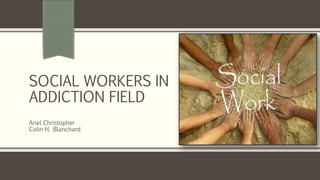
SOCIAL WORKERS IN
ADDICTION FIELD
Ariel Christopher
Colin H. Blanchard
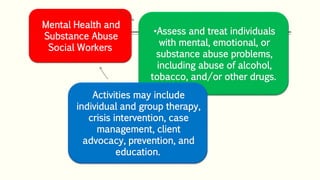
Mental Health and
Substance Abuse
Social Workers
•Assess and treat individuals
with mental, emotional, or
substance abuse problems,
including abuse of alcohol,
tobacco, and/or other drugs.
Activities may include
individual and group therapy,
crisis intervention, case
management, client
advocacy, prevention, and
education.
SOCIAL WORKERS IN THE ADDICTION FIELD
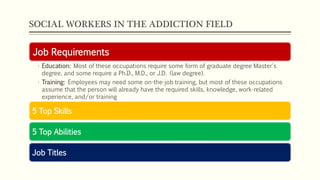
Job Requirements
• Education: Most of these occupations require some form of graduate degree Master's
degree, and some require a Ph.D., M.D., or J.D. (law degree).
• Training: Employees may need some on-the-job training, but most of these occupations
assume that the person will already have the required skills, knowledge, work-related
experience, and/or training
5 Top Skills
5 Top Abilities
Job Titles
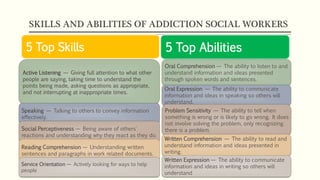
SKILLS AND ABILITIES OF ADDICTION SOCIAL WORKERS
5 Top Skills
Active Listening — Giving full attention to what other
people are saying, taking time to understand the
points being made, asking questions as appropriate,
and not interrupting at inappropriate times.
Speaking — Talking to others to convey information
effectively.
Social Perceptiveness — Being aware of others'
reactions and understanding why they react as they do.
Reading Comprehension — Understanding written
sentences and paragraphs in work related documents.
Service Orientation — Actively looking for ways to help
people
5 Top Abilities
Oral Comprehension — The ability to listen to and
understand information and ideas presented
through spoken words and sentences.
Oral Expression — The ability to communicate
information and ideas in speaking so others will
understand.
Problem Sensitivity — The ability to tell when
something is wrong or is likely to go wrong. It does
not involve solving the problem, only recognizing
there is a problem.
Written Comprehension — The ability to read and
understand information and ideas presented in
writing.
Written Expression — The ability to communicate
information and ideas in writing so others will
understand
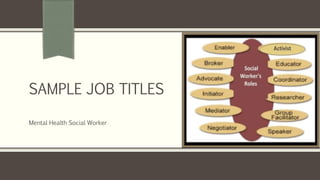
SAMPLE JOB TITLES
Mental Health Social Worker
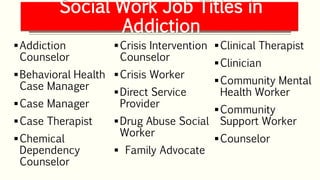
Social Work Job Titles in
Addiction
Addiction
Counselor
Behavioral Health
Case Manager
Case Manager
Case Therapist
Chemical
Dependency
Counselor
Crisis Intervention
Counselor
Crisis Worker
Direct Service
Provider
Drug Abuse Social
Worker
 Family Advocate
Clinical Therapist
Clinician
Community Mental
Health Worker
Community
Support Worker
Counselor
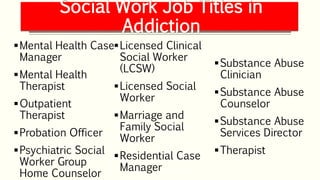
Social Work Job Titles in
Addiction
Mental Health Case
Manager
Mental Health
Therapist
Outpatient
Therapist
Probation Officer
Psychiatric Social
Worker Group
Home Counselor
Licensed Clinical
Social Worker
(LCSW)
Licensed Social
Worker
Marriage and
Family Social
Worker
Residential Case
Manager
Substance Abuse
Clinician
Substance Abuse
Counselor
Substance Abuse
Services Director
Therapist
SOCIAL WORK JOB
TASKS
Addictions
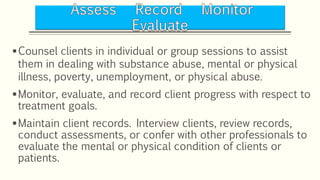
Counsel clients in individual or group sessions to assist
them in dealing with substance abuse, mental or physical
illness, poverty, unemployment, or physical abuse.
Monitor, evaluate, and record client progress with respect to
treatment goals.
Maintain client records. Interview clients, review records,
conduct assessments, or confer with other professionals to
evaluate the mental or physical condition of clients or
patients.
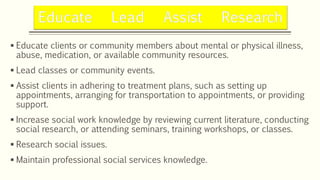
 Educate clients or community members about mental or physical illness,
abuse, medication, or available community resources.
 Lead classes or community events.
 Assist clients in adhering to treatment plans, such as setting up
appointments, arranging for transportation to appointments, or providing
support.
 Increase social work knowledge by reviewing current literature, conducting
social research, or attending seminars, training workshops, or classes.
 Research social issues.
 Maintain professional social services knowledge.
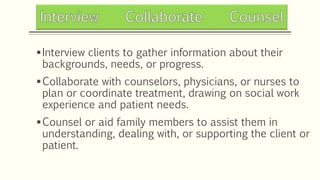
Interview clients to gather information about their
backgrounds, needs, or progress.
Collaborate with counselors, physicians, or nurses to
plan or coordinate treatment, drawing on social work
experience and patient needs.
Counsel or aid family members to assist them in
understanding, dealing with, or supporting the client or
patient.
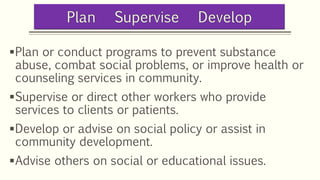
Plan or conduct programs to prevent substance
abuse, combat social problems, or improve health or
counseling services in community.
Supervise or direct other workers who provide
services to clients or patients.
Develop or advise on social policy or assist in
community development.
Advise others on social or educational issues.
WORK ACTIVITIES &
LEVEL OF
IMPORTANCE
Social work activities and duties
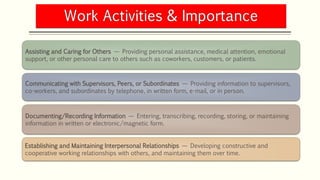
Assisting and Caring for Others — Providing personal assistance, medical attention, emotional
support, or other personal care to others such as coworkers, customers, or patients.
Communicating with Supervisors, Peers, or Subordinates — Providing information to supervisors,
co-workers, and subordinates by telephone, in written form, e-mail, or in person.
Documenting/Recording Information — Entering, transcribing, recording, storing, or maintaining
information in written or electronic/magnetic form.
Establishing and Maintaining Interpersonal Relationships — Developing constructive and
cooperative working relationships with others, and maintaining them over time.
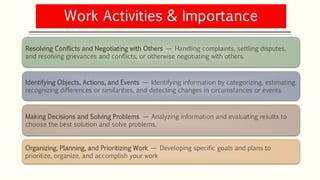
Resolving Conflicts and Negotiating with Others — Handling complaints, settling disputes,
and resolving grievances and conflicts, or otherwise negotiating with others.
Identifying Objects, Actions, and Events — Identifying information by categorizing, estimating,
recognizing differences or similarities, and detecting changes in circumstances or events.
Making Decisions and Solving Problems — Analyzing information and evaluating results to
choose the best solution and solve problems.
Organizing, Planning, and Prioritizing Work — Developing specific goals and plans to
prioritize, organize, and accomplish your work
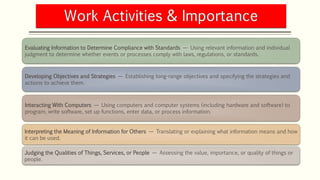
Evaluating Information to Determine Compliance with Standards — Using relevant information and individual
judgment to determine whether events or processes comply with laws, regulations, or standards.
Developing Objectives and Strategies — Establishing long-range objectives and specifying the strategies and
actions to achieve them.
Interacting With Computers — Using computers and computer systems (including hardware and software) to
program, write software, set up functions, enter data, or process information.
Interpreting the Meaning of Information for Others — Translating or explaining what information means and how
it can be used.
Judging the Qualities of Things, Services, or People — Assessing the value, importance, or quality of things or
people.
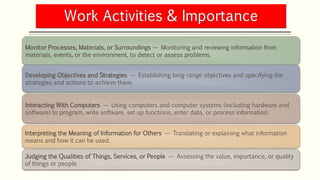
Monitor Processes, Materials, or Surroundings — Monitoring and reviewing information from
materials, events, or the environment, to detect or assess problems.
Developing Objectives and Strategies — Establishing long-range objectives and specifying the
strategies and actions to achieve them.
Interacting With Computers — Using computers and computer systems (including hardware and
software) to program, write software, set up functions, enter data, or process information.
Interpreting the Meaning of Information for Others — Translating or explaining what information
means and how it can be used.
Judging the Qualities of Things, Services, or People — Assessing the value, importance, or quality
of things or people.
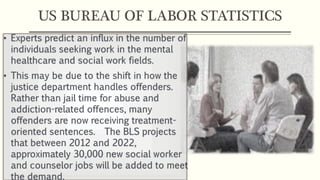
US BUREAU OF LABOR STATISTICS
LABOR STATISTICS
MEDIAN ANNUAL PAY
 Social workers get paid a median annual
wage of only $44,200, according to the
Bureau of Labor Statistics (BLS), but often
put in more than 60 hours of work a week.
They work during the week, at nights, and on
weekends.
 There are more than 600,000 of them
across the United States, and that number is
expected to grow at a rate of about 19
percent over the next 10 years – a rate that
is far faster than average.
 They are one of the least recognized
professions, yet they connect populations
most in need with the services that will help
CAROL WATSON LICSW
 Carol worked in addictions and mental health
for 10 years prior to teaching; five years of her
practice was dedicated to working with pregnant
women dependent upon opiates.
 Says Watson: “People are often confused about the role of
a social worker, but social workers are some of the most
well-prepared practitioners in our community. Social
workers are trained to understand the full range of bio-
psycho-social and cultural factors that impact an
individual’s wellbeing as well as the impact of the
environment and barriers to sustainable client change.”
CONNECTING with CLIENTS &
MULTIPLE BARRIERS to TREATMENT
WAYS TO CONNECT W CLIENT
 An addicted person, or one new to recovery,
may connect with a social worker in any
number of settings, including a hospital,
clinic, government services agency, school,
mental health clinic, or in private practice
 No matter the forum, depending upon the
specific needs of the client, the experience
with that social worker will be unique and
personal.
 There are almost no limits to what a social
worker can do to help patients grow strong
in recovery
 In some situations, it can be difficult to deal
with the red tape and legal restrictions
INDIVIDUALS MEET MULTIPLE BARRIERS
 Watson: “Because social work is a
broad profession, there are multiple
opportunities for social work
practitioners to engage with clients
and begin the process of rapport
building and resource connection.
 Most individuals seeking treatment for
addiction are met with multiple
barriers; these include distrust from
family and helping professionals, as
well as stigma and social policies that
are often geared towards punishment
rather than treatment.
COMMUNITY OUTREACH
“Community outreach social workers are in a unique position to
engage with potential clients by developing a relationship built on
the core value of the dignity and worth of all people. The client
may not be ready for change, but acknowledging that and listening
for ‘change talk’ can open the door for later opportunities. In
addition to an open door, social workers have the opportunity and
ethical responsibility to educate clients on proper prevention
techniques and prevent further harm to clients and the community.
This may include overdose prevention, resources on safer drug
use, and disease prevention.”
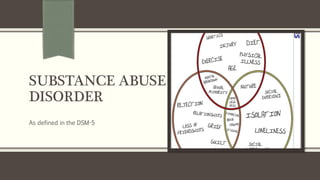
SUBSTANCE ABUSE
DISORDER
As defined in the DSM-5
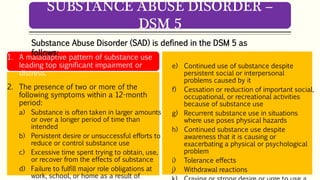
1. A maladaptive pattern of substance use
leading top significant impairment or
distress.
2. The presence of two or more of the
following symptoms within a 12-month
period:
a) Substance is often taken in larger amounts
or over a longer period of time than
intended
b) Persistent desire or unsuccessful efforts to
reduce or control substance use
c) Excessive time spent trying to obtain, use,
or recover from the effects of substance
d) Failure to fulfill major role obligations at
work, school, or home as a result of
e) Continued use of substance despite
persistent social or interpersonal
problems caused by it
f) Cessation or reduction of important social,
occupational, or recreational activities
because of substance use
g) Recurrent substance use in situations
where use poses physical hazards
h) Continued substance use despite
awareness that it is causing or
exacerbating a physical or psychological
problem
i) Tolerance effects
j) Withdrawal reactions
SUBSTANCE ABUSE DISORDER –
DSM 5
Substance Abuse Disorder (SAD) is defined in the DSM 5 as
follows:
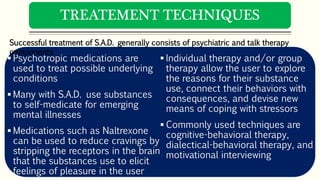
 Psychotropic medications are
used to treat possible underlying
conditions
 Many with S.A.D. use substances
to self-medicate for emerging
mental illnesses
 Medications such as Naltrexone
can be used to reduce cravings by
stripping the receptors in the brain
that the substances use to elicit
feelings of pleasure in the user
 Individual therapy and/or group
therapy allow the user to explore
the reasons for their substance
use, connect their behaviors with
consequences, and devise new
means of coping with stressors
 Commonly used techniques are
cognitive-behavioral therapy,
dialectical-behavioral therapy, and
motivational interviewing
TREATEMENT TECHNIQUES
Successful treatment of S.A.D. generally consists of psychiatric and talk therapy
components
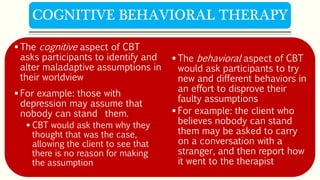
 The cognitive aspect of CBT
asks participants to identify and
alter maladaptive assumptions in
their worldview
 For example: those with
depression may assume that
nobody can stand them.
 CBT would ask them why they
thought that was the case,
allowing the client to see that
there is no reason for making
the assumption
 The behavioral aspect of CBT
would ask participants to try
new and different behaviors in
an effort to disprove their
faulty assumptions
 For example: the client who
believes nobody can stand
them may be asked to carry
on a conversation with a
stranger, and then report how
it went to the therapist
COGNITIVE BEHAVIORAL THERAPY
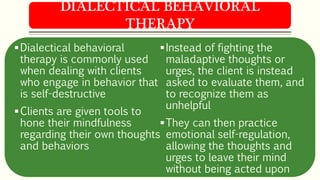
Dialectical behavioral
therapy is commonly used
when dealing with clients
who engage in behavior that
is self-destructive
Clients are given tools to
hone their mindfulness
regarding their own thoughts
and behaviors
Instead of fighting the
maladaptive thoughts or
urges, the client is instead
asked to evaluate them, and
to recognize them as
unhelpful
They can then practice
emotional self-regulation,
allowing the thoughts and
urges to leave their mind
without being acted upon
DIALECTICAL BEHAVIORAL
THERAPY
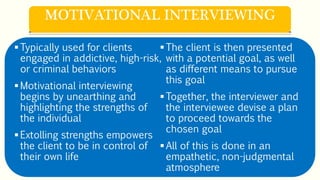
Typically used for clients
engaged in addictive, high-risk,
or criminal behaviors
Motivational interviewing
begins by unearthing and
highlighting the strengths of
the individual
Extolling strengths empowers
the client to be in control of
their own life
The client is then presented
with a potential goal, as well
as different means to pursue
this goal
Together, the interviewer and
the interviewee devise a plan
to proceed towards the
chosen goal
All of this is done in an
empathetic, non-judgmental
atmosphere
MOTIVATIONAL INTERVIEWING
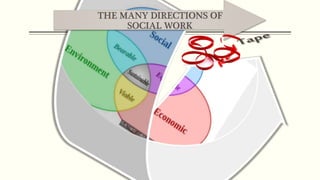
THE MANY DIRECTIONS OF
SOCIAL WORK
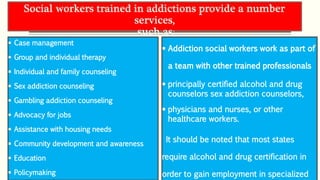
Social workers trained in addictions provide a number
services,
such as:
References
Editor. "Addiction Social Worker Outlook and Career Guidance." Substance Abuse Social Work
Careers | CareersinPsychology.org. Careers in Psychology.org, n.d. Web. 15 Nov. 2016.
Reardon, Christina, MSW, LSW. "Motivational Interviewing and Addictions: Collaboration, Not
Confrontation." Social Work Today 15.6 (n.d.): 22. Web. 15 Nov. 2016.
Ricchutio, A. D., D.D. MSW. "Yoga as Adjunct Therapy for Substance Use." Social Work Today
Sept. 2012: 8. Print.
Rubin, J., MSW. (n.d.). Addictions Advisor: A New, Integrative Approach to Curb Addiction.
Social Work Today, 15(4), 8. Retrieved November 15, 2016, from
www.socialworktoday/com.
Mental Health and Substance Abuse Social Workers: Job Description. (n.d.). Retrieved
November 15, 2016, from http://www.myplan.com/careers/mental-health-and-substance-
abuse-social-workers/description-21-1023.00.html

BSW Salem State Project

  • 1.
    SOCIAL WORKERS IN ADDICTIONFIELD Ariel Christopher Colin H. Blanchard
  • 2.
    Mental Health and SubstanceAbuse Social Workers •Assess and treat individuals with mental, emotional, or substance abuse problems, including abuse of alcohol, tobacco, and/or other drugs. Activities may include individual and group therapy, crisis intervention, case management, client advocacy, prevention, and education.
  • 3.
    SOCIAL WORKERS INTHE ADDICTION FIELD Job Requirements • Education: Most of these occupations require some form of graduate degree Master's degree, and some require a Ph.D., M.D., or J.D. (law degree). • Training: Employees may need some on-the-job training, but most of these occupations assume that the person will already have the required skills, knowledge, work-related experience, and/or training 5 Top Skills 5 Top Abilities Job Titles
  • 4.
    SKILLS AND ABILITIESOF ADDICTION SOCIAL WORKERS 5 Top Skills Active Listening — Giving full attention to what other people are saying, taking time to understand the points being made, asking questions as appropriate, and not interrupting at inappropriate times. Speaking — Talking to others to convey information effectively. Social Perceptiveness — Being aware of others' reactions and understanding why they react as they do. Reading Comprehension — Understanding written sentences and paragraphs in work related documents. Service Orientation — Actively looking for ways to help people 5 Top Abilities Oral Comprehension — The ability to listen to and understand information and ideas presented through spoken words and sentences. Oral Expression — The ability to communicate information and ideas in speaking so others will understand. Problem Sensitivity — The ability to tell when something is wrong or is likely to go wrong. It does not involve solving the problem, only recognizing there is a problem. Written Comprehension — The ability to read and understand information and ideas presented in writing. Written Expression — The ability to communicate information and ideas in writing so others will understand
  • 5.
    SAMPLE JOB TITLES MentalHealth Social Worker
  • 6.
    Social Work JobTitles in Addiction Addiction Counselor Behavioral Health Case Manager Case Manager Case Therapist Chemical Dependency Counselor Crisis Intervention Counselor Crisis Worker Direct Service Provider Drug Abuse Social Worker  Family Advocate Clinical Therapist Clinician Community Mental Health Worker Community Support Worker Counselor
  • 7.
    Social Work JobTitles in Addiction Mental Health Case Manager Mental Health Therapist Outpatient Therapist Probation Officer Psychiatric Social Worker Group Home Counselor Licensed Clinical Social Worker (LCSW) Licensed Social Worker Marriage and Family Social Worker Residential Case Manager Substance Abuse Clinician Substance Abuse Counselor Substance Abuse Services Director Therapist
  • 8.
  • 9.
    Counsel clients inindividual or group sessions to assist them in dealing with substance abuse, mental or physical illness, poverty, unemployment, or physical abuse. Monitor, evaluate, and record client progress with respect to treatment goals. Maintain client records. Interview clients, review records, conduct assessments, or confer with other professionals to evaluate the mental or physical condition of clients or patients.
  • 10.
     Educate clientsor community members about mental or physical illness, abuse, medication, or available community resources.  Lead classes or community events.  Assist clients in adhering to treatment plans, such as setting up appointments, arranging for transportation to appointments, or providing support.  Increase social work knowledge by reviewing current literature, conducting social research, or attending seminars, training workshops, or classes.  Research social issues.  Maintain professional social services knowledge.
  • 11.
    Interview clients togather information about their backgrounds, needs, or progress. Collaborate with counselors, physicians, or nurses to plan or coordinate treatment, drawing on social work experience and patient needs. Counsel or aid family members to assist them in understanding, dealing with, or supporting the client or patient.
  • 12.
    Plan or conductprograms to prevent substance abuse, combat social problems, or improve health or counseling services in community. Supervise or direct other workers who provide services to clients or patients. Develop or advise on social policy or assist in community development. Advise others on social or educational issues.
  • 13.
    WORK ACTIVITIES & LEVELOF IMPORTANCE Social work activities and duties
  • 14.
    Assisting and Caringfor Others — Providing personal assistance, medical attention, emotional support, or other personal care to others such as coworkers, customers, or patients. Communicating with Supervisors, Peers, or Subordinates — Providing information to supervisors, co-workers, and subordinates by telephone, in written form, e-mail, or in person. Documenting/Recording Information — Entering, transcribing, recording, storing, or maintaining information in written or electronic/magnetic form. Establishing and Maintaining Interpersonal Relationships — Developing constructive and cooperative working relationships with others, and maintaining them over time.
  • 15.
    Resolving Conflicts andNegotiating with Others — Handling complaints, settling disputes, and resolving grievances and conflicts, or otherwise negotiating with others. Identifying Objects, Actions, and Events — Identifying information by categorizing, estimating, recognizing differences or similarities, and detecting changes in circumstances or events. Making Decisions and Solving Problems — Analyzing information and evaluating results to choose the best solution and solve problems. Organizing, Planning, and Prioritizing Work — Developing specific goals and plans to prioritize, organize, and accomplish your work
  • 16.
    Evaluating Information toDetermine Compliance with Standards — Using relevant information and individual judgment to determine whether events or processes comply with laws, regulations, or standards. Developing Objectives and Strategies — Establishing long-range objectives and specifying the strategies and actions to achieve them. Interacting With Computers — Using computers and computer systems (including hardware and software) to program, write software, set up functions, enter data, or process information. Interpreting the Meaning of Information for Others — Translating or explaining what information means and how it can be used. Judging the Qualities of Things, Services, or People — Assessing the value, importance, or quality of things or people.
  • 17.
    Monitor Processes, Materials,or Surroundings — Monitoring and reviewing information from materials, events, or the environment, to detect or assess problems. Developing Objectives and Strategies — Establishing long-range objectives and specifying the strategies and actions to achieve them. Interacting With Computers — Using computers and computer systems (including hardware and software) to program, write software, set up functions, enter data, or process information. Interpreting the Meaning of Information for Others — Translating or explaining what information means and how it can be used. Judging the Qualities of Things, Services, or People — Assessing the value, importance, or quality of things or people.
  • 18.
    US BUREAU OFLABOR STATISTICS
  • 19.
    US BUREAU OFLABOR STATISTICS
  • 20.
    LABOR STATISTICS MEDIAN ANNUALPAY  Social workers get paid a median annual wage of only $44,200, according to the Bureau of Labor Statistics (BLS), but often put in more than 60 hours of work a week. They work during the week, at nights, and on weekends.  There are more than 600,000 of them across the United States, and that number is expected to grow at a rate of about 19 percent over the next 10 years – a rate that is far faster than average.  They are one of the least recognized professions, yet they connect populations most in need with the services that will help CAROL WATSON LICSW  Carol worked in addictions and mental health for 10 years prior to teaching; five years of her practice was dedicated to working with pregnant women dependent upon opiates.  Says Watson: “People are often confused about the role of a social worker, but social workers are some of the most well-prepared practitioners in our community. Social workers are trained to understand the full range of bio- psycho-social and cultural factors that impact an individual’s wellbeing as well as the impact of the environment and barriers to sustainable client change.”
  • 21.
    CONNECTING with CLIENTS& MULTIPLE BARRIERS to TREATMENT WAYS TO CONNECT W CLIENT  An addicted person, or one new to recovery, may connect with a social worker in any number of settings, including a hospital, clinic, government services agency, school, mental health clinic, or in private practice  No matter the forum, depending upon the specific needs of the client, the experience with that social worker will be unique and personal.  There are almost no limits to what a social worker can do to help patients grow strong in recovery  In some situations, it can be difficult to deal with the red tape and legal restrictions INDIVIDUALS MEET MULTIPLE BARRIERS  Watson: “Because social work is a broad profession, there are multiple opportunities for social work practitioners to engage with clients and begin the process of rapport building and resource connection.  Most individuals seeking treatment for addiction are met with multiple barriers; these include distrust from family and helping professionals, as well as stigma and social policies that are often geared towards punishment rather than treatment.
  • 22.
    COMMUNITY OUTREACH “Community outreachsocial workers are in a unique position to engage with potential clients by developing a relationship built on the core value of the dignity and worth of all people. The client may not be ready for change, but acknowledging that and listening for ‘change talk’ can open the door for later opportunities. In addition to an open door, social workers have the opportunity and ethical responsibility to educate clients on proper prevention techniques and prevent further harm to clients and the community. This may include overdose prevention, resources on safer drug use, and disease prevention.”
  • 23.
  • 24.
    1. A maladaptivepattern of substance use leading top significant impairment or distress. 2. The presence of two or more of the following symptoms within a 12-month period: a) Substance is often taken in larger amounts or over a longer period of time than intended b) Persistent desire or unsuccessful efforts to reduce or control substance use c) Excessive time spent trying to obtain, use, or recover from the effects of substance d) Failure to fulfill major role obligations at work, school, or home as a result of e) Continued use of substance despite persistent social or interpersonal problems caused by it f) Cessation or reduction of important social, occupational, or recreational activities because of substance use g) Recurrent substance use in situations where use poses physical hazards h) Continued substance use despite awareness that it is causing or exacerbating a physical or psychological problem i) Tolerance effects j) Withdrawal reactions SUBSTANCE ABUSE DISORDER – DSM 5 Substance Abuse Disorder (SAD) is defined in the DSM 5 as follows:
  • 25.
     Psychotropic medicationsare used to treat possible underlying conditions  Many with S.A.D. use substances to self-medicate for emerging mental illnesses  Medications such as Naltrexone can be used to reduce cravings by stripping the receptors in the brain that the substances use to elicit feelings of pleasure in the user  Individual therapy and/or group therapy allow the user to explore the reasons for their substance use, connect their behaviors with consequences, and devise new means of coping with stressors  Commonly used techniques are cognitive-behavioral therapy, dialectical-behavioral therapy, and motivational interviewing TREATEMENT TECHNIQUES Successful treatment of S.A.D. generally consists of psychiatric and talk therapy components
  • 26.
     The cognitiveaspect of CBT asks participants to identify and alter maladaptive assumptions in their worldview  For example: those with depression may assume that nobody can stand them.  CBT would ask them why they thought that was the case, allowing the client to see that there is no reason for making the assumption  The behavioral aspect of CBT would ask participants to try new and different behaviors in an effort to disprove their faulty assumptions  For example: the client who believes nobody can stand them may be asked to carry on a conversation with a stranger, and then report how it went to the therapist COGNITIVE BEHAVIORAL THERAPY
  • 27.
    Dialectical behavioral therapy iscommonly used when dealing with clients who engage in behavior that is self-destructive Clients are given tools to hone their mindfulness regarding their own thoughts and behaviors Instead of fighting the maladaptive thoughts or urges, the client is instead asked to evaluate them, and to recognize them as unhelpful They can then practice emotional self-regulation, allowing the thoughts and urges to leave their mind without being acted upon DIALECTICAL BEHAVIORAL THERAPY
  • 28.
    Typically used forclients engaged in addictive, high-risk, or criminal behaviors Motivational interviewing begins by unearthing and highlighting the strengths of the individual Extolling strengths empowers the client to be in control of their own life The client is then presented with a potential goal, as well as different means to pursue this goal Together, the interviewer and the interviewee devise a plan to proceed towards the chosen goal All of this is done in an empathetic, non-judgmental atmosphere MOTIVATIONAL INTERVIEWING
  • 29.
    THE MANY DIRECTIONSOF SOCIAL WORK
  • 30.
    Social workers trainedin addictions provide a number services, such as:
  • 31.
    References Editor. "Addiction SocialWorker Outlook and Career Guidance." Substance Abuse Social Work Careers | CareersinPsychology.org. Careers in Psychology.org, n.d. Web. 15 Nov. 2016. Reardon, Christina, MSW, LSW. "Motivational Interviewing and Addictions: Collaboration, Not Confrontation." Social Work Today 15.6 (n.d.): 22. Web. 15 Nov. 2016. Ricchutio, A. D., D.D. MSW. "Yoga as Adjunct Therapy for Substance Use." Social Work Today Sept. 2012: 8. Print. Rubin, J., MSW. (n.d.). Addictions Advisor: A New, Integrative Approach to Curb Addiction. Social Work Today, 15(4), 8. Retrieved November 15, 2016, from www.socialworktoday/com. Mental Health and Substance Abuse Social Workers: Job Description. (n.d.). Retrieved November 15, 2016, from http://www.myplan.com/careers/mental-health-and-substance- abuse-social-workers/description-21-1023.00.html

Editor's Notes

  • #2 NOTE: To change the image on this slide, select the picture and delete it. Then click the Pictures icon in the placeholder to insert your own image.
  • #6 NOTE: To change the image on this slide, select the picture and delete it. Then click the Pictures icon in the placeholder to insert your own image.
  • #9 NOTE: To change the image on this slide, select the picture and delete it. Then click the Pictures icon in the placeholder to insert your own image.
  • #14 NOTE: To change the image on this slide, select the picture and delete it. Then click the Pictures icon in the placeholder to insert your own image.
  • #24 NOTE: To change the image on this slide, select the picture and delete it. Then click the Pictures icon in the placeholder to insert your own image.