International Trade
up  Give up He’s much better than you http://www.youtube.com/watch?v=Pd_qs8ueIWw
Syllabus Aims To understand the benefits and costs of  specialisation  and trade;  To understand the law of comparative advantage. Students should understand the distinction between absolute and comparative advantage. The significance of opportunity cost should be emphasised. Comparative advantage may be illustrated numerically and diagrammatically.

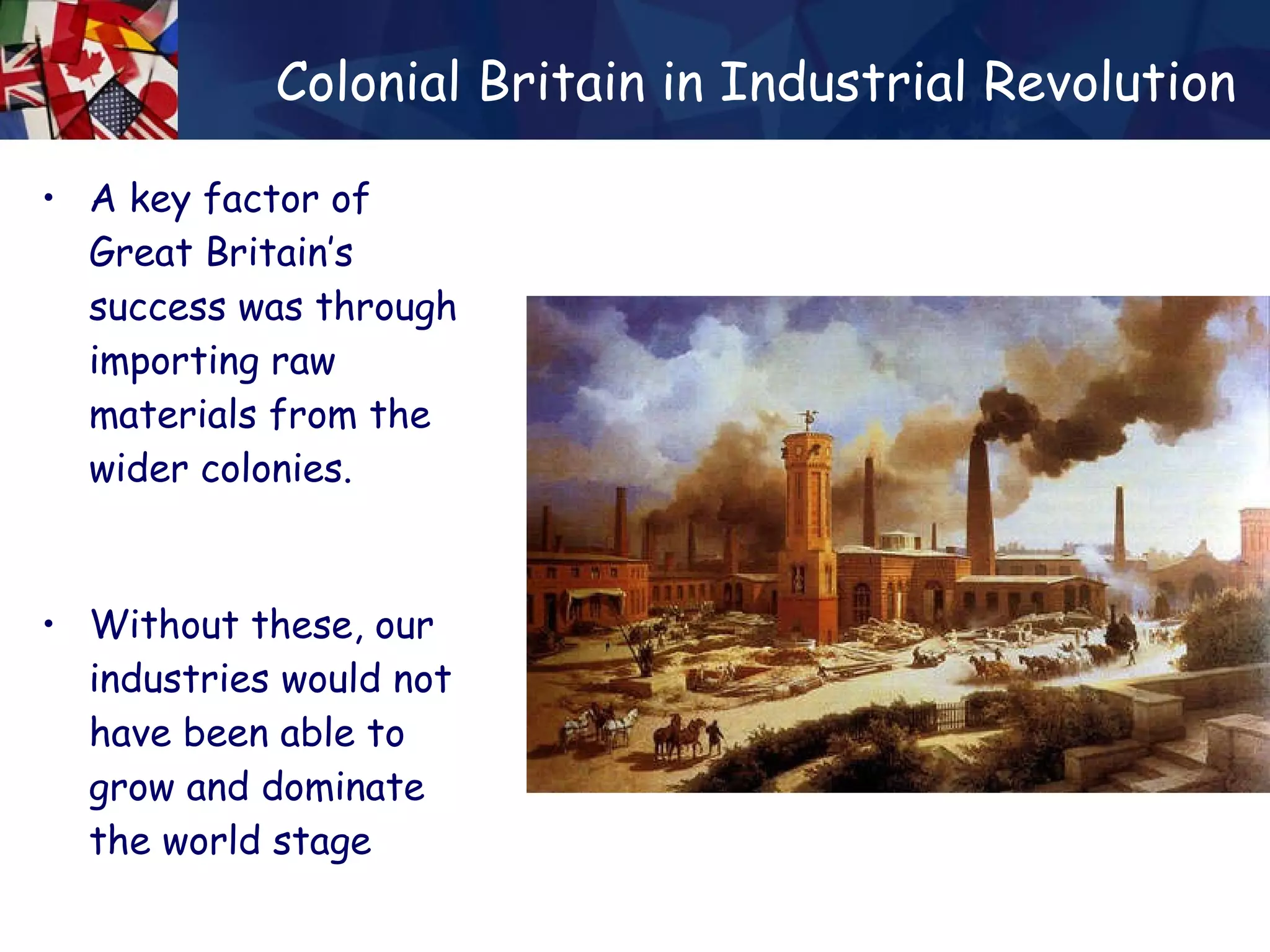
Colonial Britain in Industrial Revolution A key factor of Great Britain’s success was through importing raw materials from the wider colonies. Without these, our industries would not have been able to grow and dominate the world stage
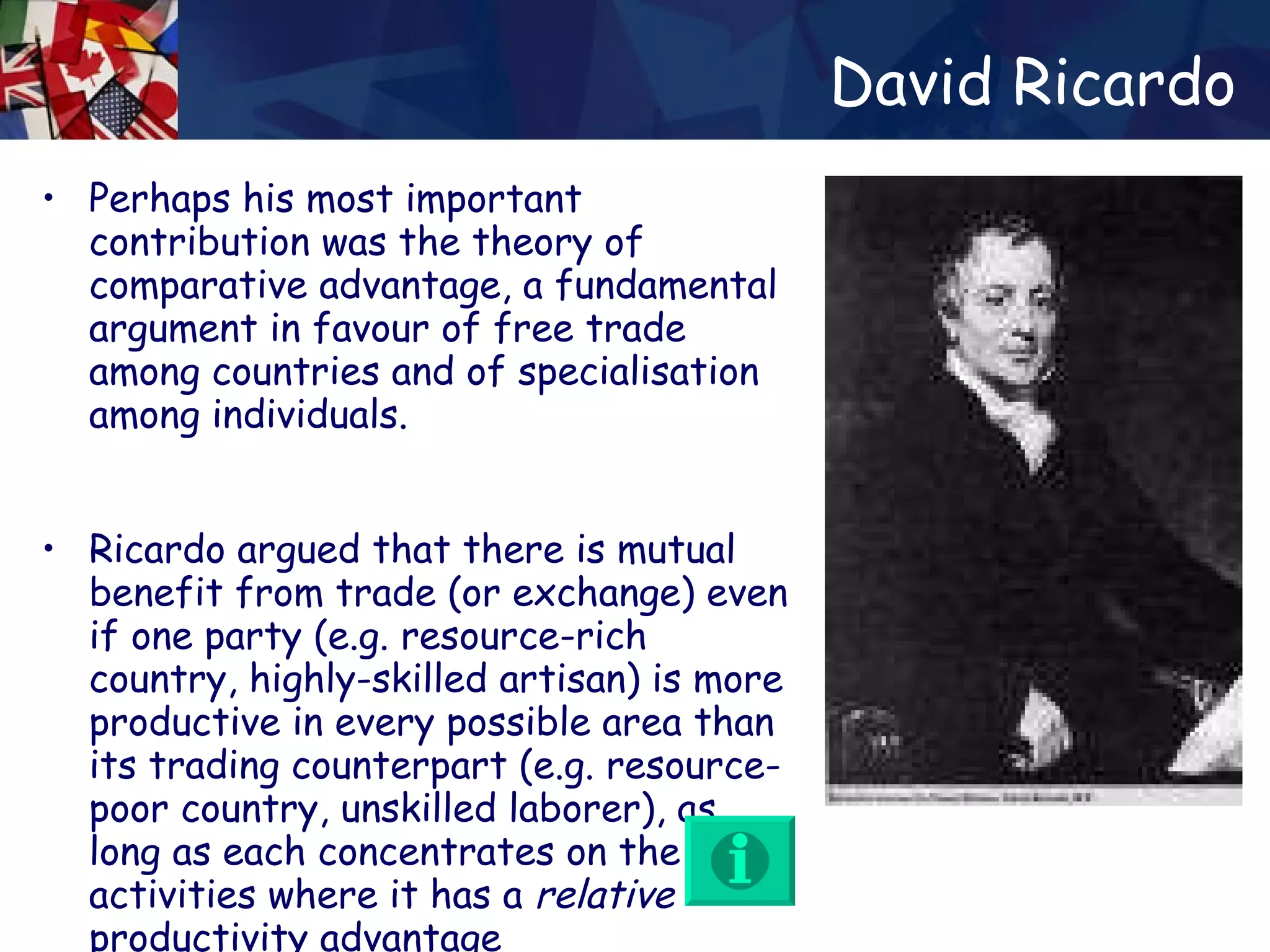
David Ricardo Perhaps his most important contribution was the theory of comparative advantage, a fundamental argument in favour of free trade among countries and of specialisation among individuals.  Ricardo argued that there is mutual benefit from trade (or exchange) even if one party (e.g. resource-rich country, highly-skilled artisan) is more productive in every possible area than its trading counterpart (e.g. resource-poor country, unskilled laborer), as long as each concentrates on the activities where it has a  relative  productivity advantage
Specialisation
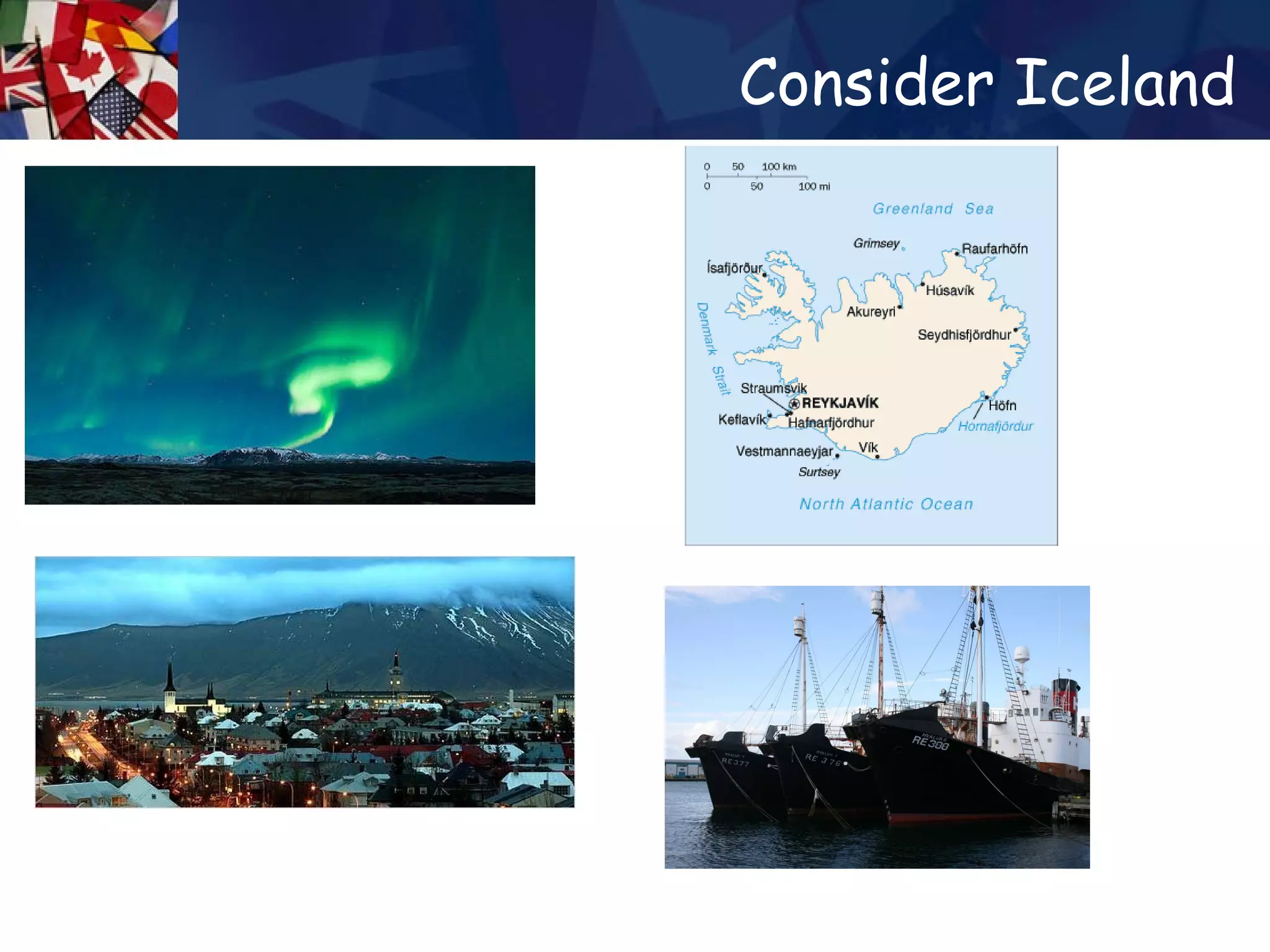
Consider Iceland
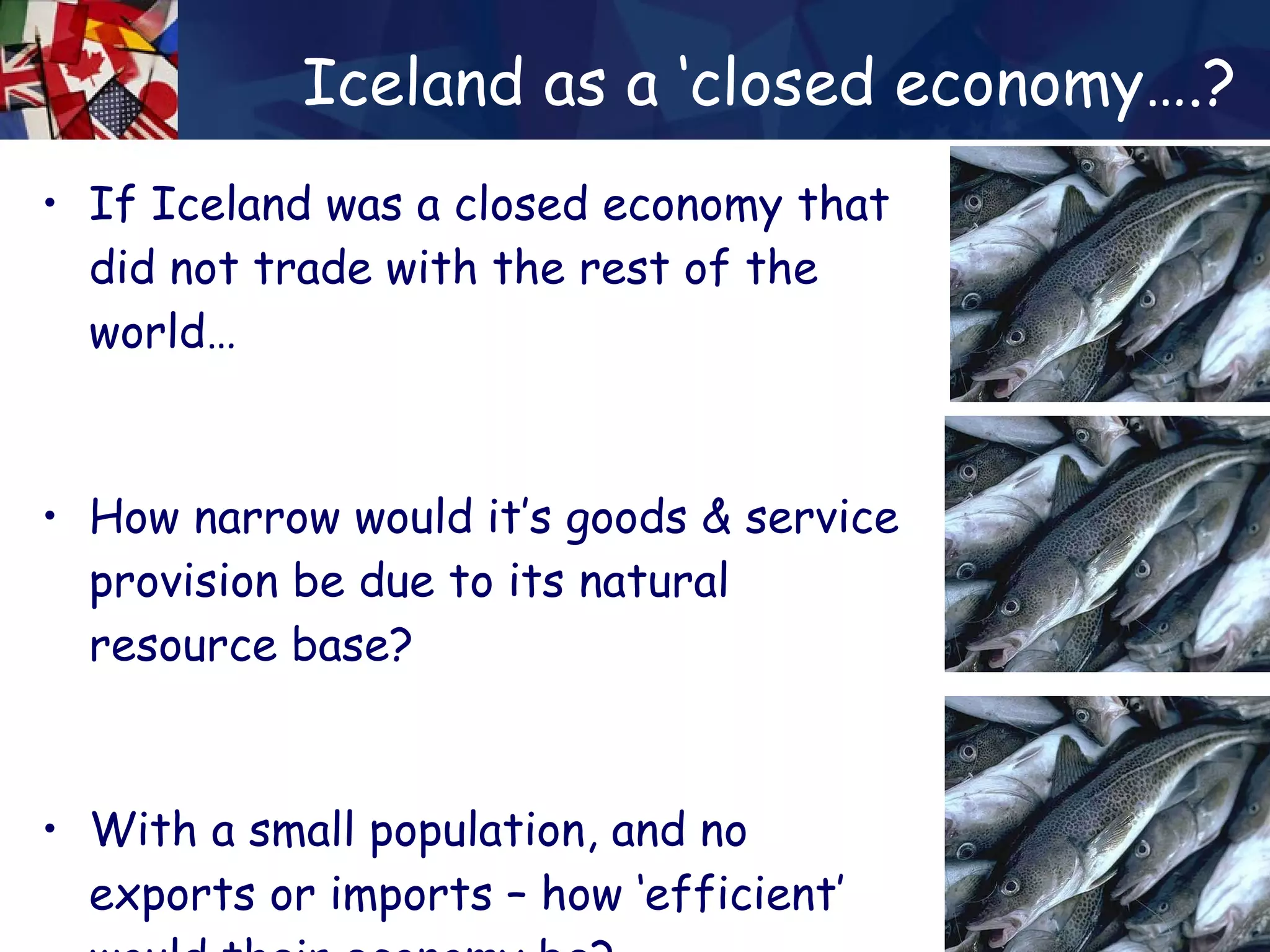
Iceland as a ‘closed economy….? If Iceland was a closed economy that did not trade with the rest of the world… How narrow would it’s goods & service provision be due to its natural resource base? With a small population, and no exports or imports – how ‘efficient’ would their economy be?
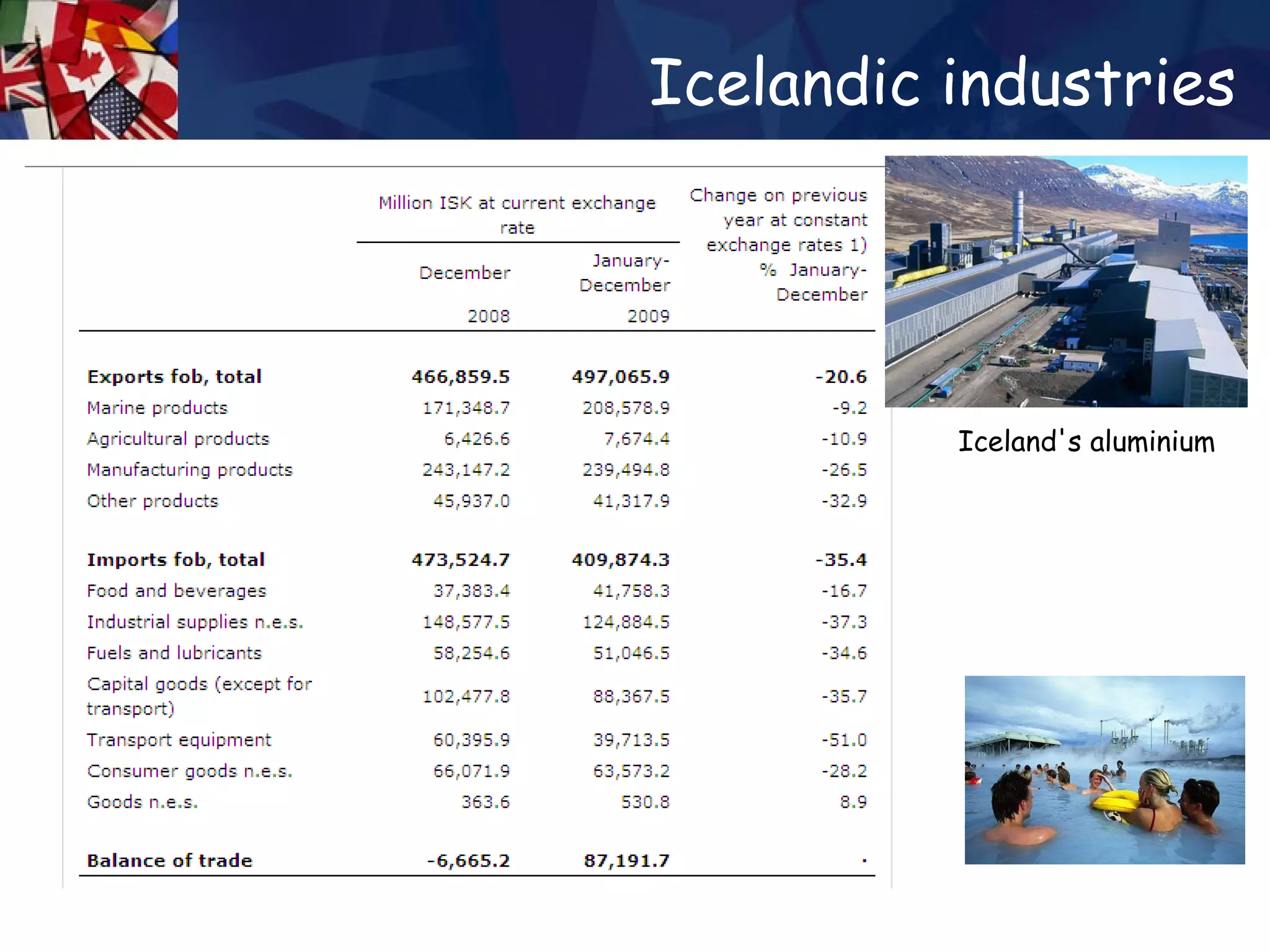
Iceland as an open economy… In an open economy, with international trade Iceland can import raw materials and energy It allows Iceland’s PPF to grow Iceland can now produce a greater range of goods and services. By gaining access to a larger market – Iceland benefits from economies of scale and larger production runs. Icelandic household’s benefit from a greater choice, higher living standards and economic welfare with international trade than it ever could generate without it.
Icelandic industries Iceland's aluminium
Key theory
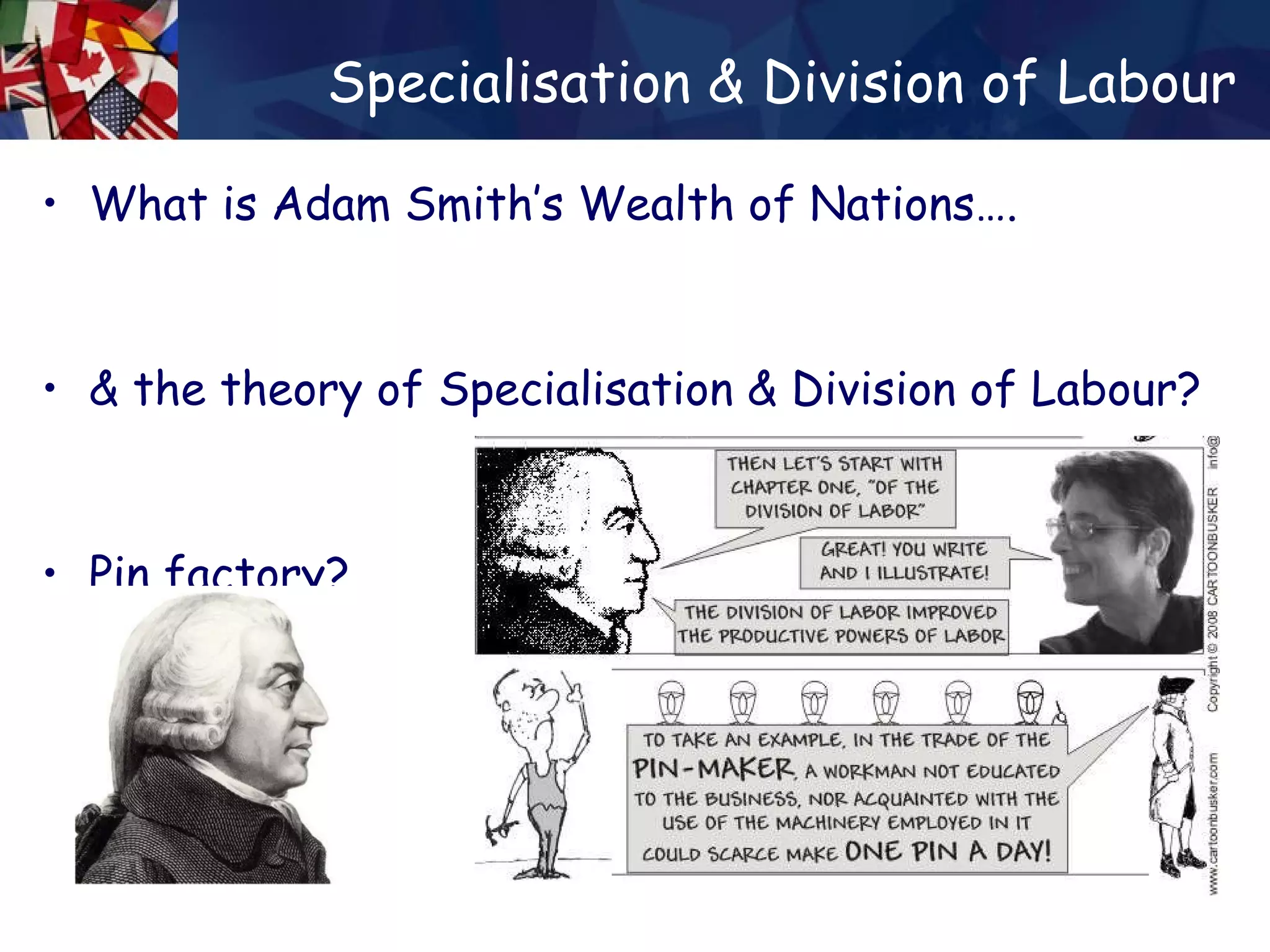
Specialisation & Division of Labour What is Adam Smith’s Wealth of Nations…. & the theory of Specialisation & Division of Labour? Pin factory?
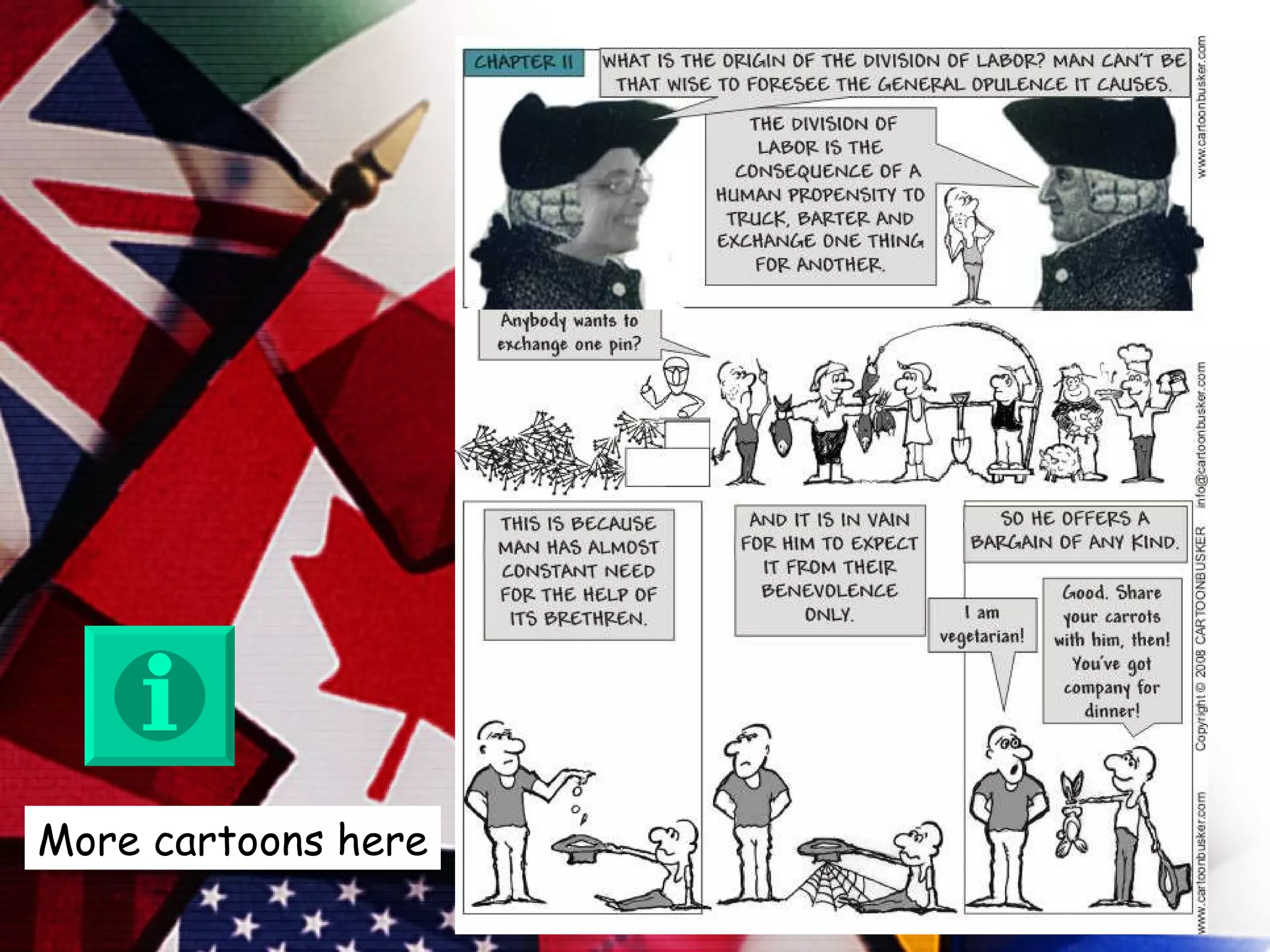
More cartoons here
Specialisation Three main reasons why specialisation increases total output: Workers don’t switch between tasks, so time is saved More & better machinery is employed, aka  capital widening   Practice makes workers more efficient & productive
So how does this link to  International trade?
Absolute Advantage Absolute Advantage  is where one country is better at producing a product rather than another country.  It can make more , i.e. it has greater productivity. Absolute Advantage is the ability to produce more using fewer resources than any other country / region.
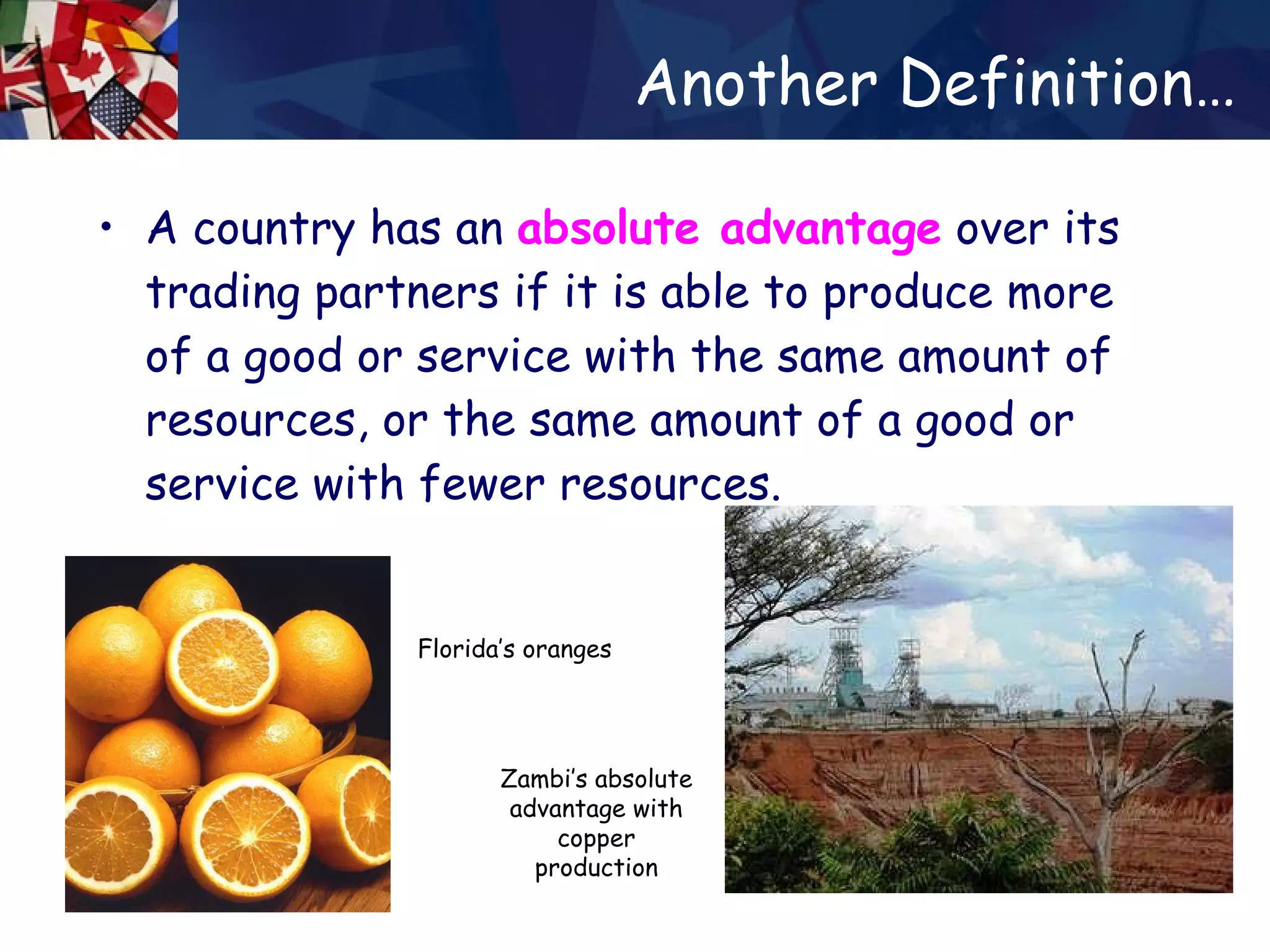
Another Definition… A country has an  absolute advantage  over its trading partners if it is able to produce more of a good or service with the same amount of resources, or the same amount of a good or service with fewer resources.  Zambi’s absolute advantage with copper production Florida’s oranges
Your go… On your whiteboard Write  UK  on one side France  on the other
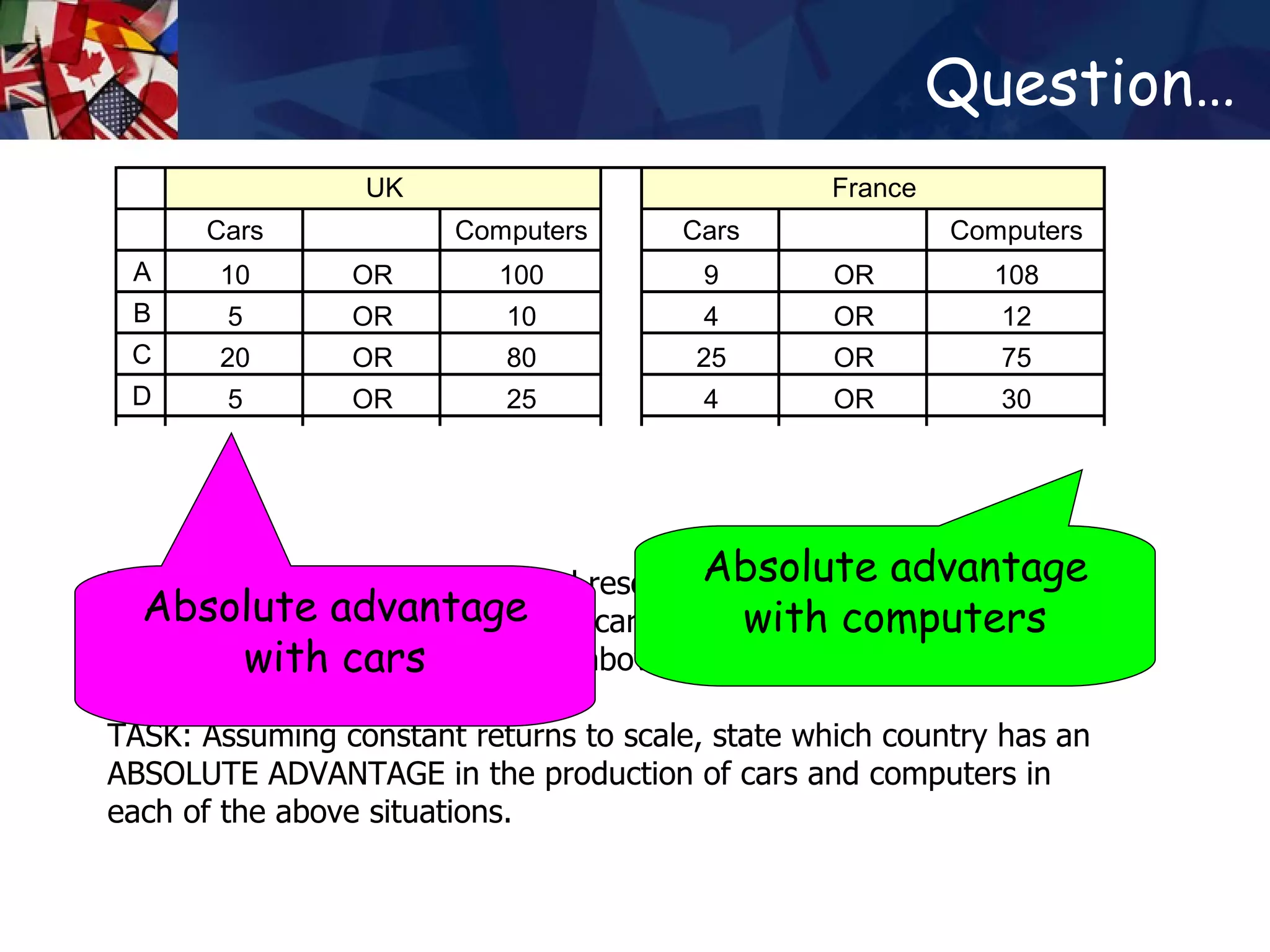
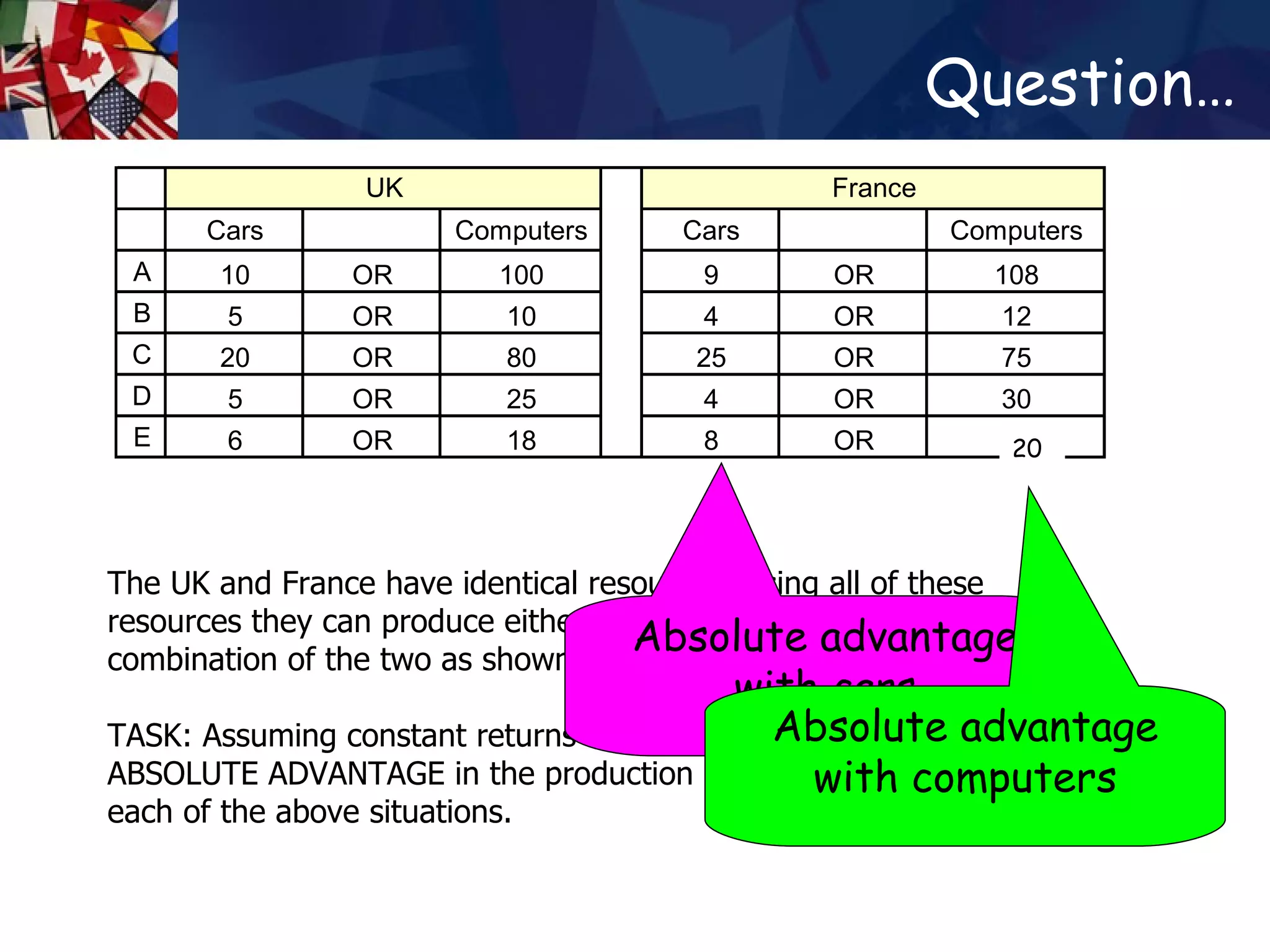
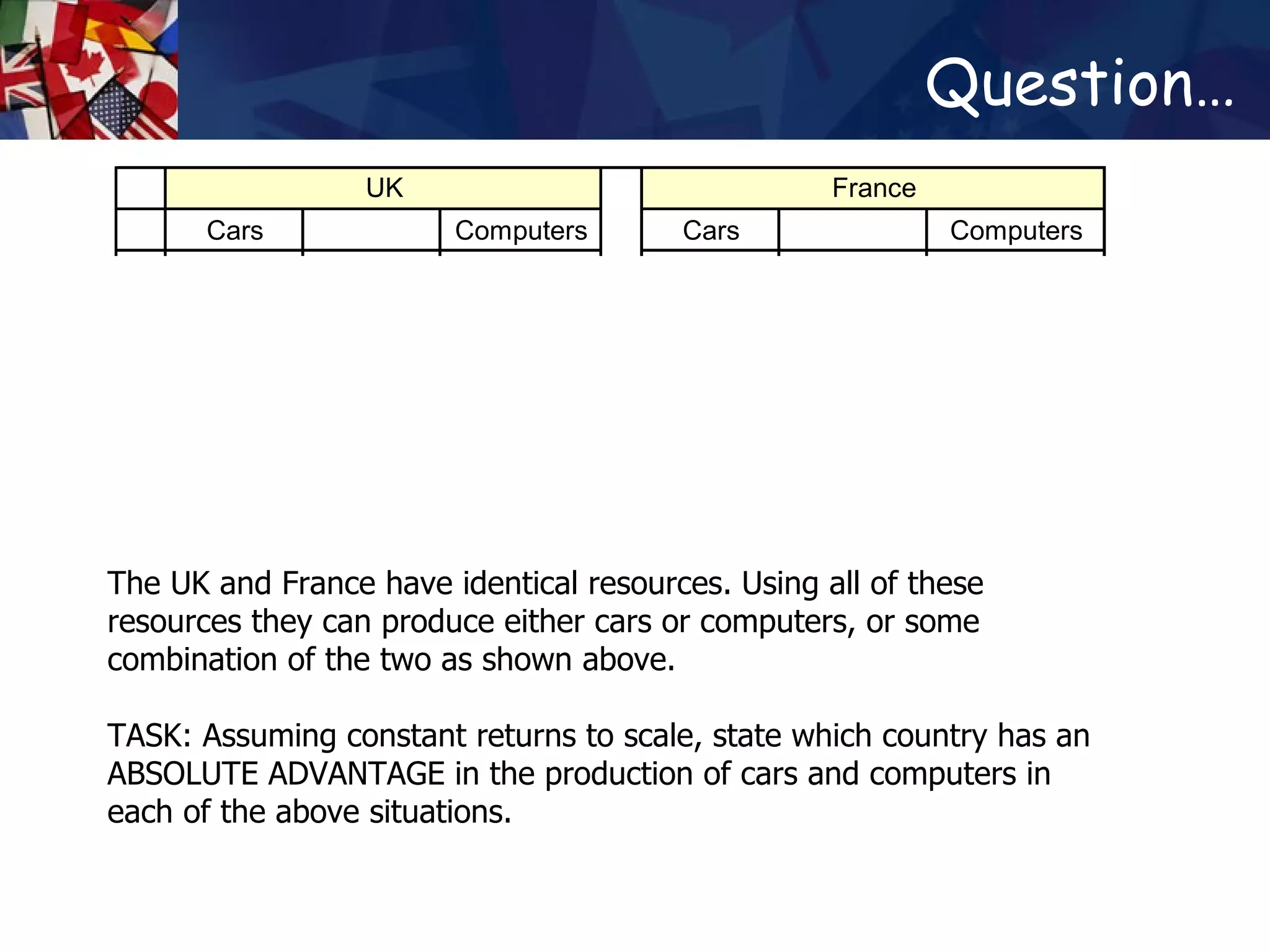
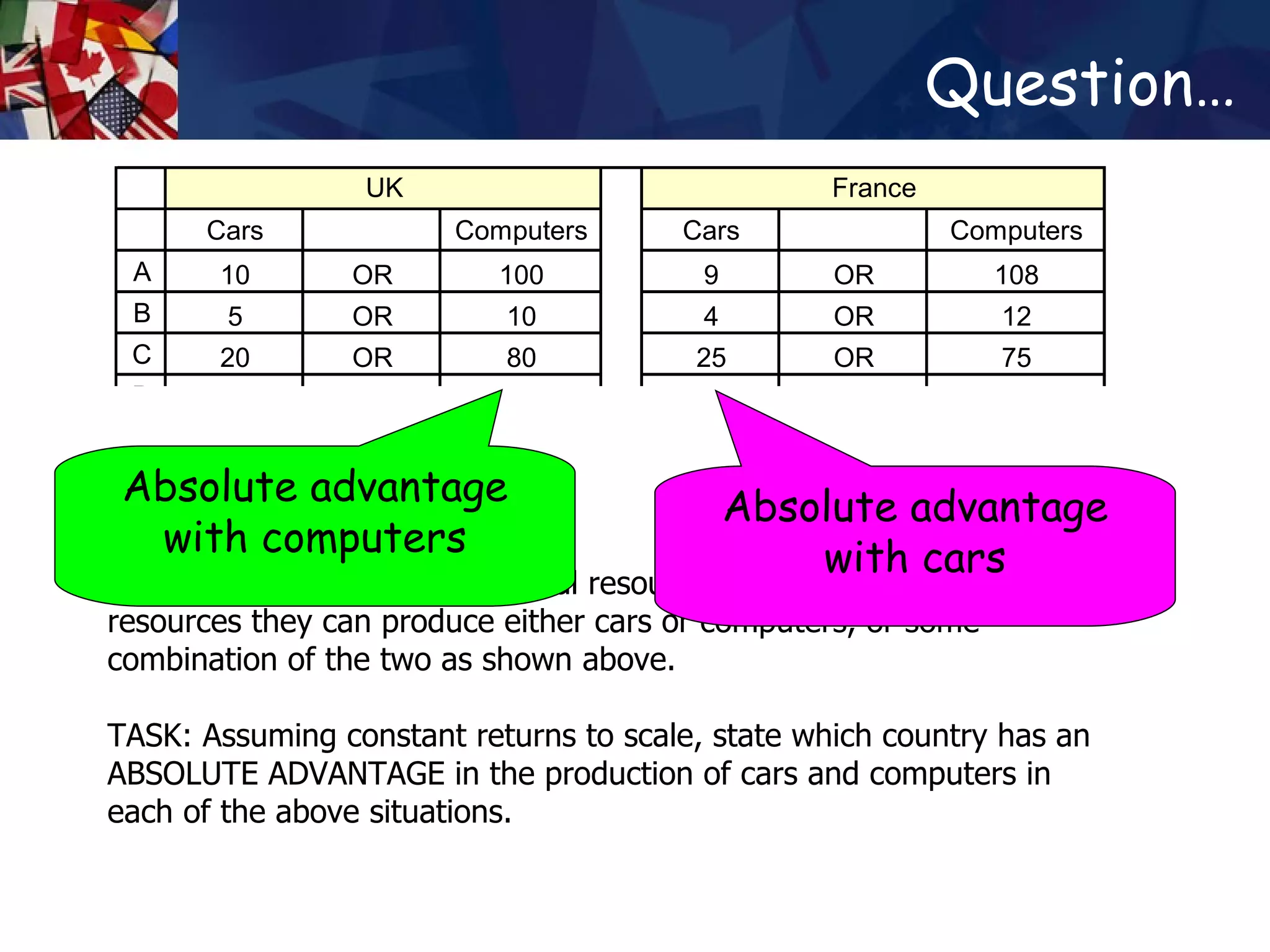
Question… The UK and France have identical resources. Using all of these resources they can produce either cars or computers, or some combination of the two as shown above.  TASK: Assuming constant returns to scale, state which country has an ABSOLUTE ADVANTAGE in the production of cars and computers in each of the above situations.
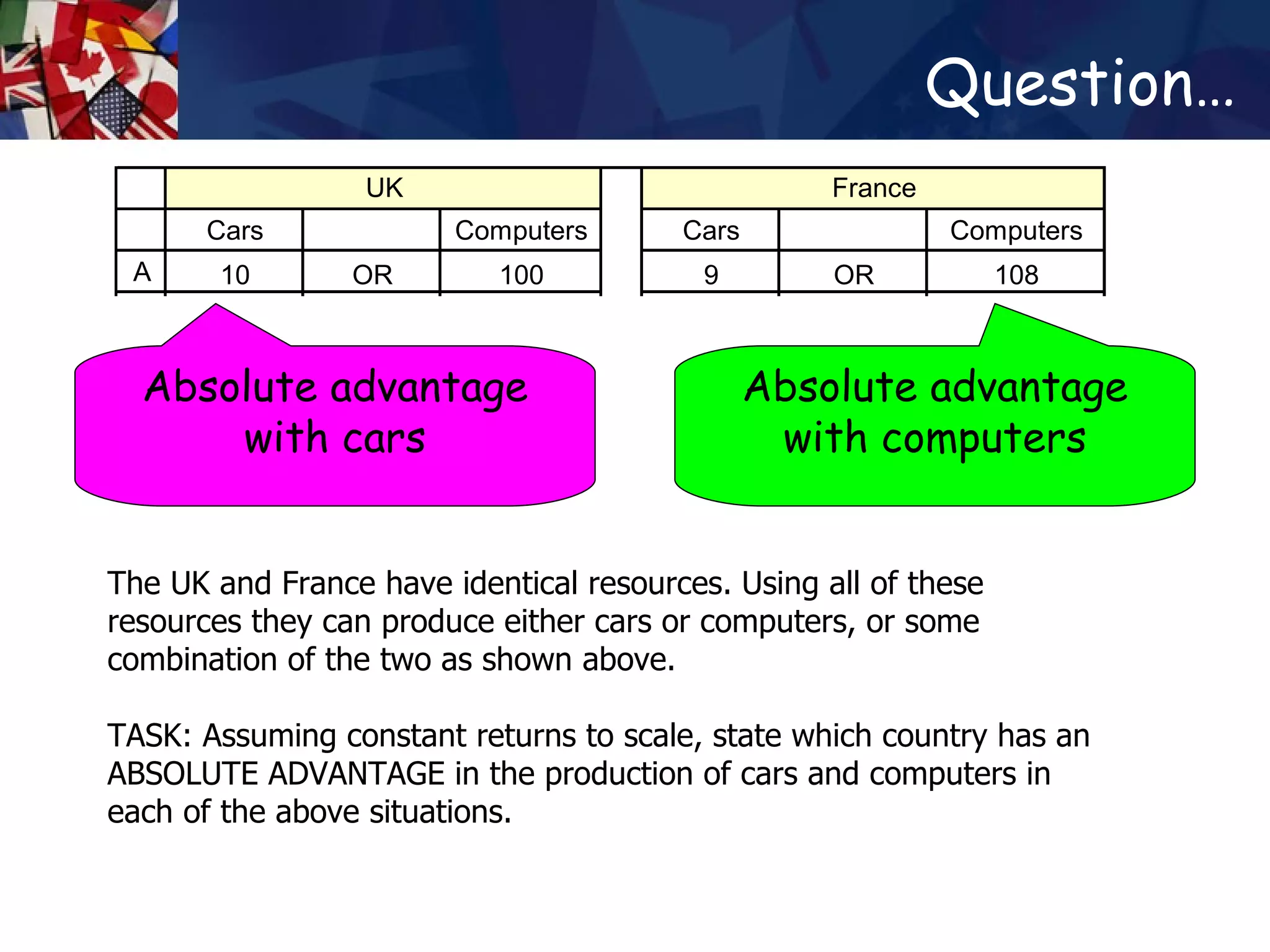
Question… The UK and France have identical resources. Using all of these resources they can produce either cars or computers, or some combination of the two as shown above.  TASK: Assuming constant returns to scale, state which country has an ABSOLUTE ADVANTAGE in the production of cars and computers in each of the above situations.  Absolute advantage with cars Absolute advantage with computers
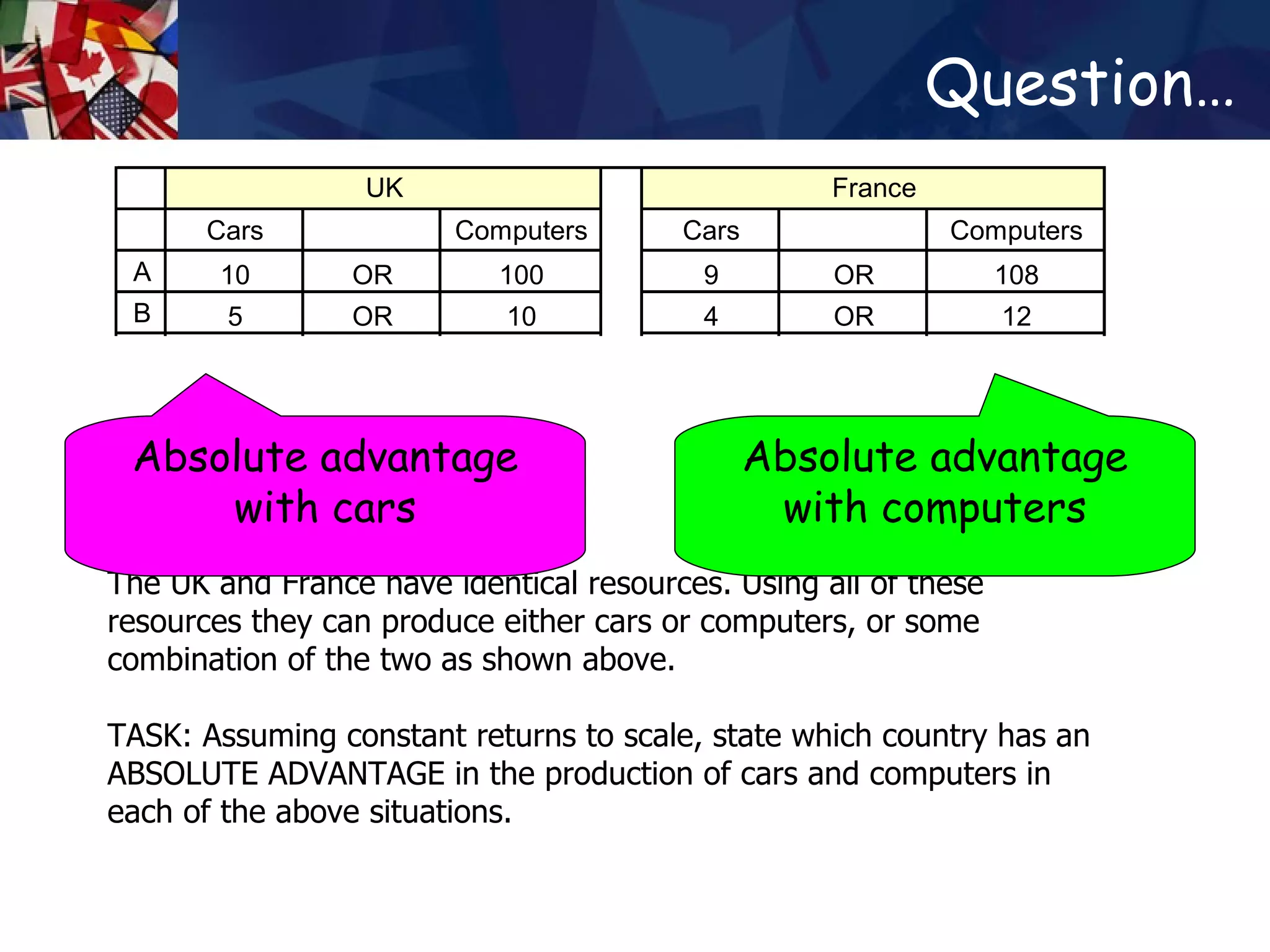
Question… The UK and France have identical resources. Using all of these resources they can produce either cars or computers, or some combination of the two as shown above.  TASK: Assuming constant returns to scale, state which country has an ABSOLUTE ADVANTAGE in the production of cars and computers in each of the above situations.  Absolute advantage with cars Absolute advantage with computers 20
Absolute advantage How would you define absolute advantage? Its where a country is ‘best at’ producing a good or service… The country is more technically capable… Productive efficiency Allocative efficient
A numerical example…
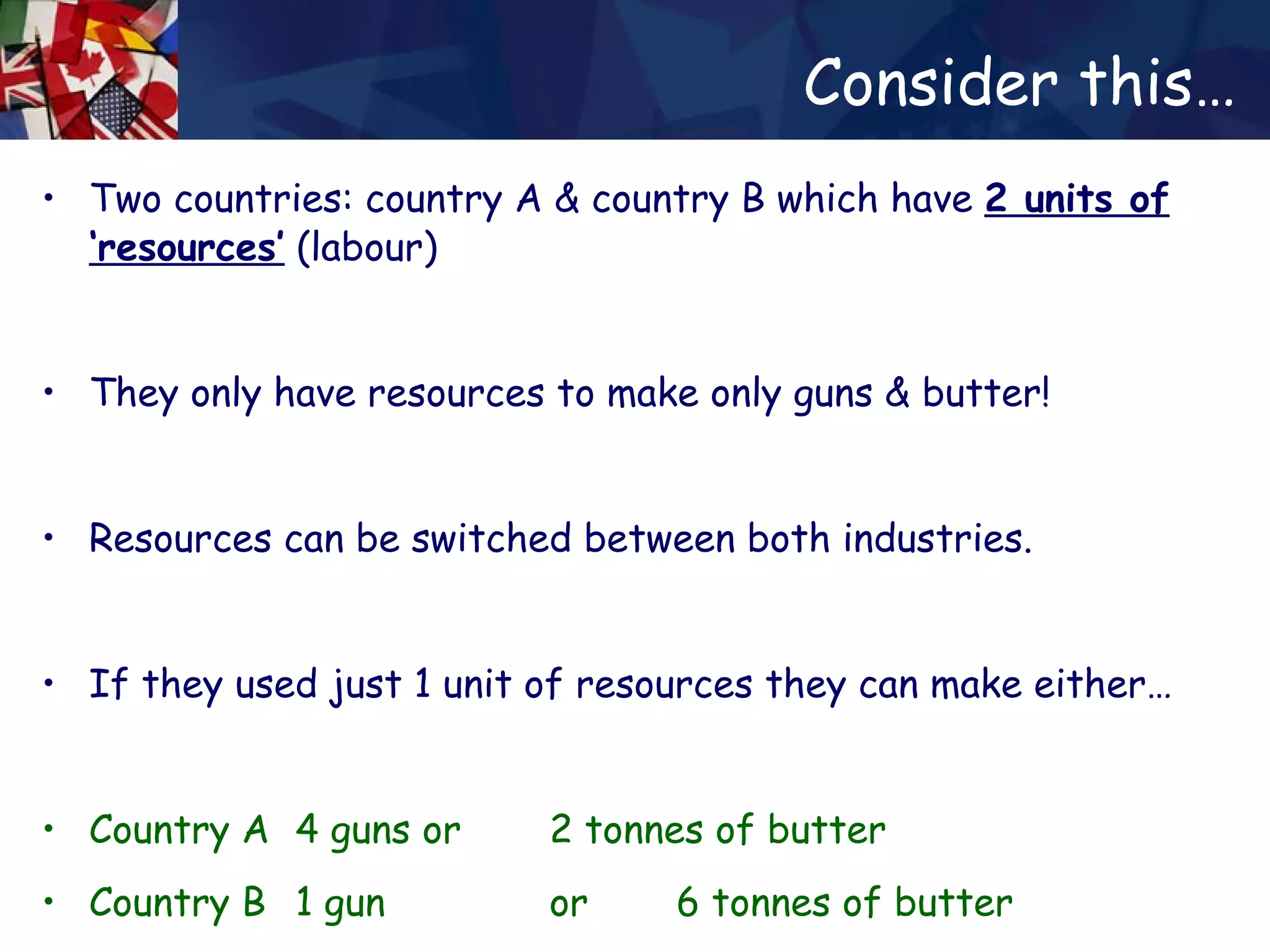
Consider this… Two countries: country A & country B which have  2 units of   ‘resources’  (labour) They only have resources to make only guns & butter! Resources can be switched between both industries. If they used just 1 unit of resources they can make either… Country A  4 guns  or  2 tonnes of butter Country B  1 gun  or  6 tonnes of butter
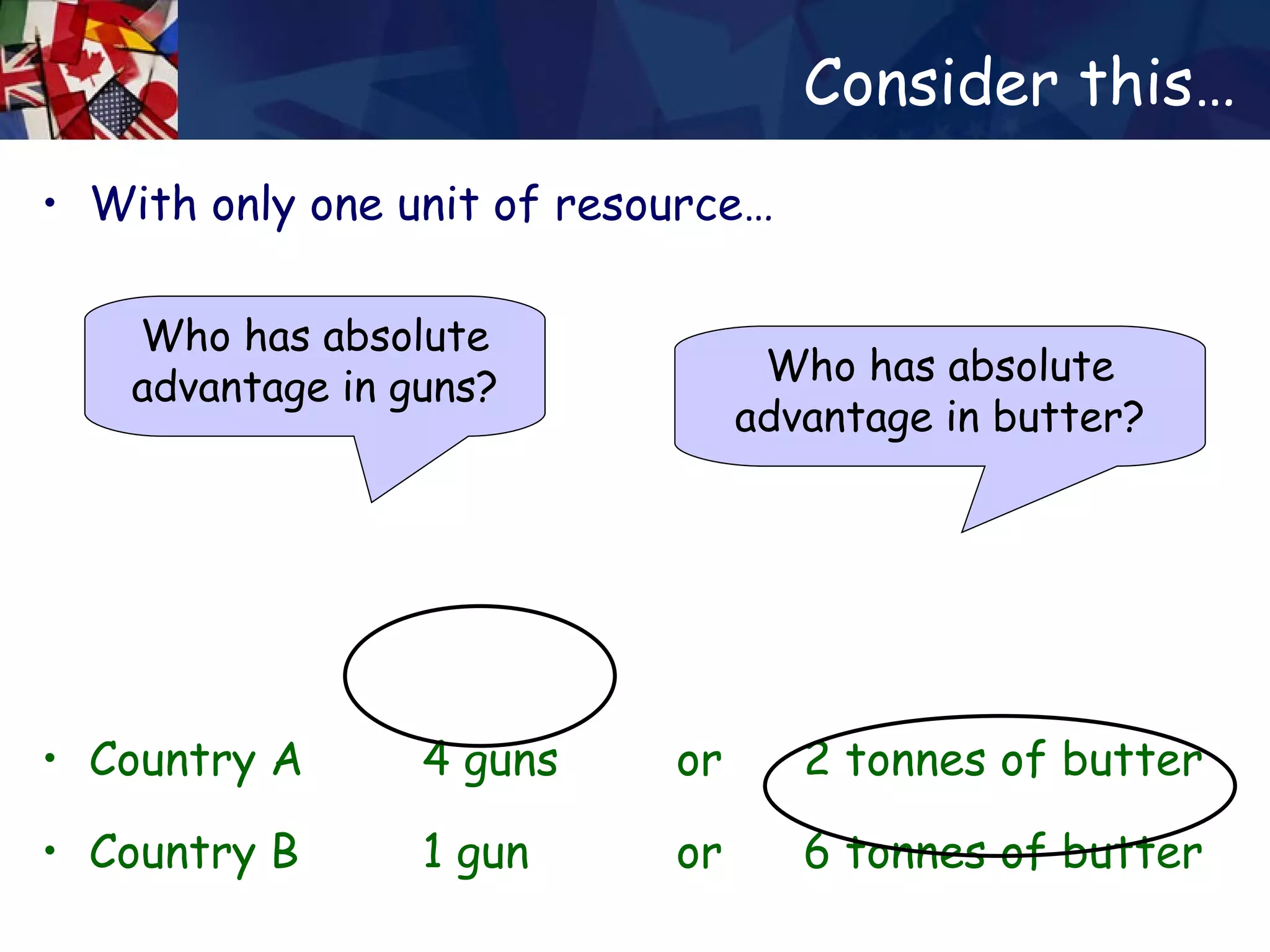
Consider this… With only one unit of resource… Country A  4 guns  or  2 tonnes of butter Country B  1 gun  or  6 tonnes of butter Who has absolute advantage in guns? Who has absolute advantage in butter?
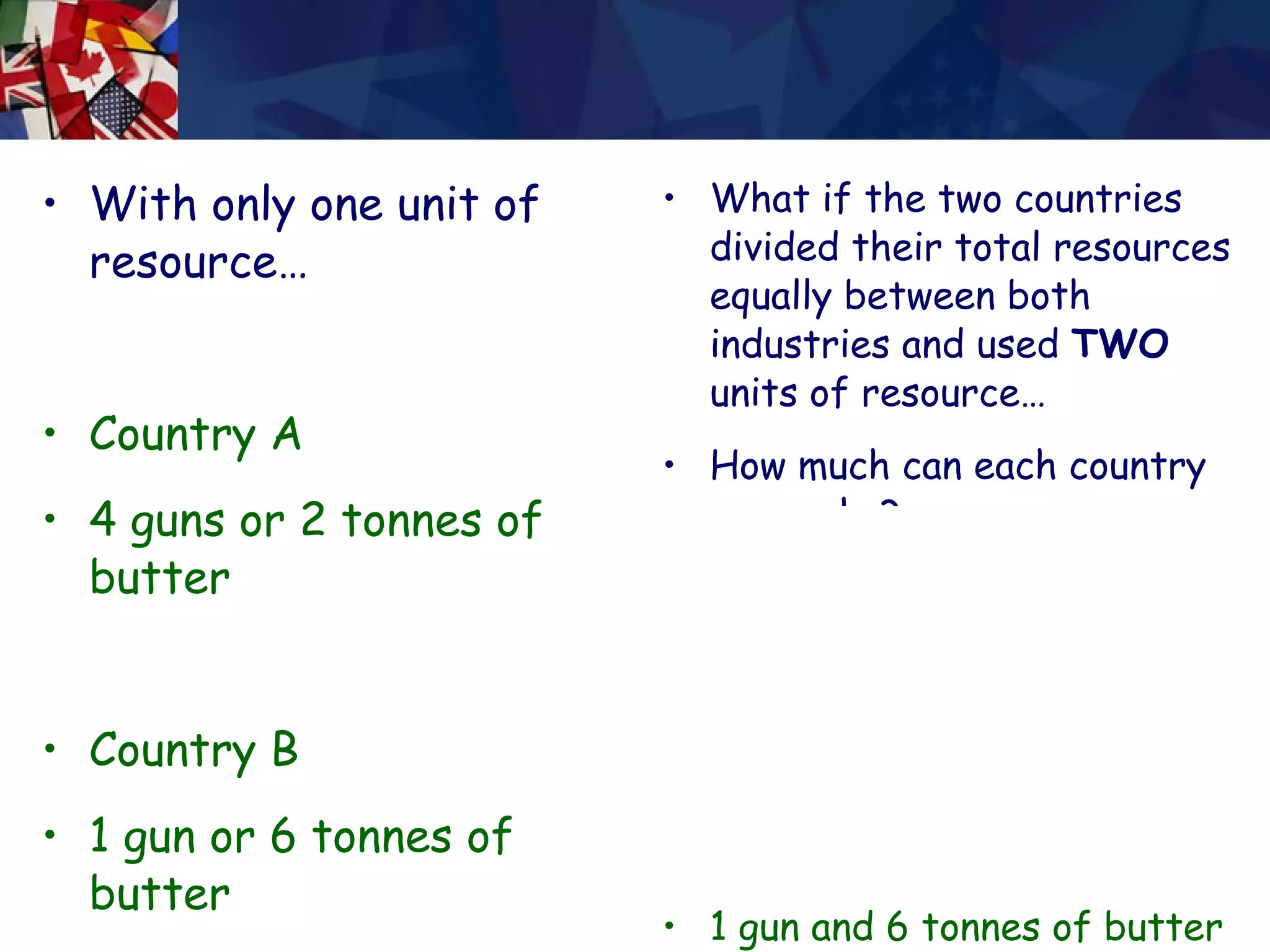
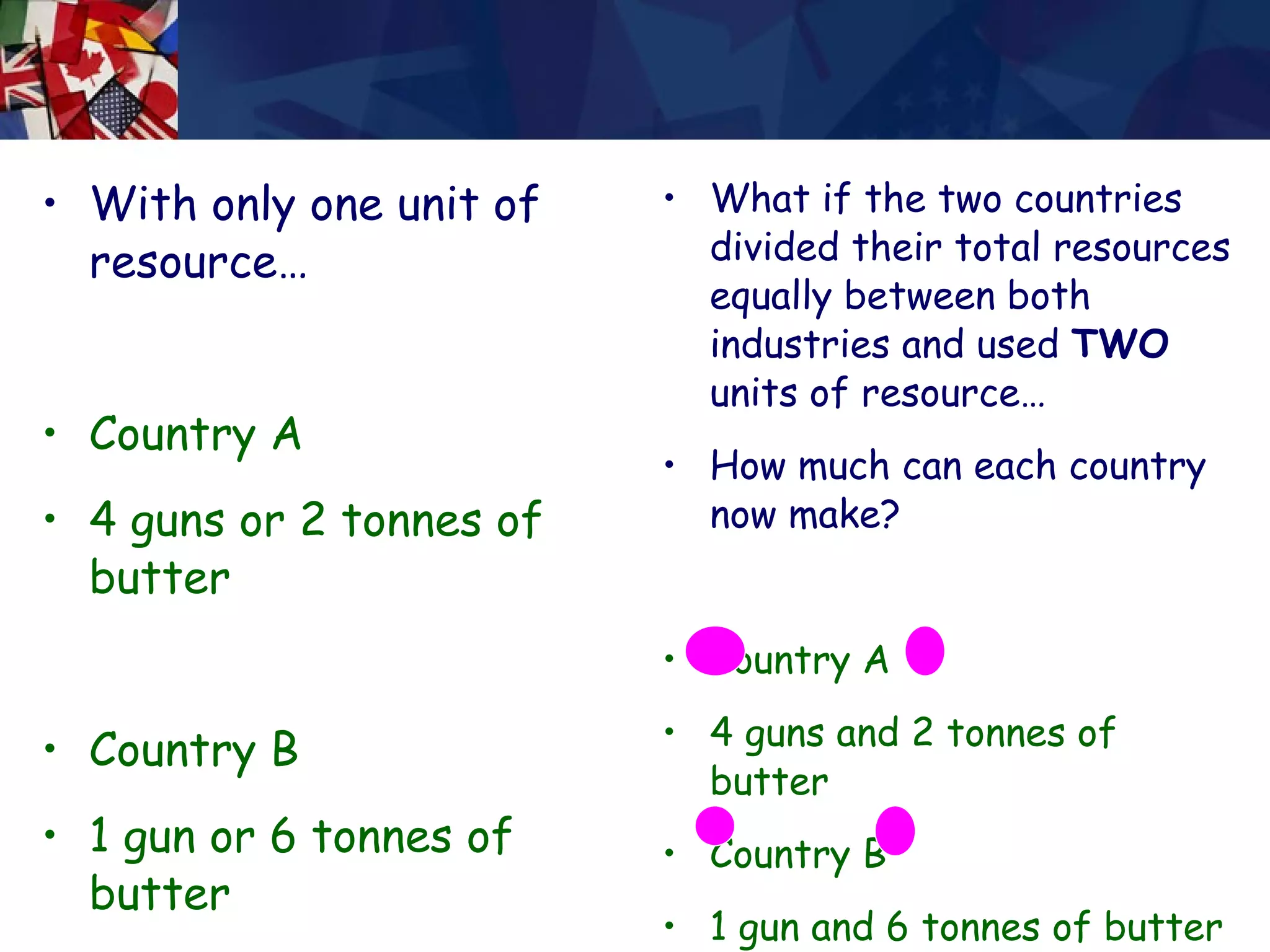
With only one unit of resource… Country A  4 guns or 2 tonnes of butter Country B  1 gun or 6 tonnes of butter What if the two countries divided their total resources equally between both industries and used  TWO  units of resource… How much can each country now make? Country A  4 guns and 2 tonnes of butter Country B  1 gun and 6 tonnes of butter
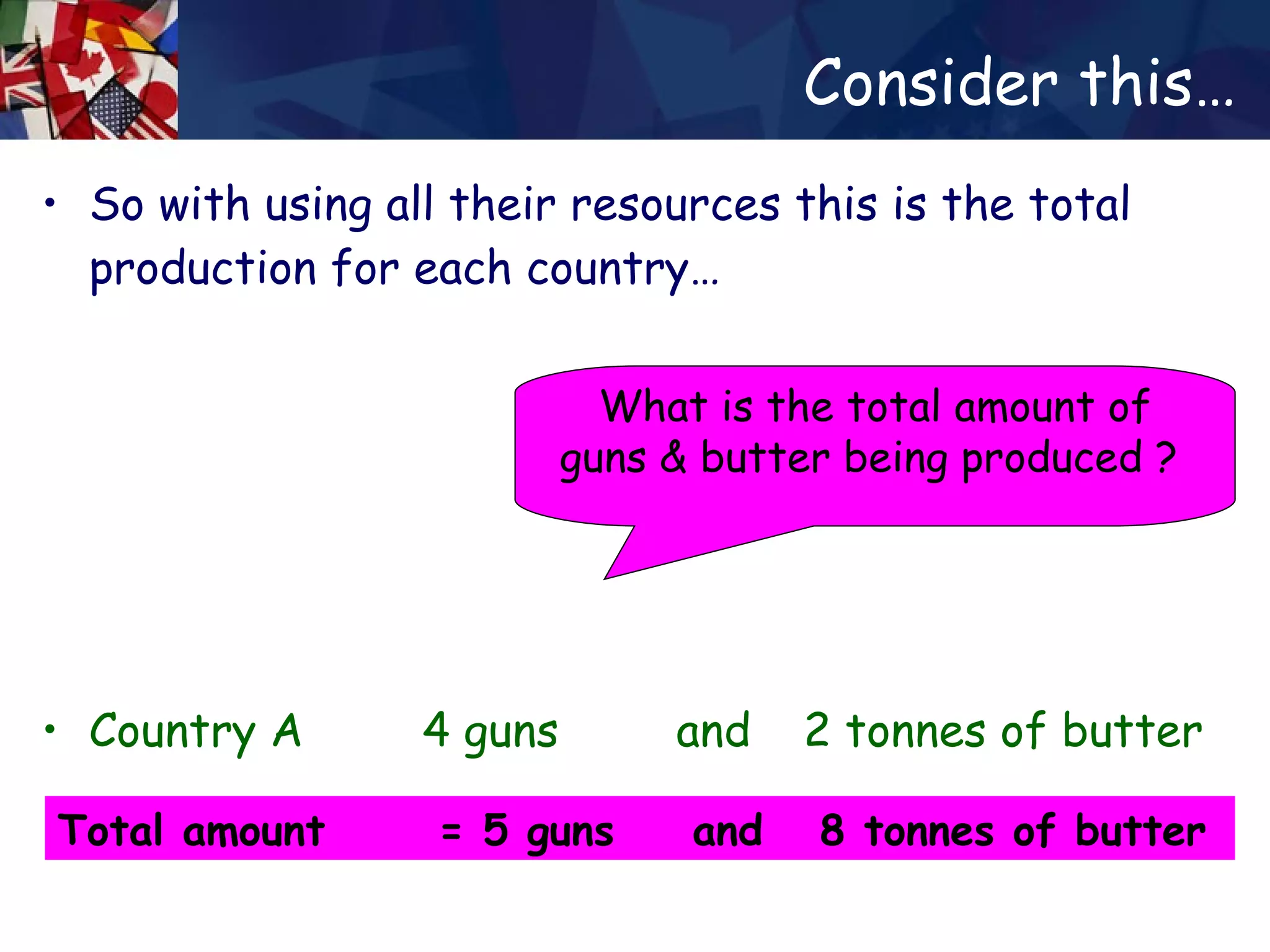
Consider this… So with using all their resources this is the total production for each country… Country A  4 guns  and  2 tonnes of butter Country B  1 gun  and  6 tonnes of butter What is the total amount of guns & butter being produced ?  Total amount  = 5 guns  and  8 tonnes of butter
So what if they ‘traded? Each country specialises in what they are good at….  Absolute advantage…
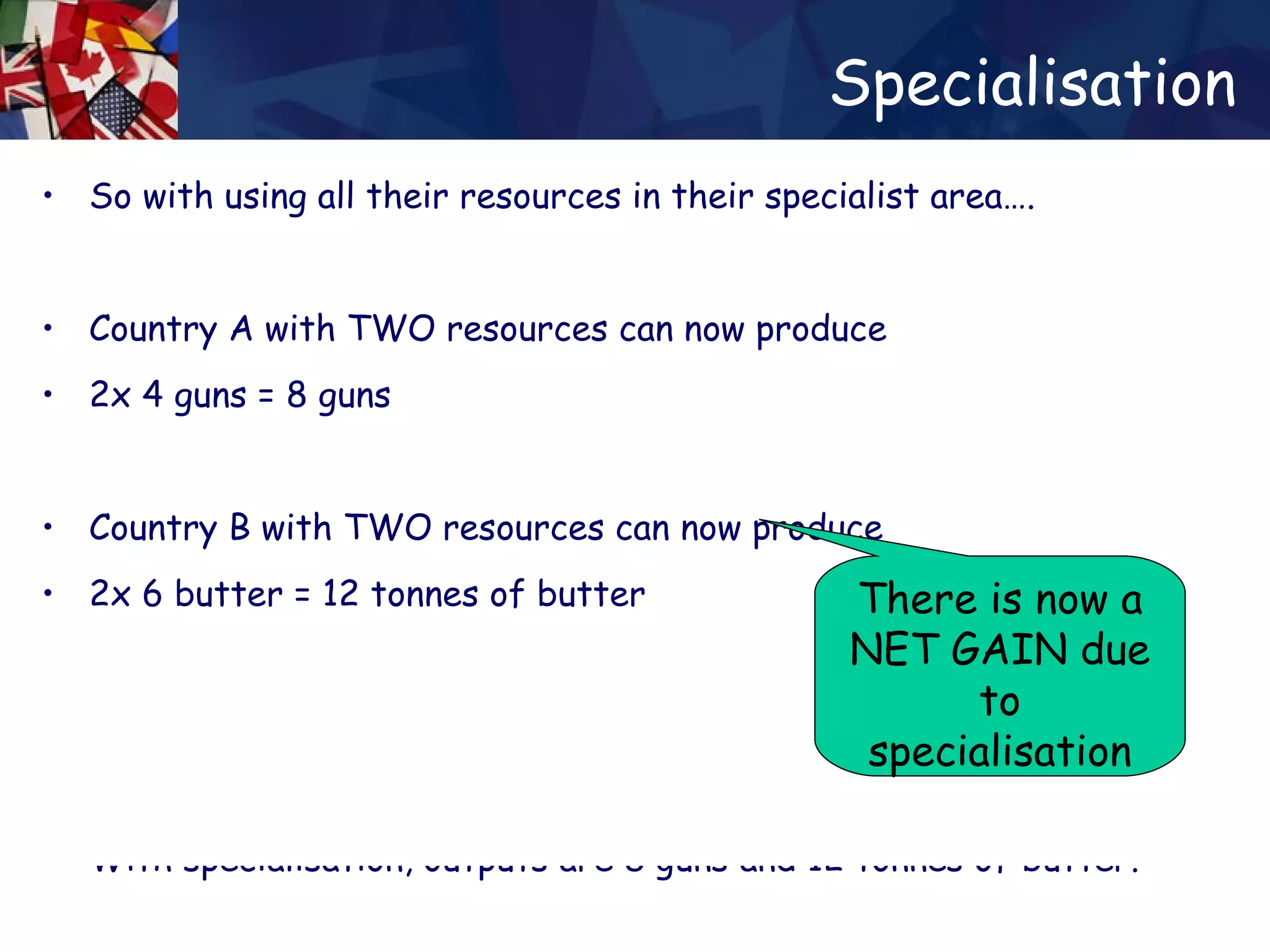
Specialisation So with using all their resources in their specialist area…. Country A with TWO resources can now produce 2x 4 guns = 8 guns  Country B with TWO resources can now produce 2x 6 butter = 12 tonnes of butter Without specialisation, outputs are 5 guns and 8 tonnes of butter. With specialisation, outputs are 8 guns and 12 tonnes of butter. Without specialisation, outputs are 5 guns and 8 tonnes of butter. With specialisation, outputs are 8 guns and 12 tonnes of butter. There is now a NET GAIN due to specialisation
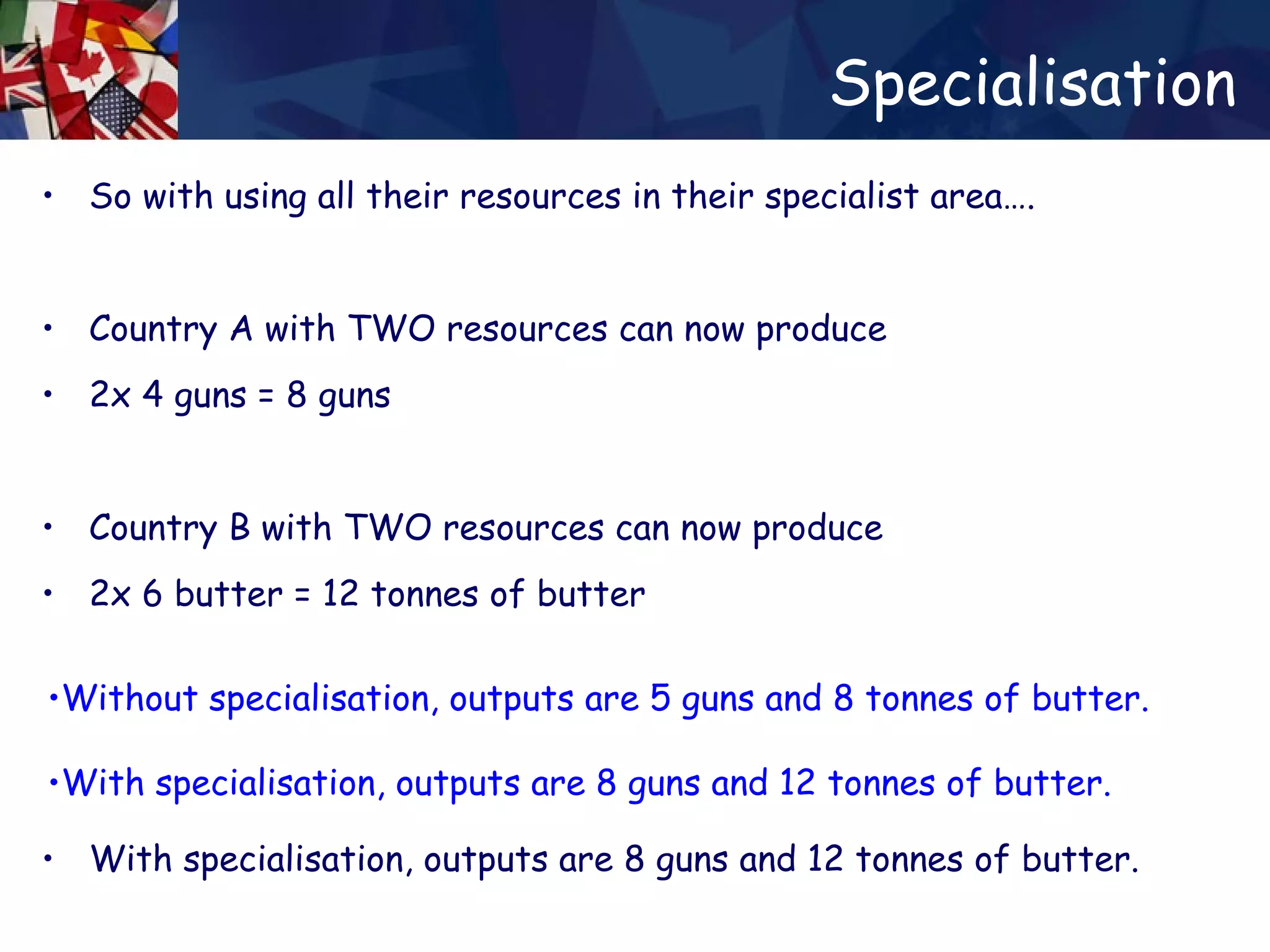
Specialisation So with using all their resources in their specialist area…. Country A with TWO resources can now produce 2x 4 guns = 8 guns  Country B with TWO resources can now produce 2x 6 butter = 12 tonnes of butter Without specialisation, outputs are 5 guns and 8 tonnes of butter. With specialisation, outputs are 8 guns and 12 tonnes of butter. Without specialisation, outputs are 5 guns and 8 tonnes of butter. With specialisation, outputs are 8 guns and 12 tonnes of butter. Without specialisation, outputs are 5 guns and 8 tonnes of butter. With specialisation, outputs are 8 guns and 12 tonnes of butter.
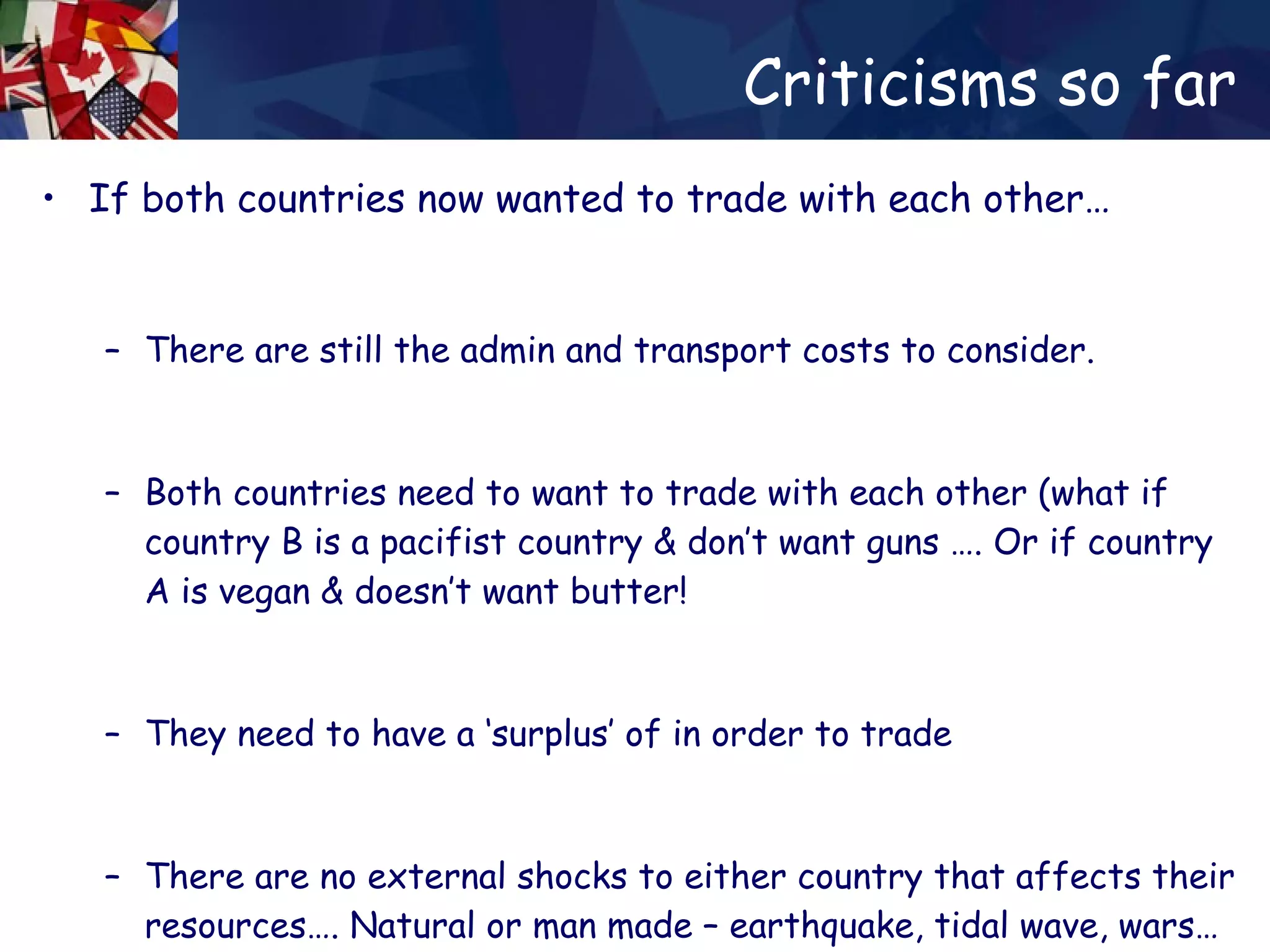
Criticisms so far If both countries now wanted to trade with each other… There are still the admin and transport costs to consider. Both countries need to want to trade with each other (what if country B is a pacifist country & don’t want guns …. Or if country A is vegan & doesn’t want butter! They need to have a ‘surplus’ of in order to trade There are no external shocks to either country that affects their resources…. Natural or man made – earthquake, tidal wave, wars…
The next stage
Comparative Advantage
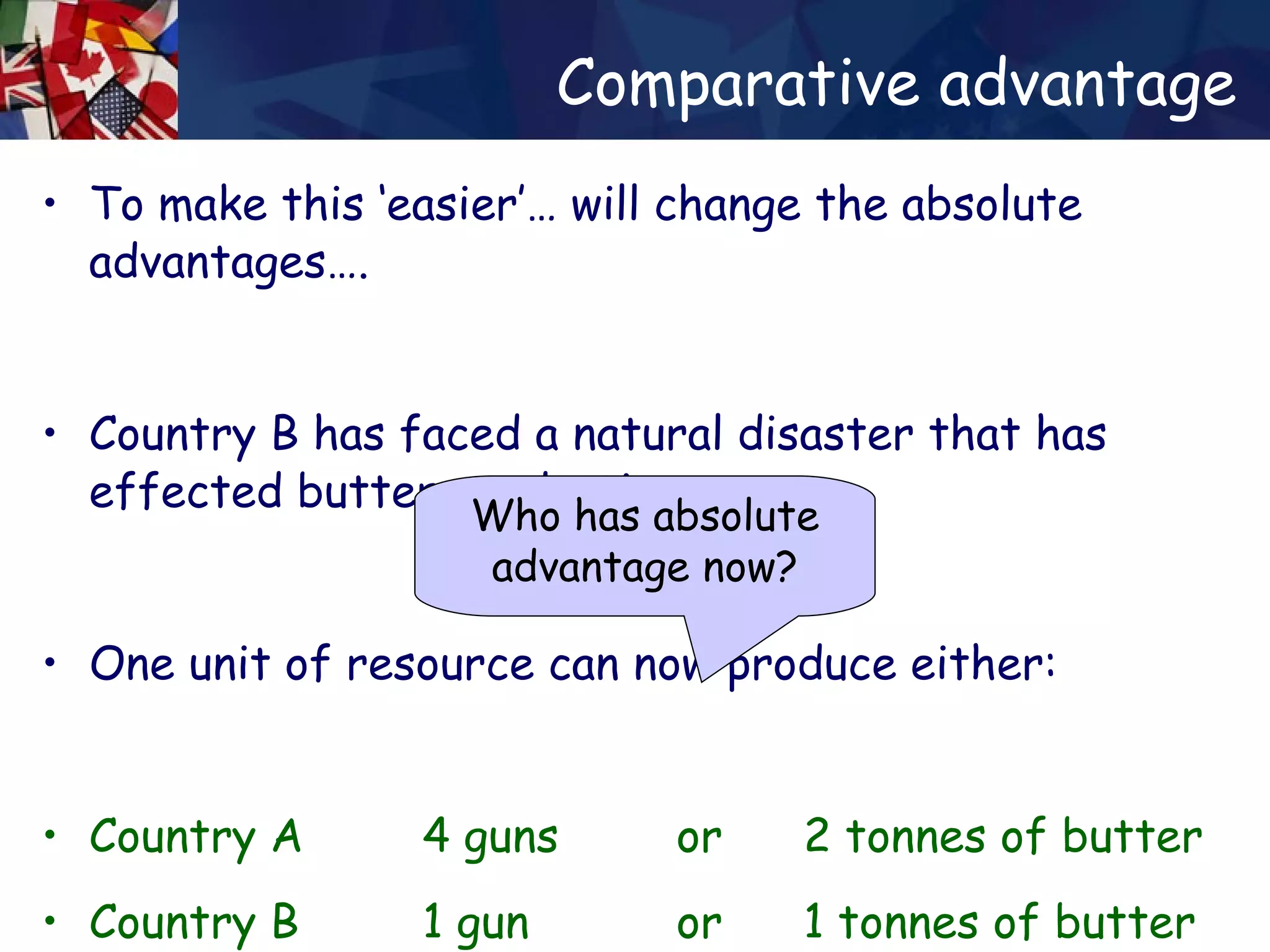
Comparative advantage To make this ‘easier’… will change the absolute advantages…. Country B has faced a natural disaster that has effected butter production…. One unit of resource can now produce either: Country A  4 guns  or  2 tonnes of butter Country B  1 gun  or  1 tonnes of butter Who has absolute advantage now?
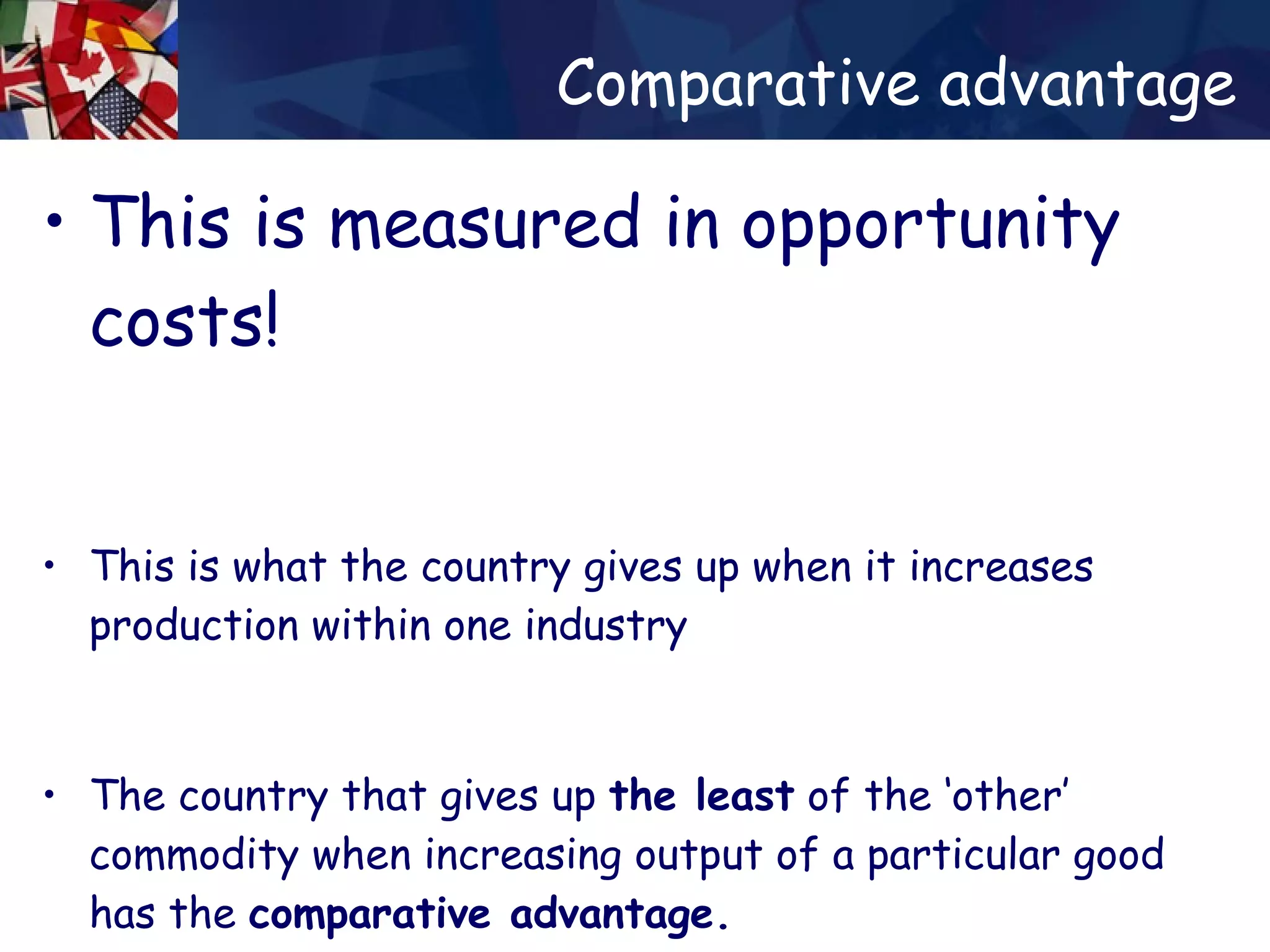
Comparative advantage This is measured in opportunity costs! This is what the country gives up when it increases production within one industry The country that gives up  the least  of the ‘other’ commodity when increasing output of a particular good has the  comparative advantage.
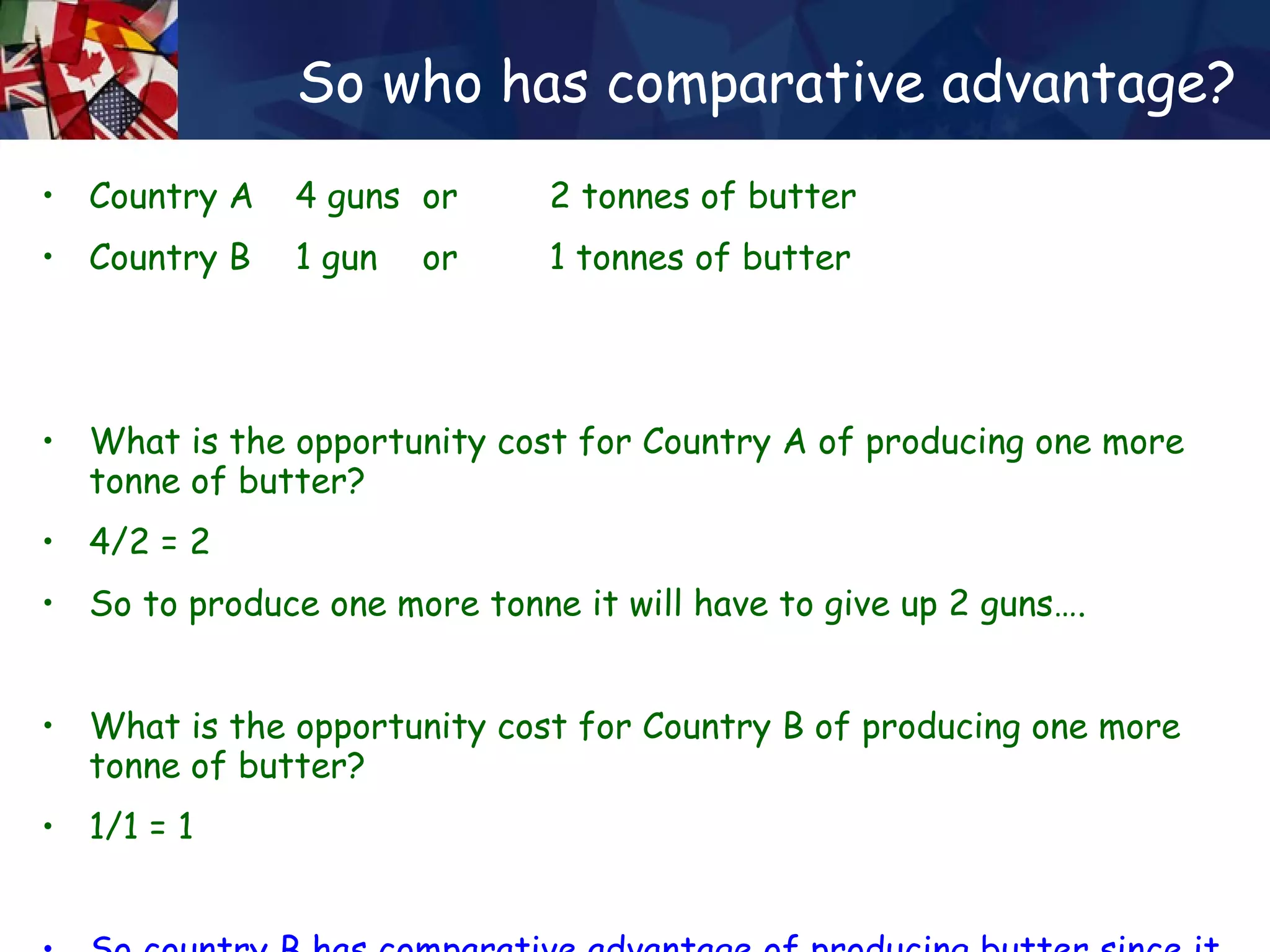
So who has comparative advantage? Country A  4 guns  or  2 tonnes of butter Country B  1 gun  or  1 tonnes of butter What is the opportunity cost for Country A of producing one more tonne of butter? 4/2 = 2  So to produce one more tonne it will have to give up 2 guns…. What is the opportunity cost for Country B of producing one more tonne of butter? 1/1 = 1 So country B has comparative advantage of producing butter since it has ‘less to loose’ by switching production…
Or put it in another way
Next lesson  We’ll recap this And look at the theory through diagrams
Homework Textbook P463 to 465 See if reading about it by yourself helps!
Further reading links http://www.bized.co.uk/virtual/dc/trade/theory/th2.htm

05 absolute and-comparative-advantage-1

  • 1.
  • 2.
    up Giveup He’s much better than you http://www.youtube.com/watch?v=Pd_qs8ueIWw
  • 3.
    Syllabus Aims Tounderstand the benefits and costs of specialisation and trade; To understand the law of comparative advantage. Students should understand the distinction between absolute and comparative advantage. The significance of opportunity cost should be emphasised. Comparative advantage may be illustrated numerically and diagrammatically.
  • 4.
    Colonial Britain inIndustrial Revolution A key factor of Great Britain’s success was through importing raw materials from the wider colonies. Without these, our industries would not have been able to grow and dominate the world stage
  • 5.
    David Ricardo Perhapshis most important contribution was the theory of comparative advantage, a fundamental argument in favour of free trade among countries and of specialisation among individuals. Ricardo argued that there is mutual benefit from trade (or exchange) even if one party (e.g. resource-rich country, highly-skilled artisan) is more productive in every possible area than its trading counterpart (e.g. resource-poor country, unskilled laborer), as long as each concentrates on the activities where it has a relative productivity advantage
  • 6.
  • 7.
  • 8.
    Iceland as a‘closed economy….? If Iceland was a closed economy that did not trade with the rest of the world… How narrow would it’s goods & service provision be due to its natural resource base? With a small population, and no exports or imports – how ‘efficient’ would their economy be?
  • 9.
    Iceland as anopen economy… In an open economy, with international trade Iceland can import raw materials and energy It allows Iceland’s PPF to grow Iceland can now produce a greater range of goods and services. By gaining access to a larger market – Iceland benefits from economies of scale and larger production runs. Icelandic household’s benefit from a greater choice, higher living standards and economic welfare with international trade than it ever could generate without it.
  • 10.
  • 11.
  • 12.
    Specialisation & Divisionof Labour What is Adam Smith’s Wealth of Nations…. & the theory of Specialisation & Division of Labour? Pin factory?
  • 13.
  • 14.
    Specialisation Three mainreasons why specialisation increases total output: Workers don’t switch between tasks, so time is saved More & better machinery is employed, aka capital widening Practice makes workers more efficient & productive
  • 15.
    So how doesthis link to International trade?
  • 16.
    Absolute Advantage AbsoluteAdvantage is where one country is better at producing a product rather than another country. It can make more , i.e. it has greater productivity. Absolute Advantage is the ability to produce more using fewer resources than any other country / region.
  • 17.
    Another Definition… Acountry has an absolute advantage over its trading partners if it is able to produce more of a good or service with the same amount of resources, or the same amount of a good or service with fewer resources. Zambi’s absolute advantage with copper production Florida’s oranges
  • 18.
    Your go… Onyour whiteboard Write UK on one side France on the other
  • 19.
    Question… The UKand France have identical resources. Using all of these resources they can produce either cars or computers, or some combination of the two as shown above. TASK: Assuming constant returns to scale, state which country has an ABSOLUTE ADVANTAGE in the production of cars and computers in each of the above situations.
  • 20.
    Question… The UKand France have identical resources. Using all of these resources they can produce either cars or computers, or some combination of the two as shown above. TASK: Assuming constant returns to scale, state which country has an ABSOLUTE ADVANTAGE in the production of cars and computers in each of the above situations. Absolute advantage with cars Absolute advantage with computers
  • 21.
    Question… The UKand France have identical resources. Using all of these resources they can produce either cars or computers, or some combination of the two as shown above. TASK: Assuming constant returns to scale, state which country has an ABSOLUTE ADVANTAGE in the production of cars and computers in each of the above situations. Absolute advantage with cars Absolute advantage with computers
  • 22.
    Question… The UKand France have identical resources. Using all of these resources they can produce either cars or computers, or some combination of the two as shown above. TASK: Assuming constant returns to scale, state which country has an ABSOLUTE ADVANTAGE in the production of cars and computers in each of the above situations. Absolute advantage with cars Absolute advantage with computers
  • 23.
    Question… The UKand France have identical resources. Using all of these resources they can produce either cars or computers, or some combination of the two as shown above. TASK: Assuming constant returns to scale, state which country has an ABSOLUTE ADVANTAGE in the production of cars and computers in each of the above situations. Absolute advantage with cars Absolute advantage with computers
  • 24.
    Question… The UKand France have identical resources. Using all of these resources they can produce either cars or computers, or some combination of the two as shown above. TASK: Assuming constant returns to scale, state which country has an ABSOLUTE ADVANTAGE in the production of cars and computers in each of the above situations. Absolute advantage with cars Absolute advantage with computers 20
  • 25.
    Absolute advantage Howwould you define absolute advantage? Its where a country is ‘best at’ producing a good or service… The country is more technically capable… Productive efficiency Allocative efficient
  • 26.
  • 27.
    Consider this… Twocountries: country A & country B which have 2 units of ‘resources’ (labour) They only have resources to make only guns & butter! Resources can be switched between both industries. If they used just 1 unit of resources they can make either… Country A 4 guns or 2 tonnes of butter Country B 1 gun or 6 tonnes of butter
  • 28.
    Consider this… Withonly one unit of resource… Country A 4 guns or 2 tonnes of butter Country B 1 gun or 6 tonnes of butter Who has absolute advantage in guns? Who has absolute advantage in butter?
  • 29.
    With only oneunit of resource… Country A 4 guns or 2 tonnes of butter Country B 1 gun or 6 tonnes of butter What if the two countries divided their total resources equally between both industries and used TWO units of resource… How much can each country now make? Country A 4 guns and 2 tonnes of butter Country B 1 gun and 6 tonnes of butter
  • 30.
    With only oneunit of resource… Country A 4 guns or 2 tonnes of butter Country B 1 gun or 6 tonnes of butter What if the two countries divided their total resources equally between both industries and used TWO units of resource… How much can each country now make? Country A 4 guns and 2 tonnes of butter Country B 1 gun and 6 tonnes of butter
  • 31.
    Consider this… Sowith using all their resources this is the total production for each country… Country A 4 guns and 2 tonnes of butter Country B 1 gun and 6 tonnes of butter What is the total amount of guns & butter being produced ? Total amount = 5 guns and 8 tonnes of butter
  • 32.
    So what ifthey ‘traded? Each country specialises in what they are good at…. Absolute advantage…
  • 33.
    Specialisation So withusing all their resources in their specialist area…. Country A with TWO resources can now produce 2x 4 guns = 8 guns Country B with TWO resources can now produce 2x 6 butter = 12 tonnes of butter Without specialisation, outputs are 5 guns and 8 tonnes of butter. With specialisation, outputs are 8 guns and 12 tonnes of butter. Without specialisation, outputs are 5 guns and 8 tonnes of butter. With specialisation, outputs are 8 guns and 12 tonnes of butter. There is now a NET GAIN due to specialisation
  • 34.
    Specialisation So withusing all their resources in their specialist area…. Country A with TWO resources can now produce 2x 4 guns = 8 guns Country B with TWO resources can now produce 2x 6 butter = 12 tonnes of butter Without specialisation, outputs are 5 guns and 8 tonnes of butter. With specialisation, outputs are 8 guns and 12 tonnes of butter. Without specialisation, outputs are 5 guns and 8 tonnes of butter. With specialisation, outputs are 8 guns and 12 tonnes of butter. Without specialisation, outputs are 5 guns and 8 tonnes of butter. With specialisation, outputs are 8 guns and 12 tonnes of butter.
  • 35.
    Criticisms so farIf both countries now wanted to trade with each other… There are still the admin and transport costs to consider. Both countries need to want to trade with each other (what if country B is a pacifist country & don’t want guns …. Or if country A is vegan & doesn’t want butter! They need to have a ‘surplus’ of in order to trade There are no external shocks to either country that affects their resources…. Natural or man made – earthquake, tidal wave, wars…
  • 36.
  • 37.
  • 38.
    Comparative advantage Tomake this ‘easier’… will change the absolute advantages…. Country B has faced a natural disaster that has effected butter production…. One unit of resource can now produce either: Country A 4 guns or 2 tonnes of butter Country B 1 gun or 1 tonnes of butter Who has absolute advantage now?
  • 39.
    Comparative advantage Thisis measured in opportunity costs! This is what the country gives up when it increases production within one industry The country that gives up the least of the ‘other’ commodity when increasing output of a particular good has the comparative advantage.
  • 40.
    So who hascomparative advantage? Country A 4 guns or 2 tonnes of butter Country B 1 gun or 1 tonnes of butter What is the opportunity cost for Country A of producing one more tonne of butter? 4/2 = 2 So to produce one more tonne it will have to give up 2 guns…. What is the opportunity cost for Country B of producing one more tonne of butter? 1/1 = 1 So country B has comparative advantage of producing butter since it has ‘less to loose’ by switching production…
  • 41.
    Or put itin another way
  • 42.
    Next lesson We’ll recap this And look at the theory through diagrams
  • 43.
    Homework Textbook P463to 465 See if reading about it by yourself helps!
  • 44.
    Further reading linkshttp://www.bized.co.uk/virtual/dc/trade/theory/th2.htm