International Trade
Absolute & Comparative Advantage
Absolute Advantage
A party’s ability to produce more goods than a
competitor using the same amount of input(s)
(assume single input : labor)
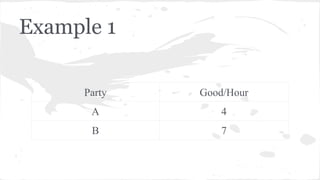
Example 1
Party

Good/Hour

A

4

B

7
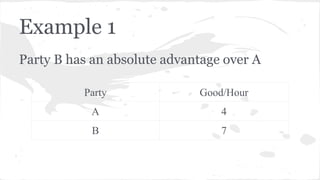
Example 1
Party B has an absolute advantage over A
Party

Good/Hour

A

4

B

7
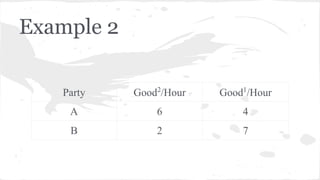
Example 2
Party

Good2/Hour

Good1/Hour

A

6

4

B

2

7
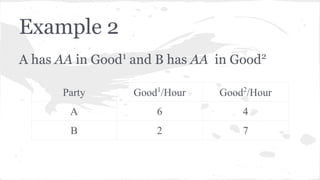
Example 2
A has AA in Good1 and B has AA in Good2
Party

Good1/Hour

Good2/Hour

A

6

4

B

2

7
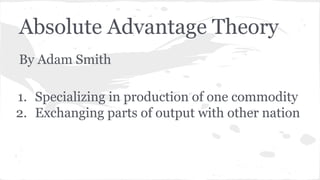
Absolute Advantage Theory
By Adam Smith
1. Specializing in production of one commodity
2. Exchanging parts of output with other nation
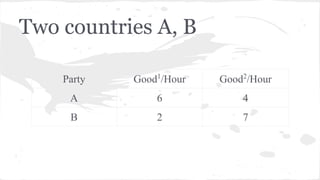
Two countries A, B
Party

Good1/Hour

Good2/Hour

A

6

4

B

2

7
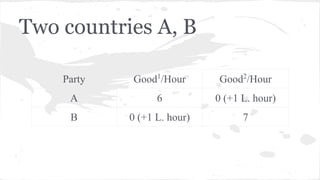
Two countries A, B
Party

Good1/Hour

Good2/Hour

A

6

0 (+1 L. hour)

B

0 (+1 L. hour)

7
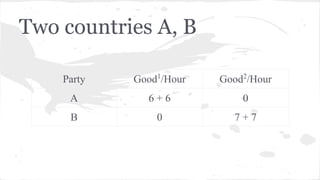
Two countries A, B
Party

Good1/Hour

Good2/Hour

A

6+6

0

B

0

7+7
Comparative Advantage
Spea e

No e :

A pe son has a ompa a
e ad an a e a
owe
os han an one e se.

p odu

n

some h n

he

Ha n a ompa a
e ad an a e s no
he same as be n
he bes
a , someone an be omp e e
uns
ed a do n some h n ,
ompa a
e ad an a e a do n
! How an ha happen?

an p odu e

a
e

a

some h n . In
s
ha e a

F s , e 's e some mo e o abu a . Someone who s he bes a do n some h n
s
sa d o ha e an abso u e ad an a e. M hae
o dan has an abso u e ad an a e a
bas e ba . Fo a
I now, M hae
o dan ma a so be he as es
p s
n he
wo d,
n h m an abso u e ad an a e a
p n , oo. S n e he's be e a
p n
han ou, an' he
pe mo e heap
han ou? Tha
s,
someone has an abso u e
ad an a e n some h n , doesn' he au oma a
ha e a ompa a e ad an a e n ?
The
p
I ,
se
se

answe
s no! I
o dan a es
me ou
om shoo n hoops o do a
h s own
n , he sa
es he a e n ome he ea ns
om en e a n n
ans o bas e ba .
ns ead, h s se e a
does he
p n , he se e a
es up an a e na e
e a a
ob—o pe haps a mu h owe sa a
p a n bas e ba . Tha
s, he
e a
s he owe - os
p s .
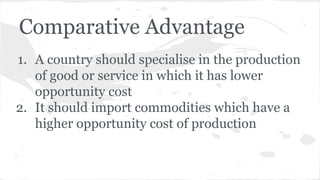
Comparative Advantage
1. A country should specialise in the production
of good or service in which it has lower
opportunity cost
2. It should import commodities which have a
higher opportunity cost of production
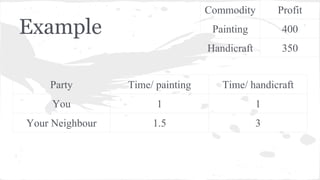
Commodity
Painting

400

Handicraft

Example

Profit

350

Party

Time/ painting

Time/ handicraft

You

1

1

Your Neighbour

1.5

3
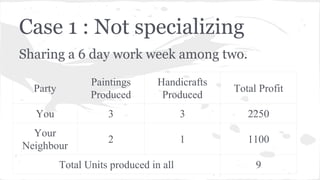
Case 1 : Not specializing
Sharing a 6 day work week among two.
Party

Paintings
Produced

Handicrafts
Produced

Total Profit

You

3

3

2250

Your
Neighbour

2

1

1100

Total Units produced in all

9
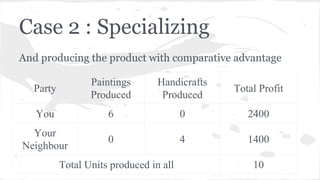
Case 2 : Specializing
And producing the product with comparative advantage
Party

Paintings
Produced

Handicrafts
Produced

Total Profit

You

6

0

2400

Your
Neighbour

0

4

1400

Total Units produced in all

10
Specializing is always good
And you can(should) specialize even if you are
good at everything
Thank you
Shivek Khurana
Cluster Innovation Centre
University Of Delhi

International Trade : Absolute vs comparative Advantage

  • 1.
    International Trade Absolute &Comparative Advantage
  • 2.
    Absolute Advantage A party’sability to produce more goods than a competitor using the same amount of input(s) (assume single input : labor)
  • 3.
  • 4.
    Example 1 Party Bhas an absolute advantage over A Party Good/Hour A 4 B 7
  • 5.
  • 6.
    Example 2 A hasAA in Good1 and B has AA in Good2 Party Good1/Hour Good2/Hour A 6 4 B 2 7
  • 7.
    Absolute Advantage Theory ByAdam Smith 1. Specializing in production of one commodity 2. Exchanging parts of output with other nation
  • 8.
    Two countries A,B Party Good1/Hour Good2/Hour A 6 4 B 2 7
  • 9.
    Two countries A,B Party Good1/Hour Good2/Hour A 6 0 (+1 L. hour) B 0 (+1 L. hour) 7
  • 10.
    Two countries A,B Party Good1/Hour Good2/Hour A 6+6 0 B 0 7+7
  • 11.
    Comparative Advantage Spea e Noe : A pe son has a ompa a e ad an a e a owe os han an one e se. p odu n some h n he Ha n a ompa a e ad an a e s no he same as be n he bes a , someone an be omp e e uns ed a do n some h n , ompa a e ad an a e a do n ! How an ha happen? an p odu e a e a some h n . In s ha e a F s , e 's e some mo e o abu a . Someone who s he bes a do n some h n s sa d o ha e an abso u e ad an a e. M hae o dan has an abso u e ad an a e a bas e ba . Fo a I now, M hae o dan ma a so be he as es p s n he wo d, n h m an abso u e ad an a e a p n , oo. S n e he's be e a p n han ou, an' he pe mo e heap han ou? Tha s, someone has an abso u e ad an a e n some h n , doesn' he au oma a ha e a ompa a e ad an a e n ? The p I , se se answe s no! I o dan a es me ou om shoo n hoops o do a h s own n , he sa es he a e n ome he ea ns om en e a n n ans o bas e ba . ns ead, h s se e a does he p n , he se e a es up an a e na e e a a ob—o pe haps a mu h owe sa a p a n bas e ba . Tha s, he e a s he owe - os p s .
  • 12.
    Comparative Advantage 1. Acountry should specialise in the production of good or service in which it has lower opportunity cost 2. It should import commodities which have a higher opportunity cost of production
  • 13.
  • 14.
    Case 1 :Not specializing Sharing a 6 day work week among two. Party Paintings Produced Handicrafts Produced Total Profit You 3 3 2250 Your Neighbour 2 1 1100 Total Units produced in all 9
  • 15.
    Case 2 :Specializing And producing the product with comparative advantage Party Paintings Produced Handicrafts Produced Total Profit You 6 0 2400 Your Neighbour 0 4 1400 Total Units produced in all 10
  • 16.
    Specializing is alwaysgood And you can(should) specialize even if you are good at everything
  • 17.
    Thank you Shivek Khurana ClusterInnovation Centre University Of Delhi