
AG. MARKETING & ECONOMIC DEVELOPMENT
A.S.M. Fazlul Hoque
Lecturer,
Dept. of Agribusiness & Marketing.
Sher-e Bangla Agricultural University.
Importance of Agricultural Marketing
 Optimization of resource use and output management
 Increase farm income
 Widening market
 Growth of agro-based industries
 Price signal
 Adoption and spread of new technology
 Employment creation
 Addition national income
 Better living
 Creation of utility
History of Ag. Marketing Development
 Specialization
 Urbanization
 Transportation& communication
 Technological change in agriculture(HYV,
Inputs,Techniques)
Producer surplus
Quantity made available to the non-producing population of the country.
Covering Areas
1.Farming sound price policies
2.Developing proper procurement and purchase
strategies
3.Checking undue price fluctuations
4.Export & Import decision
5.Development of transport and storage systems.
Producer Surplus
Marketable surplus : It is the quantity of produce which can be
made available to the non – farm population of the country.
MS = P-C
Where, MS = Marketable surplus
P=Total Production
C= Total Requirement( family consumption, farm
need, payment to labor, artisans, landlord and payment for
social and religious work)
Producer Surplus
Marketed Surplus :
Marketed surplus is that quantity of the produce which producer-
farmers actually sell in the market irrespective of their
requirements for family consumption, farm needs and others
payment.
Relationship
Marketed surplus<Marketable surplus( large farmers ,storage capacity , substitute products)
Marketed surplus>Marketable surplus(small, marginal farmers, distress sale)
Marketed surplus=Marketable surplus ( perishable commodities, average farmers)
Factors affecting Marketable Surplus
 Size of Holding
 Production
 Price of commodity
 Size of family
 Requirement of Seed& feed
 Nature of commodity
 Consumption Habits
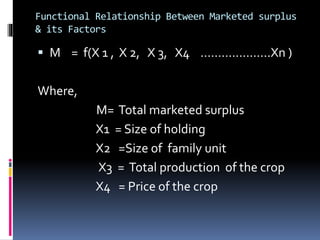
Functional Relationship Between Marketed surplus
& its Factors
 M = f(X 1 , X 2, X 3, X4 ………………..Xn )
Where,
M= Total marketed surplus
X1 = Size of holding
X2 =Size of family unit
X3 = Total production of the crop
X4 = Price of the crop
Pattern of disposal of marketed surplus
 1. Place of sale( village sale, market sale)
 2.Time of sale
Characteristics of good market
 Consumer focused need & want
 Variety of products or services
 No harmful products & consumer protection
 Information available
 No pressure on consumer to purchase
 Retailing service
 Fair & uniform price
 Absent from inefficiency or wastage in the market
 Producers should be able to sell their surplus quickly at proper price
Ideal Marketing system
 The ideal marketing system is one that maximizes the long run welfare of society. It
should operate with maximum physical and allocative efficiency .
Pricing efficient
1. Price variation based on transportation cost ( between location)
2. Price variation based on storage cost(between season)
3. Price variation based on processing cost (between form)
Characteristics of a good Marketing
System
 Free from govt. interference in free market transaction
 Independent but systematic
 Contributes to rapid development of the urban- industrial economy
 Demand & supply equilibrium
 Employment generation
Scientific Marketing of farm product
 Bring the produce for sale after cleaning
 Sell different qualities of products separately
 Sell product after grading
 Keep abreast of market information
 Carry bags/ packs of standard weighs
 Avoid immediate post harvest sale
 Patronize co-operative marketing societies
 Sell the produce in regulated markets
 Choose the right varieties
 Minimize chemical residues

Agricultural Marketing and Economic Development

  • 1.
    AG. MARKETING &ECONOMIC DEVELOPMENT A.S.M. Fazlul Hoque Lecturer, Dept. of Agribusiness & Marketing. Sher-e Bangla Agricultural University.
  • 2.
    Importance of AgriculturalMarketing  Optimization of resource use and output management  Increase farm income  Widening market  Growth of agro-based industries  Price signal  Adoption and spread of new technology  Employment creation  Addition national income  Better living  Creation of utility
  • 3.
    History of Ag.Marketing Development  Specialization  Urbanization  Transportation& communication  Technological change in agriculture(HYV, Inputs,Techniques)
  • 4.
    Producer surplus Quantity madeavailable to the non-producing population of the country. Covering Areas 1.Farming sound price policies 2.Developing proper procurement and purchase strategies 3.Checking undue price fluctuations 4.Export & Import decision 5.Development of transport and storage systems.
  • 5.
    Producer Surplus Marketable surplus: It is the quantity of produce which can be made available to the non – farm population of the country. MS = P-C Where, MS = Marketable surplus P=Total Production C= Total Requirement( family consumption, farm need, payment to labor, artisans, landlord and payment for social and religious work)
  • 6.
    Producer Surplus Marketed Surplus: Marketed surplus is that quantity of the produce which producer- farmers actually sell in the market irrespective of their requirements for family consumption, farm needs and others payment. Relationship Marketed surplus<Marketable surplus( large farmers ,storage capacity , substitute products) Marketed surplus>Marketable surplus(small, marginal farmers, distress sale) Marketed surplus=Marketable surplus ( perishable commodities, average farmers)
  • 7.
    Factors affecting MarketableSurplus  Size of Holding  Production  Price of commodity  Size of family  Requirement of Seed& feed  Nature of commodity  Consumption Habits
  • 8.
    Functional Relationship BetweenMarketed surplus & its Factors  M = f(X 1 , X 2, X 3, X4 ………………..Xn ) Where, M= Total marketed surplus X1 = Size of holding X2 =Size of family unit X3 = Total production of the crop X4 = Price of the crop
  • 9.
    Pattern of disposalof marketed surplus  1. Place of sale( village sale, market sale)  2.Time of sale
  • 10.
    Characteristics of goodmarket  Consumer focused need & want  Variety of products or services  No harmful products & consumer protection  Information available  No pressure on consumer to purchase  Retailing service  Fair & uniform price  Absent from inefficiency or wastage in the market  Producers should be able to sell their surplus quickly at proper price
  • 11.
    Ideal Marketing system The ideal marketing system is one that maximizes the long run welfare of society. It should operate with maximum physical and allocative efficiency . Pricing efficient 1. Price variation based on transportation cost ( between location) 2. Price variation based on storage cost(between season) 3. Price variation based on processing cost (between form)
  • 12.
    Characteristics of agood Marketing System  Free from govt. interference in free market transaction  Independent but systematic  Contributes to rapid development of the urban- industrial economy  Demand & supply equilibrium  Employment generation
  • 13.
    Scientific Marketing offarm product  Bring the produce for sale after cleaning  Sell different qualities of products separately  Sell product after grading  Keep abreast of market information  Carry bags/ packs of standard weighs  Avoid immediate post harvest sale  Patronize co-operative marketing societies  Sell the produce in regulated markets  Choose the right varieties  Minimize chemical residues