International Trade Theories VIPIN PS4 MBASCHOOL OF MANAGEMENT AND BUSINESS STUDIES,MG UNIVERSITY,KOTTYAM
International Trade Theory deals with the different models of international tradeDeveloped to explain the diverse ideas of exchange of goods and services globally.The theories of international trade have undergone a number of changes.International Trade Theories
An international trade theory can be seen as a measure to address problems in a country.Since 1970, the time of Adam Smith, economists have shown that free trade is efficient and leads to economic welfare.
Mercantilism
Absolute Advantage
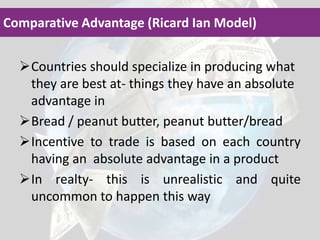
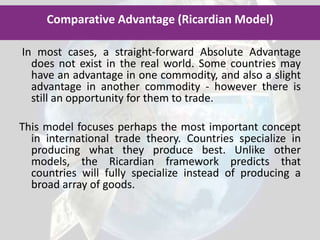
Comparative Advantage(RicardIan Model)
International Product Life-Cycle Theory (Verrons)
Factor Endowment Theory
Free trade theory.……..
The trade theory that states that nations should accumulate financial wealth, usually in the form of gold, by encouraging exports and discouraging imports is called mercantilism. 	According to this theory other measures of countries' well being, such as living standards or human development, are irrelevant. Mainly Great Britain, France, the Netherlands, Portugal and Spain used mercantilism during the 1500s to the late 1700sThis trade theory suggested that a government can improve economic well being of the country by increasing exports and reducing imports, but turned out to be a flaw strategy.Mercantilism
Mercantilistic countries practised the so-called zero-sum game, which meant that world wealth was limited and that countries only could increase their share at expense of their neighbours.The economic development was prevented when the mercantilistic countries paid the colonies little for export and charged them high price for import. The main problem with mercantilism is that all countries engaged in export but was restricted from import, another prevention from development of international trade.
To export is good, to import is to be avoided
When you exported, you receive payment- currency based on gold standard
Best thing to do is export as much as possible to gain as much gold as possible
Problem with theory is that excludes the fact that in some cases it is good to import
If you completely refuse to import, the population will have to do without certain consumer items.Theory of absolute advantageA country has an absolute advantage over it trading partners if it is able to produce more of a good or service with the same amount of resources or the same amount of a good or service with fewer resources.
Adam Smith: Wealth of Nations (1776) argued:Capability of one country to produce more of a product with the same amount of input than another country A country should produce only goods where it is most efficient,  and trade for those goods where it is not efficientTrade between countries is, therefore, beneficial Assumes there is an  absolute  balance among  nations.
… destroys the mercantilist idea since there are gains to be had by both countries party to an exchange… questions the objective of national governments to acquire wealth through restrictive trade policies… measures a nation’s wealth by the living standards of its people.
    The theory of "Absolute Advantage" seems to make sense in situations where the circumstances of the geographic and economic environment are relatively simple and straight forward – 

International trade theories

  • 1.
    International Trade TheoriesVIPIN PS4 MBASCHOOL OF MANAGEMENT AND BUSINESS STUDIES,MG UNIVERSITY,KOTTYAM
  • 2.
    International Trade Theorydeals with the different models of international tradeDeveloped to explain the diverse ideas of exchange of goods and services globally.The theories of international trade have undergone a number of changes.International Trade Theories
  • 3.
    An international tradetheory can be seen as a measure to address problems in a country.Since 1970, the time of Adam Smith, economists have shown that free trade is efficient and leads to economic welfare.
  • 4.
  • 5.
  • 6.
  • 7.
  • 8.
  • 9.
  • 10.
    The trade theorythat states that nations should accumulate financial wealth, usually in the form of gold, by encouraging exports and discouraging imports is called mercantilism. According to this theory other measures of countries' well being, such as living standards or human development, are irrelevant. Mainly Great Britain, France, the Netherlands, Portugal and Spain used mercantilism during the 1500s to the late 1700sThis trade theory suggested that a government can improve economic well being of the country by increasing exports and reducing imports, but turned out to be a flaw strategy.Mercantilism
  • 11.
    Mercantilistic countries practisedthe so-called zero-sum game, which meant that world wealth was limited and that countries only could increase their share at expense of their neighbours.The economic development was prevented when the mercantilistic countries paid the colonies little for export and charged them high price for import. The main problem with mercantilism is that all countries engaged in export but was restricted from import, another prevention from development of international trade.
  • 12.
    To export isgood, to import is to be avoided
  • 13.
    When you exported,you receive payment- currency based on gold standard
  • 14.
    Best thing todo is export as much as possible to gain as much gold as possible
  • 15.
    Problem with theoryis that excludes the fact that in some cases it is good to import
  • 16.
    If you completelyrefuse to import, the population will have to do without certain consumer items.Theory of absolute advantageA country has an absolute advantage over it trading partners if it is able to produce more of a good or service with the same amount of resources or the same amount of a good or service with fewer resources.
  • 17.
    Adam Smith: Wealthof Nations (1776) argued:Capability of one country to produce more of a product with the same amount of input than another country A country should produce only goods where it is most efficient, and trade for those goods where it is not efficientTrade between countries is, therefore, beneficial Assumes there is an absolute balance among nations.
  • 18.
    … destroys themercantilist idea since there are gains to be had by both countries party to an exchange… questions the objective of national governments to acquire wealth through restrictive trade policies… measures a nation’s wealth by the living standards of its people.
  • 19.
    The theory of "Absolute Advantage" seems to make sense in situations where the circumstances of the geographic and economic environment are relatively simple and straight forward –