Production Possibilities Curve
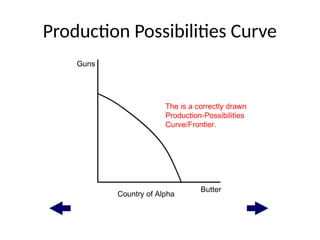
•Any point on the curve represents an efficient
use of resources
• Any point inside the curve represents an
inefficient use of resources (unemployment)
• Any point outside the curve is not possible
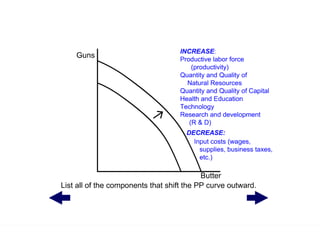
• The curve can shift inward or outward when
there are changes in costs or productive
capacity
Why Nations Trade
•Nations have different natural, human and
capital resources
• Nations are not equally efficient at producing
the goods and services demanded by their
residents
• Production of any good has an opportunity
cost
• Nations should specialize in production of
goods with the lowest opportunity costs
7.
Assumptions
• Two nations
•Two goods
• Producers in both nations can produce both
goods
• Consumers in both nations want both goods
• Resources are perfectly interchangeable
between production of both goods
8.
Absolute Advantage
• Givenequal resources, one nation (or
individual) can produce more of a good than
another nation (or individual).
• But even if one country has absolute
advantages in the production of both goods,
specialization and trade will usually benefit
both countries.
9.
Comparative Advantage
• Onenation (or individual) can produce a
good at a lower opportunity cost than
another nation (or individual).
• Examples of Comparative Advantage:
– Economics professor and secretary
– Auto mechanic and doctor
– Accountant and painter
10.
Terms of Trade
•Good terms of trade
– To benefit both nations, the terms must fall
between the two nations’ opportunity costs