International
Trade Theories
Introduction
• Fundamental questions in International Trade
–Why does international trade take place?
–What determines which country should
export a particular good and which country
should import it?
–Who gains from such trade?
Why do Nations Trade?
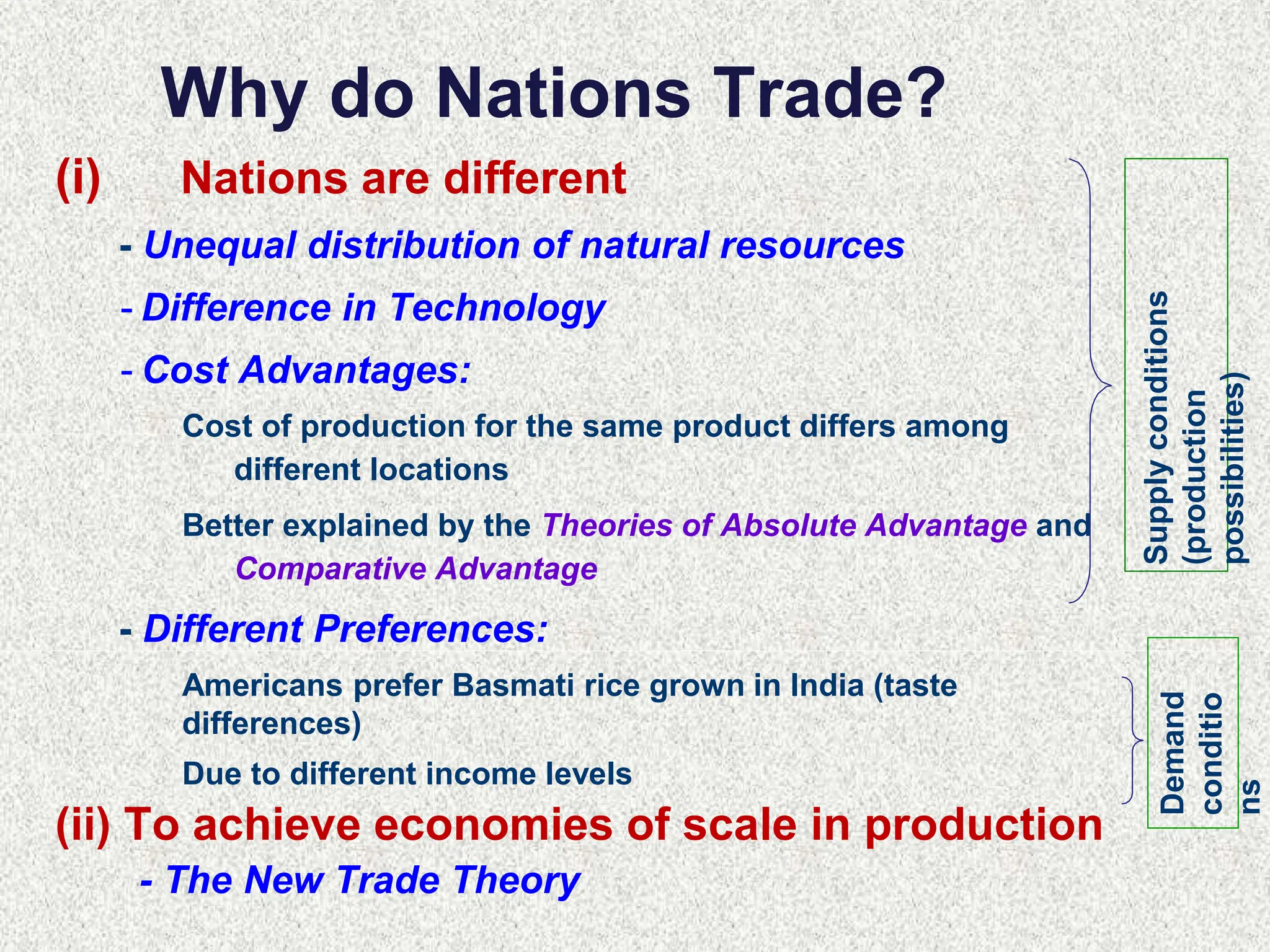
(i) Nations are different
- Unequal distribution of natural resources
- Difference in Technology
- Cost Advantages:
Cost of production for the same product differs among
different locations
Better explained by the Theories of Absolute Advantage and
Comparative Advantage
- Different Preferences:
Americans prefer Basmati rice grown in India (taste
differences)
Due to different income levels
(ii) To achieve economies of scale in production
- The New Trade Theory
Supply
conditions
(production
possibilities)
Demand
conditio
ns
Why study trade theory?
• Talks about benefits of international trade
– theories show why countries should trade for
products/ services even when they can
produce them domestically (Classical
theories)
• Talks about patterns of international trade
– theories show why countries specialize the
way they do (Factor endowment theories)
• Talks about the role of intervention
– theories help articulate the role of government
policy (tariffs, quotas, etc.)
“International trade theories has long held
that
…..some trade is better than no trade,
and more trade is better than less trade,
and free trade is better than restricted
trade…”
Free trade is a situation where a
government does not influence
international trade through quotas and
tariffs
“…. Free trade is considered to be fair
trade, because what is free must be
fair…” !!!!
An overview of trade theory
• Early thinking: Theory of Mercantilism
• Adam Smith: The theory of absolute
advantage, 1776
• Ricardo: The theory of comparative
advantage, 1817
• Heckscher-Ohlin theory: 20th century
• “New” trade theory based on economies of
scale
• Product Life Cycle theory
Theory of Mercantilism
• A trade theory prevailed during 16th to 19th centuries
• The wealth of a nation is measured based on its
accumulated wealth in terms of gold and silver
• Nations should accumulate wealth by encouraging
exports and discouraging imports
• Theory of mercantilism aims at creating trade
surplus and in turn accumulate nation’s wealth
Absolute Advantage Theory
• Adam Smith, ‘An Enquiry into the Nature and
Causes of the Wealth of Nations’, 1776
• There is international benefit from trade
– Everyone better off without making anyone
worse off
• When one country can produce a unit of good
with less cost than another country, the first
country has an absolute (cost) advantage in
producing that good
• Cost is considered based on number of labour
units used
Absolute Advantage Theory
Assumptions:
• Two countries (A&B), both producing two
products (x&y)
• Labour is the only factor of production
and its productivity remains the same
• Perfect mobility of labour between the sectors
within a country
• No mobility of labour between the countries
• Assumes perfect competition
– No transportation cost
– No restrictions on the movement of goods
between the countries (free trade)
Theory of Absolute Advantage
• Assume, two countries, country A and country
B
producing only two commodities, x and y
• Suppose, A can produce x cheaper than B,
and B can produce y cheaper than A
• Means, A has an absolute advantage in the
production of x and B in the production of y
• Thus, A will be better off concentrating
on the production of x and B on the
production of y
• A will export x to B, and B will export y to A
Conti...
• Both countries will gain from the trade
– Results in specialization
– Increases productivity
• But what happens if A has absolute
advantage in the production of both x and y?
• i.e., if A can produce x cheaper than B
and it can produce y much cheaper than
B
• Should A produce both x and y and B
nothing?
Theory of Absolute Advantage
Limitations
• Explains the causes of trade only when both the
countries enjoy absolute advantage in the
production of at least one product
• Assumes that transportation costs are either non-
existent or insignificant, which may not always
hold good
• Assumes that prices are comparable across
countries, implying stability of exchange rate
• Perfect mobility of labour between sectors –
labour may be mobile but to an extent
Comparative Advantage Theory
• David Ricardo, ‘The Principles of Political
Economy & Taxation’, 1817.
• Nations can still gain from trade even
without an absolute advantage.
• Facilitator – Difference in opportunity cost
• A country has a Comparative Advantage in
producing a good if the opportunity cost of
producing that good in terms of other goods
is lower in that country compared to other
countries
The Comparative Advantage
Theory
⮚Even if countries do not have an absolute
advantage, they can gain from trade by
allocating resources based on their
comparative advantage and trade with each
other
⮚Assumptions:
▪ Mostly same as that of absolute advantage
theory
Comparative Advantage - Illustration
• Labour requirements (opportunity cost in the
bracket)
• The relative price of one PC is 2 textiles in
India (6/3), while it is ½ textiles in the US
• Hence, PC is relatively cheaper in the US
• In the case of relative price of textiles, the
reverse is the case
• US specializes in PCs
• India Specializes in Textiles
India US
Textiles 3 (1/2) 2 (2)
PCs 6 (2) 1 (1/2)
Terms of Trade
• Gains from trade depends on the terms of
trade
• The ratio of export prices to import prices is
referred to as terms of trade
• i.e., it represents how many units of one
product is exchanged for one unit of the
other product between the two countries
Relative Wages under Recardian Model
• Labour requirements (opportunity cost
in the bracket)
• US specializes in PCs
• India Specializes in
Textiles
India US
Textiles 3 (1/2) 2 (2)
PCs 6 (2) 1 (1/2)
Ricardian Model – An Overview
• Illustrates the potential benefits from trade
• Trade leads to international specialization
• With labour as the only factor, it moves from
relatively less efficient industries to relatively
more efficient industries
Gains from Trade
(a)International trade brings in efficiency in
production and consumption, and
(b)It provides a market for goods and services
Thank You

International Trade Theories .pptx

  • 1.
  • 2.
    Introduction • Fundamental questionsin International Trade –Why does international trade take place? –What determines which country should export a particular good and which country should import it? –Who gains from such trade?
  • 3.
    Why do NationsTrade? (i) Nations are different - Unequal distribution of natural resources - Difference in Technology - Cost Advantages: Cost of production for the same product differs among different locations Better explained by the Theories of Absolute Advantage and Comparative Advantage - Different Preferences: Americans prefer Basmati rice grown in India (taste differences) Due to different income levels (ii) To achieve economies of scale in production - The New Trade Theory Supply conditions (production possibilities) Demand conditio ns
  • 4.
    Why study tradetheory? • Talks about benefits of international trade – theories show why countries should trade for products/ services even when they can produce them domestically (Classical theories) • Talks about patterns of international trade – theories show why countries specialize the way they do (Factor endowment theories) • Talks about the role of intervention – theories help articulate the role of government policy (tariffs, quotas, etc.)
  • 5.
    “International trade theorieshas long held that …..some trade is better than no trade, and more trade is better than less trade, and free trade is better than restricted trade…” Free trade is a situation where a government does not influence international trade through quotas and tariffs “…. Free trade is considered to be fair trade, because what is free must be fair…” !!!!
  • 6.
    An overview oftrade theory • Early thinking: Theory of Mercantilism • Adam Smith: The theory of absolute advantage, 1776 • Ricardo: The theory of comparative advantage, 1817 • Heckscher-Ohlin theory: 20th century • “New” trade theory based on economies of scale • Product Life Cycle theory
  • 7.
    Theory of Mercantilism •A trade theory prevailed during 16th to 19th centuries • The wealth of a nation is measured based on its accumulated wealth in terms of gold and silver • Nations should accumulate wealth by encouraging exports and discouraging imports • Theory of mercantilism aims at creating trade surplus and in turn accumulate nation’s wealth
  • 8.
    Absolute Advantage Theory •Adam Smith, ‘An Enquiry into the Nature and Causes of the Wealth of Nations’, 1776 • There is international benefit from trade – Everyone better off without making anyone worse off • When one country can produce a unit of good with less cost than another country, the first country has an absolute (cost) advantage in producing that good • Cost is considered based on number of labour units used
  • 9.
    Absolute Advantage Theory Assumptions: •Two countries (A&B), both producing two products (x&y) • Labour is the only factor of production and its productivity remains the same • Perfect mobility of labour between the sectors within a country • No mobility of labour between the countries • Assumes perfect competition – No transportation cost – No restrictions on the movement of goods between the countries (free trade)
  • 10.
    Theory of AbsoluteAdvantage • Assume, two countries, country A and country B producing only two commodities, x and y • Suppose, A can produce x cheaper than B, and B can produce y cheaper than A • Means, A has an absolute advantage in the production of x and B in the production of y • Thus, A will be better off concentrating on the production of x and B on the production of y • A will export x to B, and B will export y to A
  • 11.
    Conti... • Both countrieswill gain from the trade – Results in specialization – Increases productivity • But what happens if A has absolute advantage in the production of both x and y? • i.e., if A can produce x cheaper than B and it can produce y much cheaper than B • Should A produce both x and y and B nothing?
  • 12.
    Theory of AbsoluteAdvantage Limitations • Explains the causes of trade only when both the countries enjoy absolute advantage in the production of at least one product • Assumes that transportation costs are either non- existent or insignificant, which may not always hold good • Assumes that prices are comparable across countries, implying stability of exchange rate • Perfect mobility of labour between sectors – labour may be mobile but to an extent
  • 13.
    Comparative Advantage Theory •David Ricardo, ‘The Principles of Political Economy & Taxation’, 1817. • Nations can still gain from trade even without an absolute advantage. • Facilitator – Difference in opportunity cost • A country has a Comparative Advantage in producing a good if the opportunity cost of producing that good in terms of other goods is lower in that country compared to other countries
  • 14.
    The Comparative Advantage Theory ⮚Evenif countries do not have an absolute advantage, they can gain from trade by allocating resources based on their comparative advantage and trade with each other ⮚Assumptions: ▪ Mostly same as that of absolute advantage theory
  • 15.
    Comparative Advantage -Illustration • Labour requirements (opportunity cost in the bracket) • The relative price of one PC is 2 textiles in India (6/3), while it is ½ textiles in the US • Hence, PC is relatively cheaper in the US • In the case of relative price of textiles, the reverse is the case • US specializes in PCs • India Specializes in Textiles India US Textiles 3 (1/2) 2 (2) PCs 6 (2) 1 (1/2)
  • 16.
    Terms of Trade •Gains from trade depends on the terms of trade • The ratio of export prices to import prices is referred to as terms of trade • i.e., it represents how many units of one product is exchanged for one unit of the other product between the two countries
  • 17.
    Relative Wages underRecardian Model • Labour requirements (opportunity cost in the bracket) • US specializes in PCs • India Specializes in Textiles India US Textiles 3 (1/2) 2 (2) PCs 6 (2) 1 (1/2)
  • 18.
    Ricardian Model –An Overview • Illustrates the potential benefits from trade • Trade leads to international specialization • With labour as the only factor, it moves from relatively less efficient industries to relatively more efficient industries Gains from Trade (a)International trade brings in efficiency in production and consumption, and (b)It provides a market for goods and services
  • 19.