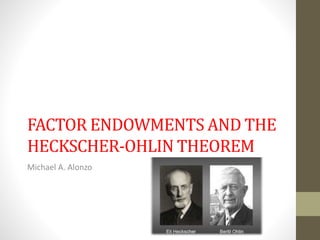
FACTOR ENDOWMENTS AND THE
HECKSCHER-OHLIN THEOREM
Michael A. Alonzo
FACTORS OF PRODUCTION
1. LAND
2. LABOR
3. CAPITAL
4. NATURAL RESOURCES
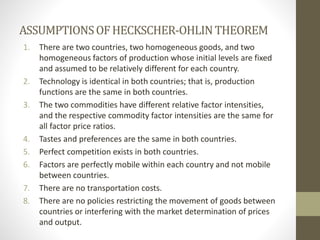
ASSUMPTIONSOFHECKSCHER-OHLINTHEOREM
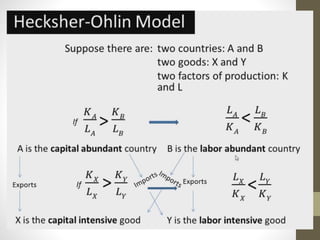
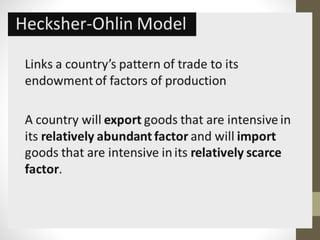
1. There are two countries, two homogeneous goods, and two
homogeneous factors of production whose initial levels are fixed
and assumed to be relatively different for each country.
2. Technology is identical in both countries; that is, production
functions are the same in both countries.
3. The two commodities have different relative factor intensities,
and the respective commodity factor intensities are the same for
all factor price ratios.
4. Tastes and preferences are the same in both countries.
5. Perfect competition exists in both countries.
6. Factors are perfectly mobile within each country and not mobile
between countries.
7. There are no transportation costs.
8. There are no policies restricting the movement of goods between
countries or interfering with the market determination of prices
and output.
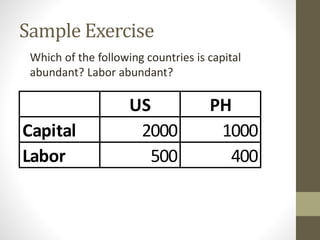
Sample Exercise
US PH
Capital 2000 1000
Labor 500 400
Which of the following countries is capital
abundant? Labor abundant?
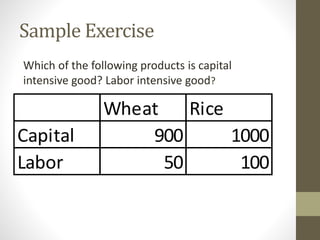
Sample Exercise
Which of the following products is capital
intensive good? Labor intensive good?
Wheat Rice
Capital 900 1000
Labor 50 100
Sample Exercise
Conclusion:
US will ______ wheat and _____ rice
while PH will _______ rice and ______
wheat.
ASSIGNMENT
1. ILLUSTRATE AND EXPLAIN THE GRAPH OF PERFECT
COMPETITION.
2. ILLUSTRATE AND EXPLAIN THE GRAPH OF MONOPOLY.
3. COMPARE THE TWO GRAPH IN TERMS OF PROFIT
MAXIMIZATION AND PRICE DETERMINATION.
THANK YOU!
Michael A. Alonzo
Instructor @IGCFI

Hecksher Ohlin Theory

  • 1.
    FACTOR ENDOWMENTS ANDTHE HECKSCHER-OHLIN THEOREM Michael A. Alonzo
  • 4.
    FACTORS OF PRODUCTION 1.LAND 2. LABOR 3. CAPITAL 4. NATURAL RESOURCES
  • 5.
    ASSUMPTIONSOFHECKSCHER-OHLINTHEOREM 1. There aretwo countries, two homogeneous goods, and two homogeneous factors of production whose initial levels are fixed and assumed to be relatively different for each country. 2. Technology is identical in both countries; that is, production functions are the same in both countries. 3. The two commodities have different relative factor intensities, and the respective commodity factor intensities are the same for all factor price ratios. 4. Tastes and preferences are the same in both countries. 5. Perfect competition exists in both countries. 6. Factors are perfectly mobile within each country and not mobile between countries. 7. There are no transportation costs. 8. There are no policies restricting the movement of goods between countries or interfering with the market determination of prices and output.
  • 11.
    Sample Exercise US PH Capital2000 1000 Labor 500 400 Which of the following countries is capital abundant? Labor abundant?
  • 12.
    Sample Exercise Which ofthe following products is capital intensive good? Labor intensive good? Wheat Rice Capital 900 1000 Labor 50 100
  • 13.
    Sample Exercise Conclusion: US will______ wheat and _____ rice while PH will _______ rice and ______ wheat.
  • 14.
    ASSIGNMENT 1. ILLUSTRATE ANDEXPLAIN THE GRAPH OF PERFECT COMPETITION. 2. ILLUSTRATE AND EXPLAIN THE GRAPH OF MONOPOLY. 3. COMPARE THE TWO GRAPH IN TERMS OF PROFIT MAXIMIZATION AND PRICE DETERMINATION.
  • 15.
    THANK YOU! Michael A.Alonzo Instructor @IGCFI