International Economic Theory
International Trade Theory Overview Mercantilism Absolute Advantage Comparative Advantage Competitive -Porter’s Diamond Product Life Cycle Theory New Trade Theory
An Overview of Trade Theory Free Trade   occurs when a government does not attempt to influence, through quotas or duties, what its citizens can buy  from another country or what they can produce and sell to another country. The Benefits of Trade allow a country to specialize in the manufacture and export of products that can be produced most efficiently in that country.
An Overview of Trade Theory The Pattern of International Trade displays patterns that are easy to understand (Saudi Arabia/oil or Mexico/labor intensive goods). Others are not so easy to understand (Japan and cars).
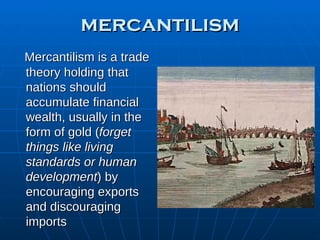
mercantilism Mercantilism is a trade theory holding that nations should accumulate financial wealth, usually in the form of gold ( forget things like living standards or human development ) by encouraging exports and discouraging imports
Mercantilism: mid-16th century A nation’s wealth depends on accumulated treasure Gold and silver are the currency  of  trade Theory says you should have a trade surplus.  Maximize export through subsidies. Minimize imports   through tariffs  and quotas Flaw: restrictions, impaired growth
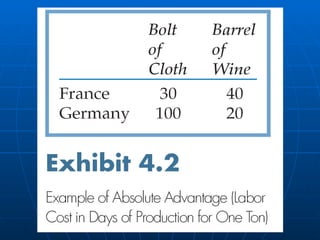
Theory of absolute advantage Adam Smith: Wealth of Nations  ( 1776) argued: Capability of one country to produce more of a product with the same amount of input than another country  A country should produce only goods where it is  most  efficient,  and trade for those goods where it is not efficient Trade between countries is, therefore, beneficial  Assumes there is an  absolute  balance among  nations
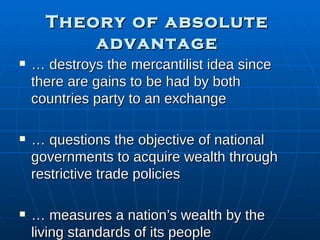
Theory of absolute advantage …  destroys the mercantilist idea since there are gains to be had by both countries party to an exchange …  questions the objective of national governments to acquire wealth through restrictive trade policies …  measures a nation’s wealth by the living standards of its people
 
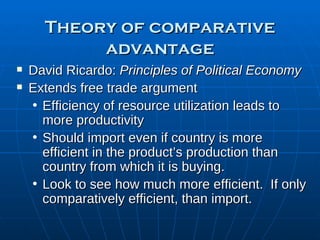
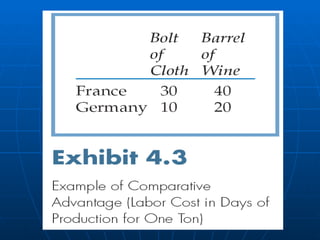
Theory of comparative advantage David Ricardo:  Principles of Political Economy  Extends free trade argument Efficiency of resource utilization leads to more productivity Should import even if country is more efficient in the product’s production than country from which it is buying. Look to see how much more efficient.  If only comparatively efficient, than import.
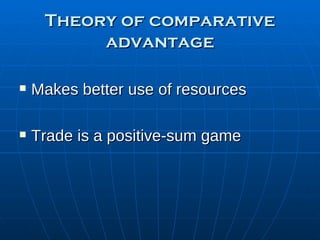
Theory of comparative advantage Makes better use of resources Trade is a positive-sum game
 
Simple Extensions of the Ricardian Model Diminishing returns: More a country produces, at some point, will require more resources. However: Free trade can increase a country’s production resources, and Increase the efficiency of resource utilization.
Examples of National Comparative Advantage China is a low labor cost production base India’s Bangalore region offers a critical mass of IT workers Ireland’s repositioning enabled a sophisticated service economy Dubai, a previously obscure Emirate, has been transformed into a knowledge-based economy
Limitations of comparative advantage Driven only by maximization of production and consumption Only 2 countries engaged in production and consumption of just 2 goods? What about the transportation costs? Only resource – labour (that too, non-transferable)  No consideration for ‘learning theory’
Assumptions of Absolute Advantage and Comparative Advantage Resources fully employed Countries primarily interested in profit maximization  Two countries, two commodities — not very realistic. Costs of transportation not considered Assume that resources can move from one good to another domestically but not free to move internationally
Competitive advantage Competitive advantage  is a position a firm occupies against its competitors. three methods for creating a sustainable competitive advantage are through  cost leadership,  differentiation  focus The primary factors of competitive advantage are innovation, reputation and relationships .
contd
Theory of national competitive advantage   The theory attempts to analyze the reasons for a nations success in a particular industry Porter studied 100 industries in 10 nations Postulated determinants of competitive advantage  of a nation based on four major attributes Factor endowments Demand conditions Related and supporting industries Firm strategy, structure and rivalry
Success occurs where these attributes exist. More/greater the attribute, the higher chance of success
Examples of Firm Competitive Advantage Nokia’s design and technology leadership in telecommunications Samsung’s leadership in flat-panel TV  Herman Miller’s design leadership in office furniture (e.g., Aeron chairs)
Limitations of Early Trade Theories Do not take into account the cost of international transportation Tariffs and import restrictions can distort trade flows Scale economies can bring about additional efficiencies
Limitations of Early Trade Theories When governments selectively target certain industries for strategic investment, this may cause trade patterns contrary to theoretical explanations Today, countries can access needed low-cost capital on global markets Some services do not lend themselves to cross-border trade full employment
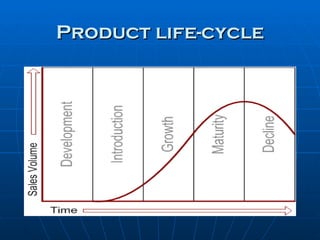
Product life-cycle Theory R. Vernon (1966)   Trade theory holding that a company will begin by exporting its product and later undertake foreign direct investment as the product moves through its lifecycle As products mature, both location of sales and optimal production changes Affects the direction and flow of imports and exports
Product life-cycle
Limitations of PLC There is no set amount of time  No real proof that all products must die The theory can lead to an over-emphasis on new product releases at the expense of mature products Individual products
Limitations of PLC No stress product redesign Most appropriate for technology-based products Some products not easily characterized by stages of maturity Most relevant to products produced through mass production Globalization and integration of the economy makes this theory less valid
New trade theory In industries with high fixed costs: Specialization increases output, and the ability to enhance economies of scale increases Learning effects are high. These are cost savings that come from ‘learning by doing’
New trade theory - applications Typically, requires industries with high, fixed costs World demand will support few competitors Competitors may emerge because of “ First-mover advantage” Economies of scale may preclude new entrants Role of the government becomes significant Some argue that it generates government intervention and strategic trade policy
Bibliography www.wikipedia.com www.google.com http://ideas.repec.org/p/wop/afpswp/_001.html http://en.wikipedia.org/wiki/New_Palgrave:_A_Dictionary_of_Economics http://internationalecon.com/v1.0/ch40/ch40.html A. O'Sullivan & S.M. Sheffrin (2003).  Economics. Principles & Tools .
THANK YOU

International Theories

  • 1.
  • 2.
    International Trade TheoryOverview Mercantilism Absolute Advantage Comparative Advantage Competitive -Porter’s Diamond Product Life Cycle Theory New Trade Theory
  • 3.
    An Overview ofTrade Theory Free Trade occurs when a government does not attempt to influence, through quotas or duties, what its citizens can buy from another country or what they can produce and sell to another country. The Benefits of Trade allow a country to specialize in the manufacture and export of products that can be produced most efficiently in that country.
  • 4.
    An Overview ofTrade Theory The Pattern of International Trade displays patterns that are easy to understand (Saudi Arabia/oil or Mexico/labor intensive goods). Others are not so easy to understand (Japan and cars).
  • 5.
    mercantilism Mercantilism isa trade theory holding that nations should accumulate financial wealth, usually in the form of gold ( forget things like living standards or human development ) by encouraging exports and discouraging imports
  • 6.
    Mercantilism: mid-16th centuryA nation’s wealth depends on accumulated treasure Gold and silver are the currency of trade Theory says you should have a trade surplus. Maximize export through subsidies. Minimize imports through tariffs and quotas Flaw: restrictions, impaired growth
  • 7.
    Theory of absoluteadvantage Adam Smith: Wealth of Nations ( 1776) argued: Capability of one country to produce more of a product with the same amount of input than another country A country should produce only goods where it is most efficient, and trade for those goods where it is not efficient Trade between countries is, therefore, beneficial Assumes there is an absolute balance among nations
  • 8.
    Theory of absoluteadvantage … destroys the mercantilist idea since there are gains to be had by both countries party to an exchange … questions the objective of national governments to acquire wealth through restrictive trade policies … measures a nation’s wealth by the living standards of its people
  • 9.
  • 10.
    Theory of comparativeadvantage David Ricardo: Principles of Political Economy Extends free trade argument Efficiency of resource utilization leads to more productivity Should import even if country is more efficient in the product’s production than country from which it is buying. Look to see how much more efficient. If only comparatively efficient, than import.
  • 11.
    Theory of comparativeadvantage Makes better use of resources Trade is a positive-sum game
  • 12.
  • 13.
    Simple Extensions ofthe Ricardian Model Diminishing returns: More a country produces, at some point, will require more resources. However: Free trade can increase a country’s production resources, and Increase the efficiency of resource utilization.
  • 14.
    Examples of NationalComparative Advantage China is a low labor cost production base India’s Bangalore region offers a critical mass of IT workers Ireland’s repositioning enabled a sophisticated service economy Dubai, a previously obscure Emirate, has been transformed into a knowledge-based economy
  • 15.
    Limitations of comparativeadvantage Driven only by maximization of production and consumption Only 2 countries engaged in production and consumption of just 2 goods? What about the transportation costs? Only resource – labour (that too, non-transferable) No consideration for ‘learning theory’
  • 16.
    Assumptions of AbsoluteAdvantage and Comparative Advantage Resources fully employed Countries primarily interested in profit maximization Two countries, two commodities — not very realistic. Costs of transportation not considered Assume that resources can move from one good to another domestically but not free to move internationally
  • 17.
    Competitive advantage Competitiveadvantage is a position a firm occupies against its competitors. three methods for creating a sustainable competitive advantage are through cost leadership, differentiation focus The primary factors of competitive advantage are innovation, reputation and relationships .
  • 18.
  • 19.
    Theory of nationalcompetitive advantage The theory attempts to analyze the reasons for a nations success in a particular industry Porter studied 100 industries in 10 nations Postulated determinants of competitive advantage of a nation based on four major attributes Factor endowments Demand conditions Related and supporting industries Firm strategy, structure and rivalry
  • 20.
    Success occurs wherethese attributes exist. More/greater the attribute, the higher chance of success
  • 21.
    Examples of FirmCompetitive Advantage Nokia’s design and technology leadership in telecommunications Samsung’s leadership in flat-panel TV Herman Miller’s design leadership in office furniture (e.g., Aeron chairs)
  • 22.
    Limitations of EarlyTrade Theories Do not take into account the cost of international transportation Tariffs and import restrictions can distort trade flows Scale economies can bring about additional efficiencies
  • 23.
    Limitations of EarlyTrade Theories When governments selectively target certain industries for strategic investment, this may cause trade patterns contrary to theoretical explanations Today, countries can access needed low-cost capital on global markets Some services do not lend themselves to cross-border trade full employment
  • 24.
    Product life-cycle TheoryR. Vernon (1966) Trade theory holding that a company will begin by exporting its product and later undertake foreign direct investment as the product moves through its lifecycle As products mature, both location of sales and optimal production changes Affects the direction and flow of imports and exports
  • 25.
  • 26.
    Limitations of PLCThere is no set amount of time No real proof that all products must die The theory can lead to an over-emphasis on new product releases at the expense of mature products Individual products
  • 27.
    Limitations of PLCNo stress product redesign Most appropriate for technology-based products Some products not easily characterized by stages of maturity Most relevant to products produced through mass production Globalization and integration of the economy makes this theory less valid
  • 28.
    New trade theoryIn industries with high fixed costs: Specialization increases output, and the ability to enhance economies of scale increases Learning effects are high. These are cost savings that come from ‘learning by doing’
  • 29.
    New trade theory- applications Typically, requires industries with high, fixed costs World demand will support few competitors Competitors may emerge because of “ First-mover advantage” Economies of scale may preclude new entrants Role of the government becomes significant Some argue that it generates government intervention and strategic trade policy
  • 30.
    Bibliography www.wikipedia.com www.google.comhttp://ideas.repec.org/p/wop/afpswp/_001.html http://en.wikipedia.org/wiki/New_Palgrave:_A_Dictionary_of_Economics http://internationalecon.com/v1.0/ch40/ch40.html A. O'Sullivan & S.M. Sheffrin (2003). Economics. Principles & Tools .
  • 31.