Copyright © 2010 by the McGraw-Hill Companies, Inc. All rights reserved.McGraw-Hill/Irwin
Chapter 6
Wage Determination and the
Allocation of Labor
6-2
1. Theory of a Perfectly
Competitive Labor
Market
6-3
Perfectly Competitive Labor
Market
o Perfectly competitive labor markets have
the following characteristics:
• Large number of firms trying to hire an
identical type of labor
• Numerous qualified people independently
offering their services
• Neither firms nor workers have control over
the market wage
• Perfect, costless information and labor
mobility
6-4
Market Labor Supply
Quantity of
Labor Hours
Wagerate
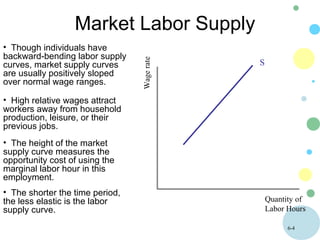
• Though individuals have
backward-bending labor supply
curves, market supply curves
are usually positively sloped
over normal wage ranges.
• High relative wages attract
workers away from household
production, leisure, or their
previous jobs.
• The height of the market
supply curve measures the
opportunity cost of using the
marginal labor hour in this
employment.
S
• The shorter the time period,
the less elastic is the labor
supply curve.
6-5
Wage and Employment
Determination
Quantity of
Labor
Hours
Wage rate
• The equilibrium wage rate W0
and level of employment Q0
occur at the intersection of labor
supply and demand.
• An excess demand of Q2- Q1
would occur at a wage rate of
Wed.
• An excess supply of Q2- Q1
would occur at a wage rate of
Wes.
S
D
Q0
W0
Wed
Q2Q1
Wes
6-6
Labor Supply Determinants
o Other wage rates
• If wages in other occupations rise (fall), then
labor supply will fall (rise).
o Nonwage income
• If nonwage income rises (falls), then labor
supply will fall (rise).
o Preferences for work versus leisure
• If preferences for work increase (decrease),
then labor supply will increase (decrease).
6-7
Labor Supply Determinants
o Nonwage aspects of job
• If the nonwage aspects of a job improve
(worsen), then labor supply will increase
(decrease).
o Number of qualified suppliers
• An increase (decrease) in the number of
qualified workers will increase (decrease)
labor supply.
6-8
Labor Demand Determinants
o Product demand
• Changes in product demand that
increase (decrease) the product price, will
increase (decrease) labor demand.
o Productivity
• An increase (decrease) in productivity will
increase (decrease) labor demand,
assuming that it does not cause an offset
in the product price.
6-9
Labor Demand Determinants
o Prices of other resources
• For gross substitutes, an increase
(decrease) in the price of a substitute
input will increase (decrease) labor
demand.
• For gross complements, an increase
(decrease) in the price of a complement
input will decrease (increase) labor
demand.
6-10
Labor Demand Determinants
o Prices of other resources
• For pure complements, an increase
(decrease) in the price of a complement
input will decrease (increase) labor
demand.
o Number of employers
• An increase (decrease) in the number of
employers will increase (decrease) labor
demand.
6-11
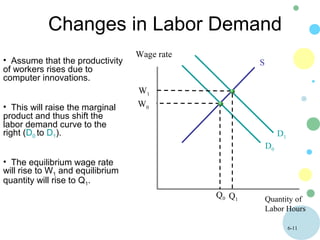
Changes in Labor Demand
Quantity of
Labor Hours
Wage rate
• Assume that the productivity
of workers rises due to
computer innovations.
• This will raise the marginal
product and thus shift the
labor demand curve to the
right (D0 to D1).
• The equilibrium wage rate
will rise to W1 and equilibrium
quantity will rise to Q1.
S
D0
Q0
W0
D1
Q1
W1
6-12
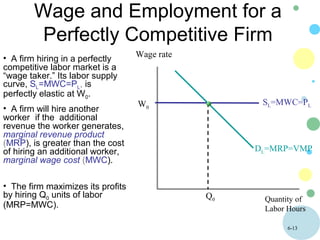
Changes in Labor Supply
Quantity of
Labor Hours
Wage rate
• Assume that the number of
working-age immigrants
increases substantially.
• This will shift the labor
supply curve to the right (S0 to
S1).
• The equilibrium wage rate
will fall to W1 and equilibrium
quantity will rise to Q1.
S0
D0
Q0
W0
S1
Q1
W1
6-13
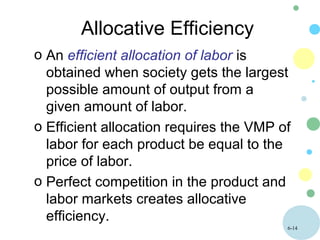
Wage and Employment for a
Perfectly Competitive Firm
Quantity of
Labor Hours
Wage rate• A firm hiring in a perfectly
competitive labor market is a
“wage taker.” Its labor supply
curve, SL=MWC=PL, is
perfectly elastic at W0.
• A firm will hire another
worker if the additional
revenue the worker generates,
marginal revenue product
(MRP), is greater than the cost
of hiring an additional worker,
marginal wage cost (MWC).
SL=MWC=PL
DL=MRP=VMP
Q0
W0
• The firm maximizes its profits
by hiring Q0 units of labor
(MRP=MWC).
6-14
Allocative Efficiency
o An efficient allocation of labor is
obtained when society gets the largest
possible amount of output from a
given amount of labor.
o Efficient allocation requires the VMP of
labor for each product be equal to the
price of labor.
o Perfect competition in the product and
labor markets creates allocative
efficiency.
6-15
Questions for Thought
1. What effect will each of the following have on
the market demand for a specific type of labor:
(a) An increase in product demand that increases the
product price.
(b) A decline in the productivity of this type of labor.
(c) An increase in the price of a gross substitute of labor.
(e) The demise of several firms that hire this type of
labor.
(f) A decline in the market wage for this type of labor.
(d) An increase in the price of a gross complement of
labor.
6-16
2. Wage and
Employment
Determination:
Monopoly in the
Product Market
6-17
Wage and Employment for a
Monopolist
Quantity of
Labor Hours
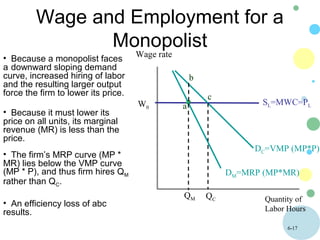
Wage rate• Because a monopolist faces
a downward sloping demand
curve, increased hiring of labor
and the resulting larger output
force the firm to lower its price.
• Because it must lower its
price on all units, its marginal
revenue (MR) is less than the
price.
SL=MWC=PL
DC=VMP (MP*P)
QC
W0
• The firm’s MRP curve (MP *
MR) lies below the VMP curve
(MP * P), and thus firm hires QM
rather than QC.
DM=MRP (MP*MR)
a
b
c
QM
• An efficiency loss of abc
results.
6-18
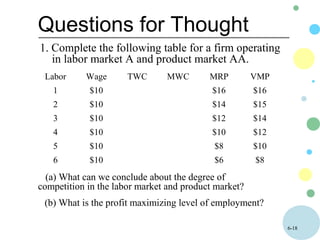
1. Complete the following table for a firm operating
in labor market A and product market AA.
Questions for Thought
Labor Wage TWC MWC MRP VMP
1 $10 $16 $16
2 $10 $14 $15
3 $10 $12 $14
4 $10 $10 $12
5 $10 $8 $10
6 $10 $6 $8
(a) What can we conclude about the degree of
competition in the labor market and product market?
(b) What is the profit maximizing level of employment?
6-19
3. Monopsony
6-20
Monopsony
o A monopsony is a labor
market where a single firm is
the sole hirer of a particular
type of labor.
• A monopsonist has control over
the wage rate workers are paid
by hiring more or less labor.
6-21
$ 2
$ 6
$12
$20
$30
$42
$56
-----
TWC
(3)
$ 7
$ 9
$ 8
$ 3
(VMP)
MRP
(5)
$ 6
$ 5
$ 4
$ 10
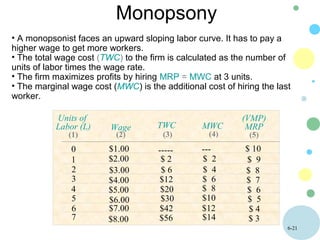
• A monopsonist faces an upward sloping labor curve. It has to pay a
higher wage to get more workers.
• The total wage cost (TWC) to the firm is calculated as the number of
units of labor times the wage rate.
• The firm maximizes profits by hiring MRP = MWC at 3 units.
• The marginal wage cost (MWC) is the additional cost of hiring the last
worker.
Monopsony
MWC
(4)
---
$ 2
$ 4
$ 6
$ 8
$10
$12
$14
Wage
(2)
Units of
Labor (L)
(1)
0
1
2
3
4
5
6
7
$1.00
$2.00
$3.00
$4.00
$5.00
$6.00
$7.00
$8.00
6-22
Wage and Employment
for a Monopsonist
Quantity of
Labor Hours
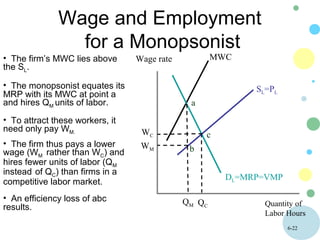
Wage rate• The firm’s MWC lies above
the SL.
• To attract these workers, it
need only pay WM.
SL=PL
QC
• The firm thus pays a lower
wage (WM rather than WC) and
hires fewer units of labor (QM
instead of QC) than firms in a
competitive labor market.
DL=MRP=VMP
• An efficiency loss of abc
results.
MWC
WC
QM
WM
• The monopsonist equates its
MRP with its MWC at point a
and hires QM units of labor.
b
a
c
6-23
4. Wage Determination:
Delayed Supply
Responses
6-24
Cobweb Model
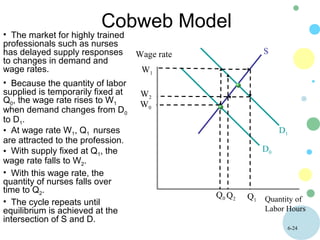
• The market for highly trained
professionals such as nurses
has delayed supply responses
to changes in demand and
wage rates.
Q0
W0
D0
Quantity of
Labor Hours
Wage rate S
• Because the quantity of labor
supplied is temporarily fixed at
Q0, the wage rate rises to W1
when demand changes from D0
to D1.
• At wage rate W1, Q1 nurses
are attracted to the profession.
• With supply fixed at Q1, the
wage rate falls to W2.
• With this wage rate, the
quantity of nurses falls over
time to Q2.
• The cycle repeats until
equilibrium is achieved at the
intersection of S and D.
D1
W1
W2
Q1
Q2
6-25
Evidence
o Some evidence exists for cobweb
adjustments in markets such as
lawyers and engineers.
o Critics argue that:
• Students make choices on the basis of the
lifetime earnings stream rather than
starting salaries.
• Students make a forecast of the long-run
outcome of a change in demand or supply
and make the right choice.

Wage Determination and the Allocation of Labor

  • 1.
    Copyright © 2010by the McGraw-Hill Companies, Inc. All rights reserved.McGraw-Hill/Irwin Chapter 6 Wage Determination and the Allocation of Labor
  • 2.
    6-2 1. Theory ofa Perfectly Competitive Labor Market
  • 3.
    6-3 Perfectly Competitive Labor Market oPerfectly competitive labor markets have the following characteristics: • Large number of firms trying to hire an identical type of labor • Numerous qualified people independently offering their services • Neither firms nor workers have control over the market wage • Perfect, costless information and labor mobility
  • 4.
    6-4 Market Labor Supply Quantityof Labor Hours Wagerate • Though individuals have backward-bending labor supply curves, market supply curves are usually positively sloped over normal wage ranges. • High relative wages attract workers away from household production, leisure, or their previous jobs. • The height of the market supply curve measures the opportunity cost of using the marginal labor hour in this employment. S • The shorter the time period, the less elastic is the labor supply curve.
  • 5.
    6-5 Wage and Employment Determination Quantityof Labor Hours Wage rate • The equilibrium wage rate W0 and level of employment Q0 occur at the intersection of labor supply and demand. • An excess demand of Q2- Q1 would occur at a wage rate of Wed. • An excess supply of Q2- Q1 would occur at a wage rate of Wes. S D Q0 W0 Wed Q2Q1 Wes
  • 6.
    6-6 Labor Supply Determinants oOther wage rates • If wages in other occupations rise (fall), then labor supply will fall (rise). o Nonwage income • If nonwage income rises (falls), then labor supply will fall (rise). o Preferences for work versus leisure • If preferences for work increase (decrease), then labor supply will increase (decrease).
  • 7.
    6-7 Labor Supply Determinants oNonwage aspects of job • If the nonwage aspects of a job improve (worsen), then labor supply will increase (decrease). o Number of qualified suppliers • An increase (decrease) in the number of qualified workers will increase (decrease) labor supply.
  • 8.
    6-8 Labor Demand Determinants oProduct demand • Changes in product demand that increase (decrease) the product price, will increase (decrease) labor demand. o Productivity • An increase (decrease) in productivity will increase (decrease) labor demand, assuming that it does not cause an offset in the product price.
  • 9.
    6-9 Labor Demand Determinants oPrices of other resources • For gross substitutes, an increase (decrease) in the price of a substitute input will increase (decrease) labor demand. • For gross complements, an increase (decrease) in the price of a complement input will decrease (increase) labor demand.
  • 10.
    6-10 Labor Demand Determinants oPrices of other resources • For pure complements, an increase (decrease) in the price of a complement input will decrease (increase) labor demand. o Number of employers • An increase (decrease) in the number of employers will increase (decrease) labor demand.
  • 11.
    6-11 Changes in LaborDemand Quantity of Labor Hours Wage rate • Assume that the productivity of workers rises due to computer innovations. • This will raise the marginal product and thus shift the labor demand curve to the right (D0 to D1). • The equilibrium wage rate will rise to W1 and equilibrium quantity will rise to Q1. S D0 Q0 W0 D1 Q1 W1
  • 12.
    6-12 Changes in LaborSupply Quantity of Labor Hours Wage rate • Assume that the number of working-age immigrants increases substantially. • This will shift the labor supply curve to the right (S0 to S1). • The equilibrium wage rate will fall to W1 and equilibrium quantity will rise to Q1. S0 D0 Q0 W0 S1 Q1 W1
  • 13.
    6-13 Wage and Employmentfor a Perfectly Competitive Firm Quantity of Labor Hours Wage rate• A firm hiring in a perfectly competitive labor market is a “wage taker.” Its labor supply curve, SL=MWC=PL, is perfectly elastic at W0. • A firm will hire another worker if the additional revenue the worker generates, marginal revenue product (MRP), is greater than the cost of hiring an additional worker, marginal wage cost (MWC). SL=MWC=PL DL=MRP=VMP Q0 W0 • The firm maximizes its profits by hiring Q0 units of labor (MRP=MWC).
  • 14.
    6-14 Allocative Efficiency o Anefficient allocation of labor is obtained when society gets the largest possible amount of output from a given amount of labor. o Efficient allocation requires the VMP of labor for each product be equal to the price of labor. o Perfect competition in the product and labor markets creates allocative efficiency.
  • 15.
    6-15 Questions for Thought 1.What effect will each of the following have on the market demand for a specific type of labor: (a) An increase in product demand that increases the product price. (b) A decline in the productivity of this type of labor. (c) An increase in the price of a gross substitute of labor. (e) The demise of several firms that hire this type of labor. (f) A decline in the market wage for this type of labor. (d) An increase in the price of a gross complement of labor.
  • 16.
  • 17.
    6-17 Wage and Employmentfor a Monopolist Quantity of Labor Hours Wage rate• Because a monopolist faces a downward sloping demand curve, increased hiring of labor and the resulting larger output force the firm to lower its price. • Because it must lower its price on all units, its marginal revenue (MR) is less than the price. SL=MWC=PL DC=VMP (MP*P) QC W0 • The firm’s MRP curve (MP * MR) lies below the VMP curve (MP * P), and thus firm hires QM rather than QC. DM=MRP (MP*MR) a b c QM • An efficiency loss of abc results.
  • 18.
    6-18 1. Complete thefollowing table for a firm operating in labor market A and product market AA. Questions for Thought Labor Wage TWC MWC MRP VMP 1 $10 $16 $16 2 $10 $14 $15 3 $10 $12 $14 4 $10 $10 $12 5 $10 $8 $10 6 $10 $6 $8 (a) What can we conclude about the degree of competition in the labor market and product market? (b) What is the profit maximizing level of employment?
  • 19.
  • 20.
    6-20 Monopsony o A monopsonyis a labor market where a single firm is the sole hirer of a particular type of labor. • A monopsonist has control over the wage rate workers are paid by hiring more or less labor.
  • 21.
    6-21 $ 2 $ 6 $12 $20 $30 $42 $56 ----- TWC (3) $7 $ 9 $ 8 $ 3 (VMP) MRP (5) $ 6 $ 5 $ 4 $ 10 • A monopsonist faces an upward sloping labor curve. It has to pay a higher wage to get more workers. • The total wage cost (TWC) to the firm is calculated as the number of units of labor times the wage rate. • The firm maximizes profits by hiring MRP = MWC at 3 units. • The marginal wage cost (MWC) is the additional cost of hiring the last worker. Monopsony MWC (4) --- $ 2 $ 4 $ 6 $ 8 $10 $12 $14 Wage (2) Units of Labor (L) (1) 0 1 2 3 4 5 6 7 $1.00 $2.00 $3.00 $4.00 $5.00 $6.00 $7.00 $8.00
  • 22.
    6-22 Wage and Employment fora Monopsonist Quantity of Labor Hours Wage rate• The firm’s MWC lies above the SL. • To attract these workers, it need only pay WM. SL=PL QC • The firm thus pays a lower wage (WM rather than WC) and hires fewer units of labor (QM instead of QC) than firms in a competitive labor market. DL=MRP=VMP • An efficiency loss of abc results. MWC WC QM WM • The monopsonist equates its MRP with its MWC at point a and hires QM units of labor. b a c
  • 23.
  • 24.
    6-24 Cobweb Model • Themarket for highly trained professionals such as nurses has delayed supply responses to changes in demand and wage rates. Q0 W0 D0 Quantity of Labor Hours Wage rate S • Because the quantity of labor supplied is temporarily fixed at Q0, the wage rate rises to W1 when demand changes from D0 to D1. • At wage rate W1, Q1 nurses are attracted to the profession. • With supply fixed at Q1, the wage rate falls to W2. • With this wage rate, the quantity of nurses falls over time to Q2. • The cycle repeats until equilibrium is achieved at the intersection of S and D. D1 W1 W2 Q1 Q2
  • 25.
    6-25 Evidence o Some evidenceexists for cobweb adjustments in markets such as lawyers and engineers. o Critics argue that: • Students make choices on the basis of the lifetime earnings stream rather than starting salaries. • Students make a forecast of the long-run outcome of a change in demand or supply and make the right choice.