OPERATIONS MANAGEMENT
Lecture # 6:
PROCESS & CAPACITY DESIGN
Humayun Akhtar
RIPHAH INTERNATIONAL UNIVERSITY
INTRODUCTION
 We have studied selection, definition and
design of goods and services
 Now we will look at their production
 It is important to find the best way to
produce
PROCESS STRATEGY
 It is an organization’s approach to transform
resources into goods and services.
 The main objective is to find a way to produce
products and services that meet customer’s
requirements / and product specifications
within cost and other managerial constraints.
 The process thus selected will have a long term
effect on efficieny and production, as well as
flexibility, cost and quality of goods.
TYPES OF PROCESS STRATEGIES
 Process Focus (Standard Register)
 Repetitive Focus (Harley Davidson)
 Product Focus (Nucor Steel)
 Mass Customization (DELL)
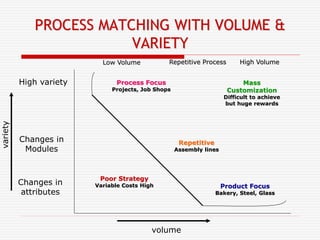
PROCESS MATCHING WITH VOLUME &
VARIETY
Low Volume High Volume
Repetitive Process
Process Focus
Projects, Job Shops
Mass
Customization
Difficult to achieve
but huge rewards
Repetitive
Assembly lines
Product Focus
Bakery, Steel, Glass
Poor Strategy
Variable Costs High
High variety
Changes in
Modules
Changes in
attributes
variety
volume
PROCESS FOCUS
 A production facility organized around
processes to facilitate low-volume, high
variety production
 High degree of product flexibility
 High variable costs
 Extremely low utilization of facilities
 Examples: restaurants, hospitals, machine
shops
REPETITIVE FOCUS
 A product oriented production process
that uses modules. It’s the classic
assembly line
 More structured and less flexible than
product focus
 Examples: Automobiles, Home Appliances,
Fast Food
PRODUCT FOCUS
 A production facility organized around
products; a product oriented, high
volume, low variety process
 Also called Continuous Processes, as they
have very long continuous process runs
 Standardization and effective quality
control essential
 Examples: glass, paper, bulbs, drinks,
cornea transplants
MASS CUSTOMIZATION FOCUS
 Rapid, low-cost production that caters to
constantly changing unique customer desires
 There is high demand for individualized goods
and services, e.g. automobiles, movies, cereals
etc
 Economically producing precisely what the
customer wants and when he wants it
 It provides the variety of process focused (low
volume) manufacture to product focused (high
volume) production
 Examples: DELL, NIKE
COMPARISON OF PROCESS STRATEGIES
 Each strategy, when matched to volume
and variety can produce a low cost
advantage, fast responsiveness and
differentiated products
PROCESS ANALYSIS AND DESIGN
 Questions to be asked:
 Is the process designed and capable to
achieve competitive advantage in terms of
low cost, response and differentiation?
 Does the process eliminate steps that do not
add value?
 Does the process maximize customer value as
perceived by the customer?
 Will the process win orders?
TOOLS FOR PROCESS ANALYSIS
 Flow Diagrams: A drawing used to analyse
movement of people and material
 Time-Function Mapping: A flow diagram but
with time added on the horizontal axis
 Process Chart: Charts using symbols to analyse
the movement of people or material
 Service Blueprinting: A process analysis
technique that focuses on the customer and
supplier’s interaction with the customer
SERVICE PROCESS DESIGN
 Mass Service
 Professional Service
 Ways to improve service processes:
 Layout
 Human Resources
 Technology
PROCESS REENGINEERING
 It is the fundamental rethinking and
radical redesign of business processes to
bring about dramatic improvements in
performance
 It can be a factory layout, a purchasing
procedure or an entirely new way of
making products
 It focuses on dramatic improvements in
cost, time and value.
ENVIRONMENTALLY FRIENDLY
PROCESSES
 Environmentally friendly ingredients
 Elimination of animal testing
 Energy efficiency
 Recyclable products and packaging
 Renewable energy sources
 Low effluent emission designs
SELECTION OF EQUIPMENT &
TECHNOLOGY
 Considerations:
 Cost
 Quality
 Capacity
 Flexibility
DESIGN CAPACITY
 Regardless of process type, OMs have to
determine capacity
 It is a large portion of fixed cost
 Too large plant, increased downtime
 Too small, customers lost
 It is the maximum theoretical output of a
system in a given period
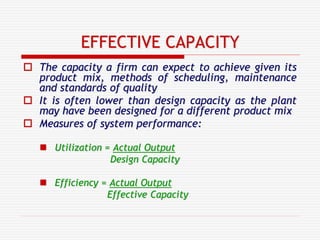
EFFECTIVE CAPACITY
 The capacity a firm can expect to achieve given its
product mix, methods of scheduling, maintenance
and standards of quality
 It is often lower than design capacity as the plant
may have been designed for a different product mix
 Measures of system performance:
 Utilization = Actual Output
Design Capacity
 Efficiency = Actual Output
Effective Capacity
FORECASTING CAPACITY REQUIREMENTS
 Determining future capacity requirements can be a
complicated procedure as it is based on future
demand.
 When demand can be forecast with a reasonable
degree of precision, determining capacity reqs. Can
be straightforward.
 First Phase: Future demand is forecast
 Second Phase: Forecast used for capacity
requirements
MANAGING DEMAND
 Demand exceeds Capacity:
 The firm may be able to curtail demand by raising
prices, scheduling long lead times and discouraging
small margins. Long term solution is capacity
increase.
 Capacity exceeds Demand:
 The firm may stimulate demand by price reductions
or aggressive marketing
 Adjusting to Seasonal Demands:
 The firm may offer products with complimentary
demand patterns
BREAK-EVEN ANALYSIS
 Break Even Point:
 The point in cash terms where the costs equal
revenues.
 Fixed Costs:
 Costs that continue even if no units are
produced, e.g. debt, taxes, depreciation
 Variable Costs:
 Costs that vary with the volume of units
produced, e.g. labour, materials
THANK YOU

LECTURE 6 - PROCESS & CAPACITY DESIGN.ppt

  • 1.
    OPERATIONS MANAGEMENT Lecture #6: PROCESS & CAPACITY DESIGN Humayun Akhtar RIPHAH INTERNATIONAL UNIVERSITY
  • 2.
    INTRODUCTION  We havestudied selection, definition and design of goods and services  Now we will look at their production  It is important to find the best way to produce
  • 3.
    PROCESS STRATEGY  Itis an organization’s approach to transform resources into goods and services.  The main objective is to find a way to produce products and services that meet customer’s requirements / and product specifications within cost and other managerial constraints.  The process thus selected will have a long term effect on efficieny and production, as well as flexibility, cost and quality of goods.
  • 4.
    TYPES OF PROCESSSTRATEGIES  Process Focus (Standard Register)  Repetitive Focus (Harley Davidson)  Product Focus (Nucor Steel)  Mass Customization (DELL)
  • 5.
    PROCESS MATCHING WITHVOLUME & VARIETY Low Volume High Volume Repetitive Process Process Focus Projects, Job Shops Mass Customization Difficult to achieve but huge rewards Repetitive Assembly lines Product Focus Bakery, Steel, Glass Poor Strategy Variable Costs High High variety Changes in Modules Changes in attributes variety volume
  • 6.
    PROCESS FOCUS  Aproduction facility organized around processes to facilitate low-volume, high variety production  High degree of product flexibility  High variable costs  Extremely low utilization of facilities  Examples: restaurants, hospitals, machine shops
  • 7.
    REPETITIVE FOCUS  Aproduct oriented production process that uses modules. It’s the classic assembly line  More structured and less flexible than product focus  Examples: Automobiles, Home Appliances, Fast Food
  • 8.
    PRODUCT FOCUS  Aproduction facility organized around products; a product oriented, high volume, low variety process  Also called Continuous Processes, as they have very long continuous process runs  Standardization and effective quality control essential  Examples: glass, paper, bulbs, drinks, cornea transplants
  • 9.
    MASS CUSTOMIZATION FOCUS Rapid, low-cost production that caters to constantly changing unique customer desires  There is high demand for individualized goods and services, e.g. automobiles, movies, cereals etc  Economically producing precisely what the customer wants and when he wants it  It provides the variety of process focused (low volume) manufacture to product focused (high volume) production  Examples: DELL, NIKE
  • 10.
    COMPARISON OF PROCESSSTRATEGIES  Each strategy, when matched to volume and variety can produce a low cost advantage, fast responsiveness and differentiated products
  • 11.
    PROCESS ANALYSIS ANDDESIGN  Questions to be asked:  Is the process designed and capable to achieve competitive advantage in terms of low cost, response and differentiation?  Does the process eliminate steps that do not add value?  Does the process maximize customer value as perceived by the customer?  Will the process win orders?
  • 12.
    TOOLS FOR PROCESSANALYSIS  Flow Diagrams: A drawing used to analyse movement of people and material  Time-Function Mapping: A flow diagram but with time added on the horizontal axis  Process Chart: Charts using symbols to analyse the movement of people or material  Service Blueprinting: A process analysis technique that focuses on the customer and supplier’s interaction with the customer
  • 13.
    SERVICE PROCESS DESIGN Mass Service  Professional Service  Ways to improve service processes:  Layout  Human Resources  Technology
  • 14.
    PROCESS REENGINEERING  Itis the fundamental rethinking and radical redesign of business processes to bring about dramatic improvements in performance  It can be a factory layout, a purchasing procedure or an entirely new way of making products  It focuses on dramatic improvements in cost, time and value.
  • 15.
    ENVIRONMENTALLY FRIENDLY PROCESSES  Environmentallyfriendly ingredients  Elimination of animal testing  Energy efficiency  Recyclable products and packaging  Renewable energy sources  Low effluent emission designs
  • 16.
    SELECTION OF EQUIPMENT& TECHNOLOGY  Considerations:  Cost  Quality  Capacity  Flexibility
  • 17.
    DESIGN CAPACITY  Regardlessof process type, OMs have to determine capacity  It is a large portion of fixed cost  Too large plant, increased downtime  Too small, customers lost  It is the maximum theoretical output of a system in a given period
  • 18.
    EFFECTIVE CAPACITY  Thecapacity a firm can expect to achieve given its product mix, methods of scheduling, maintenance and standards of quality  It is often lower than design capacity as the plant may have been designed for a different product mix  Measures of system performance:  Utilization = Actual Output Design Capacity  Efficiency = Actual Output Effective Capacity
  • 19.
    FORECASTING CAPACITY REQUIREMENTS Determining future capacity requirements can be a complicated procedure as it is based on future demand.  When demand can be forecast with a reasonable degree of precision, determining capacity reqs. Can be straightforward.  First Phase: Future demand is forecast  Second Phase: Forecast used for capacity requirements
  • 20.
    MANAGING DEMAND  Demandexceeds Capacity:  The firm may be able to curtail demand by raising prices, scheduling long lead times and discouraging small margins. Long term solution is capacity increase.  Capacity exceeds Demand:  The firm may stimulate demand by price reductions or aggressive marketing  Adjusting to Seasonal Demands:  The firm may offer products with complimentary demand patterns
  • 21.
    BREAK-EVEN ANALYSIS  BreakEven Point:  The point in cash terms where the costs equal revenues.  Fixed Costs:  Costs that continue even if no units are produced, e.g. debt, taxes, depreciation  Variable Costs:  Costs that vary with the volume of units produced, e.g. labour, materials
  • 22.