
Chapter 2
Operations performance
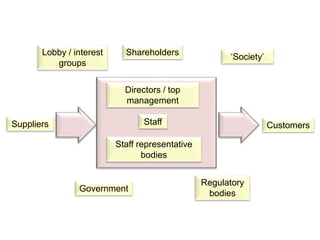
Shareholders
Directors / top
management
Staff
Staff representative
bodies
Regulatory
bodies
Government
Suppliers
Lobby / interest
groups
Customers
Stakeholder groups with a …’legitimate interest in the
operation’s activities’
‘Society’
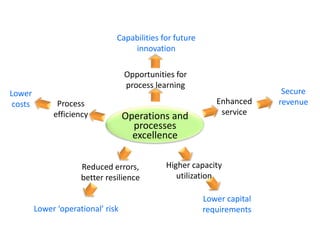
Operations and
processes
excellence
Operations and process management contribution to strategy
Enhanced
service
Secure
revenue
Lower
costs Process
efficiency
Reduced errors,
better resilience
Lower ‘operational’ risk
Higher capacity
utilization
Lower capital
requirements
Capabilities for future
innovation
Opportunities for
process learning
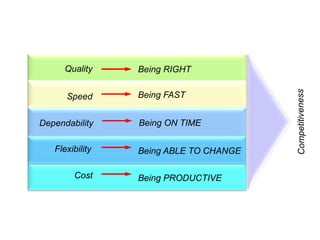
The five competitive objectives
Quality Being RIGHT
Speed Being FAST
Dependability Being ON TIME
Cost Being PRODUCTIVE
Being ABLE TO CHANGEFlexibility
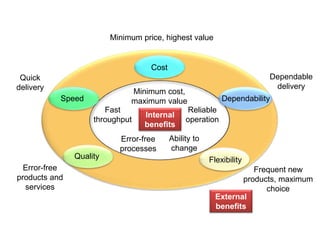
Minimum cost,
maximum value
Minimum price, highest value
Fast
throughput
Quick
delivery
Reliable
operation
Dependable
delivery
Error-free
processes
Error-free
products and
services
Ability to
change
Frequent new
products, maximum
choice
The benefits of excelling at the five objectives
Dependability
Cost
Speed
Quality Flexibility
Internal
benefits
External
benefits
What does Quality mean in…
Patients receive the most appropriate treatment.
… a hospital ?
Treatment is carried out in the correct manner.
Patients are consulted and kept informed.
Staff are courteous, friendly and helpful.
… an automobile plant?
All assembly is to specification.
Product is reliable.
All parts are made to specification.
The product is attractive and blemish-free.
What does Quality mean in… (Continued)
… a bus company?
The buses are clean and tidy.
The buses are quiet and fume-free.
The timetable is accurate and user-friendly.
Staff are courteous, friendly and helpful.
What does Quality mean in… (Continued)
… a supermarket?
The store is clean and tidy.
Décor is appropriate and attractive.
Goods are in good condition.
Staff are courteous, friendly and helpful.
What does Quality mean in… (Continued)
Irrespective of a product or service’s specification quality, producing it in a
way that it conforms to its specification consistently brings benefits to any
operation
Externally – it enhances the product or service in the market, or at least
avoids customer complaints.
Internally – it brings other benefits to the operation.
It prevents errors slowing down throughput speed.
It prevents errors causing internal unreliability and low
dependability.
It prevents errors causing wasted time and effort, therefore saving
cost.
External and internal benefits of conformance quality
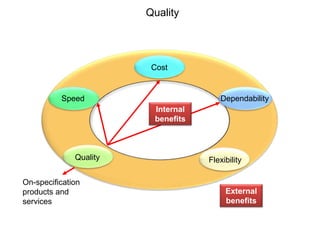
Quality
External and internal benefits of conformance quality
(Continued)
On-specification
products and
services
Internal
benefits
External
benefits
Dependability
Cost
Speed
Quality Flexibility
The time between requiring treatment and receiving
treatment is kept to a minimum.
… a hospital ?
What does Speed mean in…
The time for test results, X-rays, etc. to be returned
is kept to a minimum.
What does Speed mean in… (Continued)
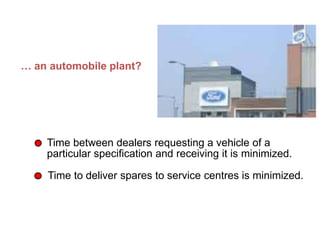
… an automobile plant?
Time between dealers requesting a vehicle of a
particular specification and receiving it is minimized.
Time to deliver spares to service centres is minimized.
… a bus company?
The time between customer setting out on the
journey and reaching his or her destination is kept
to a minimum.
What does Speed mean in… (Continued)
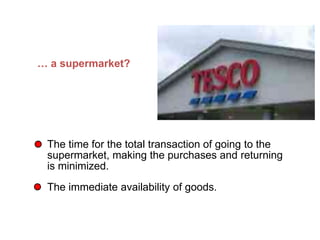
… a supermarket?
The time for the total transaction of going to the
supermarket, making the purchases and returning
is minimized.
The immediate availability of goods.
What does Speed mean in… (Continued)
Speed again has different interpretations externally and internally
Externally – it means the elapsed time between a customer asking for a
product or service and getting it (in a satisfactory condition).
It often enhances the value of the product or service to customers.
Internally – it brings other benefits to the operation.
It helps to overcome internal problems by maintaining dependability.
It reduces the need to manage transformed resources as they pass
through the operation, therefore saving cost.
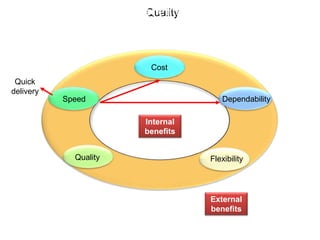
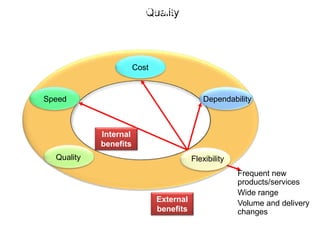
External and internal benefits of speed
QualityExternal and internal benefits of speed (Continued)
Internal
benefits
External
benefits
Dependability
Cost
Speed
Quality Flexibility
Quick
delivery
What does Dependability mean in… (Continued)
Proportion of appointments that are cancelled is
kept to a minimum.
… a hospital ?
Keeping appointment times.
Test results, X-rays, etc. are returned as promised.
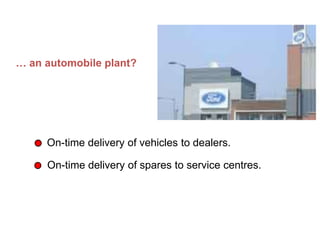
… an automobile plant?
On-time delivery of vehicles to dealers.
On-time delivery of spares to service centres.
What does Dependability mean in… (Continued)
… a bus company?
Keeping to the published timetable at all points on
the route.
Constant availability of seats for passengers.
What does Dependability mean in… (Continued)
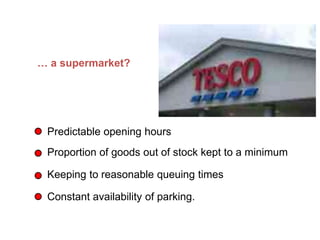
… a supermarket?
Predictable opening hours
Proportion of goods out of stock kept to a minimum
Keeping to reasonable queuing times
Constant availability of parking.
What does Dependability mean in… (Continued)
Externally – it enhances the product or service in the market, or at least
avoids customer complaints.
Internally – it brings other benefits to the operation.
It prevents late delivery slowing down throughput speed.
It prevents lateness causing disruption and wasted time and effort,
thereby saving cost.
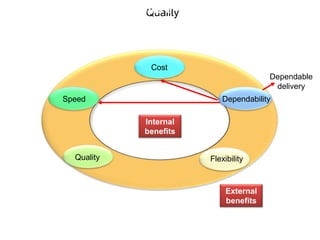
External and internal benefits of Dependability
QualityExternal and internal benefits of Dependability (Continued)
Internal
benefits
External
benefits
Dependability
Cost
Speed
Quality Flexibility
Dependable
delivery
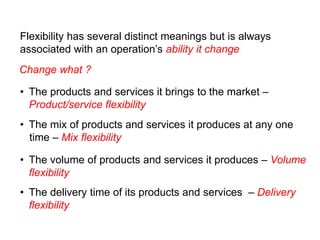
Flexibility has several distinct meanings but is always
associated with an operation’s ability it change
Change what ?
• The products and services it brings to the market –
Product/service flexibility
• The mix of products and services it produces at any one
time – Mix flexibility
• The volume of products and services it produces – Volume
flexibility
• The delivery time of its products and services – Delivery
flexibility
Flexibility – What does it mean?
What does flexibility mean in…
Introducing new treatments
…. a hospital ?
A wide range of treatments
The ability to adjust the number of patients treated
The ability to reschedule appointments.
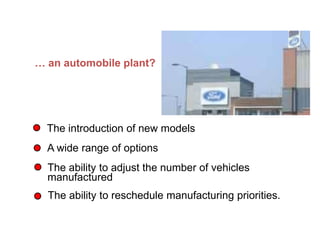
… an automobile plant?
The introduction of new models
A wide range of options
The ability to adjust the number of vehicles
manufactured
The ability to reschedule manufacturing priorities.
What does flexibility mean in… (Continued)
… a bus company?
The introduction of new routes and excursions
A large number of locations served
The ability to adjust the frequency of services
The ability to reschedule trips.
What does flexibility mean in… (Continued)
… a supermarket?
The introduction of new goods
A wide range of goods stocked
The ability to adjust the number of customers served
The ability to get out-of-stock items.
What does flexibility mean in… (Continued)
Depend-
ability
FlexibilityQuality
Speed
Cost
External and
internal benefits
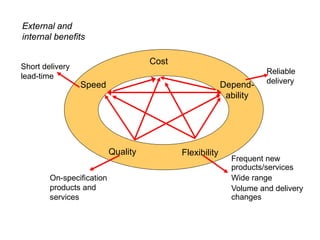
External and internal benefits of flexibility
External and
internal benefits
Depend-
ability
FlexibilityQuality
Cost
On-specification
products and
services
Short delivery
lead-time
Reliable
delivery
Speed
Frequent new
products/services
Wide range
Volume and delivery
changes
QualityExternal and internal benefits of flexibility (Continued)
Internal
benefits
External
benefits
Dependability
Cost
Speed
Quality Flexibility
Frequent new
products/services
Wide range
Volume and delivery
changes
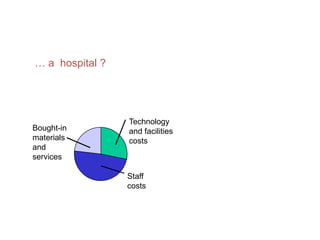
… a hospital ?
Staff
costs
Technology
and facilities
costs
Bought-in
materials
and
services
What does Cost mean in…
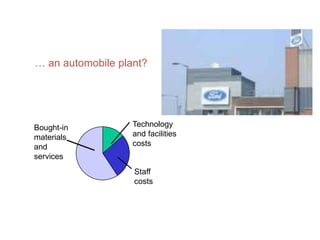
… an automobile plant?
Technology
and facilities
costs
Staff
costs
Bought-in
materials
and
services
What does Cost mean in… (Continued)
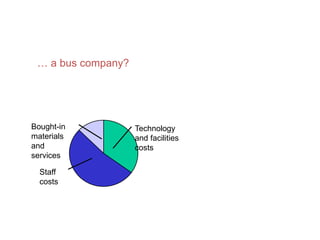
… a bus company?
Staff
costs
Technology
and facilities
costs
Bought-in
materials
and
services
What does Cost mean in… (Continued)
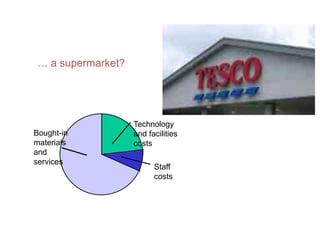
… a supermarket?
What does Cost mean in… (Continued)
Staff
costs
Technology
and facilities
costs
Bought-in
materials
and
services
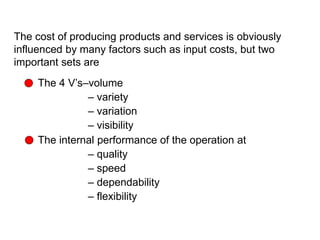
The cost of producing products and services is obviously
influenced by many factors such as input costs, but two
important sets are
The 4 V’s–volume
– variety
– variation
– visibility
The internal performance of the operation at
– quality
– speed
– dependability
– flexibility
Cost
QualityExternal and internal benefits of performance objectives
Dependability
Cost
Speed
Quality Flexibility
External
benefits
On-specification
products and
services
Short delivery
lead-time
Reliable
delivery
Frequent new
products/services
Wide range
Volume and delivery
changes
Low price, high
margin, or both
Internal
benefits
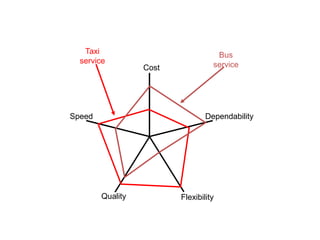
Polar diagrams
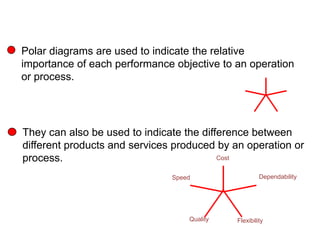
Polar diagrams are used to indicate the relative
importance of each performance objective to an operation
or process.
They can also be used to indicate the difference between
different products and services produced by an operation or
process. Cost
Quality Flexibility
DependabilitySpeed
Polar diagrams for a taxi service versus a bus service
Cost
Quality Flexibility
DependabilitySpeed
Taxi
service
Bus
service
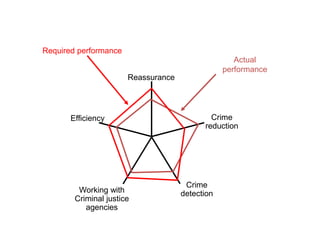
Reassurance
Crime
reduction
Crime
detectionWorking with
Criminal justice
agencies
Efficiency
Actual
performance
Required performance
Polar diagrams for a proposed police performance method
Trade-offs
‘Do you want it good, or do you want it Tuesday?’
‘No such thing as a free lunch’.
‘You can’t have an aircraft which flies at the speed of sound,
carries 400 passengers and lands on an aircraft carrier.
Operations are just the same’. (Skinner)
‘Trade-offs in operations are the way we are willing to
sacrifice one performance objective to achieve excellence in
another’.

02 operations performance_Operations Management

  • 1.
  • 2.
    Shareholders Directors / top management Staff Staffrepresentative bodies Regulatory bodies Government Suppliers Lobby / interest groups Customers Stakeholder groups with a …’legitimate interest in the operation’s activities’ ‘Society’
  • 3.
    Operations and processes excellence Operations andprocess management contribution to strategy Enhanced service Secure revenue Lower costs Process efficiency Reduced errors, better resilience Lower ‘operational’ risk Higher capacity utilization Lower capital requirements Capabilities for future innovation Opportunities for process learning
  • 4.
    The five competitiveobjectives Quality Being RIGHT Speed Being FAST Dependability Being ON TIME Cost Being PRODUCTIVE Being ABLE TO CHANGEFlexibility
  • 5.
    Minimum cost, maximum value Minimumprice, highest value Fast throughput Quick delivery Reliable operation Dependable delivery Error-free processes Error-free products and services Ability to change Frequent new products, maximum choice The benefits of excelling at the five objectives Dependability Cost Speed Quality Flexibility Internal benefits External benefits
  • 6.
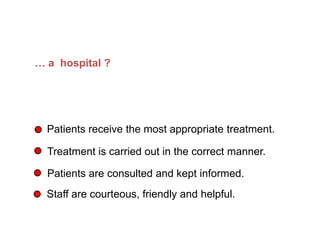
    What does Qualitymean in… Patients receive the most appropriate treatment. … a hospital ? Treatment is carried out in the correct manner. Patients are consulted and kept informed. Staff are courteous, friendly and helpful.
  • 7.
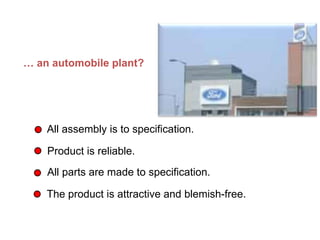
    … an automobileplant? All assembly is to specification. Product is reliable. All parts are made to specification. The product is attractive and blemish-free. What does Quality mean in… (Continued)
  • 8.
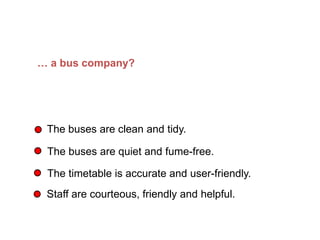
    … a buscompany? The buses are clean and tidy. The buses are quiet and fume-free. The timetable is accurate and user-friendly. Staff are courteous, friendly and helpful. What does Quality mean in… (Continued)
  • 9.
    … a supermarket? Thestore is clean and tidy. Décor is appropriate and attractive. Goods are in good condition. Staff are courteous, friendly and helpful. What does Quality mean in… (Continued)
  • 10.
    Irrespective of aproduct or service’s specification quality, producing it in a way that it conforms to its specification consistently brings benefits to any operation Externally – it enhances the product or service in the market, or at least avoids customer complaints. Internally – it brings other benefits to the operation. It prevents errors slowing down throughput speed. It prevents errors causing internal unreliability and low dependability. It prevents errors causing wasted time and effort, therefore saving cost. External and internal benefits of conformance quality
  • 11.
    Quality External and internalbenefits of conformance quality (Continued) On-specification products and services Internal benefits External benefits Dependability Cost Speed Quality Flexibility
  • 12.
    The time betweenrequiring treatment and receiving treatment is kept to a minimum. … a hospital ? What does Speed mean in… The time for test results, X-rays, etc. to be returned is kept to a minimum.
  • 13.
    What does Speedmean in… (Continued) … an automobile plant? Time between dealers requesting a vehicle of a particular specification and receiving it is minimized. Time to deliver spares to service centres is minimized.
  • 14.
    … a buscompany? The time between customer setting out on the journey and reaching his or her destination is kept to a minimum. What does Speed mean in… (Continued)
  • 15.
    … a supermarket? Thetime for the total transaction of going to the supermarket, making the purchases and returning is minimized. The immediate availability of goods. What does Speed mean in… (Continued)
  • 16.
    Speed again hasdifferent interpretations externally and internally Externally – it means the elapsed time between a customer asking for a product or service and getting it (in a satisfactory condition). It often enhances the value of the product or service to customers. Internally – it brings other benefits to the operation. It helps to overcome internal problems by maintaining dependability. It reduces the need to manage transformed resources as they pass through the operation, therefore saving cost. External and internal benefits of speed
  • 17.
    QualityExternal and internalbenefits of speed (Continued) Internal benefits External benefits Dependability Cost Speed Quality Flexibility Quick delivery
  • 18.
    What does Dependabilitymean in… (Continued) Proportion of appointments that are cancelled is kept to a minimum. … a hospital ? Keeping appointment times. Test results, X-rays, etc. are returned as promised.
  • 19.
    … an automobileplant? On-time delivery of vehicles to dealers. On-time delivery of spares to service centres. What does Dependability mean in… (Continued)
  • 20.
    … a buscompany? Keeping to the published timetable at all points on the route. Constant availability of seats for passengers. What does Dependability mean in… (Continued)
  • 21.
    … a supermarket? Predictableopening hours Proportion of goods out of stock kept to a minimum Keeping to reasonable queuing times Constant availability of parking. What does Dependability mean in… (Continued)
  • 22.
    Externally – itenhances the product or service in the market, or at least avoids customer complaints. Internally – it brings other benefits to the operation. It prevents late delivery slowing down throughput speed. It prevents lateness causing disruption and wasted time and effort, thereby saving cost. External and internal benefits of Dependability
  • 23.
    QualityExternal and internalbenefits of Dependability (Continued) Internal benefits External benefits Dependability Cost Speed Quality Flexibility Dependable delivery
  • 24.
    Flexibility has severaldistinct meanings but is always associated with an operation’s ability it change Change what ? • The products and services it brings to the market – Product/service flexibility • The mix of products and services it produces at any one time – Mix flexibility • The volume of products and services it produces – Volume flexibility • The delivery time of its products and services – Delivery flexibility Flexibility – What does it mean?
  • 25.
    What does flexibilitymean in… Introducing new treatments …. a hospital ? A wide range of treatments The ability to adjust the number of patients treated The ability to reschedule appointments.
  • 26.
    … an automobileplant? The introduction of new models A wide range of options The ability to adjust the number of vehicles manufactured The ability to reschedule manufacturing priorities. What does flexibility mean in… (Continued)
  • 27.
    … a buscompany? The introduction of new routes and excursions A large number of locations served The ability to adjust the frequency of services The ability to reschedule trips. What does flexibility mean in… (Continued)
  • 28.
    … a supermarket? Theintroduction of new goods A wide range of goods stocked The ability to adjust the number of customers served The ability to get out-of-stock items. What does flexibility mean in… (Continued)
  • 29.
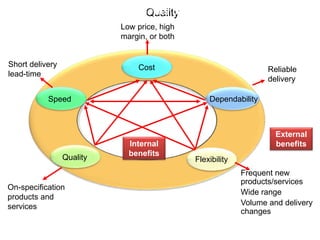
    Depend- ability FlexibilityQuality Speed Cost External and internal benefits Externaland internal benefits of flexibility External and internal benefits Depend- ability FlexibilityQuality Cost On-specification products and services Short delivery lead-time Reliable delivery Speed Frequent new products/services Wide range Volume and delivery changes
  • 30.
    QualityExternal and internalbenefits of flexibility (Continued) Internal benefits External benefits Dependability Cost Speed Quality Flexibility Frequent new products/services Wide range Volume and delivery changes
  • 31.
    … a hospital? Staff costs Technology and facilities costs Bought-in materials and services What does Cost mean in…
  • 32.
    … an automobileplant? Technology and facilities costs Staff costs Bought-in materials and services What does Cost mean in… (Continued)
  • 33.
    … a buscompany? Staff costs Technology and facilities costs Bought-in materials and services What does Cost mean in… (Continued)
  • 34.
    … a supermarket? Whatdoes Cost mean in… (Continued) Staff costs Technology and facilities costs Bought-in materials and services
  • 35.
    The cost ofproducing products and services is obviously influenced by many factors such as input costs, but two important sets are The 4 V’s–volume – variety – variation – visibility The internal performance of the operation at – quality – speed – dependability – flexibility Cost
  • 36.
    QualityExternal and internalbenefits of performance objectives Dependability Cost Speed Quality Flexibility External benefits On-specification products and services Short delivery lead-time Reliable delivery Frequent new products/services Wide range Volume and delivery changes Low price, high margin, or both Internal benefits
  • 37.
    Polar diagrams Polar diagramsare used to indicate the relative importance of each performance objective to an operation or process. They can also be used to indicate the difference between different products and services produced by an operation or process. Cost Quality Flexibility DependabilitySpeed
  • 38.
    Polar diagrams fora taxi service versus a bus service Cost Quality Flexibility DependabilitySpeed Taxi service Bus service
  • 39.
  • 40.
    Trade-offs ‘Do you wantit good, or do you want it Tuesday?’ ‘No such thing as a free lunch’. ‘You can’t have an aircraft which flies at the speed of sound, carries 400 passengers and lands on an aircraft carrier. Operations are just the same’. (Skinner) ‘Trade-offs in operations are the way we are willing to sacrifice one performance objective to achieve excellence in another’.