

Copyright © 2013 Pearson Education, Inc.
publishing as Prentice Hall
12-1
Chapter 12
Country Evaluation
and Selection
Copyright © 2013 Pearson Education, Inc.
publishing as Prentice Hall
12-2
Learning Objectives
 To grasp company strategies for sequencing the
penetration of countries
 To see how scanning techniques can help managers both
limit geographic alternatives and consider otherwise
overlooked areas
 To discern the major opportunity and risk variables a
company should consider when deciding whether and
where to expand abroad
 To know the methods and problems of collecting and
comparing international information
 To understand some simplifying tools for helping decide
where to operate
 To consider how companies allocate emphasis among the
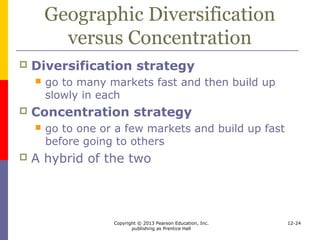
countries where they operate
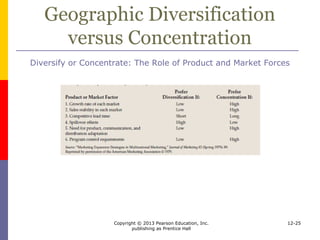
 To comprehend why location decisions do not necessarily
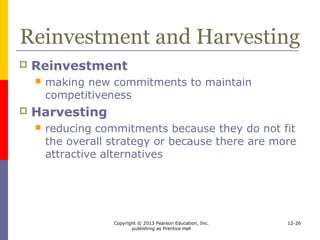
compare different countries’ possibilities
Copyright © 2013 Pearson Education, Inc.
publishing as Prentice Hall
12-3
Introduction
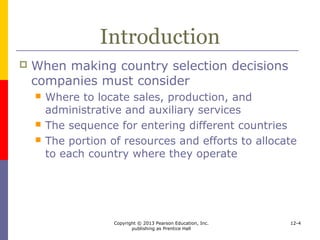
 When making country selection decisions
companies must consider
 Where to locate sales, production, and
administrative and auxiliary services
 The sequence for entering different countries
 The portion of resources and efforts to allocate
to each country where they operate
Copyright © 2013 Pearson Education, Inc.
publishing as Prentice Hall
12-4
Introduction
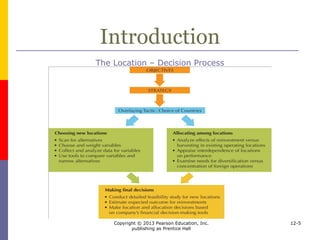
The Location – Decision Process
Copyright © 2013 Pearson Education, Inc.
publishing as Prentice Hall
12-5
Introduction
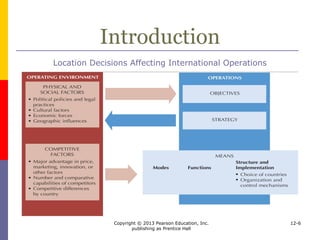
Location Decisions Affecting International Operations
Copyright © 2013 Pearson Education, Inc.
publishing as Prentice Hall
12-6
Introduction
Learning Objective 1:
To grasp company strategies for
sequencing the penetration of countries
Copyright © 2013 Pearson Education, Inc.
publishing as Prentice Hall
12-7
How Does Scanning Work?
Learning Objective 2:
To see how scanning techniques can help
managers both limit geographic
alternatives and consider otherwise
overlooked areas
Copyright © 2013 Pearson Education, Inc.
publishing as Prentice Hall
12-8
How Does Scanning Work?
 Step 1:
 Scanning
 comparing country information that is
readily available, inexpensive, and fairly
comparable
 Step 2:
 Onsite visits
Copyright © 2013 Pearson Education, Inc.
publishing as Prentice Hall
12-9
What Information Is
Important in Scanning?
Learning Objective 3:
To discern the major opportunity and risk
variables a company should consider when
deciding whether and where to expand
abroad
Copyright © 2013 Pearson Education, Inc.
publishing as Prentice Hall
12-10
What Information Is
Important in Scanning?
 Opportunities
 Sales expansion
 obsolescence and leapfrogging of products,
prices, income elasticity, substitution,
income equality, cultural factors and taste,
existence of a trading bloc
 Cost consideration
 labor, infrastructure, ease of transportation
and communications, governmental
incentives and disincentives
Copyright © 2013 Pearson Education, Inc.
publishing as Prentice Hall
12-11
What Information Is
Important in Scanning?
 Risks
 Political risk
 analyzing past patterns, analyzing opinions,
examining social and economic conditions
 Foreign exchange risk
 exchange rate changes, mobility of funds
 Competitive risk
 making operations compatible, spreading
risk, following competitors of customers,
heading off competition
Copyright © 2013 Pearson Education, Inc.
publishing as Prentice Hall
12-12
What Information Is
Important in Scanning?
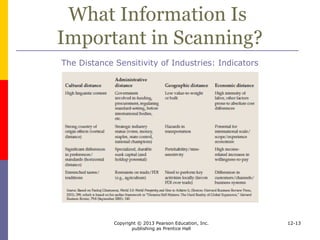
The Distance Sensitivity of Industries: Indicators
Copyright © 2013 Pearson Education, Inc.
publishing as Prentice Hall
12-13
Collecting and Analyzing Data
Learning Objective 4:
To know the methods and problems of
collecting and comparing international
information
Copyright © 2013 Pearson Education, Inc.
publishing as Prentice Hall
12-14
Collecting and Analyzing Data
 Problems with data
 Inaccurate information
 Non-compatibility
 Limited resources
 Misleading data
 Reliance on legally reported market
activities
 Poor research methodology
Copyright © 2013 Pearson Education, Inc.
publishing as Prentice Hall
12-15
Collecting and Analyzing Data
 Where can companies collect data?
 Sources of information
External
 government agencies, specialized
services, and trade associations
Internal
Copyright © 2013 Pearson Education, Inc.
publishing as Prentice Hall
12-16
Country Comparison Tools
Learning Objective 5:
To understand some simplifying tools for
helping decide where to operate
Copyright © 2013 Pearson Education, Inc.
publishing as Prentice Hall
12-17
Country Comparison Tools
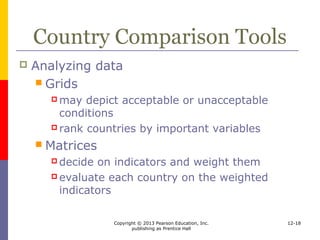
 Analyzing data
 Grids
 may depict acceptable or unacceptable
conditions
 rank countries by important variables
 Matrices
 decide on indicators and weight them
 evaluate each country on the weighted
indicators
Copyright © 2013 Pearson Education, Inc.
publishing as Prentice Hall
12-18
Country Comparison Tools
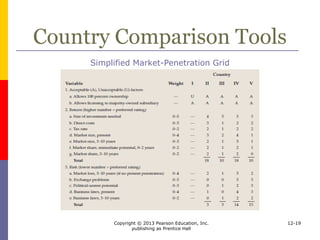
Simplified Market-Penetration Grid
Copyright © 2013 Pearson Education, Inc.
publishing as Prentice Hall
12-19
Country Comparison Tools
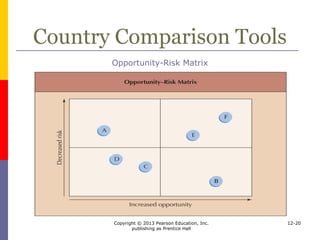
Opportunity-Risk Matrix
Copyright © 2013 Pearson Education, Inc.
publishing as Prentice Hall
12-20
Allocating Among Locations
Learning Objective 6:
To consider how companies allocate
emphasis among the countries where they
operate
Copyright © 2013 Pearson Education, Inc.
publishing as Prentice Hall
12-21
Allocating Among Locations
 Allocating
 Complementary strategies for
international expansion
 Alternative gradual commitments
 Geographic diversification versus
concentration
 Reinvestment versus harvesting
Copyright © 2013 Pearson Education, Inc.
publishing as Prentice Hall
12-22
Alternative Gradual
Commitments
The Usual Patterns of Internationalization
Copyright © 2013 Pearson Education, Inc.
publishing as Prentice Hall
12-23
Geographic Diversification
versus Concentration
 Diversification strategy
 go to many markets fast and then build up
slowly in each
 Concentration strategy
 go to one or a few markets and build up fast
before going to others
 A hybrid of the two
Copyright © 2013 Pearson Education, Inc.
publishing as Prentice Hall
12-24
Geographic Diversification
versus Concentration
Diversify or Concentrate: The Role of Product and Market Forces
Copyright © 2013 Pearson Education, Inc.
publishing as Prentice Hall
12-25
Reinvestment and Harvesting
 Reinvestment
 making new commitments to maintain
competitiveness
 Harvesting
 reducing commitments because they do not fit
the overall strategy or because there are more
attractive alternatives
Copyright © 2013 Pearson Education, Inc.
publishing as Prentice Hall
12-26
Non-Comparative
Decision Making
 Learning Objective 7:
 To comprehend why location decisions do
not necessarily compare different
countries’ possibilities
Copyright © 2013 Pearson Education, Inc.
publishing as Prentice Hall
12-27
Non-Comparative
Decision Making
 Go-no-go decisions
 need to respond quickly
 interdependent operations
Copyright © 2013 Pearson Education, Inc.
publishing as Prentice Hall
12-28
Will Prime Locations Change?
 Future growth rates will have implications
for locations of markets and labor forces
 Technological innovation allows for new
trends in urbanization as more people are
able to work from locations of their
choosing
Copyright © 2013 Pearson Education, Inc.
publishing as Prentice Hall
12-29
All rights reserved. No part of this publication may be reproduced, stored in
a retrieval system, or transmitted, in any form or by any means, electronic,
mechanical, photocopying, recording, or otherwise, without the prior
written permission of the publisher. Printed in the United States of America.

12 Country Evaluation and Selection

  • 1.
    Copyright © 2013Pearson Education, Inc. publishing as Prentice Hall 12-1 Chapter 12 Country Evaluation and Selection
  • 2.
    Copyright © 2013Pearson Education, Inc. publishing as Prentice Hall 12-2 Learning Objectives  To grasp company strategies for sequencing the penetration of countries  To see how scanning techniques can help managers both limit geographic alternatives and consider otherwise overlooked areas  To discern the major opportunity and risk variables a company should consider when deciding whether and where to expand abroad  To know the methods and problems of collecting and comparing international information  To understand some simplifying tools for helping decide where to operate  To consider how companies allocate emphasis among the countries where they operate  To comprehend why location decisions do not necessarily compare different countries’ possibilities
  • 3.
    Copyright © 2013Pearson Education, Inc. publishing as Prentice Hall 12-3 Introduction  When making country selection decisions companies must consider  Where to locate sales, production, and administrative and auxiliary services  The sequence for entering different countries  The portion of resources and efforts to allocate to each country where they operate
  • 4.
    Copyright © 2013Pearson Education, Inc. publishing as Prentice Hall 12-4 Introduction The Location – Decision Process
  • 5.
    Copyright © 2013Pearson Education, Inc. publishing as Prentice Hall 12-5 Introduction Location Decisions Affecting International Operations
  • 6.
    Copyright © 2013Pearson Education, Inc. publishing as Prentice Hall 12-6 Introduction Learning Objective 1: To grasp company strategies for sequencing the penetration of countries
  • 7.
    Copyright © 2013Pearson Education, Inc. publishing as Prentice Hall 12-7 How Does Scanning Work? Learning Objective 2: To see how scanning techniques can help managers both limit geographic alternatives and consider otherwise overlooked areas
  • 8.
    Copyright © 2013Pearson Education, Inc. publishing as Prentice Hall 12-8 How Does Scanning Work?  Step 1:  Scanning  comparing country information that is readily available, inexpensive, and fairly comparable  Step 2:  Onsite visits
  • 9.
    Copyright © 2013Pearson Education, Inc. publishing as Prentice Hall 12-9 What Information Is Important in Scanning? Learning Objective 3: To discern the major opportunity and risk variables a company should consider when deciding whether and where to expand abroad
  • 10.
    Copyright © 2013Pearson Education, Inc. publishing as Prentice Hall 12-10 What Information Is Important in Scanning?  Opportunities  Sales expansion  obsolescence and leapfrogging of products, prices, income elasticity, substitution, income equality, cultural factors and taste, existence of a trading bloc  Cost consideration  labor, infrastructure, ease of transportation and communications, governmental incentives and disincentives
  • 11.
    Copyright © 2013Pearson Education, Inc. publishing as Prentice Hall 12-11 What Information Is Important in Scanning?  Risks  Political risk  analyzing past patterns, analyzing opinions, examining social and economic conditions  Foreign exchange risk  exchange rate changes, mobility of funds  Competitive risk  making operations compatible, spreading risk, following competitors of customers, heading off competition
  • 12.
    Copyright © 2013Pearson Education, Inc. publishing as Prentice Hall 12-12 What Information Is Important in Scanning? The Distance Sensitivity of Industries: Indicators
  • 13.
    Copyright © 2013Pearson Education, Inc. publishing as Prentice Hall 12-13 Collecting and Analyzing Data Learning Objective 4: To know the methods and problems of collecting and comparing international information
  • 14.
    Copyright © 2013Pearson Education, Inc. publishing as Prentice Hall 12-14 Collecting and Analyzing Data  Problems with data  Inaccurate information  Non-compatibility  Limited resources  Misleading data  Reliance on legally reported market activities  Poor research methodology
  • 15.
    Copyright © 2013Pearson Education, Inc. publishing as Prentice Hall 12-15 Collecting and Analyzing Data  Where can companies collect data?  Sources of information External  government agencies, specialized services, and trade associations Internal
  • 16.
    Copyright © 2013Pearson Education, Inc. publishing as Prentice Hall 12-16 Country Comparison Tools Learning Objective 5: To understand some simplifying tools for helping decide where to operate
  • 17.
    Copyright © 2013Pearson Education, Inc. publishing as Prentice Hall 12-17 Country Comparison Tools  Analyzing data  Grids  may depict acceptable or unacceptable conditions  rank countries by important variables  Matrices  decide on indicators and weight them  evaluate each country on the weighted indicators
  • 18.
    Copyright © 2013Pearson Education, Inc. publishing as Prentice Hall 12-18 Country Comparison Tools Simplified Market-Penetration Grid
  • 19.
    Copyright © 2013Pearson Education, Inc. publishing as Prentice Hall 12-19 Country Comparison Tools Opportunity-Risk Matrix
  • 20.
    Copyright © 2013Pearson Education, Inc. publishing as Prentice Hall 12-20 Allocating Among Locations Learning Objective 6: To consider how companies allocate emphasis among the countries where they operate
  • 21.
    Copyright © 2013Pearson Education, Inc. publishing as Prentice Hall 12-21 Allocating Among Locations  Allocating  Complementary strategies for international expansion  Alternative gradual commitments  Geographic diversification versus concentration  Reinvestment versus harvesting
  • 22.
    Copyright © 2013Pearson Education, Inc. publishing as Prentice Hall 12-22 Alternative Gradual Commitments The Usual Patterns of Internationalization
  • 23.
    Copyright © 2013Pearson Education, Inc. publishing as Prentice Hall 12-23 Geographic Diversification versus Concentration  Diversification strategy  go to many markets fast and then build up slowly in each  Concentration strategy  go to one or a few markets and build up fast before going to others  A hybrid of the two
  • 24.
    Copyright © 2013Pearson Education, Inc. publishing as Prentice Hall 12-24 Geographic Diversification versus Concentration Diversify or Concentrate: The Role of Product and Market Forces
  • 25.
    Copyright © 2013Pearson Education, Inc. publishing as Prentice Hall 12-25 Reinvestment and Harvesting  Reinvestment  making new commitments to maintain competitiveness  Harvesting  reducing commitments because they do not fit the overall strategy or because there are more attractive alternatives
  • 26.
    Copyright © 2013Pearson Education, Inc. publishing as Prentice Hall 12-26 Non-Comparative Decision Making  Learning Objective 7:  To comprehend why location decisions do not necessarily compare different countries’ possibilities
  • 27.
    Copyright © 2013Pearson Education, Inc. publishing as Prentice Hall 12-27 Non-Comparative Decision Making  Go-no-go decisions  need to respond quickly  interdependent operations
  • 28.
    Copyright © 2013Pearson Education, Inc. publishing as Prentice Hall 12-28 Will Prime Locations Change?  Future growth rates will have implications for locations of markets and labor forces  Technological innovation allows for new trends in urbanization as more people are able to work from locations of their choosing
  • 29.
    Copyright © 2013Pearson Education, Inc. publishing as Prentice Hall 12-29 All rights reserved. No part of this publication may be reproduced, stored in a retrieval system, or transmitted, in any form or by any means, electronic, mechanical, photocopying, recording, or otherwise, without the prior written permission of the publisher. Printed in the United States of America.

Editor's Notes

  • #2 Chapter 12: Country Evaluation and Selection
  • #3 The Learning Objectives for this chapter are To grasp company strategies for sequencing the penetration of countries To see how scanning techniques can help managers both limit geographic alternatives and consider otherwise overlooked areas To discern the major opportunity and risk variables a company should consider when deciding whether and where to expand abroad To know the methods and problems of collecting and comparing international information To understand some simplifying tools for helping decide where to operate To consider how companies allocate emphasis among the countries where they operate To comprehend why location decisions do not necessarily compare different countries’ possibilities
  • #4 All companies must develop strategies to determine where to locate sales, production, and administrative services; when to enter different countries and in what order; and what resources to commit to each country.
  • #5 This Figure shows the different steps in the location decision process.
  • #6 This Figure highlights the importance of MNE location decisions. Keep in mind that allocating resources to one market means that they won’t be available for another market.
  • #7 Learning Objective 1: To grasp company strategies for sequencing the penetration of countries.
  • #8 Learning Objective 2: To see how scanning techniques can help managers both limit geographic alternatives and consider otherwise overlooked areas.
  • #9 Managers can use a technique called scanning to weed out countries that aren’t good options, and focus on those that offer the most potential. Since scanning uses publicly available information, it’s a relatively cheap way to narrow down a large group of countries. After the scanning process, managers can use onsite visits to further determine the feasibility and desirability of countries.
  • #10 Learning Objective 3: To discern the major opportunity and risk variables a company should consider when deciding whether and where to expand abroad.
  • #11 When scanning, managers need to use information that can reveal opportunities and risks. They might consider economic and demographic data such as income levels or population density to reveal sales potential in a market. Managers also need to consider other variables like the potential for a product to become obsolete or even leapfrog another product. Similarly, a firm looking at producing in foreign markets needs to consider the costs involved in doing so by exploring wage rates and differences in infrastructure that could cause operating costs to increase, and so on.
  • #12 Just because production costs are low or sales potential is high in a given country does not automatically mean it makes sense. Managers also need to factor risk into their decisions. Keep in mind that companies and managers have different perceptions of what constitutes risk, that one company’s risk may be another’s opportunity, that companies can minimize risk in other ways than simply avoiding certain locations, and that all risks have trade-offs. Risks that should be considered include political risk, foreign exchange risk, and competitive risk. When considering political risk, note that using past patterns of risk can be problematic. In fact, it’s important to consider risk as it applies to a specific company or industry. Managers should also consider the opinions of several individuals and explore social and economic conditions to gauge the potential for social uprisings. Managers need to consider exchange rate changes and the mobility of funds when exploring foreign exchange risk. Depending on the particular situation, companies may want to ensure that they have highly liquid assets for at least some of their holdings even if it means earning a lower return. Finally, managers should consider four factors when analyzing competitive risk: making operations compatible, spreading risk, following competitors or customers, and heading off competition.
  • #13 This Table shows attributes that indicate similarity and dissimilarity between countries. Typically companies prefer to operate in environments that are similar to their home country.
  • #14 Learning Objective 4: To know the methods and problems of collecting and comparing international information.
  • #15 Information is important to improving corporate performance. However, managers need to ensure that the cost of information doesn’t exceed its value. Two problems that can emerge when collecting and analyzing data involve inaccurate data and non-compatible data. These problems can be especially difficult when developing countries are involved. Data can be inaccurate because of problems with the actual collection process. For example, some countries simply don’t collect information in a timely and reliable manner, respondents may provide false information, or data may be skewed because of illegal market activities. Likewise, data may not be comparable if there are differences in when it was collected or in the definitions that were used. Currency conversion can also cause problems.
  • #16 Where can companies collect data? They can use external sources like government agencies, specialized services, and trade associations. They can also use internally generated information.
  • #17 Learning Objective 5: To understand some simplifying tools for helping decide where to operate.
  • #18 After data has been collected, it needs to be analyzed. Two common tools for analyzing data are grids and matrices.
  • #19 This Table shows a market penetration grid. Grids can be used to depict acceptable and unacceptable conditions and for ranking countries according to certain variables.
  • #20 This Figure shows the relationship between opportunity and risk. When using the matrices, managers can identify certain indicators, assign weights to them, and then evaluate each country based on the weighted indicator.
  • #21 Learning Objective 6: To consider how companies allocate emphasis among the countries where they operate.
  • #22 At this point, companies are ready to start making decisions about how to allocate resources. Three alternative strategies are alternative gradual commitments, geographic diversification versus concentration, and reinvestment versus harvesting.
  • #23 This Figure shows the alternative options a firm has. Notice that a firm can minimize risk by entering countries that are most similar to the home country first and by choosing experienced intermediaries. Firms can also minimize risk by using strategies that require smaller resource commitments and by committing to only a few markets.
  • #24 Companies can enter markets using a diversification strategy, using a concentration strategy, or some hybrid of the two.
  • #25 This Table shows the major variables a firm should consider when choosing its strategy.
  • #26 Once a firm has committed to foreign operations it has to make decisions on reinvesting and harvesting.
  • #27 Learning Objective 7: To comprehend why location decisions do not necessarily compare different countries’ possibilities
  • #28 Firms make go-no-go decisions based on the information they have about an opportunity at a given point in time. Keep in mind that sometimes decisions have to be made quickly and that interdependent activities can make decisions more complex.
  • #29 Population growth should remain robust in many developing economies, particularly those in sub-Saharan Africa, however, projections suggest that the percentage of people living in currently developed countries is expected to fall to 13.7 percent from a 2000 figure of 19.7 percent. Moreover, because the world’s population will continue to age, the share of what we now consider the working age population should fall for developed countries and increase in many developing countries. Technology may permit more people to work from anywhere as they e-mail and teleconference with their colleagues, customers, and suppliers elsewhere. This means they can live anywhere in the world and work from their homes. However, if people can work from their homes, they may move their homes where they want to live rather than living where their employers are now located. Because we’re talking here about highly creative and highly innovative self-motivated people, they can usually get permission to live in almost any country of the world.