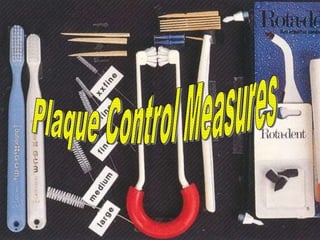
PLAQUE CONTROL
MEASURES
Introduction
 Plaque control is the key to prevention of caries ,
gingivitis , periodontitis
Dental Plaque
Plaque is defined as a highly specific variable
structural entity formed by sequential
colonization of microorganism on the tooth surface,
epithelium and restoration.
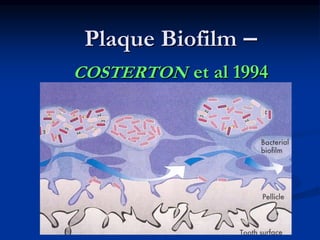
Plaque Biofilm –
COSTERTON et al 1994
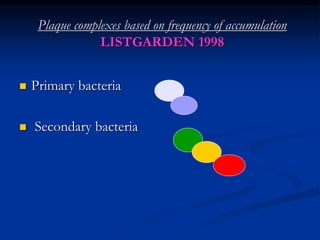
Plaque complexes based on frequency of accumulation
LISTGARDEN 1998
 Primary bacteria
 Secondary bacteria
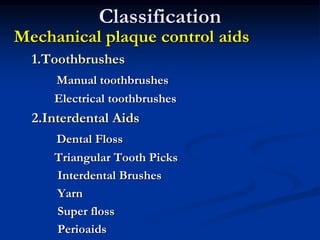
Classification
Mechanical plaque control aids
1.Toothbrushes
Manual toothbrushes
Electrical toothbrushes
2.Interdental Aids
Dental Floss
Triangular Tooth Picks
Interdental Brushes
Yarn
Super floss
Perioaids
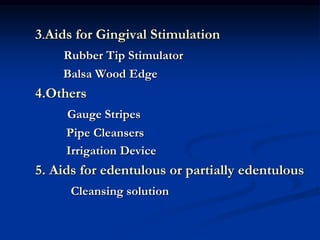
3.Aids for Gingival Stimulation
Rubber Tip Stimulator
Balsa Wood Edge
4.Others
Gauge Stripes
Pipe Cleansers
Irrigation Device
5. Aids for edentulous or partially edentulous
Cleansing solution
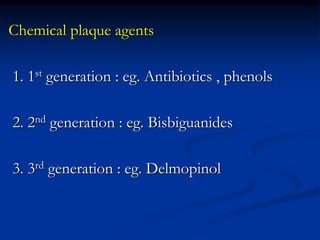
Chemical plaque agents
1. 1st generation : eg. Antibiotics , phenols
2. 2nd generation : eg. Bisbiguanides
3. 3rd generation : eg. Delmopinol
MECHANICAL PLAQUE CONTROL
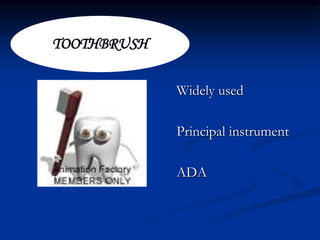
Widely used
Principal instrument
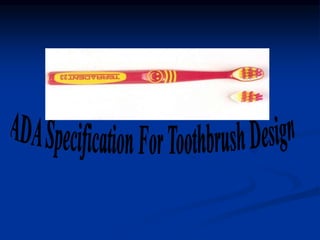
ADA
TOOTHBRUSH
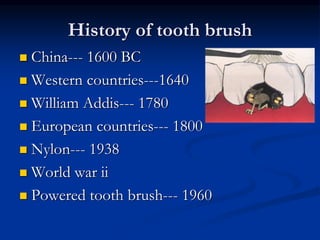
History of tooth brush
 China--- 1600 BC
 Western countries---1640
 William Addis--- 1780
 European countries--- 1800
 Nylon--- 1938
 World war ii
 Powered tooth brush--- 1960
Types of tooth brush
 Manual
 Powered
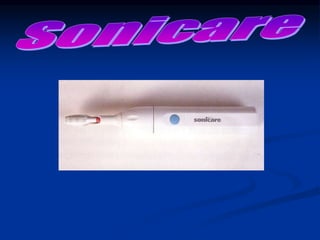
 Sonic and ultra sonic
 Ionic
Manual tooth brush
 Ideal requisites
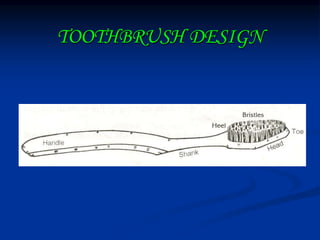
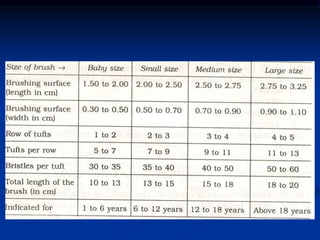
TOOTHBRUSH DESIGN
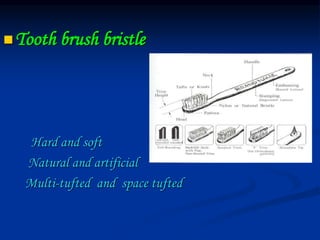
Tooth brush bristle
Hard and soft
Natural and artificial
Multi-tufted and space tufted
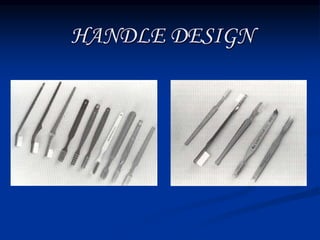
HANDLE DESIGN
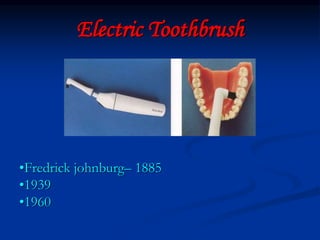
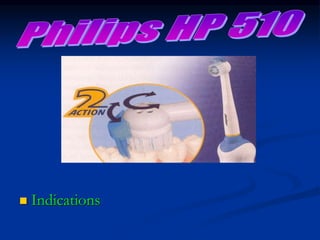
Electric Toothbrush
•Fredrick johnburg– 1885
•1939
•1960
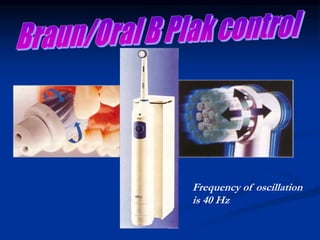
Frequency of oscillation
is 40 Hz
 Indications
 Advantages
Increases patient motivation
accessibility
No specific brushing technique
Use less brushing force
Brushing timer is incorporated
Ionic tooth brush
 Change the surface charge of tooth– positive
 Plaque is attracted by negatively charged bristle
Association between cleaning and caries &
periodontal disease indicate that quality rather
than the frequency may be related to disease
Practical & Esthetic reasons
Perception of oral freshness
Brushing twice daily
Maintenance of tooth brush
 Act as vehicle
 Clean with mouthwash
 Store in dry place
When to
change the
Toothbrush ????
Brushing Method
 Objectives
Remove plaque
Clean the teeth
Stimulate gingiva
Apply dentifrices
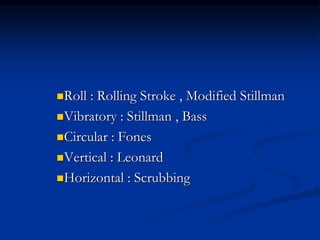
Roll : Rolling Stroke , Modified Stillman
Vibratory : Stillman , Bass
Circular : Fones
Vertical : Leonard
Horizontal : Scrubbing
Bass method(1948)
 Most widely accepted
Indication
All people
Open interproximal areas & exposed root
surface
Routine patient
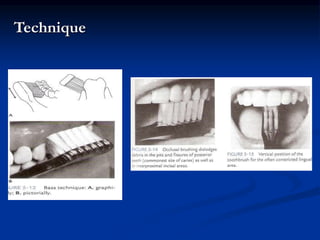
Technique
 Advantages
Effective method
Gingival stimulation
Easy to learn
 Disadvantages
Time consuming
Injury to gingival margin
Dexterity requirement is too high
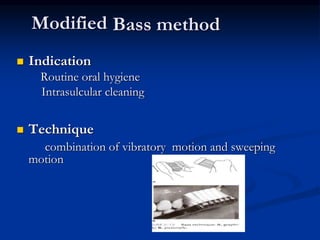
Modified
 Indication
Routine oral hygiene
Intrasulcular cleaning
 Technique
combination of vibratory motion and sweeping
motion
Bass method
 Advantages
Excellent sulcus cleaning
Good interproximal and gingival cleaning
Good gingival stimulation
 Disadvantages
Moderate dexterity of wrist
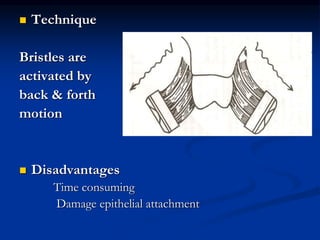
Modified Stillman's technique(1932)
 Indication
Plaque removal from cervical areas.
Cleaning tooth surface and gingival stimulation.
Gingival recession and Root exposure.
 Technique
Bristles are
activated by
back & forth
motion
 Disadvantages
Time consuming
Damage epithelial attachment
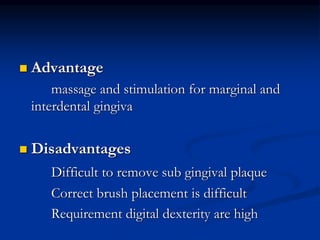
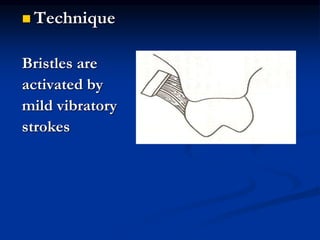
Charters method(1928)
 Indication
Open interdental spaces
Wearing FPD or ortho appliance
Perio surgery
Moderate gingival recession
 Technique
Bristles are
activated by
mild vibratory
strokes
 Advantage
massage and stimulation for marginal and
interdental gingiva
 Disadvantages
Difficult to remove sub gingival plaque
Correct brush placement is difficult
Requirement digital dexterity are high
Scrub brush method
 Technique
Horizontal+Vertical+Circular
 Disadvantages
Ineffective at plaque removal
Tooth abrasion and gingival recession
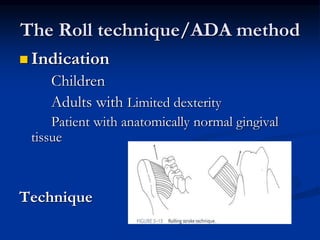
The Roll technique/ADA method
 Indication
Children
Adults with Limited dexterity
Patient with anatomically normal gingival
tissue
Technique
 Advantages
Provides gingival massage and
stimulation
 Disadvantages
Laceration of alveolar mucosa
Punctuate lesion
Fones method(1934)
 Indication
Young children
Physically and emotionally handicapped
individual
Patients who lack dexterity
 Technique
 Advantages
Easy to learn
Shorter time
Good stimulation
 Disadvantages
Trauma
Interdental area are not properly cleansed
 Leonards method/vertical method
Advantages:
Most convenient and effective for children
with dec.dent
Disadvantage :
Interdental spaces of permanent teeth of
adults are not properly cleaned
Technique :
 Physiologic method/smith method
principle: tooth brush should follow
the physiologic pathway that food does
when it transverse over the tissue during
mastication.
Advantage:
1. Natural self cleansing mechanism
2. Supragingival cleaning is good
Disadvantage:
Interdental space and sulcus areas of
teeth are not properly cleaned
Effect of improper tooth brushing
 Soft tissues
Laceration
Recession
 Hard tissues
Abrasion of teeth
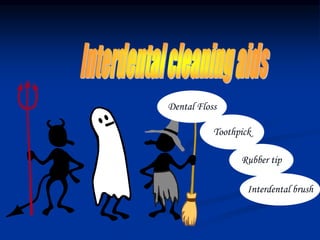
Dental Floss
Rubber tip
Interdental brush
Toothpick
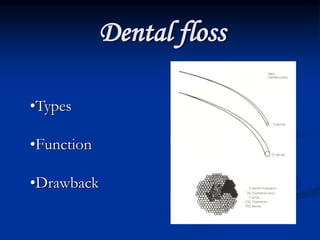
Dental floss
•Types
•Function
•Drawback
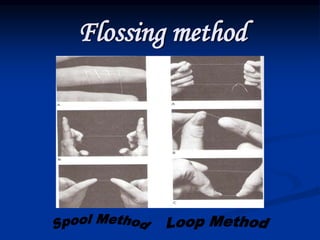
Flossing method
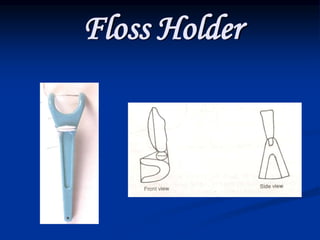
Floss Holder
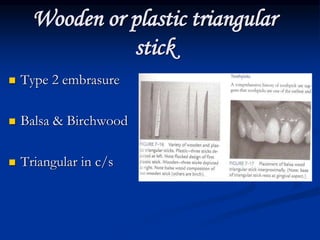
Wooden or plastic triangular
stick
 Type 2 embrasure
 Balsa & Birchwood
 Triangular in c/s
Tooth picks
 Cave people
 Recession & blunting of papilla
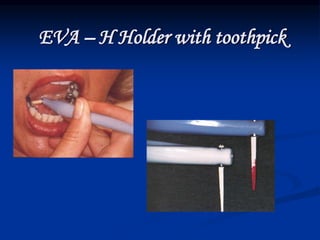
EVA – H Holder with toothpick
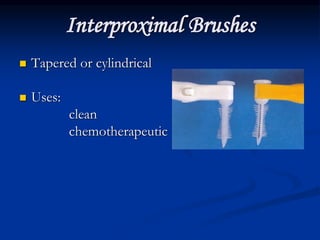
Interproximal Brushes
 Tapered or cylindrical
 Uses:
clean
chemotherapeutic
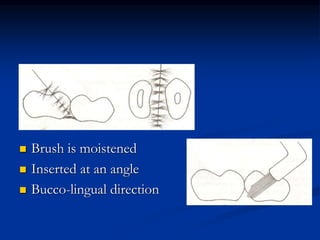
 Brush is moistened
 Inserted at an angle
 Bucco-lingual direction
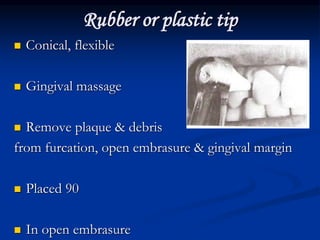
Rubber or plastic tip
 Conical, flexible
 Gingival massage
 Remove plaque & debris
from furcation, open embrasure & gingival margin
 Placed 90
 In open embrasure
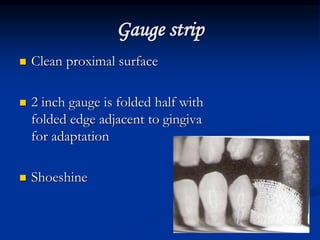
Gauge strip
 Clean proximal surface
 2 inch gauge is folded half with
folded edge adjacent to gingiva
for adaptation
 Shoeshine
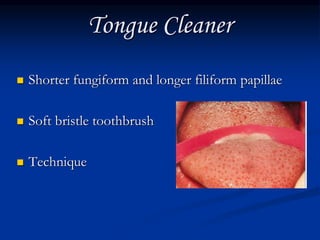
Tongue Cleaner
 Shorter fungiform and longer filiform papillae
 Soft bristle toothbrush
 Technique
Chemical plaque agents
Ideal adjunct
Prescription chlorhexidine
Nonprescription essential oil rinse. Ex: Thymol,
Menthol, Eucalyptol.
 Ideal Requisites
 Chlorexidine gluconate(0.2%)
Both antiplaque and antibacterial properties
Mechanism of action
Antiplaque action:
1. Prevents pellicle formation by blocking acidic
groups on salivary glycoproteins
2. Prevents adsorption of bacterial cell wall
3. Prevents binding of mature plaque by
displacing calcium from plaque matrix.
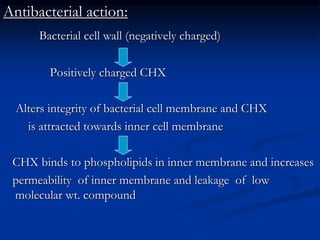
Antibacterial action:
Bacterial cell wall (negatively charged)
Positively charged CHX
Alters integrity of bacterial cell membrane and CHX
is attracted towards inner cell membrane
CHX binds to phospholipids in inner membrane and increases
permeability of inner membrane and leakage of low
molecular wt. compound
Coagulation and precipitation of cytoplasm
Free CHX molecules enters into cell and
causes coagulation of cytoplasmic membrane
Vital cell activity ceases
cell death
Vital cell elements leak out and harm substance
gain entry
 CHX should not be used before/immediately
after using tooth paste
 Adverse effects
PLAQUE CONTROL - 3.ppt

PLAQUE CONTROL - 3.ppt