Preclinical Operative Dentistry
Preventive Dentistry
&
Early Caries Detection
Presented By:
Ghina Mezher
Nermin Qurah Mohamad
Bruno Saccal
Soumayya Moubayyed
Hadi Hammoud
Presented To: Dr. Mohammad Atef
What is Preventive Dentistry?
• Is a branch of dentistry, deals with the
preservation of healthy teeth and gingiva
and the prevention of dental and oral
disease.
• The concept of prevention is the
maintenance of oral health, rather than
treatment, but may be considered as the
basis for treatment planning.
What is Preventive Dentistry?
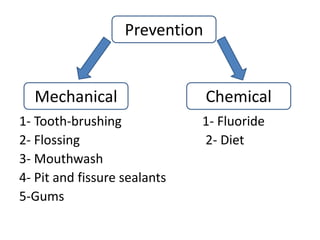
1- Tooth-brushing 1- Fluoride
2- Flossing 2- Diet
3- Mouthwash
4- Pit and fissure sealants
5-Gums
Prevention
ChemicalMechanical
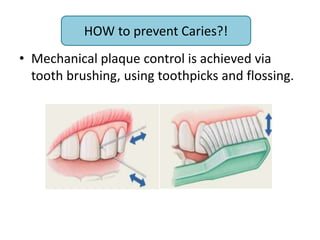
How to prevent caries?
• Mechanical plaque control is achieved via
tooth brushing, using toothpicks and flossing.
HOW to prevent Caries?!
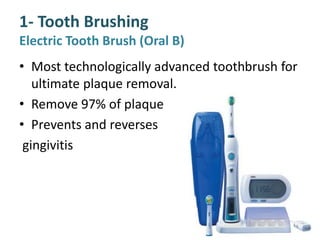
1- Tooth Brushing
Electric Tooth Brush (Oral B)
• Most technologically advanced toothbrush for
ultimate plaque removal.
• Remove 97% of plaque
• Prevents and reverses
gingivitis
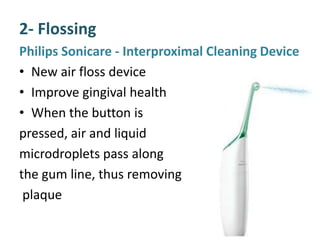
2- Flossing
Philips Sonicare - Interproximal Cleaning Device
• New air floss device
• Improve gingival health
• When the button is
pressed, air and liquid
microdroplets pass along
the gum line, thus removing
plaque
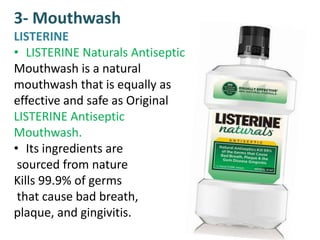
3- Mouthwash
LISTERINE
• LISTERINE Naturals Antiseptic
Mouthwash is a natural
mouthwash that is equally as
effective and safe as Original
LISTERINE Antiseptic
Mouthwash.
• Its ingredients are
sourced from nature
Kills 99.9% of germs
that cause bad breath,
plaque, and gingivitis.
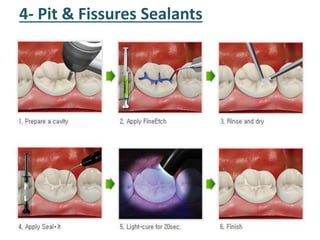
4- Pit & Fissures Sealants
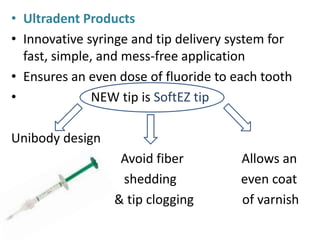
• Ultradent Products
• Innovative syringe and tip delivery system for
fast, simple, and mess-free application
• Ensures an even dose of fluoride to each tooth
• NEW tip is SoftEZ tip
Unibody design
Avoid fiber Allows an
shedding even coat
& tip clogging of varnish
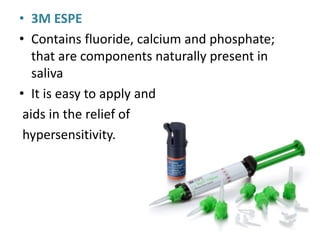
• 3M ESPE
• Contains fluoride, calcium and phosphate;
that are components naturally present in
saliva
• It is easy to apply and
aids in the relief of
hypersensitivity.
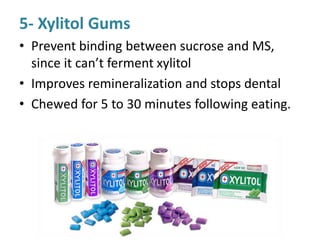
5- Xylitol Gums
• Prevent binding between sucrose and MS,
since it can’t ferment xylitol
• Improves remineralization and stops dental
• Chewed for 5 to 30 minutes following eating.
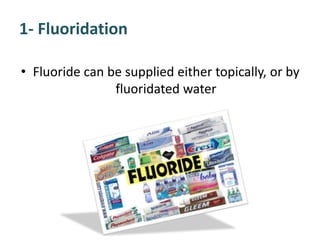
1- Fluoridation
• Fluoride can be supplied either topically, or by
fluoridated water
• Topical:
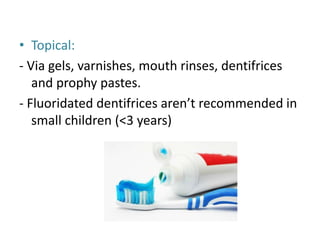
- Via gels, varnishes, mouth rinses, dentifrices
and prophy pastes.
- Fluoridated dentifrices aren’t recommended in
small children (<3 years)
• Systemic: Via fluoridated water and by
supplemental therapy
 Fluoridated water:
- Able to reduce 50% of caries amount
- Most commonly used are: sodium fluoride,
hydrofluosilic acid and sodium silicofluoride
- Has a greater effect on smooth enamel
surfaces
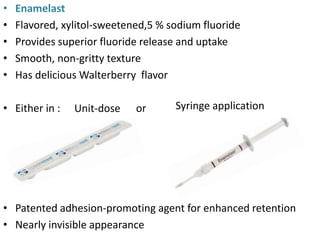
• Enamelast
• Flavored, xylitol-sweetened,5 % sodium fluoride
• Provides superior fluoride release and uptake
• Smooth, non-gritty texture
• Has delicious Walterberry flavor
• Either in : or
• Patented adhesion-promoting agent for enhanced retention
• Nearly invisible appearance
Unit-dose Syringe application
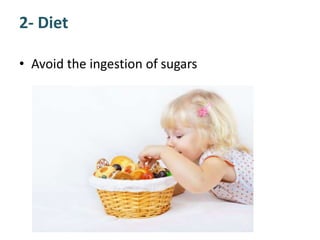
2- Diet
• Avoid the ingestion of sugars
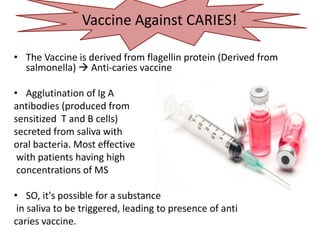
Vaccine against Caries
• The Vaccine is derived from flagellin protein (Derived from
salmonella)  Anti-caries vaccine
• Agglutination of Ig A
antibodies (produced from
sensitized T and B cells)
secreted from saliva with
oral bacteria. Most effective
with patients having high
concentrations of MS
• SO, it's possible for a substance
in saliva to be triggered, leading to presence of anti
caries vaccine.
Vaccine Against CARIES!
Early Caries
Detection
What Is Caries Detection?!
Caries detection is a task
full of risks which
involves the applying
of diagnostic criteria to
decide at what level is
the disease.
1- Patient History
One of primary steps to be done for caries diagnosis is
to ask the patient several questions regarding
• Age
• Exposure to fluoride
• Habits like smoking or alcohol
drinking
• Diet and general health
overview (Hormonal changes,
inherited diseases etc.)
• Previous caries experiences
• Family history
2- Traditional Ways For Caries
Detection
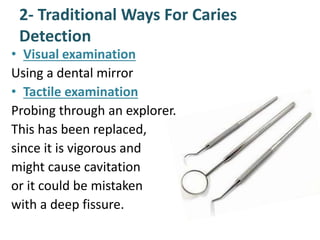
• Visual examination
Using a dental mirror
• Tactile examination
Probing through an explorer.
This has been replaced,
since it is vigorous and
might cause cavitation
or it could be mistaken
with a deep fissure.
3- Saliva Test
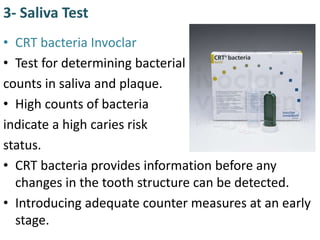
• CRT bacteria Invoclar
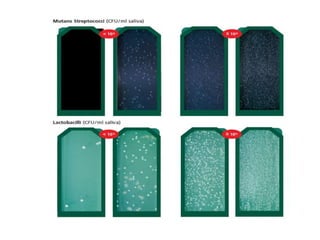
• Test for determining bacterial
counts in saliva and plaque.
• High counts of bacteria
indicate a high caries risk
status.
• CRT bacteria provides information before any
changes in the tooth structure can be detected.
• Introducing adequate counter measures at an early
stage.
4- Caries Detection Dye
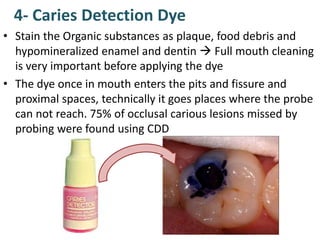
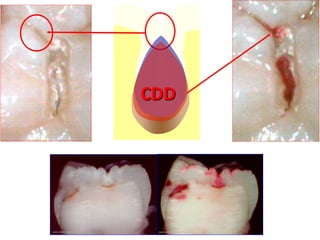
• Stain the Organic substances as plaque, food debris and
hypomineralized enamel and dentin  Full mouth cleaning
is very important before applying the dye
• The dye once in mouth enters the pits and fissure and
proximal spaces, technically it goes places where the probe
can not reach. 75% of occlusal carious lesions missed by
probing were found using CDD
CDD
5- Radiographs
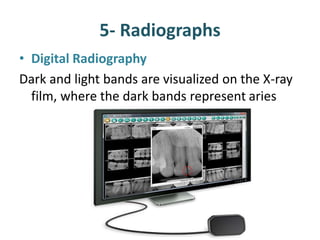
• Digital Radiography
Dark and light bands are visualized on the X-ray
film, where the dark bands represent aries
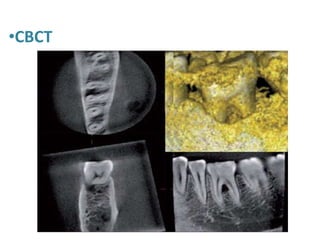
•CBCT
• Try Air Techniques- ScanX Swift Digital Imaging
System
6- Laser
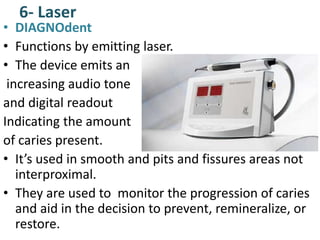
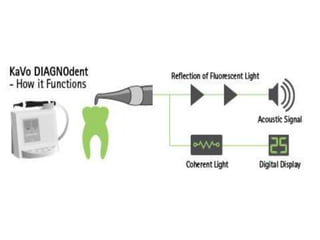
• DIAGNOdent
• Functions by emitting laser.
• The device emits an
increasing audio tone
and digital readout
Indicating the amount
of caries present.
• It’s used in smooth and pits and fissures areas not
interproximal.
• They are used to monitor the progression of caries
and aid in the decision to prevent, remineralize, or
restore.
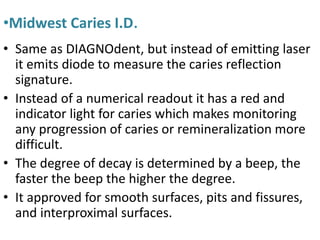
•Midwest Caries I.D.
• Same as DIAGNOdent, but instead of emitting laser
it emits diode to measure the caries reflection
signature.
• Instead of a numerical readout it has a red and
indicator light for caries which makes monitoring
any progression of caries or remineralization more
difficult.
• The degree of decay is determined by a beep, the
faster the beep the higher the degree.
• It approved for smooth surfaces, pits and fissures,
and interproximal surfaces.
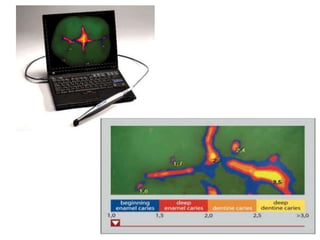
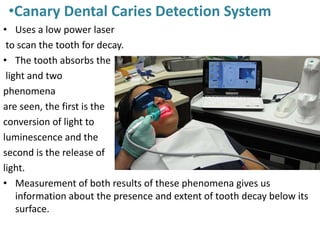
•Canary Dental Caries Detection System
• Uses a low power laser
to scan the tooth for decay.
• The tooth absorbs the
light and two
phenomena
are seen, the first is the
conversion of light to
luminescence and the
second is the release of
light.
• Measurement of both results of these phenomena gives us
information about the presence and extent of tooth decay below its
surface.
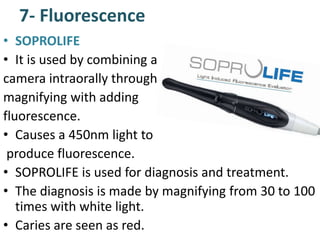
7- Fluorescence
• SOPROLIFE
• It is used by combining a
camera intraorally through
magnifying with adding
fluorescence.
• Causes a 450nm light to
produce fluorescence.
• SOPROLIFE is used for diagnosis and treatment.
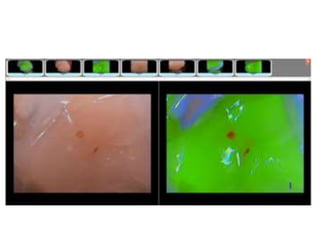
• The diagnosis is made by magnifying from 30 to 100
times with white light.
• Caries are seen as red.
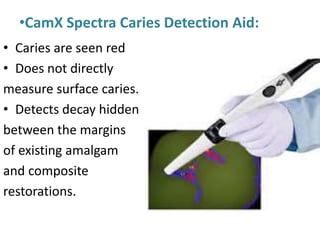
•CamX Spectra Caries Detection Aid:
• Caries are seen red
• Does not directly
measure surface caries.
• Detects decay hidden
between the margins
of existing amalgam
and composite
restorations.
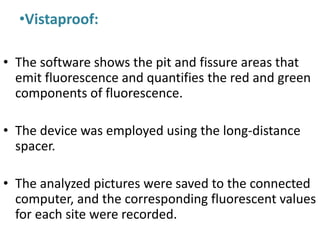
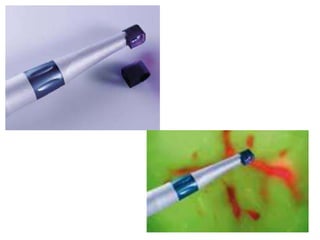
•Vistaproof:
• The software shows the pit and fissure areas that
emit fluorescence and quantifies the red and green
components of fluorescence.
• The device was employed using the long-distance
spacer.
• The analyzed pictures were saved to the connected
computer, and the corresponding fluorescent values
for each site were recorded.
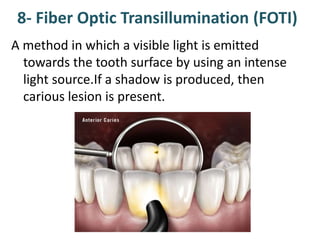
8- Fiber Optic Transillumination (FOTI)
A method in which a visible light is emitted
towards the tooth surface by using an intense
light source.If a shadow is produced, then
carious lesion is present.
References
• Art & Science of Operative Dentistry-5th
Edition
• www.dentistrytoday.com
THANK
YOU!!

Preventive dentistry- Operative assignment- Group number 6

  • 1.
    Preclinical Operative Dentistry PreventiveDentistry & Early Caries Detection Presented By: Ghina Mezher Nermin Qurah Mohamad Bruno Saccal Soumayya Moubayyed Hadi Hammoud Presented To: Dr. Mohammad Atef
  • 3.
    What is PreventiveDentistry? • Is a branch of dentistry, deals with the preservation of healthy teeth and gingiva and the prevention of dental and oral disease. • The concept of prevention is the maintenance of oral health, rather than treatment, but may be considered as the basis for treatment planning. What is Preventive Dentistry?
  • 4.
    1- Tooth-brushing 1-Fluoride 2- Flossing 2- Diet 3- Mouthwash 4- Pit and fissure sealants 5-Gums Prevention ChemicalMechanical
  • 5.
    How to preventcaries? • Mechanical plaque control is achieved via tooth brushing, using toothpicks and flossing. HOW to prevent Caries?!
  • 7.
    1- Tooth Brushing ElectricTooth Brush (Oral B) • Most technologically advanced toothbrush for ultimate plaque removal. • Remove 97% of plaque • Prevents and reverses gingivitis
  • 8.
    2- Flossing Philips Sonicare- Interproximal Cleaning Device • New air floss device • Improve gingival health • When the button is pressed, air and liquid microdroplets pass along the gum line, thus removing plaque
  • 9.
    3- Mouthwash LISTERINE • LISTERINENaturals Antiseptic Mouthwash is a natural mouthwash that is equally as effective and safe as Original LISTERINE Antiseptic Mouthwash. • Its ingredients are sourced from nature Kills 99.9% of germs that cause bad breath, plaque, and gingivitis.
  • 10.
    4- Pit &Fissures Sealants
  • 11.
    • Ultradent Products •Innovative syringe and tip delivery system for fast, simple, and mess-free application • Ensures an even dose of fluoride to each tooth • NEW tip is SoftEZ tip Unibody design Avoid fiber Allows an shedding even coat & tip clogging of varnish
  • 12.
    • 3M ESPE •Contains fluoride, calcium and phosphate; that are components naturally present in saliva • It is easy to apply and aids in the relief of hypersensitivity.
  • 13.
    5- Xylitol Gums •Prevent binding between sucrose and MS, since it can’t ferment xylitol • Improves remineralization and stops dental • Chewed for 5 to 30 minutes following eating.
  • 15.
    1- Fluoridation • Fluoridecan be supplied either topically, or by fluoridated water
  • 16.
    • Topical: - Viagels, varnishes, mouth rinses, dentifrices and prophy pastes. - Fluoridated dentifrices aren’t recommended in small children (<3 years)
  • 17.
    • Systemic: Viafluoridated water and by supplemental therapy  Fluoridated water: - Able to reduce 50% of caries amount - Most commonly used are: sodium fluoride, hydrofluosilic acid and sodium silicofluoride - Has a greater effect on smooth enamel surfaces
  • 18.
    • Enamelast • Flavored,xylitol-sweetened,5 % sodium fluoride • Provides superior fluoride release and uptake • Smooth, non-gritty texture • Has delicious Walterberry flavor • Either in : or • Patented adhesion-promoting agent for enhanced retention • Nearly invisible appearance Unit-dose Syringe application
  • 19.
    2- Diet • Avoidthe ingestion of sugars
  • 20.
    Vaccine against Caries •The Vaccine is derived from flagellin protein (Derived from salmonella)  Anti-caries vaccine • Agglutination of Ig A antibodies (produced from sensitized T and B cells) secreted from saliva with oral bacteria. Most effective with patients having high concentrations of MS • SO, it's possible for a substance in saliva to be triggered, leading to presence of anti caries vaccine. Vaccine Against CARIES!
  • 21.
  • 22.
    What Is CariesDetection?! Caries detection is a task full of risks which involves the applying of diagnostic criteria to decide at what level is the disease.
  • 23.
    1- Patient History Oneof primary steps to be done for caries diagnosis is to ask the patient several questions regarding • Age • Exposure to fluoride • Habits like smoking or alcohol drinking • Diet and general health overview (Hormonal changes, inherited diseases etc.) • Previous caries experiences • Family history
  • 24.
    2- Traditional WaysFor Caries Detection • Visual examination Using a dental mirror • Tactile examination Probing through an explorer. This has been replaced, since it is vigorous and might cause cavitation or it could be mistaken with a deep fissure.
  • 25.
    3- Saliva Test •CRT bacteria Invoclar • Test for determining bacterial counts in saliva and plaque. • High counts of bacteria indicate a high caries risk status. • CRT bacteria provides information before any changes in the tooth structure can be detected. • Introducing adequate counter measures at an early stage.
  • 27.
    4- Caries DetectionDye • Stain the Organic substances as plaque, food debris and hypomineralized enamel and dentin  Full mouth cleaning is very important before applying the dye • The dye once in mouth enters the pits and fissure and proximal spaces, technically it goes places where the probe can not reach. 75% of occlusal carious lesions missed by probing were found using CDD
  • 28.
  • 29.
    5- Radiographs • DigitalRadiography Dark and light bands are visualized on the X-ray film, where the dark bands represent aries
  • 30.
  • 31.
    • Try AirTechniques- ScanX Swift Digital Imaging System
  • 32.
    6- Laser • DIAGNOdent •Functions by emitting laser. • The device emits an increasing audio tone and digital readout Indicating the amount of caries present. • It’s used in smooth and pits and fissures areas not interproximal. • They are used to monitor the progression of caries and aid in the decision to prevent, remineralize, or restore.
  • 34.
    •Midwest Caries I.D. •Same as DIAGNOdent, but instead of emitting laser it emits diode to measure the caries reflection signature. • Instead of a numerical readout it has a red and indicator light for caries which makes monitoring any progression of caries or remineralization more difficult. • The degree of decay is determined by a beep, the faster the beep the higher the degree. • It approved for smooth surfaces, pits and fissures, and interproximal surfaces.
  • 36.
    •Canary Dental CariesDetection System • Uses a low power laser to scan the tooth for decay. • The tooth absorbs the light and two phenomena are seen, the first is the conversion of light to luminescence and the second is the release of light. • Measurement of both results of these phenomena gives us information about the presence and extent of tooth decay below its surface.
  • 37.
    7- Fluorescence • SOPROLIFE •It is used by combining a camera intraorally through magnifying with adding fluorescence. • Causes a 450nm light to produce fluorescence. • SOPROLIFE is used for diagnosis and treatment. • The diagnosis is made by magnifying from 30 to 100 times with white light. • Caries are seen as red.
  • 39.
    •CamX Spectra CariesDetection Aid: • Caries are seen red • Does not directly measure surface caries. • Detects decay hidden between the margins of existing amalgam and composite restorations.
  • 40.
    •Vistaproof: • The softwareshows the pit and fissure areas that emit fluorescence and quantifies the red and green components of fluorescence. • The device was employed using the long-distance spacer. • The analyzed pictures were saved to the connected computer, and the corresponding fluorescent values for each site were recorded.
  • 42.
    8- Fiber OpticTransillumination (FOTI) A method in which a visible light is emitted towards the tooth surface by using an intense light source.If a shadow is produced, then carious lesion is present.
  • 43.
    References • Art &Science of Operative Dentistry-5th Edition • www.dentistrytoday.com
  • 44.