Dr/ Alzahraa A. Alghriany
- Plaque control is the regular removal of
dental plaque and the prevention of its
accumulation on the teeth and adjacent
gingival surfaces.
- Objectives of plaque control are
-Removal of soft deposits
-Gingival massage keratinization and
improve circulation
-Prevention of calculus formation
- METHODS
Mechanical methods
Chemical methods
Tooth brushes
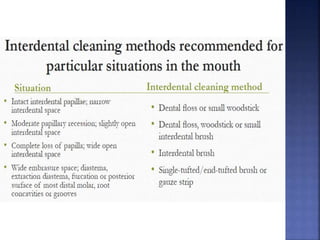
Interdental cleaning aids
Irrigation devices
Tongue cleaners
• 1- handle: The part grasped in the hand
during tooth brushing.
• 2- head : it is the working end of tooth brush
that hold bristles.
• 3- tufts: clusters of bristles secured into
head
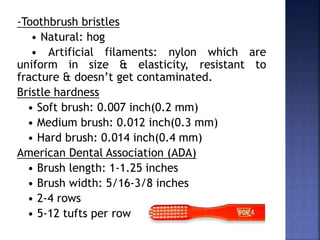
-Toothbrush bristles
• Natural: hog
• Artificial filaments: nylon which are
uniform in size & elasticity, resistant to
fracture & doesn’t get contaminated.
Bristle hardness
• Soft brush: 0.007 inch(0.2 mm)
• Medium brush: 0.012 inch(0.3 mm)
• Hard brush: 0.014 inch(0.4 mm)
American Dental Association (ADA)
• Brush length: 1-1.25 inches
• Brush width: 5/16-3/8 inches
• 2-4 rows
• 5-12 tufts per row
TOOTH BRUSHING TECHNIQUES:
Horizontal brushing (scrub)
Leonard method (vertical)
Bass method
Modified Stillman method (roll)
Charters method
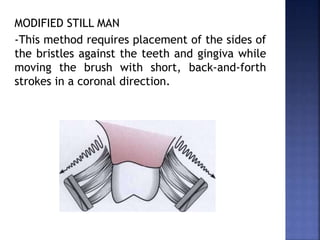
MODIFIED STILL MAN
-This method requires placement of the sides of
the bristles against the teeth and gingiva while
moving the brush with short, back-and-forth
strokes in a coronal direction.
– Dental plaque removal from cervical areas
below the height of contour of the enamel &
from exposed proximal surfaces .
– General application for cleaning tooth
surfaces and massage of the gingiva
– Recommended for cleaning in areas with
progressing gingival recession & root exposure
to prevent further tissue destruction.
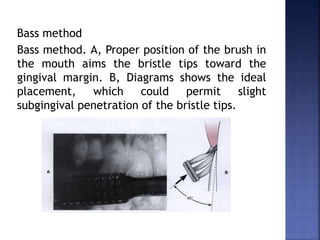
Bass method
Bass method. A, Proper position of the brush in
the mouth aims the bristle tips toward the
gingival margin. B, Diagrams shows the ideal
placement, which could permit slight
subgingival penetration of the bristle tips.
• Technique. Place the head of a soft brush
parallel with the occlusal plane, Place the
bristles at the gingival margin, establishing an
angle of 45 degrees to the long axis of the
teeth. Exert gentle vibratory pressure, using
short back and forth motions without dislodging
the tips of the bristles. This motion forces the
bristle ends into the gingival sulcus area as well
as partially into the interproximal embrasures.
The pressure should produce perceptible
blanching of the gingiva.
Complete approximately 20 strokes in the same
position.
-This repeated motion cleans the tooth
surfaces, concentrating on the apical third of
the clinical crowns, the gingival sulci, and as
far onto the proximal surfaces as the bristles
can reach.
-It concentrates the cleaning action on the
cervical and interproximal portions of the
teeth, where microbial plaque is most likely to
have accumulated.
-The Bass technique is efficient and can be
recommended for any patient with or without
periodontal involvement.
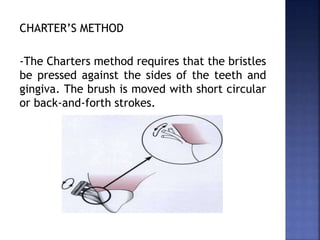
CHARTER’S METHOD
-The Charters method requires that the bristles
be pressed against the sides of the teeth and
gingiva. The brush is moved with short circular
or back-and-forth strokes.
INDICATIONS
- Individual’s having open interdental spaces
with missing papilla & exposed root surfaces
– For patients who have had periodontal
surgery
– Patients with moderate gingival recession
particularly inter-proximal (receded interdental
papillae).
-This brush position on occlusal surfaces of the
teeth is used with any technique, including the
Bass, Stillman, or Charters method.
• Powered toothbrushes are not generally
superior to manual ones
• The heads of these tooth brushes oscillate in a
side - to – side motion or in a rotary motion
• Powered toothbrushes have been shown to
improve oral health:
Children and adolescents
Children with physical or mental disabilities
Hospitalized patients
Patients with fixed orthodontic appliances
• Dental floss
• Interdental brushes
• Wooden or rubber tips
Dental Floss
-Effective for flat or convex proximal tooth
surfaces with full embrasures.
- Waxed, unwaxed or tufted types.
-Tufted and waxed are indicated for rough
restoration and tight contact
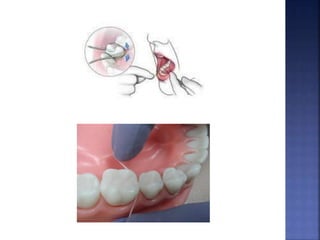
- Cut about 12cm and anchored around one
finger of each hand.
- Gentle placing at the base of gingival sulcus
then moved in an up-and down along the tooth
surface ,right and left.
-Unwaxed dental floss is generally
recommended for patients with normal tooth
contacts because it slides through the contact
area easily.
- Waxed floss is recommended for patients with
tight proximal tooth contacts.
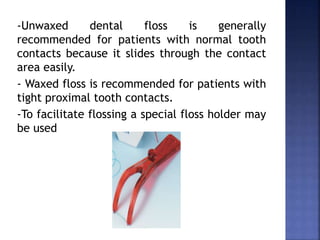
-To facilitate flossing a special floss holder may
be used
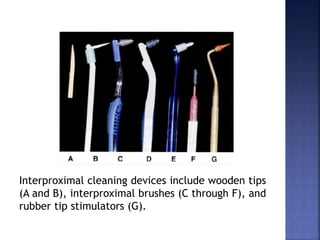
Interproximal cleaning devices include wooden tips
(A and B), interproximal brushes (C through F), and
rubber tip stimulators (G).
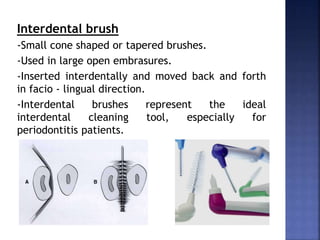
Interdental brush
-Small cone shaped or tapered brushes.
-Used in large open embrasures.
-Inserted interdentally and moved back and forth
in facio - lingual direction.
-Interdental brushes represent the ideal
interdental cleaning tool, especially for
periodontitis patients.
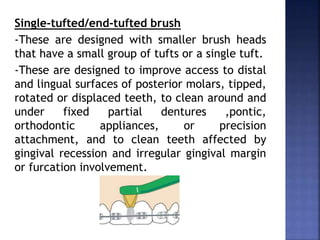
Single-tufted/end-tufted brush
-These are designed with smaller brush heads
that have a small group of tufts or a single tuft.
-These are designed to improve access to distal
and lingual surfaces of posterior molars, tipped,
rotated or displaced teeth, to clean around and
under fixed partial dentures ,pontic,
orthodontic appliances, or precision
attachment, and to clean teeth affected by
gingival recession and irregular gingival margin
or furcation involvement.
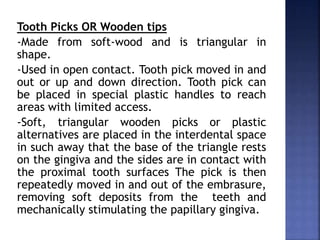
Tooth Picks OR Wooden tips
-Made from soft-wood and is triangular in
shape.
-Used in open contact. Tooth pick moved in and
out or up and down direction. Tooth pick can
be placed in special plastic handles to reach
areas with limited access.
-Soft, triangular wooden picks or plastic
alternatives are placed in the interdental space
in such away that the base of the triangle rests
on the gingiva and the sides are in contact with
the proximal tooth surfaces The pick is then
repeatedly moved in and out of the embrasure,
removing soft deposits from the teeth and
mechanically stimulating the papillary gingiva.
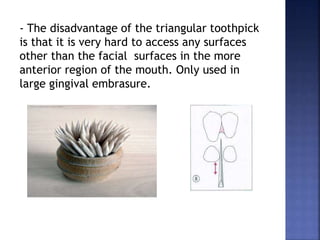
- The disadvantage of the triangular toothpick
is that it is very hard to access any surfaces
other than the facial surfaces in the more
anterior region of the mouth. Only used in
large gingival embrasure.
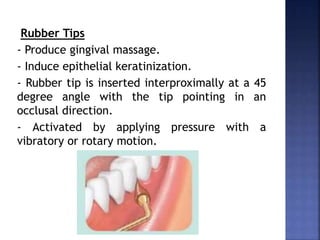
Rubber Tips
- Produce gingival massage.
- Induce epithelial keratinization.
- Rubber tip is inserted interproximally at a 45
degree angle with the tip pointing in an
occlusal direction.
- Activated by applying pressure with a
vibratory or rotary motion.
-With water and antiseptic mouth rinses. Supra or sub-gingival
irrigation.
-Hand or mechanized irrigation.
-subgingival irrigation performed with an oral irrigator using
chlorhexidine diluted to one-third strength, performed
regularly at home after scaling, root planing, and in-office
irrigation therapy, has produced significant gingival
improvement compared with controls.
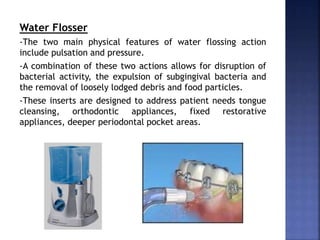
Water Flosser
-The two main physical features of water flossing action
include pulsation and pressure.
-A combination of these two actions allows for disruption of
bacterial activity, the expulsion of subgingival bacteria and
the removal of loosely lodged debris and food particles.
-These inserts are designed to address patient needs tongue
cleansing, orthodontic appliances, fixed restorative
appliances, deeper periodontal pocket areas.
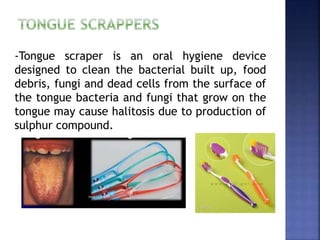
-Tongue scraper is an oral hygiene device
designed to clean the bacterial built up, food
debris, fungi and dead cells from the surface of
the tongue bacteria and fungi that grow on the
tongue may cause halitosis due to production of
sulphur compound.
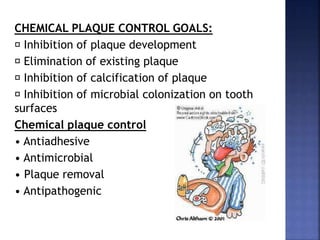
CHEMICAL PLAQUE CONTROL GOALS:
Inhibition of plaque development
Elimination of existing plaque
Inhibition of calcification of plaque
Inhibition of microbial colonization on tooth
surfaces
Chemical plaque control
• Antiadhesive
• Antimicrobial
• Plaque removal
• Antipathogenic
Antiadhesive agents
Pellicle surface removal to prevent the initial
attachment of the primary plaque-forming
bacteria.
Antifouling agents
Eg. Anionic polymers, substituted amino
alcohols.
too toxic or ineffective against dental
plaques
Antimicrobial agents
Inhibit plaque formation
2 mechanisms:
Bacteriostatic
Bacteriocidal
Eg. Chlorhexidine
Plaque removal agents
Chemical toothbrush
Eg: hypochlorites, enzymes
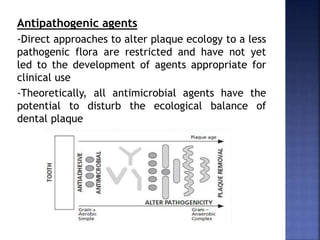
Antipathogenic agents
-Direct approaches to alter plaque ecology to a less
pathogenic flora are restricted and have not yet
led to the development of agents appropriate for
clinical use
-Theoretically, all antimicrobial agents have the
potential to disturb the ecological balance of
dental plaque
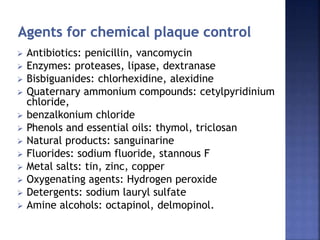
 Antibiotics: penicillin, vancomycin
 Enzymes: proteases, lipase, dextranase
 Bisbiguanides: chlorhexidine, alexidine
 Quaternary ammonium compounds: cetylpyridinium
chloride,
 benzalkonium chloride
 Phenols and essential oils: thymol, triclosan
 Natural products: sanguinarine
 Fluorides: sodium fluoride, stannous F
 Metal salts: tin, zinc, copper
 Oxygenating agents: Hydrogen peroxide
 Detergents: sodium lauryl sulfate
 Amine alcohols: octapinol, delmopinol.
TRICLOSAN
-Phenol derivative.
-Used as a topical antimicrobial agent
-Broad spectrum of action including both gram
positive and gram negative bacteria
-Mechanism of action:
Triclosan Act on cytoplasmic membrane
Induce leakage of cellular constitutes
Bacteriolysis and cell death
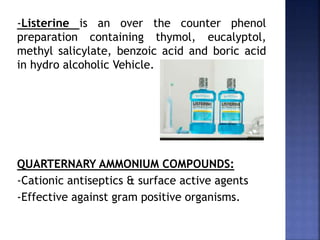
-Listerine is an over the counter phenol
preparation containing thymol, eucalyptol,
methyl salicylate, benzoic acid and boric acid
in hydro alcoholic Vehicle.
QUARTERNARY AMMONIUM COMPOUNDS:
-Cationic antiseptics & surface active agents
-Effective against gram positive organisms.
•Due to bacterial resistance problems the use of
antibiotics has been reduced.
•Despite evidence for efficacy – systemic
antimicrobials used in past (as topical/ systemic)
are Penicillin, Vancomycin, Erythromycin) for
preventing caries & gingivitis.
•Not be used as preventive agents.
BISBIGUANIDES
•Considered to most effective antiplaque
agents.
•Second generation agents.
•exhibiting substantivity.
•broad antimicrobial properties.
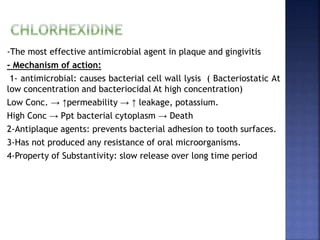
-The most effective antimicrobial agent in plaque and gingivitis
- Mechanism of action:
1- antimicrobial: causes bacterial cell wall lysis ( Bacteriostatic At
low concentration and bacteriocidal At high concentration)
Low Conc. → ↑permeability → ↑ leakage, potassium.
High Conc → Ppt bacterial cytoplasm → Death
2-Antiplaque agents: prevents bacterial adhesion to tooth surfaces.
3-Has not produced any resistance of oral microorganisms.
4-Property of Substantivity: slow release over long time period
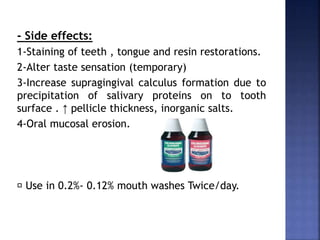
- Side effects:
1-Staining of teeth , tongue and resin restorations.
2-Alter taste sensation (temporary)
3-Increase supragingival calculus formation due to
precipitation of salivary proteins on to tooth
surface . ↑ pellicle thickness, inorganic salts.
4-Oral mucosal erosion.
Use in 0.2%- 0.12% mouth washes Twice/day.
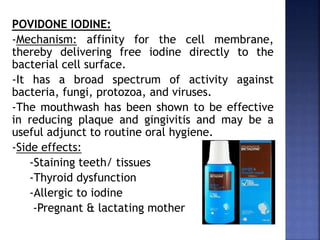
POVIDONE IODINE:
-Mechanism: affinity for the cell membrane,
thereby delivering free iodine directly to the
bacterial cell surface.
-It has a broad spectrum of activity against
bacteria, fungi, protozoa, and viruses.
-The mouthwash has been shown to be effective
in reducing plaque and gingivitis and may be a
useful adjunct to routine oral hygiene.
-Side effects:
-Staining teeth/ tissues
-Thyroid dysfunction
-Allergic to iodine
-Pregnant & lactating mother
• Toothpaste
• Mouthrinses
• Spray
• Irrigators
• Chewing gum
• Dentifrices aid in cleaning and polishing tooth
surfaces.
• Paste, powder and gel.
• Composition:
-Abrasive: silica, alumina, dicalcium phosphate, and
calcium carbonate.
- Detergent: sodium lauryl sulfate
-Thickeners: silica and gums
-Sweeteners: saccharine
-Humectants: glycerine and sorbitol
-Flavors: mint, peppermint
-Actives: fluorides, triclosan and stannous fluoride
MOUTHRINSE
-American Dental Association recognizes that
mouthrinse containing chlorhexidine and the
Listerine formula is effective in controlling
plaque and gingivitis-
-chlorhexidine, triclosan and essential oils are
used due to their proven effectiveness and
safety and general lack of sensory negatives
such as bitterness
DISCLOSING AGENTS
-Solutions or wafer capable of staining
bacterial deposits on the surfaces of teeth,
tongue, and gingiva.
• Erythrosine, fuchsin
• Fluorescein-containing dye
Plaque control.pptx

Plaque control.pptx

  • 1.
    Dr/ Alzahraa A.Alghriany
  • 2.
    - Plaque controlis the regular removal of dental plaque and the prevention of its accumulation on the teeth and adjacent gingival surfaces. - Objectives of plaque control are -Removal of soft deposits -Gingival massage keratinization and improve circulation -Prevention of calculus formation - METHODS Mechanical methods Chemical methods
  • 4.
    Tooth brushes Interdental cleaningaids Irrigation devices Tongue cleaners
  • 5.
    • 1- handle:The part grasped in the hand during tooth brushing. • 2- head : it is the working end of tooth brush that hold bristles. • 3- tufts: clusters of bristles secured into head
  • 6.
    -Toothbrush bristles • Natural:hog • Artificial filaments: nylon which are uniform in size & elasticity, resistant to fracture & doesn’t get contaminated. Bristle hardness • Soft brush: 0.007 inch(0.2 mm) • Medium brush: 0.012 inch(0.3 mm) • Hard brush: 0.014 inch(0.4 mm) American Dental Association (ADA) • Brush length: 1-1.25 inches • Brush width: 5/16-3/8 inches • 2-4 rows • 5-12 tufts per row
  • 7.
    TOOTH BRUSHING TECHNIQUES: Horizontalbrushing (scrub) Leonard method (vertical) Bass method Modified Stillman method (roll) Charters method
  • 8.
    MODIFIED STILL MAN -Thismethod requires placement of the sides of the bristles against the teeth and gingiva while moving the brush with short, back-and-forth strokes in a coronal direction.
  • 9.
    – Dental plaqueremoval from cervical areas below the height of contour of the enamel & from exposed proximal surfaces . – General application for cleaning tooth surfaces and massage of the gingiva – Recommended for cleaning in areas with progressing gingival recession & root exposure to prevent further tissue destruction.
  • 10.
    Bass method Bass method.A, Proper position of the brush in the mouth aims the bristle tips toward the gingival margin. B, Diagrams shows the ideal placement, which could permit slight subgingival penetration of the bristle tips.
  • 11.
    • Technique. Placethe head of a soft brush parallel with the occlusal plane, Place the bristles at the gingival margin, establishing an angle of 45 degrees to the long axis of the teeth. Exert gentle vibratory pressure, using short back and forth motions without dislodging the tips of the bristles. This motion forces the bristle ends into the gingival sulcus area as well as partially into the interproximal embrasures. The pressure should produce perceptible blanching of the gingiva. Complete approximately 20 strokes in the same position.
  • 12.
    -This repeated motioncleans the tooth surfaces, concentrating on the apical third of the clinical crowns, the gingival sulci, and as far onto the proximal surfaces as the bristles can reach. -It concentrates the cleaning action on the cervical and interproximal portions of the teeth, where microbial plaque is most likely to have accumulated. -The Bass technique is efficient and can be recommended for any patient with or without periodontal involvement.
  • 13.
    CHARTER’S METHOD -The Chartersmethod requires that the bristles be pressed against the sides of the teeth and gingiva. The brush is moved with short circular or back-and-forth strokes.
  • 14.
    INDICATIONS - Individual’s havingopen interdental spaces with missing papilla & exposed root surfaces – For patients who have had periodontal surgery – Patients with moderate gingival recession particularly inter-proximal (receded interdental papillae).
  • 15.
    -This brush positionon occlusal surfaces of the teeth is used with any technique, including the Bass, Stillman, or Charters method.
  • 16.
    • Powered toothbrushesare not generally superior to manual ones • The heads of these tooth brushes oscillate in a side - to – side motion or in a rotary motion • Powered toothbrushes have been shown to improve oral health: Children and adolescents Children with physical or mental disabilities Hospitalized patients Patients with fixed orthodontic appliances
  • 17.
    • Dental floss •Interdental brushes • Wooden or rubber tips
  • 18.
    Dental Floss -Effective forflat or convex proximal tooth surfaces with full embrasures. - Waxed, unwaxed or tufted types. -Tufted and waxed are indicated for rough restoration and tight contact - Cut about 12cm and anchored around one finger of each hand. - Gentle placing at the base of gingival sulcus then moved in an up-and down along the tooth surface ,right and left.
  • 20.
    -Unwaxed dental flossis generally recommended for patients with normal tooth contacts because it slides through the contact area easily. - Waxed floss is recommended for patients with tight proximal tooth contacts. -To facilitate flossing a special floss holder may be used
  • 21.
    Interproximal cleaning devicesinclude wooden tips (A and B), interproximal brushes (C through F), and rubber tip stimulators (G).
  • 22.
    Interdental brush -Small coneshaped or tapered brushes. -Used in large open embrasures. -Inserted interdentally and moved back and forth in facio - lingual direction. -Interdental brushes represent the ideal interdental cleaning tool, especially for periodontitis patients.
  • 23.
    Single-tufted/end-tufted brush -These aredesigned with smaller brush heads that have a small group of tufts or a single tuft. -These are designed to improve access to distal and lingual surfaces of posterior molars, tipped, rotated or displaced teeth, to clean around and under fixed partial dentures ,pontic, orthodontic appliances, or precision attachment, and to clean teeth affected by gingival recession and irregular gingival margin or furcation involvement.
  • 24.
    Tooth Picks ORWooden tips -Made from soft-wood and is triangular in shape. -Used in open contact. Tooth pick moved in and out or up and down direction. Tooth pick can be placed in special plastic handles to reach areas with limited access. -Soft, triangular wooden picks or plastic alternatives are placed in the interdental space in such away that the base of the triangle rests on the gingiva and the sides are in contact with the proximal tooth surfaces The pick is then repeatedly moved in and out of the embrasure, removing soft deposits from the teeth and mechanically stimulating the papillary gingiva.
  • 25.
    - The disadvantageof the triangular toothpick is that it is very hard to access any surfaces other than the facial surfaces in the more anterior region of the mouth. Only used in large gingival embrasure.
  • 26.
    Rubber Tips - Producegingival massage. - Induce epithelial keratinization. - Rubber tip is inserted interproximally at a 45 degree angle with the tip pointing in an occlusal direction. - Activated by applying pressure with a vibratory or rotary motion.
  • 28.
    -With water andantiseptic mouth rinses. Supra or sub-gingival irrigation. -Hand or mechanized irrigation. -subgingival irrigation performed with an oral irrigator using chlorhexidine diluted to one-third strength, performed regularly at home after scaling, root planing, and in-office irrigation therapy, has produced significant gingival improvement compared with controls.
  • 29.
    Water Flosser -The twomain physical features of water flossing action include pulsation and pressure. -A combination of these two actions allows for disruption of bacterial activity, the expulsion of subgingival bacteria and the removal of loosely lodged debris and food particles. -These inserts are designed to address patient needs tongue cleansing, orthodontic appliances, fixed restorative appliances, deeper periodontal pocket areas.
  • 30.
    -Tongue scraper isan oral hygiene device designed to clean the bacterial built up, food debris, fungi and dead cells from the surface of the tongue bacteria and fungi that grow on the tongue may cause halitosis due to production of sulphur compound.
  • 32.
    CHEMICAL PLAQUE CONTROLGOALS: Inhibition of plaque development Elimination of existing plaque Inhibition of calcification of plaque Inhibition of microbial colonization on tooth surfaces Chemical plaque control • Antiadhesive • Antimicrobial • Plaque removal • Antipathogenic
  • 33.
    Antiadhesive agents Pellicle surfaceremoval to prevent the initial attachment of the primary plaque-forming bacteria. Antifouling agents Eg. Anionic polymers, substituted amino alcohols. too toxic or ineffective against dental plaques
  • 34.
    Antimicrobial agents Inhibit plaqueformation 2 mechanisms: Bacteriostatic Bacteriocidal Eg. Chlorhexidine Plaque removal agents Chemical toothbrush Eg: hypochlorites, enzymes
  • 35.
    Antipathogenic agents -Direct approachesto alter plaque ecology to a less pathogenic flora are restricted and have not yet led to the development of agents appropriate for clinical use -Theoretically, all antimicrobial agents have the potential to disturb the ecological balance of dental plaque
  • 36.
     Antibiotics: penicillin,vancomycin  Enzymes: proteases, lipase, dextranase  Bisbiguanides: chlorhexidine, alexidine  Quaternary ammonium compounds: cetylpyridinium chloride,  benzalkonium chloride  Phenols and essential oils: thymol, triclosan  Natural products: sanguinarine  Fluorides: sodium fluoride, stannous F  Metal salts: tin, zinc, copper  Oxygenating agents: Hydrogen peroxide  Detergents: sodium lauryl sulfate  Amine alcohols: octapinol, delmopinol.
  • 38.
    TRICLOSAN -Phenol derivative. -Used asa topical antimicrobial agent -Broad spectrum of action including both gram positive and gram negative bacteria -Mechanism of action: Triclosan Act on cytoplasmic membrane Induce leakage of cellular constitutes Bacteriolysis and cell death
  • 39.
    -Listerine is anover the counter phenol preparation containing thymol, eucalyptol, methyl salicylate, benzoic acid and boric acid in hydro alcoholic Vehicle. QUARTERNARY AMMONIUM COMPOUNDS: -Cationic antiseptics & surface active agents -Effective against gram positive organisms.
  • 40.
    •Due to bacterialresistance problems the use of antibiotics has been reduced. •Despite evidence for efficacy – systemic antimicrobials used in past (as topical/ systemic) are Penicillin, Vancomycin, Erythromycin) for preventing caries & gingivitis. •Not be used as preventive agents.
  • 41.
    BISBIGUANIDES •Considered to mosteffective antiplaque agents. •Second generation agents. •exhibiting substantivity. •broad antimicrobial properties.
  • 42.
    -The most effectiveantimicrobial agent in plaque and gingivitis - Mechanism of action: 1- antimicrobial: causes bacterial cell wall lysis ( Bacteriostatic At low concentration and bacteriocidal At high concentration) Low Conc. → ↑permeability → ↑ leakage, potassium. High Conc → Ppt bacterial cytoplasm → Death 2-Antiplaque agents: prevents bacterial adhesion to tooth surfaces. 3-Has not produced any resistance of oral microorganisms. 4-Property of Substantivity: slow release over long time period
  • 43.
    - Side effects: 1-Stainingof teeth , tongue and resin restorations. 2-Alter taste sensation (temporary) 3-Increase supragingival calculus formation due to precipitation of salivary proteins on to tooth surface . ↑ pellicle thickness, inorganic salts. 4-Oral mucosal erosion. Use in 0.2%- 0.12% mouth washes Twice/day.
  • 44.
    POVIDONE IODINE: -Mechanism: affinityfor the cell membrane, thereby delivering free iodine directly to the bacterial cell surface. -It has a broad spectrum of activity against bacteria, fungi, protozoa, and viruses. -The mouthwash has been shown to be effective in reducing plaque and gingivitis and may be a useful adjunct to routine oral hygiene. -Side effects: -Staining teeth/ tissues -Thyroid dysfunction -Allergic to iodine -Pregnant & lactating mother
  • 45.
    • Toothpaste • Mouthrinses •Spray • Irrigators • Chewing gum
  • 46.
    • Dentifrices aidin cleaning and polishing tooth surfaces. • Paste, powder and gel. • Composition: -Abrasive: silica, alumina, dicalcium phosphate, and calcium carbonate. - Detergent: sodium lauryl sulfate -Thickeners: silica and gums -Sweeteners: saccharine -Humectants: glycerine and sorbitol -Flavors: mint, peppermint -Actives: fluorides, triclosan and stannous fluoride
  • 47.
    MOUTHRINSE -American Dental Associationrecognizes that mouthrinse containing chlorhexidine and the Listerine formula is effective in controlling plaque and gingivitis- -chlorhexidine, triclosan and essential oils are used due to their proven effectiveness and safety and general lack of sensory negatives such as bitterness
  • 48.
    DISCLOSING AGENTS -Solutions orwafer capable of staining bacterial deposits on the surfaces of teeth, tongue, and gingiva. • Erythrosine, fuchsin • Fluorescein-containing dye