PLAQUE CONTROL
BY
M.J.RENGANATH
MDS 1ST YEAR
•Plaque control is the regular removal of
microbial plaque and the prevention of its
accumulation on the teeth and adjacent
gingival surfaces.
•Microbial plaque is the major etiology of
periodontal diseases
•Patient cooperation in daily plaque removal is
critical to long-term success of all periodontal
•In 1965, Löe et al conducted the classic study-
relationship between plaque accumulation and
the development of experimental gingivitis in
humans.
•Stopped brushing and other plaque control
procedures, resulting in the development of
gingivitis in every person within 7 to 21 days.
•The composition of the plaque bacteria also
shifted so that gram negative organisms
predominated, and these changes were shown
•Plaque formation begins on the interproximal
surfaces where the toothbrush does not reach.
•Masses of plaque first develop in the molar and
premolar areas, followed by the proximal
surfaces of the anterior teeth and the facial
surfaces of the molars and premolars.
•Patients consistently leave more plaque on the
posterior teeth than the anterior teeth, with
interproximal surfaces retaining the highest
amounts of plaque, exactly the places in which
PLAQUE CONTROL MEASURES
Mechanical:
• Toothbrushing
• Interdental cleansing aids
Chemical:
• Prescription Chlorhexidine
• Nonprescription essential oils
• Other products
TOOTH BRUSH
• Chewstick as tooth brush by Chinese about 1600BC.
• Hippocrates given commentaries on removing
deposits from teeth(460-377BC)
• First bristle toothbrush was introduced by Chinese in
sixteenth century.
• Oral health- regular personal plaque removal.
• Mechanical removal of oral biofilm via toothbrushing
is the most widely accepted.
• The most commonly used device-the manual
toothbrush,
• Well designed to remove plaque from the facial,
lingual, and occlusal tooth surfaces
ADA specification:
• The head of the brush should be 1 inch to 11/4 inches
long.
• 2 – 4 rows of bristles.
• 5/16 inch to 3/8 inches wide.
• 5 – 12 tufts per row.
• 80 – 86 bristles per tuft.
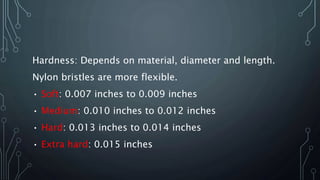
Hardness: Depends on material, diameter and length.
Nylon bristles are more flexible.
• Soft: 0.007 inches to 0.009 inches
• Medium: 0.010 inches to 0.012 inches
• Hard: 0.013 inches to 0.014 inches
• Extra hard: 0.015 inches
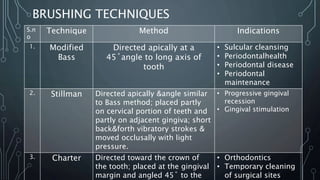
BRUSHING TECHNIQUES
S.n
o
Technique Method Indications
1. Modified
Bass
Directed apically at a
45˚angle to long axis of
tooth
• Sulcular cleansing
• Periodontalhealth
• Periodontal disease
• Periodontal
maintenance
2. Stillman Directed apically &angle similar
to Bass method; placed partly
on cervical portion of teeth and
partly on adjacent gingiva; short
back&forth vibratory strokes &
moved occlusally with light
pressure.
• Progressive gingival
recession
• Gingival stimulation
3. Charter Directed toward the crown of
the tooth; placed at the gingival
margin and angled 45˚ to the
• Orthodontics
• Temporary cleaning
of surgical sites
S.n
o
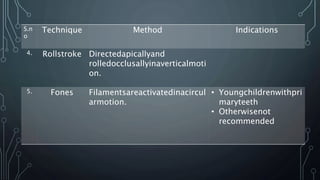
Technique Method Indications
4. Rollstroke Directedapicallyand
rolledocclusallyinaverticalmoti
on.
5. Fones Filamentsareactivatedinacircul
armotion.
• Youngchildrenwithpri
maryteeth
• Otherwisenot
recommended
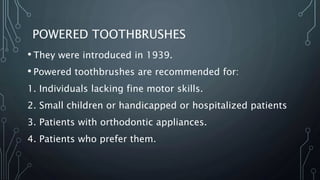
POWERED TOOTHBRUSHES
• They were introduced in 1939.
• Powered toothbrushes are recommended for:
1. Individuals lacking fine motor skills.
2. Small children or handicapped or hospitalized patients
3. Patients with orthodontic appliances.
4. Patients who prefer them.
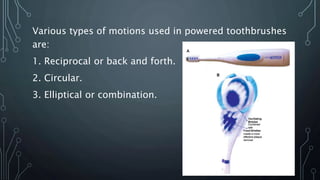
Various types of motions used in powered toothbrushes
are:
1. Reciprocal or back and forth.
2. Circular.
3. Elliptical or combination.
DENTIFRICES
• These are the aids for cleaning and polishing of teeth
surfaces.
• They are used in the form of powders, pastes and gels.
Composition:
• Abrasives: CaCO3, Ca3 (PO4)2
• Humectants: glycerine, sorbitol, mannitol, propylene
glycol
• Thickening agents: sodium carboxy-methyl cellulose
• Preservatives: benzoic acid
• Foaming agents: sodium lauryl sulphate.
• Flavoring and sweetening agents: peppermint,
saccharine, sorbitol, mannitol.
• Desensitising agents: sodium fluoride, potassium
nitrate.
• Anticaries agents: sodium monofluorophosphate,
sodium fluoride.
• Anticalculus agents: pyrophosphates or zinc
compounds.
INTERDENTAL CLEANING AIDS
• Toothbrush does not completely remove interdental
plaque
• Dental floss and interdental cleaners such as wooden
or plastic tips and interdental brushes.
Factors determining the selection of interdental aids:
• Type 1: The interdental papilla fills up the embrasure.
Dental floss is advised
• Type 2: Moderate papillary recession, miniature
interdental brushes and wood tips are recommended.
• Type 3: Complete loss of papilla (seen in diastema).
Unitufted brushes are recommended.
DENTAL FLOSS
• Most commonly recommended method of removing
plaque.
• Made from nylon filaments or plastic monofilaments,
and can be waxed, unwaxed, thick, thin, and even
flavored.
• Unwaxed floss is preferred over waxed.
METHOD
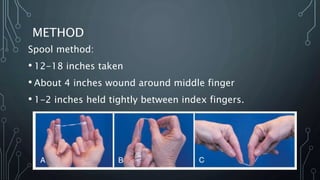
Spool method:
• 12-18 inches taken
• About 4 inches wound around middle finger
• 1-2 inches held tightly between index fingers.
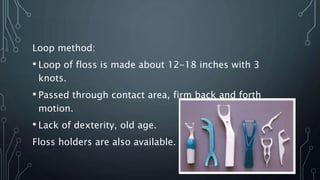
Loop method:
• Loop of floss is made about 12-18 inches with 3
knots.
• Passed through contact area, firm back and forth
motion.
• Lack of dexterity, old age.
Floss holders are also available.
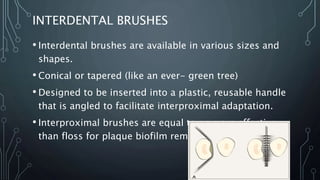
INTERDENTAL BRUSHES
• Interdental brushes are available in various sizes and
shapes.
• Conical or tapered (like an ever- green tree)
• Designed to be inserted into a plastic, reusable handle
that is angled to facilitate interproximal adaptation.
• Interproximal brushes are equal to or more effective
than floss for plaque biofilm removal.
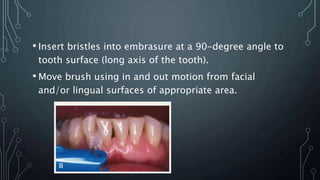
• Insert bristles into embrasure at a 90-degree angle to
tooth surface (long axis of the tooth).
• Move brush using in and out motion from facial
and/or lingual surfaces of appropriate area.
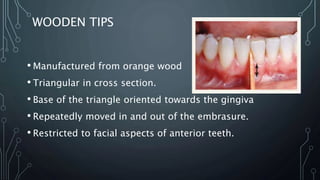
WOODEN TIPS
• Manufactured from orange wood
• Triangular in cross section.
• Base of the triangle oriented towards the gingiva
• Repeatedly moved in and out of the embrasure.
• Restricted to facial aspects of anterior teeth.
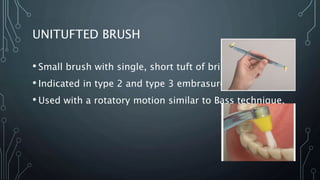
UNITUFTED BRUSH
• Small brush with single, short tuft of bristles.
• Indicated in type 2 and type 3 embrasures.
• Used with a rotatory motion similar to Bass technique.
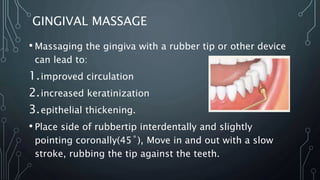
GINGIVAL MASSAGE
• Massaging the gingiva with a rubber tip or other device
can lead to:
1.improved circulation
2.increased keratinization
3.epithelial thickening.
• Place side of rubbertip interdentally and slightly
pointing coronally(45˚), Move in and out with a slow
stroke, rubbing the tip against the teeth.
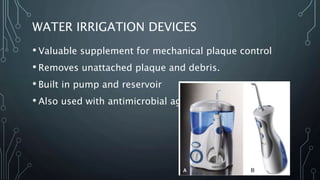
WATER IRRIGATION DEVICES
• Valuable supplement for mechanical plaque control
• Removes unattached plaque and debris.
• Built in pump and reservoir
• Also used with antimicrobial agents.
CHEMICAL PLAQUE CONTROL
• Ideal adjunct to mechanical plaque control that
includes:
1.Prescription chlorhexidine rinse
2.Nonprescription essential oil rinse
3.Antibiotics
4.Quaternary ammonium compounds
5.Enzymes
CHLORHEXIDINE
• Cationic Bisbiguanide.
• Superior antiplaque activity – ‘Substantivity’
• Low concentration: bacteriostatic
• High concentration: bactericidal
• Single rinse: antibacterial activity in saliva for about 5
hours
• Prevents pellicle formation- blocking acidic groups on
salivary glycoprotein reducing glycoprotein adsorption
on tooth surface.
• Prevents adsorption of bacterial cell wall on tooth
surface- binding to the bacteria
• Prevents binding of mature plaque- precipitating
agglutination factors in saliva & displacing calcium
from plaque matrix
NON PRESCRIPTION ESSENTIAL OIL RINSES
• Long history of use and safety
• Demonstrated plaque reductions in long term clinical
studies
• Eg: Thymol, Eucalyptol, Menthol, Methyl salicylate.
• Listerine
ANTIBIOTICS
• Vancomycin, Erythromycin, Niddamycin and
Kanamycin have been used.
• Bacterial resistance and hypersensitivity reactions.
ENZYMES
• Would be able to breakdown already formed matrix of
plaque and calculus
• Certain proteolytic enzymes are bactericidal to
microorganisms.
• Effective when applied topically in the mouth.
• Eg: Mucinase
QUATERNARY AMMONIUM COMPOUNDS
• Effective against developing plaque, predominant
gram +ve organisms.
• +vely charged molecule reacts with –vely charged cell
membrane phosphates, disrupts cell wall of
microorganisms
• Eg: Benzathonium chloride.
OTHER AGENTS
Triclosan:
• Phenol derivative, recently included.
• Broad spectrum of activity against both gram +ve and –ve
bacteria.
• Acts on microbial cytoplasmic membrane, inducing
leakage of cellular constituents, causing bacteriolysis.
• Delays plaque maturation and also inhibits formation of
Prostaglandins and leukotrienes.
Delmopinol:
• Morpholino ethanol derivative
• Interferes with plaque matrix formation and reduces
bacterial adherence.
• Causes weak binding of plaque to tooth surface, thus
aiding in easy removal of plaque by mechanical
procedures
• Pre-brushing mouthrinse.
S.APARNA ET AL
JOURNAL OF PERIODONTOLOGY: SEPTEMBER 2012
• The aims of this study are as follows: 1) to evaluate the
antibacterial efficacy of honey against oral bacteria and
compare the same with 0.2% chlorhexidine; and 2) to
compare antiplaque efficacy in vivo with chlorhexidine.
• The in vivo results revealed that plaque formation was
inhibited/reduced by chlorhexidine and honey rinses.
• Concluded that Honey has antibacterial action against
tested oral microorganisms and also has antiplaque
action.
M.P.C. VAN LEEUWEN, D.E. SLOT AND G.A. VAN DER
WEIJDEN
JOURNAL OF PERIODONTOLOGY: FEBRUARY 2011.
• No significant difference with respect to reduction of gingival
inflammation was found between EOMW and chlorhexidine
mouthwash
• In long-term use, the standardized formulation of EOMW
appeared to be a reliable alternative to chlorhexidine
mouthwash with respect to parameters of gingival
inflammation.
CONCLUSION
• Periodontal disease- majority of missing teeth
• Only possible solution to the problem is prevention.
• Proper oral hygiene practices- controls periodontal
disease.
• Patient education.
REFERENCES
• Clinical periodontology and implant dentistry- Jan Lindhe(5th edition)
• Carranza’s clinical periodontology- 11th edition
• Dental hygiene theory and practice- Michele Leonardi Darby and
Margaret M. Walsh(3rd edition)
• Essential Oils Compared to Chlorhexidine With Respect to Plaque and
Parameters of Gingival Inflammation: A Systematic Review - M.P.C. Van
Leeuwen, D.E. Slot and G.A. Van der Weijden
Journal of Periodontology: February 2011, Vol. 82, No. 2, Pages 174-194
• A Comparative Evaluation of the Antibacterial Efficacy of Honey In Vitro
and Antiplaque Efficacy in a 4-Day Plaque Regrowth Model In Vivo:
Preliminary Results- S.Aparna et al
Journal of Periodontology: September 2012, Vol. 83, No. 9, Pages 1116-1121
THANKYOU

Plaque control

  • 1.
  • 2.
    •Plaque control isthe regular removal of microbial plaque and the prevention of its accumulation on the teeth and adjacent gingival surfaces. •Microbial plaque is the major etiology of periodontal diseases •Patient cooperation in daily plaque removal is critical to long-term success of all periodontal
  • 3.
    •In 1965, Löeet al conducted the classic study- relationship between plaque accumulation and the development of experimental gingivitis in humans. •Stopped brushing and other plaque control procedures, resulting in the development of gingivitis in every person within 7 to 21 days. •The composition of the plaque bacteria also shifted so that gram negative organisms predominated, and these changes were shown
  • 4.
    •Plaque formation beginson the interproximal surfaces where the toothbrush does not reach. •Masses of plaque first develop in the molar and premolar areas, followed by the proximal surfaces of the anterior teeth and the facial surfaces of the molars and premolars. •Patients consistently leave more plaque on the posterior teeth than the anterior teeth, with interproximal surfaces retaining the highest amounts of plaque, exactly the places in which
  • 5.
    PLAQUE CONTROL MEASURES Mechanical: •Toothbrushing • Interdental cleansing aids Chemical: • Prescription Chlorhexidine • Nonprescription essential oils • Other products
  • 6.
    TOOTH BRUSH • Chewstickas tooth brush by Chinese about 1600BC. • Hippocrates given commentaries on removing deposits from teeth(460-377BC) • First bristle toothbrush was introduced by Chinese in sixteenth century.
  • 7.
    • Oral health-regular personal plaque removal. • Mechanical removal of oral biofilm via toothbrushing is the most widely accepted. • The most commonly used device-the manual toothbrush, • Well designed to remove plaque from the facial, lingual, and occlusal tooth surfaces
  • 8.
    ADA specification: • Thehead of the brush should be 1 inch to 11/4 inches long. • 2 – 4 rows of bristles. • 5/16 inch to 3/8 inches wide. • 5 – 12 tufts per row. • 80 – 86 bristles per tuft.
  • 9.
    Hardness: Depends onmaterial, diameter and length. Nylon bristles are more flexible. • Soft: 0.007 inches to 0.009 inches • Medium: 0.010 inches to 0.012 inches • Hard: 0.013 inches to 0.014 inches • Extra hard: 0.015 inches
  • 10.
    BRUSHING TECHNIQUES S.n o Technique MethodIndications 1. Modified Bass Directed apically at a 45˚angle to long axis of tooth • Sulcular cleansing • Periodontalhealth • Periodontal disease • Periodontal maintenance 2. Stillman Directed apically &angle similar to Bass method; placed partly on cervical portion of teeth and partly on adjacent gingiva; short back&forth vibratory strokes & moved occlusally with light pressure. • Progressive gingival recession • Gingival stimulation 3. Charter Directed toward the crown of the tooth; placed at the gingival margin and angled 45˚ to the • Orthodontics • Temporary cleaning of surgical sites
  • 11.
    S.n o Technique Method Indications 4.Rollstroke Directedapicallyand rolledocclusallyinaverticalmoti on. 5. Fones Filamentsareactivatedinacircul armotion. • Youngchildrenwithpri maryteeth • Otherwisenot recommended
  • 12.
    POWERED TOOTHBRUSHES • Theywere introduced in 1939. • Powered toothbrushes are recommended for: 1. Individuals lacking fine motor skills. 2. Small children or handicapped or hospitalized patients 3. Patients with orthodontic appliances. 4. Patients who prefer them.
  • 13.
    Various types ofmotions used in powered toothbrushes are: 1. Reciprocal or back and forth. 2. Circular. 3. Elliptical or combination.
  • 14.
    DENTIFRICES • These arethe aids for cleaning and polishing of teeth surfaces. • They are used in the form of powders, pastes and gels. Composition: • Abrasives: CaCO3, Ca3 (PO4)2 • Humectants: glycerine, sorbitol, mannitol, propylene glycol • Thickening agents: sodium carboxy-methyl cellulose
  • 15.
    • Preservatives: benzoicacid • Foaming agents: sodium lauryl sulphate. • Flavoring and sweetening agents: peppermint, saccharine, sorbitol, mannitol. • Desensitising agents: sodium fluoride, potassium nitrate. • Anticaries agents: sodium monofluorophosphate, sodium fluoride. • Anticalculus agents: pyrophosphates or zinc compounds.
  • 16.
    INTERDENTAL CLEANING AIDS •Toothbrush does not completely remove interdental plaque • Dental floss and interdental cleaners such as wooden or plastic tips and interdental brushes.
  • 17.
    Factors determining theselection of interdental aids: • Type 1: The interdental papilla fills up the embrasure. Dental floss is advised • Type 2: Moderate papillary recession, miniature interdental brushes and wood tips are recommended. • Type 3: Complete loss of papilla (seen in diastema). Unitufted brushes are recommended.
  • 18.
    DENTAL FLOSS • Mostcommonly recommended method of removing plaque. • Made from nylon filaments or plastic monofilaments, and can be waxed, unwaxed, thick, thin, and even flavored. • Unwaxed floss is preferred over waxed.
  • 19.
    METHOD Spool method: • 12-18inches taken • About 4 inches wound around middle finger • 1-2 inches held tightly between index fingers.
  • 21.
    Loop method: • Loopof floss is made about 12-18 inches with 3 knots. • Passed through contact area, firm back and forth motion. • Lack of dexterity, old age. Floss holders are also available.
  • 22.
    INTERDENTAL BRUSHES • Interdentalbrushes are available in various sizes and shapes. • Conical or tapered (like an ever- green tree) • Designed to be inserted into a plastic, reusable handle that is angled to facilitate interproximal adaptation. • Interproximal brushes are equal to or more effective than floss for plaque biofilm removal.
  • 23.
    • Insert bristlesinto embrasure at a 90-degree angle to tooth surface (long axis of the tooth). • Move brush using in and out motion from facial and/or lingual surfaces of appropriate area.
  • 24.
    WOODEN TIPS • Manufacturedfrom orange wood • Triangular in cross section. • Base of the triangle oriented towards the gingiva • Repeatedly moved in and out of the embrasure. • Restricted to facial aspects of anterior teeth.
  • 25.
    UNITUFTED BRUSH • Smallbrush with single, short tuft of bristles. • Indicated in type 2 and type 3 embrasures. • Used with a rotatory motion similar to Bass technique.
  • 26.
    GINGIVAL MASSAGE • Massagingthe gingiva with a rubber tip or other device can lead to: 1.improved circulation 2.increased keratinization 3.epithelial thickening. • Place side of rubbertip interdentally and slightly pointing coronally(45˚), Move in and out with a slow stroke, rubbing the tip against the teeth.
  • 27.
    WATER IRRIGATION DEVICES •Valuable supplement for mechanical plaque control • Removes unattached plaque and debris. • Built in pump and reservoir • Also used with antimicrobial agents.
  • 28.
    CHEMICAL PLAQUE CONTROL •Ideal adjunct to mechanical plaque control that includes: 1.Prescription chlorhexidine rinse 2.Nonprescription essential oil rinse 3.Antibiotics 4.Quaternary ammonium compounds 5.Enzymes
  • 29.
    CHLORHEXIDINE • Cationic Bisbiguanide. •Superior antiplaque activity – ‘Substantivity’ • Low concentration: bacteriostatic • High concentration: bactericidal • Single rinse: antibacterial activity in saliva for about 5 hours
  • 30.
    • Prevents pellicleformation- blocking acidic groups on salivary glycoprotein reducing glycoprotein adsorption on tooth surface. • Prevents adsorption of bacterial cell wall on tooth surface- binding to the bacteria • Prevents binding of mature plaque- precipitating agglutination factors in saliva & displacing calcium from plaque matrix
  • 31.
    NON PRESCRIPTION ESSENTIALOIL RINSES • Long history of use and safety • Demonstrated plaque reductions in long term clinical studies • Eg: Thymol, Eucalyptol, Menthol, Methyl salicylate. • Listerine
  • 32.
    ANTIBIOTICS • Vancomycin, Erythromycin,Niddamycin and Kanamycin have been used. • Bacterial resistance and hypersensitivity reactions.
  • 33.
    ENZYMES • Would beable to breakdown already formed matrix of plaque and calculus • Certain proteolytic enzymes are bactericidal to microorganisms. • Effective when applied topically in the mouth. • Eg: Mucinase
  • 34.
    QUATERNARY AMMONIUM COMPOUNDS •Effective against developing plaque, predominant gram +ve organisms. • +vely charged molecule reacts with –vely charged cell membrane phosphates, disrupts cell wall of microorganisms • Eg: Benzathonium chloride.
  • 35.
    OTHER AGENTS Triclosan: • Phenolderivative, recently included. • Broad spectrum of activity against both gram +ve and –ve bacteria. • Acts on microbial cytoplasmic membrane, inducing leakage of cellular constituents, causing bacteriolysis. • Delays plaque maturation and also inhibits formation of Prostaglandins and leukotrienes.
  • 36.
    Delmopinol: • Morpholino ethanolderivative • Interferes with plaque matrix formation and reduces bacterial adherence. • Causes weak binding of plaque to tooth surface, thus aiding in easy removal of plaque by mechanical procedures • Pre-brushing mouthrinse.
  • 37.
    S.APARNA ET AL JOURNALOF PERIODONTOLOGY: SEPTEMBER 2012 • The aims of this study are as follows: 1) to evaluate the antibacterial efficacy of honey against oral bacteria and compare the same with 0.2% chlorhexidine; and 2) to compare antiplaque efficacy in vivo with chlorhexidine. • The in vivo results revealed that plaque formation was inhibited/reduced by chlorhexidine and honey rinses. • Concluded that Honey has antibacterial action against tested oral microorganisms and also has antiplaque action.
  • 38.
    M.P.C. VAN LEEUWEN,D.E. SLOT AND G.A. VAN DER WEIJDEN JOURNAL OF PERIODONTOLOGY: FEBRUARY 2011. • No significant difference with respect to reduction of gingival inflammation was found between EOMW and chlorhexidine mouthwash • In long-term use, the standardized formulation of EOMW appeared to be a reliable alternative to chlorhexidine mouthwash with respect to parameters of gingival inflammation.
  • 39.
    CONCLUSION • Periodontal disease-majority of missing teeth • Only possible solution to the problem is prevention. • Proper oral hygiene practices- controls periodontal disease. • Patient education.
  • 40.
    REFERENCES • Clinical periodontologyand implant dentistry- Jan Lindhe(5th edition) • Carranza’s clinical periodontology- 11th edition • Dental hygiene theory and practice- Michele Leonardi Darby and Margaret M. Walsh(3rd edition) • Essential Oils Compared to Chlorhexidine With Respect to Plaque and Parameters of Gingival Inflammation: A Systematic Review - M.P.C. Van Leeuwen, D.E. Slot and G.A. Van der Weijden Journal of Periodontology: February 2011, Vol. 82, No. 2, Pages 174-194 • A Comparative Evaluation of the Antibacterial Efficacy of Honey In Vitro and Antiplaque Efficacy in a 4-Day Plaque Regrowth Model In Vivo: Preliminary Results- S.Aparna et al Journal of Periodontology: September 2012, Vol. 83, No. 9, Pages 1116-1121
  • 41.