PLAQUE CONTROL
Plaque control – removal of microbial
plaque and prevention of its
accumulation on teeth and adjacent
gingival tissues
Mechanical plaque control
Tooth brushes & dentifrices
Interdental aids- a. Dental floss
 b. Interdental brushes
 c. wooden tips
Aids for gingival stimulation – a.gingival
massage
B.water irrigation devices
Tongue cleaners
Objectives –Tooth Brushing
 To clean teeth and interdental spaces of food
remnants, debris, stains etc.
 To prevent plaque formation
 To disturb and remove plaque
 To stimulate and massage the gingival tissue
 To clean the tongue
Types
Manual
Powered
Sonic and ultrasonic
Ionic
Manual Tooth Brushes
 Should confirm to individual patient requirement
in shape, size and texture
 Should be easily and effectively manipulated
 Should be readily cleaned and aerated and
impervious to moisture
 Should be durable and inexpensive
Tooth Brush Designs
Bristle material-natural,artificial
Natural – fray,break,soften & lose their
elasticity
Bristle ends-rounded,flat cut
Diameter:
Soft-0.007 inch(0.2mm)
Medium-0.012inch(0.3mm)
Hard-0.014 inch(0.4mm
Parts of Tooth Brush
Handle
Head
Tufts
Brushing plane
shank
ADA Specification
Brushing surface-1-1.25 inches(25.4-
31.8mm) length
5/16 -3/8 inch (7.9 -9.5 mm) wide
2-4 rows of bristles
5-6 tufts per row
Powered Tooth Brushes
Circular or elliptic motion& oscillating
,rotating motion
Mechanical contact, low frequency acoustic
energy generates dynamic fluid movement
Hydrodynamic shear forces disrupt plaque
Indication
Children with physical or mental disabilities
Hospitalized patients inclu.older patients
who need to have their teeth cleaned by
caregivers
Pts. With ortho appliances
 Patient motivation and compliance improved
 More access in interproximal and lingual tooth
surfaces
 No specific brushing technique needed
 Less brushing force used
 Brushing timer incorporated
 Sonic and ultrasonic brushes produce high
frequency vibrations (1.6 MHZ) leads to
phenomenon of cavitation and acoustic
microstreaming
 31,000 strokes
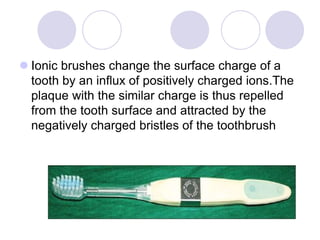
 Ionic brushes change the surface charge of a
tooth by an influx of positively charged ions.The
plaque with the similar charge is thus repelled
from the tooth surface and attracted by the
negatively charged bristles of the toothbrush
Bass Technique
 Bristles at gingival
margin pointing at 45º
to long axis of teeth
Charters method
Bass method
Indications
 Adaptable for open interproximal areas,
cervical areas
 Recommended for routine patients with
or without periodontal involvement
Advantages
 Effective method of
removing the plaque
 Provides good gingival
stimulation
 Easy to learn
Disadvantages
 May cause injury to
gingival margin
 Time consuming
 Dexterity requirement too
high
Stillman Technique
 Bristles partly on
gingiva and partly on
cervical portion of
teeth at oblique angle
to long axis of tooth
directed apically
 In gingival recession
Indications
 Plaque removal from
cervical areas and
proximal surfaces
 Gingival massage
 In areas of gingival
recession to prevent
abrasive tissue
destruction
Disadvantages
 Time consuming
 Improper brushing can
damage epithelial
attachment
Fones Method or circular/scrub method
Indications :
 Young children
 Handicapped individuals
 Lack dexterity
Advantages
 Easy to learn
 Shorter time required
Disadvantages
 Possible trauma to
gingiva
 Interdental areas are not
properly cleaned
Charter method
Indications
 FPD & FA
 Following periodontal
surgery
It is the substance used with brush for removing bacterial
plaque,materia alba & debris from tooth surface & gingiva .
DENTIFRICES
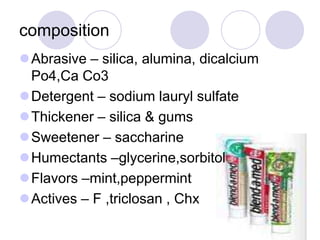
composition
Abrasive – silica, alumina, dicalcium
Po4,Ca Co3
Detergent – sodium lauryl sulfate
Thickener – silica & gums
Sweetener – saccharine
Humectants –glycerine,sorbitol
Flavors –mint,peppermint
Actives – F ,triclosan , Chx
Interdental Cleaning Aids
Interproximal Embrasure Spaces
Type1-no gingival recession-dental floss
Type 2- moderate loss of interdental
papilla –interproximal brush
Type 3-interproximal space with no
papillae-single tufted brush
Dental Floss
Twisted or non twisted
Bonded or non bonded
Waxed or unwaxed
Thick or thin
Monofilament or multifilament
Functions
 Removal of plaque in interproximal embrassure
and under pontics
 Polishing the tooth surface
 Stimulating and massaging the interdental
papilla
 Locating overhanging margins of restorations
Disadvantages
Time consuming
Requires skill
Risk of tissue damage
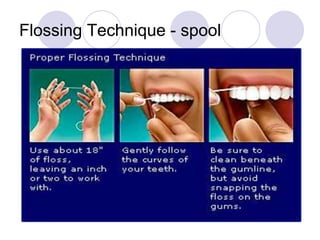
Flossing technique
Spool method
Circle or loop method
Flossing Technique - spool
Circle or Loop Method
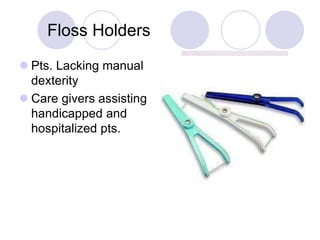
Floss Holders
 Pts. Lacking manual
dexterity
 Care givers assisting
handicapped and
hospitalized pts.
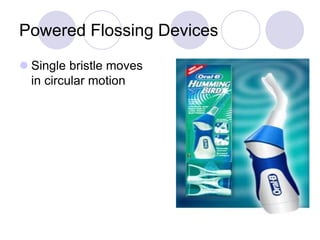
Powered Flossing Devices
 Single bristle moves
in circular motion
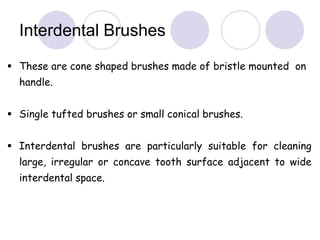
 These are cone shaped brushes made of bristle mounted on
handle.
 Single tufted brushes or small conical brushes.
 Interdental brushes are particularly suitable for cleaning
large, irregular or concave tooth surface adjacent to wide
interdental space.
Interdental Brushes
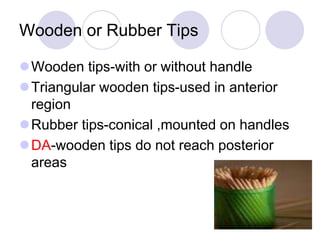
Wooden or Rubber Tips
Wooden tips-with or without handle
Triangular wooden tips-used in anterior
region
Rubber tips-conical ,mounted on handles
DA-wooden tips do not reach posterior
areas
Gingival Massage
Produces epithelial thickening
Increased keratinization
Increased mitotic activity in epithelium and
conn.tissue
It's targeted application of a pulsated or steady stream of
water for removing debris.
 It can be done by patient or the clinician.
 Oral irrigation cleans non-adherent bacteria and debris
from the oral cavity more effectively than do
toothbrush and mouth rinse.
Oral irrigation
Disrupt plaque
Deliver antimicrobials
lavage
Professionally Delivered Irrigation
Rationale:
 After scaling bacteria left behind during
mechanical debridement could be eradicated
by an antimicrobial solution applied into the
pocket
Efficacy of Irrigation
Penetration - delivered by blunt canula
placed 1-3mm into the pocket
Concentration – sufficient to kill the
bacteria
Duration –affected by GCF,half life of drug
– 1.3 mts
Mechanism of Action
Occurs through the direct application of a
pulsed or steady stream of water or other
solution
Pulsation rate-1200 per minute
Impact zone
Flushing zone
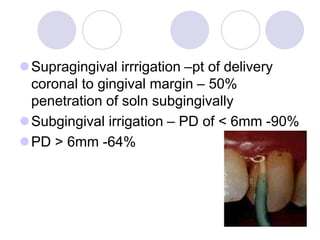
Supragingival irrrigation –pt of delivery
coronal to gingival margin – 50%
penetration of soln subgingivally
Subgingival irrigation – PD of < 6mm -90%
PD > 6mm -64%
Indications –home use
Gingivitis
Periodontal maintenance pts.
Implants
Crown & bridges
Ortho. Appliances
Intermaxillary Fixation
Diabetes
Outcomes
Removal of plaque
Reduction in calculus
↓ in BOP
↓ probing depth
↓Periodontal pathogens
 ↓ inflammatory mediators
Chemical plaque Control
Preventing bacterial attachment using
antiadhesive agents
Stop or slow bacterial proliferation using
antimicrobials
Remove established plaque – plaque
reducing
Alter the pathogenicity of plaque – anti
pathogenic
ANTIBOITICS
Penicillin ,Vancomycin,Erythromycin,
Niddamycin and kanamycin were used as
antiplaque agents.
Risk to benefit ratio high
Enzymes
Dextranase, mutanase – disrupt plaque
matrix,dislodge bacteria -poor
substantivity, mucosal erosion
Glucose oxidase, amyloglucosidase –
enhance host defense mechanism-
catalyze the conv.of thiocyanate to
hypothiocyanite thr. Salivary lacto-
peroxidase system
Bisbiguanides
Effective antiseptic for plaque inhibition
and prevention of gingivitis
QUATENARY AMMONIUM COMPOUNDS
Cetylpyridinium and benzethonium chloride
have been found to inhibit plaque.
Cationic antiseptics - + vely charged
molecules react with – vely charged cell
membrane disrupts cell wall
They are alcohol free mouth rinses but seem to
have less antimicrobial action compared to
Chlorhexidine
 CPC - .05%
Substantivity – 3-5 hours
Phenols &Essential Oils
Thymol,Eucalyptol,Menthol & Triclosan
Antibacterial action & antiinflammatory –
due to anti-oxidative activity
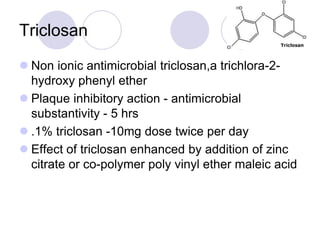
Triclosan
 Non ionic antimicrobial triclosan,a trichlora-2-
hydroxy phenyl ether
 Plaque inhibitory action - antimicrobial
substantivity - 5 hrs
 .1% triclosan -10mg dose twice per day
 Effect of triclosan enhanced by addition of zinc
citrate or co-polymer poly vinyl ether maleic acid
Natural Products
Sanguinarine –antimicrobial
DA – increases the likelihood of
precancerous lesions
Flourides
Amine flouride,stannous fluoride – little
effect on plaque formation & gingivitis
Metal Salts
Cu,sn,zn
Cu –causes staining
Zn salts –reduce VSCs
Oxygenating agents
Hydrogen peroxide, peroxy borate ,
peroxycarbonate
Used in Rx of NUG
Detergents
Sodium lauryl sulfate – antimicrobial &
plaque inhibitory activity
Substantivity – 5 – 7 hours
Amine alcohols
Octopinol – antiplaque agent
Delmopinol -.1% , .2%
Povidone iodine 1% - substantivity 60 mts
Affects thyroid fn.
Salifluor
Salifluor ,salicylanide – antibacterial ,anti-
inflammatory properties
BISBIGUANIDES
 Chlorhexidine is dicationic bisbiguanide –
symmetrical molecule -4 chlorophenyl rings & 2
biguanide groups
 Available forms – digluconate, acetate, Hcl salts
 Used as broad spectrum antiseptic.
MECHANISM OF ACTION
 The superior antiplaque activity of Chlorhexidine
is due to its property “substantivity”
 Presistent bacteriostatic action – 12 hours
 Bactericidal at high concn. Bacteriostatic at low
cocn
 Aerobic & anerobic bacteria reduced by 80-90%
 At low conc it increases the permeability causing
the leakage of intracellular components
including potassium.
 At high concentration it causes precipitation of
bacterial cytoplasm and cell death.
PIN CUSHION EFFECT
 One charged end of Chlorhexidine molecule
binds to the tooth surface and the other remains
available to initiate the interaction with the
bacterial membrane as the microorganism
approaches the tooth surface
Side effects
 Brown discoloration of teeth, restorations &
dorsum of tongue
 Taste affected – salt
 Oral mucosal lesion
 Unilateral or bilateral parotid swelling
 Enhanced supragingival calculus formation –
due to precpn of salivary proteins
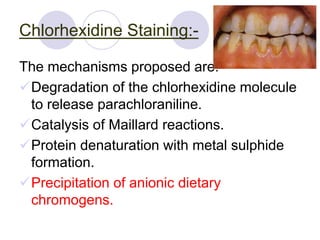
Chlorhexidine Staining:-
The mechanisms proposed are:-
Degradation of the chlorhexidine molecule
to release parachloraniline.
Catalysis of Maillard reactions.
Protein denaturation with metal sulphide
formation.
Precipitation of anionic dietary
chromogens.
Precautions:-
 Anionic substances such as sodium lauryl
sulphate based toothpaste reduce the plaque
inhibition of chlorhexidine.
 For this reason, chlorhexidine mouth rinses
should be used at least 30 minutes after other
dental products.
 For best effectiveness, food, drink, smoking, and
mouth rinses should be avoided for at least one
hour after use.
CHLORHEXIDINE
Mouth Rinses -10 ml of a 0.2% &15 ml of
.12%
Gel – 1%
Sprays - .1% & .2%
Tooth paste – 1%
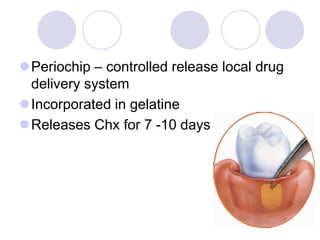
Periochip – controlled release local drug
delivery system
Incorporated in gelatine
Releases Chx for 7 -10 days
First Generation Anti Plaque Agents:
These are capable of reducing plaque
upto 20-50 %. They exhibit poor
retention within the mouth.
Ex. Antibiotics, Phenols, Quaternary
Ammonium compounds and
Sanguanarine
Second Generation Anti Plaque
Agents:
They produce an overall plaque
reduction of about 70-90% and these
are better retained than those of the first
generation.
Ex. Bisbiguanides (Chlorhexidine)
Third Generation Anti Plaque Agents:
They block binding of microorganisms to
the tooth or to each other. They have poor
retention capacity when compared to the
Second generation Chlorhexidine.
Ex. Delmopinol
plaque control.ppt

plaque control.ppt

  • 1.
  • 2.
    Plaque control –removal of microbial plaque and prevention of its accumulation on teeth and adjacent gingival tissues
  • 3.
    Mechanical plaque control Toothbrushes & dentifrices Interdental aids- a. Dental floss  b. Interdental brushes  c. wooden tips Aids for gingival stimulation – a.gingival massage B.water irrigation devices Tongue cleaners
  • 4.
    Objectives –Tooth Brushing To clean teeth and interdental spaces of food remnants, debris, stains etc.  To prevent plaque formation  To disturb and remove plaque  To stimulate and massage the gingival tissue  To clean the tongue
  • 5.
  • 6.
    Manual Tooth Brushes Should confirm to individual patient requirement in shape, size and texture  Should be easily and effectively manipulated  Should be readily cleaned and aerated and impervious to moisture  Should be durable and inexpensive
  • 7.
    Tooth Brush Designs Bristlematerial-natural,artificial Natural – fray,break,soften & lose their elasticity Bristle ends-rounded,flat cut
  • 8.
  • 9.
    Parts of ToothBrush Handle Head Tufts Brushing plane shank
  • 11.
    ADA Specification Brushing surface-1-1.25inches(25.4- 31.8mm) length 5/16 -3/8 inch (7.9 -9.5 mm) wide 2-4 rows of bristles 5-6 tufts per row
  • 12.
    Powered Tooth Brushes Circularor elliptic motion& oscillating ,rotating motion Mechanical contact, low frequency acoustic energy generates dynamic fluid movement Hydrodynamic shear forces disrupt plaque
  • 13.
    Indication Children with physicalor mental disabilities Hospitalized patients inclu.older patients who need to have their teeth cleaned by caregivers Pts. With ortho appliances
  • 14.
     Patient motivationand compliance improved  More access in interproximal and lingual tooth surfaces  No specific brushing technique needed  Less brushing force used  Brushing timer incorporated
  • 15.
     Sonic andultrasonic brushes produce high frequency vibrations (1.6 MHZ) leads to phenomenon of cavitation and acoustic microstreaming  31,000 strokes
  • 18.
     Ionic brusheschange the surface charge of a tooth by an influx of positively charged ions.The plaque with the similar charge is thus repelled from the tooth surface and attracted by the negatively charged bristles of the toothbrush
  • 20.
    Bass Technique  Bristlesat gingival margin pointing at 45º to long axis of teeth
  • 22.
  • 23.
    Indications  Adaptable foropen interproximal areas, cervical areas  Recommended for routine patients with or without periodontal involvement
  • 24.
    Advantages  Effective methodof removing the plaque  Provides good gingival stimulation  Easy to learn Disadvantages  May cause injury to gingival margin  Time consuming  Dexterity requirement too high
  • 25.
    Stillman Technique  Bristlespartly on gingiva and partly on cervical portion of teeth at oblique angle to long axis of tooth directed apically  In gingival recession
  • 26.
    Indications  Plaque removalfrom cervical areas and proximal surfaces  Gingival massage  In areas of gingival recession to prevent abrasive tissue destruction Disadvantages  Time consuming  Improper brushing can damage epithelial attachment
  • 27.
    Fones Method orcircular/scrub method Indications :  Young children  Handicapped individuals  Lack dexterity
  • 28.
    Advantages  Easy tolearn  Shorter time required Disadvantages  Possible trauma to gingiva  Interdental areas are not properly cleaned
  • 29.
    Charter method Indications  FPD& FA  Following periodontal surgery
  • 30.
    It is thesubstance used with brush for removing bacterial plaque,materia alba & debris from tooth surface & gingiva . DENTIFRICES
  • 31.
    composition Abrasive – silica,alumina, dicalcium Po4,Ca Co3 Detergent – sodium lauryl sulfate Thickener – silica & gums Sweetener – saccharine Humectants –glycerine,sorbitol Flavors –mint,peppermint Actives – F ,triclosan , Chx
  • 32.
  • 33.
    Interproximal Embrasure Spaces Type1-nogingival recession-dental floss Type 2- moderate loss of interdental papilla –interproximal brush Type 3-interproximal space with no papillae-single tufted brush
  • 35.
    Dental Floss Twisted ornon twisted Bonded or non bonded Waxed or unwaxed Thick or thin Monofilament or multifilament
  • 36.
    Functions  Removal ofplaque in interproximal embrassure and under pontics  Polishing the tooth surface  Stimulating and massaging the interdental papilla  Locating overhanging margins of restorations
  • 37.
  • 38.
  • 39.
  • 40.
  • 41.
    Floss Holders  Pts.Lacking manual dexterity  Care givers assisting handicapped and hospitalized pts.
  • 42.
    Powered Flossing Devices Single bristle moves in circular motion
  • 43.
     These arecone shaped brushes made of bristle mounted on handle.  Single tufted brushes or small conical brushes.  Interdental brushes are particularly suitable for cleaning large, irregular or concave tooth surface adjacent to wide interdental space. Interdental Brushes
  • 45.
    Wooden or RubberTips Wooden tips-with or without handle Triangular wooden tips-used in anterior region Rubber tips-conical ,mounted on handles DA-wooden tips do not reach posterior areas
  • 46.
    Gingival Massage Produces epithelialthickening Increased keratinization Increased mitotic activity in epithelium and conn.tissue
  • 47.
    It's targeted applicationof a pulsated or steady stream of water for removing debris.  It can be done by patient or the clinician.  Oral irrigation cleans non-adherent bacteria and debris from the oral cavity more effectively than do toothbrush and mouth rinse. Oral irrigation
  • 48.
  • 49.
    Professionally Delivered Irrigation Rationale: After scaling bacteria left behind during mechanical debridement could be eradicated by an antimicrobial solution applied into the pocket
  • 50.
    Efficacy of Irrigation Penetration- delivered by blunt canula placed 1-3mm into the pocket Concentration – sufficient to kill the bacteria Duration –affected by GCF,half life of drug – 1.3 mts
  • 51.
    Mechanism of Action Occursthrough the direct application of a pulsed or steady stream of water or other solution Pulsation rate-1200 per minute Impact zone Flushing zone
  • 52.
    Supragingival irrrigation –ptof delivery coronal to gingival margin – 50% penetration of soln subgingivally Subgingival irrigation – PD of < 6mm -90% PD > 6mm -64%
  • 53.
    Indications –home use Gingivitis Periodontalmaintenance pts. Implants Crown & bridges Ortho. Appliances Intermaxillary Fixation Diabetes
  • 54.
    Outcomes Removal of plaque Reductionin calculus ↓ in BOP ↓ probing depth ↓Periodontal pathogens  ↓ inflammatory mediators
  • 55.
    Chemical plaque Control Preventingbacterial attachment using antiadhesive agents Stop or slow bacterial proliferation using antimicrobials Remove established plaque – plaque reducing Alter the pathogenicity of plaque – anti pathogenic
  • 56.
    ANTIBOITICS Penicillin ,Vancomycin,Erythromycin, Niddamycin andkanamycin were used as antiplaque agents. Risk to benefit ratio high
  • 57.
    Enzymes Dextranase, mutanase –disrupt plaque matrix,dislodge bacteria -poor substantivity, mucosal erosion Glucose oxidase, amyloglucosidase – enhance host defense mechanism- catalyze the conv.of thiocyanate to hypothiocyanite thr. Salivary lacto- peroxidase system
  • 58.
    Bisbiguanides Effective antiseptic forplaque inhibition and prevention of gingivitis
  • 59.
    QUATENARY AMMONIUM COMPOUNDS Cetylpyridiniumand benzethonium chloride have been found to inhibit plaque. Cationic antiseptics - + vely charged molecules react with – vely charged cell membrane disrupts cell wall They are alcohol free mouth rinses but seem to have less antimicrobial action compared to Chlorhexidine
  • 60.
     CPC -.05% Substantivity – 3-5 hours
  • 61.
    Phenols &Essential Oils Thymol,Eucalyptol,Menthol& Triclosan Antibacterial action & antiinflammatory – due to anti-oxidative activity
  • 62.
    Triclosan  Non ionicantimicrobial triclosan,a trichlora-2- hydroxy phenyl ether  Plaque inhibitory action - antimicrobial substantivity - 5 hrs  .1% triclosan -10mg dose twice per day  Effect of triclosan enhanced by addition of zinc citrate or co-polymer poly vinyl ether maleic acid
  • 63.
    Natural Products Sanguinarine –antimicrobial DA– increases the likelihood of precancerous lesions
  • 64.
    Flourides Amine flouride,stannous fluoride– little effect on plaque formation & gingivitis
  • 65.
    Metal Salts Cu,sn,zn Cu –causesstaining Zn salts –reduce VSCs
  • 66.
    Oxygenating agents Hydrogen peroxide,peroxy borate , peroxycarbonate Used in Rx of NUG
  • 67.
    Detergents Sodium lauryl sulfate– antimicrobial & plaque inhibitory activity Substantivity – 5 – 7 hours
  • 68.
    Amine alcohols Octopinol –antiplaque agent Delmopinol -.1% , .2%
  • 69.
    Povidone iodine 1%- substantivity 60 mts Affects thyroid fn.
  • 70.
    Salifluor Salifluor ,salicylanide –antibacterial ,anti- inflammatory properties
  • 71.
    BISBIGUANIDES  Chlorhexidine isdicationic bisbiguanide – symmetrical molecule -4 chlorophenyl rings & 2 biguanide groups  Available forms – digluconate, acetate, Hcl salts  Used as broad spectrum antiseptic.
  • 72.
    MECHANISM OF ACTION The superior antiplaque activity of Chlorhexidine is due to its property “substantivity”  Presistent bacteriostatic action – 12 hours  Bactericidal at high concn. Bacteriostatic at low cocn  Aerobic & anerobic bacteria reduced by 80-90%
  • 73.
     At lowconc it increases the permeability causing the leakage of intracellular components including potassium.  At high concentration it causes precipitation of bacterial cytoplasm and cell death.
  • 75.
    PIN CUSHION EFFECT One charged end of Chlorhexidine molecule binds to the tooth surface and the other remains available to initiate the interaction with the bacterial membrane as the microorganism approaches the tooth surface
  • 76.
    Side effects  Browndiscoloration of teeth, restorations & dorsum of tongue  Taste affected – salt  Oral mucosal lesion  Unilateral or bilateral parotid swelling  Enhanced supragingival calculus formation – due to precpn of salivary proteins
  • 77.
    Chlorhexidine Staining:- The mechanismsproposed are:- Degradation of the chlorhexidine molecule to release parachloraniline. Catalysis of Maillard reactions. Protein denaturation with metal sulphide formation. Precipitation of anionic dietary chromogens.
  • 78.
    Precautions:-  Anionic substancessuch as sodium lauryl sulphate based toothpaste reduce the plaque inhibition of chlorhexidine.  For this reason, chlorhexidine mouth rinses should be used at least 30 minutes after other dental products.  For best effectiveness, food, drink, smoking, and mouth rinses should be avoided for at least one hour after use.
  • 79.
    CHLORHEXIDINE Mouth Rinses -10ml of a 0.2% &15 ml of .12% Gel – 1% Sprays - .1% & .2% Tooth paste – 1%
  • 80.
    Periochip – controlledrelease local drug delivery system Incorporated in gelatine Releases Chx for 7 -10 days
  • 81.
    First Generation AntiPlaque Agents: These are capable of reducing plaque upto 20-50 %. They exhibit poor retention within the mouth. Ex. Antibiotics, Phenols, Quaternary Ammonium compounds and Sanguanarine
  • 82.
    Second Generation AntiPlaque Agents: They produce an overall plaque reduction of about 70-90% and these are better retained than those of the first generation. Ex. Bisbiguanides (Chlorhexidine)
  • 83.
    Third Generation AntiPlaque Agents: They block binding of microorganisms to the tooth or to each other. They have poor retention capacity when compared to the Second generation Chlorhexidine. Ex. Delmopinol