HOW TO CONTROL PLAQUEDR. AAKIFA JAVED ARIANALTAMASH INSTITUTE OF DENTAL MEDICINE
  PLAQUE:             Plaque is a soft deposit that form thebiofilm adhering to the tooth surface.It cannot be rinsed but removed by brushing.
Plaque is a firmly adherent mass of bacteria in a mucopolysaccharide matrix.What Do We Mean By PLAQUE CONTROLPlaque Control is the removal of dental/ microbial plaque and the        prevention of its accumulation on the teeth and adjacent gingival tissues.  It also deals with the prevention of calculus formation.
  Plaque is the major etiology of PERIDONTAL Disease & is related to Dental CARIES; therefore, gaining patient cooperation in daily plaque REMOVAL is success of ALL periodontal and dental treatment.Remember……..!!!Plaque: Plaque is a white, sticky substance that builds up every day around your teeth and gums, and on dental appliances.
 Plaque can be removed with daily brushing, flossing, and rinsing with an antiseptic mouthwash.
 If plaque is not removed it hardens into calculus.Calculus: Once plaque has been allowed to remain it calcifies.  Onlya dental professional can then remove calculus.PlaqueCalculus
     BrushPlaque builds within hours.  Brushing your teeth helps oral health because it removes plaque from the surfaces of your teeth and gums.     FlossBecause periodontal disease often begins in areas your toothbrush cannot reach, it’s important to remove plaque from between teeth and just below your gumline by flossing.     RinseDaily rinsing with an antiseptic mouthwash may add to the benefits of brushing and flossing by reducing plaque between crowded teeth and around hard-to-reach molars.
Methods of Plaque Control:Mechanical Plaque Control Methods.2.  Chemical Plaque Control Methods.
Mechanical Plaque Control Aids:2) Interdental Aids:Dental FlossTriangular Tooth PicksInterdental BrushesSuperflossPerio-Aid1) ToothBrushes:Manual ToothbrushElectrical Toothbrush4) Others:Gauze StripsPipe Cleanserswater Irrigation Device3) Aids for Gingival Stimulation:Rubber Tip Stimulator5) Aids for Completely or Partially Edentulous Patients:Denture & Partial Clasp BrushesCleansing Solutions
Chemical Plaque Control AgentsThe Chemical agents which act on the Plaque ultrastructurally and prevent the formation of Plaque are usefull in Prevention than in a cure.
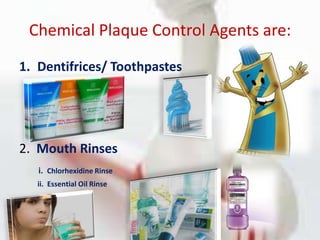
Chemical Plaque Control Agents are:Dentifrices/ Toothpastes2.  Mouth Rinsesi.  Chlorhexidine Rinse          ii.  Essential Oil Rinse
Chemical inhibitors of plaque & calculus that are incorporated in mouthwashes or dentifrices play important roles in plaque control.DO YOU KNW……..??
TOOTHPASTE / DENTIFRICESToothpaste called as dentifrice, is an inclusive term used to describe a powder, paste or gel, used with a toothbrush to aid in the removal of plaque, biofilm, materia alba, and stain from teeth and soft tissue.PURPOSECleaning
Polishing
Removal of stains
Reduce incidence of tooth decayToothpaste ContentsAbrasives (20%-40%)
Flavor- (2%) pleasant and must be associated with a “clean” feeling. E.g. Mint flavor
Colouring agent (2%)
Binders (2%)
Humectants (20%-40%)
Detergents (1%-2%)
Flavoring agent (2%)
Preservatives (<1%)
Sweetening agents (2%)
Water (20%-40%)AbrasiveAlso called as polishing agent

How to control plaque

  • 1.
    HOW TO CONTROLPLAQUEDR. AAKIFA JAVED ARIANALTAMASH INSTITUTE OF DENTAL MEDICINE
  • 2.
    PLAQUE: Plaque is a soft deposit that form thebiofilm adhering to the tooth surface.It cannot be rinsed but removed by brushing.
  • 3.
    Plaque is afirmly adherent mass of bacteria in a mucopolysaccharide matrix.What Do We Mean By PLAQUE CONTROLPlaque Control is the removal of dental/ microbial plaque and the prevention of its accumulation on the teeth and adjacent gingival tissues. It also deals with the prevention of calculus formation.
  • 4.
    Plaqueis the major etiology of PERIDONTAL Disease & is related to Dental CARIES; therefore, gaining patient cooperation in daily plaque REMOVAL is success of ALL periodontal and dental treatment.Remember……..!!!Plaque: Plaque is a white, sticky substance that builds up every day around your teeth and gums, and on dental appliances.
  • 5.
    Plaque canbe removed with daily brushing, flossing, and rinsing with an antiseptic mouthwash.
  • 6.
    If plaqueis not removed it hardens into calculus.Calculus: Once plaque has been allowed to remain it calcifies. Onlya dental professional can then remove calculus.PlaqueCalculus
  • 7.
    BrushPlaque builds within hours. Brushing your teeth helps oral health because it removes plaque from the surfaces of your teeth and gums. FlossBecause periodontal disease often begins in areas your toothbrush cannot reach, it’s important to remove plaque from between teeth and just below your gumline by flossing. RinseDaily rinsing with an antiseptic mouthwash may add to the benefits of brushing and flossing by reducing plaque between crowded teeth and around hard-to-reach molars.
  • 8.
    Methods of PlaqueControl:Mechanical Plaque Control Methods.2. Chemical Plaque Control Methods.
  • 9.
    Mechanical Plaque ControlAids:2) Interdental Aids:Dental FlossTriangular Tooth PicksInterdental BrushesSuperflossPerio-Aid1) ToothBrushes:Manual ToothbrushElectrical Toothbrush4) Others:Gauze StripsPipe Cleanserswater Irrigation Device3) Aids for Gingival Stimulation:Rubber Tip Stimulator5) Aids for Completely or Partially Edentulous Patients:Denture & Partial Clasp BrushesCleansing Solutions
  • 10.
    Chemical Plaque ControlAgentsThe Chemical agents which act on the Plaque ultrastructurally and prevent the formation of Plaque are usefull in Prevention than in a cure.
  • 11.
    Chemical Plaque ControlAgents are:Dentifrices/ Toothpastes2. Mouth Rinsesi. Chlorhexidine Rinse ii. Essential Oil Rinse
  • 12.
    Chemical inhibitors ofplaque & calculus that are incorporated in mouthwashes or dentifrices play important roles in plaque control.DO YOU KNW……..??
  • 13.
    TOOTHPASTE / DENTIFRICESToothpastecalled as dentifrice, is an inclusive term used to describe a powder, paste or gel, used with a toothbrush to aid in the removal of plaque, biofilm, materia alba, and stain from teeth and soft tissue.PURPOSECleaning
  • 14.
  • 15.
  • 16.
    Reduce incidence oftooth decayToothpaste ContentsAbrasives (20%-40%)
  • 17.
    Flavor- (2%) pleasantand must be associated with a “clean” feeling. E.g. Mint flavor
  • 18.
  • 19.
  • 20.
  • 21.
  • 22.
  • 23.
  • 24.
  • 25.