Dr.Jaffar Raza Syed Page 1
Periodontal Ligament
width of periodontal ligament  0.15 to 0.38 mm
shape  Hour-glass shape: Periodontal ligament is thinnest at the axis of
rotation in the middle and widens coronally and apically
constituents of periodontal ligament space
A. Periodontal ligament fibres
B. Cellular elements
C. Ground substances
(i) Glycosaminoglycans
(ii) Glycoproteins.
Dr.Jaffar Raza Syed
Principal Fibres of
1. Transseptal group
Functions:
(i) Reconstructed even after destruction of the
alveolar bone has occurred in the periodontal disease.
(ii) Responsible for returning teeth to their
original state after orthodontic therapy.
Position:
They may be considered
gingiva because they do not have osseous
attachment.
Principal Fibres of periodontal ligament fibres.
(i) Reconstructed even after destruction of the
occurred in the periodontal disease.
(ii) Responsible for returning teeth to their
orthodontic therapy.
may be considered to belong to the
gingiva because they do not have osseous
Page 2
Dr.Jaffar Raza Syed
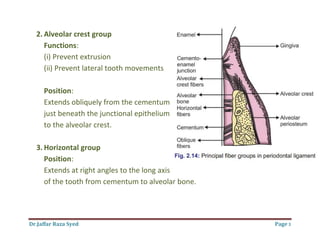
2. Alveolar crest group
Functions:
(i) Prevent extrusion
(ii) Prevent lateral tooth movements
Position:
Extends obliquely from the cementum
just beneath the junctional epithelium
to the alveolar crest.
3. Horizontal group
Position:
Extends at right angles to the long axis
of the tooth from cementum to alveolar bone.
(ii) Prevent lateral tooth movements
om the cementum
junctional epithelium
Extends at right angles to the long axis
cementum to alveolar bone.
Page 3
Dr.Jaffar Raza Syed
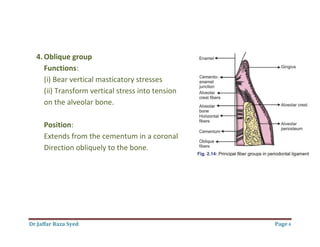
4. Oblique group
Functions:
(i) Bear vertical masticatory stress
(ii) Transform vertical stress into tension
on the alveolar bone.
Position:
Extends from the cementum in a coronal
Direction obliquely to the bone.
(i) Bear vertical masticatory stresses
(ii) Transform vertical stress into tension
cementum in a coronal
to the bone.
Page 4
Dr.Jaffar Raza Syed Page 5
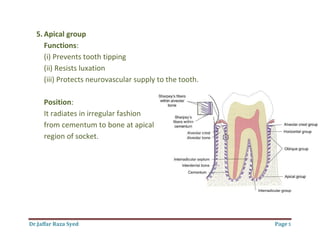
5. Apical group
Functions:
(i) Prevents tooth tipping
(ii) Resists luxation
(iii) Protects neurovascular supply to the tooth.
Position:
It radiates in irregular fashion
from cementum to bone at apical
region of socket.
Dr.Jaffar Raza Syed Page 6
6. Interradicular group
Functions:
(i) Prevents luxation
(ii) Prevents tooth tipping and torquing.
Position:
Found only between roots of multirooted tooth running from
cementum into bone, forming crest of interradicular septum
Dr.Jaffar Raza Syed Page 7
various cells of periodontal ligament
(i) Connective tissue cells:
(a) Synthetic cells
• Osteoblasts
• Fibroblasts
• Cementoblasts
(b) Resorptive cells
• Osteoclasts
• Fibroblasts
• Cementoclasts
Dr.Jaffar Raza Syed Page 8
(ii) Epithelial cells: Epithelial rests of malassez
(iii) Immune system cells:
(a) Neutrophils
(b) Lymphocytes
(c) Macrophages
(d) Mast cells
(e) Eosinophils
(iv) Cells associated with neurovascular elements
(v) Progenitor cells.
Dr.Jaffar Raza Syed Page 9
Blood supply of periodontal ligament.
The blood supply is derived from the inferior and superior alveolar
arteries and reaches the periodontal ligament from 3 sources:
(i) Apical vessels
(ii) Penetrating vessels from the alveolar bone
(iii) Anastomosing vessels from the gingival
Dr.Jaffar Raza Syed Page 10
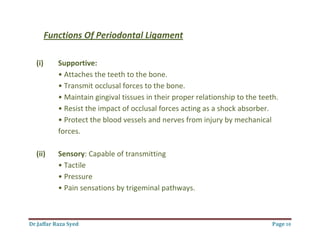
Functions Of Periodontal Ligament
(i) Supportive:
• Attaches the teeth to the bone.
• Transmit occlusal forces to the bone.
• Maintain gingival tissues in their proper relationship to the teeth.
• Resist the impact of occlusal forces acting as a shock absorber.
• Protect the blood vessels and nerves from injury by mechanical
forces.
(ii) Sensory: Capable of transmitting
• Tactile
• Pressure
• Pain sensations by trigeminal pathways.
Dr.Jaffar Raza Syed Page 11
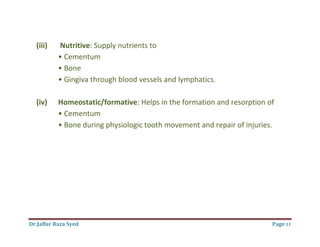
(iii) Nutritive: Supply nutrients to
• Cementum
• Bone
• Gingiva through blood vessels and lymphatics.
(iv) Homeostatic/formative: Helps in the formation and resorption of
• Cementum
• Bone during physiologic tooth movement and repair of injuries.

004.periodontal ligament

  • 1.
    Dr.Jaffar Raza SyedPage 1 Periodontal Ligament width of periodontal ligament  0.15 to 0.38 mm shape  Hour-glass shape: Periodontal ligament is thinnest at the axis of rotation in the middle and widens coronally and apically constituents of periodontal ligament space A. Periodontal ligament fibres B. Cellular elements C. Ground substances (i) Glycosaminoglycans (ii) Glycoproteins.
  • 2.
    Dr.Jaffar Raza Syed PrincipalFibres of 1. Transseptal group Functions: (i) Reconstructed even after destruction of the alveolar bone has occurred in the periodontal disease. (ii) Responsible for returning teeth to their original state after orthodontic therapy. Position: They may be considered gingiva because they do not have osseous attachment. Principal Fibres of periodontal ligament fibres. (i) Reconstructed even after destruction of the occurred in the periodontal disease. (ii) Responsible for returning teeth to their orthodontic therapy. may be considered to belong to the gingiva because they do not have osseous Page 2
  • 3.
    Dr.Jaffar Raza Syed 2.Alveolar crest group Functions: (i) Prevent extrusion (ii) Prevent lateral tooth movements Position: Extends obliquely from the cementum just beneath the junctional epithelium to the alveolar crest. 3. Horizontal group Position: Extends at right angles to the long axis of the tooth from cementum to alveolar bone. (ii) Prevent lateral tooth movements om the cementum junctional epithelium Extends at right angles to the long axis cementum to alveolar bone. Page 3
  • 4.
    Dr.Jaffar Raza Syed 4.Oblique group Functions: (i) Bear vertical masticatory stress (ii) Transform vertical stress into tension on the alveolar bone. Position: Extends from the cementum in a coronal Direction obliquely to the bone. (i) Bear vertical masticatory stresses (ii) Transform vertical stress into tension cementum in a coronal to the bone. Page 4
  • 5.
    Dr.Jaffar Raza SyedPage 5 5. Apical group Functions: (i) Prevents tooth tipping (ii) Resists luxation (iii) Protects neurovascular supply to the tooth. Position: It radiates in irregular fashion from cementum to bone at apical region of socket.
  • 6.
    Dr.Jaffar Raza SyedPage 6 6. Interradicular group Functions: (i) Prevents luxation (ii) Prevents tooth tipping and torquing. Position: Found only between roots of multirooted tooth running from cementum into bone, forming crest of interradicular septum
  • 7.
    Dr.Jaffar Raza SyedPage 7 various cells of periodontal ligament (i) Connective tissue cells: (a) Synthetic cells • Osteoblasts • Fibroblasts • Cementoblasts (b) Resorptive cells • Osteoclasts • Fibroblasts • Cementoclasts
  • 8.
    Dr.Jaffar Raza SyedPage 8 (ii) Epithelial cells: Epithelial rests of malassez (iii) Immune system cells: (a) Neutrophils (b) Lymphocytes (c) Macrophages (d) Mast cells (e) Eosinophils (iv) Cells associated with neurovascular elements (v) Progenitor cells.
  • 9.
    Dr.Jaffar Raza SyedPage 9 Blood supply of periodontal ligament. The blood supply is derived from the inferior and superior alveolar arteries and reaches the periodontal ligament from 3 sources: (i) Apical vessels (ii) Penetrating vessels from the alveolar bone (iii) Anastomosing vessels from the gingival
  • 10.
    Dr.Jaffar Raza SyedPage 10 Functions Of Periodontal Ligament (i) Supportive: • Attaches the teeth to the bone. • Transmit occlusal forces to the bone. • Maintain gingival tissues in their proper relationship to the teeth. • Resist the impact of occlusal forces acting as a shock absorber. • Protect the blood vessels and nerves from injury by mechanical forces. (ii) Sensory: Capable of transmitting • Tactile • Pressure • Pain sensations by trigeminal pathways.
  • 11.
    Dr.Jaffar Raza SyedPage 11 (iii) Nutritive: Supply nutrients to • Cementum • Bone • Gingiva through blood vessels and lymphatics. (iv) Homeostatic/formative: Helps in the formation and resorption of • Cementum • Bone during physiologic tooth movement and repair of injuries.