Lecture 3  Cell Biology Membrane Fluidity
“ Fluidity” is the capacity of  individual molecules   to move freely Lipids behave as fluids within the membrane
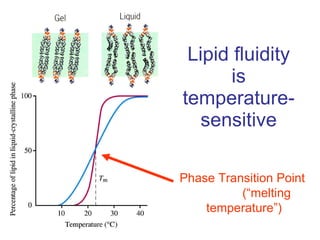
Lipid fluidity is temperature- sensitive Phase Transition Point  (“melting temperature”)
Different lipids have different “melting points”
Artificial membranes made with  just one  lipid type have a sharp MP Real  membranes with a  mix  of lipids have a broad MP
OK – the lipids can move But what about the proteins??
Classic  Indirect  Evidence   that membrane proteins  have and  require  freedom of motion within the membrane
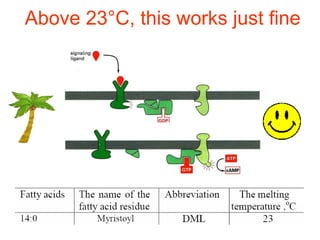
Create artificial membrane vesicles made of  pure  dimyristoyl phosphatidyl choline
Add some familiar players Hormone Receptor Adenylate Cyclase (makes cAMP) “ G” protein These three  work cooperatively  so that a hormone signal turns on AC
Above 23 °C, this works just fine
Below 23 °C, it won’t work at all
This is why cold kills
What about fish that live in  cold water?
More unsaturated fatty acids at low temperature In each pair below, the sat/unsat ratio is lower at low temp
Classic  Direct  Evidences   that membrane proteins have freedom of motion within the membrane
Antibodies can be used to locate lymphocyte receptor proteins
Antibodies can be used to locate lymphocyte receptor proteins Initially spread  all over the  cell surface Becoming patchier over time Eventually all gathered together in one “cap” Called “Patching”  &  “Capping"
Patching can’t occur if the membrane lipids are gelled 4 ° C 37 ° C
Patching results because antibodies  cross-link  proteins Each Ab can bind more than one protein, and each protein can be bound by more than one Ab
Clearly these proteins must be free to move around Does the antibody  induce  the mobility, or did it  pre-exist ???? Each Ab can bind more than one protein, and each protein can be bound by more than one Ab
Experiment to demonstrate that at least some proteins are  free to diffuse  naturally
Add some differently labeled antibody arm fragments (Fab) But if you let them sit a while . . .
Rate of blending is temperature-dependent
Wouldn’t it be nice if we could describe diffusion rates with greater  quantitative accuracy ? FLIP:   Fluorescence Loss In Photobleaching FRAP:   Fluorescence Recovery After Photobleaching
FRAP
Read about FLIP on your own
Finally – nowadays it’s sometimes even possible to watch a  single protein  diffuse
The Immunogold Technique
So –  multiple  evidences demonstrate that membrane proteins are free to move within the membrane plane
BUT let’s not go  too  far with that thought
If all proteins are freely diffusible within the membrane, then why do  some  proteins have  localized distributions ? (Guinea pig sperm labeled with fluorescent antibodies against different membrane proteins)
Integrin   a highly localized protein The orange patches – localized with a fluorescent antibody
If some proteins have less than full freedom of motion What are the  restraints  upon mobility?
Integrins bind to cytoplasmic actin network This restricts their mobility
Answer #1 Sometimes  membrane protein mobility  is restricted by  interactions with the cytoskeleton
But other restraints upon mobility are much more  indirect
Let’s return to something we looked at a little earlier Band 3 Protein Diffusion Careful analysis of the film shows that Band 3 sometimes acts like it’s “corralled”
Careful trypsinization cleaves  P-face of Band 3 protein – removes “boxed in”-type motion What are the main proteins that make up the network depicted in this diagram?
Answer #2 Sometimes protein mobility is restricted by interactions with other membrane proteins
Tight (Occluding) Junctions  An example of membrane proteins restricting each other's motion
Tight Junctions  form connective seals between epithelial cells Based on “claudin” transmembrane proteins (Another important protein type is  occludins )
Motion of claudins is restricted by  intra membrane and  inter membrane interactions  with other claudins
The multiple claudin strands  fence off separate “pastures”
A similar example  Septins  in Yeast Cytokinesis
A similar example  Septins  in Yeast Cytokinesis Some membrane proteins are found only in the daughter cell
Septins   Part of a peripheral protein network at the mother-daughter interface Are septins restricting mobility and creating separate membrane domains?  How could you tell?
A temperature-sensitive septin mutant
Natural and engineered  mutations  are another tool for your box
FINALLY  Sometimes protein mobility  is restricted by  surrounding  lipids
Lipid Rafts   Some “patches” of membrane stay together after  mild  detergent treatment Suggests their composition is different from the rest of the membrane
Rafts are enriched in  sphingolipids and cholesterol Lipid rafts stained with  Filipin  (binds to cholesterol)
Lipid rafts are also enriched for certain membrane proteins Especially  (but  not  only)   proteins with fatty acid prosthetic groups
Some protein enrichment may be due to physical thickness of raft Rafts may act to “trap” wandering proteins of the right types Proteins with longer-than-standard membrane-spanning domains
Thus, rafts influence  functional associations between  membrane proteins  The fungal pathogen  Candida albicans   (Filamentous fungal cells exhibit  tip-growth ) Stained with filipin
For Next Lecture Core-Level Things To Review in Advance: What is the difference between "anabolism" and "catabolism"?  What is the structure and what is the metabolic function of glycogen? What is the general effect in the body of epinephrine (adrenaline)? What is glucagon, and how does its general effect compare to that of epinephrine? What is the difference between ATP and cyclic AMP? In which of the following is a hydrolysis reaction involved:  1) removal of, or 2) addition of the terminal phosphate group of ATP? Does it require or release energy to remove the terminal phosphate of ATP? Is the delta-G (change in free energy) of that reaction a positive or a negative value? What is GTP?  Have you ever run across a protein that binds to GTP? Advanced-Level Things to  Learn Independently  Before Class: What is the meaning of the term “signal transduction”?  How would you define a “second messenger”?  Be sure you do more than merely memorize a dictionary definition – would you recognize when something is or isn’t a second messenger?  Who was Rube Goldberg, and what was his cultural contribution?
Also Read and understand the basic points made in pp. 169 – 177, paying particular attention to  allosteric proteins  and  protein phosphorylation
NEXT TIME Signal Transduction  How cells sense and respond to their environments

03 Membrane Fluidity

  • 1.
  • 2.
    Lecture 3 Cell Biology Membrane Fluidity
  • 3.
    “ Fluidity” isthe capacity of individual molecules to move freely Lipids behave as fluids within the membrane
  • 4.
    Lipid fluidity istemperature- sensitive Phase Transition Point (“melting temperature”)
  • 5.
    Different lipids havedifferent “melting points”
  • 6.
    Artificial membranes madewith just one lipid type have a sharp MP Real membranes with a mix of lipids have a broad MP
  • 7.
    OK – thelipids can move But what about the proteins??
  • 8.
    Classic Indirect Evidence that membrane proteins have and require freedom of motion within the membrane
  • 9.
    Create artificial membranevesicles made of pure dimyristoyl phosphatidyl choline
  • 10.
    Add some familiarplayers Hormone Receptor Adenylate Cyclase (makes cAMP) “ G” protein These three work cooperatively so that a hormone signal turns on AC
  • 11.
    Above 23 °C,this works just fine
  • 12.
    Below 23 °C,it won’t work at all
  • 13.
    This is whycold kills
  • 14.
    What about fishthat live in cold water?
  • 15.
    More unsaturated fattyacids at low temperature In each pair below, the sat/unsat ratio is lower at low temp
  • 16.
    Classic Direct Evidences that membrane proteins have freedom of motion within the membrane
  • 17.
    Antibodies can beused to locate lymphocyte receptor proteins
  • 18.
    Antibodies can beused to locate lymphocyte receptor proteins Initially spread all over the cell surface Becoming patchier over time Eventually all gathered together in one “cap” Called “Patching” & “Capping"
  • 19.
    Patching can’t occurif the membrane lipids are gelled 4 ° C 37 ° C
  • 20.
    Patching results becauseantibodies cross-link proteins Each Ab can bind more than one protein, and each protein can be bound by more than one Ab
  • 21.
    Clearly these proteinsmust be free to move around Does the antibody induce the mobility, or did it pre-exist ???? Each Ab can bind more than one protein, and each protein can be bound by more than one Ab
  • 22.
    Experiment to demonstratethat at least some proteins are free to diffuse naturally
  • 23.
    Add some differentlylabeled antibody arm fragments (Fab) But if you let them sit a while . . .
  • 24.
    Rate of blendingis temperature-dependent
  • 25.
    Wouldn’t it benice if we could describe diffusion rates with greater quantitative accuracy ? FLIP: Fluorescence Loss In Photobleaching FRAP: Fluorescence Recovery After Photobleaching
  • 26.
  • 27.
    Read about FLIPon your own
  • 28.
    Finally – nowadaysit’s sometimes even possible to watch a single protein diffuse
  • 29.
  • 30.
    So – multiple evidences demonstrate that membrane proteins are free to move within the membrane plane
  • 31.
    BUT let’s notgo too far with that thought
  • 32.
    If all proteinsare freely diffusible within the membrane, then why do some proteins have localized distributions ? (Guinea pig sperm labeled with fluorescent antibodies against different membrane proteins)
  • 33.
    Integrin a highly localized protein The orange patches – localized with a fluorescent antibody
  • 34.
    If some proteinshave less than full freedom of motion What are the restraints upon mobility?
  • 35.
    Integrins bind tocytoplasmic actin network This restricts their mobility
  • 36.
    Answer #1 Sometimes membrane protein mobility is restricted by interactions with the cytoskeleton
  • 37.
    But other restraintsupon mobility are much more indirect
  • 38.
    Let’s return tosomething we looked at a little earlier Band 3 Protein Diffusion Careful analysis of the film shows that Band 3 sometimes acts like it’s “corralled”
  • 39.
    Careful trypsinization cleaves P-face of Band 3 protein – removes “boxed in”-type motion What are the main proteins that make up the network depicted in this diagram?
  • 40.
    Answer #2 Sometimesprotein mobility is restricted by interactions with other membrane proteins
  • 41.
    Tight (Occluding) Junctions An example of membrane proteins restricting each other's motion
  • 42.
    Tight Junctions form connective seals between epithelial cells Based on “claudin” transmembrane proteins (Another important protein type is occludins )
  • 43.
    Motion of claudinsis restricted by intra membrane and inter membrane interactions with other claudins
  • 44.
    The multiple claudinstrands fence off separate “pastures”
  • 45.
    A similar example Septins in Yeast Cytokinesis
  • 46.
    A similar example Septins in Yeast Cytokinesis Some membrane proteins are found only in the daughter cell
  • 47.
    Septins Part of a peripheral protein network at the mother-daughter interface Are septins restricting mobility and creating separate membrane domains? How could you tell?
  • 48.
  • 49.
    Natural and engineered mutations are another tool for your box
  • 50.
    FINALLY Sometimesprotein mobility is restricted by surrounding lipids
  • 51.
    Lipid Rafts Some “patches” of membrane stay together after mild detergent treatment Suggests their composition is different from the rest of the membrane
  • 52.
    Rafts are enrichedin sphingolipids and cholesterol Lipid rafts stained with Filipin (binds to cholesterol)
  • 53.
    Lipid rafts arealso enriched for certain membrane proteins Especially (but not only) proteins with fatty acid prosthetic groups
  • 54.
    Some protein enrichmentmay be due to physical thickness of raft Rafts may act to “trap” wandering proteins of the right types Proteins with longer-than-standard membrane-spanning domains
  • 55.
    Thus, rafts influence functional associations between membrane proteins The fungal pathogen Candida albicans (Filamentous fungal cells exhibit tip-growth ) Stained with filipin
  • 56.
    For Next LectureCore-Level Things To Review in Advance: What is the difference between "anabolism" and "catabolism"? What is the structure and what is the metabolic function of glycogen? What is the general effect in the body of epinephrine (adrenaline)? What is glucagon, and how does its general effect compare to that of epinephrine? What is the difference between ATP and cyclic AMP? In which of the following is a hydrolysis reaction involved: 1) removal of, or 2) addition of the terminal phosphate group of ATP? Does it require or release energy to remove the terminal phosphate of ATP? Is the delta-G (change in free energy) of that reaction a positive or a negative value? What is GTP? Have you ever run across a protein that binds to GTP? Advanced-Level Things to Learn Independently Before Class: What is the meaning of the term “signal transduction”? How would you define a “second messenger”? Be sure you do more than merely memorize a dictionary definition – would you recognize when something is or isn’t a second messenger? Who was Rube Goldberg, and what was his cultural contribution?
  • 57.
    Also Read andunderstand the basic points made in pp. 169 – 177, paying particular attention to allosteric proteins and protein phosphorylation
  • 58.
    NEXT TIME SignalTransduction How cells sense and respond to their environments