Topic 2.4 Review Membranes
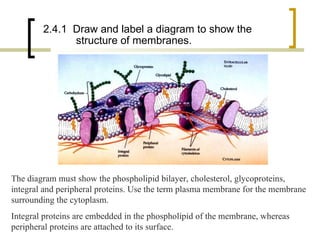
2.4.1  Draw and label a diagram to show the    structure of membranes.   The diagram must show the phospholipid bilayer, cholesterol, glycoproteins, integral and peripheral proteins. Use the term plasma membrane for the membrane surrounding the cytoplasm.  Integral proteins are embedded in the phospholipid of the membrane, whereas peripheral proteins are attached to its surface.
The phospholipid bilayer Maintains the integrity of the membrane by the position of the phospholipid molecules.  Figure 7.2 Hydrophilic head Hydrophobic tail WATER WATER
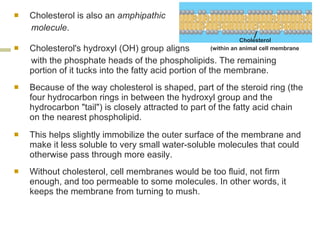
Cholesterol (a steroid) *  has different effects on membrane  fluidity  at different temperatures *  at lower temperature it prevents the membrane from freezing. Figure 7.5  (c) Cholesterol within the animal cell membrane Cholesterol
Cholesterol is also an  amphipathic  molecule . Cholesterol's hydroxyl (OH) group aligns  with the phosphate heads of the phospholipids. The remaining portion of it tucks into the fatty acid portion of the membrane.  Because of the way cholesterol is shaped, part of the steroid ring (the four hydrocarbon rings in between the hydroxyl group and the hydrocarbon "tail") is closely attracted to part of the fatty acid chain on the nearest phospholipid.  This helps slightly immobilize the outer surface of the membrane and make it less soluble to very small water-soluble molecules that could otherwise pass through more easily. Without cholesterol, cell membranes would be too fluid, not firm enough, and too permeable to some molecules. In other words, it keeps the membrane from turning to mush.  (within an animal cell membrane Cholesterol
While cholesterol adds firmness and integrity to the plasma membrane and prevents it from becoming overly fluid, it also helps maintain its fluidity.  At the high concentrations it is found in our cell's plasma membranes (close to 50 percent, molecule for molecule) cholesterol helps separate the phospholipids so that the fatty acid chains can't come together and cyrstallize. Therefore, cholesterol helps prevent extremes-- whether too fluid, or too firm-- in the consistency of the cell membrane.
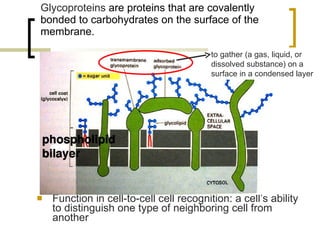
Glycoproteins  are proteins that are covalently bonded to carbohydrates on the surface of the membrane. Function in cell-to-cell cell recognition: a cell’s ability to distinguish one type of neighboring cell from another to gather (a gas, liquid, or dissolved substance) on a surface in a condensed layer
Integral & Peripheral Proteins Integral proteins penetrate the hydrophobic core of the lipid bilayer and are often transmembrane proteins, completely spanning the membrane  Peripheral proteins are loosely bound to  the surface of the membrane
The plasma membrane is the boundary that separates the living cell from its nonliving surroundings  The plasma membrane exhibits selective permeability - It allows some substances to cross it more easily than others Topic 2.4.2  – Explain how the hydrophobic and hydrophilic properties of phospholipids help to maintain the structure of cell membranes.
Cellular membranes are fluid mosaics of lipids and proteins – Phospholipids They are: the most abundant lipid in the plasma membrane amphipathic, containing both hydrophobic and hydrophilic regions Figure 7.1
Membranes have been chemically analyzed and found to be composed of proteins and lipids Scientists studying the plasma membrane reasoned that it must be a phospholipid bilayer  The fluid mosaic model of membrane structure states that a membrane is a fluid structure with a “mosaic” of various proteins embedded in it Figure 7.2 Hydrophilic head Hydrophobic tail WATER WATER
The Davson-Danielli sandwich model of membrane structure Stated that the membrane was made up of a phospholipid bilayer sandwiched between two protein layers, and  Was supported by electron microscope pictures of membranes
In 1972, Singer and Nicolson proposed that membrane proteins are dispersed and individually inserted into the phospholipid bilayer Figure 7.3 Phospholipid bilayer Hydrophobic region  of protein Hydrophobic   region of protein
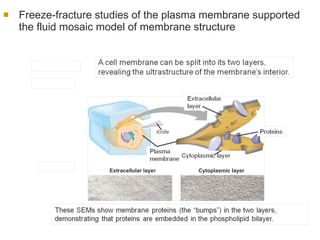
Freeze-fracture studies of the plasma membrane supported the fluid mosaic model of membrane structure A cell is frozen and fractured with a knife. The fracture plane often follows the hydrophobic interior of a membrane, splitting the phospholipid bilayer into two separated layers. The membrane proteins go wholly with one of the layers. Extracellular layer Cytoplasmic layer
The Fluidity of Membranes Phospholipids in the plasma membrane can move within the bilayer  Figure 7.5 A Lateral movement (~10 7  times per second)  Flip-flop (~ once per month) (a) Movement of phospholipids
An overview of six major functions  of  membrane proteins Topic 2.4.3  – List the functions of membrane proteins.
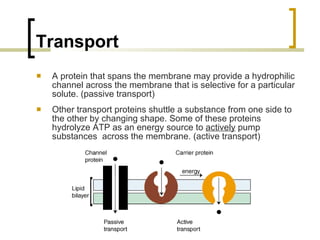
Transport A protein that spans the membrane may provide a hydrophilic channel across the membrane that is selective for a particular solute. (passive transport) Other transport proteins shuttle a substance from one side to the other by changing shape. Some of these proteins hydrolyze ATP as an energy source to  actively  pump substances  across the membrane. (active transport)
Enzymatic activity (hormone binding sites and immobilized enzymes) A protein built into the membrane may be an enzyme with its active site exposed to substances in the adjacent solution.  In some cases, several enzymes in a membrane are organized as a team that carries out sequential steps of a metabolic pathway.
Signal transduction A membrane protein may have a binding site with a specific shape that fits the shape of a chemical messenger, such as a hormone.  The external messenger (signal) may cause a conformational change in the protein (receptor) that relays the message to the inside of the cell.
Cell-cell recognition Some glycoproteins serve as identification tags that are specifically recognized by other cells.
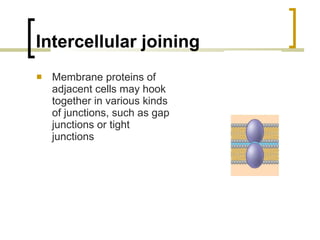
Intercellular joining Membrane proteins of adjacent cells may hook together in various kinds of junctions, such as gap junctions or tight junctions
Attachment to the cytoskeleton and extracellular matrix (ECM). Microfilaments or other elements of the cytoskeleton may be bonded to membrane proteins, a function that helps maintain cell shape and stabilizes the location of certain membrane proteins.  Proteins that adhere to the ECM can coordinate extracellular and intracellular changes
Topic 2.4.4   - Define diffusion and osmosis.   Diffusion  Is the tendency for molecules of any substance to spread out evenly into the available space The membrane has pores large enough for some molecules through. Random  movement of the molecules will cause some to pass through the pores;  The molecules diffuse from where it is more concentrated to where it is less concentrated (called diffusing down a concentration gradient).  This leads to a dynamic equilibrium: The solute molecules continue to cross the membrane, but at equal rates in both directions
 
Osmosis Osmosis  is the movement of water across a semipermeable membrane Osmosis is affected by the concentration gradient of dissolved substances
Water Balance of Cells Without Walls Tonicity  is the ability of a solution to cause a cell to gain or lose water. Has a great impact on cells without walls If  a solution is  isotonic  the concentration of solutes is the same as it is inside the cell There will be no net movement of water into or out of the cell If a solution is  hypertonic  the concentration of solutes is greater than it is inside the cell The cell will lose water and shrivel (crenate) If a solution is  hypotonic  the concentration of solutes is less than it is inside the cell  The cell will gain water and may burst
 
Water Balance of Cells with Walls Cell walls help maintain water balance If a plant cell is  turgid  it is in a hypotonic environment It is very firm, a healthy state in most plants If a plant cell is  flaccid  it is in an isotonic or hypertonic environment Plant cell.  Plant cells  are turgid (firm) and  generally healthiest in a hypotonic environ- ment, where the uptake of water is eventually balanced by the elastic wall pushing back on the cell. (b) H 2 O H 2 O H 2 O H 2 O Turgid (normal) Flaccid Plasmolyzed Figure 7.13
Topic 2.4.5  - Explain passive transport across membranes by simple diffusion and facilitated diffusion.   Passive transport . Substances diffuse spontaneously  down their concentration gradients, crossing a  membrane with no expenditure of energy by the cell.  The rate of diffusion can be greatly increased by transport  proteins in the membrane. Active transport . Some transport proteins act as pumps, moving substances across a membrane against their concentration gradients. Energy for this work is usually supplied by ATP. Diffusion.  Hydrophobic molecules and (at a slow  rate) very small uncharged  polar molecules can diffuse through the lipid bilayer. Facilitated diffusion.  Many hydrophilic substances diffuse through membranes with the assistance of transport proteins, either channel or carrier proteins. ATP
Topic 2.4.6   - Explain the role of protein pumps and ATP in active transport across membranes. Active transport moves substances  against  their concentration gradient Requires energy, usually in the form of ATP
The sodium-potassium pump is one type of active transport system (2)  Na+ binding stimulates phosphorylation by ATP. Na + 1 (1)  Cytoplasmic  Na +   binds to the sodium-potassium pump. 3 (3)  K +  is released and Na +  sites are receptive again;  the cycle repeats. (4) Phosphorylation causes the  protein to change its conformation, expelling Na +  to the outside. (6) Extracellular K +  binds to the  protein, triggering release of the  Phosphate group. (5) Loss of the phosphate restores the protein’s  original conformation. CYTOPLASM [Na + ] low [K + ] high Na + Na + Na + Na + Na + P ATP Na + Na + Na + P ADP K + K + K + K + K + K + [Na + ] high [K + ] low
Topic 2.4.7  - Explain how vesicles are used to transport materials within a cell between the rough endoplasmic reticulum, Golgi apparatus and plasma membrane. Membranes are not static structures Since the membrane has some flexibility, small amounts of membrane can be added or removed without tearing the membrane itself Since the structure of the plasma membrane is essentially the same as that of the nuclear envelope, the ER, and the Golgi apparatus, it is possible to exchange membrane sections between them.
The rough ER produces proteins that are destined to be exported out of the cell. The Golgi apparatus prepares these substances to be moved out of the cell. This involves “wrapping” the substance in a section of membrane from the Golgi itself. This membrane “pouch” – a vesicle – then joins with the cell surface membrane in the process of “exocytosis”
Many of the substances which the cell “exports” are proteins. The following organelles and processes are involved: the nucleus – contains chromosomes that contain genes that code for proteins. Messenger RNA (mRNA) is formed within the nucleus and passes out to the ER. the rough ER (RER) uses the mRNA to produce the proteins which are passed into the “lumen” of the RER where it is now surrounded by membrane. the protein then moves to the Golgi apparatus for processing into a vesicle. the vesicle then migrates to the cell membrane where it fuses and the protein is “secreted” outside the cell. There is no continuous connection between the rough ER and the Golgi.
Topic 2.4.8  - Describe how the fluidity of the membrane allows it to change shape, break and  reform during endocytosis and exocytosis. Bulk transport across the plasma membrane occurs by exocytosis and endocytosis Large proteins cross the membrane by different mechanisms
Exocytosis In exocytosis transport vesicles migrate to the plasma membrane, fuse with it, and release their contents
Endocytosis In endocytosis the cell takes in macromolecules by forming new vesicles from the plasma membrane
Three types of endocytosis In  phagocytosis,  a cell engulfs a particle by  Wrapping pseudopodia  around it and packaging  it within a membrane- enclosed sac large  enough to be classified  as a vacuole. The  particle is digested after  the vacuole fuses with a  lysosome containing  hydrolytic enzymes.  PHAGOCYTOSIS EXTRACELLULAR FLUID Pseudopodium CYTOPLASM “ Food” or  other particle Food vacuole 1 µm Pseudopodium of amoeba Bacterium Food vacuole An amoeba engulfing a bacterium via phagocytosis (TEM). PINOCYTOSIS Pinocytosis vesicles forming (arrows) in a cell lining a small blood vessel (TEM). 0.5 µm In  pinocytosis,  the cell  “ gulps” droplets of  extracellular fluid into tiny vesicles. It is not the fluid itself that is needed by the  cell, but the molecules  dissolved in the droplet.  Because any and all  included solutes are taken  into the cell, pinocytosis is nonspecific in the  substances it transports. Plasma membrane Vesicle
0.25 µm RECEPTOR-MEDIATED ENDOCYTOSIS Receptor Ligand Coat protein Coated pit Coated vesicle A coated pit and a coated vesicle formed during receptor- mediated endocytosis (TEMs). Plasma membrane Coat protein Receptor-mediated endocytosis  enables the cell to acquire bulk quantities of specific  substances, even though those substances  may not be very concentrated in the  extracellular fluid.  Embedded in the membrane are proteins with  specific receptor sites exposed to  the extracellular fluid. The receptor proteins are usually already clustered  in regions of the membrane called  coated  pits , which are lined on their cytoplasmic  side by a fuzzy layer of coat proteins.  Extracellular substances (ligands) bind  to these receptors. When binding occurs,  the coated pit forms a vesicle containing the  ligand molecules. Notice that there are  relatively more bound molecules (purple)  inside the vesicle, other molecules  (green) are also present. After this ingested  material is liberated from the vesicle, the  receptors are recycled to the plasma  membrane by the same vesicle.

Membranes

  • 1.
  • 2.
    2.4.1 Drawand label a diagram to show the structure of membranes. The diagram must show the phospholipid bilayer, cholesterol, glycoproteins, integral and peripheral proteins. Use the term plasma membrane for the membrane surrounding the cytoplasm. Integral proteins are embedded in the phospholipid of the membrane, whereas peripheral proteins are attached to its surface.
  • 3.
    The phospholipid bilayerMaintains the integrity of the membrane by the position of the phospholipid molecules. Figure 7.2 Hydrophilic head Hydrophobic tail WATER WATER
  • 4.
    Cholesterol (a steroid)* has different effects on membrane fluidity at different temperatures * at lower temperature it prevents the membrane from freezing. Figure 7.5 (c) Cholesterol within the animal cell membrane Cholesterol
  • 5.
    Cholesterol is alsoan amphipathic molecule . Cholesterol's hydroxyl (OH) group aligns with the phosphate heads of the phospholipids. The remaining portion of it tucks into the fatty acid portion of the membrane. Because of the way cholesterol is shaped, part of the steroid ring (the four hydrocarbon rings in between the hydroxyl group and the hydrocarbon "tail") is closely attracted to part of the fatty acid chain on the nearest phospholipid. This helps slightly immobilize the outer surface of the membrane and make it less soluble to very small water-soluble molecules that could otherwise pass through more easily. Without cholesterol, cell membranes would be too fluid, not firm enough, and too permeable to some molecules. In other words, it keeps the membrane from turning to mush. (within an animal cell membrane Cholesterol
  • 6.
    While cholesterol addsfirmness and integrity to the plasma membrane and prevents it from becoming overly fluid, it also helps maintain its fluidity. At the high concentrations it is found in our cell's plasma membranes (close to 50 percent, molecule for molecule) cholesterol helps separate the phospholipids so that the fatty acid chains can't come together and cyrstallize. Therefore, cholesterol helps prevent extremes-- whether too fluid, or too firm-- in the consistency of the cell membrane.
  • 7.
    Glycoproteins areproteins that are covalently bonded to carbohydrates on the surface of the membrane. Function in cell-to-cell cell recognition: a cell’s ability to distinguish one type of neighboring cell from another to gather (a gas, liquid, or dissolved substance) on a surface in a condensed layer
  • 8.
    Integral & PeripheralProteins Integral proteins penetrate the hydrophobic core of the lipid bilayer and are often transmembrane proteins, completely spanning the membrane Peripheral proteins are loosely bound to the surface of the membrane
  • 9.
    The plasma membraneis the boundary that separates the living cell from its nonliving surroundings The plasma membrane exhibits selective permeability - It allows some substances to cross it more easily than others Topic 2.4.2 – Explain how the hydrophobic and hydrophilic properties of phospholipids help to maintain the structure of cell membranes.
  • 10.
    Cellular membranes arefluid mosaics of lipids and proteins – Phospholipids They are: the most abundant lipid in the plasma membrane amphipathic, containing both hydrophobic and hydrophilic regions Figure 7.1
  • 11.
    Membranes have beenchemically analyzed and found to be composed of proteins and lipids Scientists studying the plasma membrane reasoned that it must be a phospholipid bilayer The fluid mosaic model of membrane structure states that a membrane is a fluid structure with a “mosaic” of various proteins embedded in it Figure 7.2 Hydrophilic head Hydrophobic tail WATER WATER
  • 12.
    The Davson-Danielli sandwichmodel of membrane structure Stated that the membrane was made up of a phospholipid bilayer sandwiched between two protein layers, and Was supported by electron microscope pictures of membranes
  • 13.
    In 1972, Singerand Nicolson proposed that membrane proteins are dispersed and individually inserted into the phospholipid bilayer Figure 7.3 Phospholipid bilayer Hydrophobic region of protein Hydrophobic region of protein
  • 14.
    Freeze-fracture studies ofthe plasma membrane supported the fluid mosaic model of membrane structure A cell is frozen and fractured with a knife. The fracture plane often follows the hydrophobic interior of a membrane, splitting the phospholipid bilayer into two separated layers. The membrane proteins go wholly with one of the layers. Extracellular layer Cytoplasmic layer
  • 15.
    The Fluidity ofMembranes Phospholipids in the plasma membrane can move within the bilayer Figure 7.5 A Lateral movement (~10 7 times per second) Flip-flop (~ once per month) (a) Movement of phospholipids
  • 16.
    An overview ofsix major functions of membrane proteins Topic 2.4.3 – List the functions of membrane proteins.
  • 17.
    Transport A proteinthat spans the membrane may provide a hydrophilic channel across the membrane that is selective for a particular solute. (passive transport) Other transport proteins shuttle a substance from one side to the other by changing shape. Some of these proteins hydrolyze ATP as an energy source to actively pump substances across the membrane. (active transport)
  • 18.
    Enzymatic activity (hormonebinding sites and immobilized enzymes) A protein built into the membrane may be an enzyme with its active site exposed to substances in the adjacent solution. In some cases, several enzymes in a membrane are organized as a team that carries out sequential steps of a metabolic pathway.
  • 19.
    Signal transduction Amembrane protein may have a binding site with a specific shape that fits the shape of a chemical messenger, such as a hormone. The external messenger (signal) may cause a conformational change in the protein (receptor) that relays the message to the inside of the cell.
  • 20.
    Cell-cell recognition Someglycoproteins serve as identification tags that are specifically recognized by other cells.
  • 21.
    Intercellular joining Membraneproteins of adjacent cells may hook together in various kinds of junctions, such as gap junctions or tight junctions
  • 22.
    Attachment to thecytoskeleton and extracellular matrix (ECM). Microfilaments or other elements of the cytoskeleton may be bonded to membrane proteins, a function that helps maintain cell shape and stabilizes the location of certain membrane proteins. Proteins that adhere to the ECM can coordinate extracellular and intracellular changes
  • 23.
    Topic 2.4.4 - Define diffusion and osmosis. Diffusion Is the tendency for molecules of any substance to spread out evenly into the available space The membrane has pores large enough for some molecules through. Random movement of the molecules will cause some to pass through the pores; The molecules diffuse from where it is more concentrated to where it is less concentrated (called diffusing down a concentration gradient). This leads to a dynamic equilibrium: The solute molecules continue to cross the membrane, but at equal rates in both directions
  • 24.
  • 25.
    Osmosis Osmosis is the movement of water across a semipermeable membrane Osmosis is affected by the concentration gradient of dissolved substances
  • 26.
    Water Balance ofCells Without Walls Tonicity is the ability of a solution to cause a cell to gain or lose water. Has a great impact on cells without walls If a solution is isotonic the concentration of solutes is the same as it is inside the cell There will be no net movement of water into or out of the cell If a solution is hypertonic the concentration of solutes is greater than it is inside the cell The cell will lose water and shrivel (crenate) If a solution is hypotonic the concentration of solutes is less than it is inside the cell The cell will gain water and may burst
  • 27.
  • 28.
    Water Balance ofCells with Walls Cell walls help maintain water balance If a plant cell is turgid it is in a hypotonic environment It is very firm, a healthy state in most plants If a plant cell is flaccid it is in an isotonic or hypertonic environment Plant cell. Plant cells are turgid (firm) and generally healthiest in a hypotonic environ- ment, where the uptake of water is eventually balanced by the elastic wall pushing back on the cell. (b) H 2 O H 2 O H 2 O H 2 O Turgid (normal) Flaccid Plasmolyzed Figure 7.13
  • 29.
    Topic 2.4.5 - Explain passive transport across membranes by simple diffusion and facilitated diffusion. Passive transport . Substances diffuse spontaneously down their concentration gradients, crossing a membrane with no expenditure of energy by the cell. The rate of diffusion can be greatly increased by transport proteins in the membrane. Active transport . Some transport proteins act as pumps, moving substances across a membrane against their concentration gradients. Energy for this work is usually supplied by ATP. Diffusion. Hydrophobic molecules and (at a slow rate) very small uncharged polar molecules can diffuse through the lipid bilayer. Facilitated diffusion. Many hydrophilic substances diffuse through membranes with the assistance of transport proteins, either channel or carrier proteins. ATP
  • 30.
    Topic 2.4.6 - Explain the role of protein pumps and ATP in active transport across membranes. Active transport moves substances against their concentration gradient Requires energy, usually in the form of ATP
  • 31.
    The sodium-potassium pumpis one type of active transport system (2) Na+ binding stimulates phosphorylation by ATP. Na + 1 (1) Cytoplasmic Na + binds to the sodium-potassium pump. 3 (3) K + is released and Na + sites are receptive again; the cycle repeats. (4) Phosphorylation causes the protein to change its conformation, expelling Na + to the outside. (6) Extracellular K + binds to the protein, triggering release of the Phosphate group. (5) Loss of the phosphate restores the protein’s original conformation. CYTOPLASM [Na + ] low [K + ] high Na + Na + Na + Na + Na + P ATP Na + Na + Na + P ADP K + K + K + K + K + K + [Na + ] high [K + ] low
  • 32.
    Topic 2.4.7 - Explain how vesicles are used to transport materials within a cell between the rough endoplasmic reticulum, Golgi apparatus and plasma membrane. Membranes are not static structures Since the membrane has some flexibility, small amounts of membrane can be added or removed without tearing the membrane itself Since the structure of the plasma membrane is essentially the same as that of the nuclear envelope, the ER, and the Golgi apparatus, it is possible to exchange membrane sections between them.
  • 33.
    The rough ERproduces proteins that are destined to be exported out of the cell. The Golgi apparatus prepares these substances to be moved out of the cell. This involves “wrapping” the substance in a section of membrane from the Golgi itself. This membrane “pouch” – a vesicle – then joins with the cell surface membrane in the process of “exocytosis”
  • 34.
    Many of thesubstances which the cell “exports” are proteins. The following organelles and processes are involved: the nucleus – contains chromosomes that contain genes that code for proteins. Messenger RNA (mRNA) is formed within the nucleus and passes out to the ER. the rough ER (RER) uses the mRNA to produce the proteins which are passed into the “lumen” of the RER where it is now surrounded by membrane. the protein then moves to the Golgi apparatus for processing into a vesicle. the vesicle then migrates to the cell membrane where it fuses and the protein is “secreted” outside the cell. There is no continuous connection between the rough ER and the Golgi.
  • 35.
    Topic 2.4.8 - Describe how the fluidity of the membrane allows it to change shape, break and reform during endocytosis and exocytosis. Bulk transport across the plasma membrane occurs by exocytosis and endocytosis Large proteins cross the membrane by different mechanisms
  • 36.
    Exocytosis In exocytosistransport vesicles migrate to the plasma membrane, fuse with it, and release their contents
  • 37.
    Endocytosis In endocytosisthe cell takes in macromolecules by forming new vesicles from the plasma membrane
  • 38.
    Three types ofendocytosis In phagocytosis, a cell engulfs a particle by Wrapping pseudopodia around it and packaging it within a membrane- enclosed sac large enough to be classified as a vacuole. The particle is digested after the vacuole fuses with a lysosome containing hydrolytic enzymes. PHAGOCYTOSIS EXTRACELLULAR FLUID Pseudopodium CYTOPLASM “ Food” or other particle Food vacuole 1 µm Pseudopodium of amoeba Bacterium Food vacuole An amoeba engulfing a bacterium via phagocytosis (TEM). PINOCYTOSIS Pinocytosis vesicles forming (arrows) in a cell lining a small blood vessel (TEM). 0.5 µm In pinocytosis, the cell “ gulps” droplets of extracellular fluid into tiny vesicles. It is not the fluid itself that is needed by the cell, but the molecules dissolved in the droplet. Because any and all included solutes are taken into the cell, pinocytosis is nonspecific in the substances it transports. Plasma membrane Vesicle
  • 39.
    0.25 µm RECEPTOR-MEDIATEDENDOCYTOSIS Receptor Ligand Coat protein Coated pit Coated vesicle A coated pit and a coated vesicle formed during receptor- mediated endocytosis (TEMs). Plasma membrane Coat protein Receptor-mediated endocytosis enables the cell to acquire bulk quantities of specific substances, even though those substances may not be very concentrated in the extracellular fluid. Embedded in the membrane are proteins with specific receptor sites exposed to the extracellular fluid. The receptor proteins are usually already clustered in regions of the membrane called coated pits , which are lined on their cytoplasmic side by a fuzzy layer of coat proteins. Extracellular substances (ligands) bind to these receptors. When binding occurs, the coated pit forms a vesicle containing the ligand molecules. Notice that there are relatively more bound molecules (purple) inside the vesicle, other molecules (green) are also present. After this ingested material is liberated from the vesicle, the receptors are recycled to the plasma membrane by the same vesicle.