Energy Efficiency Building Code
 2nd Consultative Workshop - 27 January 2011
                    Presented by
                  Emma Özsen
               Sustainability Consultant
       M.Sc. Environmental Design and Engineering
Passive Design Strategies
• Building envelope design is a very important
  part of the passive solar design process.
• It is essential to adapt the envelope design to
  the climate where the building is located.
• Important factors to consider:
 Orientation, Shading, Building material, Colour…
Comments on passive design strategies


   The passive design strategies aspect
 would rather be moved to a specific guide


The project does not consider the thermal
   capacity of walls and night cooling
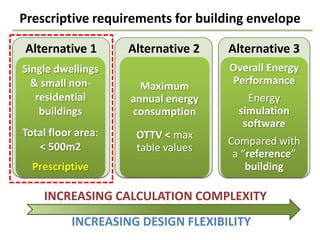
Prescriptive requirements for building envelope

Alternative 1       Alternative 2   Alternative 3
Single dwellings                    Overall Energy
  & small non-        Maximum       Performance
   residential      annual energy       Energy
    buildings       consumption       simulation
                                       software
Total floor area:    OTTV < max
   < 500m2                          Compared with
                     table values
                                     a “reference”
  Prescriptive                          building

    INCREASING CALCULATION COMPLEXITY
          INCREASING DESIGN FLEXIBILITY
Prescriptive requirements for building envelope
• Maximum Solar Factor (S) specified for walls,
  roof and windows.
• Similar to U-value but with additional coefficients
  of shading and absorption.


where
R : thermal resistance of the element, based on the thermal
conductivity of the material and its thickness

α : absorption coefficient, based on the colour of element
Cm : coefficient of reduction, based on shading of element
Other requirements/recommendations
           of the building envelope

Restriction of skylights (depending on
exposure to direct sunlight)
To minimise solar heat gains through the roof.

Transparent / translucent skylights in roofs not allowed
unless skylight is not exposed to direct solar gains (i.e.
oriented South or adequately shaded) and has a
purpose towards passive cooling, such as to enhance
stack ventilation.
Overall Thermal Transfer Value (OTTV)
OTTV = measure of the energy consumption of a building due
to its envelope, i.e. rate of heat transfer from the outdoor
environment into a building, through walls and roof.
Comments on OTTV
   Values of OTTV for Mauritius have to be
         provided by the Consultant
• Limiting OTTV usually is based on the latitude.
• Will consider other countries with similar latitudes
  and climate as Mauritius.
                       Maximum OTTV criteria (W/m2)
           Countries
                            Wall             Roof
           Thailand          45               45
           Singapore         45               45
           Malaysia          45               25
        Comparison of OTTV values for some Asian countries
THANK YOU
FOR YOUR ATTENTION!
Prescriptive requirements - building envelope
• Values for α and Cm to be chosen from tables provided
                                                  Dark red, light       Brown, dark        Black, dark
                              White, Yellow,
                 Colour      Orange, pale red
                                                    green, light        green, blue,      brown, dark
                                                  blue, light grey         grey          blue, dark grey
               Description        Light              Medium                Dark             Very dark
Absorption      Horizontal
                                 α = 0.6              α = 0.6               α = 0.8          α = 1.0
                 surface
Coefficient      Vertical
    α                            α = 0.4              α = 0.6               α = 0.8          α = 1.0
                 surface

                                                Cm value for walls
                  Without With ventilated
 Orientation                                               Wall with horizontal shading
                  shading vertical shading
                                                 d/h ≥ 0.25 d/h ≥ 0.50 d/h ≥ 0.75 d/h = 1.0
 North               1.0           0.25             0.70             0.45          0.3        0.25
 West                1.0           0.25             0.80             0.50          0.4        0.35
 South               0.3           0.25             0.25             0.25         0.25        0.25
 East                0.5           0.25             0.80             0.50          0.4        0.35

                    Examples of Cm and α values for walls
Example calculation of S factor for walls
IDEAL CASE FOR A NORTH-FACING WALL
Assuming:
Colour = white
Optimal shading, i.e., shaded by a horizontal overhang of depth
(d), which is equal to the height of the wall (h)
Cm = 0.25 and α = 0.4
Therefore,
S = (0.074 x 0.25 x 0.4) / (0.228 + 0.20) = 1.73%

WORST CASE
Unprotected north-facing wall
Colour = Very dark
Cm = 1 and α = 1
S = (0.074 x 1x 1) / (0.228 + 0.20) = 17.3%
Solar Heat Load
All buildings should be designed and constructed such that:
• Naturally ventilated spaces do not overheat; and
• Spaces subject to mechanical ventilation or cooling do
  not require excessive cooling plant capacity.

Compliance with solar heat load requirement
Compliance Method 1: meeting the prescriptive
requirements for the Solar Factor of building envelope.
Compliance Method 2: meeting the OTTV limit.
Compliance Method 3: showing that the solar heat
load per unit floor area would not exceed the maximum
load specified in the EEBC.

Presentation on the Energy Efficiency Building Code

  • 1.
    Energy Efficiency BuildingCode 2nd Consultative Workshop - 27 January 2011 Presented by Emma Özsen Sustainability Consultant M.Sc. Environmental Design and Engineering
  • 2.
    Passive Design Strategies •Building envelope design is a very important part of the passive solar design process. • It is essential to adapt the envelope design to the climate where the building is located. • Important factors to consider: Orientation, Shading, Building material, Colour…
  • 3.
    Comments on passivedesign strategies The passive design strategies aspect would rather be moved to a specific guide The project does not consider the thermal capacity of walls and night cooling
  • 4.
    Prescriptive requirements forbuilding envelope Alternative 1 Alternative 2 Alternative 3 Single dwellings Overall Energy & small non- Maximum Performance residential annual energy Energy buildings consumption simulation software Total floor area: OTTV < max < 500m2 Compared with table values a “reference” Prescriptive building INCREASING CALCULATION COMPLEXITY INCREASING DESIGN FLEXIBILITY
  • 5.
    Prescriptive requirements forbuilding envelope • Maximum Solar Factor (S) specified for walls, roof and windows. • Similar to U-value but with additional coefficients of shading and absorption. where R : thermal resistance of the element, based on the thermal conductivity of the material and its thickness α : absorption coefficient, based on the colour of element Cm : coefficient of reduction, based on shading of element
  • 6.
    Other requirements/recommendations of the building envelope Restriction of skylights (depending on exposure to direct sunlight) To minimise solar heat gains through the roof. Transparent / translucent skylights in roofs not allowed unless skylight is not exposed to direct solar gains (i.e. oriented South or adequately shaded) and has a purpose towards passive cooling, such as to enhance stack ventilation.
  • 7.
    Overall Thermal TransferValue (OTTV) OTTV = measure of the energy consumption of a building due to its envelope, i.e. rate of heat transfer from the outdoor environment into a building, through walls and roof.
  • 8.
    Comments on OTTV Values of OTTV for Mauritius have to be provided by the Consultant • Limiting OTTV usually is based on the latitude. • Will consider other countries with similar latitudes and climate as Mauritius. Maximum OTTV criteria (W/m2) Countries Wall Roof Thailand 45 45 Singapore 45 45 Malaysia 45 25 Comparison of OTTV values for some Asian countries
  • 9.
  • 10.
    Prescriptive requirements -building envelope • Values for α and Cm to be chosen from tables provided Dark red, light Brown, dark Black, dark White, Yellow, Colour Orange, pale red green, light green, blue, brown, dark blue, light grey grey blue, dark grey Description Light Medium Dark Very dark Absorption Horizontal α = 0.6 α = 0.6 α = 0.8 α = 1.0 surface Coefficient Vertical α α = 0.4 α = 0.6 α = 0.8 α = 1.0 surface Cm value for walls Without With ventilated Orientation Wall with horizontal shading shading vertical shading d/h ≥ 0.25 d/h ≥ 0.50 d/h ≥ 0.75 d/h = 1.0 North 1.0 0.25 0.70 0.45 0.3 0.25 West 1.0 0.25 0.80 0.50 0.4 0.35 South 0.3 0.25 0.25 0.25 0.25 0.25 East 0.5 0.25 0.80 0.50 0.4 0.35 Examples of Cm and α values for walls
  • 11.
    Example calculation ofS factor for walls IDEAL CASE FOR A NORTH-FACING WALL Assuming: Colour = white Optimal shading, i.e., shaded by a horizontal overhang of depth (d), which is equal to the height of the wall (h) Cm = 0.25 and α = 0.4 Therefore, S = (0.074 x 0.25 x 0.4) / (0.228 + 0.20) = 1.73% WORST CASE Unprotected north-facing wall Colour = Very dark Cm = 1 and α = 1 S = (0.074 x 1x 1) / (0.228 + 0.20) = 17.3%
  • 12.
    Solar Heat Load Allbuildings should be designed and constructed such that: • Naturally ventilated spaces do not overheat; and • Spaces subject to mechanical ventilation or cooling do not require excessive cooling plant capacity. Compliance with solar heat load requirement Compliance Method 1: meeting the prescriptive requirements for the Solar Factor of building envelope. Compliance Method 2: meeting the OTTV limit. Compliance Method 3: showing that the solar heat load per unit floor area would not exceed the maximum load specified in the EEBC.

Editor's Notes

  • #3 The building envelope design is a very important part of the design process. The building envelope should be considered as the first characteristic of the building which can be modified based on the climate and immediate environment, in order to control the indoor climate. It is essential to adapt the envelope design to the climate where the building is located, failing which it may not performance as expected. For instance, Mauritius is subject to a predominantly hot and humid climate throughout the year. It is important to design the building envelope such that it minimises solar heat gains and risks of overheating. In colder climates, insulation is principally used to preserve heat inside buildings. In Mauritius, it is usually effective to use a combination of shading and thermal mass to attenuate heat gains, and to use insulation only where it is found to positively reduce solar gains without causing internal gains to be “trapped” inside the building (for example using insulation in roofs rather than walls).
  • #4 There is a Passive Solar Guidelines document which we have produced, where thermal mass and night cooling are covered. The Code document was produced before the Guidelines. We will now remove the passive design chapter from the Code, and move it to the Guidelines document.Thermal mass effect and night cooling are not covered under Alternatives 1 and 2, as these are stationary (static) calculation methods, i.e. they do not take account for thermal storage and external variables. However they can are considered in Alternative 3 (dynamic simulation) where the benefit of thermal mass and natural ventilation is considered in the software calculations.
  • #5 Building envelope prescriptive requirements set out in Compliance Method 1.Limiting values for each building envelope element = less design flexibility but less complex calculations.
  • #6 The U-value is also called the “overall heat transfer coefficient”, and describes the thermal transmittance of an element. It is a measure of how much heat can go through one square metre of the element when the air temperatures on either side differ by one degree. The U-value of an element is based on the combination of the thermal resistance (denoted as the R-value) of the materials that make up that element.The resistance can be calculated based on the thermal conductivity of the material and its thickness.The lower the U value, the greater the resistance to heat and therefore has a better insulating value.However, the parameters that making up of the U-value mean that it can only be varied based on the materials used and its thickness. A low U-value can therefore only be achieved by using highly insulating materials. The U-value does not take into account factors such as shading or colour of the materials.If a wall is properly shaded and lightly coloured, the limiting solar factor should be achieved without need for insulation.
  • #8 An OTTV is a measure of the energy consumption of a building due to its envelope.The OTTV concept originates from the first energy conservation standard of the&quot; American Society of Heating, Refrigerating and Air-Conditioning Engineers&quot; (ASHRAE Standard 90-75), &quot;Energy Conservation in New Building Design&quot;, later revised as ANSI/ASHRAE/IES Standard 90A-1980, in which the cooling criteria set maximum allowable OTTVs for mechanically-cooled buildings. As compared with the prescriptive requirements, the OTTV allows more flexibility in that the various envelope components (type of glazing, window size, external shading to windows, wall colour and wall type) can be varied so as to meet the maximum OTTV criteria.
  • #9 The requirement for a limiting OTTV has been successfully used in countries with hot and humid climates, such as Thailand, Malaysia, Indonesia and Singapore.Limiting OTTV usually is based on the latitude. E.g. Thailand has a similar latitude to Mauritius. We will consider OTTV values for countries with similar latitudes and climate.
  • #13 Overheating of buildings due to solar gains is a problem in Mauritius. The purpose of solar heat load limitation is to ensure that all buildings are designed and constructed such that:Naturally ventilated spaces do not overheat; Spaces subject to mechanical ventilation or cooling do not require excessive cooling plant capacity to maintain the desired temperature within the space.Compliance Method 1:compliance with the prescriptive requirements for the Solar Factor of opaque and transparent elements would suffice to show that solar heat gains entering the building are limited.For buildings following Compliance Method 2 (maximum energy consumption and OTTV), the requirement for limiting solar heat gains would be met by meeting the OTTV limit prescribed.For buildings following Compliance Method 3 (overall energy performance calculation through simulation), it is required to show that the solar heat load per unit floor area, averaged over the operational hours of the building (e.g. 7:30am to 5:30pm for office buildings), would not exceed xx W/m2.