Energy Efficiency Policy of India


    WORKSHOP ON ENERGY EFFICIENCY AND IMPLEMENTING
      ENERGY MANAGEMENT SYSTEMS FOR INDUSTRIES
                    5th March,2013


                     K. K. Chakarvarti
                    Energy Economist,
                Bureau of Energy Efficiency
                    New Delhi (INDIA)
INTRODUCTION

India has made rapid strides towards economic
self-reliance over the last few decades.

Impressive progress has been made in the fields
of industry, agriculture, communication, transport
and other sectors necessitating growing
consumption of energy for developmental and
economic activities.


                                                2
INTRODUCTION (contd.)
Conventional source of energy such as coal, oil and gas
are scarce and exhaustible.
Energy prices will rise in the long run to reflect their
relative scarcity and high cost of exploration and
extraction.
Hence, all attempts need to be made expeditiously to
ensure the optimal use of the available resources so as
to manage the viability and availability of energy use
and supply.
This has led the Government of India through the
Energy Conservation Act and the Bureau of Energy
Efficiency to launch several programmes.
                                                       3
THE INDIAN ENERGY CONSERVATION ACT

 EC Act enacted in October 2001
 Become effective from 1st March 2002
  Bureau of Energy Efficiency (BEE) operationalized from 1st
 March 2002.
       2002.
MISSION OF BEE

 Develop policy and strategies with a thrust
 on     self     regulation    and    market
 principles, within the overall framework of
 the EC Act with the primary objective of
 reducing energy intensity of the Indian
 economy.
 economy.
                                                               4
THE INDIAN ENERGY CONSERVATION ACT


The five major provisions of EC Act relate to:
Designated Consumers (mainly energy intensive industries) to comply
with the specific energy consumption norms for the manufactured products
and services and establishment of energy management system,
Standards and Labeling of energy consuming appliances, gadgets and
equipment to ensure promotion of energy efficiency of the new stocks
entering the market
Energy Conservation Building Code ensuring that new commercial
buildings constructed in the country have less electricity consumption
Creation of Institutional Set up (Bureau of Energy Efficiency) for effective
coordination of the energy conservation efforts in the country and
Establishment of Energy Conservation Fund at Centre and States to
provide necessary financial support for energy efficiency initiatives in the
country.
Energy efficiency institutional practices and programs in India are now
mainly being guided through various voluntary and mandatory
provisions of the Energy Conservation Act
                                                                           5
Mandatory Requirements to be fulfilled by DCs`

    Schedule to EC Act provides list of 15 energy intensive industries and other
    establishments to be notified as designated consumers (DC). DCs to
        Appoint or designate energy managers in charge of activities for efficient
        use of energy and its conservation (clause 14(l)).
•   (Note: The minimum qualification of energy manager to be designated or appointed
    under clause 14(l) is the passing of certification examination, conducted by Bureau of
    Energy Efficiency. The following information to be provided for energy manager:
     – Name of the energy manager
     – Registration number (EA/EM No.)
     – Complete postal office address
     – Telephone and Mobile number
     – Email address)
        The information with regard to energy consumed (clause 14(a)) in Form 1
        Get energy audits conducted by accredited energy auditors
        Implement techno-economic viable recommendations
        Comply with norms of specific energy consumption fixed
        Submit report on steps taken
•
Designated Consumers -Initiatives
9 energy intensive industry have been notified as
designated consumers
13 National Certification examinations for Energy
Managers and Energy Auditors have been successfully
conducted. India has now about 9993 Certified Energy
Managers, out of which 7201 are also qualified as
Certified Energy Auditors
4 Guidebooks have been prepared to assist energy
professionals
85 Coal fired power generating units of various sizes
(110-500 MW) have been mapped. Studies have
identified 3 million tonne of coal savings potential in 49
nos. of 210 MW units
Baseline energy audits studies have been carried out in
about 400 units of 8 energy audit industry and thermal
power units.
                                                             7
8
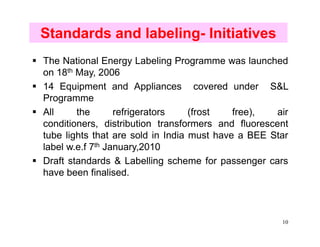
Standards and labeling- Initiatives
The National Energy Labeling Programme was launched
on 18th May, 2006
14 Equipment and Appliances covered under S&L
Programme
All     the       refrigerators    (frost   free),  air
conditioners, distribution transformers and fluorescent
tube lights that are sold in India must have a BEE Star
label w.e.f 7th January,2010
Draft standards & Labelling scheme for passenger cars
have been finalised.


                                                     10
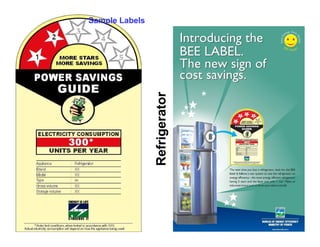
Sample Labels


                Refrigerator


                               11
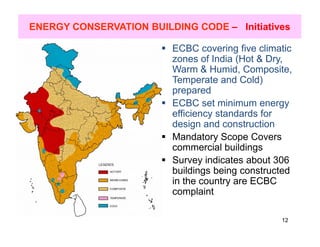
ENERGY CONSERVATION BUILDING CODE – Initiatives

                         ECBC covering five climatic
                         zones of India (Hot & Dry,
                         Warm & Humid, Composite,
                         Temperate and Cold)
                         prepared
                         ECBC set minimum energy
                         efficiency standards for
                         design and construction
                         Mandatory Scope Covers
                         commercial buildings
                         Survey indicates about 306
                         buildings being constructed
                         in the country are ECBC
                         complaint

                                                 12
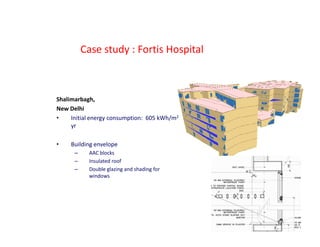
Case study : Fortis Hospital


Shalimarbagh,
New Delhi
•    Initial energy consumption: 605 kWh/m2
     yr

•    Building envelope
      –    AAC blocks
      –    Insulated roof
      –    Double glazing and shading for
           windows
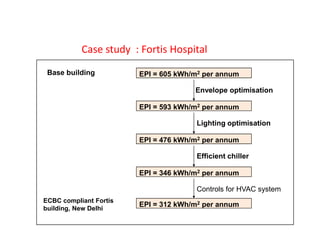
Case study : Fortis Hospital
 Base building          EPI = 605 kWh/m2 per annum

                                      Envelope optimisation

                        EPI = 593 kWh/m2 per annum

                                      Lighting optimisation

                        EPI = 476 kWh/m2 per annum

                                      Efficient chiller

                        EPI = 346 kWh/m2 per annum

                                      Controls for HVAC system
ECBC compliant Fortis
                        EPI = 312 kWh/m2 per annum
building, New Delhi
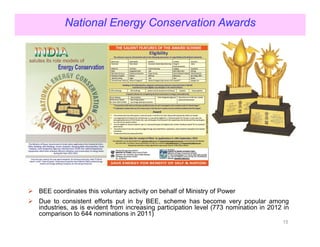
National Energy Conservation Awards


BEE coordinates this voluntary activity on behalf of Ministry of Power
Due to consistent efforts put in by BEE, scheme has become very popular among
industries, as is evident from increasing participation level (773 nomination in 2012 in
comparison to 644 nominations in 2011)
                                                                                     15
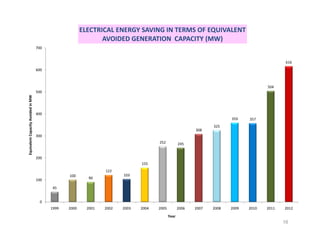
ELECTRICAL ENERGY SAVING IN TERMS OF EQUIVALENT
                                                               AVOIDED GENERATION CAPACITY (MW)
                                    700


                                                                                                                                               616
                                    600


                                                                                                                                       504
                                    500
Equivalent Capacity Avoided in MW


                                    400
                                                                                                                         359    357
                                                                                                                  325
                                                                                                           308
                                    300
                                                                                      252           245


                                    200
                                                                               155
                                                                 122
                                                 100                    103
                                    100                   90

                                          45


                                     0
                                          1999   2000     2001   2002   2003   2004   2005          2006   2007   2008   2009   2010   2011   2012
                                                                                             Year
                                                                                                                                              16
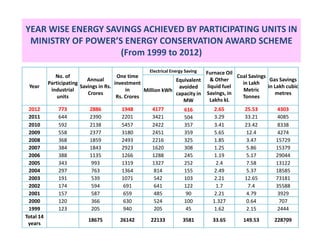
YEAR WISE ENERGY SAVINGS ACHIEVED BY PARTICIPATING UNITS IN
 MINISTRY OF POWER’S ENERGY CONSERVATION AWARD SCHEME
                    (From 1999 to 2012)
                                                     Electrical Energy Saving   Furnace Oil
              No. of                     One time                                            Coal Savings
                            Annual                              Equivalent         & Other                 Gas Savings
           Participating                investment                                             in Lakh
 Year                    Savings in Rs.                          avoided         liquid fuel              in Lakh cubic
            industrial                       in     Million kWh                                Metric
                            Crores                              capacity in     Savings, in                  metres
               units                     Rs. Crores                                            Tonnes
                                                                   MW             Lakhs kL
 2012          773          2886         1948         4177            616         2.65          25.53        4303
 2011          644          2390         2201         3421            504         3.29          33.21        4085
 2010          592          2138         5457         2422            357         3.41          23.42        8338
 2009          558          2377         3180         2451            359         5.65           12.4        4274
 2008          368          1859         2493         2216            325         1.85           3.47        15729
 2007          384          1843         2923         1620            308         1.25           5.86        15379
 2006          388          1135         1266         1288            245         1.19           5.17        29044
 2005          343           993         1319         1327            252          2.4           7.58        13122
 2004          297           763         1364         814             155         2.49           5.37        18585
 2003          191           539         1071         542             103         2.21          12.65        73181
 2002          174           594          691         641             122          1.7           7.4         35588
 2001          157           587          659         485             90          2.21           4.79        3929
 2000          120           366          630         524             100         1.327          0.64         707
 1999          123           205          940         205             45          1.62           2.15        2444
Total 14
                           18675         26142        22133          3581         33.65        149.53       228709
                                                                                                               17
 years
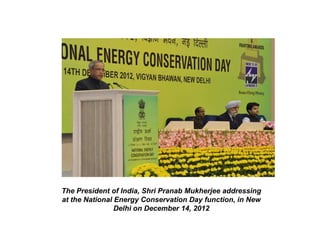
The President of India, Shri Pranab Mukherjee addressing
at the National Energy Conservation Day function, in New
                Delhi on December 14, 2012
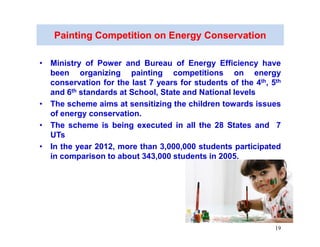
Painting Competition on Energy Conservation

• Ministry of Power and Bureau of Energy Efficiency have
  been organizing painting competitions on energy
  conservation for the last 7 years for students of the 4th, 5th
  and 6th standards at School, State and National levels
• The scheme aims at sensitizing the children towards issues
  of energy conservation.
• The scheme is being executed in all the 28 States and 7
  UTs
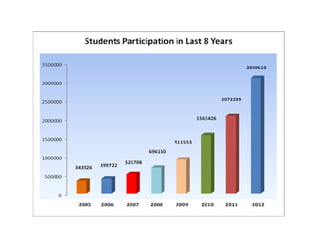
• In the year 2012, more than 3,000,000 students participated
  in comparison to about 343,000 students in 2005.


                                                              19
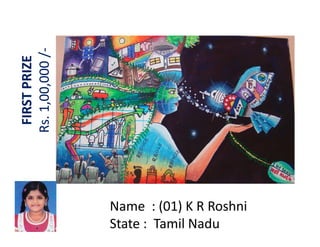
/-
Rs. 1,00,000 /-
 FIRST PRIZE


                  Name : (01) K R Roshni
                  State : Tamil Nadu
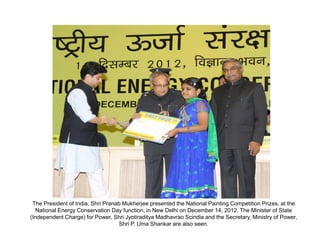
The President of India, Shri Pranab Mukherjee presented the National Painting Competition Prizes, at the
   National Energy Conservation Day function, in New Delhi on December 14, 2012. The Minister of State
(Independent Charge) for Power, Shri Jyotiraditya Madhavrao Scindia and the Secretary, Ministry of Power,
                                   Shri P. Uma Shankar are also seen.
NMEEE – Four New Initiatives

• Perform Achieve and Trade (PAT): A market based mechanism to
  enhance cost effec-tiveness of improvements in energy efficiency in
  energy-intensive large industries and facilities, through certification
  of energy savings that could be traded.
• Market Transformation for Energy Efficiency (MTEE):
  Accelerating the shift to energy efficient appliances in designated
  sectors through innovative measures to make the products more
  affordable
• Energy Efficiency Financing Platform (EEFP): Creation of
  mechanisms that would help finance demand side management
  programmes in all sectors by capturing future energy savings.
• Framework for Energy Efficient Economic Development
  (FEEED): Developing fiscal instruments to promote energy
  efficiency
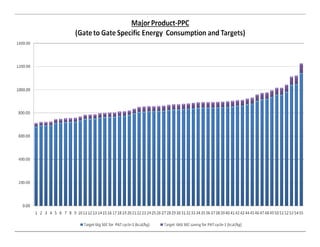
Perform, Achieve & Trade (PAT)
The key goal of the PAT scheme is to mandate specific
energy efficiency improvements for the most energy
intensive industries.
The scheme builds on the large variation in energy
intensities of different units in almost every sector,
ranging from amongst the best in the world, to extremely
inefficient units as well.
The energy intensity reduction target mandated for each
unit is dependent on its current efficiency : the reduction
target is less for those who are more efficient, and is
higher for the currently less-efficient units.
The design of PAT is the result of extensive consultations
over the last two years (2010-11 and 2011-12), which
have contributed to its robustness and simplicity.
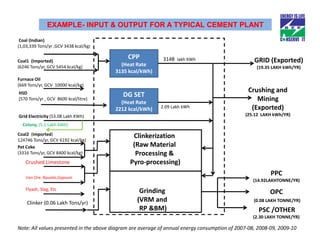
EXAMPLE-
              EXAMPLE- INPUT & OUTPUT FOR A TYPICAL CEMENT PLANT

 Coal (Indian)
(1,03,339 Tons/yr ,GCV 3438 kcal/kg)


Coal1 (Imported)
                                              CPP            3148 lakh KWh                         GRID (Exported)
(6246 Tons/yr, GCV 5454 kcal/kg)           (Heat Rate                                               (19.35 LAKH kWh/YR)
                                         3135 kcal/kWh)
Furnace Oil
(669 Tons/yr, GCV 10000 kcal/kg)
HSD                                                                                             Crushing and
                                            DG SET
(570 Tons/yr , GCV 8600 kcal/litre)
                                           (Heat Rate
                                                                                                   Mining
                                         2212 kcal/kWh)     2.09 Lakh kWh                        (Exported)
Grid Electricity (53.08 Lakh KWh)                                                              (25.12 LAKH kWh/YR)

  Colony, (5.1 Lakh kWh)
Coal2 (Imported)                                Clinkerization
124746 Tons/yr, GCV 6192 kcal/kg)
Pet Coke                                        (Raw Material
(3316 Tons/yr, GCV 8400 kcal/kg)                 Processing &
   Crushed Limestone                           Pyro-processing)

   Iron Ore, Bauxite,Gypsum
                                                                                                          PPC
                                                                                                  (14.92LAKHTONNE/YR)
   Flyash, Slag, Etc                               Grinding                                              OPC
    Clinker (0.06 Lakh Tons/yr)
                                                  (VRM and                                         (0.08 LAKH TONNE/YR)
                                                   RP &BM)                                           PSC /OTHER
                                                                                                  (2.30 LAKH TONNE/YR)

Note: All values presented in the above diagram are average of annual energy consumption of 2007-08, 2008-09, 2009-10
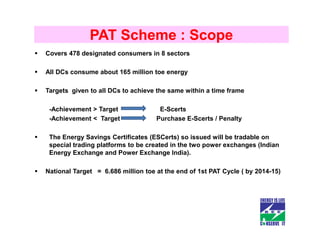
PAT Scheme : Scope
Covers 478 designated consumers in 8 sectors

All DCs consume about 165 million toe energy

Targets given to all DCs to achieve the same within a time frame

 -Achievement > Target               E-Scerts
 -Achievement < Target              Purchase E-Scerts / Penalty

 The Energy Savings Certificates (ESCerts) so issued will be tradable on
 special trading platforms to be created in the two power exchanges (Indian
 Energy Exchange and Power Exchange India).

National Target = 6.686 million toe at the end of 1st PAT Cycle ( by 2014-15)
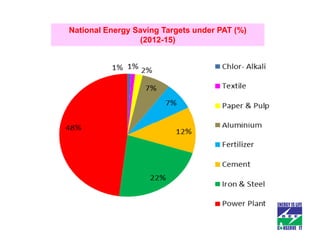
National Energy Saving Targets under PAT (%)
                 (2012-15)
PAT Benefits
The direct benefit for the participating
industries in this period is reductions in
input costs related to energy of
approximately Rs 68000 million.
Needless to add, this will significantly
enhance global competitiveness of
industry while simultaneously reducing
India's CO2 emissions by 24 million tons
per year in 2014-15.
ISO 50001 ENERGY MANAGEMENT
       SYSTEM STANDARD
Energy Management

“The judicious and effective use of energy to
maximize profits (minimize costs) and enhance
competitive positions”

 “The strategy of adjusting and optimizing energy, using systems
 and procedures so as to reduce energy requirements per unit of
 output while holding constant or reducing total costs of
 producing the output from these systems”
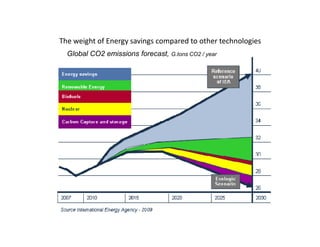
The weight of Energy savings compared to other technologies
  Global CO2 emissions forecast, G.tons CO2 / year
ISO 50001: Energy Management Systems Standard-
                  Introduction
ISO 50001- the International Standard for Energy Management
Systems (EnMS)
This Draft International Standard was released in April 2010 and
was published in mid-2011.
Energy Management Systems offers a comprehensive and
structured approach for energy efficiency improvement.
ISO 50001: 2011(E) defines EnMS as “set of interrelated or
interacting elements to establish an energy policy and energy
objectives, and processes and procedures to achieve those
objectives “
Applicable to any organization, whatever the size, industry or
geographical location
An organization embracing ISO 50001 is likely to further accelerate
adoption of energy efficiency practices and to continuously improve
its energy performance and cost.
ISO 50001: Energy Management Systems Standard-
                  Introduction ( contd.)
    Application of the standard can be tailored to fit the requirements of
    the organization, including degree of documentation, resources and
    complexity of the system
    This       International   Standard  can      be     used          for
    certification/registration  and/or  self-declaration    of         an
    organization's energy management system.
    The fact that it's based on measurement and verification will help
    organization stay on track to meet their declared energy policies.
    Adoption of ISO 50001 by any organization will:
•     Reduce energy bills
•     Make manufacturing more sustainable
•     Promotes energy efficiency throughout the supply chain
•     Helps in meeting National GHG reduction targets
ISO 50001-EnMS Requirement

    ISO 50001 specifies requirements for an organization to establish,
    implement, maintain and improve an energy management system.
     Specifies energy management system (EnMS) to :
•   develop and implement an energy policy,
•   establish objectives, targets, and action plans which take into
    account legal requirements
       This International Standard specifies requirements for all factors
    affecting:
•   energy supply, uses and consumption
•   measurement, documentation and reporting,
•   design and procurement practices for energy using equipment,
    processes, systems, and personnel.

    ISO 50001 does not prescribe specific performance criteria with
    respect to energy
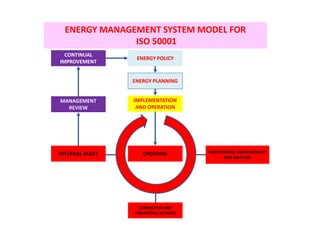
ENERGY MANAGEMENT SYSTEM MODEL FOR
               ISO 50001
  CONTINUAL
                  ENERGY POLICY
IMPROVEMENT


                 ENERGY PLANNING


MANAGEMENT       IMPLEMENTATION
  REVIEW          AND OPERATION


INTERNAL AUDIT      CHECKING          MONITORING, MEASUREMENT
                                            AND ANALYSIS


                   CORRECTIVE AND
                 PREVENTIVE ACTIONS
Comparison between ISO 50001, ISO 9001 and
                   ISO 14001
•    ISO 50001 is in line with ISO 9001 and ISO 14001 standards that address
     quality management and environmental management issues.
•    ISO 50001 is based on the same Plan-Do-Check-Act approach of ISO 9001
     and ISO 14001 and it draws extensively on the structure and content of the
     QMS and EMS.
•    Implementation of ISO 9001 means what the organization does to fulfill the
     customer's quality requirements, and applicable regulatory requirements,
     while aiming to enhance customer satisfaction,
•    Implementation of ISO 14001 means what the organization does to
     minimize harmful effects on the environment caused by its activities, and to
     achieve continual improvement of its environmental performance.
•    Similarly ISO 50001 implementation is expected to address what the
     organization does to effectively manage energy resources and performance
     that is relevant to global standards.
ISO 50001 in Indian Context (contd.)
In order to achieve the targets, as set , the plant is required to have
a strong energy management system , well defined energy policy
and qualified human resource.
More than 200 industrial units and other establishments have
already declared their energy policy and have certified energy
managers and energy auditors.
India has now about 9993 Certified Energy Managers, out of which
7201 are also qualified as Certified Energy Auditors, from the
previous 12 examinations conducted by Bureau of Energy Efficiency
since 2004.
These professionally qualified energy managers and energy
auditors have expertise in energy management, project
management, financing and implementation of energy efficiency
projects, and policy analysis
In view of the above , it may be relatively easier for Indian industry to
adopt ISO 50001 Standard
ISO 50001Certified Establishments in India

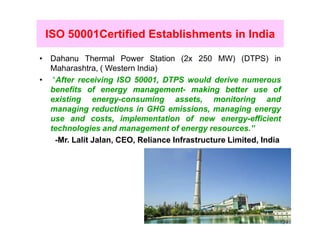
• Dahanu Thermal Power Station (2x 250 MW) (DTPS) in
  Maharashtra, ( Western India)
• “After receiving ISO 50001, DTPS would derive numerous
  benefits of energy management- making better use of
  existing energy-consuming assets, monitoring and
  managing reductions in GHG emissions, managing energy
  use and costs, implementation of new energy-efficient
  technologies and management of energy resources.”
   -Mr. Lalit Jalan, CEO, Reliance Infrastructure Limited, India


                                                                   39
ISO 50001Certified Establishments in India


• IEC Gensets Limited & Core Metal Krafts
  Limited, based in Chandigarh (Northern India)
• Vedanta Aluminium Ltd., Lanjigarh Unit in Orissa
  (Eastern India).
• BSES Kerala Power Limited, a subsidiary of Reliance
  Infrastructure Limited (Southern India)
• The Delhi International Airport Limited (DIAL). DIAL
  became the first airport operator to receive this
  certification.
• In India, so far, more than 30 companies have got
  ISO- 50001 certification

                                                         40
ISO/TC 242
• The next meeting of ISO/TC 242 and its Working Group Meetings to
   be held from 22 to 26 April 2013 at Cape Town ,South Africa.
• The following documents, which are Committee Drafts (CD), are
   being put up by ISO for discussion during the meeting:
1. ISO/CD 50002 Energy audits.
2. ISO/CD 50003 Energy management system audits and auditor
    competency
3. ISO/CD 50004 Guidance for the Implementation, Maintenance
    and Improvement of an EnMS
4. ISO/CD 50006 Energy Baseline and Energy Performance
    Indicators (EnPIs) -- General Principles and Guidance
5. ISO/CD 50015 Monitoring, measurement, analysis and
    verification of organizational energy performance
Impact of BEE Programmes
Standards and Labelling of equipment and appliances
programme has created a market transformation and
promoted energy efficiency among consumers
Energy saving targets have been fixed for 8 sectors of
energy intensive industry- 6.60 million ton of oil equivalent
by 2014-15
More than 200 industrial units and other establishments
have already declared their energy management policy
Promotion of ISO 50001 has been taken as one of the thrust
area of 12th Plan (2012-2017)
Various activities under different schemes have resulted in
savings in avoided power generation capacity of about
10,836 MW during 11th Five Year Plan (2007-2012).


                                                            42
12th Plan(2012-17): Energy Savings Program

• Avoided Peaking Capacity target:       12,350 MW*

• Savings in BU            44.85 BU (consumer end)
                           60.17 BU (at bus bar)

* 12th Plan baseline is the achieved energy efficiency
levels in 2011-12 (Not levels in 2006-07 as for the 11th
Plan)


                                                           43
Each and every one has the energy to save energy
and we must use that energy to save energy every
         moment in every way we can!


      Visit us at www.energymanagertraining.com
                   www.bee-india.nic.in
                                                   44

BEE_India’s Energy Efficiency Policy

  • 1.
    Energy Efficiency Policyof India WORKSHOP ON ENERGY EFFICIENCY AND IMPLEMENTING ENERGY MANAGEMENT SYSTEMS FOR INDUSTRIES 5th March,2013 K. K. Chakarvarti Energy Economist, Bureau of Energy Efficiency New Delhi (INDIA)
  • 2.
    INTRODUCTION India has maderapid strides towards economic self-reliance over the last few decades. Impressive progress has been made in the fields of industry, agriculture, communication, transport and other sectors necessitating growing consumption of energy for developmental and economic activities. 2
  • 3.
    INTRODUCTION (contd.) Conventional sourceof energy such as coal, oil and gas are scarce and exhaustible. Energy prices will rise in the long run to reflect their relative scarcity and high cost of exploration and extraction. Hence, all attempts need to be made expeditiously to ensure the optimal use of the available resources so as to manage the viability and availability of energy use and supply. This has led the Government of India through the Energy Conservation Act and the Bureau of Energy Efficiency to launch several programmes. 3
  • 4.
    THE INDIAN ENERGYCONSERVATION ACT EC Act enacted in October 2001 Become effective from 1st March 2002 Bureau of Energy Efficiency (BEE) operationalized from 1st March 2002. 2002. MISSION OF BEE Develop policy and strategies with a thrust on self regulation and market principles, within the overall framework of the EC Act with the primary objective of reducing energy intensity of the Indian economy. economy. 4
  • 5.
    THE INDIAN ENERGYCONSERVATION ACT The five major provisions of EC Act relate to: Designated Consumers (mainly energy intensive industries) to comply with the specific energy consumption norms for the manufactured products and services and establishment of energy management system, Standards and Labeling of energy consuming appliances, gadgets and equipment to ensure promotion of energy efficiency of the new stocks entering the market Energy Conservation Building Code ensuring that new commercial buildings constructed in the country have less electricity consumption Creation of Institutional Set up (Bureau of Energy Efficiency) for effective coordination of the energy conservation efforts in the country and Establishment of Energy Conservation Fund at Centre and States to provide necessary financial support for energy efficiency initiatives in the country. Energy efficiency institutional practices and programs in India are now mainly being guided through various voluntary and mandatory provisions of the Energy Conservation Act 5
  • 6.
    Mandatory Requirements tobe fulfilled by DCs` Schedule to EC Act provides list of 15 energy intensive industries and other establishments to be notified as designated consumers (DC). DCs to Appoint or designate energy managers in charge of activities for efficient use of energy and its conservation (clause 14(l)). • (Note: The minimum qualification of energy manager to be designated or appointed under clause 14(l) is the passing of certification examination, conducted by Bureau of Energy Efficiency. The following information to be provided for energy manager: – Name of the energy manager – Registration number (EA/EM No.) – Complete postal office address – Telephone and Mobile number – Email address) The information with regard to energy consumed (clause 14(a)) in Form 1 Get energy audits conducted by accredited energy auditors Implement techno-economic viable recommendations Comply with norms of specific energy consumption fixed Submit report on steps taken •
  • 7.
    Designated Consumers -Initiatives 9energy intensive industry have been notified as designated consumers 13 National Certification examinations for Energy Managers and Energy Auditors have been successfully conducted. India has now about 9993 Certified Energy Managers, out of which 7201 are also qualified as Certified Energy Auditors 4 Guidebooks have been prepared to assist energy professionals 85 Coal fired power generating units of various sizes (110-500 MW) have been mapped. Studies have identified 3 million tonne of coal savings potential in 49 nos. of 210 MW units Baseline energy audits studies have been carried out in about 400 units of 8 energy audit industry and thermal power units. 7
  • 8.
  • 10.
    Standards and labeling-Initiatives The National Energy Labeling Programme was launched on 18th May, 2006 14 Equipment and Appliances covered under S&L Programme All the refrigerators (frost free), air conditioners, distribution transformers and fluorescent tube lights that are sold in India must have a BEE Star label w.e.f 7th January,2010 Draft standards & Labelling scheme for passenger cars have been finalised. 10
  • 11.
    Sample Labels Refrigerator 11
  • 12.
    ENERGY CONSERVATION BUILDINGCODE – Initiatives ECBC covering five climatic zones of India (Hot & Dry, Warm & Humid, Composite, Temperate and Cold) prepared ECBC set minimum energy efficiency standards for design and construction Mandatory Scope Covers commercial buildings Survey indicates about 306 buildings being constructed in the country are ECBC complaint 12
  • 13.
    Case study :Fortis Hospital Shalimarbagh, New Delhi • Initial energy consumption: 605 kWh/m2 yr • Building envelope – AAC blocks – Insulated roof – Double glazing and shading for windows
  • 14.
    Case study :Fortis Hospital Base building EPI = 605 kWh/m2 per annum Envelope optimisation EPI = 593 kWh/m2 per annum Lighting optimisation EPI = 476 kWh/m2 per annum Efficient chiller EPI = 346 kWh/m2 per annum Controls for HVAC system ECBC compliant Fortis EPI = 312 kWh/m2 per annum building, New Delhi
  • 15.
    National Energy ConservationAwards BEE coordinates this voluntary activity on behalf of Ministry of Power Due to consistent efforts put in by BEE, scheme has become very popular among industries, as is evident from increasing participation level (773 nomination in 2012 in comparison to 644 nominations in 2011) 15
  • 16.
    ELECTRICAL ENERGY SAVINGIN TERMS OF EQUIVALENT AVOIDED GENERATION CAPACITY (MW) 700 616 600 504 500 Equivalent Capacity Avoided in MW 400 359 357 325 308 300 252 245 200 155 122 100 103 100 90 45 0 1999 2000 2001 2002 2003 2004 2005 2006 2007 2008 2009 2010 2011 2012 Year 16
  • 17.
    YEAR WISE ENERGYSAVINGS ACHIEVED BY PARTICIPATING UNITS IN MINISTRY OF POWER’S ENERGY CONSERVATION AWARD SCHEME (From 1999 to 2012) Electrical Energy Saving Furnace Oil No. of One time Coal Savings Annual Equivalent & Other Gas Savings Participating investment in Lakh Year Savings in Rs. avoided liquid fuel in Lakh cubic industrial in Million kWh Metric Crores capacity in Savings, in metres units Rs. Crores Tonnes MW Lakhs kL 2012 773 2886 1948 4177 616 2.65 25.53 4303 2011 644 2390 2201 3421 504 3.29 33.21 4085 2010 592 2138 5457 2422 357 3.41 23.42 8338 2009 558 2377 3180 2451 359 5.65 12.4 4274 2008 368 1859 2493 2216 325 1.85 3.47 15729 2007 384 1843 2923 1620 308 1.25 5.86 15379 2006 388 1135 1266 1288 245 1.19 5.17 29044 2005 343 993 1319 1327 252 2.4 7.58 13122 2004 297 763 1364 814 155 2.49 5.37 18585 2003 191 539 1071 542 103 2.21 12.65 73181 2002 174 594 691 641 122 1.7 7.4 35588 2001 157 587 659 485 90 2.21 4.79 3929 2000 120 366 630 524 100 1.327 0.64 707 1999 123 205 940 205 45 1.62 2.15 2444 Total 14 18675 26142 22133 3581 33.65 149.53 228709 17 years
  • 18.
    The President ofIndia, Shri Pranab Mukherjee addressing at the National Energy Conservation Day function, in New Delhi on December 14, 2012
  • 19.
    Painting Competition onEnergy Conservation • Ministry of Power and Bureau of Energy Efficiency have been organizing painting competitions on energy conservation for the last 7 years for students of the 4th, 5th and 6th standards at School, State and National levels • The scheme aims at sensitizing the children towards issues of energy conservation. • The scheme is being executed in all the 28 States and 7 UTs • In the year 2012, more than 3,000,000 students participated in comparison to about 343,000 students in 2005. 19
  • 21.
    /- Rs. 1,00,000 /- FIRST PRIZE Name : (01) K R Roshni State : Tamil Nadu
  • 22.
    The President ofIndia, Shri Pranab Mukherjee presented the National Painting Competition Prizes, at the National Energy Conservation Day function, in New Delhi on December 14, 2012. The Minister of State (Independent Charge) for Power, Shri Jyotiraditya Madhavrao Scindia and the Secretary, Ministry of Power, Shri P. Uma Shankar are also seen.
  • 23.
    NMEEE – FourNew Initiatives • Perform Achieve and Trade (PAT): A market based mechanism to enhance cost effec-tiveness of improvements in energy efficiency in energy-intensive large industries and facilities, through certification of energy savings that could be traded. • Market Transformation for Energy Efficiency (MTEE): Accelerating the shift to energy efficient appliances in designated sectors through innovative measures to make the products more affordable • Energy Efficiency Financing Platform (EEFP): Creation of mechanisms that would help finance demand side management programmes in all sectors by capturing future energy savings. • Framework for Energy Efficient Economic Development (FEEED): Developing fiscal instruments to promote energy efficiency
  • 24.
    Perform, Achieve &Trade (PAT) The key goal of the PAT scheme is to mandate specific energy efficiency improvements for the most energy intensive industries. The scheme builds on the large variation in energy intensities of different units in almost every sector, ranging from amongst the best in the world, to extremely inefficient units as well. The energy intensity reduction target mandated for each unit is dependent on its current efficiency : the reduction target is less for those who are more efficient, and is higher for the currently less-efficient units. The design of PAT is the result of extensive consultations over the last two years (2010-11 and 2011-12), which have contributed to its robustness and simplicity.
  • 25.
    EXAMPLE- EXAMPLE- INPUT & OUTPUT FOR A TYPICAL CEMENT PLANT Coal (Indian) (1,03,339 Tons/yr ,GCV 3438 kcal/kg) Coal1 (Imported) CPP 3148 lakh KWh GRID (Exported) (6246 Tons/yr, GCV 5454 kcal/kg) (Heat Rate (19.35 LAKH kWh/YR) 3135 kcal/kWh) Furnace Oil (669 Tons/yr, GCV 10000 kcal/kg) HSD Crushing and DG SET (570 Tons/yr , GCV 8600 kcal/litre) (Heat Rate Mining 2212 kcal/kWh) 2.09 Lakh kWh (Exported) Grid Electricity (53.08 Lakh KWh) (25.12 LAKH kWh/YR) Colony, (5.1 Lakh kWh) Coal2 (Imported) Clinkerization 124746 Tons/yr, GCV 6192 kcal/kg) Pet Coke (Raw Material (3316 Tons/yr, GCV 8400 kcal/kg) Processing & Crushed Limestone Pyro-processing) Iron Ore, Bauxite,Gypsum PPC (14.92LAKHTONNE/YR) Flyash, Slag, Etc Grinding OPC Clinker (0.06 Lakh Tons/yr) (VRM and (0.08 LAKH TONNE/YR) RP &BM) PSC /OTHER (2.30 LAKH TONNE/YR) Note: All values presented in the above diagram are average of annual energy consumption of 2007-08, 2008-09, 2009-10
  • 27.
    PAT Scheme :Scope Covers 478 designated consumers in 8 sectors All DCs consume about 165 million toe energy Targets given to all DCs to achieve the same within a time frame -Achievement > Target E-Scerts -Achievement < Target Purchase E-Scerts / Penalty The Energy Savings Certificates (ESCerts) so issued will be tradable on special trading platforms to be created in the two power exchanges (Indian Energy Exchange and Power Exchange India). National Target = 6.686 million toe at the end of 1st PAT Cycle ( by 2014-15)
  • 28.
    National Energy SavingTargets under PAT (%) (2012-15)
  • 29.
    PAT Benefits The directbenefit for the participating industries in this period is reductions in input costs related to energy of approximately Rs 68000 million. Needless to add, this will significantly enhance global competitiveness of industry while simultaneously reducing India's CO2 emissions by 24 million tons per year in 2014-15.
  • 30.
    ISO 50001 ENERGYMANAGEMENT SYSTEM STANDARD
  • 31.
    Energy Management “The judiciousand effective use of energy to maximize profits (minimize costs) and enhance competitive positions” “The strategy of adjusting and optimizing energy, using systems and procedures so as to reduce energy requirements per unit of output while holding constant or reducing total costs of producing the output from these systems”
  • 32.
    The weight ofEnergy savings compared to other technologies Global CO2 emissions forecast, G.tons CO2 / year
  • 33.
    ISO 50001: EnergyManagement Systems Standard- Introduction ISO 50001- the International Standard for Energy Management Systems (EnMS) This Draft International Standard was released in April 2010 and was published in mid-2011. Energy Management Systems offers a comprehensive and structured approach for energy efficiency improvement. ISO 50001: 2011(E) defines EnMS as “set of interrelated or interacting elements to establish an energy policy and energy objectives, and processes and procedures to achieve those objectives “ Applicable to any organization, whatever the size, industry or geographical location An organization embracing ISO 50001 is likely to further accelerate adoption of energy efficiency practices and to continuously improve its energy performance and cost.
  • 34.
    ISO 50001: EnergyManagement Systems Standard- Introduction ( contd.) Application of the standard can be tailored to fit the requirements of the organization, including degree of documentation, resources and complexity of the system This International Standard can be used for certification/registration and/or self-declaration of an organization's energy management system. The fact that it's based on measurement and verification will help organization stay on track to meet their declared energy policies. Adoption of ISO 50001 by any organization will: • Reduce energy bills • Make manufacturing more sustainable • Promotes energy efficiency throughout the supply chain • Helps in meeting National GHG reduction targets
  • 35.
    ISO 50001-EnMS Requirement ISO 50001 specifies requirements for an organization to establish, implement, maintain and improve an energy management system. Specifies energy management system (EnMS) to : • develop and implement an energy policy, • establish objectives, targets, and action plans which take into account legal requirements This International Standard specifies requirements for all factors affecting: • energy supply, uses and consumption • measurement, documentation and reporting, • design and procurement practices for energy using equipment, processes, systems, and personnel. ISO 50001 does not prescribe specific performance criteria with respect to energy
  • 36.
    ENERGY MANAGEMENT SYSTEMMODEL FOR ISO 50001 CONTINUAL ENERGY POLICY IMPROVEMENT ENERGY PLANNING MANAGEMENT IMPLEMENTATION REVIEW AND OPERATION INTERNAL AUDIT CHECKING MONITORING, MEASUREMENT AND ANALYSIS CORRECTIVE AND PREVENTIVE ACTIONS
  • 37.
    Comparison between ISO50001, ISO 9001 and ISO 14001 • ISO 50001 is in line with ISO 9001 and ISO 14001 standards that address quality management and environmental management issues. • ISO 50001 is based on the same Plan-Do-Check-Act approach of ISO 9001 and ISO 14001 and it draws extensively on the structure and content of the QMS and EMS. • Implementation of ISO 9001 means what the organization does to fulfill the customer's quality requirements, and applicable regulatory requirements, while aiming to enhance customer satisfaction, • Implementation of ISO 14001 means what the organization does to minimize harmful effects on the environment caused by its activities, and to achieve continual improvement of its environmental performance. • Similarly ISO 50001 implementation is expected to address what the organization does to effectively manage energy resources and performance that is relevant to global standards.
  • 38.
    ISO 50001 inIndian Context (contd.) In order to achieve the targets, as set , the plant is required to have a strong energy management system , well defined energy policy and qualified human resource. More than 200 industrial units and other establishments have already declared their energy policy and have certified energy managers and energy auditors. India has now about 9993 Certified Energy Managers, out of which 7201 are also qualified as Certified Energy Auditors, from the previous 12 examinations conducted by Bureau of Energy Efficiency since 2004. These professionally qualified energy managers and energy auditors have expertise in energy management, project management, financing and implementation of energy efficiency projects, and policy analysis In view of the above , it may be relatively easier for Indian industry to adopt ISO 50001 Standard
  • 39.
    ISO 50001Certified Establishmentsin India • Dahanu Thermal Power Station (2x 250 MW) (DTPS) in Maharashtra, ( Western India) • “After receiving ISO 50001, DTPS would derive numerous benefits of energy management- making better use of existing energy-consuming assets, monitoring and managing reductions in GHG emissions, managing energy use and costs, implementation of new energy-efficient technologies and management of energy resources.” -Mr. Lalit Jalan, CEO, Reliance Infrastructure Limited, India 39
  • 40.
    ISO 50001Certified Establishmentsin India • IEC Gensets Limited & Core Metal Krafts Limited, based in Chandigarh (Northern India) • Vedanta Aluminium Ltd., Lanjigarh Unit in Orissa (Eastern India). • BSES Kerala Power Limited, a subsidiary of Reliance Infrastructure Limited (Southern India) • The Delhi International Airport Limited (DIAL). DIAL became the first airport operator to receive this certification. • In India, so far, more than 30 companies have got ISO- 50001 certification 40
  • 41.
    ISO/TC 242 • Thenext meeting of ISO/TC 242 and its Working Group Meetings to be held from 22 to 26 April 2013 at Cape Town ,South Africa. • The following documents, which are Committee Drafts (CD), are being put up by ISO for discussion during the meeting: 1. ISO/CD 50002 Energy audits. 2. ISO/CD 50003 Energy management system audits and auditor competency 3. ISO/CD 50004 Guidance for the Implementation, Maintenance and Improvement of an EnMS 4. ISO/CD 50006 Energy Baseline and Energy Performance Indicators (EnPIs) -- General Principles and Guidance 5. ISO/CD 50015 Monitoring, measurement, analysis and verification of organizational energy performance
  • 42.
    Impact of BEEProgrammes Standards and Labelling of equipment and appliances programme has created a market transformation and promoted energy efficiency among consumers Energy saving targets have been fixed for 8 sectors of energy intensive industry- 6.60 million ton of oil equivalent by 2014-15 More than 200 industrial units and other establishments have already declared their energy management policy Promotion of ISO 50001 has been taken as one of the thrust area of 12th Plan (2012-2017) Various activities under different schemes have resulted in savings in avoided power generation capacity of about 10,836 MW during 11th Five Year Plan (2007-2012). 42
  • 43.
    12th Plan(2012-17): EnergySavings Program • Avoided Peaking Capacity target: 12,350 MW* • Savings in BU 44.85 BU (consumer end) 60.17 BU (at bus bar) * 12th Plan baseline is the achieved energy efficiency levels in 2011-12 (Not levels in 2006-07 as for the 11th Plan) 43
  • 44.
    Each and everyone has the energy to save energy and we must use that energy to save energy every moment in every way we can! Visit us at www.energymanagertraining.com www.bee-india.nic.in 44