Intermolecular
Forces
Intermolecular Forces,
Liquids, and Solids
Intermolecular
Forces
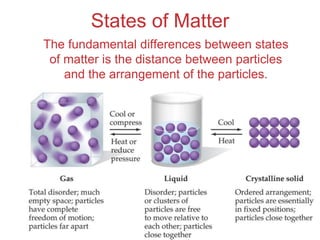
States of Matter
The fundamental differences between states
of matter is the distance between particles
and the arrangement of the particles.
Intermolecular
Forces
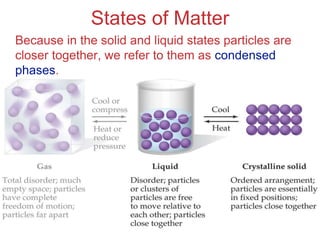
States of Matter
Because in the solid and liquid states particles are
closer together, we refer to them as condensed
phases.
Intermolecular
Forces
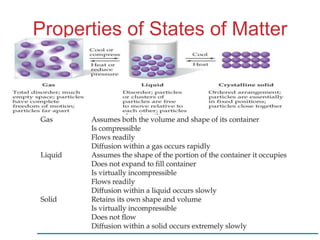
Properties of States of Matter
Intermolecular
Forces
The States of Matter
• The state a substance is in at a particular
temperature and pressure depends on two
antagonistic entities
The kinetic energy of the particles
The strength of the attractions
between the particles
Intermolecular
Forces
Intermolecular Forces
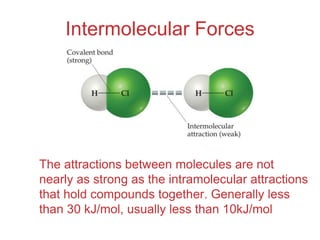
The attractions between molecules are not
nearly as strong as the intramolecular attractions
that hold compounds together. Generally less
than 30 kJ/mol, usually less than 10kJ/mol
Intermolecular
Forces
Intermolecular Forces
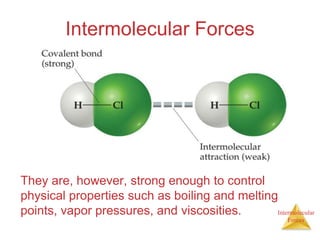
They are, however, strong enough to control
physical properties such as boiling and melting
points, vapor pressures, and viscosities.
Intermolecular
Forces
Intermolecular Forces
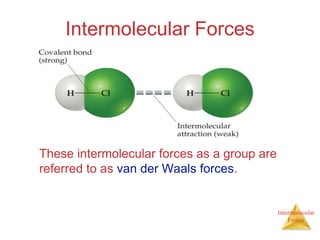
These intermolecular forces as a group are
referred to as van der Waals forces.
Intermolecular
Forces
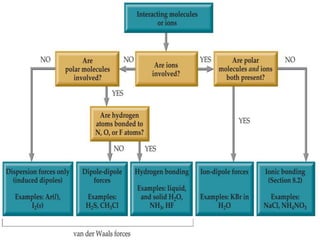
Van der Waals Forces
• Dipole-dipole interactions
• Hydrogen bonding
• London dispersion forces
Intermolecular
Forces
1. Dipole-Dipole Interactions
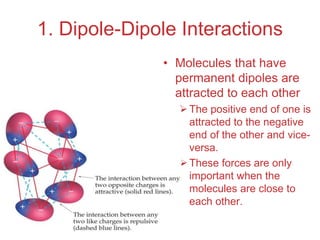
• Molecules that have
permanent dipoles are
attracted to each other
The positive end of one is
attracted to the negative
end of the other and vice-
versa.
These forces are only
important when the
molecules are close to
each other.
Intermolecular
Forces
Dipole-Dipole Interactions
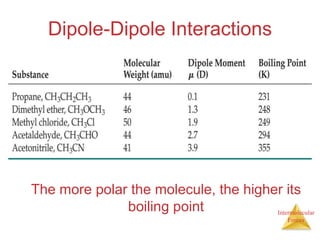
The more polar the molecule, the higher its
boiling point
Intermolecular
Forces
2. London Dispersion Forces
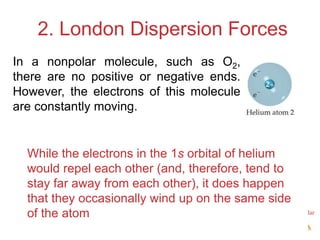
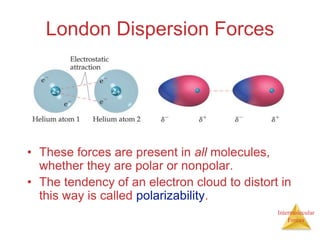
While the electrons in the 1s orbital of helium
would repel each other (and, therefore, tend to
stay far away from each other), it does happen
that they occasionally wind up on the same side
of the atom
In a nonpolar molecule, such as O​2,
there are no positive or negative ends.
However, the electrons of this molecule
are constantly moving.
Intermolecular
Forces
London Dispersion Forces
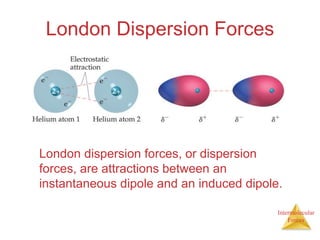
London dispersion forces, or dispersion
forces, are attractions between an
instantaneous dipole and an induced dipole.
Intermolecular
Forces
London Dispersion Forces
• These forces are present in all molecules,
whether they are polar or nonpolar.
• The tendency of an electron cloud to distort in
this way is called polarizability.
Intermolecular
Forces
Factors Affecting London Forces
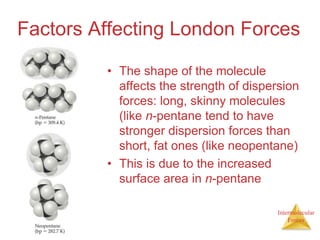
• The shape of the molecule
affects the strength of dispersion
forces: long, skinny molecules
(like n-pentane tend to have
stronger dispersion forces than
short, fat ones (like neopentane)
• This is due to the increased
surface area in n-pentane
Intermolecular
Forces
Factors Affecting London Forces
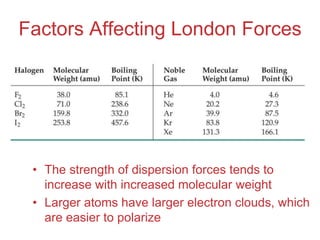
• The strength of dispersion forces tends to
increase with increased molecular weight
• Larger atoms have larger electron clouds, which
are easier to polarize
Intermolecular
Forces
Which Have a Greater Effect:
Dipole-Dipole Interactions or Dispersion Forces?
• If two molecules are of comparable size
and shape, dipole-dipole interactions
will likely be the dominating force
• If one molecule is much larger than
another, dispersion forces will likely
determine its physical properties
Intermolecular
Forces
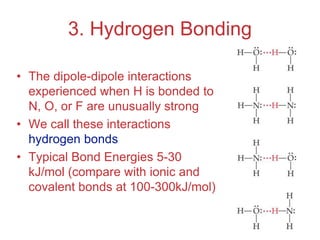
3. Hydrogen Bonding
• The dipole-dipole interactions
experienced when H is bonded to
N, O, or F are unusually strong
• We call these interactions
hydrogen bonds
• Typical Bond Energies 5-30
kJ/mol (compare with ionic and
covalent bonds at 100-300kJ/mol)
Intermolecular
Forces
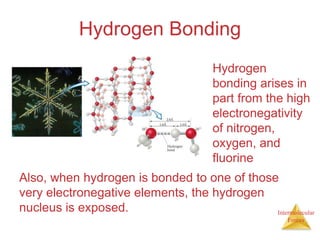
Hydrogen Bonding
Hydrogen
bonding arises in
part from the high
electronegativity
of nitrogen,
oxygen, and
fluorine
Also, when hydrogen is bonded to one of those
very electronegative elements, the hydrogen
nucleus is exposed.
Intermolecular
Forces
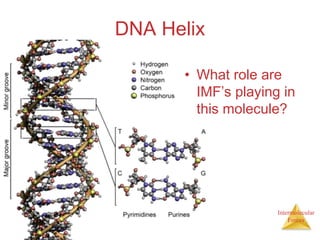
DNA Helix
• What role are
IMF’s playing in
this molecule?
Intermolecular
Forces
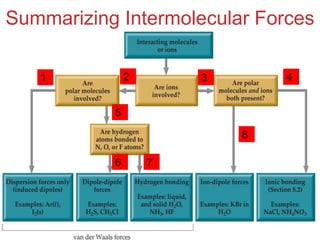
Summarizing Intermolecular Forces
1 4
3
2
7
6
5
8
Intermolecular
Forces
Intermolecular
Forces
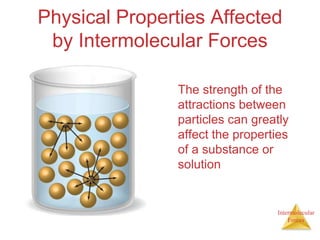
Physical Properties Affected
by Intermolecular Forces
The strength of the
attractions between
particles can greatly
affect the properties
of a substance or
solution
Intermolecular
Forces
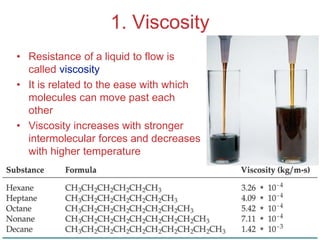
1. Viscosity
• Resistance of a liquid to flow is
called viscosity
• It is related to the ease with which
molecules can move past each
other
• Viscosity increases with stronger
intermolecular forces and decreases
with higher temperature
Intermolecular
Forces
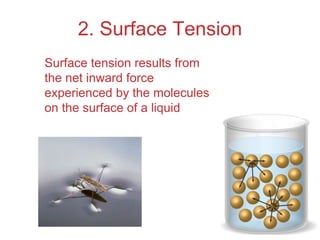
2. Surface Tension
Surface tension results from
the net inward force
experienced by the molecules
on the surface of a liquid
Intermolecular
Forces
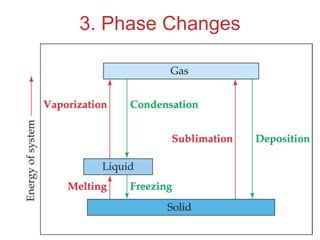
3. Phase Changes
Intermolecular
Forces
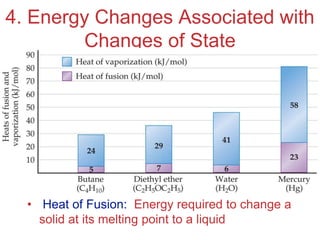
4. Energy Changes Associated with
Changes of State
• Heat of Fusion: Energy required to change a
solid at its melting point to a liquid
Intermolecular
Forces
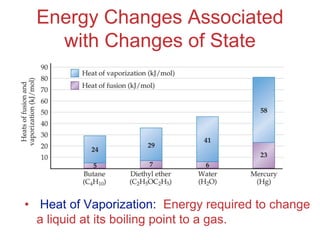
Energy Changes Associated
with Changes of State
• Heat of Vaporization: Energy required to change
a liquid at its boiling point to a gas.
Intermolecular
Forces
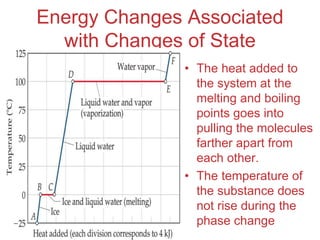
Energy Changes Associated
with Changes of State
• The heat added to
the system at the
melting and boiling
points goes into
pulling the molecules
farther apart from
each other.
• The temperature of
the substance does
not rise during the
phase change
Intermolecular
Forces
5. Vapor Pressure
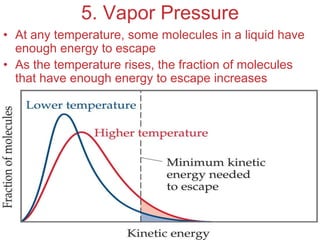
• At any temperature, some molecules in a liquid have
enough energy to escape
• As the temperature rises, the fraction of molecules
that have enough energy to escape increases
Intermolecular
Forces
Vapor Pressure
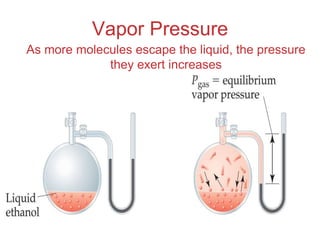
As more molecules escape the liquid, the pressure
they exert increases
Intermolecular
Forces
Vapor Pressure
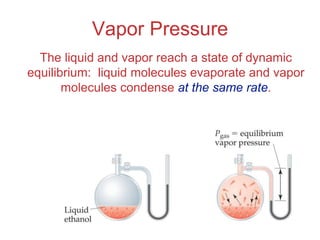
The liquid and vapor reach a state of dynamic
equilibrium: liquid molecules evaporate and vapor
molecules condense at the same rate.
Intermolecular
Forces
Vapor Pressure
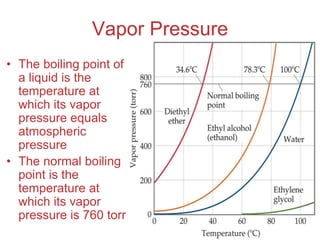
• The boiling point of
a liquid is the
temperature at
which its vapor
pressure equals
atmospheric
pressure
• The normal boiling
point is the
temperature at
which its vapor
pressure is 760 torr
Intermolecular
Forces
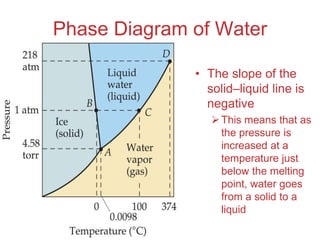
Phase Diagram of Water
• The slope of the
solid–liquid line is
negative
This means that as
the pressure is
increased at a
temperature just
below the melting
point, water goes
from a solid to a
liquid
Intermolecular
Forces
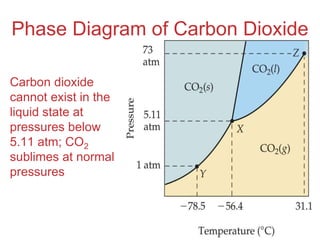
Phase Diagram of Carbon Dioxide
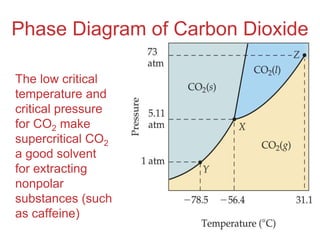
Carbon dioxide
cannot exist in the
liquid state at
pressures below
5.11 atm; CO2
sublimes at normal
pressures
Intermolecular
Forces
Phase Diagram of Carbon Dioxide
The low critical
temperature and
critical pressure
for CO2 make
supercritical CO2
a good solvent
for extracting
nonpolar
substances (such
as caffeine)
Intermolecular
Forces
Solids
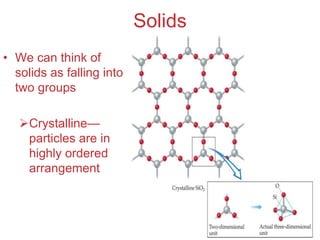
• We can think of
solids as falling into
two groups
Crystalline—
particles are in
highly ordered
arrangement
Intermolecular
Forces
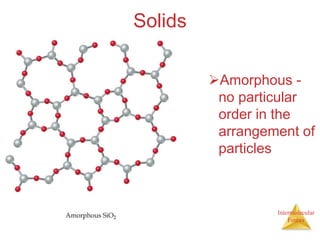
Solids
Amorphous -
no particular
order in the
arrangement of
particles
Intermolecular
Forces
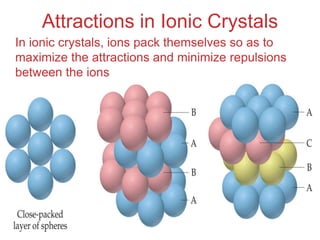
Attractions in Ionic Crystals
In ionic crystals, ions pack themselves so as to
maximize the attractions and minimize repulsions
between the ions
Intermolecular
Forces
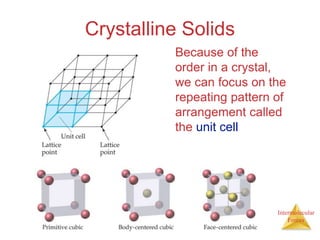
Crystalline Solids
Because of the
order in a crystal,
we can focus on the
repeating pattern of
arrangement called
the unit cell
Intermolecular
Forces
Crystalline Solids
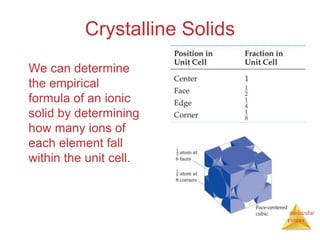
We can determine
the empirical
formula of an ionic
solid by determining
how many ions of
each element fall
within the unit cell.
Intermolecular
Forces
Ionic Solids
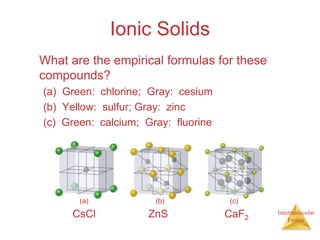
What are the empirical formulas for these
compounds?
(a) Green: chlorine; Gray: cesium
(b) Yellow: sulfur; Gray: zinc
(c) Green: calcium; Gray: fluorine
CsCl ZnS CaF2
(a) (b) (c)
Intermolecular
Forces
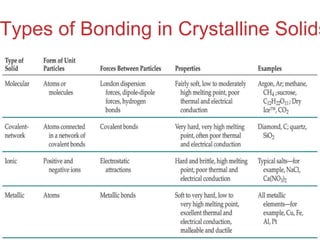
Types of Bonding in Crystalline Solids
Intermolecular
Forces
Covalent-Network and
Molecular Solids
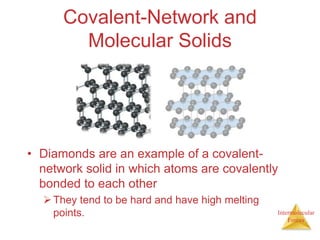
• Diamonds are an example of a covalent-
network solid in which atoms are covalently
bonded to each other
They tend to be hard and have high melting
points.
Intermolecular
Forces
Covalent-Network and
Molecular Solids
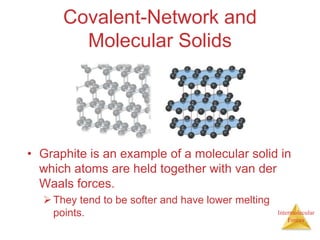
• Graphite is an example of a molecular solid in
which atoms are held together with van der
Waals forces.
They tend to be softer and have lower melting
points.
Intermolecular
Forces
Metallic Solids
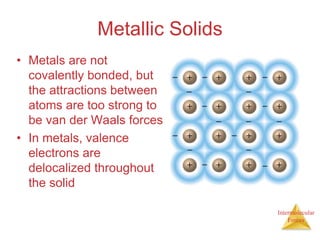
• Metals are not
covalently bonded, but
the attractions between
atoms are too strong to
be van der Waals forces
• In metals, valence
electrons are
delocalized throughout
the solid
Intermolecular
Forces

Intermolecular_Forces_Liquids_and_Solids-Autosaved.ppt