© 2012 Pearson Education, Inc.
Chapter 11
Intermolecular
Forces
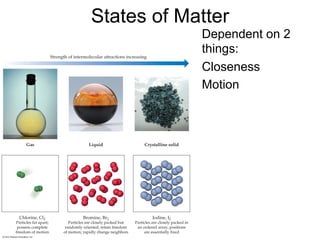
States of Matter
Dependent on 2
things:
Closeness
Motion
States of Matter
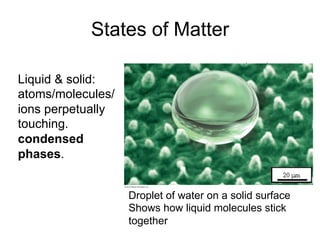
Liquid & solid:
atoms/molecules/
ions perpetually
touching.
condensed
phases.
Droplet of water on a solid surface
Shows how liquid molecules stick
together
The States of Matter
• The state of matter depends on:
– temperature
– pressure
– The kinetic energy of the particles.
– The strength of the attractions between the particles.
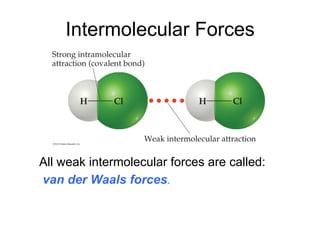
Intermolecular Forces
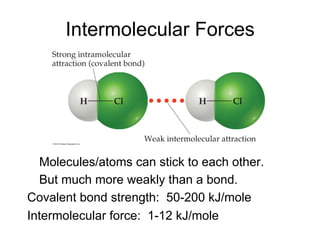
Molecules/atoms can stick to each other.
But much more weakly than a bond.
Covalent bond strength: 50-200 kJ/mole
Intermolecular force: 1-12 kJ/mole
Intermolecular Forces
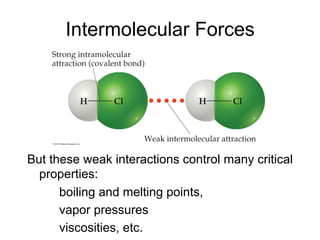
But these weak interactions control many critical
properties:
boiling and melting points,
vapor pressures
viscosities, etc.
Intermolecular Forces
All weak intermolecular forces are called:
van der Waals forces.
van der Waals Forces
Two major forms:
• Dipole–dipole interactions
– Hydrogen bonding
• London dispersion forces
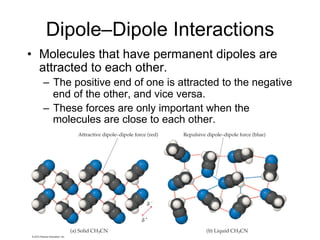
Dipole–Dipole Interactions
• Molecules that have permanent dipoles are
attracted to each other.
– The positive end of one is attracted to the negative
end of the other, and vice versa.
– These forces are only important when the
molecules are close to each other.
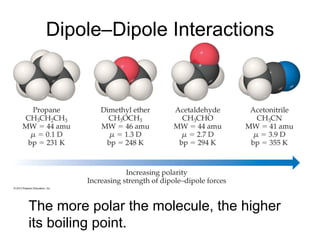
Dipole–Dipole Interactions
The more polar the molecule, the higher
its boiling point.
Hydrogen Bonding
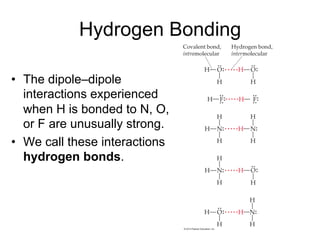
• The dipole–dipole
interactions experienced
when H is bonded to N, O,
or F are unusually strong.
• We call these interactions
hydrogen bonds.
Hydrogen Bonding
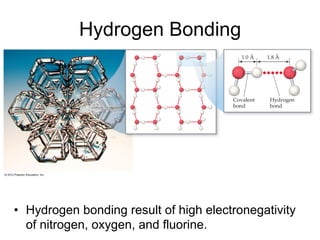
• Hydrogen bonding result of high electronegativity
of nitrogen, oxygen, and fluorine.
Ion–Dipole Interactions
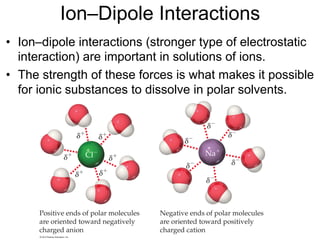
• Ion–dipole interactions (stronger type of electrostatic
interaction) are important in solutions of ions.
• The strength of these forces is what makes it possible
for ionic substances to dissolve in polar solvents.
London Dispersion Forces
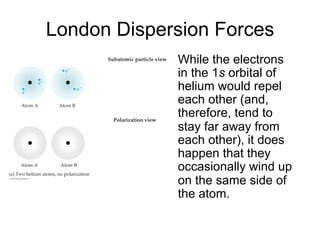
While the electrons
in the 1s orbital of
helium would repel
each other (and,
therefore, tend to
stay far away from
each other), it does
happen that they
occasionally wind up
on the same side of
the atom.
London Dispersion Forces
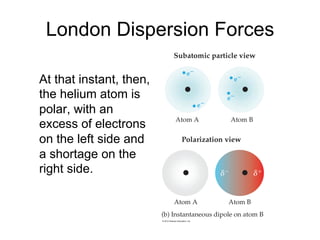
At that instant, then,
the helium atom is
polar, with an
excess of electrons
on the left side and
a shortage on the
right side.
London Dispersion Forces
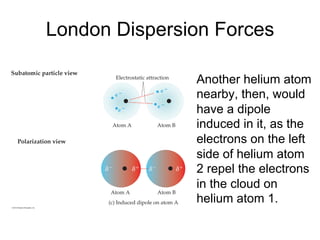
Another helium atom
nearby, then, would
have a dipole
induced in it, as the
electrons on the left
side of helium atom
2 repel the electrons
in the cloud on
helium atom 1.
London Dispersion Forces
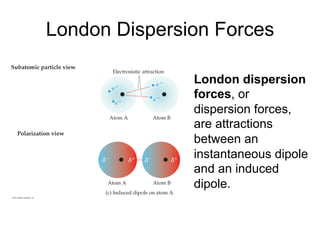
London dispersion
forces, or
dispersion forces,
are attractions
between an
instantaneous dipole
and an induced
dipole.
London Dispersion Forces
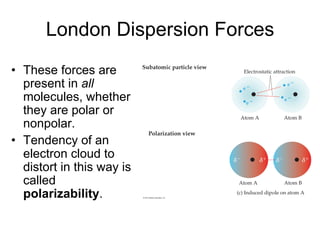
• These forces are
present in all
molecules, whether
they are polar or
nonpolar.
• Tendency of an
electron cloud to
distort in this way is
called
polarizability.
Factors Affecting London Forces
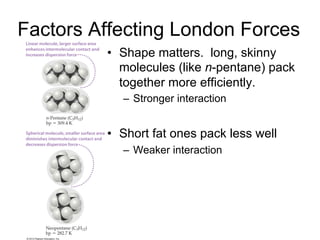
• Shape matters. long, skinny
molecules (like n-pentane) pack
together more efficiently.
– Stronger interaction
• Short fat ones pack less well
– Weaker interaction
Factors Affecting London Forces
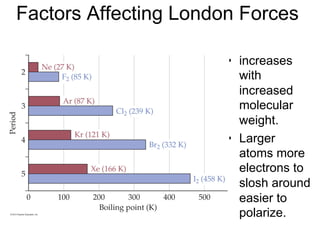
• increases
with
increased
molecular
weight.
• Larger
atoms more
electrons to
slosh around
easier to
polarize.
Which Have a Greater Effect?
Dipole–Dipole Interactions or Dispersion Forces
• If two molecules are of comparable size
and shape, dipole–dipole interactions
will likely be the dominating force.
• If one molecule is much larger than
another, dispersion forces will likely
determine its physical properties.
How Do We Explain This?
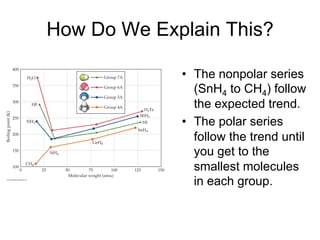
• The nonpolar series
(SnH4 to CH4) follow
the expected trend.
• The polar series
follow the trend until
you get to the
smallest molecules
in each group.
Summarizing Intermolecular Forces
Intermolecular Forces Affect
Many Physical Properties
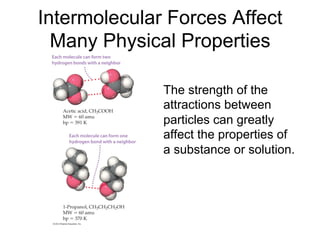
The strength of the
attractions between
particles can greatly
affect the properties of
a substance or solution.
Viscosity
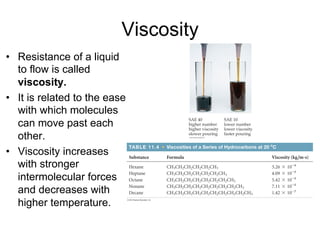
• Resistance of a liquid
to flow is called
viscosity.
• It is related to the ease
with which molecules
can move past each
other.
• Viscosity increases
with stronger
intermolecular forces
and decreases with
higher temperature.
Surface Tension
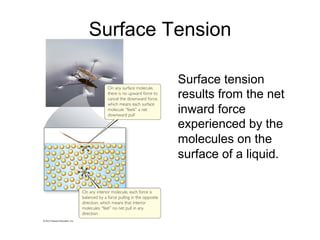
Surface tension
results from the net
inward force
experienced by the
molecules on the
surface of a liquid.

Intramolecularforces.pdf

  • 1.
    © 2012 PearsonEducation, Inc. Chapter 11 Intermolecular Forces
  • 2.
    States of Matter Dependenton 2 things: Closeness Motion
  • 3.
    States of Matter Liquid& solid: atoms/molecules/ ions perpetually touching. condensed phases. Droplet of water on a solid surface Shows how liquid molecules stick together
  • 4.
    The States ofMatter • The state of matter depends on: – temperature – pressure – The kinetic energy of the particles. – The strength of the attractions between the particles.
  • 5.
    Intermolecular Forces Molecules/atoms canstick to each other. But much more weakly than a bond. Covalent bond strength: 50-200 kJ/mole Intermolecular force: 1-12 kJ/mole
  • 6.
    Intermolecular Forces But theseweak interactions control many critical properties: boiling and melting points, vapor pressures viscosities, etc.
  • 7.
    Intermolecular Forces All weakintermolecular forces are called: van der Waals forces.
  • 8.
    van der WaalsForces Two major forms: • Dipole–dipole interactions – Hydrogen bonding • London dispersion forces
  • 9.
    Dipole–Dipole Interactions • Moleculesthat have permanent dipoles are attracted to each other. – The positive end of one is attracted to the negative end of the other, and vice versa. – These forces are only important when the molecules are close to each other.
  • 10.
    Dipole–Dipole Interactions The morepolar the molecule, the higher its boiling point.
  • 11.
    Hydrogen Bonding • Thedipole–dipole interactions experienced when H is bonded to N, O, or F are unusually strong. • We call these interactions hydrogen bonds.
  • 12.
    Hydrogen Bonding • Hydrogenbonding result of high electronegativity of nitrogen, oxygen, and fluorine.
  • 13.
    Ion–Dipole Interactions • Ion–dipoleinteractions (stronger type of electrostatic interaction) are important in solutions of ions. • The strength of these forces is what makes it possible for ionic substances to dissolve in polar solvents.
  • 14.
    London Dispersion Forces Whilethe electrons in the 1s orbital of helium would repel each other (and, therefore, tend to stay far away from each other), it does happen that they occasionally wind up on the same side of the atom.
  • 15.
    London Dispersion Forces Atthat instant, then, the helium atom is polar, with an excess of electrons on the left side and a shortage on the right side.
  • 16.
    London Dispersion Forces Anotherhelium atom nearby, then, would have a dipole induced in it, as the electrons on the left side of helium atom 2 repel the electrons in the cloud on helium atom 1.
  • 17.
    London Dispersion Forces Londondispersion forces, or dispersion forces, are attractions between an instantaneous dipole and an induced dipole.
  • 18.
    London Dispersion Forces •These forces are present in all molecules, whether they are polar or nonpolar. • Tendency of an electron cloud to distort in this way is called polarizability.
  • 19.
    Factors Affecting LondonForces • Shape matters. long, skinny molecules (like n-pentane) pack together more efficiently. – Stronger interaction • Short fat ones pack less well – Weaker interaction
  • 20.
    Factors Affecting LondonForces • increases with increased molecular weight. • Larger atoms more electrons to slosh around easier to polarize.
  • 21.
    Which Have aGreater Effect? Dipole–Dipole Interactions or Dispersion Forces • If two molecules are of comparable size and shape, dipole–dipole interactions will likely be the dominating force. • If one molecule is much larger than another, dispersion forces will likely determine its physical properties.
  • 22.
    How Do WeExplain This? • The nonpolar series (SnH4 to CH4) follow the expected trend. • The polar series follow the trend until you get to the smallest molecules in each group.
  • 23.
  • 24.
    Intermolecular Forces Affect ManyPhysical Properties The strength of the attractions between particles can greatly affect the properties of a substance or solution.
  • 25.
    Viscosity • Resistance ofa liquid to flow is called viscosity. • It is related to the ease with which molecules can move past each other. • Viscosity increases with stronger intermolecular forces and decreases with higher temperature.
  • 26.
    Surface Tension Surface tension resultsfrom the net inward force experienced by the molecules on the surface of a liquid.