Intermolecular
Forces of
Attraction
CA Standards
Students know the atoms and
molecules in liquids move in a random
pattern relative to one another
because the intermolecular forces are
too weak to hold the atoms or
molecules in a solid form.
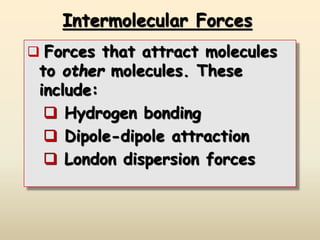
Intermolecular Forces
 Forces that attract molecules
to other molecules. These
include:
 Hydrogen bonding
 Dipole-dipole attraction
 London dispersion forces
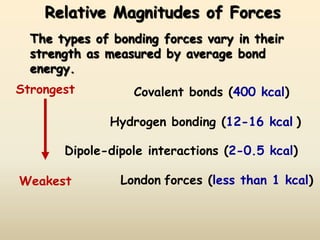
Relative Magnitudes of Forces
The types of bonding forces vary in their
strength as measured by average bond
energy.
Covalent bonds (400 kcal)
Hydrogen bonding (12-16 kcal )
Dipole-dipole interactions (2-0.5 kcal)
London forces (less than 1 kcal)
Strongest
Weakest
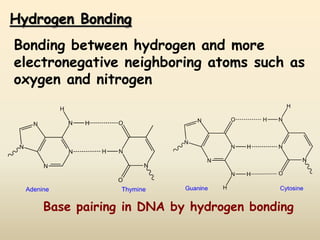
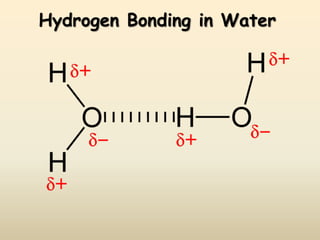
Hydrogen Bonding
Bonding between hydrogen and more
electronegative neighboring atoms such as
oxygen and nitrogen
Base pairing in DNA by hydrogen bonding
Hydrogen Bonding in Water
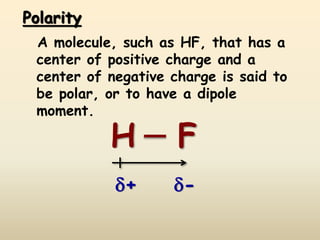
Polarity
A molecule, such as HF, that has a
center of positive charge and a
center of negative charge is said to
be polar, or to have a dipole
moment.
H F
+ -
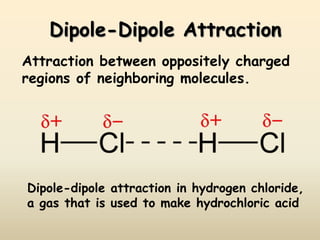
Dipole-Dipole Attraction
Attraction between oppositely charged
regions of neighboring molecules.
Dipole-dipole attraction in hydrogen chloride,
a gas that is used to make hydrochloric acid
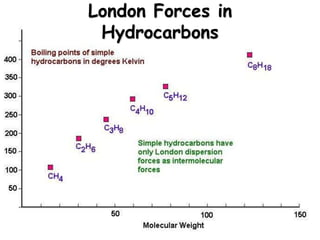
London (Dispersion) Forces
 The weakest of intermolecular forces,
these forces are proportional to the mass of
the molecule
 These are the only forces of attraction
between completely nonpolar molecules
 Large nonpolar molecules may have
substantial dispersion forces, resulting in
relatively high boiling points
 Small nonpolar molecules have weak
dispersion forces and exist almost
exclusively as gases
London Forces in
Hydrocarbons

IntermolecularForces.ppsx

  • 1.
  • 2.
    CA Standards Students knowthe atoms and molecules in liquids move in a random pattern relative to one another because the intermolecular forces are too weak to hold the atoms or molecules in a solid form.
  • 3.
    Intermolecular Forces  Forcesthat attract molecules to other molecules. These include:  Hydrogen bonding  Dipole-dipole attraction  London dispersion forces
  • 4.
    Relative Magnitudes ofForces The types of bonding forces vary in their strength as measured by average bond energy. Covalent bonds (400 kcal) Hydrogen bonding (12-16 kcal ) Dipole-dipole interactions (2-0.5 kcal) London forces (less than 1 kcal) Strongest Weakest
  • 5.
    Hydrogen Bonding Bonding betweenhydrogen and more electronegative neighboring atoms such as oxygen and nitrogen Base pairing in DNA by hydrogen bonding
  • 6.
  • 7.
    Polarity A molecule, suchas HF, that has a center of positive charge and a center of negative charge is said to be polar, or to have a dipole moment. H F + -
  • 8.
    Dipole-Dipole Attraction Attraction betweenoppositely charged regions of neighboring molecules. Dipole-dipole attraction in hydrogen chloride, a gas that is used to make hydrochloric acid
  • 9.
    London (Dispersion) Forces The weakest of intermolecular forces, these forces are proportional to the mass of the molecule  These are the only forces of attraction between completely nonpolar molecules  Large nonpolar molecules may have substantial dispersion forces, resulting in relatively high boiling points  Small nonpolar molecules have weak dispersion forces and exist almost exclusively as gases
  • 10.