




Language	
  and	
  
                                    Communication:	
  
Matsumoto, D. & Juang, L. (2007).
Culture and Psychology (4th Ed.).
          Wadsworth.
                                    A Culture and Psychology Perspective

                                                    Prof. Dr. Hora Tjitra & Ran Shan, Zhejiang University
                                                                                    Hangzhou, February 2011
What is “communication”?


                                                            	
  What	
  is	
  communica-on?

                                                           	
  Why	
  communica-on	
  is	
  
                                                           • 	


  one	
  of	
  the	
  most	
  important	
  	
  
                                                           • 	


  aspects	
  of	
  our	
  lives?

                                                           	
  What	
  is	
  important	
  in	
  the	


                                                           • 	


  cross-­‐culture	
  communica-on?


           Language	
  and	
  Communica.on	
  from	
  Cross-­‐cultural	
  Perspec.ve

                                                                                                                             2
Prof. Dr. Hora Tjitra - Excellence in Culture, Talent and Change


                                                                    14	
  years	
  in	
  Germany


                                                                                                   7	
  years	
  in	
  China


                                                                                                             Born	
  and	
  grew	
  up	
  
                                                                                                             in	
  Indonesia


               Language	
  and	
  Communica.on	
  from	
  Cross-­‐cultural	
  Perspec.ve

                                                                                                                                             3
Prof. Dr. Hora Tjitra - Excellence in Culture, Talent and Change


                                                                                         14	
  years	
  in	
  Germany


 Professional activities:
 • Academic Teaching and Research, as well as Consulting,
   Coaching, Training and Assessment in the area of:                                                                    7	
  years	
  in	
  China
   -   Cross-Cultural Awareness and Communication
   -   Cross-Cultural Issues in HR Management
   -   Corporate Learning and Development
   -   Executive Coaching and Assessment
   -   Global Leadership Development Program
   -   Facilitation of Strategic Conference                                                                                       Born	
  and	
  grew	
  up	
  
       Large Strategic Change Projects                                                                                            in	
  Indonesia
   -
 International and National project references:
 • BASF, Siemens, Dupont, Commerzbank, Hugo Boss, SAP,
   Barco, GTZ, Telkom Indonesia, etc.


                                    Language	
  and	
  Communica.on	
  from	
  Cross-­‐cultural	
  Perspec.ve

                                                                                                                                                                  3
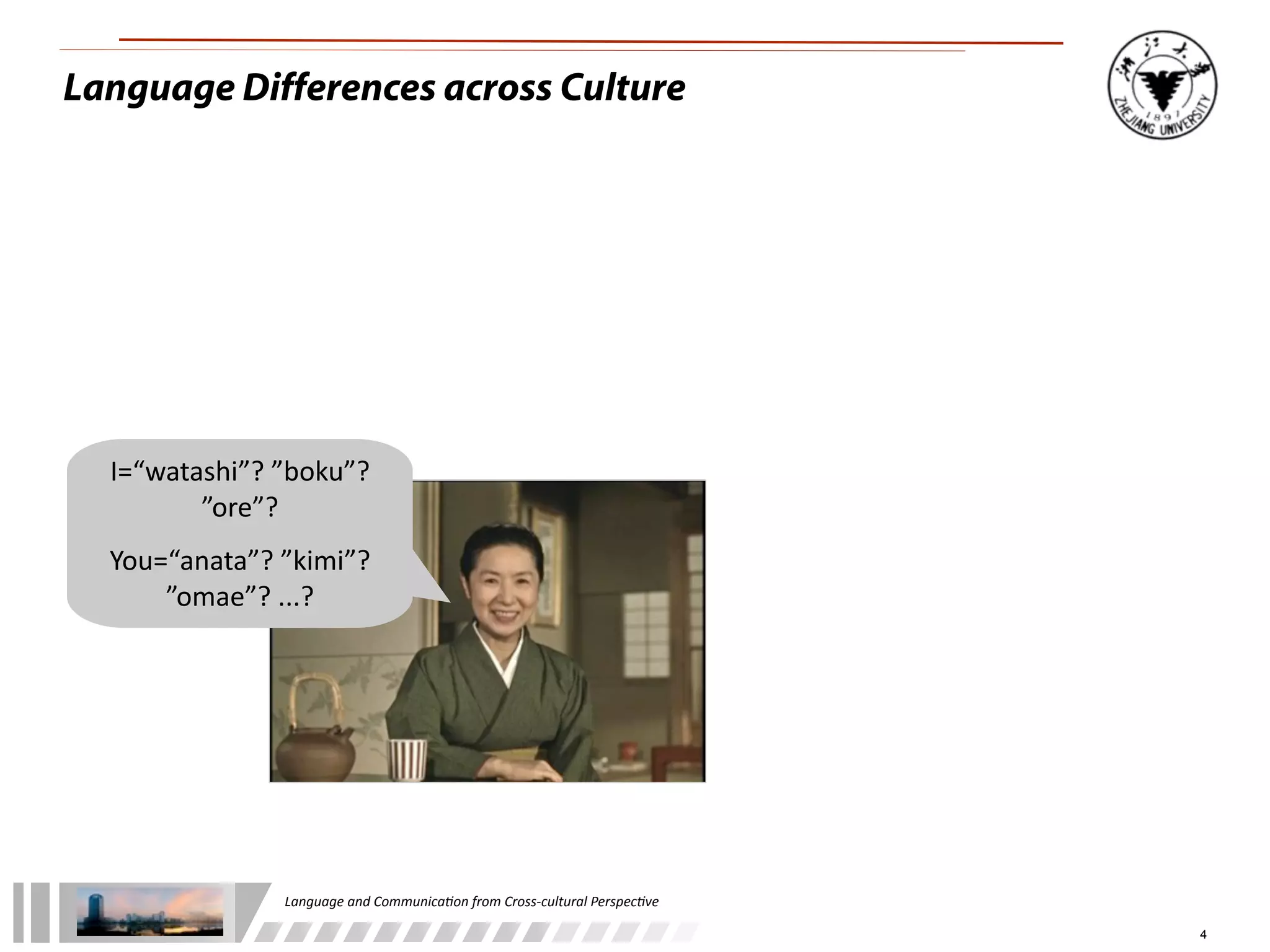
Language Differences across Culture


  I=“watashi”?	
  ”boku”?	
  
         ”ore”?	
  
  You=“anata”?	
  ”kimi”?	
  	
  
      ”omae”?	
  ...?


                     Language	
  and	
  Communica.on	
  from	
  Cross-­‐cultural	
  Perspec.ve

                                                                                                 4
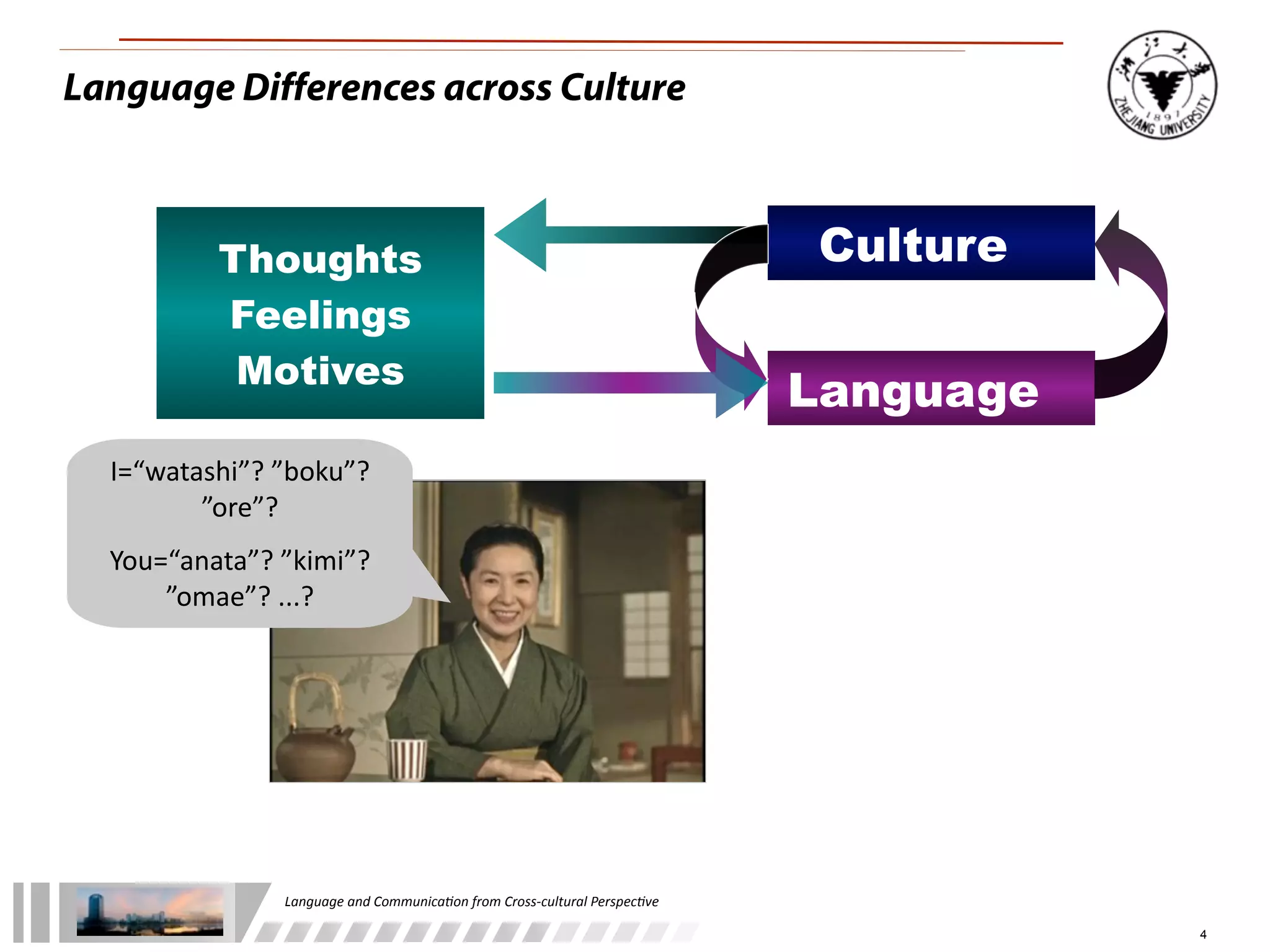
Language Differences across Culture


              Thoughts                                                                           Culture
              Feelings
               Motives
                                                                                                 Language
  I=“watashi”?	
  ”boku”?	
  
         ”ore”?	
  
  You=“anata”?	
  ”kimi”?	
  	
  
      ”omae”?	
  ...?


                     Language	
  and	
  Communica.on	
  from	
  Cross-­‐cultural	
  Perspec.ve

                                                                                                            4
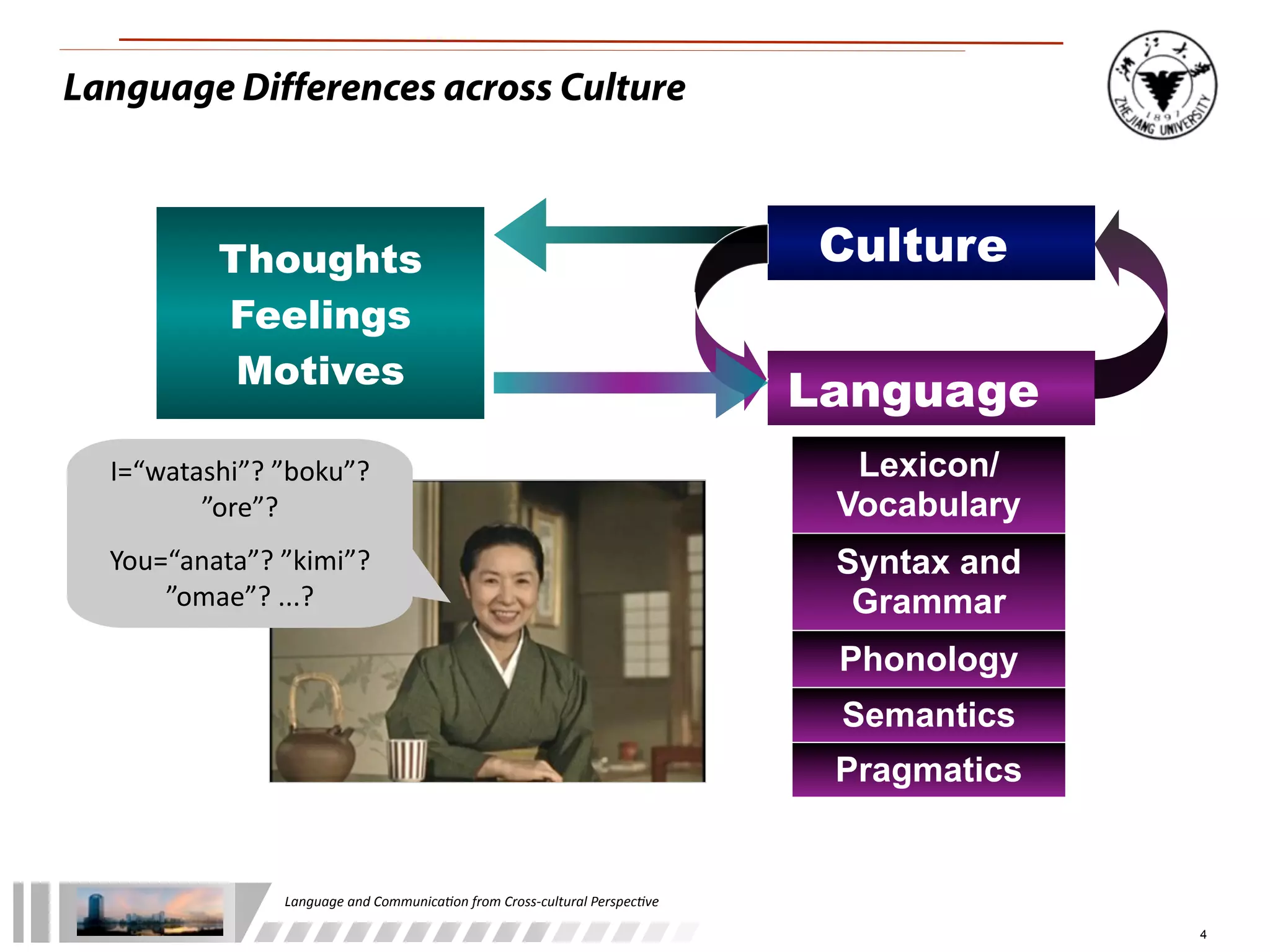
Language Differences across Culture


              Thoughts                                                                           Culture
              Feelings
               Motives
                                                                                                 Language
  I=“watashi”?	
  ”boku”?	
                                                                        Lexicon/
         ”ore”?	
                                                                                 Vocabulary
  You=“anata”?	
  ”kimi”?	
  	
                                                                   Syntax and
      ”omae”?	
  ...?                                                                              Grammar
                                                                                                  Phonology
                                                                                                  Semantics
                                                                                                  Pragmatics


                     Language	
  and	
  Communica.on	
  from	
  Cross-­‐cultural	
  Perspec.ve

                                                                                                               4
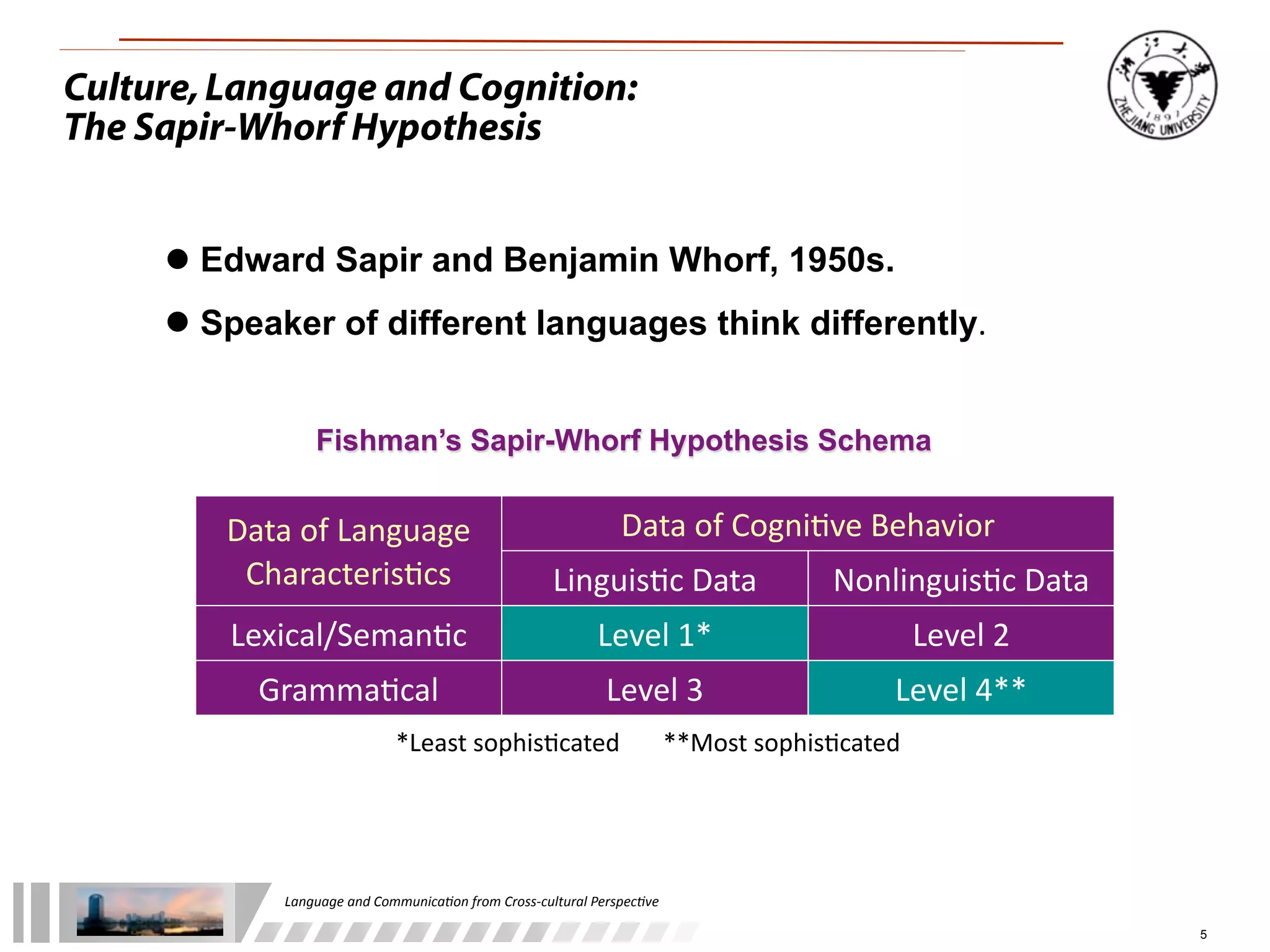
Culture, Language and Cognition:
The Sapir-Whorf Hypothesis


      Edward Sapir and Benjamin Whorf, 1950s.
      Speaker of different languages think differently.


                     Fishman’s Sapir-Whorf Hypothesis Schema


         Data	
  of	
  Language	
                                               Data	
  of	
  Cogni3ve	
  Behavior
          Characteris3cs                                           Linguis3c	
  Data               Nonlinguis3c	
  Data
         Lexical/Seman3c                                                   Level	
  1*                         Level	
  2
            Gramma3cal                                                       Level	
  3                    Level	
  4**
                                    *Least	
  sophis:cated	


  **Most	
  sophis:cated


               Language	
  and	
  Communica.on	
  from	
  Cross-­‐cultural	
  Perspec.ve

                                                                                                                            5
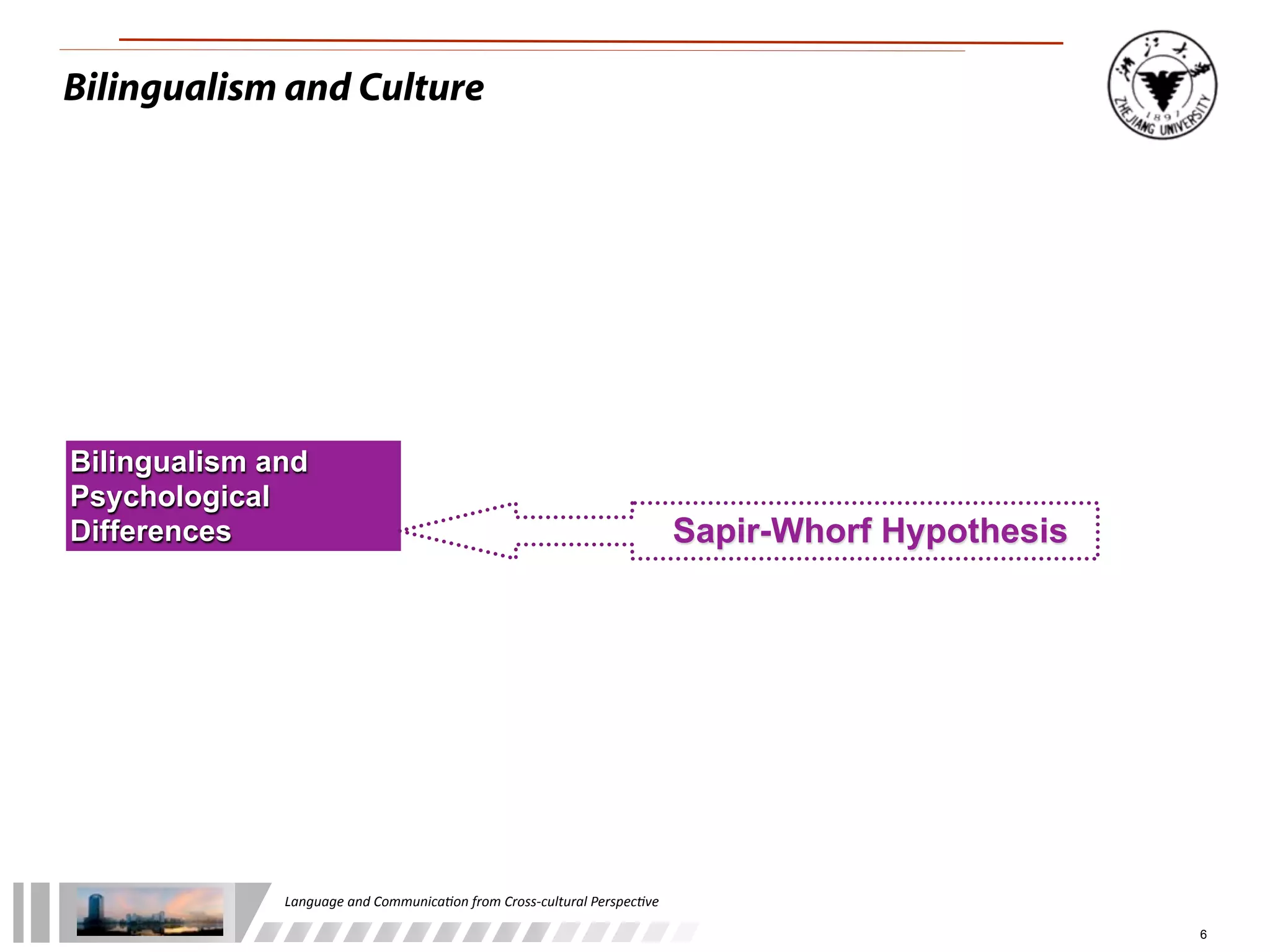
Bilingualism and Culture


Bilingualism and
Psychological
Differences                                                                               Sapir-Whorf Hypothesis


              Language	
  and	
  Communica.on	
  from	
  Cross-­‐cultural	
  Perspec.ve

                                                                                                                   6
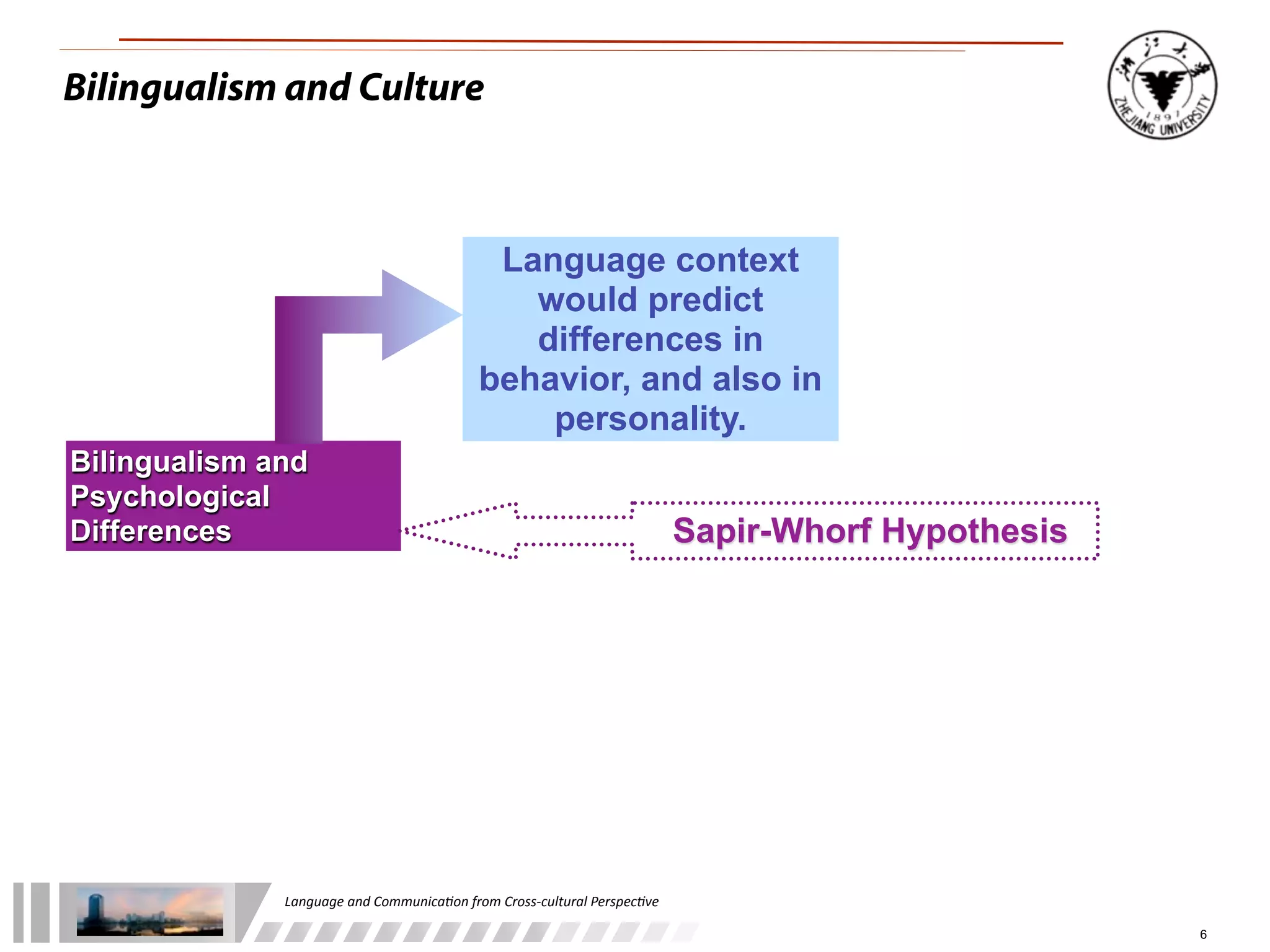
Bilingualism and Culture


                                                    Language context
                                                      would predict
                                                      differences in
                                                   behavior, and also in
                                                       personality.
Bilingualism and
Psychological
Differences                                                                               Sapir-Whorf Hypothesis


              Language	
  and	
  Communica.on	
  from	
  Cross-­‐cultural	
  Perspec.ve

                                                                                                                   6
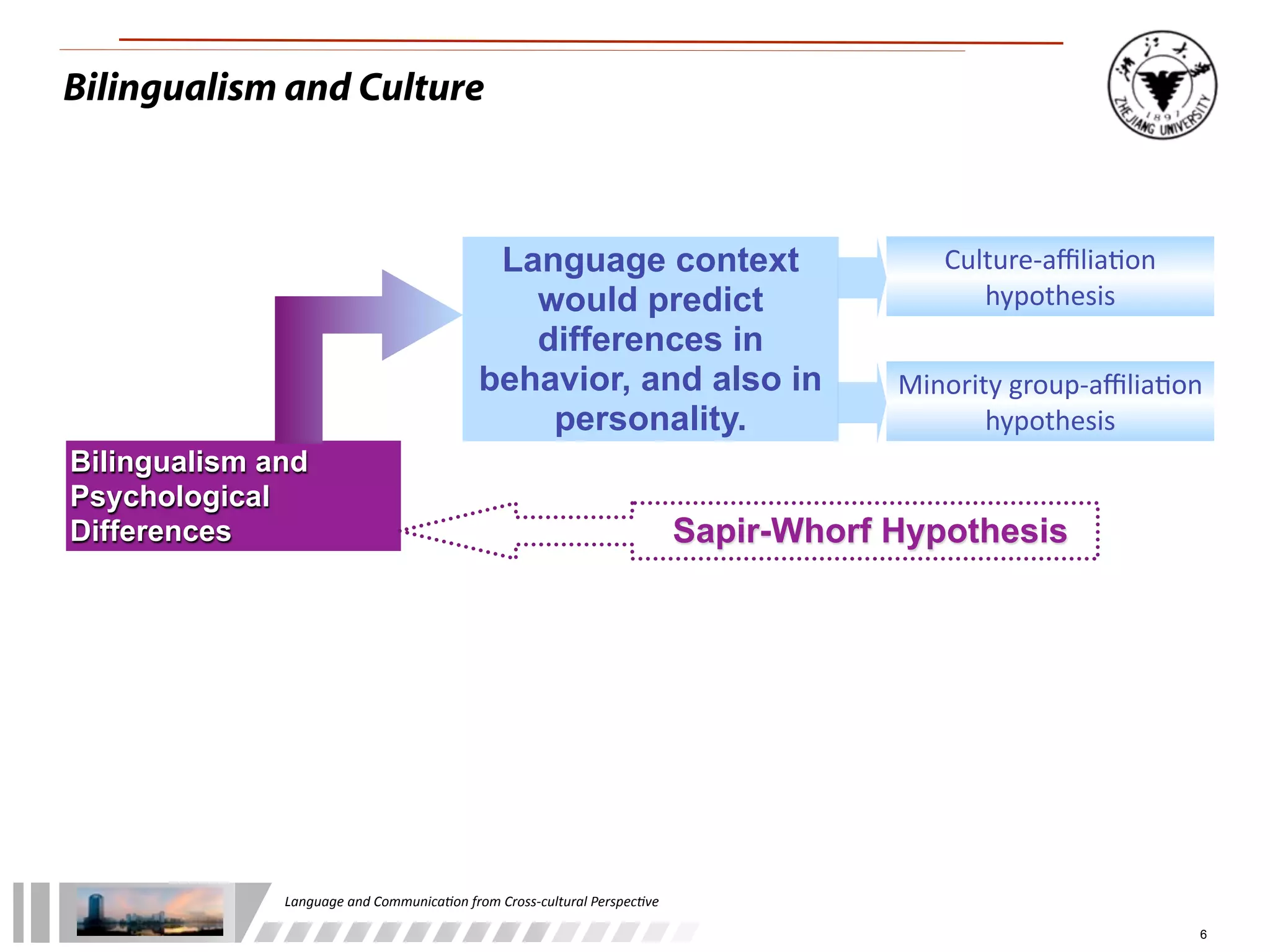
Bilingualism and Culture


                                                    Language context                                      Culture-­‐affilia:on	
  
                                                      would predict                                          hypothesis
                                                      differences in
                                                   behavior, and also in                              Minority	
  group-­‐affilia:on	
  
                                                       personality.                                          hypothesis
Bilingualism and
Psychological
Differences                                                                               Sapir-Whorf Hypothesis


              Language	
  and	
  Communica.on	
  from	
  Cross-­‐cultural	
  Perspec.ve

                                                                                                                                     6
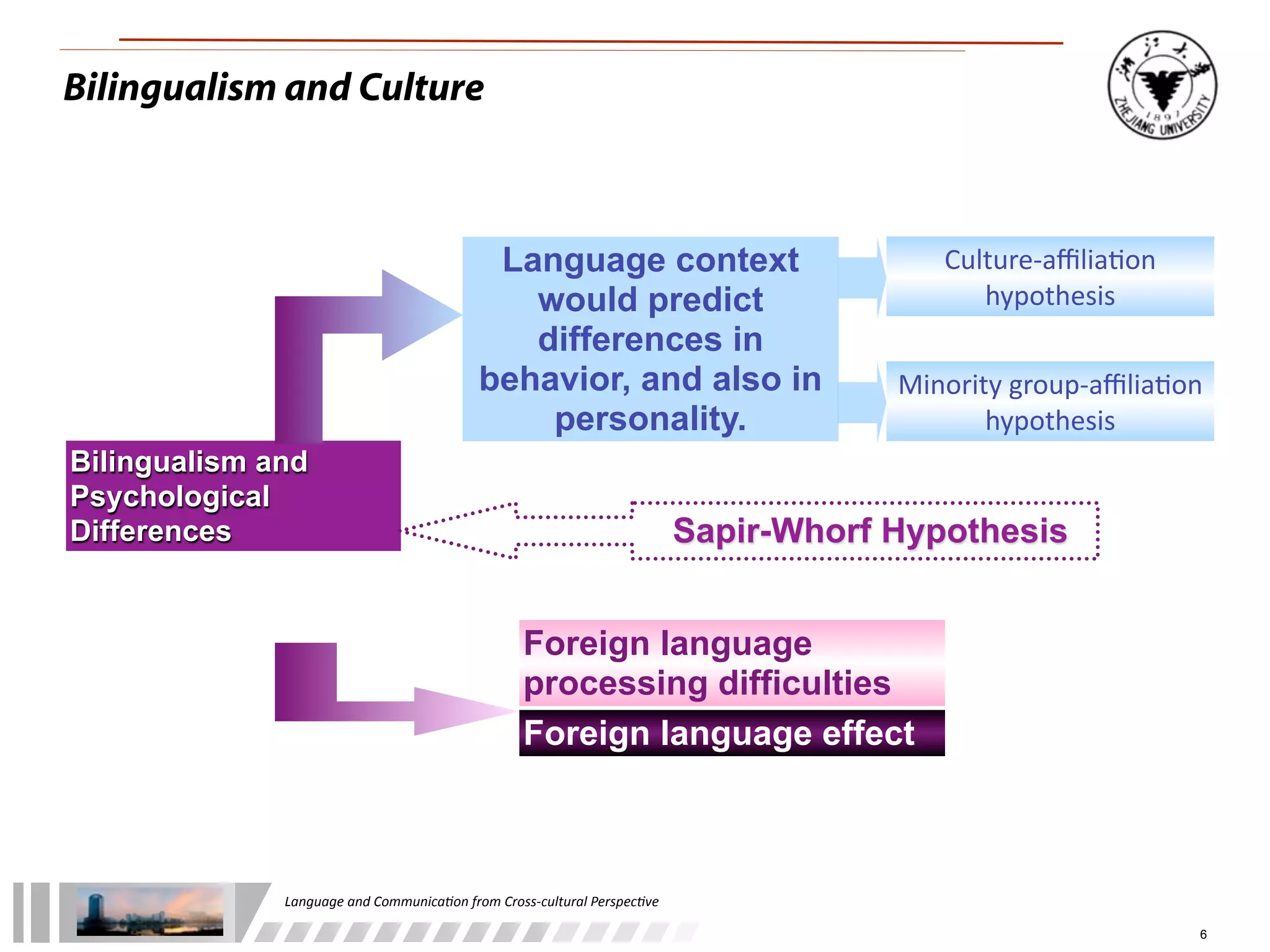
Bilingualism and Culture


                                                    Language context                                      Culture-­‐affilia:on	
  
                                                      would predict                                          hypothesis
                                                      differences in
                                                   behavior, and also in                              Minority	
  group-­‐affilia:on	
  
                                                       personality.                                          hypothesis
Bilingualism and
Psychological
Differences                                                                               Sapir-Whorf Hypothesis


                                                            Foreign language
                                                            processing difficulties
                                                            Foreign language effect


              Language	
  and	
  Communica.on	
  from	
  Cross-­‐cultural	
  Perspec.ve

                                                                                                                                     6
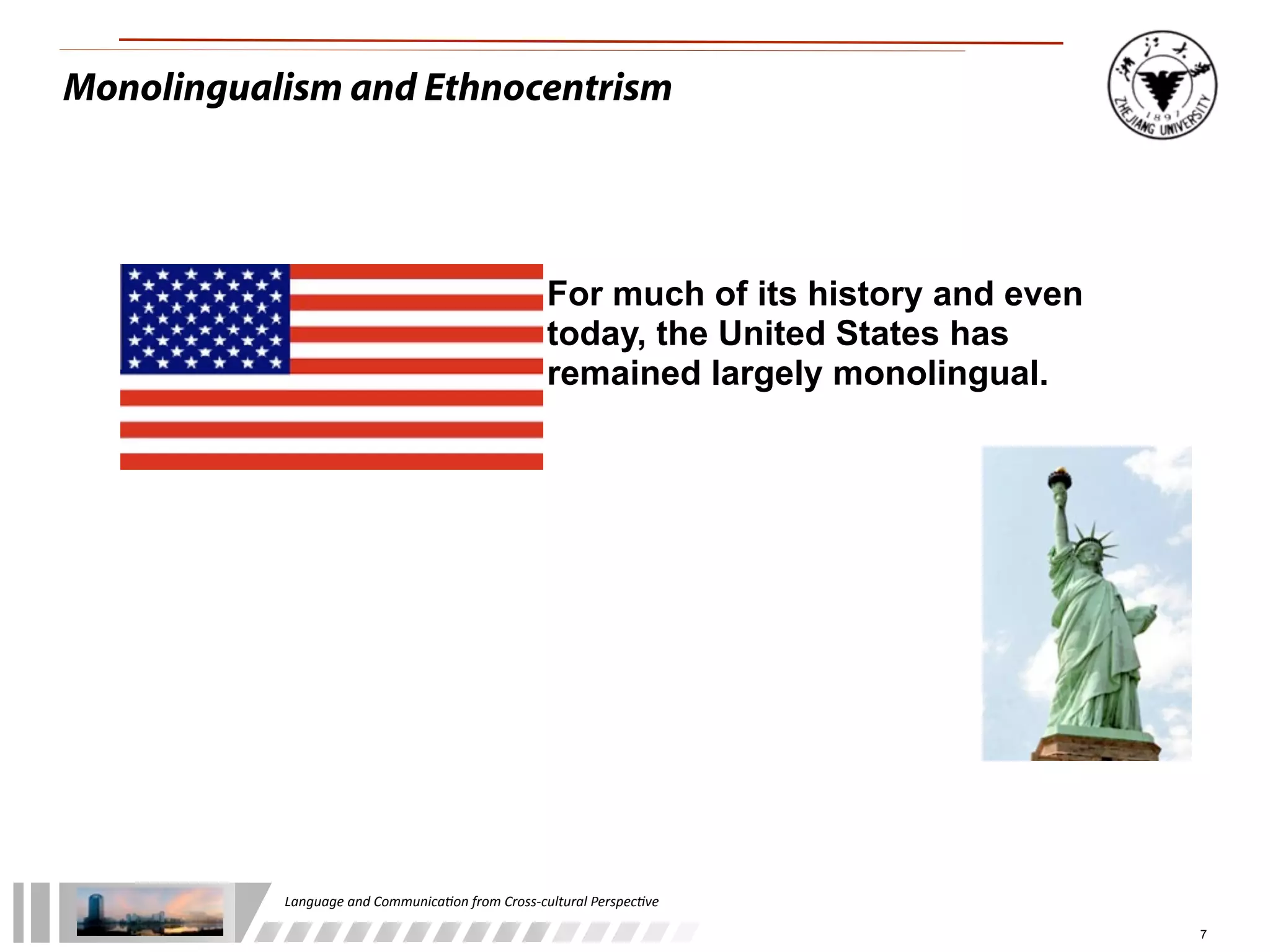
Monolingualism and Ethnocentrism


                                                              For much of its history and even
                                                              today, the United States has
                                                              remained largely monolingual.


           Language	
  and	
  Communica.on	
  from	
  Cross-­‐cultural	
  Perspec.ve

                                                                                                 7
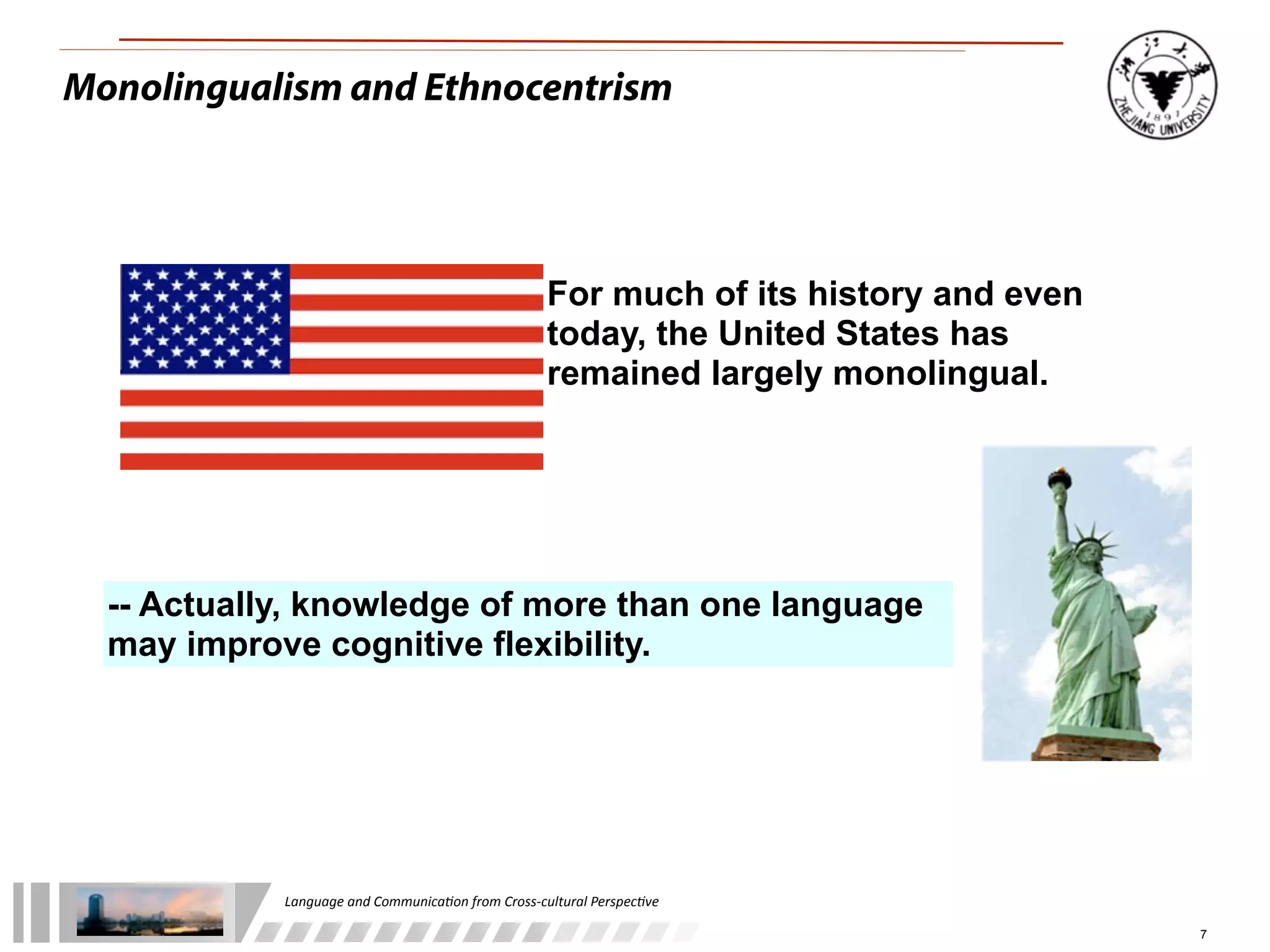
Monolingualism and Ethnocentrism


                                                               For much of its history and even
                                                               today, the United States has
                                                               remained largely monolingual.


  -- Actually, knowledge of more than one language
  may improve cognitive flexibility.


            Language	
  and	
  Communica.on	
  from	
  Cross-­‐cultural	
  Perspec.ve

                                                                                                  7
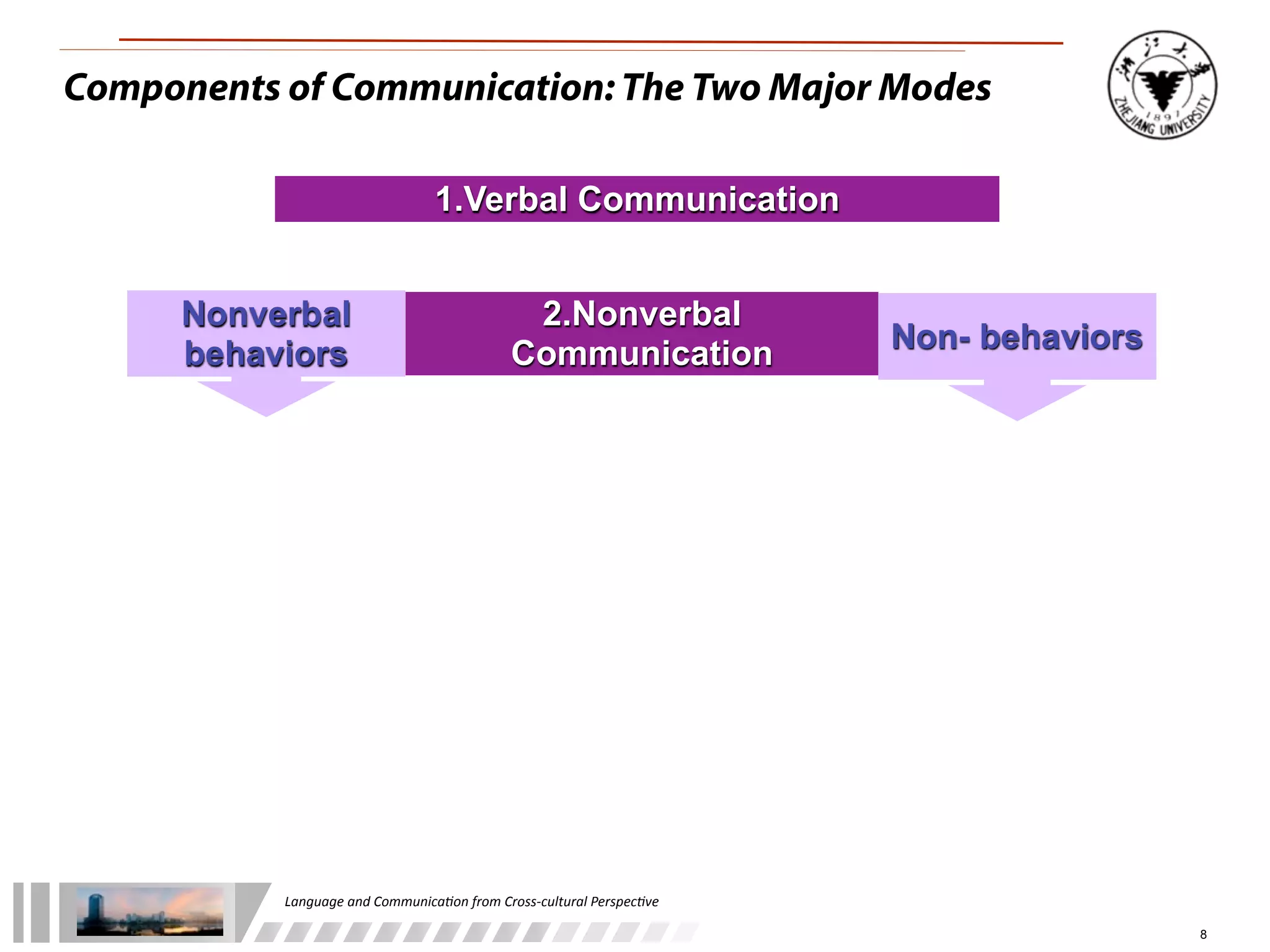
Components of Communication: The Two Major Modes


           Language	
  and	
  Communica.on	
  from	
  Cross-­‐cultural	
  Perspec.ve

                                                                                       8
Components of Communication: The Two Major Modes

                                        1.Verbal Communication


           Language	
  and	
  Communica.on	
  from	
  Cross-­‐cultural	
  Perspec.ve

                                                                                       8
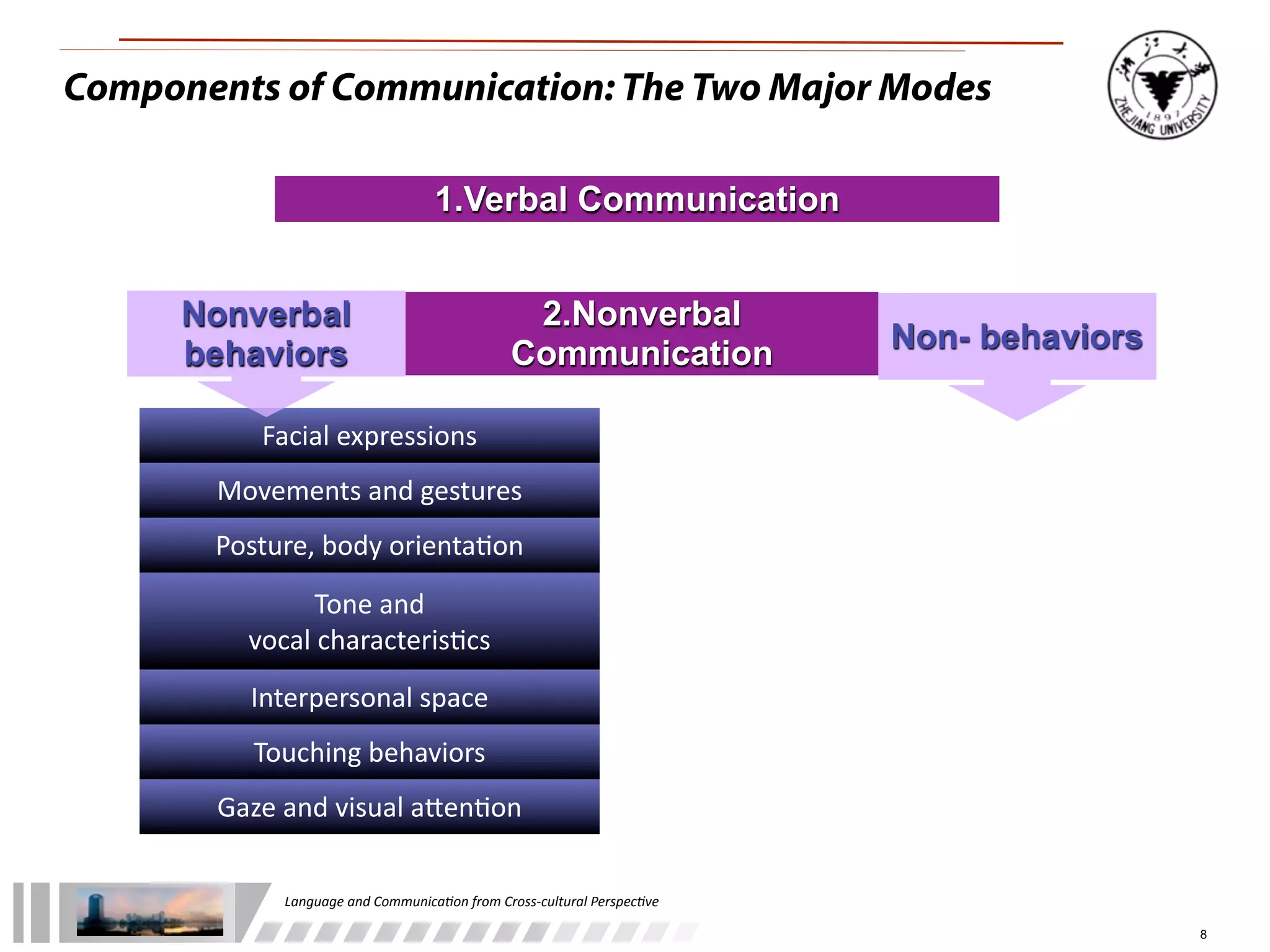
Components of Communication: The Two Major Modes

                                        1.Verbal Communication


      Nonverbal                                         2.Nonverbal
      behaviors                                        Communication                   Non- behaviors


           Language	
  and	
  Communica.on	
  from	
  Cross-­‐cultural	
  Perspec.ve

                                                                                                        8
Components of Communication: The Two Major Modes

                                           1.Verbal Communication


      Nonverbal                                            2.Nonverbal
      behaviors                                           Communication                   Non- behaviors

           Facial	
  expressions
       Movements	
  and	
  gestures
       Posture,	
  body	
  orienta:on
                 Tone	
  and	
  
          vocal	
  characteris:cs
          Interpersonal	
  space
          Touching	
  behaviors
       Gaze	
  and	
  visual	
  aLen:on


              Language	
  and	
  Communica.on	
  from	
  Cross-­‐cultural	
  Perspec.ve

                                                                                                           8
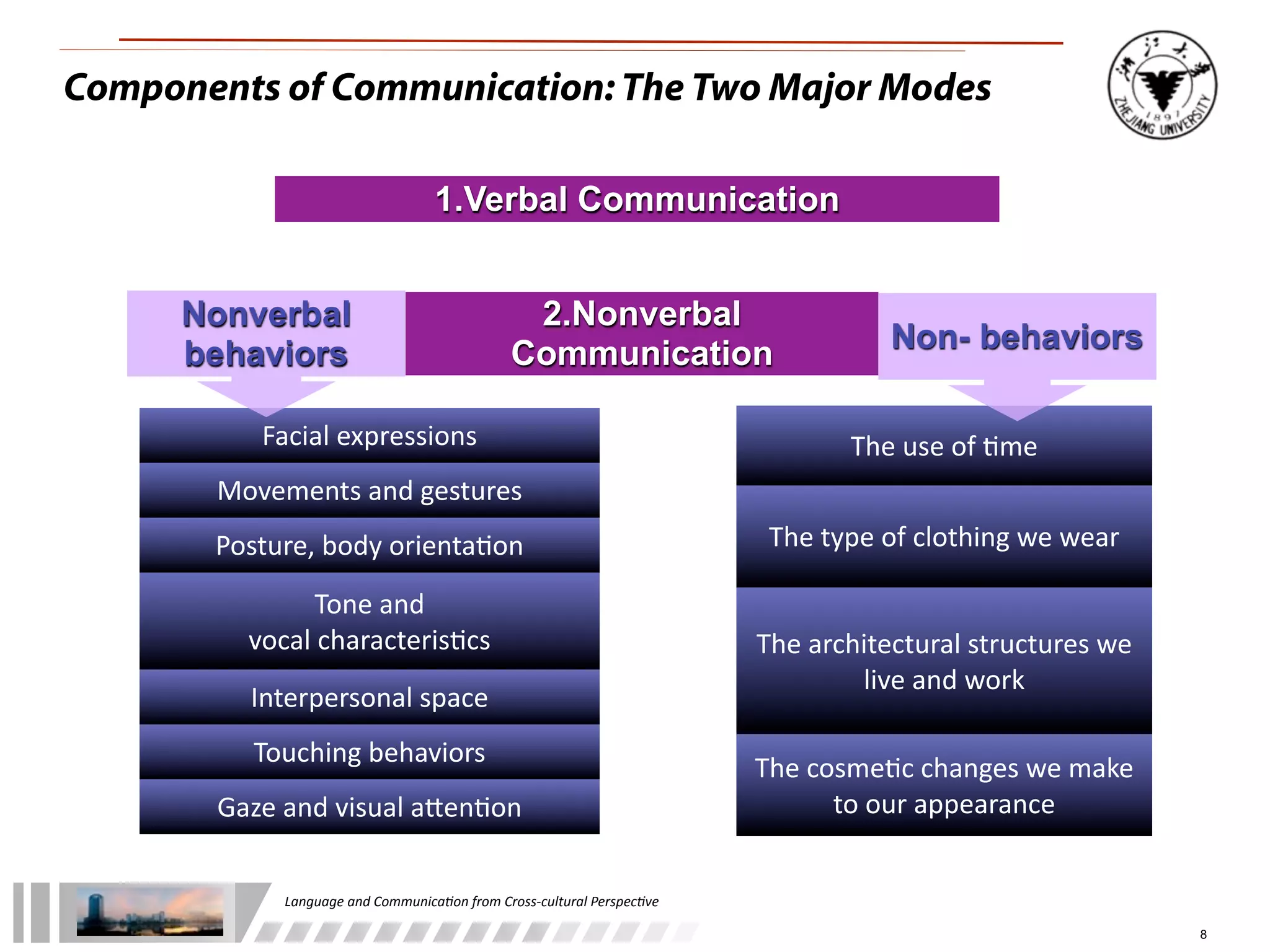
Components of Communication: The Two Major Modes

                                           1.Verbal Communication


      Nonverbal                                            2.Nonverbal
      behaviors                                           Communication                                  Non- behaviors

           Facial	
  expressions                                                                     The	
  use	
  of	
  :me
       Movements	
  and	
  gestures
       Posture,	
  body	
  orienta:on                                                      The	
  type	
  of	
  clothing	
  we	
  wear

                 Tone	
  and	
  
          vocal	
  characteris:cs                                                         The	
  architectural	
  structures	
  we	
  
                                                                                                     live	
  and	
  work
          Interpersonal	
  space
          Touching	
  behaviors
                                                                                          The	
  cosme:c	
  changes	
  we	
  make	
  
       Gaze	
  and	
  visual	
  aLen:on                                                            to	
  our	
  appearance


              Language	
  and	
  Communica.on	
  from	
  Cross-­‐cultural	
  Perspec.ve

                                                                                                                                         8
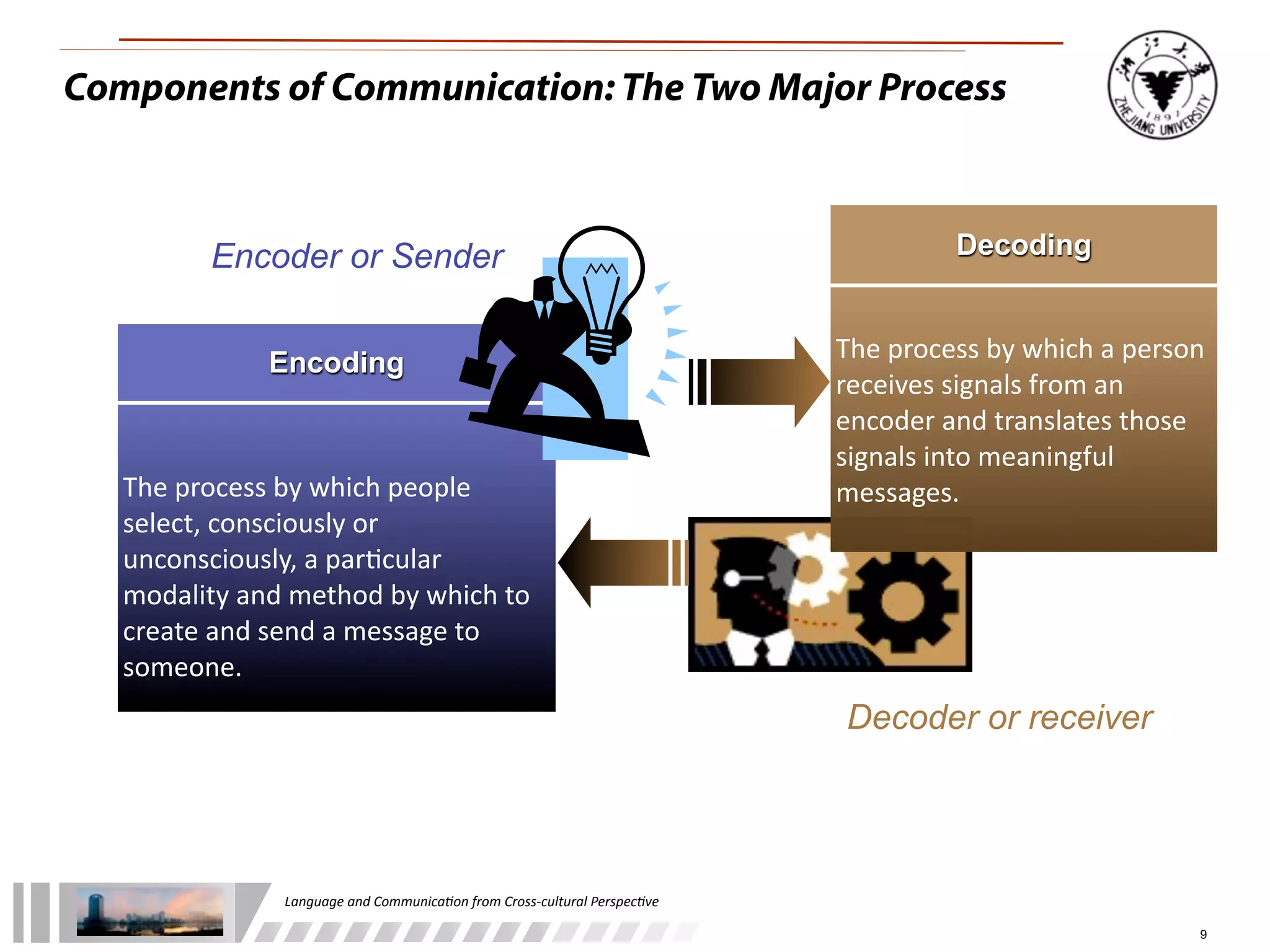
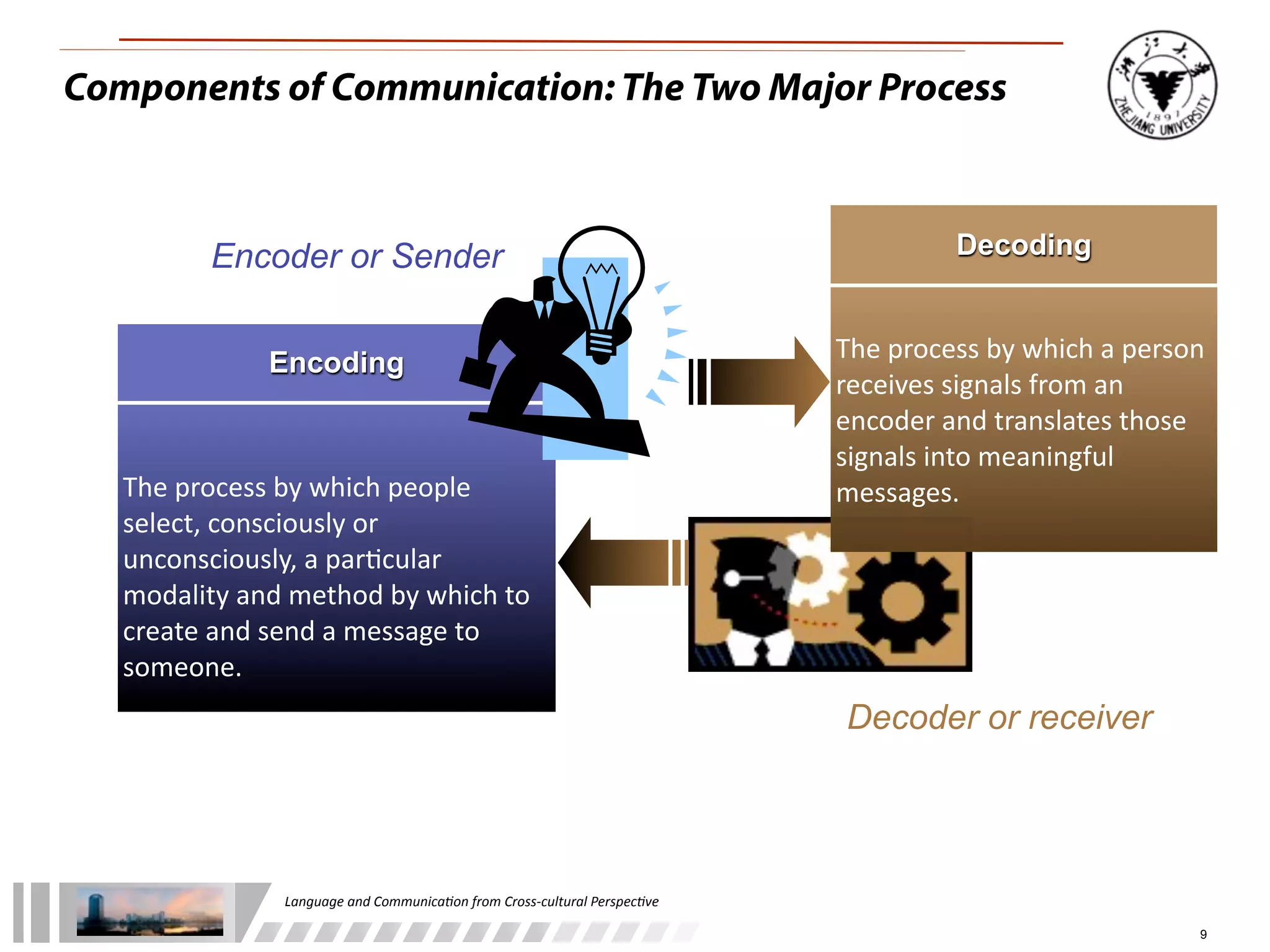
Components of Communication: The Two Major Process


             Encoder or Sender                                                                                   Decoding


                    Encoding                                                                      The	
  process	
  by	
  which	
  a	
  person	
  
                                                                                                  receives	
  signals	
  from	
  an	
  
                                                                                                  encoder	
  and	
  translates	
  those	
  
                                                                                                  signals	
  into	
  meaningful	
  
   The	
  process	
  by	
  which	
  people	
                                                      messages.
   select,	
  consciously	
  or	
  
   unconsciously,	
  a	
  par:cular	
  
   modality	
  and	
  method	
  by	
  which	
  to	
  
   create	
  and	
  send	
  a	
  message	
  to	
  
   someone.
                                                                                                   Decoder or receiver


                      Language	
  and	
  Communica.on	
  from	
  Cross-­‐cultural	
  Perspec.ve

                                                                                                                                                9
Components of Communication: The Two Major Process


             Encoder or Sender                                                                                   Decoding


                    Encoding                                                                      The	
  process	
  by	
  which	
  a	
  person	
  
                                                                                                  receives	
  signals	
  from	
  an	
  
                                                                                                  encoder	
  and	
  translates	
  those	
  
                                                                                                  signals	
  into	
  meaningful	
  
   The	
  process	
  by	
  which	
  people	
                                                      messages.
   select,	
  consciously	
  or	
  
   unconsciously,	
  a	
  par:cular	
  
   modality	
  and	
  method	
  by	
  which	
  to	
  
   create	
  and	
  send	
  a	
  message	
  to	
  
   someone.
                                                                                                   Decoder or receiver


                      Language	
  and	
  Communica.on	
  from	
  Cross-­‐cultural	
  Perspec.ve

                                                                                                                                                9
Components of Communication: Others


           Language	
  and	
  Communica.on	
  from	
  Cross-­‐cultural	
  Perspec.ve

                                                                                       10
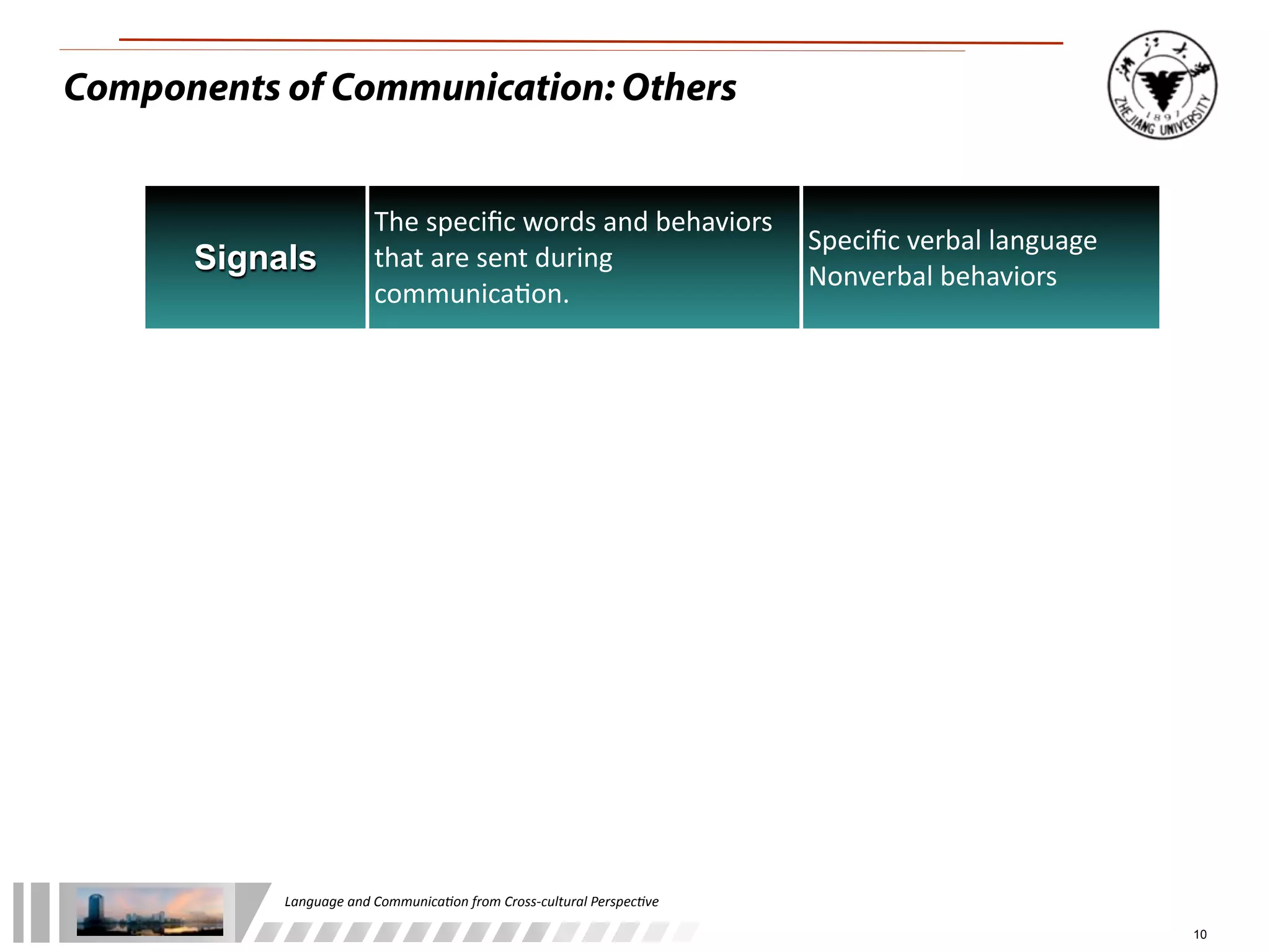
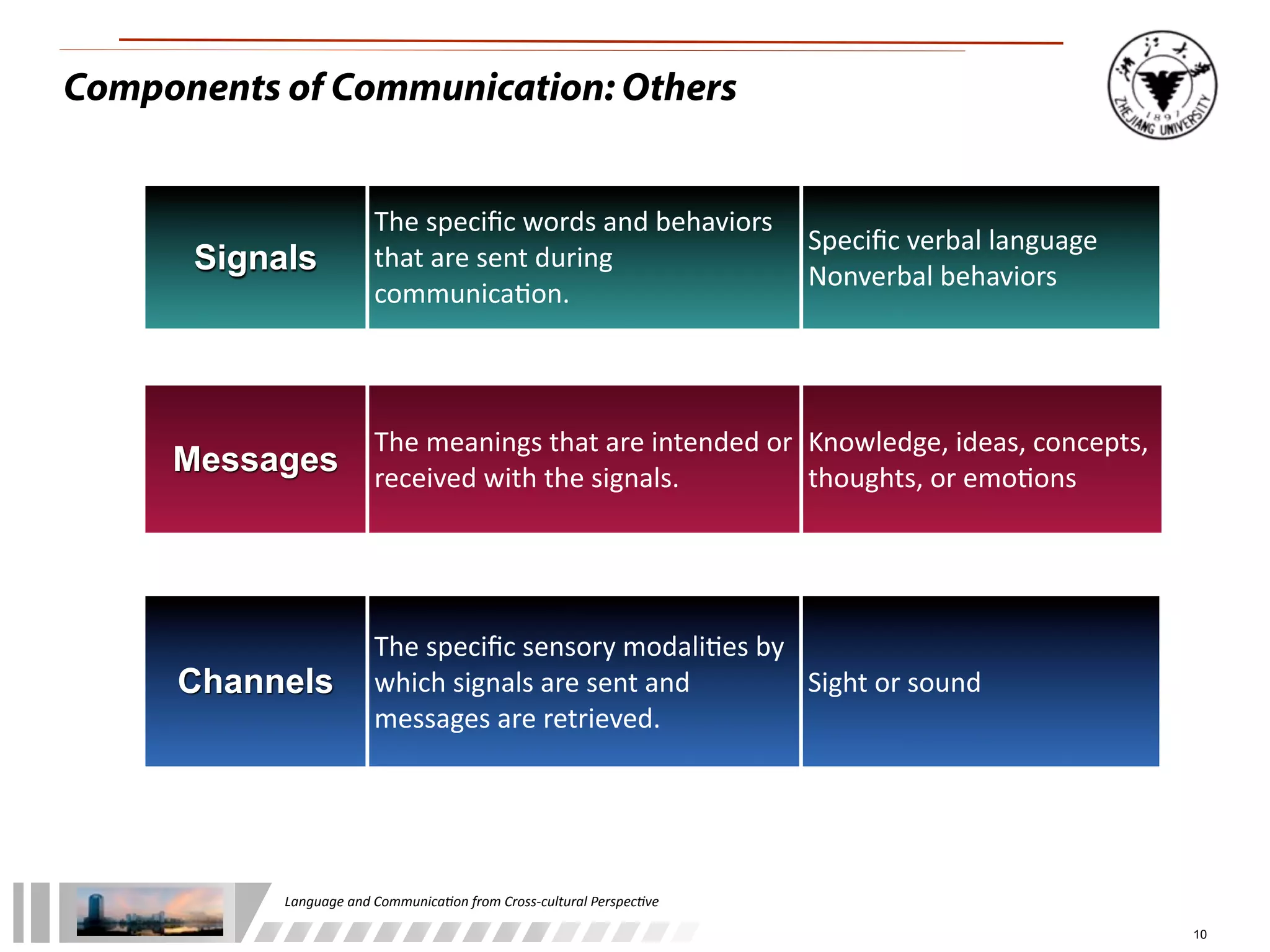
Components of Communication: Others


                            The	
  specific	
  words	
  and	
  behaviors	
  
                                                                            Specific	
  verbal	
  language
      Signals               that	
  are	
  sent	
  during	
  
                                                                            Nonverbal	
  behaviors	
  
                            communica:on.


           Language	
  and	
  Communica.on	
  from	
  Cross-­‐cultural	
  Perspec.ve

                                                                                                            10
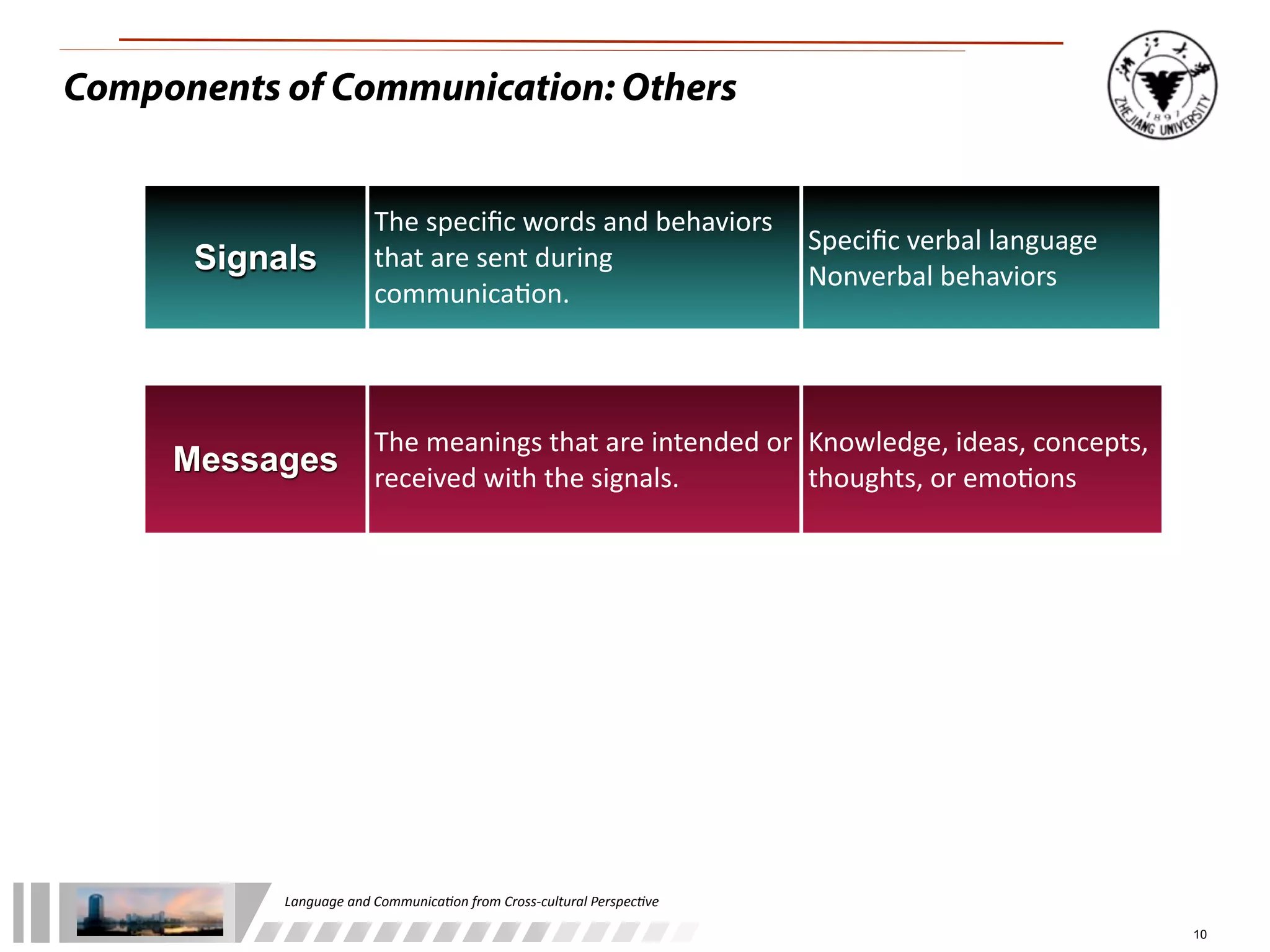
Components of Communication: Others


                            The	
  specific	
  words	
  and	
  behaviors	
  
                                                                            Specific	
  verbal	
  language
      Signals               that	
  are	
  sent	
  during	
  
                                                                            Nonverbal	
  behaviors	
  
                            communica:on.


                            The	
  meanings	
  that	
  are	
  intended	
  or	
   Knowledge,	
  ideas,	
  concepts,	
  
     Messages               received	
  with	
  the	
  signals.                  thoughts,	
  or	
  emo:ons


           Language	
  and	
  Communica.on	
  from	
  Cross-­‐cultural	
  Perspec.ve

                                                                                                                         10
Components of Communication: Others


                            The	
  specific	
  words	
  and	
  behaviors	
  
                                                                            Specific	
  verbal	
  language
      Signals               that	
  are	
  sent	
  during	
  
                                                                            Nonverbal	
  behaviors	
  
                            communica:on.


                            The	
  meanings	
  that	
  are	
  intended	
  or	
   Knowledge,	
  ideas,	
  concepts,	
  
     Messages               received	
  with	
  the	
  signals.                  thoughts,	
  or	
  emo:ons


                            The	
  specific	
  sensory	
  modali:es	
  by	
  
     Channels               which	
  signals	
  are	
  sent	
  and	
         Sight	
  or	
  sound
                            messages	
  are	
  retrieved.


           Language	
  and	
  Communica.on	
  from	
  Cross-­‐cultural	
  Perspec.ve

                                                                                                                         10
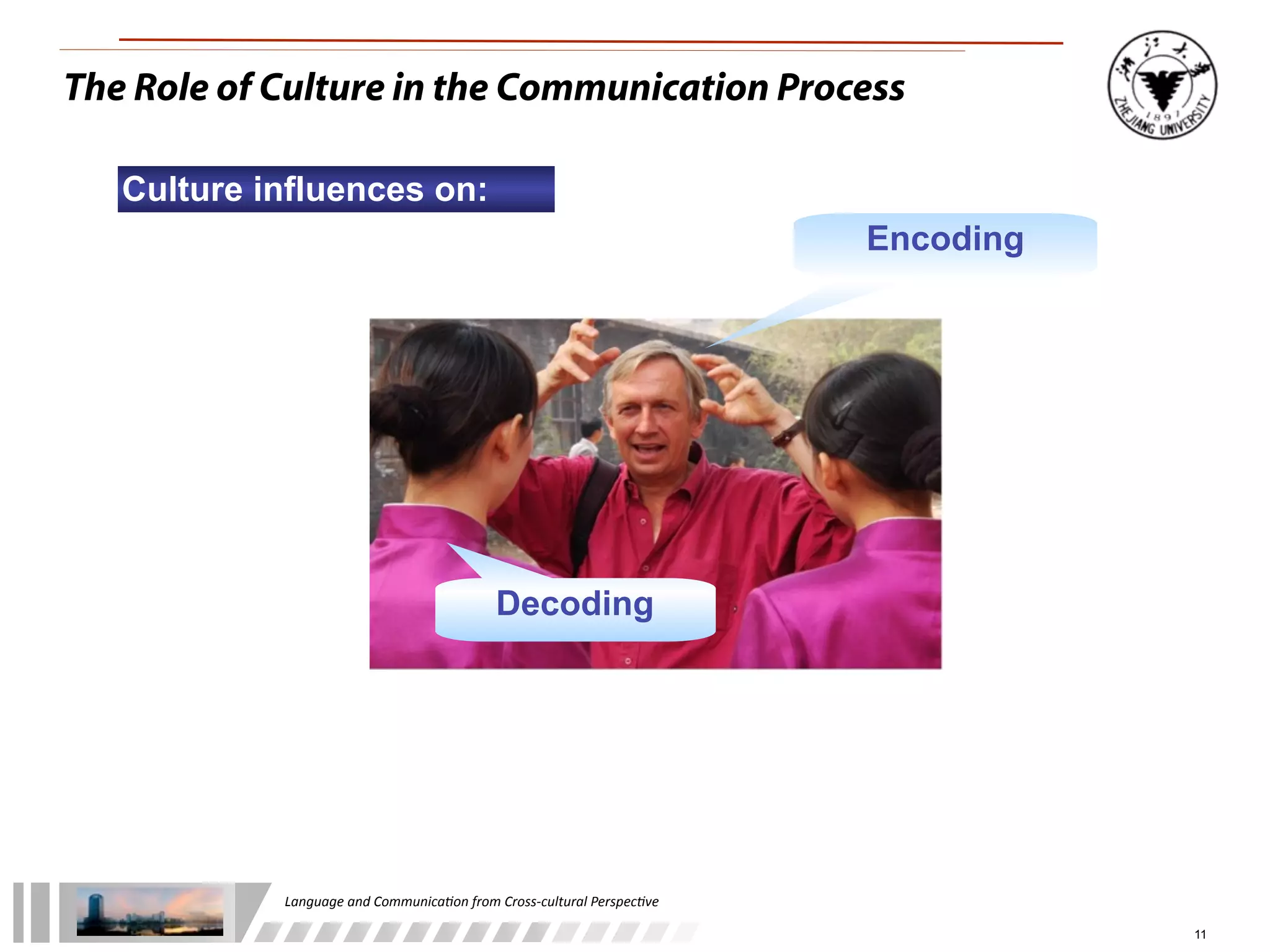
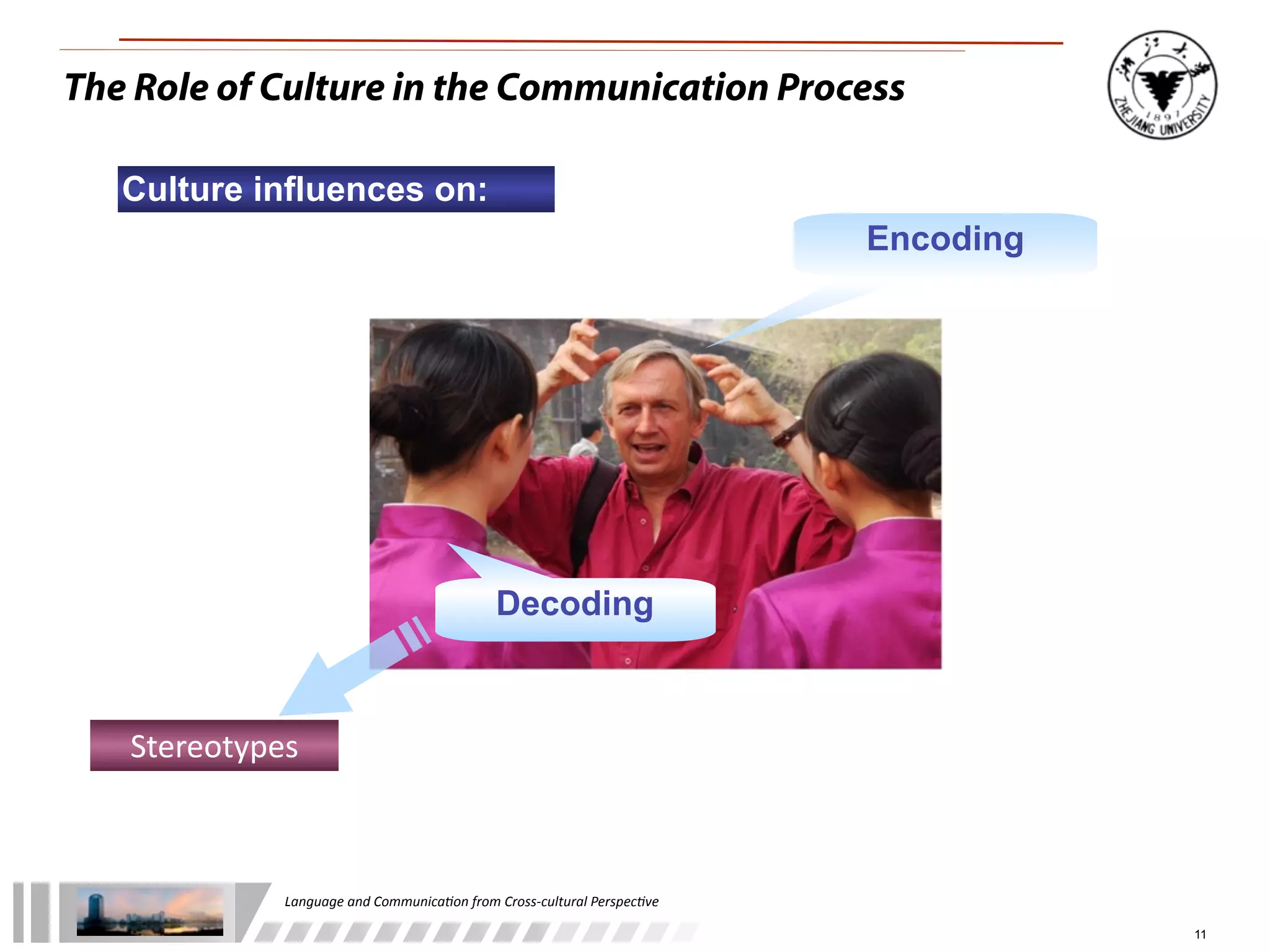
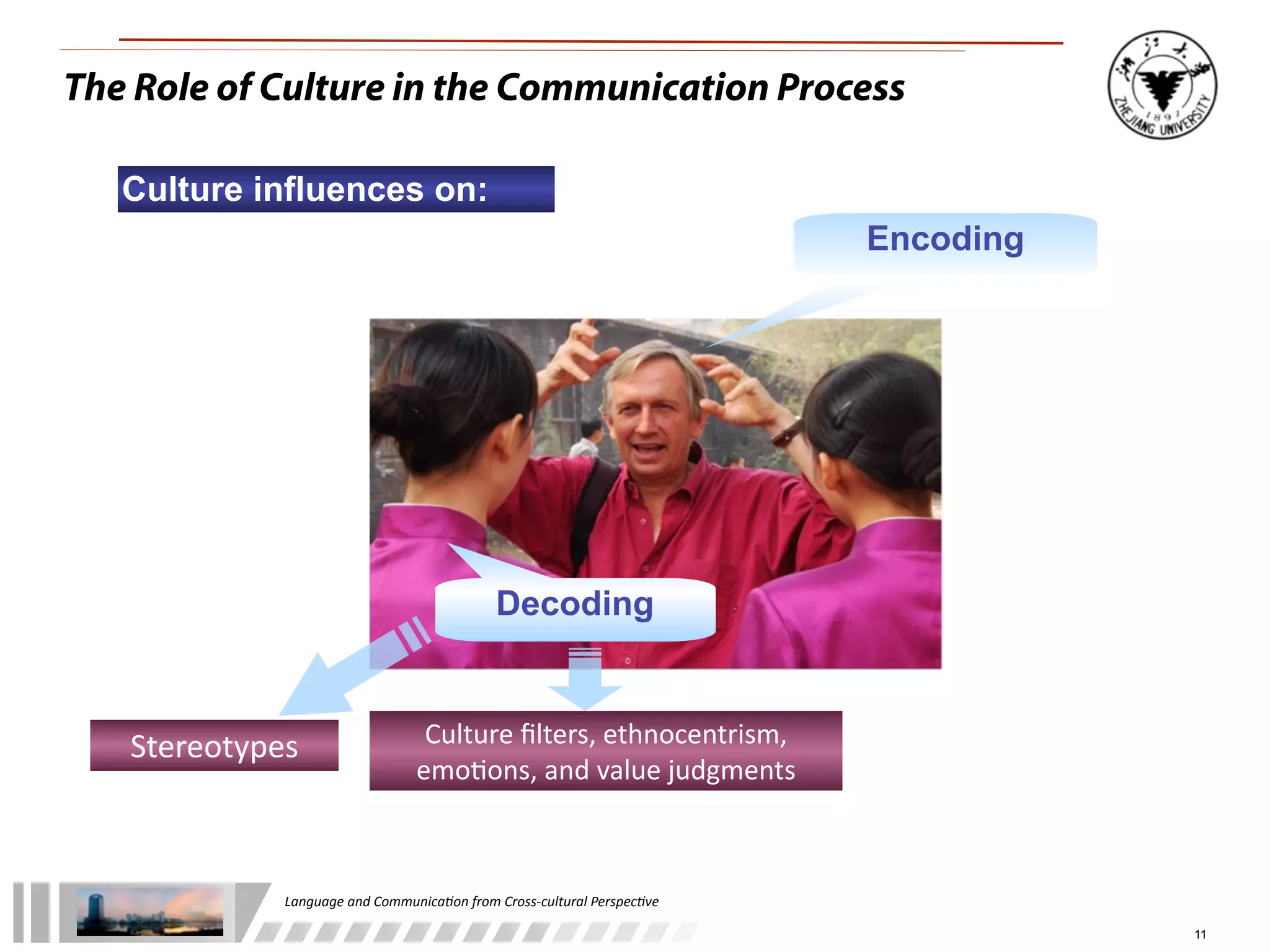
The Role of Culture in the Communication Process

   Culture influences on:


            Language	
  and	
  Communica.on	
  from	
  Cross-­‐cultural	
  Perspec.ve

                                                                                        11
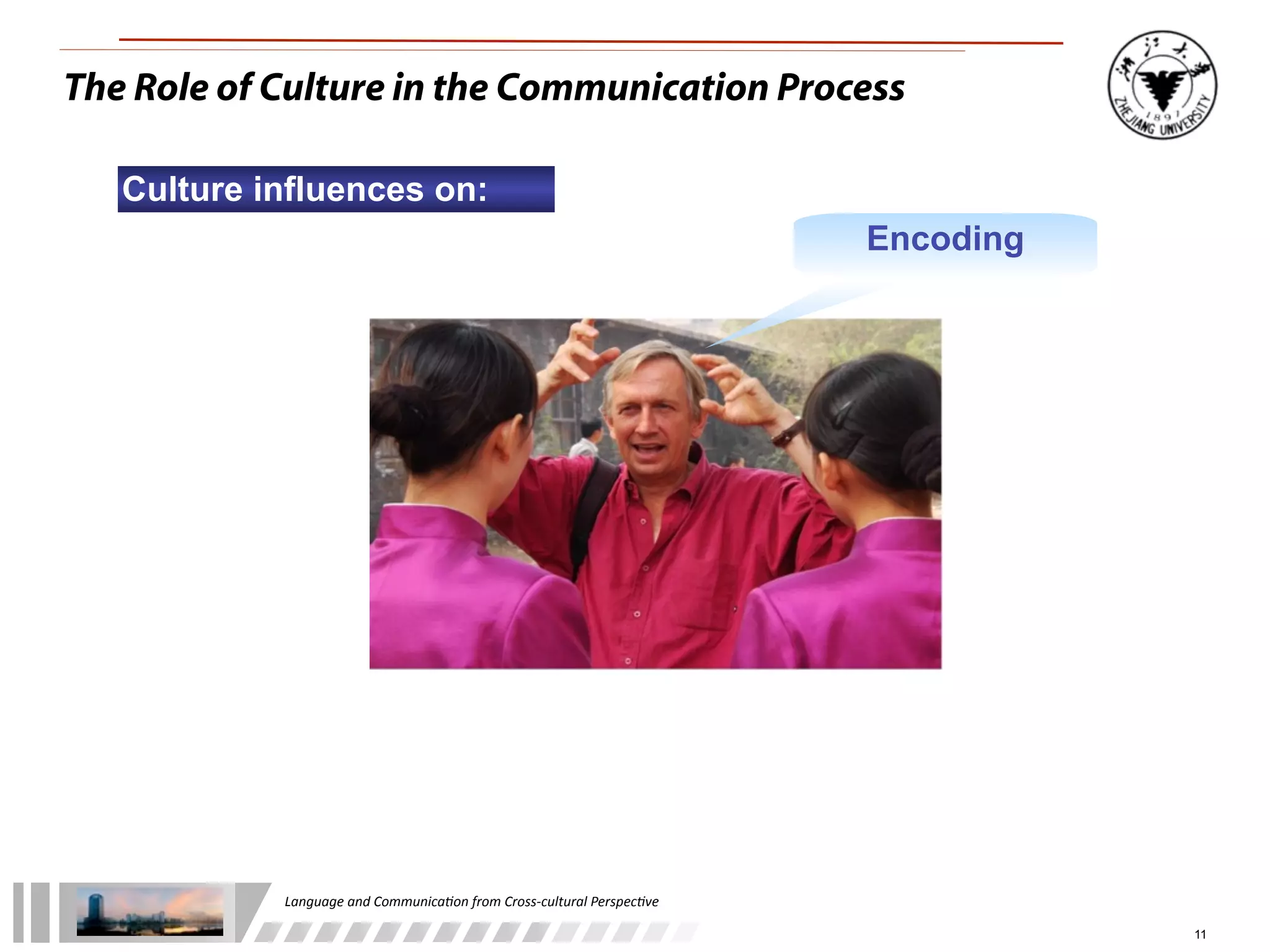
The Role of Culture in the Communication Process

   Culture influences on:
                                                                                        Encoding


            Language	
  and	
  Communica.on	
  from	
  Cross-­‐cultural	
  Perspec.ve

                                                                                                   11
The Role of Culture in the Communication Process

   Culture influences on:
                                                                                        Encoding


                                                     Decoding


            Language	
  and	
  Communica.on	
  from	
  Cross-­‐cultural	
  Perspec.ve

                                                                                                   11
The Role of Culture in the Communication Process

   Culture influences on:
                                                                                         Encoding


                                                      Decoding


   Stereotypes


             Language	
  and	
  Communica.on	
  from	
  Cross-­‐cultural	
  Perspec.ve

                                                                                                    11
The Role of Culture in the Communication Process

   Culture influences on:
                                                                                         Encoding


                                                      Decoding


   Stereotypes                         Culture	
  filters,	
  ethnocentrism,	
  
                                      emo:ons,	
  and	
  value	
  judgments


             Language	
  and	
  Communica.on	
  from	
  Cross-­‐cultural	
  Perspec.ve

                                                                                                    11
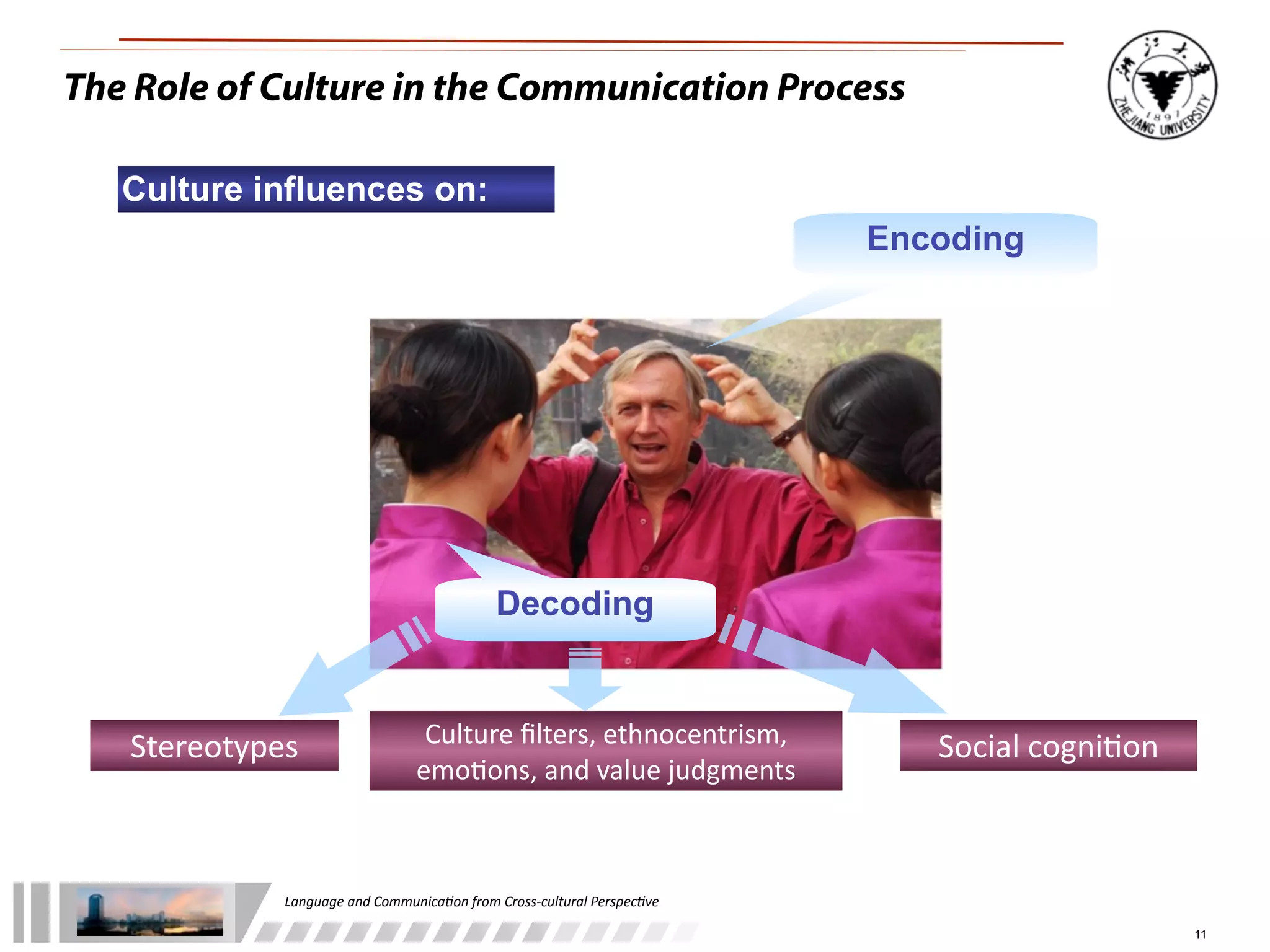
The Role of Culture in the Communication Process

   Culture influences on:
                                                                                         Encoding


                                                      Decoding


   Stereotypes                         Culture	
  filters,	
  ethnocentrism,	
               Social	
  cogni3on
                                      emo:ons,	
  and	
  value	
  judgments


             Language	
  and	
  Communica.on	
  from	
  Cross-­‐cultural	
  Perspec.ve

                                                                                                                 11
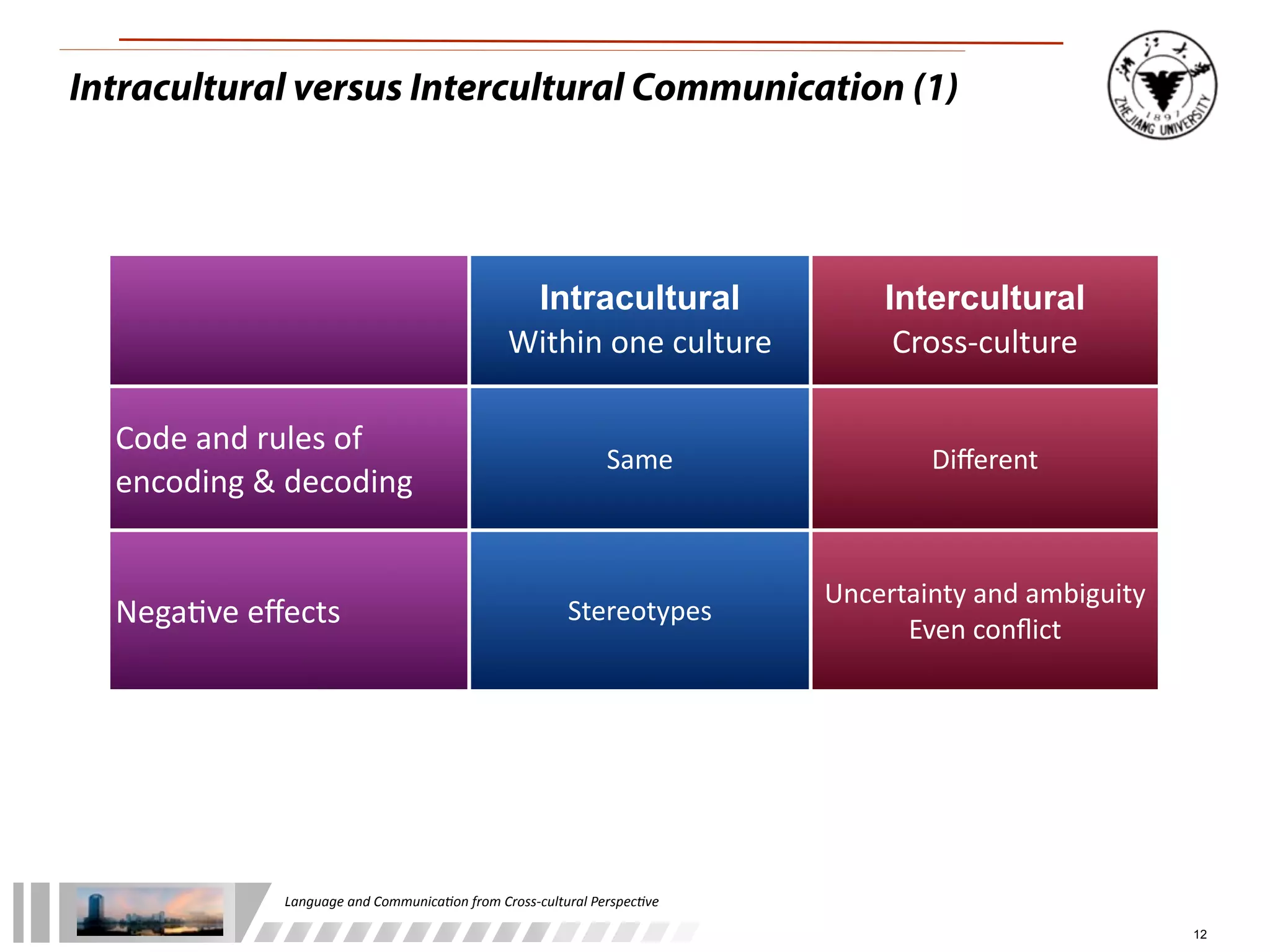
Intracultural versus Intercultural Communication (1)


                                                               Intracultural                        Intercultural
                                                              Within	
  one	
  culture               Cross-­‐culture

  Code	
  and	
  rules	
  of	
  
                                                                                 Same                    Different
  encoding	
  &	
  decoding


                                                                                               Uncertainty	
  and	
  ambiguity
  Nega3ve	
  effects                                                       Stereotypes
                                                                                                     Even	
  conflict


                   Language	
  and	
  Communica.on	
  from	
  Cross-­‐cultural	
  Perspec.ve

                                                                                                                                 12
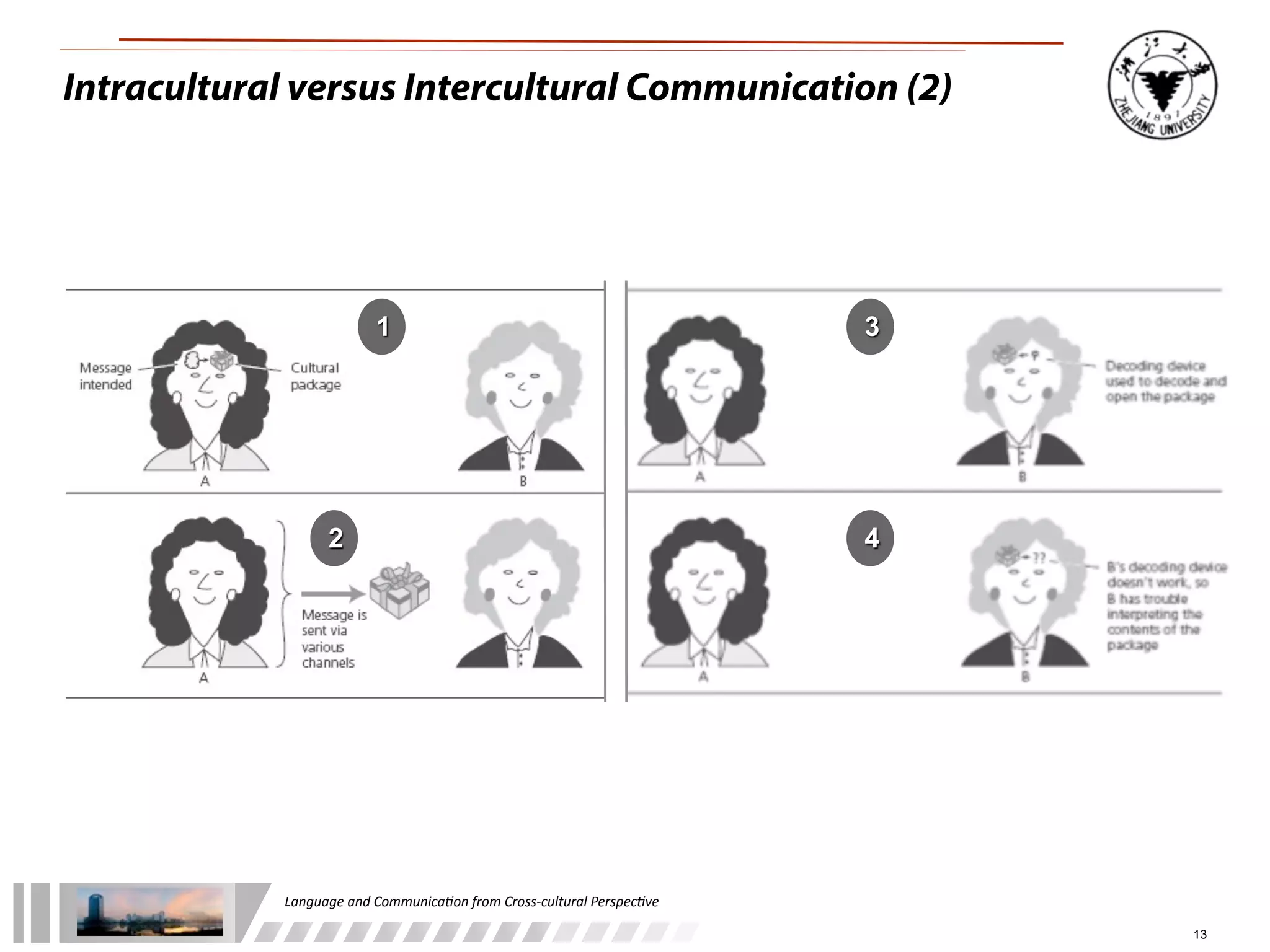
Intracultural versus Intercultural Communication (2)


                             1                                                          3


                    2                                                                   4


            Language	
  and	
  Communica.on	
  from	
  Cross-­‐cultural	
  Perspec.ve

                                                                                            13
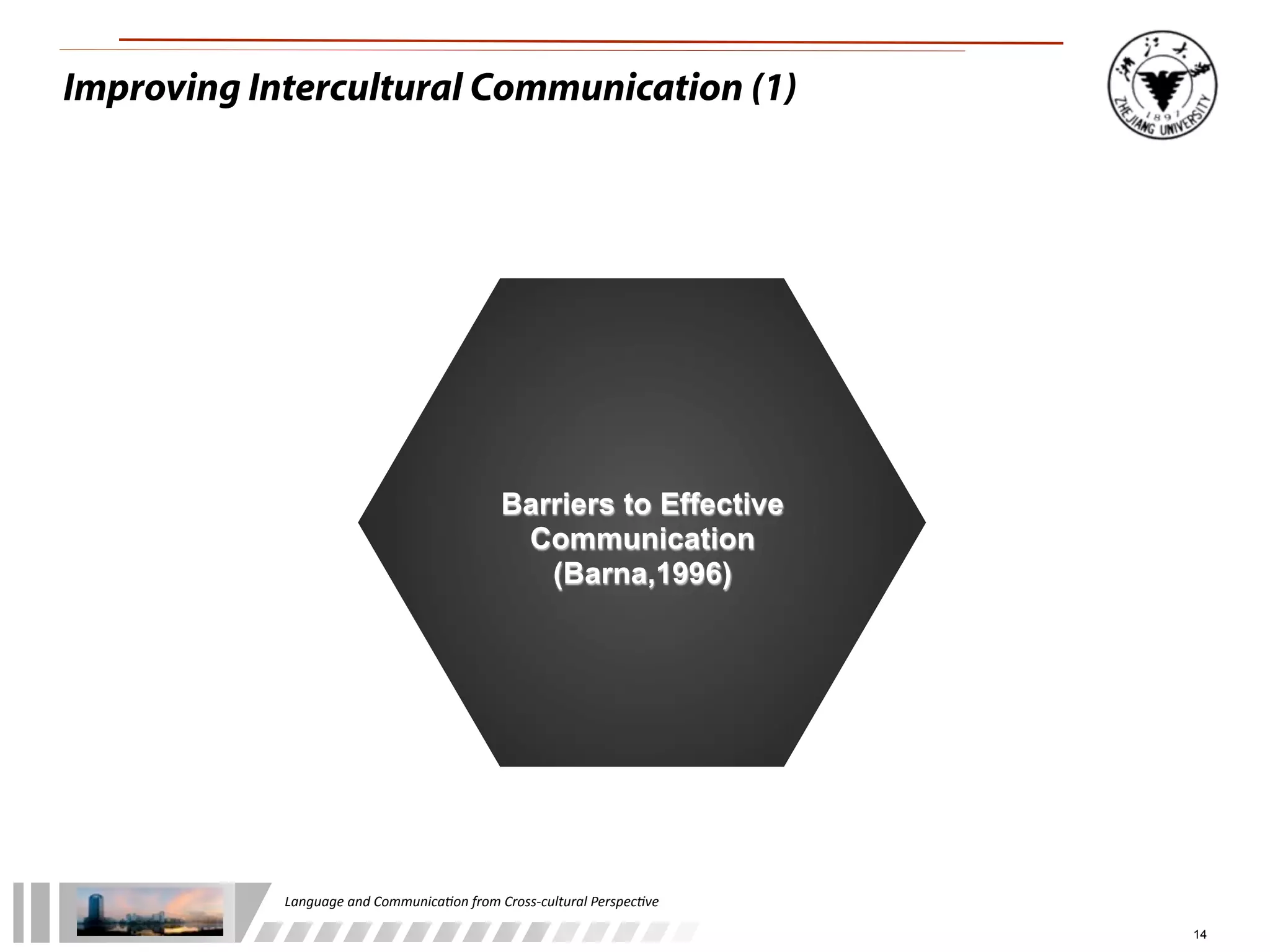
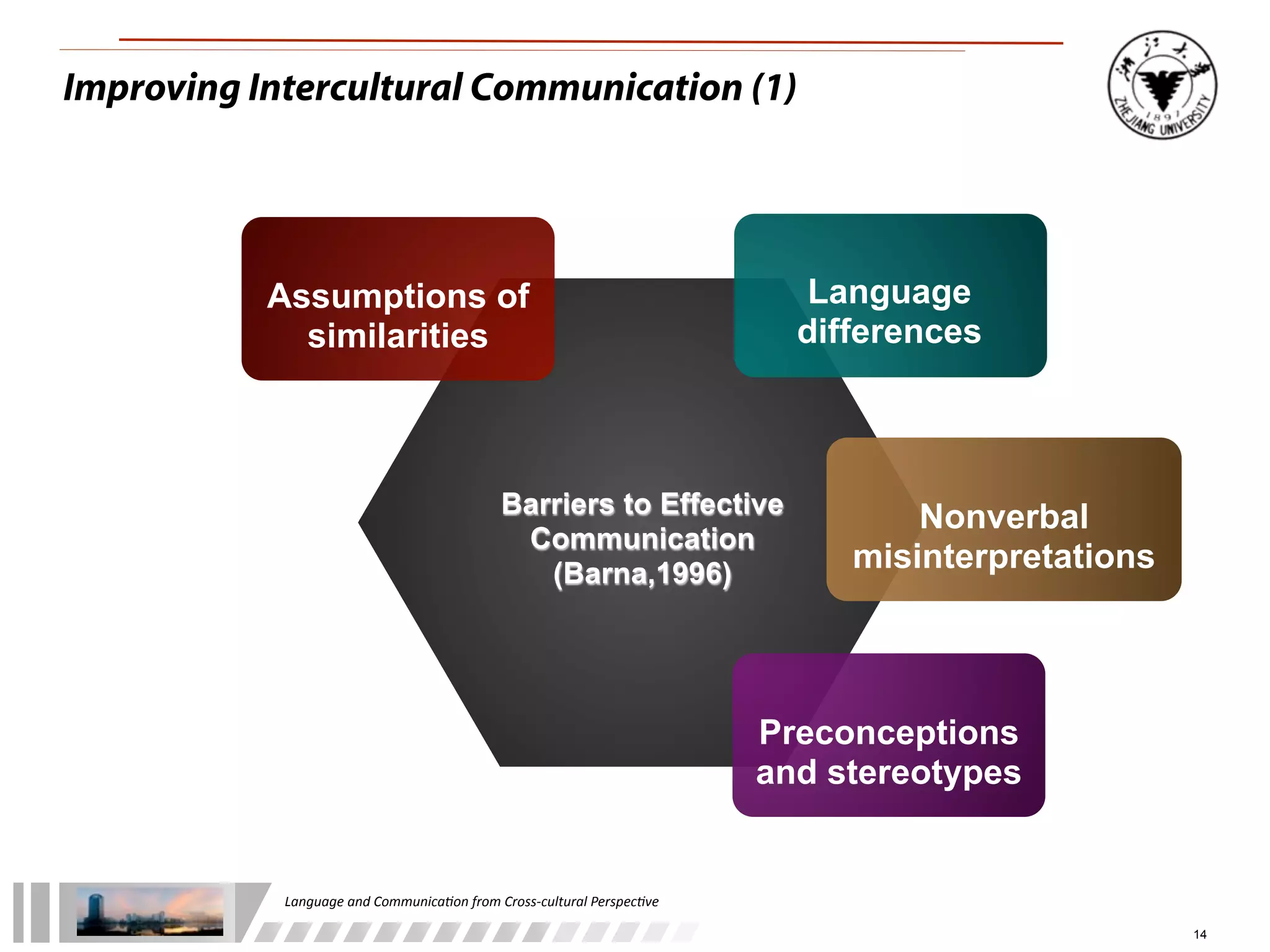
Improving Intercultural Communication (1)


                                                      Barriers to Effective
                                                       Communication
                                                         (Barna,1996)


            Language	
  and	
  Communica.on	
  from	
  Cross-­‐cultural	
  Perspec.ve

                                                                                        14
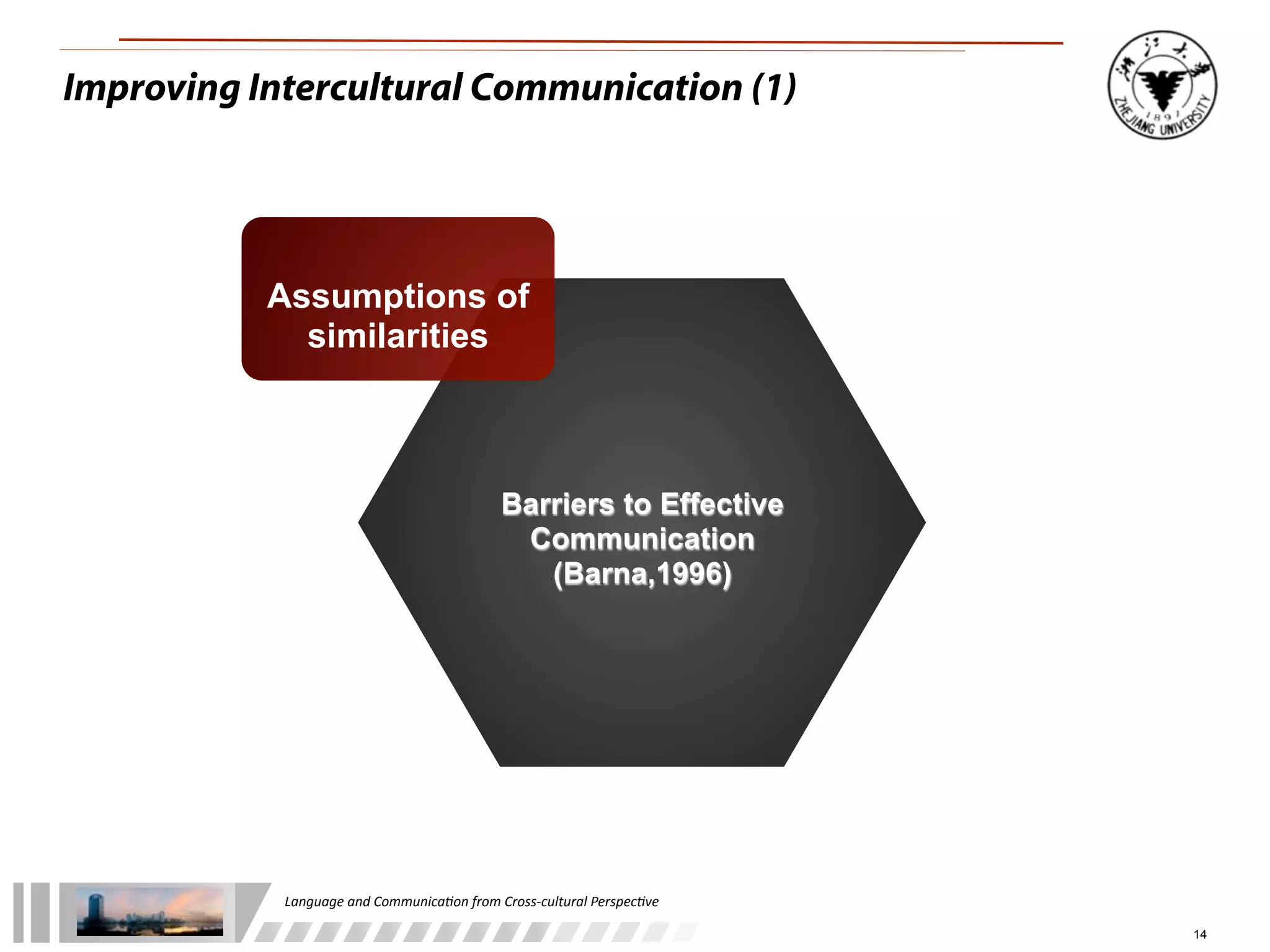
Improving Intercultural Communication (1)


           Assumptions of
             similarities


                                                      Barriers to Effective
                                                       Communication
                                                         (Barna,1996)


            Language	
  and	
  Communica.on	
  from	
  Cross-­‐cultural	
  Perspec.ve

                                                                                        14
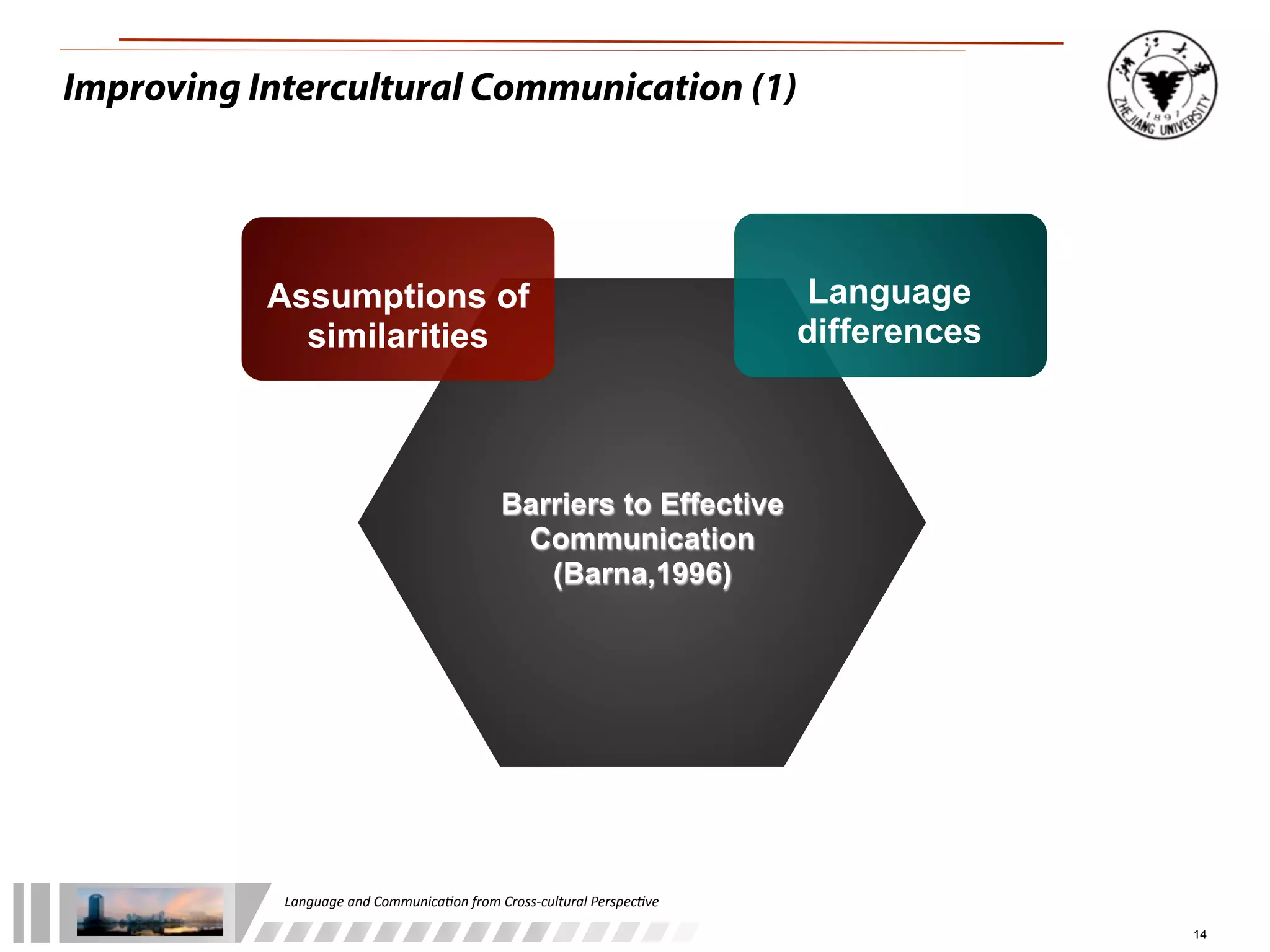
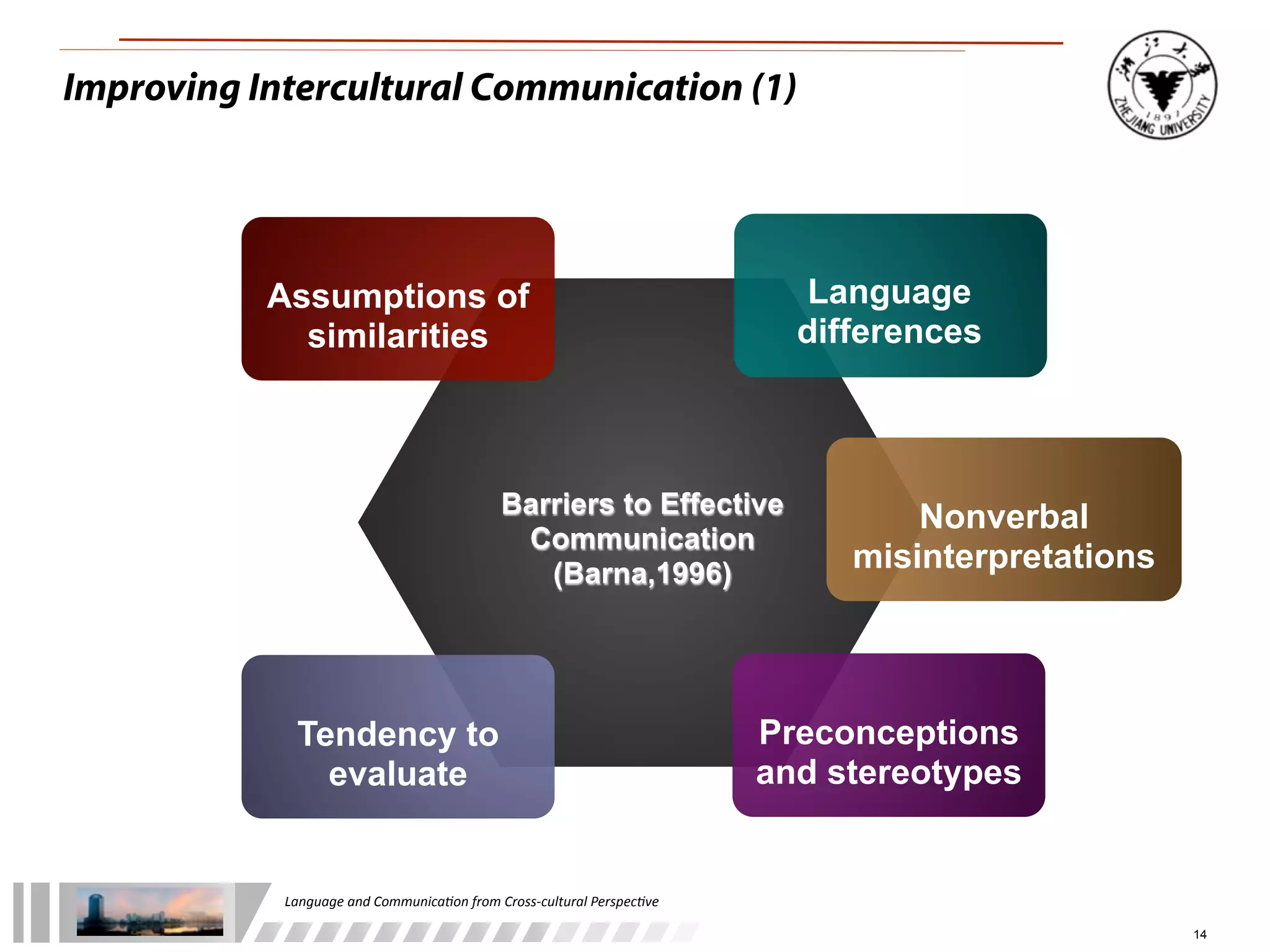
Improving Intercultural Communication (1)


           Assumptions of                                                                Language
             similarities                                                               differences


                                                      Barriers to Effective
                                                       Communication
                                                         (Barna,1996)


            Language	
  and	
  Communica.on	
  from	
  Cross-­‐cultural	
  Perspec.ve

                                                                                                      14
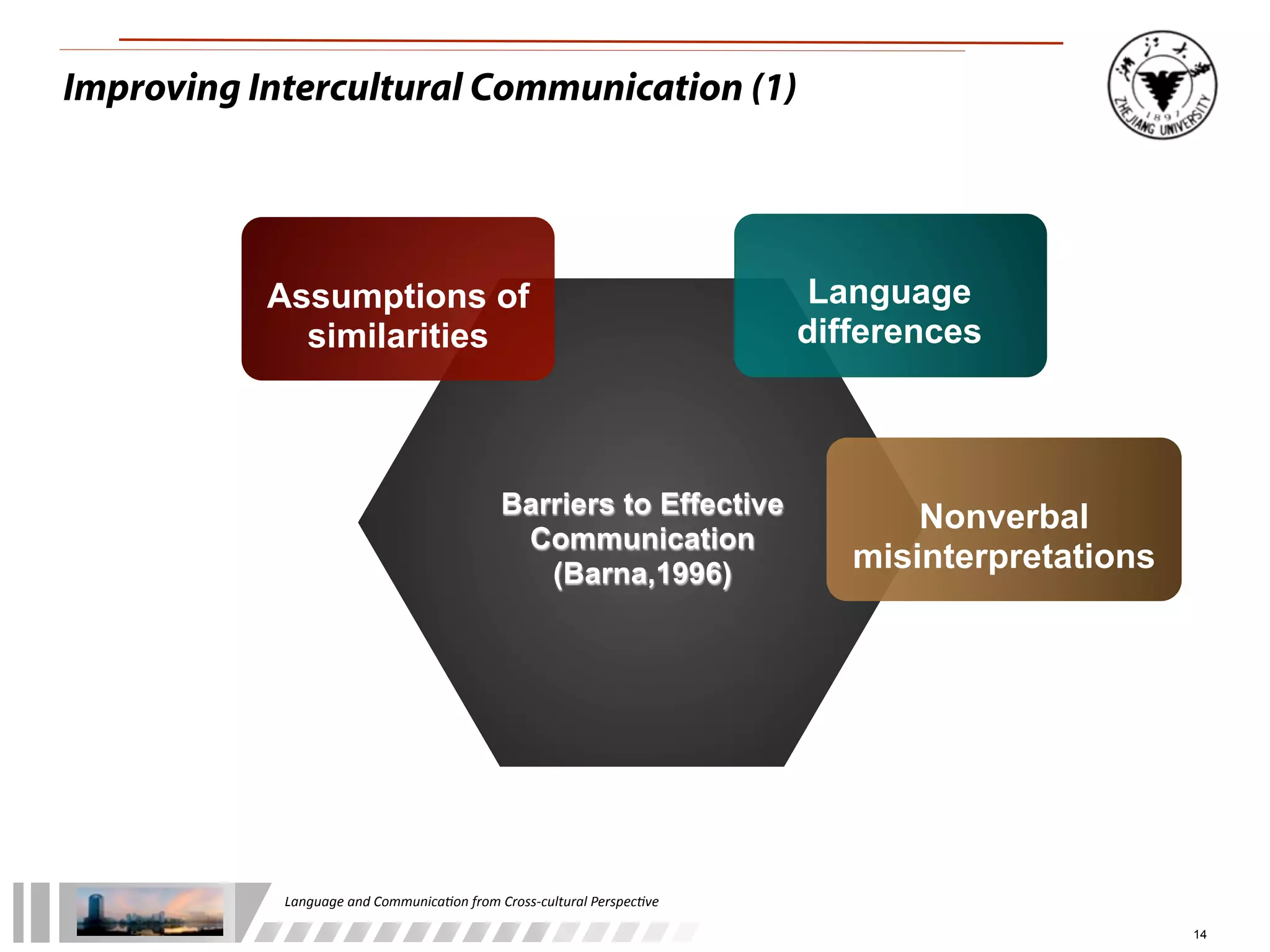
Improving Intercultural Communication (1)


           Assumptions of                                                                Language
             similarities                                                               differences


                                                      Barriers to Effective                    Nonverbal
                                                       Communication
                                                         (Barna,1996)
                                                                                           misinterpretations


            Language	
  and	
  Communica.on	
  from	
  Cross-­‐cultural	
  Perspec.ve

                                                                                                                14
Improving Intercultural Communication (1)


           Assumptions of                                                                  Language
             similarities                                                                 differences


                                                      Barriers to Effective                      Nonverbal
                                                       Communication
                                                         (Barna,1996)
                                                                                             misinterpretations


                                                                                        Preconceptions
                                                                                        and stereotypes


            Language	
  and	
  Communica.on	
  from	
  Cross-­‐cultural	
  Perspec.ve

                                                                                                                  14
Improving Intercultural Communication (1)


           Assumptions of                                                                  Language
             similarities                                                                 differences


                                                      Barriers to Effective                      Nonverbal
                                                       Communication
                                                         (Barna,1996)
                                                                                             misinterpretations


              Tendency to                                                               Preconceptions
                evaluate                                                                and stereotypes


            Language	
  and	
  Communica.on	
  from	
  Cross-­‐cultural	
  Perspec.ve

                                                                                                                  14
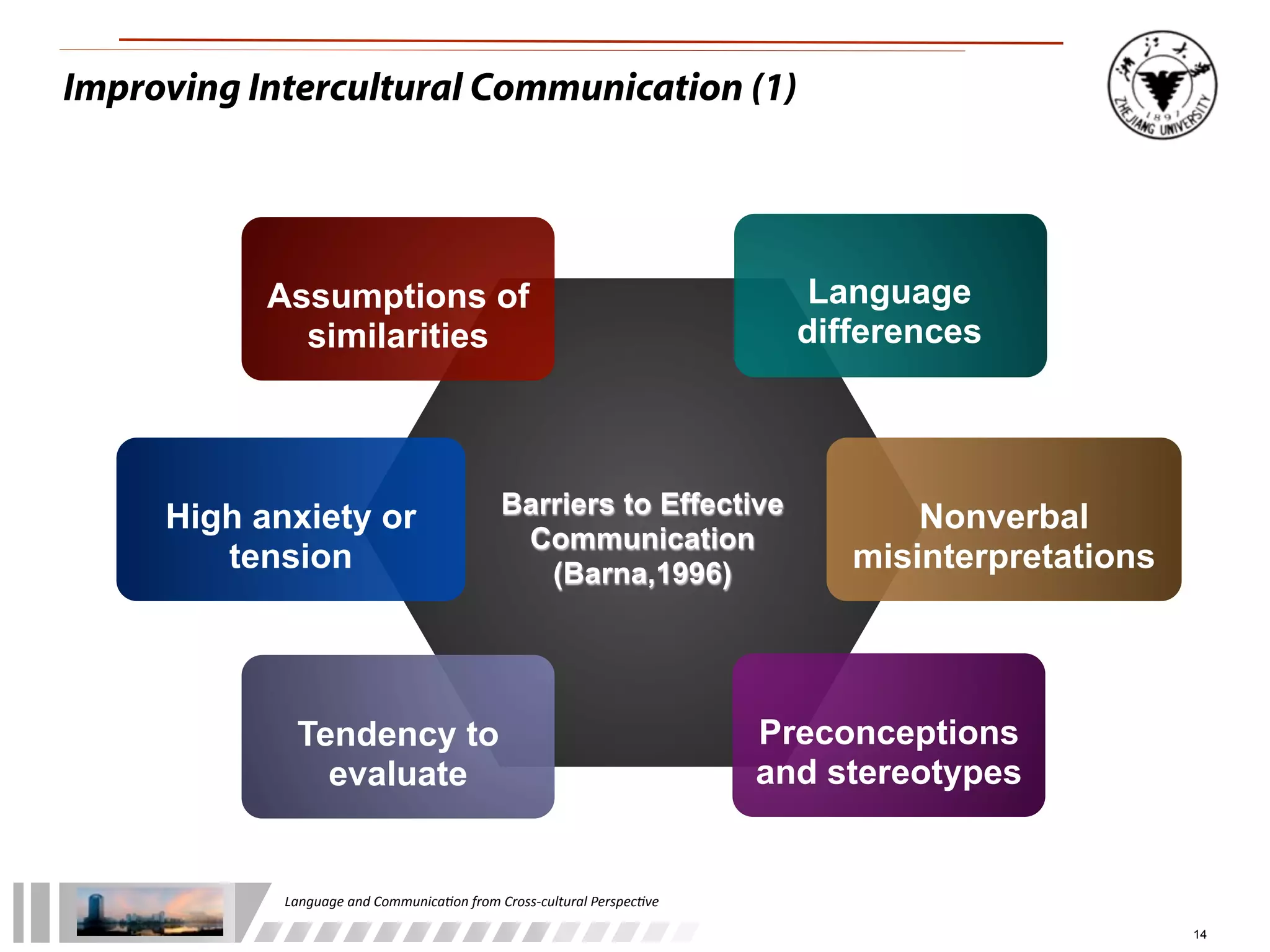
Improving Intercultural Communication (1)


           Assumptions of                                                                  Language
             similarities                                                                 differences


     High anxiety or                                  Barriers to Effective                      Nonverbal
                                                       Communication
        tension                                          (Barna,1996)
                                                                                             misinterpretations


              Tendency to                                                               Preconceptions
                evaluate                                                                and stereotypes


            Language	
  and	
  Communica.on	
  from	
  Cross-­‐cultural	
  Perspec.ve

                                                                                                                  14
Improving Intercultural Communication (2)


            Language	
  and	
  Communica.on	
  from	
  Cross-­‐cultural	
  Perspec.ve

                                                                                        15
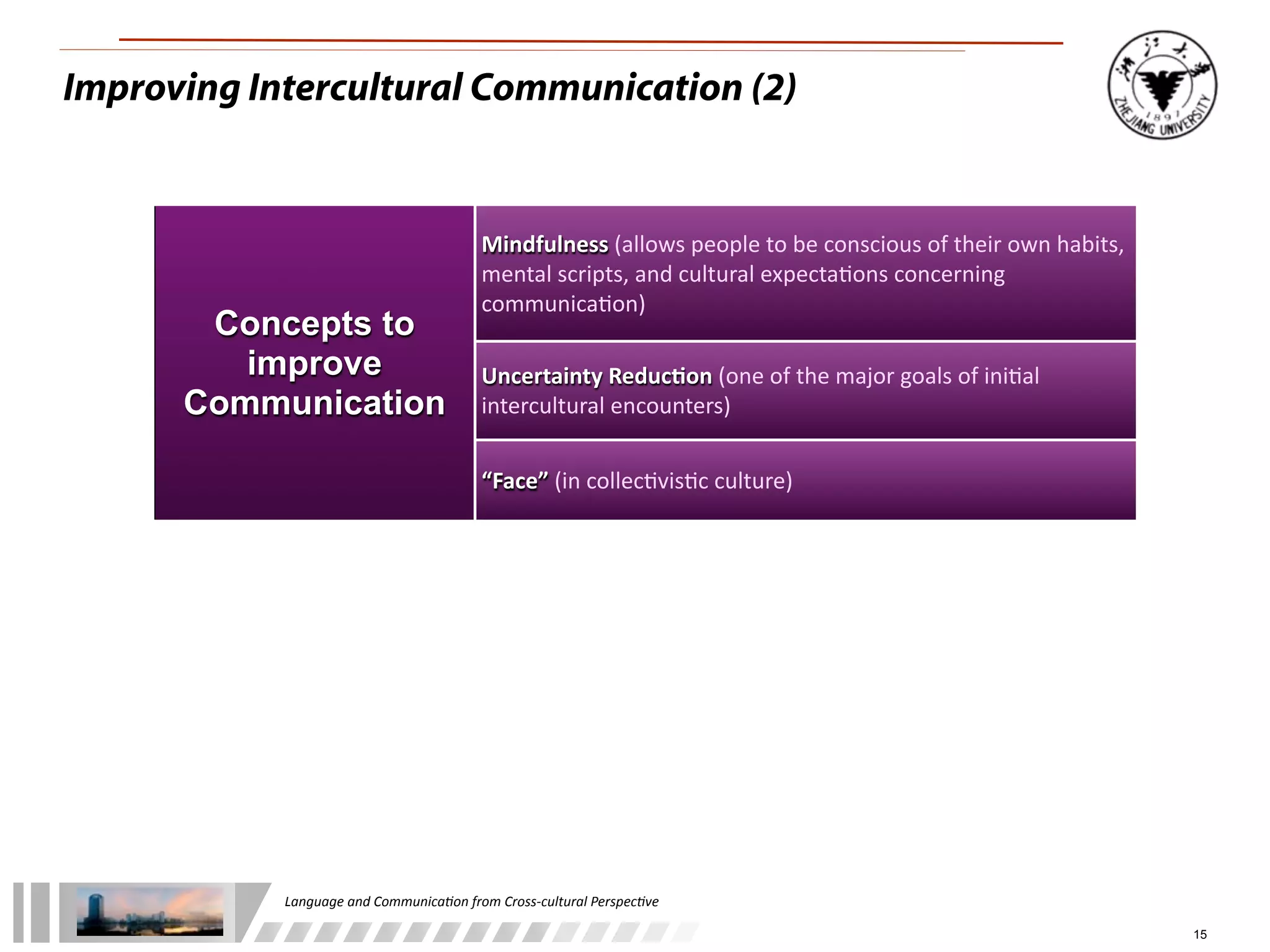
Improving Intercultural Communication (2)


                                                  Mindfulness	
  (allows	
  people	
  to	
  be	
  conscious	
  of	
  their	
  own	
  habits,	
  
                                                  mental	
  scripts,	
  and	
  cultural	
  expecta3ons	
  concerning	
  
                                                  communica3on)
       Concepts to
         improve                                  Uncertainty	
  Reduc-on	
  (one	
  of	
  the	
  major	
  goals	
  of	
  ini3al	
  
      Communication                               intercultural	
  encounters)


                                                  “Face”	
  (in	
  collec3vis3c	
  culture)


            Language	
  and	
  Communica.on	
  from	
  Cross-­‐cultural	
  Perspec.ve

                                                                                                                                                   15
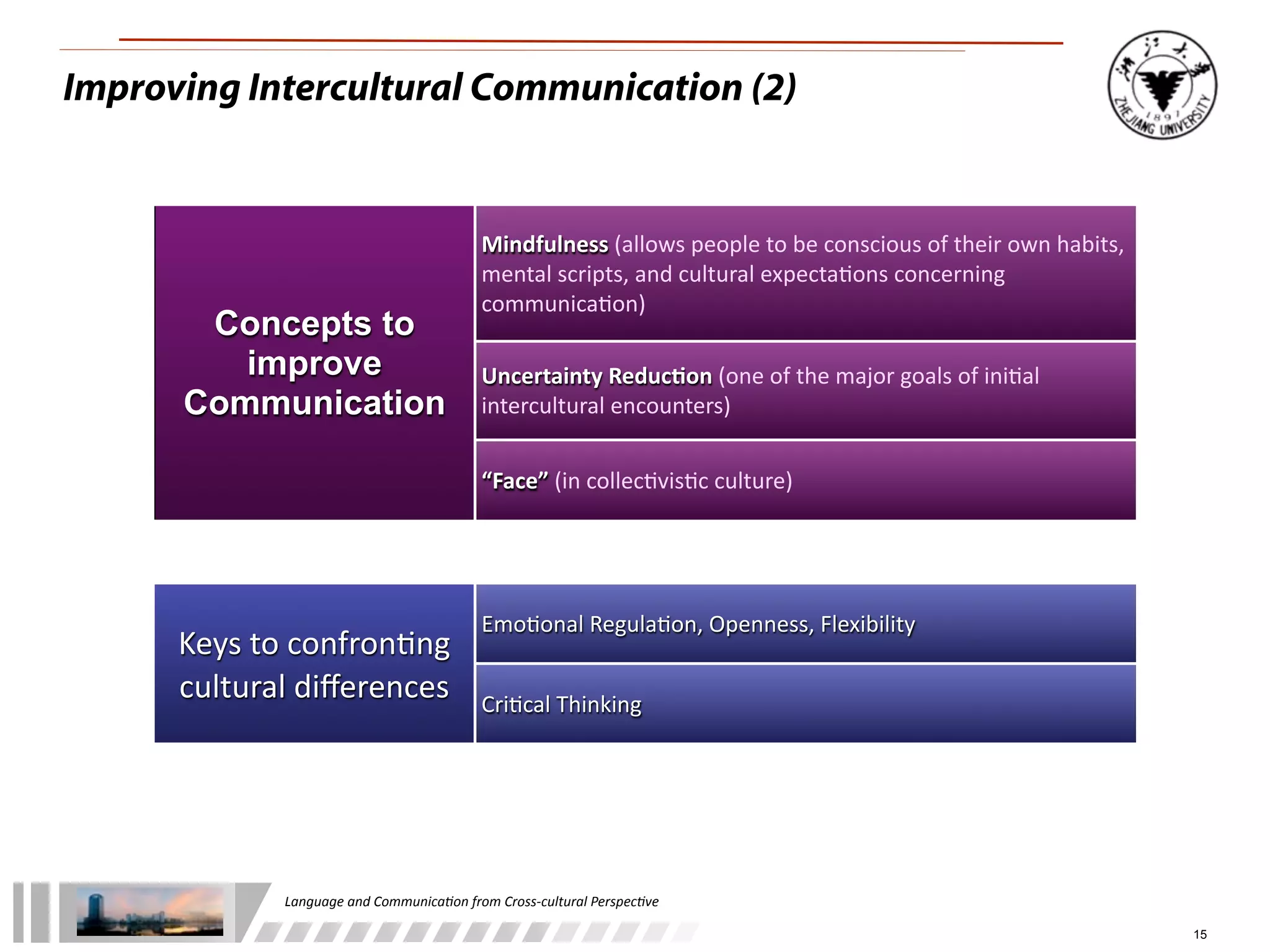
Improving Intercultural Communication (2)


                                                      Mindfulness	
  (allows	
  people	
  to	
  be	
  conscious	
  of	
  their	
  own	
  habits,	
  
                                                      mental	
  scripts,	
  and	
  cultural	
  expecta3ons	
  concerning	
  
                                                      communica3on)
       Concepts to
         improve                                      Uncertainty	
  Reduc-on	
  (one	
  of	
  the	
  major	
  goals	
  of	
  ini3al	
  
      Communication                                   intercultural	
  encounters)


                                                      “Face”	
  (in	
  collec3vis3c	
  culture)


                                                      Emo3onal	
  Regula3on,	
  Openness,	
  Flexibility
      Keys	
  to	
  confron3ng	
  
      cultural	
  differences	
                        Cri3cal	
  Thinking


                Language	
  and	
  Communica.on	
  from	
  Cross-­‐cultural	
  Perspec.ve

                                                                                                                                                       15
Thank	
  You
Contact us via …

Mail:    hora_t@mac.com
Follow: twitter@htjitra
Website: http://horatjitra.com


        Zhejiang	
  University,	
  Hangzhou	
  (China)

Language & Communication across Cultures

  • 1.
    Language  and   Communication:   Matsumoto, D. & Juang, L. (2007). Culture and Psychology (4th Ed.). Wadsworth. A Culture and Psychology Perspective Prof. Dr. Hora Tjitra & Ran Shan, Zhejiang University Hangzhou, February 2011
  • 2.
    What is “communication”?   What  is  communica-on?   Why  communica-on  is   •        one  of  the  most  important     •        aspects  of  our  lives?   What  is  important  in  the       •        cross-­‐culture  communica-on? Language  and  Communica.on  from  Cross-­‐cultural  Perspec.ve 2
  • 3.
    Prof. Dr. HoraTjitra - Excellence in Culture, Talent and Change 14  years  in  Germany 7  years  in  China Born  and  grew  up   in  Indonesia Language  and  Communica.on  from  Cross-­‐cultural  Perspec.ve 3
  • 4.
    Prof. Dr. HoraTjitra - Excellence in Culture, Talent and Change 14  years  in  Germany Professional activities: • Academic Teaching and Research, as well as Consulting, Coaching, Training and Assessment in the area of: 7  years  in  China - Cross-Cultural Awareness and Communication - Cross-Cultural Issues in HR Management - Corporate Learning and Development - Executive Coaching and Assessment - Global Leadership Development Program - Facilitation of Strategic Conference Born  and  grew  up   Large Strategic Change Projects in  Indonesia - International and National project references: • BASF, Siemens, Dupont, Commerzbank, Hugo Boss, SAP, Barco, GTZ, Telkom Indonesia, etc. Language  and  Communica.on  from  Cross-­‐cultural  Perspec.ve 3
  • 5.
    Language Differences acrossCulture I=“watashi”?  ”boku”?   ”ore”?   You=“anata”?  ”kimi”?     ”omae”?  ...? Language  and  Communica.on  from  Cross-­‐cultural  Perspec.ve 4
  • 6.
    Language Differences acrossCulture Thoughts Culture Feelings Motives Language I=“watashi”?  ”boku”?   ”ore”?   You=“anata”?  ”kimi”?     ”omae”?  ...? Language  and  Communica.on  from  Cross-­‐cultural  Perspec.ve 4
  • 7.
    Language Differences acrossCulture Thoughts Culture Feelings Motives Language I=“watashi”?  ”boku”?   Lexicon/ ”ore”?   Vocabulary You=“anata”?  ”kimi”?     Syntax and ”omae”?  ...? Grammar Phonology Semantics Pragmatics Language  and  Communica.on  from  Cross-­‐cultural  Perspec.ve 4
  • 8.
    Culture, Language andCognition: The Sapir-Whorf Hypothesis  Edward Sapir and Benjamin Whorf, 1950s.  Speaker of different languages think differently. Fishman’s Sapir-Whorf Hypothesis Schema Data  of  Language   Data  of  Cogni3ve  Behavior Characteris3cs Linguis3c  Data Nonlinguis3c  Data Lexical/Seman3c Level  1* Level  2 Gramma3cal Level  3 Level  4** *Least  sophis:cated              **Most  sophis:cated Language  and  Communica.on  from  Cross-­‐cultural  Perspec.ve 5
  • 9.
    Bilingualism and Culture Bilingualismand Psychological Differences Sapir-Whorf Hypothesis Language  and  Communica.on  from  Cross-­‐cultural  Perspec.ve 6
  • 10.
    Bilingualism and Culture Language context would predict differences in behavior, and also in personality. Bilingualism and Psychological Differences Sapir-Whorf Hypothesis Language  and  Communica.on  from  Cross-­‐cultural  Perspec.ve 6
  • 11.
    Bilingualism and Culture Language context Culture-­‐affilia:on   would predict hypothesis differences in behavior, and also in Minority  group-­‐affilia:on   personality. hypothesis Bilingualism and Psychological Differences Sapir-Whorf Hypothesis Language  and  Communica.on  from  Cross-­‐cultural  Perspec.ve 6
  • 12.
    Bilingualism and Culture Language context Culture-­‐affilia:on   would predict hypothesis differences in behavior, and also in Minority  group-­‐affilia:on   personality. hypothesis Bilingualism and Psychological Differences Sapir-Whorf Hypothesis Foreign language processing difficulties Foreign language effect Language  and  Communica.on  from  Cross-­‐cultural  Perspec.ve 6
  • 13.
    Monolingualism and Ethnocentrism For much of its history and even today, the United States has remained largely monolingual. Language  and  Communica.on  from  Cross-­‐cultural  Perspec.ve 7
  • 14.
    Monolingualism and Ethnocentrism For much of its history and even today, the United States has remained largely monolingual. -- Actually, knowledge of more than one language may improve cognitive flexibility. Language  and  Communica.on  from  Cross-­‐cultural  Perspec.ve 7
  • 15.
    Components of Communication:The Two Major Modes Language  and  Communica.on  from  Cross-­‐cultural  Perspec.ve 8
  • 16.
    Components of Communication:The Two Major Modes 1.Verbal Communication Language  and  Communica.on  from  Cross-­‐cultural  Perspec.ve 8
  • 17.
    Components of Communication:The Two Major Modes 1.Verbal Communication Nonverbal 2.Nonverbal behaviors Communication Non- behaviors Language  and  Communica.on  from  Cross-­‐cultural  Perspec.ve 8
  • 18.
    Components of Communication:The Two Major Modes 1.Verbal Communication Nonverbal 2.Nonverbal behaviors Communication Non- behaviors Facial  expressions Movements  and  gestures Posture,  body  orienta:on Tone  and   vocal  characteris:cs Interpersonal  space Touching  behaviors Gaze  and  visual  aLen:on Language  and  Communica.on  from  Cross-­‐cultural  Perspec.ve 8
  • 19.
    Components of Communication:The Two Major Modes 1.Verbal Communication Nonverbal 2.Nonverbal behaviors Communication Non- behaviors Facial  expressions The  use  of  :me Movements  and  gestures Posture,  body  orienta:on The  type  of  clothing  we  wear Tone  and   vocal  characteris:cs The  architectural  structures  we   live  and  work Interpersonal  space Touching  behaviors The  cosme:c  changes  we  make   Gaze  and  visual  aLen:on to  our  appearance Language  and  Communica.on  from  Cross-­‐cultural  Perspec.ve 8
  • 20.
    Components of Communication:The Two Major Process Encoder or Sender Decoding Encoding The  process  by  which  a  person   receives  signals  from  an   encoder  and  translates  those   signals  into  meaningful   The  process  by  which  people   messages. select,  consciously  or   unconsciously,  a  par:cular   modality  and  method  by  which  to   create  and  send  a  message  to   someone. Decoder or receiver Language  and  Communica.on  from  Cross-­‐cultural  Perspec.ve 9
  • 21.
    Components of Communication:The Two Major Process Encoder or Sender Decoding Encoding The  process  by  which  a  person   receives  signals  from  an   encoder  and  translates  those   signals  into  meaningful   The  process  by  which  people   messages. select,  consciously  or   unconsciously,  a  par:cular   modality  and  method  by  which  to   create  and  send  a  message  to   someone. Decoder or receiver Language  and  Communica.on  from  Cross-­‐cultural  Perspec.ve 9
  • 22.
    Components of Communication:Others Language  and  Communica.on  from  Cross-­‐cultural  Perspec.ve 10
  • 23.
    Components of Communication:Others The  specific  words  and  behaviors   Specific  verbal  language Signals that  are  sent  during   Nonverbal  behaviors   communica:on. Language  and  Communica.on  from  Cross-­‐cultural  Perspec.ve 10
  • 24.
    Components of Communication:Others The  specific  words  and  behaviors   Specific  verbal  language Signals that  are  sent  during   Nonverbal  behaviors   communica:on. The  meanings  that  are  intended  or   Knowledge,  ideas,  concepts,   Messages received  with  the  signals. thoughts,  or  emo:ons Language  and  Communica.on  from  Cross-­‐cultural  Perspec.ve 10
  • 25.
    Components of Communication:Others The  specific  words  and  behaviors   Specific  verbal  language Signals that  are  sent  during   Nonverbal  behaviors   communica:on. The  meanings  that  are  intended  or   Knowledge,  ideas,  concepts,   Messages received  with  the  signals. thoughts,  or  emo:ons The  specific  sensory  modali:es  by   Channels which  signals  are  sent  and   Sight  or  sound messages  are  retrieved. Language  and  Communica.on  from  Cross-­‐cultural  Perspec.ve 10
  • 26.
    The Role ofCulture in the Communication Process Culture influences on: Language  and  Communica.on  from  Cross-­‐cultural  Perspec.ve 11
  • 27.
    The Role ofCulture in the Communication Process Culture influences on: Encoding Language  and  Communica.on  from  Cross-­‐cultural  Perspec.ve 11
  • 28.
    The Role ofCulture in the Communication Process Culture influences on: Encoding Decoding Language  and  Communica.on  from  Cross-­‐cultural  Perspec.ve 11
  • 29.
    The Role ofCulture in the Communication Process Culture influences on: Encoding Decoding Stereotypes Language  and  Communica.on  from  Cross-­‐cultural  Perspec.ve 11
  • 30.
    The Role ofCulture in the Communication Process Culture influences on: Encoding Decoding Stereotypes Culture  filters,  ethnocentrism,   emo:ons,  and  value  judgments Language  and  Communica.on  from  Cross-­‐cultural  Perspec.ve 11
  • 31.
    The Role ofCulture in the Communication Process Culture influences on: Encoding Decoding Stereotypes Culture  filters,  ethnocentrism,   Social  cogni3on emo:ons,  and  value  judgments Language  and  Communica.on  from  Cross-­‐cultural  Perspec.ve 11
  • 32.
    Intracultural versus InterculturalCommunication (1) Intracultural Intercultural Within  one  culture Cross-­‐culture Code  and  rules  of   Same Different encoding  &  decoding Uncertainty  and  ambiguity Nega3ve  effects Stereotypes Even  conflict Language  and  Communica.on  from  Cross-­‐cultural  Perspec.ve 12
  • 33.
    Intracultural versus InterculturalCommunication (2) 1 3 2 4 Language  and  Communica.on  from  Cross-­‐cultural  Perspec.ve 13
  • 34.
    Improving Intercultural Communication(1) Barriers to Effective Communication (Barna,1996) Language  and  Communica.on  from  Cross-­‐cultural  Perspec.ve 14
  • 35.
    Improving Intercultural Communication(1) Assumptions of similarities Barriers to Effective Communication (Barna,1996) Language  and  Communica.on  from  Cross-­‐cultural  Perspec.ve 14
  • 36.
    Improving Intercultural Communication(1) Assumptions of Language similarities differences Barriers to Effective Communication (Barna,1996) Language  and  Communica.on  from  Cross-­‐cultural  Perspec.ve 14
  • 37.
    Improving Intercultural Communication(1) Assumptions of Language similarities differences Barriers to Effective Nonverbal Communication (Barna,1996) misinterpretations Language  and  Communica.on  from  Cross-­‐cultural  Perspec.ve 14
  • 38.
    Improving Intercultural Communication(1) Assumptions of Language similarities differences Barriers to Effective Nonverbal Communication (Barna,1996) misinterpretations Preconceptions and stereotypes Language  and  Communica.on  from  Cross-­‐cultural  Perspec.ve 14
  • 39.
    Improving Intercultural Communication(1) Assumptions of Language similarities differences Barriers to Effective Nonverbal Communication (Barna,1996) misinterpretations Tendency to Preconceptions evaluate and stereotypes Language  and  Communica.on  from  Cross-­‐cultural  Perspec.ve 14
  • 40.
    Improving Intercultural Communication(1) Assumptions of Language similarities differences High anxiety or Barriers to Effective Nonverbal Communication tension (Barna,1996) misinterpretations Tendency to Preconceptions evaluate and stereotypes Language  and  Communica.on  from  Cross-­‐cultural  Perspec.ve 14
  • 41.
    Improving Intercultural Communication(2) Language  and  Communica.on  from  Cross-­‐cultural  Perspec.ve 15
  • 42.
    Improving Intercultural Communication(2) Mindfulness  (allows  people  to  be  conscious  of  their  own  habits,   mental  scripts,  and  cultural  expecta3ons  concerning   communica3on) Concepts to improve Uncertainty  Reduc-on  (one  of  the  major  goals  of  ini3al   Communication intercultural  encounters) “Face”  (in  collec3vis3c  culture) Language  and  Communica.on  from  Cross-­‐cultural  Perspec.ve 15
  • 43.
    Improving Intercultural Communication(2) Mindfulness  (allows  people  to  be  conscious  of  their  own  habits,   mental  scripts,  and  cultural  expecta3ons  concerning   communica3on) Concepts to improve Uncertainty  Reduc-on  (one  of  the  major  goals  of  ini3al   Communication intercultural  encounters) “Face”  (in  collec3vis3c  culture) Emo3onal  Regula3on,  Openness,  Flexibility Keys  to  confron3ng   cultural  differences   Cri3cal  Thinking Language  and  Communica.on  from  Cross-­‐cultural  Perspec.ve 15
  • 44.
    Thank  You Contact usvia … Mail: hora_t@mac.com Follow: twitter@htjitra Website: http://horatjitra.com Zhejiang  University,  Hangzhou  (China)