


Evaluation	
  Studies	
  
of	
  Cross-­cultural	
  Training
A Review of the Literature From 1988 to 2000

                    Prof. Dr. Hora Tjitra & Mu Tong, Zhejiang University
                                                     Hangzhou, March 2011
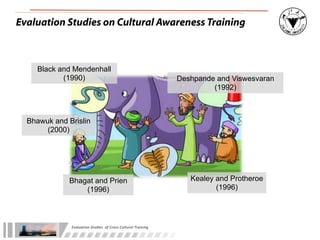
Evaluation Studies on Cultural Awareness Training


    Black and Mendenhall
           (1990)                                                               Deshpande and Viswesvaran
                                                                                         (1992)


  Bhawuk and Brislin
       (2000)


              Bhagat and Prien                                                     Kealey and Protheroe
                  (1996)                                                                  (1996)


              Evaluation	
  Studies	
  	
  of	
  Cross-­‐Cultural	
  Training
Prof. Dr. Hora Tjitra - Cross-cultural and Business Psychology


                                                                                         14	
  years	
  in	
  Germany


                                                                                                                        7	
  years	
  in	
  China


      Dipl.-Psych., Technical University of Braunschweig
  Organizational Psychology and Human Resource Management

                                                                                                                                  Born	
  and	
  grew	
  up	
  
                                                                                                                                  in	
  Indonesia
              Dr. Phil., University of Regensburg
      Intercultural Psychology and Strategic Management


                Executive Education, INSEAD
                   HR Management in Asia


                                Evaluation	
  Studies	
  	
  of	
  Cross-­‐Cultural	
  Training

                                                                                                                                                                  3
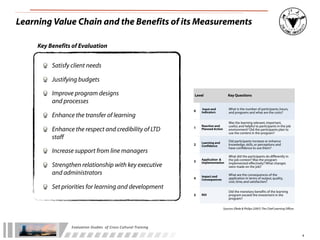
Learning Value Chain and the Benefits of its Measurements

     Key Benefits of Evaluation


          Satisfy client needs

          Justifying budgets

          Improve program designs                                                   Level                    Key Questions
          and processes
                                                                                         Input and           What is the number of participants, hours,
                                                                                    0   Indicators           and programs and what are the costs?
          Enhance the transfer of learning
                                                                                                             Was the learning relevant, important,
                                                                                        Reaction and         useful, and helpful to participants in the job
                                                                                    1
          Enhance the respect and credibility of LTD                                    Planned Action       environment? Did the participants plan to
                                                                                                             use the content in the program?
          staff                                                                                              Did participants increase or enhance
                                                                                        Learning and
                                                                                    2   Confidence           knowledge, skills, or perceptions and
                                                                                                             have confidence to use them?
          Increase support from line managers
                                                                                                             What did the participants do differently in
                                                                                        Application &        the job context? Was the program
                                                                                    3   Implementation       implemented effectively? What changes
          Strengthen relationship with key executive                                                         were made on the job?
          and administrators                                                            Impact and           What are the consequences of the
                                                                                    4   Consequences         application in terms of output, quality,
                                                                                                             cost, time, and satisfaction?
          Set priorities for learning and development
                                                                                                             Did the monetary benefits of the learning
                                                                                    5   ROI                  program exceed the investment in the
                                                                                                             program?

                                                                                                         Sources: Elkele & Philips (2007). The Chief Learning Officer.


                  Evaluation	
  Studies	
  	
  of	
  Cross-­‐Cultural	
  Training

                                                                                                                                                                         4
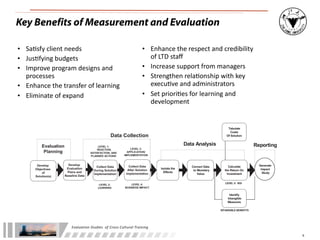
Key Benefits of Measurement and Evaluation

• Sa#sfy	
  client	
  needs                          • Enhance	
  the	
  respect	
  and	
  credibility	
  
• Jus#fying	
  budgets                                 of	
  LTD	
  staff
• Improve	
  program	
  designs	
  and	
             • Increase	
  support	
  from	
  managers
  processes                                          • Strengthen	
  rela#onship	
  with	
  key	
  
• Enhance	
  the	
  transfer	
  of	
  learning         execu#ve	
  and	
  administrators
• Eliminate	
  of	
  expand                          • Set	
  priori#es	
  for	
  learning	
  and	
  
        208                                The Chief Learning Officer
                                                       development

        The ROI Process

                                                                                                                    Tabulate
                                                                                                                      Costs
                                                     Data Collection                                               Of Solution


           Evaluation                        LEVEL 1:
                                                                                             Data Analysis                           Reporting
                                            REACTION,           LEVEL 3:
            Planning                    SATISFACTION, AND     APPLICATION/
                                        PLANNED ACTIONS     IMPLEMENTATION


        Develop           Develop                                                                                                      Generate
                                            Collect Data       Collect Data                     Convert Data        Calculate
       Objectives        Evaluation                                            Isolate the                                              Impact
                                          During Solution     After Solution                     to Monetary     the Return On
           of            Plans and                                               Effects                                                 Study
                                          Implementation     Implementation                         Value          Investment
       Solution(s)      Baseline Data

                                                                LEVEL 4:                                          LEVEL 5: ROI
                                             LEVEL 2:
                                            LEARNING        BUSINESS IMPACT

                                                                                                                    Identify
                                                                                                                   Intangible
                                                                                                                   Measures

                                                                                                               INTANGIBLE BENEFITS


                     Figure 8-4. ROI methodology. (Source: Phillips, 2003.
                                                              Used with permission.)
                        Evaluation	
  Studies	
  	
  of	
  Cross-­‐Cultural	
  Training

                                                                                                                                                  5
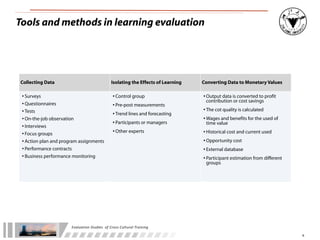
Tools and methods in learning evaluation


Collecting Data                                        Isolating the Effects of Learning   Converting Data to Monetary Values

 • Surveys                                              • Control group                    • Output data is converted to profit
                                                                                            contribution or cost savings
 • Questionnaires                                       • Pre-post measurements
 • Tests                                                                                   • The cot quality is calculated
                                                        • Trend lines and forecasting
 • On-the-job observation                                                                  • Wages and benefits for the used of
                                                        • Participants or managers          time value
 • Interviews
 • Focus groups                                         • Other experts                    • Historical cost and current used
 • Action plan and program assignments                                                     • Opportunity cost
 • Performance contracts                                                                   • External database
 • Business performance monitoring                                                         • Participant estimation from different
                                                                                            groups


                       Evaluation	
  Studies	
  	
  of	
  Cross-­‐Cultural	
  Training

                                                                                                                                     6
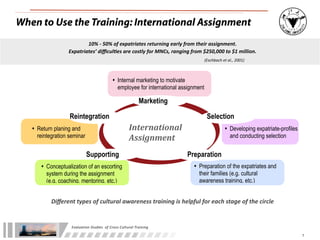
When to Use the Training: International Assignment
                            10%	
  -­‐	
  50%	
  of	
  expatriates	
  returning	
  early	
  from	
  their	
  assignment.	
  
                    Expatriates’	
  difficulAes	
  are	
  costly	
  for	
  MNCs,	
  ranging	
  from	
  $250,000	
  to	
  $1	
  million.	


  (Eschbach	
  et	
  al.,	
  2001)


                                                                                                                                    • Internal marketing to motivate
                                                                                                                                                    employee for international assignment

                                                                                                                                                                                                                         Marketing

                     Reintegration                                                                                                                                                                                                                                                                                                                                                                                                                     Selection
   • Return planing and                                                                                                                                                                  International	
                                                                                                                                                                                                                                                                                                         • Developing expatriate-profiles
     reintegration seminar                                                                                                                                                               Assignment                                                                                                                                                                                                                                                                                                                              and conducting selection


                                              Supporting                                                                                                                                                                                                                                                                                                                               Preparation
      • Conceptualization of an escorting                                                                                                                                                                                                                                                                                                                                                                    • Preparation of the expatriates and
         system during the assignment                                                                                                                                                                                                                                                                                                                                                                                         their families (e.g. cultural
         (e.g. coaching, mentoring, etc.)                                                                                                                                                                                                                                                                                                                                                                                     awareness training, etc.)


           Different	
  types	
  of	
  cultural	
  awareness	
  training	
  is	
  helpful	
  for	
  each	
  stage	
  of	
  the	
  circle


                      Evaluation	
  Studies	
  	
  of	
  Cross-­‐Cultural	
  Training

                                                                                                                                                                                                                                                                                                                                                                                                                                                                                                                                                                                    7
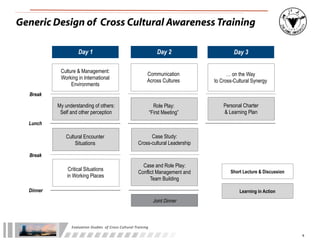
Generic Design of Cross Cultural Awareness Training

                      Day 1                                                            Day 2                  Day 3

            Culture & Management:
                                                                               Communication               … on the Way
            Working in International
                                                                               Across Cultures       to Cross-Cultural Synergy
                 Environments
  Break

           My understanding of others:                                               Role Play:          Personal Charter
            Self and other perception                                              “First Meeting”       & Learning Plan
  Lunch

               Cultural Encounter                                            Case Study:
                   Situations                                          Cross-cultural Leadership

  Break
                                                                         Case and Role Play:
                Critical Situations
                                                                       Conflict Management and              Short Lecture & Discussion
               in Working Places
                                                                             Team Building

  Dinner                                                                                                        Learning in Action
                                                                                     Joint Dinner


                 Evaluation	
  Studies	
  	
  of	
  Cross-­‐Cultural	
  Training

                                                                                                                                         8
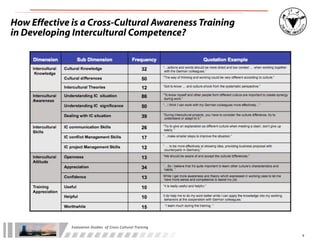
How Effective is a Cross-Cultural Awareness Training
in Developing Intercultural Competence?


              Evaluation	
  Studies	
  	
  of	
  Cross-­‐Cultural	
  Training

                                                                                9
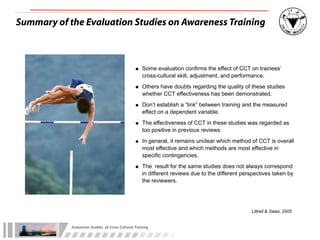
Summary of the Evaluation Studies on Awareness Training


                                                                • Some evaluation confirms the effect of CCT on trainees’
                                                                      cross-cultural skill, adjustment, and performance.

                                                                • Others have doubts regarding the quality of these studies
                                                                      whether CCT effectiveness has been demonstrated.

                                                                • Don’t establish a “link” between training and the measured
                                                                      effect on a dependent variable.

                                                                • The effectiveness of CCT in these studies was regarded as
                                                                      too positive in previous reviews.

                                                                • In general, it remains unclear which method of CCT is overall
                                                                      most effective and which methods are most effective in
                                                                      specific contingencies.

                                                                • The result for the same studies does not always correspond
                                                                      in different reviews due to the different perspectives taken by
                                                                      the reviewers.


                                                                                                                   Littrell & Salas, 2005


            Evaluation	
  Studies	
  	
  of	
  Cross-­‐Cultural	
  Training
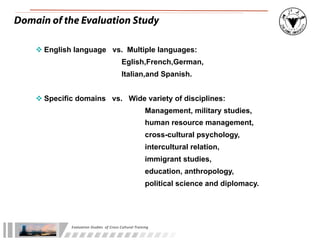
Domain of the Evaluation Study

     English language vs. Multiple languages:
                                                      Eglish,French,German,
                                                      Italian,and Spanish.


     Specific domains vs. Wide variety of disciplines:
                                                                         Management, military studies,
                                                                         human resource management,
                                                                         cross-cultural psychology,
                                                                         intercultural relation,
                                                                         immigrant studies,
                                                                         education, anthropology,
                                                                         political science and diplomacy.


             Evaluation	
  Studies	
  	
  of	
  Cross-­‐Cultural	
  Training
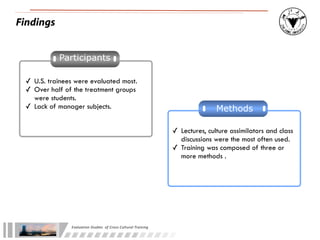
Findings


           Participants

 ✓ U.S. trainees were evaluated most.
 ✓ Over half of the treatment groups
   were students.
 ✓ Lack of manager subjects.                                                                    Methods

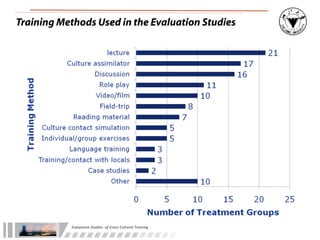
                                                                                 ✓ Lectures, culture assimilators and class
                                                                                   discussions were the most often used.
                                                                                 ✓ Training was composed of three or
                                                                                   more methods .


               Evaluation	
  Studies	
  	
  of	
  Cross-­‐Cultural	
  Training
Training Methods Used in the Evaluation Studies


           Evaluation	
  Studies	
  	
  of	
  Cross-­‐Cultural	
  Training
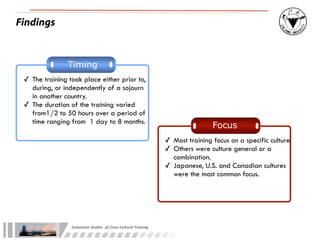
Findings


                Timing
 ✓ The training took place either prior to,
   during, or independently of a sojourn
   in another country.
 ✓ The duration of the training varied
   from1/2 to 50 hours over a period of
   time ranging from 1 day to 8 months.
                                                                                                   Focus
                                                                                   ✓ Most training focus on a specific culture.
                                                                                   ✓ Others were culture general or a
                                                                                     combination.
                                                                                   ✓ Japanese, U.S. and Canadian cultures
                                                                                     were the most common focus.


                 Evaluation	
  Studies	
  	
  of	
  Cross-­‐Cultural	
  Training
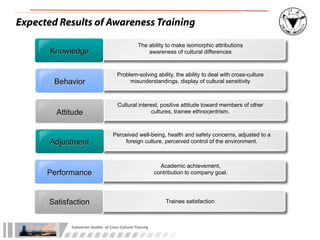
Expected Results of Awareness Training

                                                                   The ability to make isomorphic attributions
       Knowledge                                                       awareness of cultural differences


                                                  Problem-solving ability, the ability to deal with cross-culture
        Behavior                                       misunderstandings, display of cultural sensitivity


                                                  Cultural interest, positive attitude toward members of other
         Attitude                                                cultures, trainee ethnocentrism.


                                               Perceived well-being, health and safety concerns, adjusted to a
       Adjustment                                   foreign culture, perceived control of the environment.


                                                                                 Academic achievement,
      Performance                                                              contribution to company goal.


       Satisfaction                                                                Trainee satisfaction


             Evaluation	
  Studies	
  	
  of	
  Cross-­‐Cultural	
  Training
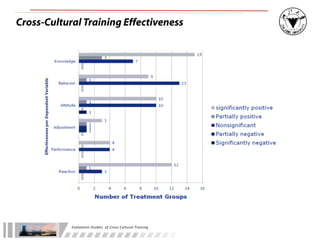
Cross-Cultural Training Effectiveness


            Evaluation	
  Studies	
  	
  of	
  Cross-­‐Cultural	
  Training
Some Critical Issues of the Current Evaluation Studies


                                                                      • Control Groups
                                                                      • Pre- and Post-Training Test
                                                                      • Randomly Assign
                                                                      • Long-term vs. Short Term Effects
                                                                      • Different Measurement Methods
                                                                      • Placebo and Hawthorne Effects


            Evaluation	
  Studies	
  	
  of	
  Cross-­‐Cultural	
  Training
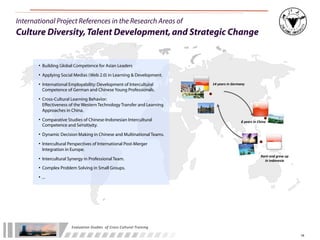
International Project References in the Research Areas of
Culture Diversity, Talent Development, and Strategic Change


       • Building Global Competence for Asian Leaders
       • Applying Social Medias (Web 2.0) in Learning & Development.
       • International Employability: Development of Intercultural                        14	
  years	
  in	
  Germany
         Competence of German and Chinese Young Professionals.

       • Cross-Cultural Learning Behavior:
         Effectiveness of the Western Technology Transfer and Learning
         Approaches in China.

       • Comparative Studies of Chinese-Indonesian Intercultural                                                   8	
  years	
  in	
  China
         Competence and Sensitivity.

       • Dynamic Decision Making in Chinese and Multinational Teams.
       • Intercultural Perspectives of International Post-Merger
         Integration in Europe.
                                                                                                                                       Born	
  and	
  grew	
  up	
  
       • Intercultural Synergy in Professional Team.                                                                                     in	
  Indonesia

       • Complex Problem Solving in Small Groups.
       • ...


                        Evaluation	
  Studies	
  	
  of	
  Cross-­‐Cultural	
  Training

                                                                                                                                                                       18
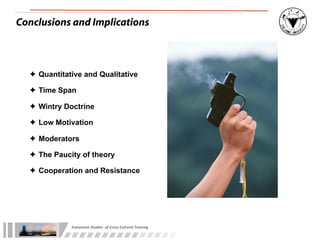
Conclusions and Implications


  ✦ Quantitative and Qualitative

  ✦ Time Span

  ✦ Wintry Doctrine

  ✦ Low Motivation

  ✦ Moderators

  ✦ The Paucity of theory

  ✦ Cooperation and Resistance


             Evaluation	
  Studies	
  	
  of	
  Cross-­‐Cultural	
  Training
Thank	
  You
                                                                                                 Contact us via …

                                                                                                 Mail:    hora_t@mac.com
                                                                                                 Follow: twitter@htjitra
                                                                                                 Website: http://horatjitra.com


Based on: LISA N. LITTRELL, EDUARDO SALAS:
          A Review of Cross-Cultural Training: Best Practices, Guidelines, and Research Needs.           Zhejiang	
  University,	
  Hangzhou	
  (China)
          Human Resource Development Review, 4(3), 2005. p305-334

Evaluation Studies of Cross-Cultural Training Program

  • 1.
    Evaluation  Studies   of  Cross-­cultural  Training A Review of the Literature From 1988 to 2000 Prof. Dr. Hora Tjitra & Mu Tong, Zhejiang University Hangzhou, March 2011
  • 2.
    Evaluation Studies onCultural Awareness Training Black and Mendenhall (1990) Deshpande and Viswesvaran (1992) Bhawuk and Brislin (2000) Bhagat and Prien Kealey and Protheroe (1996) (1996) Evaluation  Studies    of  Cross-­‐Cultural  Training
  • 3.
    Prof. Dr. HoraTjitra - Cross-cultural and Business Psychology 14  years  in  Germany 7  years  in  China Dipl.-Psych., Technical University of Braunschweig Organizational Psychology and Human Resource Management Born  and  grew  up   in  Indonesia Dr. Phil., University of Regensburg Intercultural Psychology and Strategic Management Executive Education, INSEAD HR Management in Asia Evaluation  Studies    of  Cross-­‐Cultural  Training 3
  • 4.
    Learning Value Chainand the Benefits of its Measurements Key Benefits of Evaluation Satisfy client needs Justifying budgets Improve program designs Level Key Questions and processes Input and What is the number of participants, hours, 0 Indicators and programs and what are the costs? Enhance the transfer of learning Was the learning relevant, important, Reaction and useful, and helpful to participants in the job 1 Enhance the respect and credibility of LTD Planned Action environment? Did the participants plan to use the content in the program? staff Did participants increase or enhance Learning and 2 Confidence knowledge, skills, or perceptions and have confidence to use them? Increase support from line managers What did the participants do differently in Application & the job context? Was the program 3 Implementation implemented effectively? What changes Strengthen relationship with key executive were made on the job? and administrators Impact and What are the consequences of the 4 Consequences application in terms of output, quality, cost, time, and satisfaction? Set priorities for learning and development Did the monetary benefits of the learning 5 ROI program exceed the investment in the program? Sources: Elkele & Philips (2007). The Chief Learning Officer. Evaluation  Studies    of  Cross-­‐Cultural  Training 4
  • 5.
    Key Benefits ofMeasurement and Evaluation • Sa#sfy  client  needs • Enhance  the  respect  and  credibility   • Jus#fying  budgets of  LTD  staff • Improve  program  designs  and   • Increase  support  from  managers processes • Strengthen  rela#onship  with  key   • Enhance  the  transfer  of  learning execu#ve  and  administrators • Eliminate  of  expand • Set  priori#es  for  learning  and   208 The Chief Learning Officer development The ROI Process Tabulate Costs Data Collection Of Solution Evaluation LEVEL 1: Data Analysis Reporting REACTION, LEVEL 3: Planning SATISFACTION, AND APPLICATION/ PLANNED ACTIONS IMPLEMENTATION Develop Develop Generate Collect Data Collect Data Convert Data Calculate Objectives Evaluation Isolate the Impact During Solution After Solution to Monetary the Return On of Plans and Effects Study Implementation Implementation Value Investment Solution(s) Baseline Data LEVEL 4: LEVEL 5: ROI LEVEL 2: LEARNING BUSINESS IMPACT Identify Intangible Measures INTANGIBLE BENEFITS Figure 8-4. ROI methodology. (Source: Phillips, 2003. Used with permission.) Evaluation  Studies    of  Cross-­‐Cultural  Training 5
  • 6.
    Tools and methodsin learning evaluation Collecting Data Isolating the Effects of Learning Converting Data to Monetary Values • Surveys • Control group • Output data is converted to profit contribution or cost savings • Questionnaires • Pre-post measurements • Tests • The cot quality is calculated • Trend lines and forecasting • On-the-job observation • Wages and benefits for the used of • Participants or managers time value • Interviews • Focus groups • Other experts • Historical cost and current used • Action plan and program assignments • Opportunity cost • Performance contracts • External database • Business performance monitoring • Participant estimation from different groups Evaluation  Studies    of  Cross-­‐Cultural  Training 6
  • 7.
    When to Usethe Training: International Assignment 10%  -­‐  50%  of  expatriates  returning  early  from  their  assignment.   Expatriates’  difficulAes  are  costly  for  MNCs,  ranging  from  $250,000  to  $1  million.                                                                                                                                                                                                                                                            (Eschbach  et  al.,  2001) • Internal marketing to motivate employee for international assignment Marketing Reintegration Selection • Return planing and International   • Developing expatriate-profiles reintegration seminar Assignment and conducting selection Supporting Preparation • Conceptualization of an escorting • Preparation of the expatriates and system during the assignment their families (e.g. cultural (e.g. coaching, mentoring, etc.) awareness training, etc.) Different  types  of  cultural  awareness  training  is  helpful  for  each  stage  of  the  circle Evaluation  Studies    of  Cross-­‐Cultural  Training 7
  • 8.
    Generic Design ofCross Cultural Awareness Training Day 1 Day 2 Day 3 Culture & Management: Communication … on the Way Working in International Across Cultures to Cross-Cultural Synergy Environments Break My understanding of others: Role Play: Personal Charter Self and other perception “First Meeting” & Learning Plan Lunch Cultural Encounter Case Study: Situations Cross-cultural Leadership Break Case and Role Play: Critical Situations Conflict Management and Short Lecture & Discussion in Working Places Team Building Dinner Learning in Action Joint Dinner Evaluation  Studies    of  Cross-­‐Cultural  Training 8
  • 9.
    How Effective isa Cross-Cultural Awareness Training in Developing Intercultural Competence? Evaluation  Studies    of  Cross-­‐Cultural  Training 9
  • 10.
    Summary of theEvaluation Studies on Awareness Training • Some evaluation confirms the effect of CCT on trainees’ cross-cultural skill, adjustment, and performance. • Others have doubts regarding the quality of these studies whether CCT effectiveness has been demonstrated. • Don’t establish a “link” between training and the measured effect on a dependent variable. • The effectiveness of CCT in these studies was regarded as too positive in previous reviews. • In general, it remains unclear which method of CCT is overall most effective and which methods are most effective in specific contingencies. • The result for the same studies does not always correspond in different reviews due to the different perspectives taken by the reviewers. Littrell & Salas, 2005 Evaluation  Studies    of  Cross-­‐Cultural  Training
  • 11.
    Domain of theEvaluation Study  English language vs. Multiple languages: Eglish,French,German, Italian,and Spanish.  Specific domains vs. Wide variety of disciplines: Management, military studies, human resource management, cross-cultural psychology, intercultural relation, immigrant studies, education, anthropology, political science and diplomacy. Evaluation  Studies    of  Cross-­‐Cultural  Training
  • 12.
    Findings Participants ✓ U.S. trainees were evaluated most. ✓ Over half of the treatment groups were students. ✓ Lack of manager subjects. Methods ✓ Lectures, culture assimilators and class discussions were the most often used. ✓ Training was composed of three or more methods . Evaluation  Studies    of  Cross-­‐Cultural  Training
  • 13.
    Training Methods Usedin the Evaluation Studies Evaluation  Studies    of  Cross-­‐Cultural  Training
  • 14.
    Findings Timing ✓ The training took place either prior to, during, or independently of a sojourn in another country. ✓ The duration of the training varied from1/2 to 50 hours over a period of time ranging from 1 day to 8 months. Focus ✓ Most training focus on a specific culture. ✓ Others were culture general or a combination. ✓ Japanese, U.S. and Canadian cultures were the most common focus. Evaluation  Studies    of  Cross-­‐Cultural  Training
  • 15.
    Expected Results ofAwareness Training The ability to make isomorphic attributions Knowledge awareness of cultural differences Problem-solving ability, the ability to deal with cross-culture Behavior misunderstandings, display of cultural sensitivity Cultural interest, positive attitude toward members of other Attitude cultures, trainee ethnocentrism. Perceived well-being, health and safety concerns, adjusted to a Adjustment foreign culture, perceived control of the environment. Academic achievement, Performance contribution to company goal. Satisfaction Trainee satisfaction Evaluation  Studies    of  Cross-­‐Cultural  Training
  • 16.
    Cross-Cultural Training Effectiveness Evaluation  Studies    of  Cross-­‐Cultural  Training
  • 17.
    Some Critical Issuesof the Current Evaluation Studies • Control Groups • Pre- and Post-Training Test • Randomly Assign • Long-term vs. Short Term Effects • Different Measurement Methods • Placebo and Hawthorne Effects Evaluation  Studies    of  Cross-­‐Cultural  Training
  • 18.
    International Project Referencesin the Research Areas of Culture Diversity, Talent Development, and Strategic Change • Building Global Competence for Asian Leaders • Applying Social Medias (Web 2.0) in Learning & Development. • International Employability: Development of Intercultural 14  years  in  Germany Competence of German and Chinese Young Professionals. • Cross-Cultural Learning Behavior: Effectiveness of the Western Technology Transfer and Learning Approaches in China. • Comparative Studies of Chinese-Indonesian Intercultural 8  years  in  China Competence and Sensitivity. • Dynamic Decision Making in Chinese and Multinational Teams. • Intercultural Perspectives of International Post-Merger Integration in Europe. Born  and  grew  up   • Intercultural Synergy in Professional Team. in  Indonesia • Complex Problem Solving in Small Groups. • ... Evaluation  Studies    of  Cross-­‐Cultural  Training 18
  • 19.
    Conclusions and Implications ✦ Quantitative and Qualitative ✦ Time Span ✦ Wintry Doctrine ✦ Low Motivation ✦ Moderators ✦ The Paucity of theory ✦ Cooperation and Resistance Evaluation  Studies    of  Cross-­‐Cultural  Training
  • 20.
    Thank  You Contact us via … Mail: hora_t@mac.com Follow: twitter@htjitra Website: http://horatjitra.com Based on: LISA N. LITTRELL, EDUARDO SALAS: A Review of Cross-Cultural Training: Best Practices, Guidelines, and Research Needs. Zhejiang  University,  Hangzhou  (China) Human Resource Development Review, 4(3), 2005. p305-334