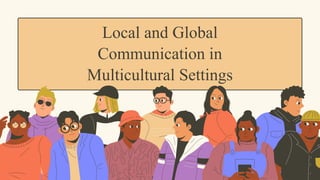
Local and Global
Communication in
Multicultural Settings
Learning Outcomes
Understand how
cultural diversity
impacts
communication.
Appreciate the
benefits and
challenges of cross-
cultural
communication.
01
Recognize the reality
of cultural diversity.
02 03
Terms defined…
✓ Local- refers to something that is specific
to a particular place, region, or community.
✓ Global - relating to the entire world or a very large
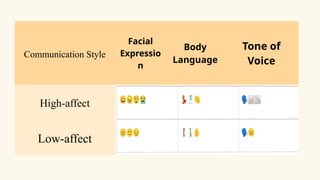
area.
✓ Multicultural Setting - A place or environment
where people from different cultures live and interact.
?
Why Are We So Different?
? ?
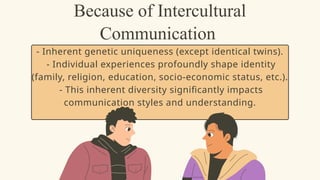
Because of Intercultural
Communication
- Inherent genetic uniqueness (except identical twins).
- Individual experiences profoundly shape identity
(family, religion, education, socio-economic status, etc.).
- This inherent diversity significantly impacts
communication styles and understanding.
We are all
different.
We are
unique
on our
own way.
Sarah, from a rural Midwest background, values direct
communication and punctuality. Maria, from the Philippines,
prioritizes relationships and flexible timeframes. These
contrasting communication styles, shaped by their unique
experiences and cultural values, could easily lead to
misunderstandings.
Think!
? ? ?
Now, let's consider
how their
backgrounds
influence their
communication:
Individual
Experiences
Inherent Diversity
The Miscommunication Myth
• Miscommunication extends beyond
language proficiency.
• Cultural differences are a major
factor influencing understanding.
• Even fluent speakers can experience
significant miscommunication across
cultures.
What do you
think
happened here?
?
"direct"
"efficient "
"deadline"
"understanding"
"respect "
"friendly"
?
?
How do we approach Intercultural
Communication?
? ? ?
Challenges of
Intercultural
Communication.
• Take for granted
• Cultural biases
• Domestic workforce
• Cultural overtones
• Durable bond
• Grossly disloyal
"Communicating Across Cultures"
by Carol Kinsey Goman (2011)
• Each culture has its own set of
unspoken rules.
• Cultural biases are often
unconscious and deeply
ingrained.
•Much of cultural knowledge is
absorbed subconsciously, not
explicitly taught.
Communicating across cultures is challenging.
The challenge for multinational communic
never been
greater.
• Globalization and increasingly
diverse workforces necessitate
intercultural understanding.
• Multinational organizations
increasingly recognize the critical
importance of intercultural
communication training.
• While individuals vary, cultural
generalizations offer valuable
insights.
• These generalizations provide
helpful clues for navigating
cross-cultural interactions.
Understanding Cultural Clues
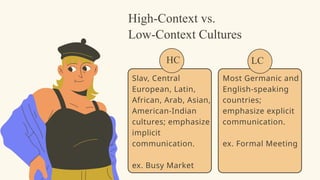
High-Context vs.
Low-Context Cultures
Slav, Central
European, Latin,
African, Arab, Asian,
American-Indian
cultures; emphasize
implicit
communication.
ex. Busy Market
Most Germanic and
English-speaking
countries;
emphasize explicit
communication.
ex. Formal Meeting
HC LC
Some cultures think of time
sequentially, as a linear
commodity to "spend," "save," or
"waste." Other cultures 1 view
time synchronically, as a
constant flow to be experienced
in the moment, and as a force
that cannot be contained or
controlled.
Sequential vs. Synchronic Time
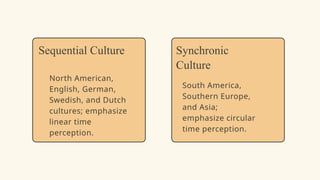
North American,
English, German,
Swedish, and Dutch
cultures; emphasize
linear time
perception.
South America,
Southern Europe,
and Asia;
emphasize circular
time perception.
Sequential Culture Synchronic
Culture
Time Orientation: Past, Present, Future
• Cultural differences in prioritizing past,
present, and future significantly impact
decision-making.
• Long-term vs. short-term perspectives
influence business practices and
relationships.
Affective vs. Neutral
Communication
In international business,
some cultures are
emotionally expressive
(high affect), openly
displaying feelings. Others
are emotionally neutral,
carefully controlling
emotions. The dominant
approach significantly
impacts business
interactions.
Communication Style
Facial
Expressio
n
Body
Language
Tone of
Voice
High-affect 😆😠😲😭 💃👏 🗣️
📈📉
Low-affect 😐😒😔 👍 ️
😐
🗣️
• The interplay of reason and
emotion varies across cultures.
• Different cultures seek
different types of confirmation
(emotional vs. rational).
Reason vs. Emotion in
Communication
• Illustrates the clash between
rational and emotional
communication styles.
• Highlights the crucial role of
cultural understanding in
conflict resolution.
The Italian and the Dutch Manager
• Cultural differences significantly
impact communication effectiveness.
• Understanding and respecting these
differences is essential for successful
cross-cultural interactions.
• Adaptability and cultural sensitivity
are key to navigating a globalized
world.
Key Takeaways
Any questions?
Clarifications?
Violent Reactions ?
Rants?
Comments?
And whatsoever?
Thank you for
listening!
Reference

local and global communication in multicultural settings

  • 1.
    Local and Global Communicationin Multicultural Settings
  • 2.
    Learning Outcomes Understand how culturaldiversity impacts communication. Appreciate the benefits and challenges of cross- cultural communication. 01 Recognize the reality of cultural diversity. 02 03
  • 3.
    Terms defined… ✓ Local-refers to something that is specific to a particular place, region, or community. ✓ Global - relating to the entire world or a very large area. ✓ Multicultural Setting - A place or environment where people from different cultures live and interact.
  • 4.
    ? Why Are WeSo Different? ? ?
  • 5.
    Because of Intercultural Communication -Inherent genetic uniqueness (except identical twins). - Individual experiences profoundly shape identity (family, religion, education, socio-economic status, etc.). - This inherent diversity significantly impacts communication styles and understanding.
  • 6.
    We are all different. Weare unique on our own way.
  • 7.
    Sarah, from arural Midwest background, values direct communication and punctuality. Maria, from the Philippines, prioritizes relationships and flexible timeframes. These contrasting communication styles, shaped by their unique experiences and cultural values, could easily lead to misunderstandings. Think! ? ? ?
  • 8.
    Now, let's consider howtheir backgrounds influence their communication: Individual Experiences Inherent Diversity
  • 9.
    The Miscommunication Myth •Miscommunication extends beyond language proficiency. • Cultural differences are a major factor influencing understanding. • Even fluent speakers can experience significant miscommunication across cultures.
  • 10.
    What do you think happenedhere? ? "direct" "efficient " "deadline" "understanding" "respect " "friendly" ? ?
  • 11.
    How do weapproach Intercultural Communication? ? ? ?
  • 12.
    Challenges of Intercultural Communication. • Takefor granted • Cultural biases • Domestic workforce • Cultural overtones • Durable bond • Grossly disloyal "Communicating Across Cultures" by Carol Kinsey Goman (2011)
  • 13.
    • Each culturehas its own set of unspoken rules. • Cultural biases are often unconscious and deeply ingrained. •Much of cultural knowledge is absorbed subconsciously, not explicitly taught. Communicating across cultures is challenging.
  • 14.
    The challenge formultinational communic never been greater. • Globalization and increasingly diverse workforces necessitate intercultural understanding. • Multinational organizations increasingly recognize the critical importance of intercultural communication training.
  • 15.
    • While individualsvary, cultural generalizations offer valuable insights. • These generalizations provide helpful clues for navigating cross-cultural interactions. Understanding Cultural Clues
  • 16.
    High-Context vs. Low-Context Cultures Slav,Central European, Latin, African, Arab, Asian, American-Indian cultures; emphasize implicit communication. ex. Busy Market Most Germanic and English-speaking countries; emphasize explicit communication. ex. Formal Meeting HC LC
  • 17.
    Some cultures thinkof time sequentially, as a linear commodity to "spend," "save," or "waste." Other cultures 1 view time synchronically, as a constant flow to be experienced in the moment, and as a force that cannot be contained or controlled. Sequential vs. Synchronic Time
  • 18.
    North American, English, German, Swedish,and Dutch cultures; emphasize linear time perception. South America, Southern Europe, and Asia; emphasize circular time perception. Sequential Culture Synchronic Culture
  • 19.
    Time Orientation: Past,Present, Future • Cultural differences in prioritizing past, present, and future significantly impact decision-making. • Long-term vs. short-term perspectives influence business practices and relationships.
  • 20.
    Affective vs. Neutral Communication Ininternational business, some cultures are emotionally expressive (high affect), openly displaying feelings. Others are emotionally neutral, carefully controlling emotions. The dominant approach significantly impacts business interactions.
  • 21.
    Communication Style Facial Expressio n Body Language Tone of Voice High-affect😆😠😲😭 💃👏 🗣️ 📈📉 Low-affect 😐😒😔 👍 ️ 😐 🗣️
  • 22.
    • The interplayof reason and emotion varies across cultures. • Different cultures seek different types of confirmation (emotional vs. rational). Reason vs. Emotion in Communication
  • 23.
    • Illustrates theclash between rational and emotional communication styles. • Highlights the crucial role of cultural understanding in conflict resolution. The Italian and the Dutch Manager
  • 24.
    • Cultural differencessignificantly impact communication effectiveness. • Understanding and respecting these differences is essential for successful cross-cultural interactions. • Adaptability and cultural sensitivity are key to navigating a globalized world. Key Takeaways
  • 25.
    Any questions? Clarifications? Violent Reactions? Rants? Comments? And whatsoever?
  • 26.
  • 27.