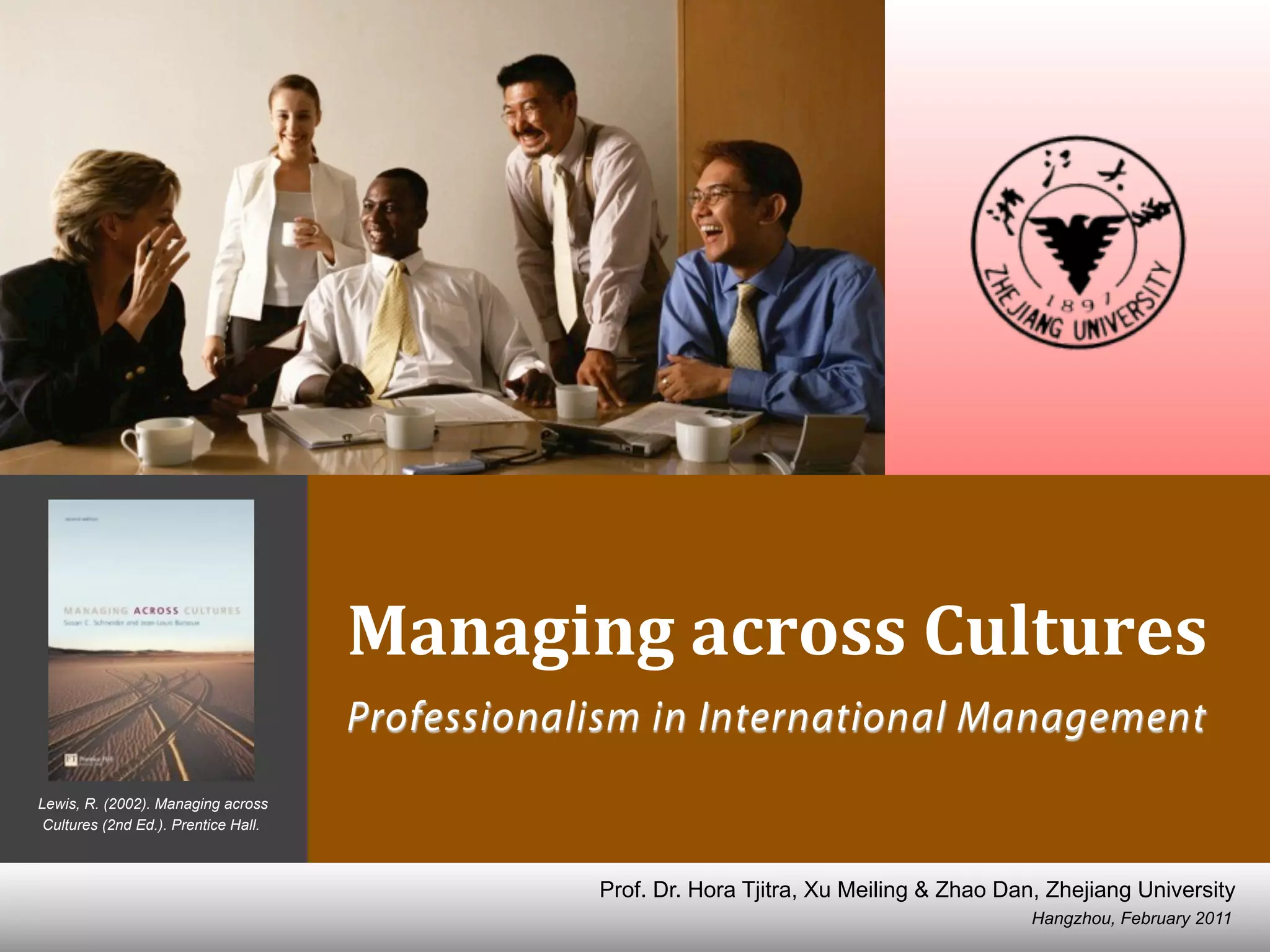
Hangzhou, February 2011
Prof. Dr. Hora Tjitra, Xu Meiling & Zhao Dan, Zhejiang University
Managing	
  across	
  Cultures
Professionalism in International Management
Lewis, R. (2002). Managing across
Cultures (2nd Ed.). Prentice Hall.
Richard	
  Lewis:	
  When	
  Cultures	
  Collide
About Authors
Susan C. Schneider (Swiss	
  )
Susan	
  C.	
  Schneider,	
  is	
  professor	
  of	
  human	
  resources	
  at	
  HEC	
  Geneva,	
  (Hautes	
  
Etudes	
  Commerciales	
  Geneve),	
  part	
  of	
  the	
  Faculty	
  of	
  Economics	
  and	
  Social	
  
Sciences	
  at	
  the	
  University	
  of	
  Geneva.	
  Professor	
  Schneider's	
  main	
  research	
  
topics	
  are	
  intercultural	
  management,	
  cogniBve	
  sciences	
  and	
  their	
  impact	
  on	
  
firms'	
  strategies.
Jean-Louis Barsoux (French)
Jean-­‐Louis	
  Barsoux	
  is	
  a	
  Senior	
  Research	
  Fellow	
  at	
  
INSEAD	
  and	
  a	
  co-­‐authour	
  of	
  The	
  Set-­‐Up-­‐To-­‐Fail	
  
Syndrome:	
  How	
  good	
  managers	
  cause	
  great	
  people	
  to	
  
fail,	
  Harvard	
  Business	
  School	
  Press,	
  Boston,	
  2002.
2
Richard	
  Lewis:	
  When	
  Cultures	
  Collide
3
14	
  years	
  in	
  Germany
7	
  years	
  in	
  China
Born	
  and	
  grew	
  up	
  
in	
  Indonesia
Prof.Dr.Hora Tjitra - Excellence in Culture,Talent and Change
Richard	
  Lewis:	
  When	
  Cultures	
  Collide
3
14	
  years	
  in	
  Germany
7	
  years	
  in	
  China
Born	
  and	
  grew	
  up	
  
in	
  Indonesia
Prof.Dr.Hora Tjitra - Excellence in Culture,Talent and Change
Professional activities:
• Academic Teaching and Research,as well as Consulting,
Coaching,Training and Assessment in the area of:
- Cross-Cultural Awareness and Communication
- Cross-Cultural Issues in HR Management
- Corporate Learning and Development
- Executive Coaching and Assessment
- Global Leadership Development Program
- Facilitation of Strategic Conference
- Large Strategic Change Projects
International and National project references:
• BASF,Siemens,Dupont,Commerzbank,Hugo Boss,SAP,
Barco,GTZ,Telkom Indonesia,etc.
Richard	
  Lewis:	
  When	
  Cultures	
  Collide
Map and Brief Introduction
4
Richard	
  Lewis:	
  When	
  Cultures	
  Collide
Part I Contents
Converging	
  cultures
Culture	
  as	
  a	
  source	
  of	
  compe33ve	
  advantage/disadvantage
Recognizing	
  culture
Discovering	
  cultural	
  advantage
The	
  search	
  for	
  meaning
Ar3facts	
  and	
  behavior
Beliefs	
  and	
  value
Basic	
  assump3ons
Interpre3ng	
  pa?erns	
  of	
  culture
Cultural	
  spheres	
  of	
  influence
Crea3ng	
  compe33ve	
  advantage:	
  interac3ng	
  spheres
The	
  undertow	
  of	
  culture
Exploring	
  culture
InteracBng	
  spheres	
  of	
  culture
5
Richard	
  Lewis:	
  When	
  Cultures	
  Collide
Surface
Deep
Inside
The world is
getting smaller?
Cultural Identity and Integrity!
• Switzerland’s	
  refusal	
  to	
  
join	
  in	
  European
• AdvocaBng	
  learning	
  
ancient	
  language
• Global	
  Village
• Informa(on	
  sharing,	
  ea(ng	
  
habits,	
  	
  dress
• MelBng	
  Pot
• People	
  from	
  many	
  different	
  
origins	
  living	
  in	
  big	
  ci(es,	
  e.g.,	
  
Landon.
• DisBnct	
  Cultural	
  fragments
• Chinatown,	
  Italy	
  Town
• CompeBBve	
  language	
  and	
  
culture
• Restaurant	
  menu
6
Converging Cultures?
Richard	
  Lewis:	
  When	
  Cultures	
  Collide
Universal of Management practice
• A set of principles and techniques
• Scientifically engineered
Cultural influence
• Different road systems
• Different medical needs and prescriptions
7
Converging Cultures - Management is Management?
Richard	
  Lewis:	
  When	
  Cultures	
  Collide
The	
  presence	
  
and	
  power	
  of	
  
Culture
8
Forces For and Against convergence
Richard	
  Lewis:	
  When	
  Cultures	
  Collide
Country-­‐level	
  Factors
Availability	
  of	
  resources
The	
  size	
  and	
  sophis3ca3on	
  of	
  the	
  market
The	
  nature	
  of	
  government	
  interven3on
The	
  type	
  of	
  strategic	
  networks
InsBtuBonal	
  
Arrangements
Cultural	
  
ConfiguraBons
France
EducaBon	
  System	
  places	
  high	
  value	
  on	
  
engineering	
  and	
  administraBon	
  and	
  the	
  
close	
  relaBonship	
  between	
  state	
  and	
  
industry
9
Culture as a source of competitive advantage/disadvantage
Richard	
  Lewis:	
  When	
  Cultures	
  Collide
Culture	
  to	
  one	
  as	
  water	
  to	
  fish:
A	
  fish	
  doesn't	
  think	
  about	
  what	
  water	
  it	
  is	
  
in	
  Bll	
  it’s	
  stranded!
Open for discussion My blind spot
Their blind spot Shared blind spot
What	
  I	
  see	


  What	
  I	
  do	
  not	
  see
What	
  they	
  
see
What	
  they	
  
do	
  not	
  see
Johari	
  window
Source:	
  adapted	
  from	
  S.Jourard(1964)	
  The	
  Transparent	
  Self,	
  Van	
  Nostrand	
  
Reinhold,	
  Princeton,	
  NJ.
Recognizing	
  cultural	
  
differences
Insights
10
Recognizing culture
Richard	
  Lewis:	
  When	
  Cultures	
  Collide
The	
  point	
  is	
  not	
  the	
  existence	
  but	
  the	
  way	
  they	
  are	
  used!
EffecBve	
  way	
  of	
  using	
  Stereotypes
11
Stereotypes
Richard	
  Lewis:	
  When	
  Cultures	
  Collide
The	
  Swiss…
Consider	
  themselves	
  to	
  be:	
   Are	
  perceived	
  by	
  foreigners	
  as	
  being:	
  
Expect	
  foreigners	
  to	
  be:
Step	
  1 Step	
  2
Step	
  3
Step 4: Find the potential cultural aspects to achieve competitive
advantages 12
Discovering cultural advantage
Richard	
  Lewis:	
  When	
  Cultures	
  Collide
Part I Contents
Converging	
  cultures
Culture	
  as	
  a	
  source	
  of	
  compe33ve	
  advantage/disadvantage
Recognizing	
  culture
Discovering	
  cultural	
  advantage
The	
  search	
  for	
  meaning
Ar3facts	
  and	
  behavior
Beliefs	
  and	
  value
Basic	
  assump3ons
Interpre3ng	
  pa?erns	
  of	
  culture
Cultural	
  spheres	
  of	
  influence
Crea3ng	
  compe33ve	
  advantage:	
  interac3ng	
  spheres
The	
  undertow	
  of	
  culture
Exploring	
  culture
InteracBng	
  spheres	
  of	
  culture
13
Richard	
  Lewis:	
  When	
  Cultures	
  Collide
Exploring culture
14
Richard	
  Lewis:	
  When	
  Cultures	
  Collide
Artifacts & Behaviors
• Wri,en	
  vs.	
  verbal	
  contacts
• Architecture	
  &	
  design
• Gree=ng	
  rituals
• Forms	
  of	
  address
• Making	
  contact
• Dress	
  codes
15
Richard	
  Lewis:	
  When	
  Cultures	
  Collide
Beliefs & values
Criteria	
  for	
  
success
What	
  is	
  
manage-­‐
ment?
The	
  right	
  person	
  
for	
  the	
  job
•Shareholders
•Customer
•Employees
Beliefs
•	
  people-­‐oriented
•	
  task-­‐oriented
Hire	
  what	
  kind	
  of


  people
Values
16
Richard	
  Lewis:	
  When	
  Cultures	
  Collide
Basic assumptions
External adaptation
• Relationship with nature
	
  Control
	
  Uncertainty	
  avoidance
• Nature of human activity
	
  Doing/being
	
  Achievement/ascripBon
• Nature	
  of	
  reality	
  and	
  truth
Internal integration
• Human nature
	
  Basically	
  good/	
  evil
• Nature of human relationships
	
  Social/task	
  orientaBon
	
  ParBcularism/universalism
	
  Hierarchical
	
  Individualism/collecBvism
Linking assumptions
• Space
	
  Personal/physical
• Language
	
  High/low	
  context
• Time
	
  Monochronic	
  and	
  polychronic
	
  Past/present/future
17
Richard	
  Lewis:	
  When	
  Cultures	
  Collide
External adaptation
External
adapta3on
Internal
integra3on


  Rela1onship	
  with	
  nature
–Control
–Uncertainty	
  avoidance


  Nature	
  of	
  human	
  ac1vity
–Doing/being
–Achievement/ascrip9on


  Nature	
  of	
  reality	
  and	
  truth
Linking
assump3ons
Don’t	
  just	
  stand	
  there,	
  do	
  something.
VS
Don’t	
  just	
  do	
  something,	
  stand	
  there.
18
Richard	
  Lewis:	
  When	
  Cultures	
  Collide
• Human nature
	
  Basically	
  good/	
  evil
• Rela1onships	
  with	
  people
★ Social/task	
  orienta>on
★ Masculinity/femininity
★ Hierarchy
★ Individualism/collec>vism
Internal integration
External
adapta3on
Internal
integra3on
Linking
assump3ons
19
Richard	
  Lewis:	
  When	
  Cultures	
  Collide
Linking assumptions
External
adapta3on
Internal
integra3on
Linking
assump3ons
20
Richard	
  Lewis:	
  When	
  Cultures	
  Collide
Part I Contents
Converging	
  cultures
Culture	
  as	
  a	
  source	
  of	
  compe33ve	
  advantage/disadvantage
Recognizing	
  culture
Discovering	
  cultural	
  advantage
The	
  search	
  for	
  meaning
Ar3facts	
  and	
  behavior
Beliefs	
  and	
  value
Basic	
  assump3ons
Interpre3ng	
  pa?erns	
  of	
  culture
Cultural	
  spheres	
  of	
  influence
Crea3ng	
  compe33ve	
  advantage:	
  interac3ng	
  spheres


  The	
  undertow	
  of	
  culture


  Exploring	
  culture
InteracBng	
  spheres	
  of	
  culture
21
Richard	
  Lewis:	
  When	
  Cultures	
  Collide
Interacting spheres of culture
National/Regional
Geography,
history,	
  
poliBcal	
  and	
  economic	
  forces,
climate,
religion,
language
Industry
Resources,
technology,
product	
  market,
regulaBon,
compeBBve	
  advantage
Company
Founder,	
  leader,
administraBve	
  heritage,
nature	
  of	
  product/industry	
  stage	
  of	
  development
Professional
EducaBon,
training,
selecBon,
socializaBon
Functional
External	
  environment,
nature	
  of	
  task,
Bme	
  horizon
22
Richard	
  Lewis:	
  When	
  Cultures	
  Collide
National X Industry
Industry
Culture
Walkman Movie
Japanese American
X
= Japanese	
  invasion	
  into	
  the	
  soul	
  of	
  America
23
Richard	
  Lewis:	
  When	
  Cultures	
  Collide
Professional X National
Doctors Engineers Accountant
Germany USA UK
24
Richard	
  Lewis:	
  When	
  Cultures	
  Collide
Part II Culture & Managing Practice
25
Richard	
  Lewis:	
  When	
  Cultures	
  Collide
Culture & Organization
26
Richard	
  Lewis:	
  When	
  Cultures	
  Collide
Culture & Structure --- Five Value Dimensions
	
  
Hofstede
27
Richard	
  Lewis:	
  When	
  Cultures	
  Collide
Culture & Structure --- Cultural Profiles
28
Richard	
  Lewis:	
  When	
  Cultures	
  Collide
The Meaning of Organization
Task VS Social systems
Survey	
  done	
  by	
  A.	
  Laurent
What’s	
  
an	
  
organiza>on
29
Richard	
  Lewis:	
  When	
  Cultures	
  Collide
Culture & Process
30
Richard	
  Lewis:	
  When	
  Cultures	
  Collide
Culture & Strategy
31
Richard	
  Lewis:	
  When	
  Cultures	
  Collide
Interaction effects
Strategic	
  
process
Controlling	
  vs.	
  Adap3ng
Strategic	
  content
Conserva3ve	
  vs.	
  innova3ve
Cost-­‐cuLng
Efficiency
Ra3onaliza3on
Seeking	
  new	
  markets/products
Market	
  expansion
Inves3ng	
  in	
  R&D
Diversifica3on
Forming	
  alliances
Strategic
profile
Defender(control	
  &	
  efficiency)
	
  vs.	
  
Prospector
(products	
  &market
	
  opportuni3es)
32
Richard	
  Lewis:	
  When	
  Cultures	
  Collide
Strategic implications of culture
33
Thank	
  You
Contact us via …
Mail: hora_t@mac.com
Follow: twitter@htjitra
Website: http://horatjitra.com
Zhejiang	
  University,	
  Hangzhou	
  (China)

Managing Across Cultures

  • 1.
    Hangzhou, February 2011 Prof.Dr. Hora Tjitra, Xu Meiling & Zhao Dan, Zhejiang University Managing  across  Cultures Professionalism in International Management Lewis, R. (2002). Managing across Cultures (2nd Ed.). Prentice Hall.
  • 2.
    Richard  Lewis:  When  Cultures  Collide About Authors Susan C. Schneider (Swiss  ) Susan  C.  Schneider,  is  professor  of  human  resources  at  HEC  Geneva,  (Hautes   Etudes  Commerciales  Geneve),  part  of  the  Faculty  of  Economics  and  Social   Sciences  at  the  University  of  Geneva.  Professor  Schneider's  main  research   topics  are  intercultural  management,  cogniBve  sciences  and  their  impact  on   firms'  strategies. Jean-Louis Barsoux (French) Jean-­‐Louis  Barsoux  is  a  Senior  Research  Fellow  at   INSEAD  and  a  co-­‐authour  of  The  Set-­‐Up-­‐To-­‐Fail   Syndrome:  How  good  managers  cause  great  people  to   fail,  Harvard  Business  School  Press,  Boston,  2002. 2
  • 3.
    Richard  Lewis:  When  Cultures  Collide 3 14  years  in  Germany 7  years  in  China Born  and  grew  up   in  Indonesia Prof.Dr.Hora Tjitra - Excellence in Culture,Talent and Change
  • 4.
    Richard  Lewis:  When  Cultures  Collide 3 14  years  in  Germany 7  years  in  China Born  and  grew  up   in  Indonesia Prof.Dr.Hora Tjitra - Excellence in Culture,Talent and Change Professional activities: • Academic Teaching and Research,as well as Consulting, Coaching,Training and Assessment in the area of: - Cross-Cultural Awareness and Communication - Cross-Cultural Issues in HR Management - Corporate Learning and Development - Executive Coaching and Assessment - Global Leadership Development Program - Facilitation of Strategic Conference - Large Strategic Change Projects International and National project references: • BASF,Siemens,Dupont,Commerzbank,Hugo Boss,SAP, Barco,GTZ,Telkom Indonesia,etc.
  • 5.
    Richard  Lewis:  When  Cultures  Collide Map and Brief Introduction 4
  • 6.
    Richard  Lewis:  When  Cultures  Collide Part I Contents Converging  cultures Culture  as  a  source  of  compe33ve  advantage/disadvantage Recognizing  culture Discovering  cultural  advantage The  search  for  meaning Ar3facts  and  behavior Beliefs  and  value Basic  assump3ons Interpre3ng  pa?erns  of  culture Cultural  spheres  of  influence Crea3ng  compe33ve  advantage:  interac3ng  spheres The  undertow  of  culture Exploring  culture InteracBng  spheres  of  culture 5
  • 7.
    Richard  Lewis:  When  Cultures  Collide Surface Deep Inside The world is getting smaller? Cultural Identity and Integrity! • Switzerland’s  refusal  to   join  in  European • AdvocaBng  learning   ancient  language • Global  Village • Informa(on  sharing,  ea(ng   habits,    dress • MelBng  Pot • People  from  many  different   origins  living  in  big  ci(es,  e.g.,   Landon. • DisBnct  Cultural  fragments • Chinatown,  Italy  Town • CompeBBve  language  and   culture • Restaurant  menu 6 Converging Cultures?
  • 8.
    Richard  Lewis:  When  Cultures  Collide Universal of Management practice • A set of principles and techniques • Scientifically engineered Cultural influence • Different road systems • Different medical needs and prescriptions 7 Converging Cultures - Management is Management?
  • 9.
    Richard  Lewis:  When  Cultures  Collide The  presence   and  power  of   Culture 8 Forces For and Against convergence
  • 10.
    Richard  Lewis:  When  Cultures  Collide Country-­‐level  Factors Availability  of  resources The  size  and  sophis3ca3on  of  the  market The  nature  of  government  interven3on The  type  of  strategic  networks InsBtuBonal   Arrangements Cultural   ConfiguraBons France EducaBon  System  places  high  value  on   engineering  and  administraBon  and  the   close  relaBonship  between  state  and   industry 9 Culture as a source of competitive advantage/disadvantage
  • 11.
    Richard  Lewis:  When  Cultures  Collide Culture  to  one  as  water  to  fish: A  fish  doesn't  think  about  what  water  it  is   in  Bll  it’s  stranded! Open for discussion My blind spot Their blind spot Shared blind spot What  I  see                          What  I  do  not  see What  they   see What  they   do  not  see Johari  window Source:  adapted  from  S.Jourard(1964)  The  Transparent  Self,  Van  Nostrand   Reinhold,  Princeton,  NJ. Recognizing  cultural   differences Insights 10 Recognizing culture
  • 12.
    Richard  Lewis:  When  Cultures  Collide The  point  is  not  the  existence  but  the  way  they  are  used! EffecBve  way  of  using  Stereotypes 11 Stereotypes
  • 13.
    Richard  Lewis:  When  Cultures  Collide The  Swiss… Consider  themselves  to  be:   Are  perceived  by  foreigners  as  being:   Expect  foreigners  to  be: Step  1 Step  2 Step  3 Step 4: Find the potential cultural aspects to achieve competitive advantages 12 Discovering cultural advantage
  • 14.
    Richard  Lewis:  When  Cultures  Collide Part I Contents Converging  cultures Culture  as  a  source  of  compe33ve  advantage/disadvantage Recognizing  culture Discovering  cultural  advantage The  search  for  meaning Ar3facts  and  behavior Beliefs  and  value Basic  assump3ons Interpre3ng  pa?erns  of  culture Cultural  spheres  of  influence Crea3ng  compe33ve  advantage:  interac3ng  spheres The  undertow  of  culture Exploring  culture InteracBng  spheres  of  culture 13
  • 15.
    Richard  Lewis:  When  Cultures  Collide Exploring culture 14
  • 16.
    Richard  Lewis:  When  Cultures  Collide Artifacts & Behaviors • Wri,en  vs.  verbal  contacts • Architecture  &  design • Gree=ng  rituals • Forms  of  address • Making  contact • Dress  codes 15
  • 17.
    Richard  Lewis:  When  Cultures  Collide Beliefs & values Criteria  for   success What  is   manage-­‐ ment? The  right  person   for  the  job •Shareholders •Customer •Employees Beliefs •  people-­‐oriented •  task-­‐oriented Hire  what  kind  of                people Values 16
  • 18.
    Richard  Lewis:  When  Cultures  Collide Basic assumptions External adaptation • Relationship with nature  Control  Uncertainty  avoidance • Nature of human activity  Doing/being  Achievement/ascripBon • Nature  of  reality  and  truth Internal integration • Human nature  Basically  good/  evil • Nature of human relationships  Social/task  orientaBon  ParBcularism/universalism  Hierarchical  Individualism/collecBvism Linking assumptions • Space  Personal/physical • Language  High/low  context • Time  Monochronic  and  polychronic  Past/present/future 17
  • 19.
    Richard  Lewis:  When  Cultures  Collide External adaptation External adapta3on Internal integra3on      Rela1onship  with  nature –Control –Uncertainty  avoidance      Nature  of  human  ac1vity –Doing/being –Achievement/ascrip9on      Nature  of  reality  and  truth Linking assump3ons Don’t  just  stand  there,  do  something. VS Don’t  just  do  something,  stand  there. 18
  • 20.
    Richard  Lewis:  When  Cultures  Collide • Human nature  Basically  good/  evil • Rela1onships  with  people ★ Social/task  orienta>on ★ Masculinity/femininity ★ Hierarchy ★ Individualism/collec>vism Internal integration External adapta3on Internal integra3on Linking assump3ons 19
  • 21.
    Richard  Lewis:  When  Cultures  Collide Linking assumptions External adapta3on Internal integra3on Linking assump3ons 20
  • 22.
    Richard  Lewis:  When  Cultures  Collide Part I Contents Converging  cultures Culture  as  a  source  of  compe33ve  advantage/disadvantage Recognizing  culture Discovering  cultural  advantage The  search  for  meaning Ar3facts  and  behavior Beliefs  and  value Basic  assump3ons Interpre3ng  pa?erns  of  culture Cultural  spheres  of  influence Crea3ng  compe33ve  advantage:  interac3ng  spheres        The  undertow  of  culture        Exploring  culture InteracBng  spheres  of  culture 21
  • 23.
    Richard  Lewis:  When  Cultures  Collide Interacting spheres of culture National/Regional Geography, history,   poliBcal  and  economic  forces, climate, religion, language Industry Resources, technology, product  market, regulaBon, compeBBve  advantage Company Founder,  leader, administraBve  heritage, nature  of  product/industry  stage  of  development Professional EducaBon, training, selecBon, socializaBon Functional External  environment, nature  of  task, Bme  horizon 22
  • 24.
    Richard  Lewis:  When  Cultures  Collide National X Industry Industry Culture Walkman Movie Japanese American X = Japanese  invasion  into  the  soul  of  America 23
  • 25.
    Richard  Lewis:  When  Cultures  Collide Professional X National Doctors Engineers Accountant Germany USA UK 24
  • 26.
    Richard  Lewis:  When  Cultures  Collide Part II Culture & Managing Practice 25
  • 27.
    Richard  Lewis:  When  Cultures  Collide Culture & Organization 26
  • 28.
    Richard  Lewis:  When  Cultures  Collide Culture & Structure --- Five Value Dimensions   Hofstede 27
  • 29.
    Richard  Lewis:  When  Cultures  Collide Culture & Structure --- Cultural Profiles 28
  • 30.
    Richard  Lewis:  When  Cultures  Collide The Meaning of Organization Task VS Social systems Survey  done  by  A.  Laurent What’s   an   organiza>on 29
  • 31.
    Richard  Lewis:  When  Cultures  Collide Culture & Process 30
  • 32.
    Richard  Lewis:  When  Cultures  Collide Culture & Strategy 31
  • 33.
    Richard  Lewis:  When  Cultures  Collide Interaction effects Strategic   process Controlling  vs.  Adap3ng Strategic  content Conserva3ve  vs.  innova3ve Cost-­‐cuLng Efficiency Ra3onaliza3on Seeking  new  markets/products Market  expansion Inves3ng  in  R&D Diversifica3on Forming  alliances Strategic profile Defender(control  &  efficiency)  vs.   Prospector (products  &market  opportuni3es) 32
  • 34.
    Richard  Lewis:  When  Cultures  Collide Strategic implications of culture 33
  • 35.
    Thank  You Contact usvia … Mail: hora_t@mac.com Follow: twitter@htjitra Website: http://horatjitra.com Zhejiang  University,  Hangzhou  (China)