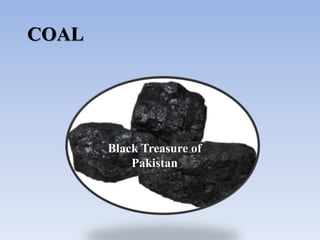
Black Treasure of
Pakistan
COAL
Presentation layout
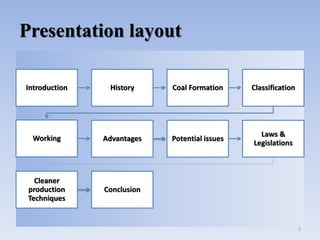
Introduction History Coal Formation Classification
Working Advantages Potential issues
Laws &
Legislations
Cleaner
production
Techniques
Conclusion
2
Introduction
Coal is a brown or black, carbon-rich material that most
often occurs in stratified sedimentary deposits. It is one
of the most important of the primary fossil fuels
 There are over 861 billion tons of proven coal reserves
worldwide.
 This much coal will last us around 112 years at current
rates of production.
 In contrast, proven oil and gas reserves are equivalent
to around 46 and 54 years at current production levels.
3
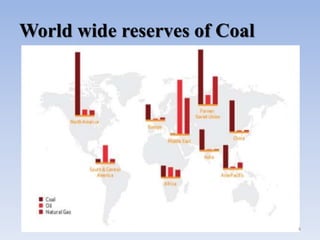
World wide reserves of Coal
4
Cont…
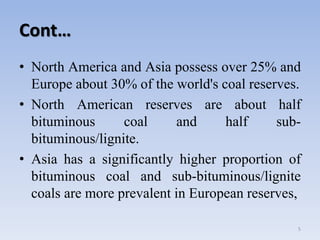
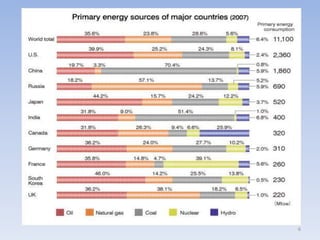
• North America and Asia possess over 25% and
Europe about 30% of the world's coal reserves.
• North American reserves are about half
bituminous coal and half sub-
bituminous/lignite.
• Asia has a significantly higher proportion of
bituminous coal and sub-bituminous/lignite
coals are more prevalent in European reserves,
5
6
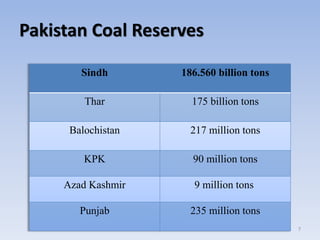
Pakistan Coal Reserves
Sindh 186.560 billion tons
Thar 175 billion tons
Balochistan 217 million tons
KPK 90 million tons
Azad Kashmir 9 million tons
Punjab 235 million tons
7
History
 Coal is the fuel of industrial revolution.
 Coal has a long history of use as an energy source.
 It still is an important fuel for electrical generation.
 Historically, the Greeks, Romans and Chinese were
early users of coal.
8
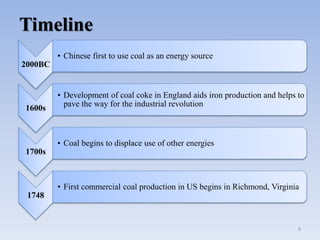
Timeline
2000BC
• Chinese first to use coal as an energy source
1600s
• Development of coal coke in England aids iron production and helps to
pave the way for the industrial revolution
1700s
• Coal begins to displace use of other energies
1748
• First commercial coal production in US begins in Richmond, Virginia
9
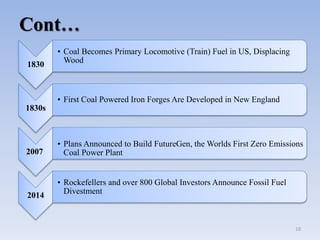
Cont…
1830
• Coal Becomes Primary Locomotive (Train) Fuel in US, Displacing
Wood
1830s
• First Coal Powered Iron Forges Are Developed in New England
2007
• Plans Announced to Build FutureGen, the Worlds First Zero Emissions
Coal Power Plant
2014
• Rockefellers and over 800 Global Investors Announce Fossil Fuel
Divestment
10
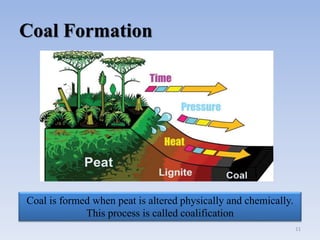
Coal Formation
Coal is formed when peat is altered physically and chemically.
This process is called coalification
11
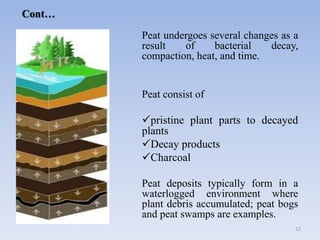
Cont…
Peat undergoes several changes as a
result of bacterial decay,
compaction, heat, and time.
Peat consist of
pristine plant parts to decayed
plants
Decay products
Charcoal
Peat deposits typically form in a
waterlogged environment where
plant debris accumulated; peat bogs
and peat swamps are examples.
12
Cont…
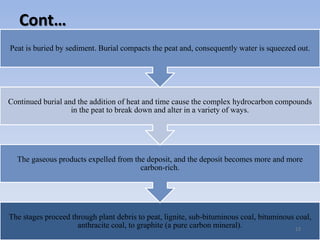
The stages proceed through plant debris to peat, lignite, sub-bituminous coal, bituminous coal,
anthracite coal, to graphite (a pure carbon mineral).
The gaseous products expelled from the deposit, and the deposit becomes more and more
carbon-rich.
Continued burial and the addition of heat and time cause the complex hydrocarbon compounds
in the peat to break down and alter in a variety of ways.
Peat is buried by sediment. Burial compacts the peat and, consequently water is squeezed out.
13
Optimum Conditions
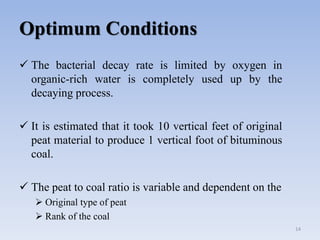
 The bacterial decay rate is limited by oxygen in
organic-rich water is completely used up by the
decaying process.
 It is estimated that it took 10 vertical feet of original
peat material to produce 1 vertical foot of bituminous
coal.
 The peat to coal ratio is variable and dependent on the
 Original type of peat
 Rank of the coal
14
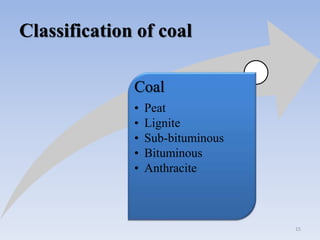
Coal
• Peat
• Lignite
• Sub-bituminous
• Bituminous
• Anthracite
Classification of coal
15
Cont…
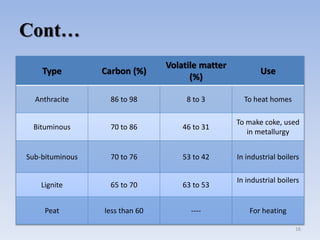
Type Carbon (%)
Volatile matter
(%)
Use
Anthracite 86 to 98 8 to 3 To heat homes
Bituminous 70 to 86 46 to 31
To make coke, used
in metallurgy
Sub-bituminous 70 to 76 53 to 42 In industrial boilers
Lignite 65 to 70 63 to 53
In industrial boilers
Peat less than 60 ---- For heating
16
Working Principle
17
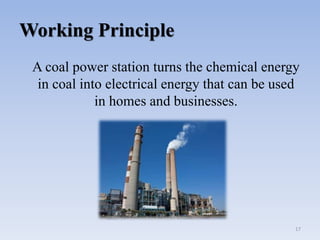
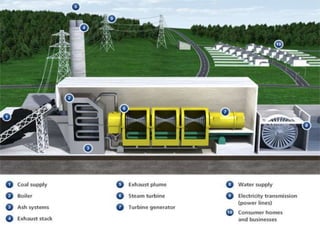
A coal power station turns the chemical energy
in coal into electrical energy that can be used
in homes and businesses.
18
Cont…
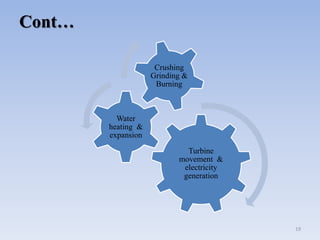
Turbine
movement &
electricity
generation
Water
heating &
expansion
Crushing
Grinding &
Burning
19
Advantages
Coal as an energy source
Chemical feedstock of various synthetic
compounds
Coke production
Major source of energy in electricity
production
20
Potential issues
Coal mining hazards
 Each year hundreds of coal miners lose their lives due
to roof falls, rock bursts, fires and explosions.
Environmental damage
 Exposed areas during mining weathered rapidly
 Acid mine drainage caused marked reductions in the
numbers of plants and animals living in the vicinity
 Release significant amount of green house gases
21
Cont…
Health damage
 Repeated inhalation of coal dust over extended
periods of time can result in serious health problems
e.g. black lung
Economical damage
 The establishment of coal mines seriously upsets a
region's the groundwater regime.
 This can then hamper with a region's future
agricultural production.
22
Reputed incidents
US Worst Coal Ash Spill Dec. 22, 2008
 1.3 million cubic meters (1.7 million cubic yards) of fly ash
released
 The spill buried some 120 hectares (300 acres) in sludge, and
even knocked a nearby home completely off its foundation.
 Estimates of the time required to clean up the spill ranged from
weeks to years.
London's historic "Black Fog’’ Dec. 5-9 ,1952
 4,000 London citizens died from inhaling sulfur dioxide gas.
23
Laws & Legislations
 1985
Clean coal technology program to decrease the effect of acid rain by
Canada and America
 Mar. 27, 2012
Us EPA First Clean Air Act for newer power plants
 June 2, 2014
EPA Proposes First Ever Rules to Reduce Carbon Emissions from Existing
Power Plants
Since the 1970s, stricter laws have significantly reduced the environmental
damage caused by coal mining in developed countries, though more-severe
damage continues to occur in many developing countries.
24
25
Cleaner Production Techniques
Need to clean??
 Coal is not a perfect fuel.
 There are traces of impurities like sulfur and nitrogen.
When coal burns impurities are released and cause
"acid rain."
 There are also tiny specks of minerals e.g. common
dirt mixed in coal. These tiny particles don't burn and
make up the ash left behind in a coal combustor.
26
Coal Cleaner Technology
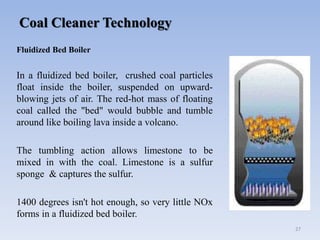
Fluidized Bed Boiler
In a fluidized bed boiler, crushed coal particles
float inside the boiler, suspended on upward-
blowing jets of air. The red-hot mass of floating
coal called the "bed" would bubble and tumble
around like boiling lava inside a volcano.
The tumbling action allows limestone to be
mixed in with the coal. Limestone is a sulfur
sponge & captures the sulfur.
1400 degrees isn't hot enough, so very little NOx
forms in a fluidized bed boiler.
27
Cont…
 Crushing and washing coal
 The Cleanest Coal Technology - a Real Gas
The breaking down of coal and conversions of its
component into gas
28
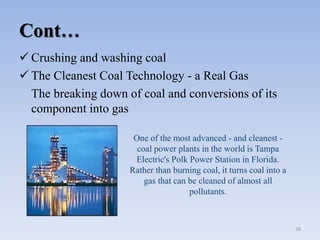
One of the most advanced - and cleanest -
coal power plants in the world is Tampa
Electric's Polk Power Station in Florida.
Rather than burning coal, it turns coal into a
gas that can be cleaned of almost all
pollutants.
Conclusion
All of us want an affordable and reliable energy
source which we can only get by using coal energy.
Although using coal energy is very significant for us
and living without it would become impossible, we
should always open our minds to the damage the
continuous use of coal energy will eventually bring to
us and to our environment.
29
30
Thank you
References
1. www.worldcoal.org/coal/where-is-coal-found
2. www.f03.classes.colgate.edu/fsem037-
coal/Coal/Default/composition_of_coal.htm
3. www.fossil.energy.gov/education/energylessons/coal/
index.html
4. www.uky.edu/KGS/coal/coalform.htm
5. www.planete-
energies.com/en/medias/explanations/how-coal-
formed-process-spanning-eras
6. www.alternativeenergy.procon.org/view.timeline.php
?timelineID=000015
31

Coal

  • 1.
  • 2.
    Presentation layout Introduction HistoryCoal Formation Classification Working Advantages Potential issues Laws & Legislations Cleaner production Techniques Conclusion 2
  • 3.
    Introduction Coal is abrown or black, carbon-rich material that most often occurs in stratified sedimentary deposits. It is one of the most important of the primary fossil fuels  There are over 861 billion tons of proven coal reserves worldwide.  This much coal will last us around 112 years at current rates of production.  In contrast, proven oil and gas reserves are equivalent to around 46 and 54 years at current production levels. 3
  • 4.
  • 5.
    Cont… • North Americaand Asia possess over 25% and Europe about 30% of the world's coal reserves. • North American reserves are about half bituminous coal and half sub- bituminous/lignite. • Asia has a significantly higher proportion of bituminous coal and sub-bituminous/lignite coals are more prevalent in European reserves, 5
  • 6.
  • 7.
    Pakistan Coal Reserves Sindh186.560 billion tons Thar 175 billion tons Balochistan 217 million tons KPK 90 million tons Azad Kashmir 9 million tons Punjab 235 million tons 7
  • 8.
    History  Coal isthe fuel of industrial revolution.  Coal has a long history of use as an energy source.  It still is an important fuel for electrical generation.  Historically, the Greeks, Romans and Chinese were early users of coal. 8
  • 9.
    Timeline 2000BC • Chinese firstto use coal as an energy source 1600s • Development of coal coke in England aids iron production and helps to pave the way for the industrial revolution 1700s • Coal begins to displace use of other energies 1748 • First commercial coal production in US begins in Richmond, Virginia 9
  • 10.
    Cont… 1830 • Coal BecomesPrimary Locomotive (Train) Fuel in US, Displacing Wood 1830s • First Coal Powered Iron Forges Are Developed in New England 2007 • Plans Announced to Build FutureGen, the Worlds First Zero Emissions Coal Power Plant 2014 • Rockefellers and over 800 Global Investors Announce Fossil Fuel Divestment 10
  • 11.
    Coal Formation Coal isformed when peat is altered physically and chemically. This process is called coalification 11
  • 12.
    Cont… Peat undergoes severalchanges as a result of bacterial decay, compaction, heat, and time. Peat consist of pristine plant parts to decayed plants Decay products Charcoal Peat deposits typically form in a waterlogged environment where plant debris accumulated; peat bogs and peat swamps are examples. 12
  • 13.
    Cont… The stages proceedthrough plant debris to peat, lignite, sub-bituminous coal, bituminous coal, anthracite coal, to graphite (a pure carbon mineral). The gaseous products expelled from the deposit, and the deposit becomes more and more carbon-rich. Continued burial and the addition of heat and time cause the complex hydrocarbon compounds in the peat to break down and alter in a variety of ways. Peat is buried by sediment. Burial compacts the peat and, consequently water is squeezed out. 13
  • 14.
    Optimum Conditions  Thebacterial decay rate is limited by oxygen in organic-rich water is completely used up by the decaying process.  It is estimated that it took 10 vertical feet of original peat material to produce 1 vertical foot of bituminous coal.  The peat to coal ratio is variable and dependent on the  Original type of peat  Rank of the coal 14
  • 15.
    Coal • Peat • Lignite •Sub-bituminous • Bituminous • Anthracite Classification of coal 15
  • 16.
    Cont… Type Carbon (%) Volatilematter (%) Use Anthracite 86 to 98 8 to 3 To heat homes Bituminous 70 to 86 46 to 31 To make coke, used in metallurgy Sub-bituminous 70 to 76 53 to 42 In industrial boilers Lignite 65 to 70 63 to 53 In industrial boilers Peat less than 60 ---- For heating 16
  • 17.
    Working Principle 17 A coalpower station turns the chemical energy in coal into electrical energy that can be used in homes and businesses.
  • 18.
  • 19.
  • 20.
    Advantages Coal as anenergy source Chemical feedstock of various synthetic compounds Coke production Major source of energy in electricity production 20
  • 21.
    Potential issues Coal mininghazards  Each year hundreds of coal miners lose their lives due to roof falls, rock bursts, fires and explosions. Environmental damage  Exposed areas during mining weathered rapidly  Acid mine drainage caused marked reductions in the numbers of plants and animals living in the vicinity  Release significant amount of green house gases 21
  • 22.
    Cont… Health damage  Repeatedinhalation of coal dust over extended periods of time can result in serious health problems e.g. black lung Economical damage  The establishment of coal mines seriously upsets a region's the groundwater regime.  This can then hamper with a region's future agricultural production. 22
  • 23.
    Reputed incidents US WorstCoal Ash Spill Dec. 22, 2008  1.3 million cubic meters (1.7 million cubic yards) of fly ash released  The spill buried some 120 hectares (300 acres) in sludge, and even knocked a nearby home completely off its foundation.  Estimates of the time required to clean up the spill ranged from weeks to years. London's historic "Black Fog’’ Dec. 5-9 ,1952  4,000 London citizens died from inhaling sulfur dioxide gas. 23
  • 24.
    Laws & Legislations 1985 Clean coal technology program to decrease the effect of acid rain by Canada and America  Mar. 27, 2012 Us EPA First Clean Air Act for newer power plants  June 2, 2014 EPA Proposes First Ever Rules to Reduce Carbon Emissions from Existing Power Plants Since the 1970s, stricter laws have significantly reduced the environmental damage caused by coal mining in developed countries, though more-severe damage continues to occur in many developing countries. 24
  • 25.
  • 26.
    Need to clean?? Coal is not a perfect fuel.  There are traces of impurities like sulfur and nitrogen. When coal burns impurities are released and cause "acid rain."  There are also tiny specks of minerals e.g. common dirt mixed in coal. These tiny particles don't burn and make up the ash left behind in a coal combustor. 26
  • 27.
    Coal Cleaner Technology FluidizedBed Boiler In a fluidized bed boiler, crushed coal particles float inside the boiler, suspended on upward- blowing jets of air. The red-hot mass of floating coal called the "bed" would bubble and tumble around like boiling lava inside a volcano. The tumbling action allows limestone to be mixed in with the coal. Limestone is a sulfur sponge & captures the sulfur. 1400 degrees isn't hot enough, so very little NOx forms in a fluidized bed boiler. 27
  • 28.
    Cont…  Crushing andwashing coal  The Cleanest Coal Technology - a Real Gas The breaking down of coal and conversions of its component into gas 28 One of the most advanced - and cleanest - coal power plants in the world is Tampa Electric's Polk Power Station in Florida. Rather than burning coal, it turns coal into a gas that can be cleaned of almost all pollutants.
  • 29.
    Conclusion All of uswant an affordable and reliable energy source which we can only get by using coal energy. Although using coal energy is very significant for us and living without it would become impossible, we should always open our minds to the damage the continuous use of coal energy will eventually bring to us and to our environment. 29
  • 30.
  • 31.
    References 1. www.worldcoal.org/coal/where-is-coal-found 2. www.f03.classes.colgate.edu/fsem037- coal/Coal/Default/composition_of_coal.htm 3.www.fossil.energy.gov/education/energylessons/coal/ index.html 4. www.uky.edu/KGS/coal/coalform.htm 5. www.planete- energies.com/en/medias/explanations/how-coal- formed-process-spanning-eras 6. www.alternativeenergy.procon.org/view.timeline.php ?timelineID=000015 31

Editor's Notes

  • #5 Coal reserves are available in almost every country in the world. The biggest reserves are in the USA, Russia, China and India.
  • #13 Peat deposits are quite varied and contain everything pristine plant parts (roots, bark, spores, etc.)
  • #22 Coal is responsible for 89% of all carbon dioxide emissions from the production of electricity.
  • #24 Fly ash: a coal-combustion waste product captured and stored in wet form