Healthy feet = happy animals
(and happy owners, too!)
Hoof care and health
SUSAN SCHOENIAN
SHEEP & GOAT SPECIALIST
UNIVERSITY OF MARYLAND EXTENSION
SSCHOEN@UMD.EDU
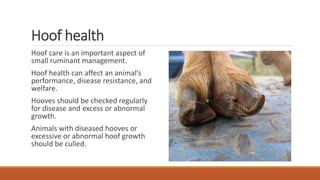
Hoof health
Hoof care is an important aspect of
small ruminant management.
Hoof health can affect an animal’s
performance, disease resistance, and
welfare.
Hooves should be checked regularly
for disease and excess or abnormal
growth.
Animals with diseased hooves or
excessive or abnormal hoof growth
should be culled.
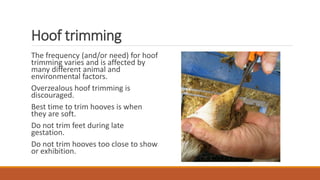
Hoof trimming
The frequency (and/or need) for hoof
trimming varies and is affected by
many different animal and
environmental factors.
Overzealous hoof trimming is
discouraged.
Best time to trim hooves is when
they are soft.
Do not trim feet during late
gestation.
Do not trim hooves too close to show
or exhibition.
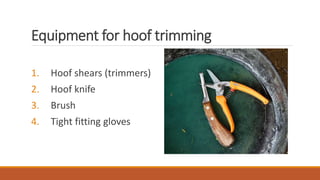
Equipment for hoof trimming
1. Hoof shears (trimmers)
2. Hoof knife
3. Brush
4. Tight fitting gloves
Restraint for hoof trimming
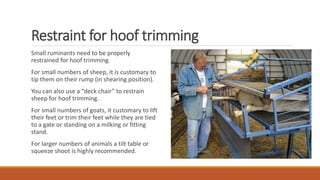
Small ruminants need to be properly
restrained for hoof trimming.
For small numbers of sheep, it is customary to
tip them on their rump (in shearing position).
You can also use a “deck chair” to restrain
sheep for hoof trimming.
For small numbers of goats, it customary to lift
their feet or trim their feet while they are tied
to a gate or standing on a milking or fitting
stand.
For larger numbers of animals a tilt table or
squeeze shoot is highly recommended.
Trimming hooves properly
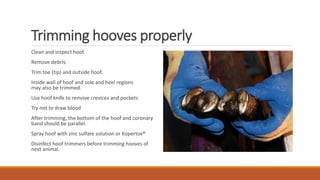
Clean and inspect hoof.
Remove debris.
Trim toe (tip) and outside hoof.
Inside wall of hoof and sole and heel regions
may also be trimmed.
Use hoof knife to remove crevices and pockets
Try not to draw blood
After trimming, the bottom of the hoof and coronary
band should be parallel.
Spray hoof with zinc sulfate solution or Kopertox®
Disinfect hoof trimmers before trimming hooves of
next animal.
Diseases Affecting the Hooves
COMMON (BACTERIAL)
Foot rot
Foot scald
Hoof abscesses
LESS COMMON (MOSTLY VIRAL)
Laminitis (founder)
Blue tongue
Sore mouth Hoof and mouth disease
Diseases affecting the hooves
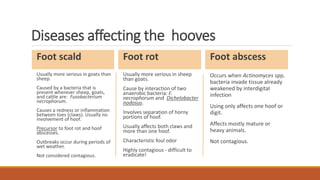
Foot scald
Usually more serious in goats than
sheep.
Caused by a bacteria that is
present wherever sheep, goats,
and cattle are: Fusobacterium
necrophorum.
Causes a redness or inflammation
between toes (claws). Usually no
involvement of hoof.
Precursor to foot rot and hoof
abscesses.
Outbreaks occur during periods of
wet weather.
Not considered contagious.
Foot rot
Usually more serious in sheep
than goats.
Cause by interaction of two
anaerobic bacteria: F.
necrophorum and Dichelobacter
nodosus.
Involves separation of horny
portions of hoof.
Usually affects both claws and
more than one hoof.
Characteristic foul odor
Highly contagious - difficult to
eradicate!
Foot abscess
Occurs when Actinomyces spp.
bacteria invade tissue already
weakened by interdigital
infection
Using only affects one hoof or
digit.
Affects mostly mature or
heavy animals.
Not contagious.
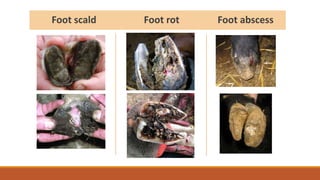
Foot scald Foot rot Foot abscess
Dealing with foot rot and foot scald
ERADICATE (OR CONTROL)
Hoof scoring and trimming
Topical treatments, e.g. Koppertox, zinc sulfate
Repeated (e.g. weekly) foot bathing (w/zinc
sulfate)
Separate infected animals from clean animals
and put in clean area after treatment.
Soak pads
Dry chemicals
Antibiotic sprays
Antibiotic injections (LA-200®, Draxxin®)
Cull animals that do not respond to treatment
or those who have re-occurring infections.
PREVENTION
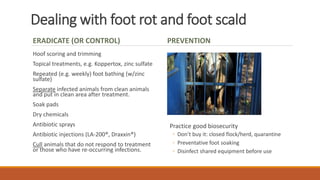
Practice good biosecurity
◦ Don’t buy it: closed flock/herd, quarantine
◦ Preventative foot soaking
◦ Disinfect shared equipment before use
Thank you for your attention. Questions? Comments?
SUSAN SCHOENIAN
SHEEP & GOAT SPECIALIST
UNIVERSITY OF MARYLAND EXTENSION
SSCHOEN@UMD.EDU

Healthy hooves

  • 1.
    Healthy feet =happy animals (and happy owners, too!) Hoof care and health SUSAN SCHOENIAN SHEEP & GOAT SPECIALIST UNIVERSITY OF MARYLAND EXTENSION SSCHOEN@UMD.EDU
  • 2.
    Hoof health Hoof careis an important aspect of small ruminant management. Hoof health can affect an animal’s performance, disease resistance, and welfare. Hooves should be checked regularly for disease and excess or abnormal growth. Animals with diseased hooves or excessive or abnormal hoof growth should be culled.
  • 3.
    Hoof trimming The frequency(and/or need) for hoof trimming varies and is affected by many different animal and environmental factors. Overzealous hoof trimming is discouraged. Best time to trim hooves is when they are soft. Do not trim feet during late gestation. Do not trim hooves too close to show or exhibition.
  • 4.
    Equipment for hooftrimming 1. Hoof shears (trimmers) 2. Hoof knife 3. Brush 4. Tight fitting gloves
  • 5.
    Restraint for hooftrimming Small ruminants need to be properly restrained for hoof trimming. For small numbers of sheep, it is customary to tip them on their rump (in shearing position). You can also use a “deck chair” to restrain sheep for hoof trimming. For small numbers of goats, it customary to lift their feet or trim their feet while they are tied to a gate or standing on a milking or fitting stand. For larger numbers of animals a tilt table or squeeze shoot is highly recommended.
  • 6.
    Trimming hooves properly Cleanand inspect hoof. Remove debris. Trim toe (tip) and outside hoof. Inside wall of hoof and sole and heel regions may also be trimmed. Use hoof knife to remove crevices and pockets Try not to draw blood After trimming, the bottom of the hoof and coronary band should be parallel. Spray hoof with zinc sulfate solution or Kopertox® Disinfect hoof trimmers before trimming hooves of next animal.
  • 7.
    Diseases Affecting theHooves COMMON (BACTERIAL) Foot rot Foot scald Hoof abscesses LESS COMMON (MOSTLY VIRAL) Laminitis (founder) Blue tongue Sore mouth Hoof and mouth disease
  • 8.
    Diseases affecting thehooves Foot scald Usually more serious in goats than sheep. Caused by a bacteria that is present wherever sheep, goats, and cattle are: Fusobacterium necrophorum. Causes a redness or inflammation between toes (claws). Usually no involvement of hoof. Precursor to foot rot and hoof abscesses. Outbreaks occur during periods of wet weather. Not considered contagious. Foot rot Usually more serious in sheep than goats. Cause by interaction of two anaerobic bacteria: F. necrophorum and Dichelobacter nodosus. Involves separation of horny portions of hoof. Usually affects both claws and more than one hoof. Characteristic foul odor Highly contagious - difficult to eradicate! Foot abscess Occurs when Actinomyces spp. bacteria invade tissue already weakened by interdigital infection Using only affects one hoof or digit. Affects mostly mature or heavy animals. Not contagious.
  • 9.
    Foot scald Footrot Foot abscess
  • 10.
    Dealing with footrot and foot scald ERADICATE (OR CONTROL) Hoof scoring and trimming Topical treatments, e.g. Koppertox, zinc sulfate Repeated (e.g. weekly) foot bathing (w/zinc sulfate) Separate infected animals from clean animals and put in clean area after treatment. Soak pads Dry chemicals Antibiotic sprays Antibiotic injections (LA-200®, Draxxin®) Cull animals that do not respond to treatment or those who have re-occurring infections. PREVENTION Practice good biosecurity ◦ Don’t buy it: closed flock/herd, quarantine ◦ Preventative foot soaking ◦ Disinfect shared equipment before use
  • 11.
    Thank you foryour attention. Questions? Comments? SUSAN SCHOENIAN SHEEP & GOAT SPECIALIST UNIVERSITY OF MARYLAND EXTENSION SSCHOEN@UMD.EDU